

The DOI matches its Crossref record; 27 of the 27 references it cites were found in a registry or an index.
Rapid urine-based screening for tuberculosis in HIV-positive patients admitted to hospital in Africa (STAMP): a pragmatic, multicentre, parallel-group, double-blind, randomised controlled trial
Open accessAbstract
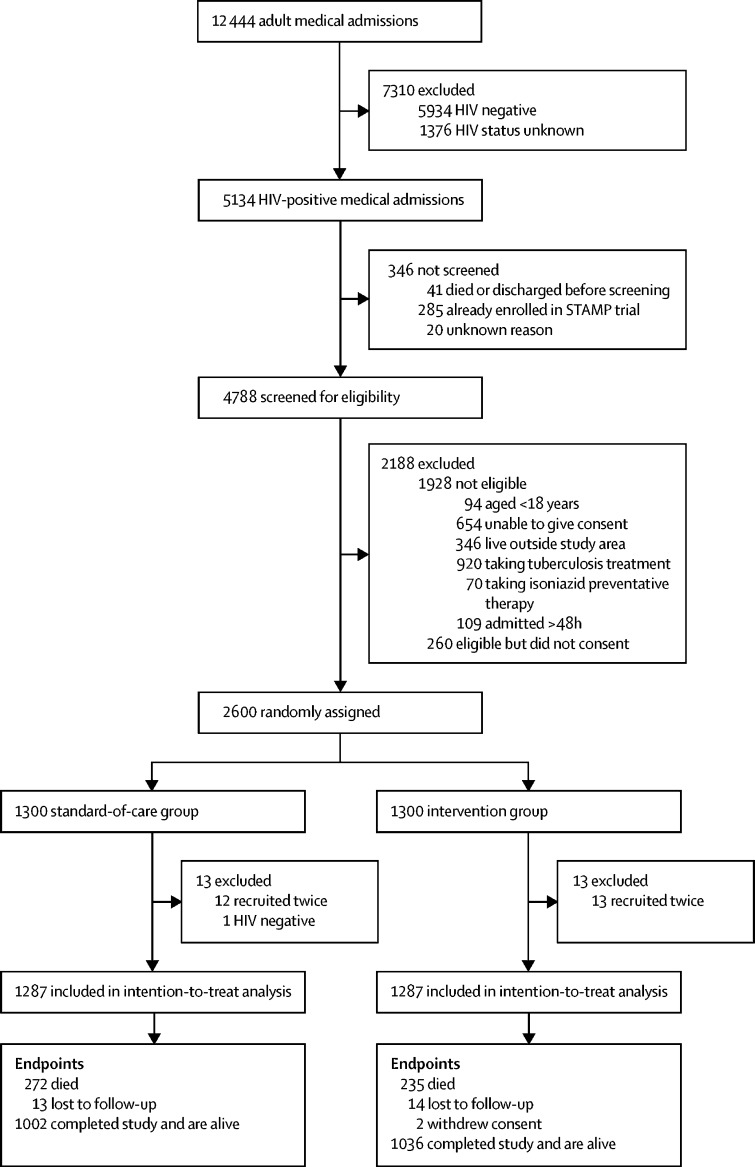
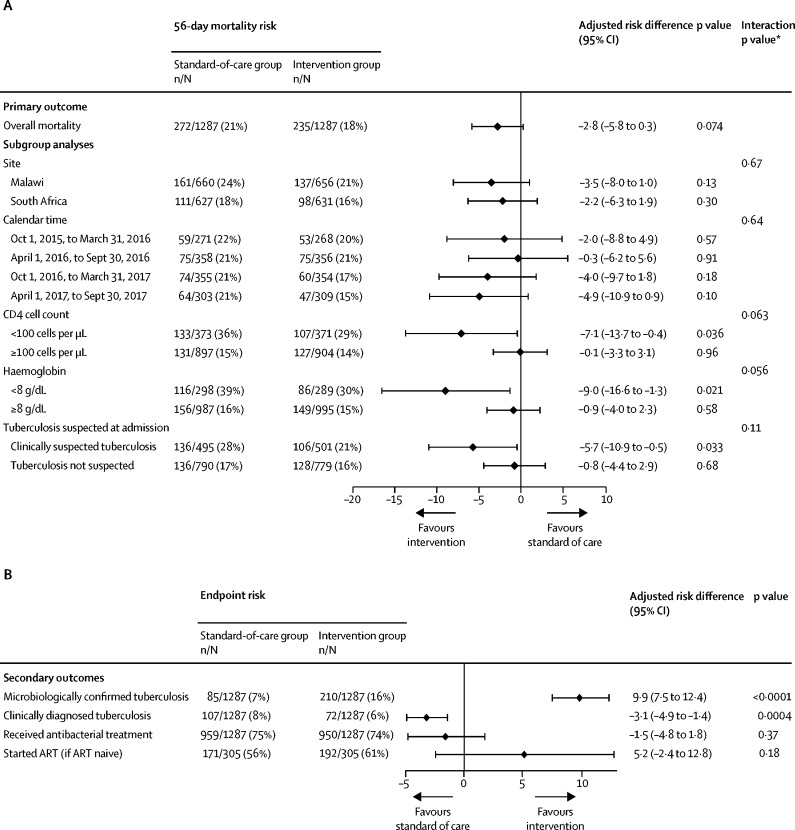
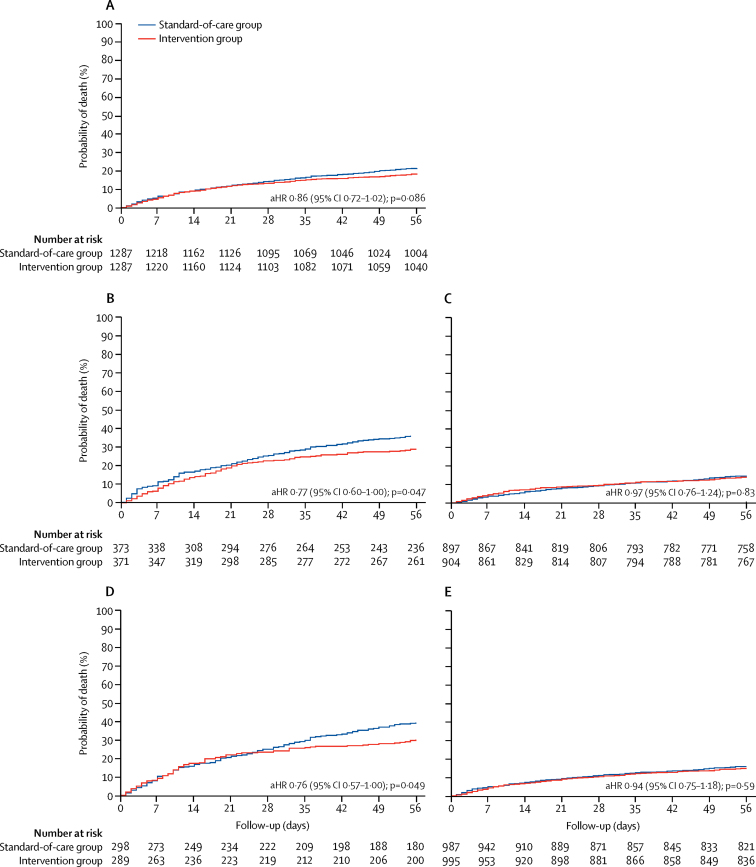
BACKGROUND: Current diagnostics for HIV-associated tuberculosis are suboptimal, with missed diagnoses contributing to high hospital mortality and approximately 374 000 annual HIV-positive deaths globally. Urine-based assays have a good diagnostic yield; therefore, we aimed to assess whether urine-based screening in HIV-positive inpatients for tuberculosis improved outcomes. METHODS: We did a pragmatic, multicentre, double-blind, randomised controlled trial in two hospitals in Malawi and South Africa. We included HIV-positive medical inpatients aged 18 years or more who were not taking tuberculosis treatment. We randomly assigned patients (1:1), using a computer-generated list of random block size stratified by site, to either the standard-of-care or the intervention screening group, irrespective of symptoms or clinical presentation. Attending clinicians made decisions about care; and patients, clinicians, and the study team were masked to the group allocation. In both groups, sputum was tested using the Xpert MTB/RIF assay (Xpert; Cepheid, Sunnyvale, CA, USA). In the standard-of-care group, urine samples were not tested for tuberculosis. In the intervention group, urine was tested with the Alere Determine TB-LAM Ag (TB-LAM; Alere, Waltham, MA, USA), and Xpert assays. The primary outcome was all-cause 56-day mortality. Subgroup analyses for the primary outcome were prespecified based on baseline CD4 count, haemoglobin, clinical suspicion for tuberculosis; and by study site and calendar time. We used an intention-to-treat principle for our analyses. This trial is registered with the ISRCTN registry, number ISRCTN71603869. FINDINGS: Between Oct 26, 2015, and Sept 19, 2017, we screened 4788 HIV-positive adults, of which 2600 (54%) were randomly assigned to the study groups (n=1300 for each group). 13 patients were excluded after randomisation from analysis in each group, leaving 2574 in the final intention-to-treat analysis (n=1287 in each group). At admission, 1861 patients were taking antiretroviral therapy and median CD4 count was 227 cells per μL (IQR 79-436). Mortality at 56 days was reported for 272 (21%) of 1287 patients in the standard-of-care group and 235 (18%) of 1287 in the intervention group (adjusted risk reduction [aRD] -2·8%, 95% CI -5·8 to 0·3; p=0·074). In three of the 12 prespecified, but underpowered subgroups, mortality was lower in the intervention group than in the standard-of-care group for CD4 counts less than 100 cells per μL (aRD -7·1%, 95% CI -13·7 to -0·4; p=0.036), severe anaemia (-9·0%, -16·6 to -1·3; p=0·021), and patients with clinically suspected tuberculosis (-5·7%, -10·9 to -0·5; p=0·033); with no difference by site or calendar period. Adverse events were similar in both groups. INTERPRETATION: Urine-based tuberculosis screening did not reduce overall mortality in all HIV-positive inpatients, but might benefit some high-risk subgroups. Implementation could contribute towards global targets to reduce tuberculosis mortality. FUNDING: Joint Global Health Trials Scheme of the Medical Research Council, the UK Department for International Development, and the Wellcome Trust.
Overview
The claims and statistics of this paper haven’t been checked yet.
Run the check — free, no account needed. It reads the open-access text and checks the sources it cites.
Integrity signals
Registry
Cites
Statistics
Figures
Verification
Claims the paper makes
The claims and statistics of this paper haven’t been checked yet.
Run the check — free, no account needed. It reads the open-access text and checks the sources it cites.
Claims other papers make about this one
Each is checked against this paper’s own text: does it say what the citing paper says it does?
The source backs part of the claim, not all of it — or backs it for a different population, condition or comparison.
In the citing paper
“In two randomized trials, the use of Alere LAM in HIV‐positive adult inpatients was shown to reduce mortality (Gupta‐Wright 2018; Peter 2016).”
From Xpert MTB/RIF Ultra and Xpert MTB/RIF assays for extrapulmonary tuberculosis and rifampicin resistance in adults (2021) · cites this paper as Gupta‐Wright 2018
Experimental — accuracy not yet measured
Self-check
Percentages, sums and reported differences re-computed from the paper’s own numbers.
The self-check needs the paper’s full text.
Citations
Cites
Xpert® MTB/RIF assay for pulmonary tuberculosis and rifampicin resistance in adults
Steingart, K. R., Schiller, I., Horne, D. J. D. L., Pai, M., Boehme, C. C., & Dendukuri, N. (2014) · Cochrane Database of Systematic Reviews · doi:10.1002/14651858.cd009593.pub3 · Cited by 1,187
Denkinger, C. M., Schumacher, S. G., Boehme, C. C., Dendukuri, N., Pai, M., & Steingart, K. R. (2014) · European Respiratory Journal · doi:10.1183/09031936.00007814 · Cited by 527
Lawn, S. D., Mwaba, P., Bates, M., Piatek, A. S., Alexander, H. L., Marais, B. J., Cuevas, L. E., McHugh, T. D., Zijenah, L. S., Kapata, N., et al. (2013) · The Lancet Infectious Diseases · doi:10.1016/s1473-3099(13)70008-2 · Cited by 459
Self-citationGupta, R. K., Lucas, S. B., Fielding, K., & Lawn, S. D. (2015) · AIDS · doi:10.1097/qad.0000000000000802 · Cited by 373
Self-citationFord, N. P., Shubber, Z., Meintjes, G., Grinsztejn, B. G. J., Eholié, S. P., Mills, E. J., Davies, M., Vitória, M., Penazzato, M., Nsanzimana, S., et al. (2015) · The Lancet HIV · doi:10.1016/s2352-3018(15)00137-x · Cited by 328
Peter, J. G., Zijenah, L. S., Chanda, D., Clowes, P., Lesosky, M., Gina, P., Mehta, N., Calligaro, G., Lombard, C. J., Kadzirange, G., et al. (2016) · The Lancet · doi:10.1016/s0140-6736(15)01092-2 · Cited by 276
Enhanced Prophylaxis plus Antiretroviral Therapy for Advanced HIV Infection in Africa
Hakim, J. G., Musiime, V., Szubert, A. J., Mallewa, J., Siika, A. M., Agutu, C., Walker, S., Pett, S. L., Bwakura‐Dangarembizi, M., Lugemwa, A., et al. (2017) · New England Journal of Medicine · doi:10.1056/nejmoa1615822 · Cited by 207
Lateral flow urine lipoarabinomannan assay for detecting active tuberculosis in HIV-positive adults
Shah, M., Hanrahan, C. F., Wang, Z. Y., Dendukuri, N., Lawn, S. D., Denkinger, C. M., & Steingart, K. R. (2016) · Cochrane Database of Systematic Reviews · doi:10.1002/14651858.cd011420.pub2 · Cited by 178
Self-citationBadje, A., Moh, R., Gabillard, D., Guéhi, C., Kabran, M., Ntakpé, J.-B., Carrou, J. L., Kouamé, G. M., Ouattara, E. N., Messou, E., et al. (2017) · The Lancet Global Health · doi:10.1016/s2214-109x(17)30372-8 · Cited by 170
Ford, N. P., Matteelli, A., Shubber, Z., Hermans, S., Meintjes, G., Grinsztejn, B. G. J., Waldrop, G. E., Kranzer, K., Doherty, M. C., & Getahun, H. (2016) · Journal of the International AIDS Society · doi:10.7448/ias.19.1.20714 · Cited by 164
Research works printed but not linked: 1
- Reddy KP, Gupta-Wright A, Fielding K, et al. Cost-effectiveness of urine TB screening for hospitalized people with HIV in Africa. The Conference on Retroviruses and Opportunistic Infections (CROI); Boston, MA, USA; 2018. Abstract number 3521.
Cited by
Sorted by citations
Furin, J. J., Cox, H. S., & Pai, M. (2019) · The Lancet · doi:10.1016/s0140-6736(19)30308-3 · Cited by 876
Xpert MTB/RIF and Xpert MTB/RIF Ultra for pulmonary tuberculosis and rifampicin resistance in adults
Horne, D. J. D. L., Kohli, M., Zifodya, J. S., Schiller, I., Dendukuri, N., Tollefson, D., Schumacher, S. G., Ochodo, E., Pai, M., & Steingart, K. R. (2019) · Cochrane Database of Systematic Reviews · doi:10.1002/14651858.cd009593.pub4 · Cited by 296
Drug resistant Tuberculosis: A review
Khawbung, J. L., Nath, D., & Chakraborty, S. (2020) · Comparative Immunology Microbiology and Infectious Diseases · doi:10.1016/j.cimid.2020.101574 · Cited by 252
Urogenital tuberculosis — epidemiology, pathogenesis and clinical features
Muneer, A., Macrae, B., Krishnamoorthy, S., & Zumla, A. I. (2019) · Nature Reviews Urology · doi:10.1038/s41585-019-0228-9 · Cited by 219
Novel High Sensitivity Tuberculosis Point-of-Care Test for People Living with HIV
Broger, T., Sossen, B., du Toit, E., Kerkhoff, A. D., Schutz, C., Reipold, E. I., Ward, A. M., Barr, D. A., Macé, A., Trollip, A., et al. (2018) · The Lancet Infectious Diseases · doi:10.1016/s1473-3099(19)30001-5 · Cited by 222
Kohli, M., Schiller, I., Dendukuri, N., Yao, M., Dheda, K., Denkinger, C. M., Schumacher, S. G., & Steingart, K. R. (2021) · Cochrane Database of Systematic Reviews · doi:10.1002/14651858.cd012768.pub3 · Cited by 215
Bjerrum, S., Schiller, I., Dendukuri, N., Kohli, M., Nathavitharana, R. R., Zwerling, A. A., Denkinger, C. M., Steingart, K. R., & Shah, M. (2019) · Cochrane Database of Systematic Reviews · doi:10.1002/14651858.cd011420.pub3 · Cited by 186
Zifodya, J. S., Kreniske, J. S., Schiller, I., Kohli, M., Dendukuri, N., Schumacher, S. G., Ochodo, E., Haraka, F., Zwerling, A. A., Pai, M., et al. (2021) · Cochrane Database of Systematic Reviews · doi:10.1002/14651858.cd009593.pub5 · Cited by 200
Point-Of-Care Urine LAM Tests for Tuberculosis Diagnosis: A Status Update
Bulterys, M. A., Wagner, B. G., Redard-Jacot, M., Suresh, A., Pollock, N. R., Moreau, E., Denkinger, C. M., Drain, P. K., & Broger, T. (2019) · Journal of Clinical Medicine · doi:10.3390/jcm9010111 · Cited by 162
HIV epidemiology, prevention, treatment, and implementation strategies for public health
Mody, A., Sohn, A. H., Iwuji, C. C., Tan, R. K. J., Venter, F., & Geng, E. (2023) · The Lancet · doi:10.1016/s0140-6736(23)01381-8 · Cited by 146
Kay, A. W., Fernández, L. G., Takwoingi, Y., Eisenhut, M., Detjen, A., Steingart, K. R., & Mandalakas, A. M. (2020) · Cochrane Database of Systematic Reviews · doi:10.1002/14651858.cd013359.pub2 · Cited by 136
Closing gaps in the tuberculosis care cascade: an action-oriented research agenda
Subbaraman, R., Jhaveri, T. A., & Nathavitharana, R. R. (2020) · Journal of Clinical Tuberculosis and Other Mycobacterial Diseases · doi:10.1016/j.jctube.2020.100144 · Cited by 122
Diagnostic accuracy of 3 urine lipoarabinomannan tuberculosis assays in HIV-negative outpatients
Broger, T., Nicol, M. P., Sigal, G. B., Gotuzzo, E., Zimmer, A., Surtie, S., Caceres-Nakiche, T., Mantsoki, A., Reipold, E. I., Székely, R., et al. (2020) · Journal of Clinical Investigation · doi:10.1172/jci140461 · Cited by 95
Hamada, Y., Getahun, H., Tadesse, B. T., & Ford, N. P. (2021) · International Journal of STD & AIDS · doi:10.1177/0956462421992257 · Cited by 86
Broger, T., Koeppel, L., Huerga, H., Miller, P., Gupta‐Wright, A., Blanc, F. –., Esmail, A., Reeve, B. W. P., Floridia, M., Kerkhoff, A. D., et al. (2023) · The Lancet Global Health · doi:10.1016/s2214-109x(23)00135-3 · Cited by 90
Self-citationEtiology and Risk Factors for Mortality in an Adult Community-acquired Pneumonia Cohort in Malawi
Aston, S., Ho, A. Y. W., Jary, H. R., Huwa, J. M., Mitchell, T., Ibitoye, S., Greenwood, S., Joekes, E. C., Daire, A., Mallewa, J., et al. (2019) · American Journal of Respiratory and Critical Care Medicine · doi:10.1164/rccm.201807-1333oc · Cited by 83
Gupta‐Wright, A., Fielding, K., van Oosterhout, J. J., Alufandika, M., Grint, D. J., Chimbayo, E. T., Heaney, J., Byott, M., Nastouli, E., Mwandumba, H. C., et al. (2020) · The Lancet HIV · doi:10.1016/s2352-3018(20)30172-7 · Cited by 78
Self-citationBarr, D. A., Lewis, J. M., Feasey, N., Schutz, C., Kerkhoff, A. D., Jacob, S. T., Andrews, B., Kelly, P. M., Lakhi, S., Muchemwa, L., et al. (2020) · The Lancet Infectious Diseases · doi:10.1016/s1473-3099(19)30695-4 · Cited by 80
Self-citationBroger, T., Nicol, M. P., Székely, R., Bjerrum, S., Sossen, B., Schutz, C., Opintan, J. A., Johansen, I. S., Mitarai, S., Chikamatsu, K., et al. (2020) · PLoS Medicine · doi:10.1371/journal.pmed.1003113 · Cited by 80
Schutz, C., Barr, D. A., Andrade, B. B., Shey, M. S., Ward, A. M., Janssen, S., Burton, R., Wilkinson, K. A., Sossen, B., Fukutani, K. F., et al. (2019) · PLoS Medicine · doi:10.1371/journal.pmed.1002840 · Cited by 76
Advanced HIV: diagnosis, treatment, and prevention
Prabhu, S., Harwell, J. I., & Kumarasamy, N. (2019) · The Lancet HIV · doi:10.1016/s2352-3018(19)30189-4 · Cited by 81
Meintjes, G., & Maartens, G. (2024) · New England Journal of Medicine · doi:10.1056/nejmra2308181 · Cited by 78
Challenges and Progress with Diagnosing Pulmonary Tuberculosis in Low- and Middle-Income Countries
Harries, A. D., & Kumar, A. M. V. (2018) · Diagnostics · doi:10.3390/diagnostics8040078 · Cited by 79
Letang, E., Ellis, J. P., Naidoo, K., Casas, E. C., Sánchez, P., Hassan-Moosa, R., Cresswell, F. V., Miró, J. M., & García‐Basteiro, A. L. (2020) · Archivos de Bronconeumología · doi:10.1016/j.arbr.2019.11.013 · Cited by 75
Perspective for Precision Medicine for Tuberculosis
Lange, C. G., Aarnoutse, R. E., Chesov, D., van Crevel, R., Gillespie, S. H., Grobbel, H.-P., Kalsdorf, B., Kontsevaya, I., van Laarhoven, A., Nishiguchi, T., et al. (2020) · Frontiers in Immunology · doi:10.3389/fimmu.2020.566608 · Cited by 70
Management of active tuberculosis in adults with HIV
Meintjes, G., Brust, J. C. M., Nuttall, J. J. C., & Maartens, G. (2019) · The Lancet HIV · doi:10.1016/s2352-3018(19)30154-7 · Cited by 69
Biomarkers for tuberculosis: the case for lipoarabinomannan
Correia‐Neves, M., Fröberg, G., Korshun, L., Viegas, S. O., Vaz, P., Ramanlal, N., Bruchfeld, J., Hamasur, B., Brennan, P. J., & Källenius, G. (2019) · ERJ Open Research · doi:10.1183/23120541.00115-2018 · Cited by 68
Huerga, H., Bastard, M., Lubega, A. V., Akinyi, M., Antabak, N. T., Ohler, L., Muyindike, W. R., Taremwa, I. M., Stewart, R., Bossard, C., et al. (2022) · The Lancet Global Health · doi:10.1016/s2214-109x(22)00463-6 · Cited by 66
Self-citationShapiro, A. E., Ross, J. M., Yao, M., Schiller, I., Kohli, M., Dendukuri, N., Steingart, K. R., & Horne, D. J. D. L. (2021) · Cochrane Database of Systematic Reviews · doi:10.1002/14651858.cd013694.pub2 · Cited by 67
Tuberculosis and HIV coinfection: Progress and challenges towards reducing incidence and mortality
Sossen, B., Kubjane, M., & Meintjes, G. (2025) · International Journal of Infectious Diseases · doi:10.1016/j.ijid.2025.107876 · Cited by 74
Kuupiel, D., Adu, K. M., Apiribu, F., Bawontuo, V., Adogboba, D. A., Ali, K. T., & Mashamba-Thompson, T. P. (2019) · BMC Public Health · doi:10.1186/s12889-019-7052-2 · Cited by 59
Tam, P. I., Arnold, S. L. M., Barrett, L. K., Chen, C. R., Conrad, T. M., Douglas, E., Gordon, M. A., Hebert, D., Henrion, M., Hermann, D., et al. (2020) · Clinical Infectious Diseases · doi:10.1093/cid/ciaa421 · Cited by 61
Intensified antibiotic treatment of tuberculosis meningitis
Cresswell, F. V., Brake, L. T., Atherton, R. R., Ruslami, R., Dooley, K. E., Aarnoutse, R. E., & van Crevel, R. (2018) · Expert Review of Clinical Pharmacology · doi:10.1080/17512433.2019.1552831 · Cited by 56
Global tuberculosis research and its future prospects
Garrido-Cárdenas, J. A., Sevilla, C. D. L., Cabezas-Fernández, M. T., Manzano-Agugliaro, F. R., & Martínez‐Lirola, M. (2020) · Tuberculosis · doi:10.1016/j.tube.2020.101917 · Cited by 55
Yuan, C., Qu, Z., Tang, X., Liu, Q., Luo, W., Huang, C., Pan, Q., & Zhang, X. (2018) · iScience · doi:10.1016/j.isci.2018.11.039 · Cited by 53
Bjerrum, S., Broger, T., Székely, R., Mitarai, S., Opintan, J. A., Kenu, E., Lartey, M. Y., Addo, K. K., Chikamatsu, K., Macé, A., et al. (2019) · Open Forum Infectious Diseases · doi:10.1093/ofid/ofz530 · Cited by 52
Nicol, M. P., Schumacher, S. G., Workman, L., Broger, T., Baard, C., Prins, M. L. M., Bateman, L., du Toit, E., van Heerden, J., Székely, R., et al. (2020) · Clinical Infectious Diseases · doi:10.1093/cid/ciaa1052 · Cited by 51
Singhroy, D. N., MacLean, E. L.-H., Kohli, M., Lessem, E., Branigan, D., England, K., Suleiman, K., Drain, P. K., Rühwald, M., Schumacher, S. G., et al. (2020) · Gates Open Research · doi:10.12688/gatesopenres.13112.1 · Cited by 48
Reddy, K. P., Gupta‐Wright, A., Fielding, K., Costantini, S., Zheng, A., Corbett, E. L., Yu, L., van Oosterhout, J. J., Resch, S., Wilson, D., et al. (2019) · The Lancet Global Health · doi:10.1016/s2214-109x(18)30436-4 · Cited by 47
Self-citationHou, X., Wang, D., Zuo, J., Li, J., Wang, T., Guo, C., Peng, F., Su, D., Zhao, L., Ye, Z., et al. (2019) · EBioMedicine · doi:10.1016/j.ebiom.2019.09.031 · Cited by 47
Morton, B., Stolbrink, M., Kagima, W., Rylance, J., & Mortimer, K. (2018) · International Journal of Environmental Research and Public Health · doi:10.3390/ijerph15092017 · Cited by 46
Kerkhoff, A. D., Sossen, B., Schutz, C., Reipold, E. I., Trollip, A. P., Moreau, E., Schumacher, S. G., Burton, R., Ward, A. M., Nicol, M. P., et al. (2019) · European Respiratory Journal · doi:10.1183/13993003.01259-2019 · Cited by 46
Dhana, A., Hamada, Y., Kengne, A. P., Kerkhoff, A. D., Rangaka, M. X., Kredo, T., Baddeley, A., Miller, C., Gupta‐Wright, A., Fielding, K., et al. (2022) · The Lancet HIV · doi:10.1016/s2352-3018(22)00002-9 · Cited by 48
Self-citationSinghroy, D. N., MacLean, E. L.-H., Kohli, M., Lessem, E., Branigan, D., England, K., Suleiman, K., Drain, P. K., Rühwald, M., Schumacher, S. G., et al. (2020) · Gates Open Research · doi:10.12688/gatesopenres.13112.2 · Cited by 40
Cresswell, F. V., Ellis, J. P., Kagimu, E., Bangdiwala, A. S., Okirwoth, M., Mugumya, G., Rutakingirwa, M. K., Kasibante, J., Quinn, C. M., Ssebambulidde, K., et al. (2020) · Open Forum Infectious Diseases · doi:10.1093/ofid/ofaa100 · Cited by 37
Self-citationDoes tuberculosis screening improve individual outcomes? A systematic review
Telisinghe, L., Rupérez, M., Amofa-Sekyi, M., Mwenge, L., Mainga, T., Kumar, R., Hassan, M., Chaisson, L. H., Naufal, F., Shapiro, A. E., et al. (2021) · EClinicalMedicine · doi:10.1016/j.eclinm.2021.101127 · Cited by 36
Self-citationBiomarkers in diagnosing and therapeutic monitoring of tuberculosis: a review
Leo, S., Narasimhan, M., Rathinam, S., & Banerjee, A. (2024) · Annals of Medicine · doi:10.1080/07853890.2024.2386030 · Cited by 40
Gupta‐Wright, A., Corbett, E. L., Wilson, D., van Oosterhout, J. J., Dheda, K. U. J., Huerga, H., Peter, J., Bonnet, M., Moyo, M., Grint, D. J., et al. (2019) · PLoS Medicine · doi:10.1371/journal.pmed.1002776 · Cited by 38
Self-citationSevere disseminated tuberculosis in HIV-negative refugees
Suárez, I., Fünger, S. M., Jung, N., Lehmann, C., Reimer, R. P., Mehrkens, D., Bunte, A., Plum, G., Jaspers, N., Schmidt, M., et al. (2019) · The Lancet Infectious Diseases · doi:10.1016/s1473-3099(19)30162-8 · Cited by 35
Nathavitharana, R. R., Lederer, P. A., Chaplin, M., Bjerrum, S., Steingart, K. R., & Shah, M. (2021) · Cochrane Database of Systematic Reviews · doi:10.1002/14651858.cd014641 · Cited by 34
Advances in the diagnosis of pulmonary tuberculosis in children
Nicol, M. P., & Zar, H. J. (2020) · Paediatric Respiratory Reviews · doi:10.1016/j.prrv.2020.05.003 · Cited by 33
Incidence of HIV-positive admission and inpatient mortality in Malawi (2012–2019)
Burke, R. M., Henrion, M., Mallewa, J., Masamba, L. P. L., Kalua, T., Khundi, M., Gupta‐Wright, A., Rylance, J., Gordon, S. B., Masesa, C., et al. (2021) · AIDS · doi:10.1097/qad.0000000000003006 · Cited by 32
Self-citationSzékely, R., Sossen, B., Mukoka, M., Muyoyeta, M., Nakabugo, E., Hella, J., Nguyen, H. V., Ubolyam, S., Chikamatsu, K., Macé, A., et al. (2024) · PLoS ONE · doi:10.1371/journal.pone.0303846 · Cited by 31
Huerga, H., Rücker, S. C. M., Cossa, L., Bastard, M., Quiles, I. A., Manhiça, I., Mbendera, K. N., Telnov, A., Szumilin, E., Sánchez-Padilla, E., et al. (2019) · PLoS Medicine · doi:10.1371/journal.pmed.1002792 · Cited by 31
Advanced HIV disease: A review of diagnostic and prophylactic strategies
Lehman, A. C., Ellis, J. P., Nalintya, E., Bahr, N. C., Loyse, A., & Rajasingham, R. (2023) · HIV Medicine · doi:10.1111/hiv.13487 · Cited by 30
What pulmonologists need to know about extrapulmonary tuberculosis
Natali, D., Cloatre, G., Brosset, C., Verdalle, P., Fauvy, A., Massart, J.-P., Van, Q. V., Gerard, N., Dobler, C. C., & Hovette, P. (2020) · Breathe · doi:10.1183/20734735.0216-2020 · Cited by 31
Lewis, J. M., Mphasa, M., Keyala, L., Banda, R. L., Smith, E., Duggan, J., Brooks, T. J. G., Catton, M., Mallewa, J., Katha, G., et al. (2021) · Clinical Infectious Diseases · doi:10.1093/cid/ciab710 · Cited by 29
Diagnosis of extrapulmonary tuberculosis by GeneXpert MTB/RIF Ultra assay
Dahiya, B., Mehta, N., Soni, A., & Mehta, P. K. (2023) · Expert Review of Molecular Diagnostics · doi:10.1080/14737159.2023.2223980 · Cited by 26
Advances in the diagnosis, treatment, and prevention of tuberculosis in children
Furin, J. J. (2019) · Expert Review of Respiratory Medicine · doi:10.1080/17476348.2019.1569518 · Cited by 25
Gupta‐Wright, A., Fielding, K., Wilson, D., van Oosterhout, J. J., Grint, D. J., Mwandumba, H. C., Moyo, M., Peters, J. A., Chiume, L., Lawn, S. D., et al. (2019) · Clinical Infectious Diseases · doi:10.1093/cid/ciz1133 · Cited by 26
Self-citationRicks, S., Denkinger, C. M., Schumacher, S. G., Hallett, T. B., & Arinaminpathy, N. (2020) · PLoS Medicine · doi:10.1371/journal.pmed.1003466 · Cited by 25
Tenforde, M. W., Walker, A. S., Gibb, D. M., & Manabe, Y. C. (2019) · PLoS Medicine · doi:10.1371/journal.pmed.1002723 · Cited by 22
García, J. I., Kelley, H. V., Meléndez, J., de León, R. A. A., Castillo, A., Sidiki, S., Yusoof, K. A., Nunes, E. A., López-Téllez, C., Mejía-Villatoro, C. R., et al. (2019) · Scientific Reports · doi:10.1038/s41598-019-54537-9 · Cited by 24
Yan, Z., Zhao, B., Pang, Y., Wang, X.-J., Yi, L., Wang, H., Yang, B., Wei, P., Jia, H., Li, S., et al. (2020) · Journal of Microbiology Immunology and Infection · doi:10.1016/j.jmii.2020.02.005 · Cited by 23
Kuupiel, D., Vezi, P. N., Bawontuo, V., Osei, E., & Mashamba-Thompson, T. P. (2020) · BMC Infectious Diseases · doi:10.1186/s12879-020-05283-1 · Cited by 22
Sossen, B., Székely, R., Mukoka, M., Muyoyeta, M., Nakabugo, E., Hella, J., Nguyen, V. H., Ubolyam, S., Erkoşar, B., Vermeulen, M., et al. (2024) · The Lancet Global Health · doi:10.1016/s2214-109x(24)00357-7 · Cited by 21
Dhana, A. V., Hamada, Y., Kengne, A. P., Kerkhoff, A. D., Broger, T., Denkinger, C. M., Rangaka, M. X., Gupta‐Wright, A., Fielding, K., Wood, R., et al. (2022) · Journal of Infection · doi:10.1016/j.jinf.2022.05.010 · Cited by 22
Self-citationLaboratory Evaluation of the VISITECT Advanced Disease Semiquantitative Point-of-Care CD4 Test
Lechiile, K., Leeme, T. B., Tenforde, M. W., Bapabi, M., Magwenzi, J., Maithamako, O., Mulenga, F., Mohammed, T., Ngidi, J., Mokomane, M., et al. (2022) · JAIDS Journal of Acquired Immune Deficiency Syndromes · doi:10.1097/qai.0000000000003092 · Cited by 20
Huerga, H., Rücker, S. C. M., Bastard, M., Dimba, A., Kamba, C., Quiles, I. A., & Szumilin, E. (2019) · JAIDS Journal of Acquired Immune Deficiency Syndromes · doi:10.1097/qai.0000000000002206 · Cited by 20
Reddy, K. P., Denkinger, C. M., Broger, T., McCann, N. C., Gupta‐Wright, A., Kerkhoff, A. D., Pei, P. P., Shebl, F. M., Fielding, K., Nicol, M. P., et al. (2020) · Clinical Infectious Diseases · doi:10.1093/cid/ciaa1698 · Cited by 20
Self-citationElbehiry, A., Marzouk, E., Edrees, H. M., AlShaqi, R., Ellethy, A. T., Alzaben, F. A., Anagreyyah, S. A., Algarni, A., Almuhaydili, K., AlOtaibi, I. A. B., et al. (2025) · Frontiers in Medicine · doi:10.3389/fmed.2025.1596579 · Cited by 23
New management approaches to tuberculosis in people living with HIV
Mhango, D. V., Mzinza, D. T., Jambo, K., & Mwandumba, H. C. (2020) · Current Opinion in Infectious Diseases · doi:10.1097/qco.0000000000000704 · Cited by 17
Diagnosing active tuberculosis in people living with HIV
MacLean, E. L.-H., Saravu, K., & Pai, M. (2018) · Current Opinion in HIV and AIDS · doi:10.1097/coh.0000000000000512 · Cited by 17
Nasuuna, E. M., Tenforde, M. W., Muganzi, A. M., Jarvis, J. N., Manabe, Y. C., & Kigozi, J. (2020) · Clinical Infectious Diseases · doi:10.1093/cid/ciaa261 · Cited by 17
Burke, R. M., Twabi, H. H., Johnston, C., Nliwasa, M., Gupta‐Wright, A., Fielding, K., Ford, N. P., MacPherson, P., & Corbett, E. L. (2023) · PLOS Global Public Health · doi:10.1371/journal.pgph.0001557 · Cited by 17
Self-citationDu, M., Liu, M., & Liu, J. (2023) · Epidemiology and Infection · doi:10.1017/s0950268823001954 · Cited by 16
Drain, P. K., Niu, X., Shapiro, A. E., Magcaba, Z. P., Ngcobo, Z., Ngwane, M. W., Thomas, K. K., Dalmat, R. R., Morton, J. F., Budiawan, E., et al. (2024) · EBioMedicine · doi:10.1016/j.ebiom.2024.105353 · Cited by 16
Self-citationImplementation science: point-of-care diagnostics in HIV and tuberculosis
Gupta‐Wright, A., & Manabe, Y. C. (2019) · Clinical Medicine · doi:10.7861/clinmedicine.19-2-145 · Cited by 16
Self-citationHuerga, H., Cossa, L., Manhiça, I., Bastard, M., Telnov, A., Molfino, L., & Sánchez-Padilla, E. (2020) · American Journal of Tropical Medicine and Hygiene · doi:10.4269/ajtmh.19-0493 · Cited by 16
Vasconcellos, K. D., Ramjathan, P., & Singh, D. (2021) · BMC Infectious Diseases · doi:10.1186/s12879-021-05979-y · Cited by 16
Tuberculosis: current scenario, drug targets, and future prospects
Bose, P., Harit, A. K., Das, R., Sau, S., Iyer, A. K., & Kashaw, S. K. (2021) · Medicinal Chemistry Research · doi:10.1007/s00044-020-02691-5 · Cited by 18
Kwizera, R., Cresswell, F. V., Mugumya, G., Okirwoth, M., Kagimu, E., Bangdiwala, A. S., Williams, D. A., Rhein, J., Boulware, D. R., & Meya, D. B. (2019) · Wellcome Open Research · doi:10.12688/wellcomeopenres.15389.1 · Cited by 16
Kanyama, C., Chagomerana, M., Chawinga, C., Ngoma, J., Shumba, I., Kumwenda, W., Armando, B., Kumwenda, T., Kumwenda, E., & Hosseinipour, M. C. (2022) · BMC Infectious Diseases · doi:10.1186/s12879-022-07224-6 · Cited by 15
Linkage Case Management and Posthospitalization Outcomes in People With HIV
Peck, R. N., Issarow, B., Kisigo, G., Kabakama, S., Okello, E. S., Rutachunzibwa, T., Willkens, M. A., Deogratias, D., Hashim, R., Grosskurth, H., et al. (2024) · JAMA · doi:10.1001/jama.2024.2177 · Cited by 15
Barr, D. A., Schutz, C., Balfour, A., Shey, M. S., Kamariza, M., Bertozzi, C. R., de Wet, T. J., Dinkele, R., Ward, A. M., Haigh, K. A., et al. (2022) · EBioMedicine · doi:10.1016/j.ebiom.2022.103949 · Cited by 15
A new point-of-care test to diagnose tuberculosis
Drain, P. K., Heichman, K. A., & Wilson, D. (2019) · The Lancet Infectious Diseases · doi:10.1016/s1473-3099(19)30053-2 · Cited by 15
Self-citationSzékely, R., Sossen, B., Mukoka, M., Muyoyeta, M., Nakabugo, E., Hella, J., Nguyen, H. V., Ubolyam, S., Chikamatsu, K., Macé, A., et al. (2022) · medRxiv · doi:10.1101/2022.09.07.22278961 · Cited by 15
Åhsberg, J., Puplampu, P., Kwashie, A., Commey, J. O., Ganu, V. J., Omari, M. A., Adusi-Poku, Y., Andersen, Å. B., Kenu, E., Lartey, M., et al. (2023) · Clinical Infectious Diseases · doi:10.1093/cid/ciad316 · Cited by 14
Horne, D. J. D. L., Zifodya, J. S., Shapiro, A. E., Church, E. C., Kreniske, J. S., Kay, A. W., Scandrett, K., Steingart, K. R., & Takwoingi, Y. (2025) · Cochrane Database of Systematic Reviews · doi:10.1002/14651858.cd009593.pub6 · Cited by 22
Herrmann, Y., Lainati, F., Castro, M. D. M., Mwamba, C., Kumwenda, M., Muyoyeta, M., Broger, T., Heinrich, N., Olbrich, L., Corbett, E. L., et al. (2022) · PLOS Global Public Health · doi:10.1371/journal.pgph.0000672 · Cited by 13
Self-citationBurke, R. M., Feasey, N., Rangaraj, A., Camps, M. R., Meintjes, G., El-Sadr, W. M., & Ford, N. P. (2023) · The Lancet HIV · doi:10.1016/s2352-3018(23)00109-1 · Cited by 13
Huerga, H., Rücker, S. C. M., Bastard, M., Mpunga, J. A., Quiles, I. A., Kabaghe, C., Sannino, L., & Szumilin, E. (2020) · Open Forum Infectious Diseases · doi:10.1093/ofid/ofaa639 · Cited by 13
Plasma hemoglobin and the risk of death in HIV/AIDS patients treated with antiretroviral therapy
Wang, D., Hou, X., Yu, X., Wang, T., Ye, Z., Li, J., Su, F., Guo, C., Peng, F., Zhao, S., et al. (2021) · Aging · doi:10.18632/aging.202987 · Cited by 13
Improving sepsis care in Africa: an opportunity for change?
Keeley, A. J., & Nsutebu, E. F. (2021) · Pan African Medical Journal · doi:10.11604/pamj.2021.40.204.30127 · Cited by 13
Sossen, B., Broger, T., Kerkhoff, A. D., Schutz, C., Trollip, A. P., Moreau, E., Schumacher, S. G., Burton, R., Ward, A. M., Wilkinson, R. J., et al. (2020) · Clinical Infectious Diseases · doi:10.1093/cid/ciaa024 · Cited by 13
Roberts, T., Sahu, S., Malar, J., Abdullaev, T., Vandevelde, W., Pillay, Y. G., Fujiwara, P. I., Reid, A., Hader, S., Singh, S., et al. (2021) · Journal of the International AIDS Society · doi:10.1002/jia2.25696 · Cited by 13
Urine Xpert MTB/RIF for the diagnosis of childhood tuberculosis
Lopez, A. L., Aldaba, J. G., Morales-Dizon, M., Sarol, J. N., Jr., Daag, J. V., Ama, M. C. G., Sylim, P. G., Salonga, A. M., & Nielsen‐Saines, K. (2018) · International Journal of Infectious Diseases · doi:10.1016/j.ijid.2018.11.013 · Cited by 12
van Hoving, D. J., Lahri, S., Lategan, H. J., Nicol, M. P., Maartens, G., & Meintjes, G. (2019) · JAIDS Journal of Acquired Immune Deficiency Syndromes · doi:10.1097/qai.0000000000002002 · Cited by 12
van Schalkwyk, E., Mhlanga, M., Maphanga, T. G., Mpembe, R. S., Shillubane, A., Iyaloo, S., Tsotetsi, E., Pieton, K., Karstaedt, A., Sahid, F., et al. (2020) · Mycoses · doi:10.1111/myc.13071 · Cited by 12
Constructing confidence: User perspectives on AlereLAM testing for tuberculosis
Mwaura, M., & Engel, N. (2021) · International Journal of Infectious Diseases · doi:10.1016/j.ijid.2021.09.018 · Cited by 12
Metadata
- Authors
- Gupta-Wright, A., Corbett, E. L., van Oosterhout, J. J., Wilson, D., Grint, D., Alufandika-Moyo, M., Peters, J. A., Chiume, L., Flach, C., Lawn, S. D., & Fielding, K.
- Affiliations
- Malawi-Liverpool-Wellcome Trust Clinical Research Programme (MW)
- Edendale Hospital (ZA)
- London School of Hygiene & Tropical Medicine (GB)
- King's College London (GB)
- University of the Witwatersrand (ZA)
- ORCID
- Venue
- The Lancet
- Publisher
- Elsevier BV
- Published
- 2018-07
- Volume
- 392
- Issue
- 10144
- Pages
- 292-301
- ISSN
- 0099-5355 (ISSN-L)
- 0140-6736
- PMC
- PMC6078909
- OpenAlex
- W2883578784
- Cited by
- 213
- References
- 27
- Citations by year
- 2026: 15 · 2025: 23 · 2024: 17 · 2023: 22 · 2022: 29 · 2021: 18 · 2020: 35 · 2019: 46 · 2018: 8
- FWCI
- 20.20
- Type
- journal article
- Language
- en
- Open access
- hybrid
- doi.org
- Locations
- The Lancet (publishedVersion, cc-by)
- Europe PMC (PubMed Central) (publishedVersion, cc-by)
- PubMed Central (publishedVersion, cc-by)
- PubMed (publishedVersion)
- LSTM Online Archive (Liverpool School of Tropical Medicine) (acceptedVersion)
- LSHTM Research Online (London School of Hygiene and Tropical Medicine) (acceptedVersion)
- Research Portal (King's College London) (submittedVersion, cc-by)
- Greater South Information System
- Funders
- Wellcome Trust (WT200901, MR/M007375, WT200901/Z/16/Z, MR/M007375/1)
- Department for International Development
- Medical Research Council (MR/M007375/1, MR/K012126/1)
- Topics
- Health Sciences › Medicine › Infectious Diseases › Tuberculosis Research and Epidemiology
- Health Sciences › Medicine › Infectious Diseases › Infectious Diseases and Tuberculosis
- Health Sciences › Medicine › Infectious Diseases › HIV/AIDS Research and Interventions
- Keywords
- HIV-associated tuberculosis, tuberculosis screening, Xpert MTB/RIF, in-hospital mortality, CD4 count, antiretroviral therapy, tuberculosis diagnosis, Malawi, South Africa, Africa
- MeSH terms
- Adult, Developing Countries, Double-Blind Method, Female, HIV Seropositivity, Humans, Malawi, Male, Mass Screening, Middle Aged, Rifampin, South Africa, Sputum, Tuberculosis, Urinalysis, AIDS-Related Opportunistic Infections, Drug Resistance, Bacterial
About these checks
Registry, retraction, Cites and statistics results are computed, not judged, with one exception: a printed reference that no index lists is read once by a model before it counts as a citation error. Claims are extracted by a model and kept only when their quote appears verbatim in the text; each cited source is then checked, with a model’s help, for whether it says what the claim relies on. Those verdicts can be wrong — read the claim’s quote and the cited source before relying on one.
Statistics and arithmetic are recomputed, not judged.
Confidence bands are shown only for fields calibrated on our annotated test set. None is calibrated yet, so no band is shown.
What counts as a claim ›How we measure confidence ›How we check this ›
Are you an author, or do you see a problem with this page? Request a review
