

The Community-Level Interventions for Pre-eclampsia (CLIP) cluster randomised trials in Mozambique, Pakistan, and India: an individual participant-level meta-analysis
Open accessThe DOI matches its Crossref record; 26 of the 27 references it cites were found in a registry or an index.
Abstract
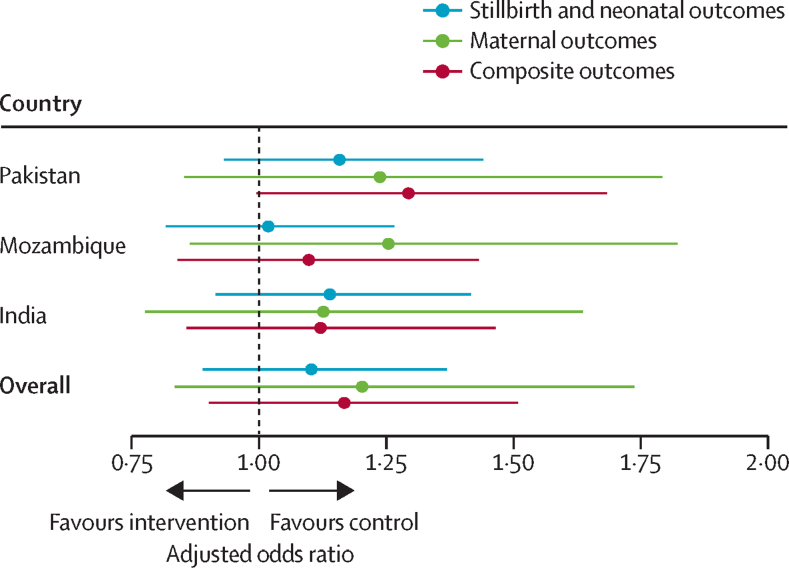
BACKGROUND: To overcome the three delays in triage, transport and treatment that underlie adverse pregnancy outcomes, we aimed to reduce all-cause adverse outcomes with community-level interventions targeting women with pregnancy hypertension in three low-income countries. METHODS: In this individual participant-level meta-analysis, we de-identified and pooled data from the Community-Level Interventions for Pre-eclampsia (CLIP) cluster randomised controlled trials in Mozambique, Pakistan, and India, which were run in 2014-17. Consenting pregnant women, aged 12-49 years, were recruited in their homes. Clusters, defined by local administrative units, were randomly assigned (1:1) to intervention or control groups. The control groups continued local standard of care. The intervention comprised community engagement and existing community health worker-led mobile health-supported early detection, initial treatment, and hospital referral of women with hypertension. For this meta-analysis, as for the original studies, the primary outcome was a composite of maternal or perinatal outcome (either maternal, fetal, or neonatal death, or severe morbidity for the mother or baby), assessed by unmasked trial surveillance personnel. For this analysis, we included all consenting participants who were followed up with completed pregnancies at trial end. We analysed the outcome data with multilevel modelling and present data with the summary statistic of adjusted odds ratios (ORs) with 95% CIs (fixed effects for maternal age, parity, maternal education, and random effects for country and cluster). This meta-analysis is registered with PROSPERO, CRD42018102564. FINDINGS: Overall, 44 clusters (69 330 pregnant women) were randomly assigned to intervention (22 clusters [36 008 pregnancies]) or control (22 clusters [33 322 pregnancies]) groups. 32 290 (89·7%) pregnancies in the intervention group and 29 698 (89·1%) in the control group were followed up successfully. Median maternal age of included women was 26 years (IQR 22-30). In the intervention clusters, 6990 group and 16 691 home-based community engagement sessions and 138 347 community health worker-led visits to 20 819 (57·8%) of 36 008 women (of whom 11 095 [53·3%] had a visit every 4 weeks) occurred. Blood pressure and dipstick proteinuria were assessed per protocol. Few women were eligible for methyldopa for severe hypertension (181 [1%] of 20 819) or intramuscular magnesium sulfate for pre-eclampsia (198 [1%]), of whom most accepted treatment (162 [89·5%] of 181 for severe hypertension and 133 [67·2%] of 198 for pre-eclampsia). 1255 (6%) were referred to a comprehensive emergency obstetric care facility, of whom 864 (82%) accepted the referral. The primary outcome was similar in the intervention (7871 [24%] of 32 290 pregnancies) and control clusters (6516 [22%] of 29 698; adjusted OR 1·17, 95% CI 0·90-1·51; p=0·24). No intervention-related serious adverse events occurred, and few adverse effects occurred after in-community treatment with methyldopa (one [2%] of 51; India only) and none occurred after in-community treatment with magnesium sulfate or during transport to facility. INTERPRETATION: The CLIP intervention did not reduce adverse pregnancy outcomes. Future community-level interventions should expand the community health worker workforce, assess general (rather than condition-specific) messaging, and include health system strengthening. FUNDING: University of British Columbia, a grantee of the Bill & Melinda Gates Foundation.
Overview
The claims and statistics of this paper haven’t been checked yet.
Free: it reads the open-access text and checks the first 5 claims that cite a source we can check. Create a free account to check every claim.
Integrity signals
Registry
Cites
Statistics
Figures
Verification
Claims the paper makes
The claims and statistics of this paper haven’t been checked yet.
Free: it reads the open-access text and checks the first 5 claims that cite a source we can check. Create a free account to check every claim.
Claims other papers make about this one
Each is checked against this paper’s own text: does it say what the citing paper says it does?
The source backs part of the claim, not all of it — or backs it for a different population, condition or comparison.
In the citing paper
“The findings from the CLIP trials suggest that community-level interventions for women with HDP can be successfully completed by community health workers, but their numbers must be adequate to provide at least eight antenatal care contacts to reduce adverse outcomes259.”
From A global view of hypertensive disorders and diabetes mellitus during pregnancy (2022) · cites this paper as [259]
Experimental — accuracy not yet measuredThe cited source says what the claim attributes to it.
In the citing paper
“This finding suggests that a focus only on community-level intervention without facility enhancement is inadequate to improve maternal and neonatal outcomes259.”
From A global view of hypertensive disorders and diabetes mellitus during pregnancy (2022) · cites this paper as [259]
The cited source says what the claim attributes to it.
In the citing paper
“However, the CLIP study did not generate a statistically significant reduction in all-cause maternal and perinatal mortality or morbidity.”
From A global view of hypertensive disorders and diabetes mellitus during pregnancy (2022) · cites this paper as [259]
Self-check
Percentages, sums and reported differences re-computed from the paper’s own numbers.
The self-check needs the paper’s full text.
Citations
Cites
Too far to walk: Maternal mortality in context
Thaddeus, S., & Maine, D. (1994) · Social Science & Medicine · doi:10.1016/0277-9536(94)90226-7 · Cited by 3,240
Steegers, E. A., von Dadelszen, P., Duvekot, J. J., & Pijnenborg, R. (2010) · The Lancet · doi:10.1016/s0140-6736(10)60279-6 · Cited by 2,850
Mol, B. W. J., Roberts, C. T., Thangaratinam, S., Magee, L. A., de Groot, C. J. M., & Hofmeyr, G. J. (2016) · The Lancet · doi:10.1016/s0140-6736(15)00070-7 · Cited by 1,597
Self-citationKassebaum, N. J., Barber, R. M., Bhutta, Z. A., Dandona, L., Gething, P. W., Hay, S. I., Kinfu, Y., Larson, H. J., Liang, X., Lim, S. S., et al. (2016) · The Lancet · doi:10.1016/s0140-6736(16)31470-2 · Cited by 1,162
Self-citationManandhar, D. S., Osrin, D., Shrestha, B. P., Mesko, N., Morrison, J., Tumbahangphe, K. M., Tamang, S., Thapa, S., Shrestha, D., Thapa, B., et al. (2004) · The Lancet · doi:10.1016/s0140-6736(04)17021-9 · Cited by 847
Less-Tight versus Tight Control of Hypertension in Pregnancy
Magee, L. A., von Dadelszen, P., Rey, E., Ross, S., Asztalos, E., Murphy, K. E., Menzies, J., Sanchez, J., Singer, J., Gafni, A., et al. (2015) · New England Journal of Medicine · doi:10.1056/nejmoa1404595 · Cited by 672
Self-citationLassi, Z. S., & Bhutta, Z. A. (2015) · Cochrane Database of Systematic Reviews · doi:10.1002/14651858.cd007754.pub3 · Cited by 579
Self-citationKumar, V., Mohanty, S., Kumar, A., Misra, R. P., Santosham, M., Awasthi, S., Baqui, A. H., Singh, P., Singh, V., Ahuja, R. C., et al. (2008) · The Lancet · doi:10.1016/s0140-6736(08)61483-x · Cited by 498
Tripathy, P., Nair, N., Barnett, S., Mahapatra, R., Borghi, J., Rath, S., Rath, S., Gope, R., Mahto, D., Sinha, R., et al. (2010) · The Lancet · doi:10.1016/s0140-6736(09)62042-0 · Cited by 497
Research works printed but not linked: 5
- Payne BA von Dadelszen P Bhutta ZA Protocol 13PRT/9313: The Community Level Interventions for Pre-eclampsia (CLIP) Trials: four prospective cluster randomised controlled trials comparing a package of interventions directed towards improving maternal and perinatal outcomes related to pre-eclampsia with current standards of care (NCT01911494) January 2018 The Lancet London https://www.thelancet.com/protocol-reviews/13PRT-9313
- WHO WHO recommendations for prevention and treatment of pre-eclampsia and eclampsia 2011 World Health Organization Geneva 23741776
- Higgins JPT Green S Chapter 16.3.2. Assessing risk of bias in cluster-randomized trials Higgins JPT Green S Cochrane handbook for systematic reviews of interventions, version 5.1.0 2011 The Cochrane Collaboration https://handbook-5-1.cochrane.org/chapter_16/16_3_2_assessing_risk_of_bias_in_cluster_randomized_trials.htm
- WHO WHO recommendations on antenatal care for a positive pregnancy 2016 World Health Organization Geneva 28079998
- Midhet F Becker S Impact of community-based interventions on maternal and neonatal health indicators: results from a community randomized trial in rural Balochistan, Pakistan Reprod Health 7 2010 30 21054870 PMC2993657 · DOI · Paper page
Cited by
Magee, L. A., Brown, M. A., Hall, D. R., Gupte, S., Hennessy, A., Karumanchi, S. A., Kenny, L. C., McCarthy, F., Myers, J., Poon, L. C., et al. (2022) · Pregnancy Hypertension · doi:10.1016/j.preghy.2021.09.008 · Cited by 1,134
“• Measurement of BP in hypertensive women on postpartum days 3 – 6 may require task-sharing to community health workers, as achieved in the Community-Level Interventions for Pre-eclampsia Trials [222].”
BackgroundSelf-citationChappell, L. C., Cluver, C. A., Kingdom, J., & Tong, S. (2021) · The Lancet · doi:10.1016/s0140-6736(20)32335-7 · Cited by 925
A global view of hypertensive disorders and diabetes mellitus during pregnancy
Jiang, L., Tang, K., Magee, L. A., von Dadelszen, P., Ekeroma, A., Li, X., Zhang, E., & Bhutta, Z. A. (2022) · Nature Reviews Endocrinology · doi:10.1038/s41574-022-00734-y · Cited by 314
Self-citationKnop, M. R., Hayashi, M., Lin, R., Saing, C. H., Ung, M., Oy, S., Yam, E. L. Y., Zahari, M., & Yi, S. (2024) · BMC Medicine · doi:10.1186/s12916-024-03417-9 · Cited by 167
“[40, 44, 50, 74, 77, 126, 135, 139, 153], followed by mHealth Function 6 (electronic decision support, n = 8, 40”
BackgroundInfluentialMontgomery-Csobán, T., Kavanagh, K., Murray, P., Robertson, C., Barry, S., Ukah, U. V., Payne, B. A., Nicolaides, K. H., Syngelaki, A., Ionescu, O., et al. (2024) · The Lancet Digital Health · doi:10.1016/s2589-7500(23)00267-4 · Cited by 75
Self-citationAdvances in pathogenesis of preeclampsia
Yang, M., Wang, M., & Li, N. (2024) · Archives of Gynecology and Obstetrics · doi:10.1007/s00404-024-07393-6 · Cited by 61
“Annually, preeclampsia leads to nearly 76,000 maternal and 500,000 infant fatalities on a global scale [3].”
Vera-Ponce, V. J., Loayza-Castro, J. A., Ballena-Caicedo, J., Valladolid-Sandoval, L. A. M., Zuzunaga-Montoya, F. E., & Carrillo, C. I. G. D. (2025) · Frontiers in Reproductive Health · doi:10.3389/frph.2025.1706009 · Cited by 117
Bone, J. N., Magee, L. A., Singer, J., Nathan, H. L., Qureshi, R. N., Sacoor, C. N., Sevene, E., Shennan, A. H., Bellad, M. B., Goudar, S. S., et al. (2021) · The Lancet Global Health · doi:10.1016/s2214-109x(21)00219-9 · Cited by 35
Self-citationAukes, A. M., Arion, K., Bone, J. N., Li, J., Vidler, M., Bellad, M. B., Charantimath, U., Goudar, S. S., Hoodbhoy, Z. A., Katageri, G., et al. (2021) · The Lancet Global Health · doi:10.1016/s2214-109x(21)00263-1 · Cited by 27
Self-citationCardiovascular Deaths in Pregnancy: Growing Concerns and Preventive Strategies
Keepanasseril, A., Pfaller, B., Metcalfe, A., Siu, S. C., Davis, M. B., & Silversides, C. K. (2021) · Canadian Journal of Cardiology · doi:10.1016/j.cjca.2021.09.022 · Cited by 34
Lv, Z., Xiong, L., Qin, X., Zhang, H., Luo, X., Peng, W., Kilby, M. D., Saffery, R., Baker, P. N., & Qi, H. (2021) · Frontiers in Cell and Developmental Biology · doi:10.3389/fcell.2021.694261 · Cited by 26
von Dadelszen, P., Vidler, M., Tsigas, E. Z., & Magee, L. A. (2021) · Maternal-Fetal Medicine · doi:10.1097/fm9.0000000000000096 · Cited by 35
Self-citationSevene, E., Boene, H. E., Vidler, M., Valá, A., Macuácua, S., Augusto, O. J., Fernandes, Q., Bique, C., Macete, E., Sidat, M., et al. (2021) · Reproductive Health · doi:10.1186/s12978-021-01192-x · Cited by 26
“The proposed CLIP Trial intervention that this study aimed to inform was planned to cover two delays, namely seeking care and prompt referral [24, 25].”
MethodSelf-citationHoodbhoy, Z. A., Sheikh, S. S., Qureshi, R. N., Memon, J., Raza, F., Kinshella, M. W., Bone, J. N., Vidler, M., Sharma, S., Payne, B. A., et al. (2021) · PubMed Central · doi:10.7189/jogh.11.04045 · Cited by 25
Self-citationChoudhury, A., Shahsavar, Y., Sarkar, K., Choudhury, M., & Nimbarte, A. D. (2023) · Nutrients · doi:10.3390/nu15173699 · Cited by 27
Soundararajan, R., Khan, T., & von Dadelszen, P. (2024) · Best Practice & Research Clinical Obstetrics & Gynaecology · doi:10.1016/j.bpobgyn.2024.102525 · Cited by 23
Vidler, M., Kinshella, M. W., Sevene, E., Lewis, G., von Dadelszen, P., Bhutta, Z. A., the CLIP Working Group, Sevene, E., Macete, E., Munguambe, K., et al. (2023) · BMC Pregnancy and Childbirth · doi:10.1186/s12884-023-06055-w · Cited by 27
Self-citationGlobal inequities in adverse pregnancy outcomes: what can we do?
Roberts, J. M., Abímbọ́lá, Ṣ., Bale, T. L., BARROS, A., Bhutta, Z. A., Browne, J. L., Celi, A. C., Dube, P., Graves, C. R., Hollestelle, M. J., et al. (2024) · AJOG Global Reports · doi:10.1016/j.xagr.2024.100385 · Cited by 17
Self-citationBone, J. N., Khowaja, A. R., Vidler, M., Payne, B. A., Bellad, M. B., Goudar, S. S., Mallapur, A. A., Munguambe, K., Qureshi, R. N., Sacoor, C., et al. (2021) · BMJ Global Health · doi:10.1136/bmjgh-2020-004123 · Cited by 14
Self-citationNagraj, S., Kennedy, S., Jha, V., Norton, R., Hinton, L., Billot, L., Rajan, E., Arora, V., Praveen, D., & Hirst, J. E. (2021) · Frontiers in Global Women s Health · doi:10.3389/fgwh.2021.620759 · Cited by 14
“There is evidence to suggest that involving CHWs in women’s health is feasible (41) and can improve antenatal care practises (42, 43), although no CHW-led intervention studies focusing exclusively on high-risk pregnancy have to date shown an improvement on clinical endpoints (43, 44).”
BackgroundBoene, H. E., Valá, A., Kinshella, M. W., La, M., Sharma, S., Vidler, M., Magee, L. A., von Dadelszen, P., Sevene, E., Munguambe, K., et al. (2021) · Frontiers in Global Women s Health · doi:10.3389/fgwh.2021.659582 · Cited by 15
Self-citationThe role of the pregnancy heart team in clinical practice
Lucà, F., Colivicchi, F., Parrini, I., Russo, M. G., Fusco, S. A. D., Ceravolo, R., Riccio, C., Favilli, S., Rossini, R., Gelsomino, S., et al. (2023) · Frontiers in Cardiovascular Medicine · doi:10.3389/fcvm.2023.1135294 · Cited by 16
Magee, L. A., Bone, J. N., Owasil, S., Singer, J., Lee, T., Bellad, M. B., Goudar, S. S., Logan, A. G., Macuácua, S., Mallapur, A. A., et al. (2021) · Hypertension · doi:10.1161/hypertensionaha.120.16851 · Cited by 10
Self-citationAdepoju, A., Vidler, M., Akadri, A. A., Jaiyesimi, E., Nwankpa, C. C., Odubena, O. O., Sharma, S., Li, L., Tu, D. K., Drebit, S. K., et al. (2021) · Pregnancy Hypertension · doi:10.1016/j.preghy.2021.05.005 · Cited by 12
Self-citationMalhamé, I., Destiné, R., Jacquecilien, W., Coriolan, B., St-Loth, W., Excellent, M. C., Scaide, B., Wong, R., Meltzer, S., Jean-Baptiste, E., et al. (2021) · Journal of Global Health · doi:10.7189/jogh.11.04020 · Cited by 11
Shartyanie, N. P., Hanifa, I. N., & Khan, N. (2025) · Journal of Medical Internet Research · doi:10.2196/75738 · Cited by 17
“Preliminary data comparing outcomes from the 6 months pre-and post-implementation (n=7926) revealed a significant reduction in intrapartum stillbirths (0.37%; P< .001) and early neonatal deaths (0.58%, P <.001), alongside a rise in cesarean section rates (2.1%; P =.004) [40].”
InfluentialDon't forget eclampsia in the efforts to reduce maternal morbidity and mortality
Nicholson, W. K., Stones, W. R., Visser, G. H. A., Barnea, E. R., & Nassar, A. H. (2021) · International Journal of Gynecology & Obstetrics · doi:10.1002/ijgo.13530 · Cited by 11
Makuluni, R., & Stones, W. R. (2021) · BMC Pregnancy and Childbirth · doi:10.1186/s12884-021-03867-6 · Cited by 8
Liu, X., Bai, Y., Chen, H., Qian, N., Wu, L., Zhao, L., Wang, S., Shen, C., & Jiang, H. (2025) · Medicine · doi:10.1097/md.0000000000041784 · Cited by 5
Yang, M., Wang, M., Zhu, Q., & Li, N. (2025) · Placenta · doi:10.1016/j.placenta.2025.03.005 · Cited by 7
Association of BMAL1 and CLOCK Gene Polymorphisms with Preeclampsia Risk with Subtype Analysis
Xia, F., Wang, P., Li, Z., Wei, J., Wei, J., Wu, Y., Liu, C., Lin, S., Guo, S., He, L., et al. (2025) · International Journal of Molecular Sciences · doi:10.3390/ijms262110797 · Cited by 3
Xie, Y., & Tian, S. (2021) · Journal of Biomaterials and Tissue Engineering · doi:10.1166/jbt.2022.2902 · Cited by 3
von Dadelszen, P., Bone, J. N., Sandhu, A., Ansermino, J. M., Qureshi, R. N., Sacoor, C. N., Sevene, E., Li, J., Vidler, M., Bellad, M. B., et al. (2023) · BJOG An International Journal of Obstetrics & Gynaecology · doi:10.1111/1471-0528.17465 · Cited by 4
“Using BP data from in-community measurement in the Community-Level Interventions in Pre-eclampsia (CLIP) trials, 12– 15 our aim was to compare the relation to adverse maternal and perinatal outcomes for BP levels defined according to different outputs, i.e. sBP and/or dBP, sBP alone, dBP alone or…”
BackgroundMethodInfluentialSelf-citationFrom Nephron Number to Global Health
Luyckx, V. A. (2026) · Seminars in Nephrology · doi:10.1016/j.semnephrol.2026.151691 · Cited by 2
Wu, Z., Chen, J., Huang, K., Li, Y., Chen, J., Lin, B., Lin, C., & Pan, G. (2024) · The Journal of Maternal-Fetal & Neonatal Medicine · doi:10.1080/14767058.2024.2389979 · Cited by 2
“Approximately 10 million pregnancies worldwide are affected by hypertension during pregnancy, specifically pre-eclampsia, leading to approximately 76,000 maternal fatalities and 500,000 fetal and neonatal fatalities annually [26].”
Resveratrol Activates SIRT1 to Inhibit Trophoblast Pyroptosis in Preeclampsia
Lin, W., Wei, J., Xie, Z., Song, P., & Li, R. (2025) · Reproductive Sciences · doi:10.1007/s43032-025-02003-5 · Cited by 2
“With a global incidence ranging from 2 Weizhao Lin, Jiachun Wei and Zhuojun Xie These co-first authors share the first author position. to 8%, showing regional variations [1 ], PE contributes to approximately 76,000 maternal deaths and 500,000 infant deaths annually [ 3].”
Sk, M. I. K. (2022) · Health care science · doi:10.1002/hcs2.28 · Cited by 1
“Eclampsia adversely affects maternal and perinatal health, particularly in low resource countries, which contributes to substantial fetal and maternal mortality [1, 2].”
BackgroundEconomic Analysis of the CLIP Trials in India, Pakistan and MozambiquePreprint
Bone, J. N., Khowaja, A. R., Vidler, M., Payne, B. A., Bellad, M. B., Goudar, S. S., Mallapur, A. A., Munguambe, K., Qureshi, R. N., Sacoor, C. N., et al. (2020) · doi:10.21203/rs.3.rs-60194/v1 · Cited by 1
“Given that we consistently observed similar results in maternal morbidity (no effect overall, decrease with at least eight POM contacts) to mortality (8) it is probable that the cost-effectiveness results seen here would be similar if this could be included.”
ResultSelf-citationEconomic analysis of the CLIP Trials in India, Pakistan and MozambiquePreprint
Bone, J. N., Khowaja, A. R., Vidler, M., Payne, B. A., Bellad, M. B., Goudar, S. S., Mallapur, A. A., Munguambe, K., Qureshi, R. N., Sacoor, C. N., et al. (2020) · doi:10.21203/rs.3.rs-60194/v2
Self-citationAssisted Reproductive Technologies: Complications, Skill, Triage, and Simulation
Mina, M., Tsakiridis, I. G., Salta, S., Dagklis, T., Mamopoulos, A. M., Vatopoulou, A., Daniilidis, A., Athanasiadis, A. P., Paschopoulos, M. E., Kosmas, I. P., et al. (2023) · Springer eBooks · doi:10.1007/978-3-031-10067-3_4
Khodijah, D., Yustina, I., Lumbanraja, S. N., & Zuska, F. (2024) · Universal Journal of Public Health · doi:10.13189/ujph.2024.120213
“Understanding the reasons why mothers arrive at the hospital late is important [16].”
Mwashigadi, G., Akuze, J., Koech, A. C., Jah, H., Roca, A., D’Alessandro, U., Sevene, E., Maculuve, S. A., Valá, A., Singh, S., et al. (2026) · The Lancet Regional Health - Africa · doi:10.1016/j.lanafr.2026.100089
Self-citationYang, M., Wang, M., Zhu, Q., & Li, N. (2026) · Scientific Reports · doi:10.1038/s41598-026-48499-y
Samuels, L., Mukape, M., Kuhrt, K., Oliveira, L. G., Shennan, A. H., Chappell, L. C., & Hurrell, A. (2026) · The Lancet Obstetrics Gynaecology & Women s Health · doi:10.1016/s3050-5038(26)00057-9
Self-citationvon Dadelszen, P., Sandhu, A., Bone, J. N., Qureshi, R. N., Dada, O. A., Mallapur, A. A., Temmerman, M., Volvert, M., Waiswa, J. A., Mukhanya, M. W., et al. (2026) · JMIR mhealth and uhealth · doi:10.2196/73307 · Cited by 1
“…hypertension [at least 160 mm Hg], eclampsia, stroke, or vaginal bleeding); or refer the woman to a comprehensive emergency obstetric care facility for suspected preeclampsia or increased risk of stillbirth (4+ dipstick proteinuria value, or absent fetal movements for at least 12 h) [10,14].”
Self-citationRiley, K., Yan, L. D., Deschamps, M., Ogyu, A., Alexandre, W., Malha, L. P., Sinkey, R. G., Pape, J. W., Rouzier, V., & McNairy, M. L. (2026) · Frontiers in Global Women s Health · doi:10.3389/fgwh.2026.1848249
Walker, M. C., Murphy, M. S. Q., Souza, S. C. S., Koi-Larbi, K., Costa, M. L., Hyett, J. A., von Dadelszen, P., Magee, L. A., Muteti, A., Tsigas, E. Z., et al. (2026) · The Lancet · doi:10.1016/s0140-6736(26)01071-8 · Cited by 1
Self-citationBoniface, F. A., Ogaji, D., Odikpo, L. C., & Ndep, A. O. (2026) · British Journal of Contemporary Research · doi:10.67693/bjcr-48jl8nfq
Marques, H. F. F., Lourenço, I. M., Leal, C. R. V., & Júnior, M. D. C. (2026) · Revista Brasileira Ginecologia e Obstetrícia · doi:10.61622/rbgo/2026rbgo68
Metadata
- Authors
- von Dadelszen, P., Bhutta, Z. A., Sharma, S., Bone, J., Singer, J., Wong, H., Bellad, M. B., Goudar, S. S., Lee, T., Li, J., Mallapur, A. A., Munguambe, K., Payne, B. A., Qureshi, R. N., Sacoor, C., Sevene, E., Vidler, M., Magee, L. A., Macete, E., Boene, H., Amose, F., Augusto, O., Bique, C., Biz, A. I., Chiaú, R., Cutana, S., Filimone, P., Gonçálves, E., Macamo, M., Macuacua, S., Maculuve, S., Mandlate, E., Matavele, A., Mocumbi, S., Mulungo, D., Nhamirre, Z., Nhancolo, A., Nkumbula, C., Nobela, V., Pires, R., Tchavana, C., Vala, A., Vilanculo, F., Sheikh, S., Hoodbhoy, Z., Ahmed, I., Hussain, A., Memon, J., Raza, F., Katageri, G. M., Charantimath, U. S., Bannale, S. G., Chougala, K. S., Dhamanekar, V. B., Honnungar, N. V., Joshi, A. M., Kamble, N. A., Karadiguddi, C. C., Kavi, A. J., Kengapur, G. S., Kodkany, B. S., Kudachi, U. S., Mastiholi, S. S., Mungarwadi, G. I., Ramdurg, U. Y., Revankar, A. P., Drebit, S. K., Dunsmuir, D. T., Kariya, C., Lui, M., Sawchuck, D., Tu, D. K., Ukah, U. V., Woo Kinshella, M.-L., Ansermino, J. M., Betrán, A. P., Derman, R., Dharamsi, S., Donnay, F., Dumont, G., Engelbrecht, S. M., Fillipi, V., Firoz, T., Grobman, W., Knight, M., Langer, A., Lewin, S., Lewis, G., Mitton, C., Schuurman, N., Shennan, A., Thornton, J., Adetoro, O., & Sotunsa, J. O.
- Affiliations
- Aga Khan University (PK)
- University of British Columbia (CA)
- Jawaharlal Nehru Medical College (IN)
- S Nijalingappa Medical College and HSK Hospital & Research Centre (IN)
- Eduardo Mondlane University (MZ)
- Manhiça Health Research Centre (MZ)
- ORCID
- Bhutta, Zulfiqar A
- Sharma, Sumedha
- Bone, Jeffrey
- Singer, Joel
- Wong, Hubert
- Bellad, Mrutyunjaya B
- Goudar, Shivaprasad S
- Li, Jing
- Mallapur, Ashalata A
- Munguambe, Khátia
- Payne, Beth A
- Qureshi, Rahat N
- Sacoor, Charfudin
- Sevene, Esperança
- Vidler, Marianne
- Magee, Laura A
- Macete, Eusébio
- Boene, Helena
- Augusto, Orvalho
- Gonçálves, Emília
- Sheikh, Sana
- Hoodbhoy, Zahra
- Ahmed, Imran
- Hussain, Amjad
- Memon, Javed
- Katageri, Geetanjali M
- Charantimath, Umesh S
- Joshi, Anjali M
- Kavi, Avinash J
- Ramdurg, Umesh Y
- Drebit, Sharla K
- Dunsmuir, Dustin T
- Ansermino, J Mark
- Betrán, Ana Pilar
- Derman, Richard
- Dharamsi, Shafik
- Donnay, France
- Dumont, Guy
- Firoz, Tabassum
- Knight, Marian
- Langer, Ana
- Lewin, Simon
- Mitton, Craig
- Schuurman, Nadine
- Shennan, Andrew
- Thornton, Jim
- Adetoro, Olalekan
- Sotunsa, John O
- Venue
- The Lancet
- Publisher
- Elsevier BV
- Published
- 2020-08
- Volume
- 396
- Issue
- 10250
- Pages
- 553-563
- ISSN
- 0099-5355 (ISSN-L)
- 0140-6736
- PMC
- PMC7445426
- OpenAlex
- W3064233627
- Cited by
- 49
- References
- 27
- Citations by year
- 2026: 9 · 2025: 6 · 2024: 7 · 2023: 5 · 2022: 2 · 2021: 17 · 2020: 3
- FWCI
- 1.49
- Type
- journal article
- Language
- en
- Update notices
- erratum (2020-09-19)
- Open access
- hybrid
- doi.org
- Licence
- cc-by
- www.elsevier.com/tdm/userlicense/1.0/ (tdm)
- www.elsevier.com/legal/tdmrep-license (tdm)
- creativecommons.org/licenses/by/4.0/ (vor)
- Locations
- The Lancet (publishedVersion, cc-by)
- PubMed Central (publishedVersion, cc-by)
- PubMed (publishedVersion)
- eCommons - AKU (Aga Khan University) (submittedVersion, cc-by)
- Research Portal (King's College London) (submittedVersion, other-oa)
- Greater South Information System
- Funders
- University of British Columbia
- Bill and Melinda Gates Foundation (OPP1017337)
- Topics
- Health Sciences › Medicine › Pediatrics, Perinatology and Child Health › Global Maternal and Child Health
- Health Sciences › Medicine › Obstetrics and Gynecology › Pregnancy and preeclampsia studies
- Health Sciences › Medicine › Pediatrics, Perinatology and Child Health › Maternal and Neonatal Healthcare
- Keywords
- preeclampsia, hypertensive disorders of pregnancy, community health workers, mobile health, community participation, early detection, hospital referral, maternal mortality, perinatal outcomes, adverse pregnancy outcomes, three delays, low-income countries, Mozambique, Pakistan, India, home care, obstetric care, multilevel modelling, parity
- MeSH terms
- Adolescent, Adult, Child, Community Health Services, Female, Humans, India, Middle Aged, Mozambique, Pakistan, Pre-Eclampsia, Pregnancy, Pregnancy Outcome, Randomized Controlled Trials as Topic, Young Adult, Maternal Death
About these checks
Registry, retraction, Cites and statistics results are computed, not judged, with one exception: a printed reference that no index lists is read once by a model before it counts as a citation error. Claims are extracted by a model and kept only when their quote appears verbatim in the text; each cited source is then checked, with a model’s help, for whether it says what the claim relies on. Those verdicts can be wrong — read the claim’s quote and the cited source before relying on one.
Statistics and arithmetic are recomputed, not judged.
Confidence bands are shown only for fields calibrated on our annotated test set. None is calibrated yet, so no band is shown.
What counts as a claim ›How we measure confidence ›How we check this ›
Are you an author, or do you see a problem with this page? Request a review
Data sources
Bibliographic data: Semantic Scholar, OpenAlex, Crossref.
Contains information from the Semantic Scholar Academic Graph Datasets, made available under the ODC Attribution License (ODC-BY 1.0).
Semantic Scholar’s data is described in: Kinney, R., et al. (2023). The Semantic Scholar Open Data Platform. arXiv:2301.10140.
