Cited by 298

The DOI matches its Crossref record; 1 of the 1 references it cites were found in a registry or an index.

Lentiviral haematopoietic stem-cell gene therapy for early-onset metachromatic leukodystrophy: long-term results from a non-randomised, open-label, phase 1/2 trial and expanded access

Fumagalli, Francesca, Calbi, Valeria, Natali Sora, Maria Grazia, Sessa, Maria, Baldoli, Cristina, Rancoita, Paola Maria V, Ciotti, Francesca, Sarzana, Marina, Fraschini, Maddalena, Zambon, Alberto Andrea, Acquati, Serena, Redaelli, Daniela, Attanasio, Vanessa, Miglietta, Simona, De Mattia, Fabiola, Barzaghi, Federica, Ferrua, Francesca, Migliavacca, Maddalena, Tucci, Francesca, Gallo, Vera, Del Carro, Ubaldo, Canale, Sabrina, Spiga, Ivana, Lorioli, Laura, Recupero, Salvatore, Fratini, Elena Sophia, Morena, Francesco, Silvani, Paolo, Calvi, Maria Rosa, Facchini, Marcella, Locatelli, Sara, Corti, Ambra, Zancan, Stefano, Antonioli, Gigliola, Farinelli, Giada, Gabaldo, Michela, Garcia-Segovia, Jesus, Schwab, Laetitia C, Downey, Gerald F, Filippi, Massimo, Cicalese, Maria Pia, Martino, Sabata, Di Serio, Clelia, Ciceri, Fabio, Bernardo, Maria Ester, Naldini, Luigi, Biffi, Alessandra, Aiuti, Alessandro·2022·The Lancet

Overview

The claims and statistics of this paper haven’t been checked yet.

Run the check — free, no account needed. It reads the open-access text and checks the sources it cites.

A few free checks a day · papers already verified open instantly · results are public

Integrity signals

Registry

Crossref · 10.1016/s0140-6736(21)02017-1

Cites

1 of 1 references verified0 citation errors · 0 not checkable

Statistics

Figures

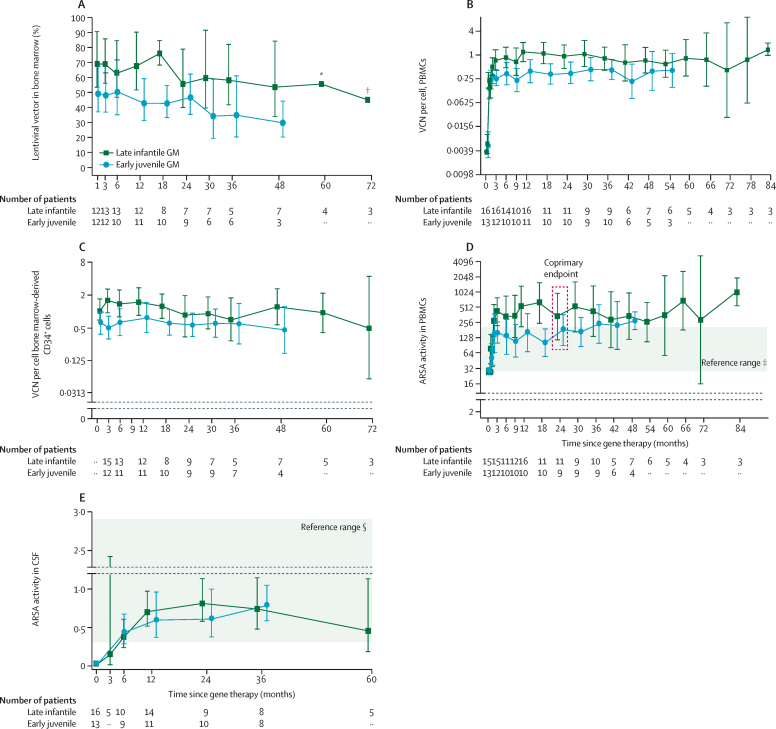
Figure 1 High-level engraftment of gene-corrected HSPCs (A) Assessed over time by disease subtype by percentage of lentiviral vector-transduced cells in bone marrow clonogenic progenitors. (B) Mean VCN in PBMCs. LLQ is 0·0037 VCN per cell. Zero values are plotted as 0·001. (C) Mean VCN in bone marrow-derived CD34+ cells. LLQ is 0·0037 vector copy number/cell. Zero values are plotted as 0·001. (D) Mean ARSA activity in PBMCs. LLQ is 25·79 nmol/mg/h. ARSA activity measured in PBMC in the intention-to-treat set after treatment at years 2 (coprimary endpoint) and 3 was compared with pre-treatment values using a mixed-model repeated measures model. (E) Mean ARSA activity in cerebrospinal fluid (CSF). LLQ is 0·0032 nmol/mg/h. Geometric means and 95% CIs are presented where there are at least three patients with non-missing data. ARSA=arylsulfatase A. GM=geometric mean. LLQ=lower limit of quantification. PBMCs=peripheral blood mononuclear cells. VCN=vector copy number. *95% CI for 60-month timepoint: 24·35–128·73. †95% CI for 72-month timepoint: 6·69–303·48. ‡From adult reference donors. §From paediatric reference donors.20 In all panels, values less than the LLQ were imputed as the LLQ as this represents a conservative approach to treatment evaluation in those cases.
Figure 1 High-level engraftment of gene-corrected HSPCs (A) Assessed over time by disease subtype by percentage of lentiviral vector-transduced cells in bone marrow clonogenic progenitors. (B) Mean VCN in PBMCs. LLQ is 0·0037 VCN per cell. Zero values are plotted as 0·001. (C) Mean VCN in bone marrow-derived CD34+ cells. LLQ is 0·0037 vector copy number/cell. Zero values are plotted as 0·001. (D) Mean ARSA activity in PBMCs. LLQ is 25·79 nmol/mg/h. ARSA activity measured in PBMC in the intention-to-treat set after treatment at years 2 (coprimary endpoint) and 3 was compared with pre-treatment values using a mixed-model repeated measures model. (E) Mean ARSA activity in cerebrospinal fluid (CSF). LLQ is 0·0032 nmol/mg/h. Geometric means and 95% CIs are presented where there are at least three patients with non-missing data. ARSA=arylsulfatase A. GM=geometric mean. LLQ=lower limit of quantification. PBMCs=peripheral blood mononuclear cells. VCN=vector copy number. *95% CI for 60-month timepoint: 24·35–128·73. †95% CI for 72-month timepoint: 6·69–303·48. ‡From adult reference donors. §From paediatric reference donors.20 In all panels, values less than the LLQ were imputed as the LLQ as this represents a conservative approach to treatment evaluation in those cases.CC BY · PubMed Central
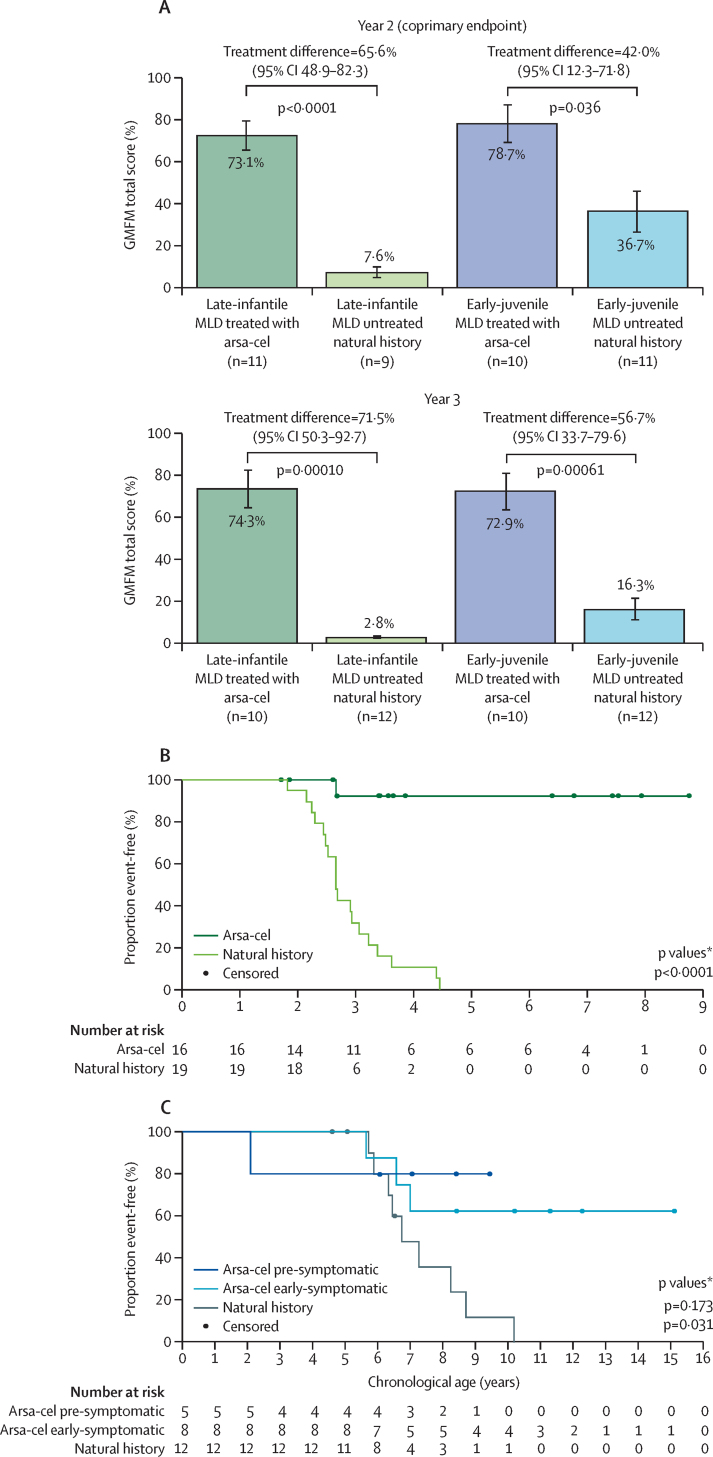
Figure 2 GMFM scores and age at severe motor impairment or death (A) GMFM scores for patients with late-infantile and early-juvenile MLD compared with age-matched and disease subtype-matched untreated natural history controls at 2 and 3 years after treatment. Adjusted least-squares means, treatment difference (atidarsagene autotemcel [arsa-cel] minus natural history), and the associated 95% CI and p value were reported overall and by disease subtype (late infantile, early juvenile) for the null hypothesis of 10% or less difference in total GMFM scores between treated and natural history patients at years 2 and 3. (B) Kaplan-Meier plot showing age at severe motor impairment or death in patients with late-infantile MLD versus untreated natural history late-infantile MLD controls. (C) Kaplan-Meier plot showing age at severe motor impairment or death in patients with pre-symptomatic and early-symptomatic early-juvenile MLD versus untreated natural history early-juvenile MLD controls. Severe motor impairment-free survival is defined as the interval from birth to the earlier loss of locomotion and sitting without support (GMFC level 5 or 6) or death from any cause; otherwise severe motor impairment-free survival is censored at the last GMFC assessment date. Symptomatic status refers to arsa-cel treated patients at the time of treatment. GMFM=gross motor function measure. MLD=metachromatic leukodystrophy. *p values calculated using an unstratified log-rank test.
Figure 2 GMFM scores and age at severe motor impairment or death (A) GMFM scores for patients with late-infantile and early-juvenile MLD compared with age-matched and disease subtype-matched untreated natural history controls at 2 and 3 years after treatment. Adjusted least-squares means, treatment difference (atidarsagene autotemcel [arsa-cel] minus natural history), and the associated 95% CI and p value were reported overall and by disease subtype (late infantile, early juvenile) for the null hypothesis of 10% or less difference in total GMFM scores between treated and natural history patients at years 2 and 3. (B) Kaplan-Meier plot showing age at severe motor impairment or death in patients with late-infantile MLD versus untreated natural history late-infantile MLD controls. (C) Kaplan-Meier plot showing age at severe motor impairment or death in patients with pre-symptomatic and early-symptomatic early-juvenile MLD versus untreated natural history early-juvenile MLD controls. Severe motor impairment-free survival is defined as the interval from birth to the earlier loss of locomotion and sitting without support (GMFC level 5 or 6) or death from any cause; otherwise severe motor impairment-free survival is censored at the last GMFC assessment date. Symptomatic status refers to arsa-cel treated patients at the time of treatment. GMFM=gross motor function measure. MLD=metachromatic leukodystrophy. *p values calculated using an unstratified log-rank test.CC BY · PubMed Central
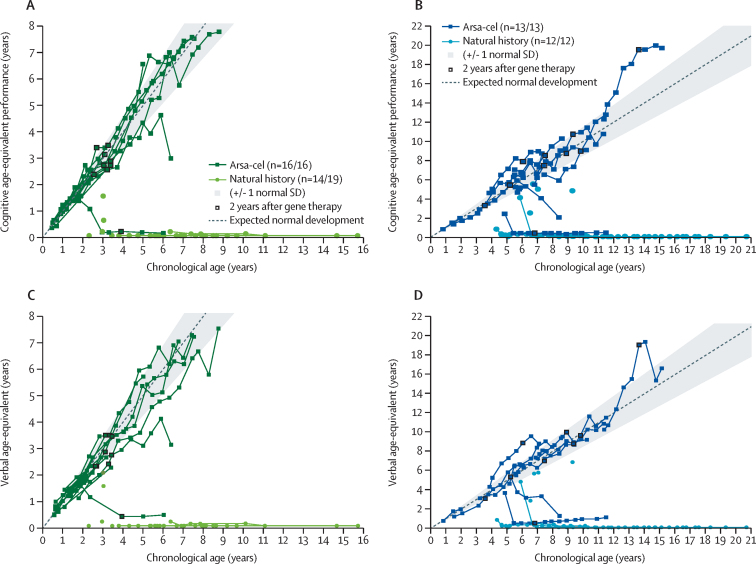
Figure 3 Cognitive performance and verbal age-equivalent profiles (A) Age-equivalent cognitive performance in late-infantile patients. (B) Age-equivalent cognitive performance in early-juvenile patients. (C) Verbal-age equivalent in late-infantile patients. (D) Verbal-age equivalent in early-juvenile patients. Age-equivalent corresponds to the chronological age at which, on average, typically developing children reach a given raw score. Cognitive age-equivalent for late-infantile (A) and early-juvenile (B) at each visit has been derived as follows. For Wechsler Preschool & Primary Scale of Intelligence (WPPSI) and Wechsler Intelligence Scale for Children (WISC): (development quotient performance x chronological age)/100 for which development quotient is derived by dividing the age-equivalent by the chronological age and then multiplying by 100. For Bayley III: cognitive raw scores have been compared with the tabulated values in the Bayley III manual to calculate cognitive age-equivalent. For Bayley II and in cases for which a neuropsychological assessment has been done but a questionnaire could not be completed because of severe clinical condition, cognitive age-equivalent is based on mental development age as reported on the case report form (CRF). Verbal age-equivalent for late-infantile (C) and early-juvenile (D) at each visit has been derived as follows. For WPPSI and WISC: (development quotient language x chronological age)/100. For Bayley III: expressive communication and receptive communication raw scores have each been compared with the tabulated values in the Bayley III manual and based on the average of the mental development ages for the two scores. For Bayley II and in cases for which a neuropsychological assessment has been done but a questionnaire could not be completed because of severe clinical condition, verbal age-equivalent is based on mental development age as reported on the CRF. Arsa-cel=atidarsagene autotemcel. MLD=metachromatic leukodystrophy.
Figure 3 Cognitive performance and verbal age-equivalent profiles (A) Age-equivalent cognitive performance in late-infantile patients. (B) Age-equivalent cognitive performance in early-juvenile patients. (C) Verbal-age equivalent in late-infantile patients. (D) Verbal-age equivalent in early-juvenile patients. Age-equivalent corresponds to the chronological age at which, on average, typically developing children reach a given raw score. Cognitive age-equivalent for late-infantile (A) and early-juvenile (B) at each visit has been derived as follows. For Wechsler Preschool & Primary Scale of Intelligence (WPPSI) and Wechsler Intelligence Scale for Children (WISC): (development quotient performance x chronological age)/100 for which development quotient is derived by dividing the age-equivalent by the chronological age and then multiplying by 100. For Bayley III: cognitive raw scores have been compared with the tabulated values in the Bayley III manual to calculate cognitive age-equivalent. For Bayley II and in cases for which a neuropsychological assessment has been done but a questionnaire could not be completed because of severe clinical condition, cognitive age-equivalent is based on mental development age as reported on the case report form (CRF). Verbal age-equivalent for late-infantile (C) and early-juvenile (D) at each visit has been derived as follows. For WPPSI and WISC: (development quotient language x chronological age)/100. For Bayley III: expressive communication and receptive communication raw scores have each been compared with the tabulated values in the Bayley III manual and based on the average of the mental development ages for the two scores. For Bayley II and in cases for which a neuropsychological assessment has been done but a questionnaire could not be completed because of severe clinical condition, verbal age-equivalent is based on mental development age as reported on the CRF. Arsa-cel=atidarsagene autotemcel. MLD=metachromatic leukodystrophy.CC BY · PubMed Central
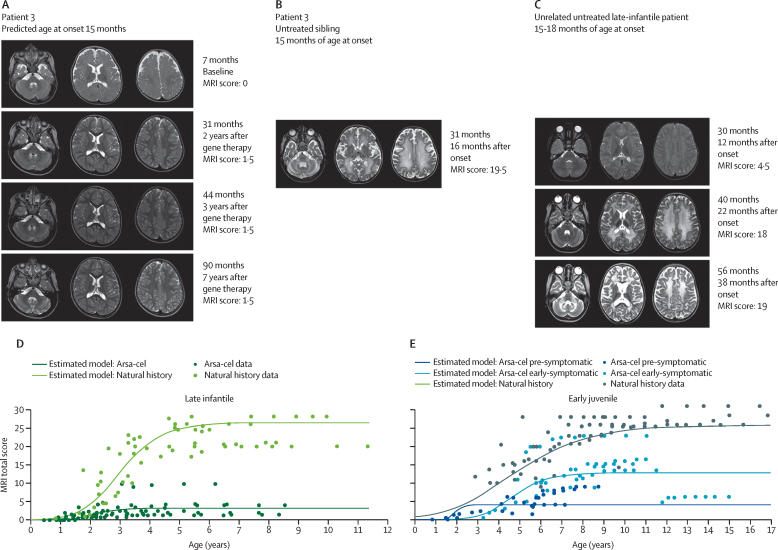
Figure 4 Longitudinal evaluation of brain MRI of patients treated with arsa-cel vs natural history (A) Axial T2-weighted MRI obtained from a patient with late-infantile MLD (patient 3) over time showing, at baseline, a physiological T2 signal corresponding to myelin maturation, typical of the first year of life, followed by appearance of subtle posterior periventricular T2 hyperintensities that stabilised over time, with normal maturation of the remaining brain regions. (B) The comparison with the corresponding images obtained from his untreated sibling at the same age. (C) The comparison with an unrelated untreated patient with late-infantile MLD with similar age of onset, followed along disease course demonstrating white matter alterations (T2 hyperintensities) involving, in the earliest phases, periventricular areas and corpus callosum, spreading to subcortical regions, cerebellum and corticospinal tracts, and associated with progressive brain atrophy (enlargement of ventricular system and subarachnoid spaces). (D and E) Comparison of brain MRI total scores of patients with late-infantile (D) and early-juvenile by symptomatic status (E) treated with atidarsagene autotemcel [arsa-cel] versus natural history through an non-linear mixed-effects model based on a published methodology and strategy for model selection.17 MRI severity scoring system is a modified Loes’ score using methodology as previously described.17 The maximum total score is 31·5. MLD=metachromatic leukodystrophy.
Figure 4 Longitudinal evaluation of brain MRI of patients treated with arsa-cel vs natural history (A) Axial T2-weighted MRI obtained from a patient with late-infantile MLD (patient 3) over time showing, at baseline, a physiological T2 signal corresponding to myelin maturation, typical of the first year of life, followed by appearance of subtle posterior periventricular T2 hyperintensities that stabilised over time, with normal maturation of the remaining brain regions. (B) The comparison with the corresponding images obtained from his untreated sibling at the same age. (C) The comparison with an unrelated untreated patient with late-infantile MLD with similar age of onset, followed along disease course demonstrating white matter alterations (T2 hyperintensities) involving, in the earliest phases, periventricular areas and corpus callosum, spreading to subcortical regions, cerebellum and corticospinal tracts, and associated with progressive brain atrophy (enlargement of ventricular system and subarachnoid spaces). (D and E) Comparison of brain MRI total scores of patients with late-infantile (D) and early-juvenile by symptomatic status (E) treated with atidarsagene autotemcel [arsa-cel] versus natural history through an non-linear mixed-effects model based on a published methodology and strategy for model selection.17 MRI severity scoring system is a modified Loes’ score using methodology as previously described.17 The maximum total score is 31·5. MLD=metachromatic leukodystrophy.CC BY · PubMed Central

Verification

Claims the paper makes

The claims and statistics of this paper haven’t been checked yet.

Run the check — free, no account needed. It reads the open-access text and checks the sources it cites.

A few free checks a day · papers already verified open instantly · results are public

Claims other papers make about this one

Each is checked against this paper’s own text: does it say what the citing paper says it does?

Self-check

Percentages, sums and reported differences re-computed from the paper’s own numbers.

The self-check needs the paper’s full text.

Citations

Cites

Research works printed but not linked: 31

  1. van Rappard, 2015, Metachromatic leukodystrophy: disease spectrum and approaches for treatment, Best Pract Res Clin Endocrinol Metab, 29, 261, 10.1016/j.beem.2014.10.001 · DOI
  2. Gieselmann, 2010, Metachromatic leukodystrophy–an update, Neuropediatrics, 41, 1, 10.1055/s-0030-1253412 · DOI
  3. Elgun, 2019, Phenotypic variation between siblings with metachromatic leukodystrophy, Orphanet J Rare Dis, 14, 136, 10.1186/s13023-019-1113-6 · DOI
  4. Lorioli, 2015, Abnormalities of acid-base balance and predisposition to metabolic acidosis in metachromatic leukodystrophy patients, Mol Genet Metab, 115, 48, 10.1016/j.ymgme.2015.02.009 · DOI
  5. Kim, 2017, Gallbladder abnormalities in children with metachromatic leukodystrophy, J Surg Res, 208, 187, 10.1016/j.jss.2016.08.081 · DOI
  6. Kehrer, 2011, The natural course of gross motor deterioration in metachromatic leukodystrophy, Dev Med Child Neurol, 53, 850, 10.1111/j.1469-8749.2011.04028.x · DOI
  7. Kehrer, 2021, Association of age at onset and first symptoms with disease progression in patients with metachromatic leukodystrophy, Neurology, 96, e255, 10.1212/WNL.0000000000011047 · DOI
  8. Biffi, 2008, Metachromatic leukodystrophy – mutation analysis provides further evidence of genotype–phenotype correlation, Clin Genet, 74, 349, 10.1111/j.1399-0004.2008.01058.x · DOI
  9. Bredius, 2007, Early marrow transplantation in a pre-symptomatic neonate with late infantile metachromatic leukodystrophy does not halt disease progression, Bone Marrow Transplant, 39, 309, 10.1038/sj.bmt.1705581 · DOI
  10. Boucher, 2015, Long-term outcomes after allogeneic hematopoietic stem cell transplantation for metachromatic leukodystrophy: the largest single-institution cohort report, Orphanet J Rare Dis, 10, 94, 10.1186/s13023-015-0313-y · DOI
  11. Martin, 2013, Neurodevelopmental outcomes of umbilical cord blood transplantation in metachromatic leukodystrophy, Biol Blood Marrow Transplant, 19, 616, 10.1016/j.bbmt.2013.01.010 · DOI
  12. van den Broek, 2018, Early and late outcomes after cord blood transplantation for pediatric patients with inherited leukodystrophies, Blood Adv, 2, 49, 10.1182/bloodadvances.2017010645 · DOI
  13. Dali, 2020, Safety of intrathecal delivery of recombinant human arylsulfatase A in children with metachromatic leukodystrophy: results from a phase 1/2 clinical trial, Mol Genet Metab, 131, 235, 10.1016/j.ymgme.2020.07.002 · DOI
  14. Sevin, 2018, Intracerebral gene therapy in children with metachromatic leukodystrophy: results of a phase I/II trial, Mol Genet Metab, 123, S129, 10.1016/j.ymgme.2017.12.352 · DOI
  15. Biffi, 2013, Lentiviral hematopoietic stem cell gene therapy benefits metachromatic leukodystrophy, Science, 341, 10.1126/science.1233158 · DOI · Paper page
  16. Fumagalli, 2021, Metachromatic leukodystrophy: a single-center longitudinal study of 45 patients, J Inherit Metab Dis, 44, 1151, 10.1002/jimd.12388 · DOI
  17. Morena, 2020, Toward reference intervals of ARSA activity in the cerebrospinal fluid: implication for the clinical practice of metachromatic leukodystrophy, J Appl Lab Med, 6, 354, 10.1093/jalm/jfaa108 · DOI
  18. Calbi, 2018, Use of defibrotide to help prevent post-transplant endothelial injury in a genetically predisposed infant with metachromatic leukodystrophy undergoing hematopoietic stem cell gene therapy, Bone Marrow Transplant, 53, 913, 10.1038/s41409-017-0085-1 · DOI
  19. Calabria, 2020, Late phases of hematopoietic reconstitution in metachromatic leukodystrophy gene therapy patients characterized by lineage commitment of individual HSC clones, Mol Ther, 28, 234
  20. Groeschel, 2016, Long-term outcome of allogeneic hematopoietic stem cell transplantation in patients with juvenile metachromatic leukodystrophy compared with nontransplanted control patients, JAMA Neurol, 73, 1133, 10.1001/jamaneurol.2016.2067 · DOI
  21. Tan, 2019, Hematopoietic stem cell transplantation in inborn errors of metabolism, Front Pediatr, 7, 433, 10.3389/fped.2019.00433 · DOI
  22. Capotondo, 2012, Brain conditioning is instrumental for successful microglia reconstitution following hematopoietic stem cell transplantation, Proc Natl Acad Sci USA, 109, 15018, 10.1073/pnas.1205858109 · DOI · Paper page
  23. Biffi, 2004, Correction of metachromatic leukodystrophy in the mouse model by transplantation of genetically modified hematopoietic stem cells, J Clin Invest, 113, 1118, 10.1172/JCI200419205 · DOI
  24. Biffi, 2006, Gene therapy of metachromatic leukodystrophy reverses neurological damage and deficits in mice, J Clin Invest, 116, 3070, 10.1172/JCI28873 · DOI
  25. Staal, 2019, Autologous stem-cell-based gene therapy for inherited disorders: state of the art and perspectives, Front Pediatr, 7, 443, 10.3389/fped.2019.00443 · DOI
  26. Hong, 2021, Toward newborn screening of metachromatic leukodystrophy: results from analysis of over 27,000 newborn dried blood spots, Genet Med, 23, 555, 10.1038/s41436-020-01017-5 · DOI
  27. Hong, 2020, Leukocyte and dried blood spot arylsulfatase A assay by tandem mass spectrometry, Anal Chem, 92, 6341, 10.1021/acs.analchem.9b05274 · DOI
  28. Capotondo, 2017, Intracerebroventricular delivery of hematopoietic progenitors results in rapid and robust engraftment of microglia-like cells, Sci Adv, 3, 10.1126/sciadv.1701211 · DOI
  29. Meneghini, 2016, Pervasive supply of therapeutic lysosomal enzymes in the CNS of normal and Krabbe-affected non-human primates by intracerebral lentiviral gene therapy, EMBO Mol Med, 8, 489, 10.15252/emmm.201505850 · DOI
  30. Audouard, 2021, Complete correction of brain and spinal cord pathology in metachromatic leukodystrophy mice, Front Mol Neurosci, 14, 10.3389/fnmol.2021.677895 · DOI
  31. Eichler, 2016, Metachromatic leukodystrophy: an assessment of disease burden, J Child Neurol, 31, 1457, 10.1177/0883073816656401 · DOI

Cited by

See all 298

Metadata

Authors
Fumagalli, F., Calbi, V., Natali Sora, M. G., Sessa, M., Baldoli, C., Rancoita, P. M. V., Ciotti, F., Sarzana, M., Fraschini, M., Zambon, A. A., Acquati, S., Redaelli, D., Attanasio, V., Miglietta, S., De Mattia, F., Barzaghi, F., Ferrua, F., Migliavacca, M., Tucci, F., Gallo, V., Del Carro, U., Canale, S., Spiga, I., Lorioli, L., Recupero, S., Fratini, E. S., Morena, F., Silvani, P., Calvi, M. R., Facchini, M., Locatelli, S., Corti, A., Zancan, S., Antonioli, G., Farinelli, G., Gabaldo, M., Garcia-Segovia, J., Schwab, L. C., Downey, G. F., Filippi, M., Cicalese, M. P., Martino, S., Di Serio, C., Ciceri, F., Bernardo, M. E., Naldini, L., Biffi, A., & Aiuti, A.
Venue
The Lancet
Publisher
Elsevier BV
Published
2022-01
Volume
399
Issue
10322
Pages
372-383
ISSN
0140-6736
Cited by
298
References
1
Language
en
Funders
  • GlaxoSmithKline Plc
  • Fondazione Telethon

About these checks

Registry, retraction, Cites and statistics results are computed, not judged, with one exception: a printed reference that no index lists is read once by a model before it counts as a citation error. Claims are extracted by a model and kept only when their quote appears verbatim in the text; each cited source is then checked, with a model’s help, for whether it says what the claim relies on. Those verdicts can be wrong — read the claim’s quote and the cited source before relying on one.

Statistics and arithmetic are recomputed, not judged.

Confidence bands are shown only for fields calibrated on our annotated test set. None is calibrated yet, so no band is shown.

What counts as a claim ›How we measure confidence ›How we check this ›

Are you an author, or do you see a problem with this page? Request a review