

Evaluation of the safety, immunogenicity, and faecal shedding of novel oral polio vaccine type 2 in healthy newborn infants in Bangladesh: a randomised, controlled, phase 2 clinical trial
Open accessThe DOI matches its Crossref record; 20 of the 20 references it cites were found in a registry or an index.
Abstract
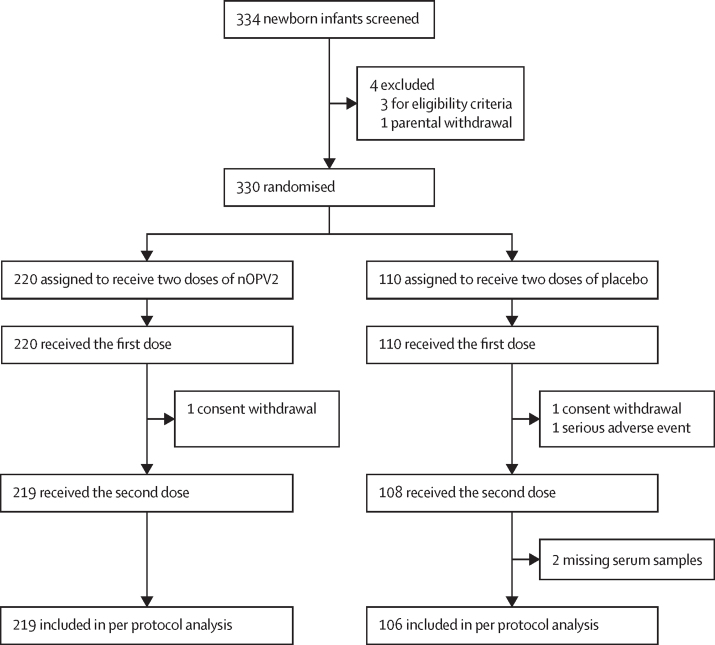
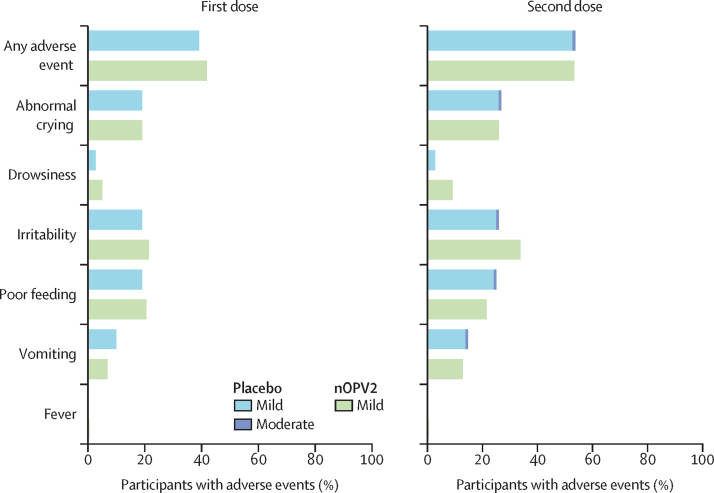
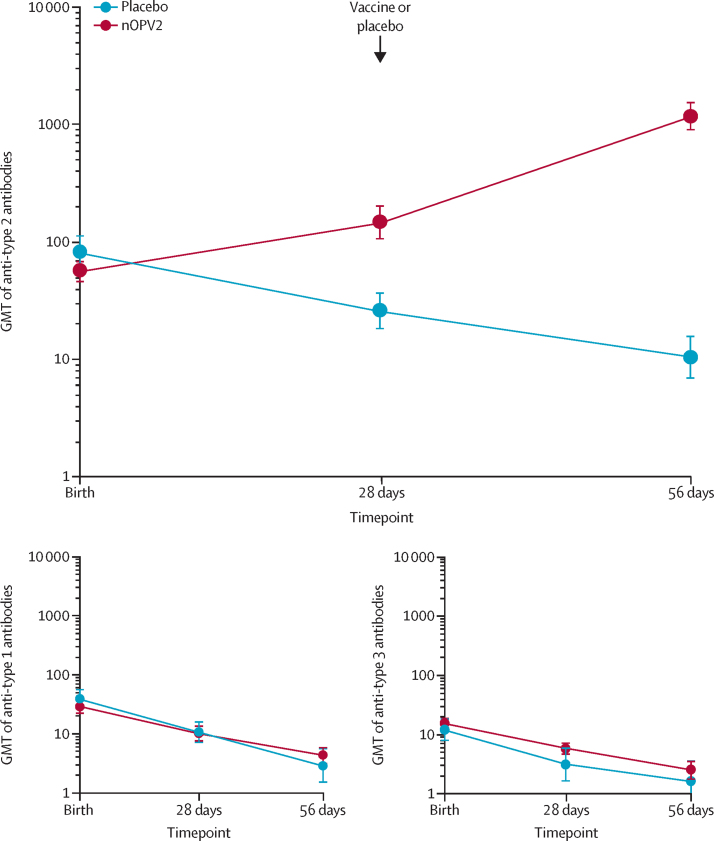
BACKGROUND: Type 2 circulating vaccine-derived polioviruses (cVDPV2) from Sabin oral poliovirus vaccines (OPVs) are the leading cause of poliomyelitis. A novel type 2 OPV (nOPV2) has been developed to be more genetically stable with similar tolerability and immunogenicity to that of Sabin type 2 vaccines to mitigate the risk of cVDPV2. We aimed to assess these aspects of nOPV2 in poliovirus vaccine-naive newborn infants. METHODS: In this randomised, double-blind, controlled, phase 2 trial we enrolled newborn infants at the Matlab Health Research Centre, Chandpur, Bangladesh. We included infants who were healthy and were a single birth after at least 37 weeks' gestation. Infants were randomly assigned (2:1) to receive either two doses of nOPV2 or placebo, administered at age 0-3 days and at 4 weeks. Exclusion criteria included receipt of rotavirus or any other poliovirus vaccine, any infection or illness at the time of enrolment (vomiting, diarrhoea, or intolerance to liquids), diagnosis or suspicion of any immunodeficiency disorder in the infant or a close family member, or any contraindication for venipuncture. The primary safety outcome was safety and tolerability after one and two doses of nOPV2, given 4 weeks apart in poliovirus vaccine-naive newborn infants and the primary immunogenicity outcome was the seroconversion rate for neutralising antibodies against type 2 poliovirus, measured 28 days after the first and second vaccinations with nOPV2. Study staff recorded solicited and unsolicited adverse events after each dose during daily home visits for 7 days. Poliovirus neutralising antibody responses were measured in sera drawn at birth and at age 4 weeks and 8 weeks. This study is registered on ClinicalTrials.gov, NCT04693286. FINDINGS: Between Sept 21, 2020, and Aug 16, 2021, we screened 334 newborn infants, of whom three (<1%) were found to be ineligible and one (<1%) was withdrawn by the parents; the remaining 330 (99%) infants were assigned to receive nOPV2 (n=220 [67%]) or placebo (n=110 [33%]). nOPV2 was well tolerated; 154 (70%) of 220 newborn infants in the nOPV2 group and 78 (71%) of 110 in the placebo group had solicited adverse events, which were all mild or moderate in severity. Severe unsolicited adverse events in 11 (5%) vaccine recipients and five (5%) placebo recipients were considered unrelated to vaccination. 306 (93%) of 330 infants had seroprotective maternal antibodies against type 2 poliovirus at birth, decreasing to 58 (56%) of 104 in the placebo group at 8 weeks. In the nOPV2 group 196 (90%) of 217 infants seroconverted by week 8 after two doses, when 214 (99%) had seroprotective antibodies. INTERPRETATION: nOPV2 was well tolerated and immunogenic in newborn infants, with two doses, at birth and 4 weeks, resulting in almost 99% of infants having protective neutralising antibodies. FUNDING: Bill & Melinda Gates Foundation.
Overview
The claims and statistics of this paper haven’t been checked yet.
Free: it reads the open-access text and checks the first 5 claims that cite a source we can check. Create a free account to check every claim.
Integrity signals
Registry
Cites
Statistics
Figures
Verification
Claims the paper makes
The claims and statistics of this paper haven’t been checked yet.
Free: it reads the open-access text and checks the first 5 claims that cite a source we can check. Create a free account to check every claim.
Claims other papers make about this one
Each is checked against this paper’s own text: does it say what the citing paper says it does?
The source backs part of the claim, not all of it — or backs it for a different population, condition or comparison.
In the citing paper
“Antibody levels were significantly higher in infants who received the vaccine compared to the placebo group.”
From The Fight against Poliovirus Is Not Over (2023) · cites this paper as [126]
Experimental — accuracy not yet measuredThe cited source says what the claim attributes to it.
In the citing paper
“nOPV2 was well tolerated and did not cause any serious adverse events in infants, according to results from a randomised phase 2 trial.”
From The Fight against Poliovirus Is Not Over (2023) · cites this paper as [126]
The cited source says what the claim attributes to it.
In the citing paper
“However, the duration of fecal shedding of the vaccine virus was longer in vaccinated infants than in the placebo group [126].”
From The Fight against Poliovirus Is Not Over (2023) · cites this paper as [126]
Self-check
Percentages, sums and reported differences re-computed from the paper’s own numbers.
The self-check needs the paper’s full text.
Citations
Cites
Factors affecting the immunogenicity of oral poliovirus vaccine in developing countries: Review.
Patriarca, P. A., Wright, P. F., & John, T. J. (1991) · Clinical Infectious Diseases · doi:10.1093/clinids/13.5.926 · Cited by 453
Burns, C. C., Diop, O. M., Sutter, R. W., & Kew, O. M. (2014) · Journal of Infectious Diseases · doi:10.1093/infdis/jiu295 · Cited by 309
Engineering the Live-Attenuated Polio Vaccine to Prevent Reversion to Virulence
Yeh, M. T., Bujaki, E., Dolan, P. T., Smith, M., Wahid, R., Konz, J., Weiner, A. J., Bandyopadhyay, A. S., Van Damme, P., De Coster, I., et al. (2020) · Cell Host & Microbe · doi:10.1016/j.chom.2020.04.003 · Cited by 221
Self-citationHampton, L. M., Farrell, M., Ramirez-Gonzalez, A., Menning, L., Shendale, S., Lewis, I., Rubin, J., Garon, J., Harris, J., Hyde, T., et al. (2016) · MMWR Morbidity and Mortality Weekly Report · doi:10.15585/mmwr.mm6535a3 · Cited by 193
Link‐Gelles, R., Lutterloh, E. C., Ruppert, P. S., Backenson, P. B., George, K. S., Rosenberg, E. S., Anderson, B. J., Fuschino, M. E., Popowich, M. D., Punjabi, C., et al. (2022) · MMWR Morbidity and Mortality Weekly Report · doi:10.15585/mmwr.mm7133e2 · Cited by 157
Sutter, R. W., John, T. J., Jain, H., Agarkhedkar, S., Ramanan, P. V., Verma, H., Deshpande, J. M., Singh, A. P., Sreevatsava, M., Malankar, P., et al. (2010) · The Lancet · doi:10.1016/s0140-6736(10)61230-5 · Cited by 144
Van Damme, P., De Coster, I., Bandyopadhyay, A. S., Revets, H., Withanage, K., De Smedt, P., Suykens, L., Oberste, M. S., Weldon, W. C., Costa-Clemens, S. A., et al. (2019) · The Lancet · doi:10.1016/s0140-6736(19)31279-6 · Cited by 141
Self-citationStandardized Methods for Detection of Poliovirus Antibodies
Weldon, W. C., Oberste, M. S., & Pallansch, M. A. (2016) · Methods in molecular biology · doi:10.1007/978-1-4939-3292-4_8 · Cited by 128
De Coster, I., Leroux-Roels, I., Bandyopadhyay, A. S., Gast, C., Withanage, K., Steenackers, K., De Smedt, P., Aerssens, A., Leroux-Roels, G., Oberste, M. S., et al. (2021) · The Lancet · doi:10.1016/s0140-6736(20)32541-1 · Cited by 86
Self-citationSáez-Llorens, X., Bandyopadhyay, A. S., Gast, C., Leon, T. D., DeAntonio, R., Jimeno, J., Caballero, M. I., Aguirre, G., Oberste, M. S., Weldon, W. C., et al. (2021) · The Lancet · doi:10.1016/s0140-6736(20)32540-x · Cited by 81
Self-citation
Cited by
Hodel, K. V. S., Fiuza, B. S. D., Conceição, R. S., Aleluia, A. C. M., Pitanga, T. N., Fonseca, L. M. D. S., Valente, C. O., Rezende, C. S. M. E., & Machado, B. A. S. (2024) · Pharmaceuticals · doi:10.3390/ph17060807 · Cited by 57
“However, evidence shows that polio vaccines (IPV and OPV) are among the most vulnerable groups have a safe profile [297].”
BackgroundThe Fight against Poliovirus Is Not Over
Mbani, C. J., Nekoua, M. P., Moukassa, D., & Hober, D. (2023) · Microorganisms · doi:10.3390/microorganisms11051323 · Cited by 34
Davlantes, E. A., Jorba, J. C., Henderson, E., Bullard, K., Deka, M. A., Kfutwah, A. K. W., Martín, J. E.-S., Bessaud, M., Shulman, L. M., Hawes, K. M., et al. (2023) · MMWR Morbidity and Mortality Weekly Report · doi:10.15585/mmwr.mm7238a4 · Cited by 28
Self-citationWilkinson, A. L., Zaman, K., Hoque, M., Estívariz, C. F., Burns, C. C., Konopka‐Anstadt, J. L., Mainou, B. A., Kovacs, S., An, Q., Lickness, J. S., et al. (2023) · The Lancet Infectious Diseases · doi:10.1016/s1473-3099(23)00139-1 · Cited by 29
Self-citationCooper, L., Erbeto, T. B., Danzomo, A. A., Abdullahi, H., Boateng, K., Adamu, U. S., Shuaib, F. M. B., Ndoutabé, M., Gray, E. J., Bandyopadhyay, A. S., et al. (2024) · The Lancet Infectious Diseases · doi:10.1016/s1473-3099(23)00688-6 · Cited by 27
Self-citationOchoge, M., Futa, A. C., Umesi, A., Affleck, L., Kotei, L., Daffeh, B., Saidy-Jah, E., Njie, A., Oyadiran, O. T., Edem, B. E., et al. (2024) · The Lancet · doi:10.1016/s0140-6736(23)02844-1 · Cited by 28
Self-citationMohanty, A., Rohilla, R., Zaman, K., Hada, V., Dhakal, S., Shah, A., Padhi, B. K., Al‐qaim, Z. H., Altawfiq, K. J. A., Tirupathi, R., et al. (2023) · Infezioni in Medicina · doi:10.53854/liim-3102-5 · Cited by 27
Self-citationMejía, L. R., Méndez, L. P., Bandyopadhyay, A. S., Gast, C., Mazara, S., Rodríguez, K., Rosario, N., Zhang, Y., Mainou, B. A., Jimeno, J., et al. (2023) · The Lancet Infectious Diseases · doi:10.1016/s1473-3099(23)00519-4 · Cited by 11
“11,19 Similarly, secondary spread of the vaccine virus that could result in enhancing herd immunity and transmission interruption in the context of polio outbreaks was not assessed in this study.”
BackgroundSelf-citationGeographic disparities impacting oral vaccine performance: Observations and future directions
Burke, R. M., Ramani, S., Lynch, J. A., Cooper, L., Cho, H., Bandyopadhyay, A. S., Kirkwood, C. D., Steele, A. D., & Kang, G. (2024) · Clinical & Experimental Immunology · doi:10.1093/cei/uxae124 · Cited by 11
Self-citationIvanova, O. E., Eremeeva, T. P., Baykova, O. Y., Krasota, A. Y., Yakovchuk, E. V., Shustova, E. Y., Malyshkina, L. P., Mustafina, A. N., Mikhailova, Y. M., Chirova, A. V., et al. (2024) · Vaccines · doi:10.3390/vaccines12070718 · Cited by 8
“In studies examining the immunogenicity, efficacy, and safety of nOPV2, the period for fecal sampling was limited by the conditions of preclinical and clinical trials; it did not exceed 28 days [37–41].”
BackgroundGodin, A., Brickley, E. B., Connor, R. I., Wieland‐Alter, W., Ackerman, M. E., Weiner, J. A., Modlin, J. F., Arita, M., Bandyopadhyay, A. S., Gast, C., et al. (2025) · The Lancet Microbe · doi:10.1016/j.lanmic.2024.101028 · Cited by 7
Self-citationThe oral poliovirus vaccine—a solution and a concern for eradication
Faye, M., & Fernández-García, M. D. (2024) · The Lancet Infectious Diseases · doi:10.1016/s1473-3099(23)00680-1 · Cited by 8
The role of a genetically stable, novel oral type 2 poliovirus vaccine in the poliomyelitis endgame
Clemens, S. A. C., Santos, G. M. L., Gonzalez, I., & Clemens, R. L. (2023) · Revista Panamericana de Salud Pública · doi:10.26633/rpsp.2023.99 · Cited by 7
“genicity nOPV2 in infants negative for type 2 poliovirus, which could pave the way for inclusion in the Essential Programme on Immunization (known as EPI) in high incidence areas (15).”
BackgroundSelf-citationWassilak, S. G. F., Mohamed, A., & Bigouette, J. P. (2025) · Vaccines · doi:10.3390/vaccines13101060 · Cited by 6
Longley, A. T., Nsubuga, F., Gilani, Z., Tobolowsky, F. A., Kisakye, A., Greene, S. A., Ampeire, I., Ssennono, V. F., Gyasi, S. O., Ntale, I., et al. (2025) · The Lancet Global Health · doi:10.1016/s2214-109x(25)00110-x · Cited by 5
Threat of resurgence or hope for global eradication of poliovirus?
Kim, C. Y., Piamonte, B. L. C., Allen, R., & Thakur, K. T. (2023) · Current Opinion in Neurology · doi:10.1097/wco.0000000000001156 · Cited by 5
“Notably, a phase II trial in Bangladesh has recently demonstrated that the nOPV2 is also well tolerated and immunogenic in infants previously unvaccinated against polio; when vaccinated in two doses – once at birth and the second at 4weeks – nearly 99% of these infants had antibodies against serotype 2 poliovirus at 8…”
BackgroundTerekhov, R. P., Svotin, A. A., Korochkina, M. D., Khodyachikh, A. A., Varnavskiy, M. A., Piniaeva, A. N., Ivin, Y. Y., Zhdanov, D. D., Kozlovskaya, L. I., & Taldaev, A. K. (2025) · Virology Journal · doi:10.1186/s12985-025-02977-3 · Cited by 3
“The efficacy of OPV (nOPV2, bOPV, tOPV) against polio strains was assessed in 3,738 participants [33, 34, 40–42].”
Fu, Y., Ma, R., Zhao, Z., Mo, Z., Ying, Z., Li, J., Ye, H., Li, G., Liu, X., Liang, J., et al. (2025) · npj Vaccines · doi:10.1038/s41541-025-01134-9 · Cited by 6
“Then the shedding rate gradually decreased and the shedding period was gradually shortened with the increase in bOPV dose, which was consistent with the results of foreign clinical trials 24,25 .”
Identifying and reducing risks of neurological complications associated with vaccination
Handunnetthi, L., Ramasamy, M., Turtle, L. C. W., & Hunt, D. P. J. (2024) · Nature Reviews Neurology · doi:10.1038/s41582-024-01000-7 · Cited by 4
Cooper, L., Bandyopadhyay, A. S., Grassly, N. C., Gray, E. J., Voorman, A., Zipursky, S., & Blake, I. M. (2025) · The Journal of Infectious Diseases · doi:10.1093/infdis/jiae614 · Cited by 4
“We do not consider vaccine induced immunity in infants aged under 6 months as this cohort typically have maternal antibodies [10, 13].”
Self-citationOutbreak of circulating vaccine-derived poliovirus type 2 (cVDPV2) in Indonesia in 2023–2024
Ashique, S., Srivastava, S., Sridhar, S. B., Kumar, S., Rahaman, S. A., Hussain, M. S., Mohanty, A., Sah, S. K., & Mehta, R. (2025) · The Egyptian Journal of Internal Medicine · doi:10.1186/s43162-025-00421-0 · Cited by 2
“This vaccine has been mentioned as secure and easily endured, with no immunogenicity, and shows greater genetic steadiness [8, 9].”
Mercer, L. D., Seña, A. C., Colgate, E. R., Crothers, J. W., Wright, P. F., Al-Ibrahim, M. S., Tritama, E., Vincent, A., Mainou, B. A., Zhang, Y., et al. (2025) · The Lancet Infectious Diseases · doi:10.1016/s1473-3099(25)00285-3 · Cited by 2
Self-citationIntestinal Mucosal Immune Responses to Novel Oral Poliovirus Vaccine Type 2 in Healthy Newborns
Godin, A., Brickley, E. B., Connor, R. I., Wieland‐Alter, W., Weiner, J. A., Ackerman, M. E., Modlin, J. F., Sajjad, O. M., Arita, M., Gast, C., et al. (2025) · Clinical Infectious Diseases · doi:10.1093/cid/ciaf484 · Cited by 2
“Notably, the vaccine virus shedding titers in stool (measurable by cell culture) at week 2 were very low in the newborn, as reported by the parent study [9], although a previous study in older infants suggests that shedding peaks 7 days after vaccination [7].”
InfluentialSelf-citationPolio vaccines: hope, hype, and history repeating?
Fortner, R. S. (2023) · BMJ · doi:10.1136/bmj.p1763 · Cited by 2
First Africa-based clinical trial for novel type 2 oral poliovirus vaccine
Cooper, L., & Blake, I. M. (2024) · The Lancet · doi:10.1016/s0140-6736(24)00053-9 · Cited by 2
Should birth-dose vaccines for preterm newborns still be debated?
Alemayehu, T., England, R., Oguttu, B., & Jarovsky, D. (2025) · International Journal of Infectious Diseases · doi:10.1016/j.ijid.2025.107866 · Cited by 1
Insights on vaccine-derived poliovirus type 2 outbreaks and novel oral polio vaccine candidates
Aboshanab, K. M., Alshahrani, M. Y., Enshasy, H. A. E., Shabana, M. R., & Majeed, A. B. A. (2025) · Diagnostic Microbiology and Infectious Disease · doi:10.1016/j.diagmicrobio.2025.117221 · Cited by 1
Fecal shedding and transmission of vaccine–derived poliovirus: A systematic review and meta–analysis
Yunus, G. M., Taher, K. A., Akram, K. A., Anil, D. S., Anis, H. S., & Shaikh, A. (2024) · One Health Bulletin · doi:10.4103/ohbl.ohbl_29_24 · Cited by 1
Sahu, T. K., & Rao, A. R. (2024) · Wiley eBooks · doi:10.1002/9781119896869.ch3 · Cited by 1
Sun, G., Wang, G., & Zhong, H. (2024) · Inflammopharmacology · doi:10.1007/s10787-023-01395-7
“The Guidance for the Use of Inactivated Polio Vaccine issued by the Chinese CDC recommends a primary immunization schedule of one dose at 2, 3, and 4 months of age, with a booster dose at 18 months of age (Zaman et al. 2023; Bravo et al. 2020).”
Tobolowsky, F. A., Nsubuga, F., Gilani, Z., Kisakye, A., Ndagije, H. B., Kyabayinze, D., & Gidudu, J. (2024) · Emerging infectious diseases · doi:10.3201/eid3004.231361
The Epidemic Situation of Polio in the World in 2014 –2023
Chernyavskaya, O. P., Frolova, M. A., & Smirnova, V. M. (2025) · Epidemiology and Vaccinal Prevention · doi:10.31631/2073-3046-2025-24-2-88-97
Wang, X., Hu, Y., Yin, A., Chen, C., Xiang, H., Wang, L., Liu, B., Tian, Y., Gao, Y., Zhang, M., et al. (2025) · Immunobiology · doi:10.1016/j.imbio.2025.153121
Boene, J. L., Campos, L. R., Carpi, G. C., Muhawenimana, M., Machado, S. H., de Deus, N., & Bauhofer, A. F. L. (2026) · BMC Infectious Diseases · doi:10.1186/s12879-026-13584-0
Boubaker, S., Khemiri, H., Farès, W., Mekki, N., Alibi, C., Salem, I. B., Touzi, H., Meddeb, Z., Mrad, I. B., Yahyaoui, M., et al. (2026) · Frontiers in Medicine · doi:10.3389/fmed.2026.1904434
“Similarly, in a phase 2 trial in Bangladesh, fecal shedding in newborns was monitored for 28 days following two doses of nOPV2, with no documented safety risks (10).”
Padonou, S. G. R., Sasse, A., Jennifer, O., Kaucley, L., & Aguèmon, B. (2026) · Science Journal of Public Health · doi:10.11648/j.sjph.20261404.15
Anand, A., Jepkosgei, D., Mwachari, C., Jalango, R. E., Kitwan, L., Kagecha, C., Leboo, I., Hussein, A., Kitungulu, B., Kigen, H. T., et al. (2026) · Vaccine · doi:10.1016/j.vaccine.2026.128969
Self-citation
Metadata
- Authors
- Zaman, K., Bandyopadhyay, A. S., Hoque, M., Gast, C., Yunus, M., Jamil, K. M., Mainou, B. A., Konopka-Anstadt, J. L., Hendley, W. S., Vincent, A., Clemens, R., Clemens, S. A. C., Ross, A. G., Clemens, J. D., & Tritama, E.
- Affiliations
- Gates Foundation (US)
- International Centre for Diarrhoeal Disease Research (BD)
- Program for Appropriate Technology in Health (US)
- Ministry of Health and Family Welfare (BD)
- Centers for Disease Control and Prevention (US)
- University of Oxford (GB)
- Charles Sturt University (AU)
- International Vaccine Institute (KR)
- PT Bio Farma (Indonesia) (ID)
- Corresponding author
- Bandyopadhyay, Ananda S
- ORCID
- Venue
- The Lancet
- Publisher
- Elsevier BV
- Published
- 2023-01
- Volume
- 401
- Issue
- 10371
- Pages
- 131-139
- ISSN
- 0099-5355 (ISSN-L)
- 0140-6736
- PMC
- PMC9860215
- OpenAlex
- W4310828209
- Cited by
- 39
- References
- 20
- Citations by year
- 2026: 4 · 2025: 15 · 2024: 12 · 2023: 8
- FWCI
- 6.09
- Type
- journal article
- Language
- en
- Open access
- hybrid
- doi.org
- Licence
- cc-by
- www.elsevier.com/tdm/userlicense/1.0/ (tdm)
- www.elsevier.com/legal/tdmrep-license (tdm)
- creativecommons.org/licenses/by/4.0/ (vor)
- Locations
- The Lancet (publishedVersion, cc-by)
- PubMed Central (publishedVersion, cc-by)
- PubMed (publishedVersion)
- Charles Sturt University Research Output (CRO) (submittedVersion, cc-by)
- Greater South Information System
- Funders
- Bill and Melinda Gates Foundation
- Dartmouth College
- International Centre for Diarrhoeal Disease Research, Bangladesh
- Centers for Disease Control and Prevention
- Topics
- Health Sciences › Medicine › Infectious Diseases › Viral Infections and Immunology Research
- Health Sciences › Medicine › Epidemiology › Virology and Viral Diseases
- Social Sciences › Health › Vaccine Coverage and Hesitancy
- Keywords
- circulating vaccine-derived poliovirus type 2, vaccine immunogenicity, fecal shedding, neonates, neutralizing antibodies, vaccine adverse events, poliomyelitis prevention, Bangladesh, polio eradication, mother-to-child transmission
- MeSH terms
- Antibodies, Viral, Bangladesh, Child, Preschool, Double-Blind Method, Humans, Infant, Infant, Newborn, Poliomyelitis, Poliovirus Vaccine, Oral, Poliovirus, Antibodies, Neutralizing
About these checks
Registry, retraction, Cites and statistics results are computed, not judged, with one exception: a printed reference that no index lists is read once by a model before it counts as a citation error. Claims are extracted by a model and kept only when their quote appears verbatim in the text; each cited source is then checked, with a model’s help, for whether it says what the claim relies on. Those verdicts can be wrong — read the claim’s quote and the cited source before relying on one.
Statistics and arithmetic are recomputed, not judged.
Confidence bands are shown only for fields calibrated on our annotated test set. None is calibrated yet, so no band is shown.
What counts as a claim ›How we measure confidence ›How we check this ›
Are you an author, or do you see a problem with this page? Request a review
Data sources
Bibliographic data: Semantic Scholar, OpenAlex, Crossref.
Contains information from the Semantic Scholar Academic Graph Datasets, made available under the ODC Attribution License (ODC-BY 1.0).
Semantic Scholar’s data is described in: Kinney, R., et al. (2023). The Semantic Scholar Open Data Platform. arXiv:2301.10140.
