

Attachment relationships among alcohol dependent persons
Open accessThe DOI matches its Crossref record; 42 of the 42 references it cites were found in a registry or an index.
Abstract
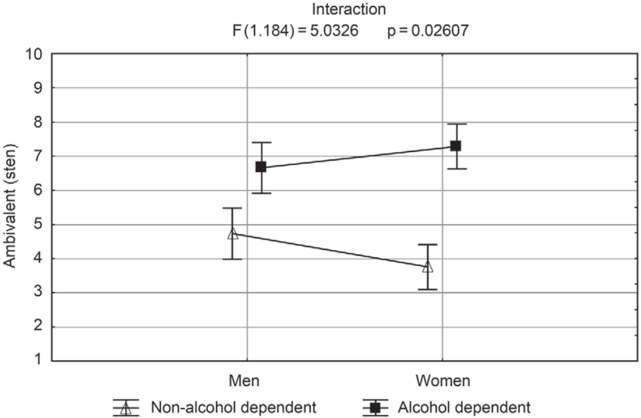
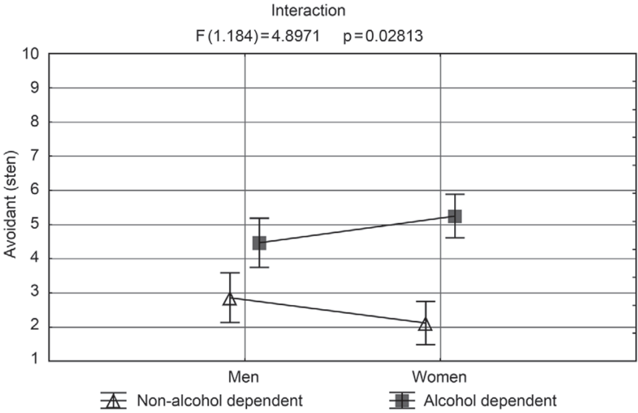
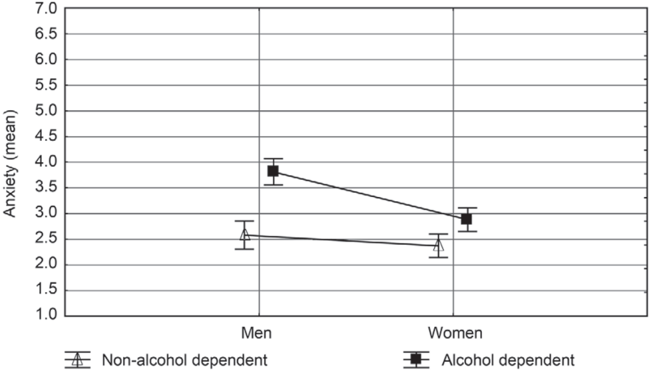
This article presents the results of a study on alcohol dependent patients attachment style and its various dimensions. There were 94 alcoholic and 94 non-alcoholic participants (both 53 women and 41 men). Plopa's Questionnaire of Attachment Styles (KSP) and Collins and Read's Adult Attachment Scale (AAS) were used. The variable of having a dependent parent was also taken into consideration. The study has shown that people with alcohol dependence significantly differ from non-alcoholics in terms of attachment style and its dimensions. They also receive significantly lower scores on secure attachment style and higher scores on insecure attachment style – anxious-ambivalent and avoidant style, and higher scores on attachment dimensions – anxiety and avoidance. There were no differences in attachment styles and their dimensions for patients with alcohol dependent and non-dependent parents. Alcohol dependent persons rarely present secure connection to others and more often manifest mistrust in interpersonal relationships and avoid closeness and intimacy.
Overview
The claims and statistics of this paper haven’t been checked yet.
Free: it reads the open-access text and checks the first 5 claims that cite a source we can check. Create a free account to check every claim.
Integrity signals
Registry
Cites
Statistics
Figures
Verification
Claims the paper makes
The claims and statistics of this paper haven’t been checked yet.
Free: it reads the open-access text and checks the first 5 claims that cite a source we can check. Create a free account to check every claim.
Self-check
Percentages, sums and reported differences re-computed from the paper’s own numbers.
The self-check needs the paper’s full text.
Citations
Cites
Attachment styles among young adults: A test of a four-category model.
Bartholomew, K., & Horowitz, L. M. (1991) · Journal of Personality and Social Psychology · doi:10.1037//0022-3514.61.2.226 · Cited by 8,384
Adult attachment, working models, and relationship quality in dating couples.
Collins, N. L., & Read, S. J. (1990) · Journal of Personality and Social Psychology · doi:10.1037/0022-3514.58.4.644 · Cited by 3,678
Attachment and development: A prospective, longitudinal study from birth to adulthood
Sroufe, L. A. (2005) · Attachment & Human Development · doi:10.1080/14616730500365928 · Cited by 1,685
Working models of attachment: implications for explanation, emotion, and behavior
Collins, N. L. (1996) · Journal of Personality and Social Psychology · doi:10.1037/0022-3514.71.4.810 · Cited by 996
SHAVER, P. R., BELSKY, J., & BRENNAN, K. A. (2000) · Personal Relationships · doi:10.1111/j.1475-6811.2000.tb00002.x · Cited by 264
Addiction as an attachment disorder
Flores, P. J., Roth, J. D., & Straus, B. (2023) · Group Psychotherapy with Addicted Populations · doi:10.4324/9781003398684-3 · Cited by 247
McWilliams, L. A., & Bailey, S. J. (2010) · Health Psychology · doi:10.1037/a0020061 · Cited by 226
Adult attachment security and college student substance use
Kassel, J. D., Wardle, M., & Roberts, J. E. (2007) · Addictive Behaviors · doi:10.1016/j.addbeh.2006.08.005 · Cited by 181
Attachment dimensions and drinking-related problems among young adults
McNally, A. M., Palfai, T. P., Levine, R. V., & Moore, B. M. (2003) · Addictive Behaviors · doi:10.1016/s0306-4603(02)00224-1 · Cited by 172
Schindler, A., Thomasius, R., Sack, P.-M., Gemeinhardt, B., KÜStner, U., & Eckert, J. (2005) · Attachment & Human Development · doi:10.1080/14616730500173918 · Cited by 154
Research works printed but not linked: 4
- 2. Senator D (2012) Teoria więzi Johna Bowlby' ego. In: Tryjarska B (ed.) Bliskość w rodzinie. Więzi w dzieciństwie a zaburzenia w dorosłości. Warszawa: Wydawnictwo Naukowe Scholar, 17-39.
- 4. Tryjarska B (2012) Style przywiązania partnerów a tworzenie bliskich związków w dorosłości. In: Tryjarska B (ed.) Bliskość w rodzinie. Więzi w dzieciństwie a zaburzenia w dorosłości. Warszawa: Wydawnictwo Naukowe Scholar, 185-217.
- 12. Lubiewska K, Van de Vijver FJR: Attachment Types or Dimensions: Evidence form Adult Attach- ment Scale across Three Generations. Attachment and Human Development (in review).
- 21. Wyrzykowska E (2012) Uzależnienie od alkoholu jako wyraz deficytu w zakresie relacji przywiązania. Alkoholizm i Narkomania, 25 (3), 307-315.
Cited by
Meulewaeter, F., De Pauw, S. S. W., & Vanderplasschen, W. (2019) · Frontiers in Psychiatry · doi:10.3389/fpsyt.2019.00728 · Cited by 70
“Moreover, insecure attachment can serve as a vulnerability factor for alcohol (36) and other SUDs (37, 38) and may contribute to early drop-out in treatment, whereas secure attachment bonds provide a sense of safety, comfort and predictability for individuals with SUDs (39).”
BackgroundZakhour, M., Haddad, C., Salameh, P., Akel, M., Fares, K., Sacre, H., Hallit, S. R., & Obeïd, S. (2019) · Alcohol · doi:10.1016/j.alcohol.2019.08.007 · Cited by 48
Gerges, S., Hallit, S. R., Malaeb, D. N., & Obeïd, S. (2022) · International Journal of Environmental Research and Public Health · doi:10.3390/ijerph191811620 · Cited by 23
Unterrainer, H., Hiebler‐Ragger, M., Rogen, L., & Kapfhammer, H. (2017) · Der Nervenarzt · doi:10.1007/s00115-017-0462-4 · Cited by 21
Topino, E., Griffiths, M. D., & Gori, A. (2023) · International Journal of Mental Health and Addiction · doi:10.1007/s11469-023-01080-4 · Cited by 19
“…et al., 2021), in addition to other behavioral addictions such as gaming addiction (Sung et al., 2020), compulsive online shopping (Topino et al., 2022), and sexual addiction (Gilliland et al., 2015), as well as alcohol abuse and substance use disorder (Schindler, 2019; Wyrzykowska et al., 2014).”
You, C.-W., Chuang, Y., Lin, H.-Y., Tsai, J.-T., Huang, Y., Kuo, C.-H., Huang, M., Wu, S. J., Liu, F. W., Hsu, J. Y.-J., et al. (2019) · Proceedings of the ACM on Interactive Mobile Wearable and Ubiquitous Technologies · doi:10.1145/3351277 · Cited by 18
“Researchers have reported that alcohol dependent patients manifest mistrust in interpersonal relationships and have difficulties in maintaining good relationships with others [45–47 , 77 ].”
BackgroundNeilson, E. C., Maitland, D. W. M., & George, W. H. (2022) · Sexual Abuse · doi:10.1177/10790632221096420 · Cited by 10
“The current study’s hypotheses were grounded in the past literature examining the associations between fear of intimacy and sexual assault (Martin & Tardif, 2014) and alcohol use (Thorberg & Lyvers, 2006; Wyrzykowska et al., 2014).”
BackgroundKeskin, G., & Gümüş, A. B. (2017) · Dusunen Adam The Journal of Psychiatry and Neurological Sciences · doi:10.5350/dajpn2017300206 · Cited by 7
“In addition, generalized anxiety, depression, schizoid features and alexithymia were frequently observed in alcohol addicts who developed insecure attachment style (11-13).”
BackgroundDrunkorexia Among a Sample of Lebanese Adults: The Role of Early Maladaptive Schemas
Gerges, S., Hallit, S. R., Malaeb, D. N., Laghi, F., & Obeïd, S. (2022) · Psychological Reports · doi:10.1177/00332941221137242 · Cited by 6
“This association is in line with previous research showing that alcohol-dependent people manifested struggles and mistrust in interpersonal relationships (Wyrzykowska et al., 2014).”
ResultEmerging Adult Attachment and Alcohol Abuse Among American Indians Raised in Stepfamilies
Ward, K. P., & Limb, G. E. (2019) · The British Journal of Social Work · doi:10.1093/bjsw/bcz010 · Cited by 6
Insecure Attachment and Drug Misuse among Women
Fridman, E. (2019) · Journal of Social Work Practice in the Addictions · doi:10.1080/1533256x.2019.1637229 · Cited by 6
Şimşek, G., Ünübol, B., & Bilici, R. (2021) · ALPHA PSYCHIATRY · doi:10.5152/alphapsychiatry.2021.21239 · Cited by 5
Attachment Security Priming Reduces Risk‐Taking and Emotional Responses to Loss
Wang, B., Gillath, O., Gu, R., Zhang, J., & Wu, L. (2025) · Psychophysiology · doi:10.1111/psyp.70010 · Cited by 2
“…was also found to predict an increase in addictive behavior, including substance use (Meredith, Moyle, and Kerley 2020; for a review, Fairbairn et al. 2018), alcohol use (Kassel, Wardle, and Roberts 2007; Wyrzykowska, Głogowska, and Mickiewicz 2014), and social network site addiction (Chen 2019).”
Daniels, S. (2020) · cIRcle (University of British Columbia) · doi:10.14288/1.0388191 · Cited by 2
Kpelly, D. E. E. (2018) · theses.fr (ABES) · doi:10.70675/6d1eda75ze319z44ffza277z82b59c964901 · Cited by 2
The influence of members’ attachment style on group cohesion in substance use therapy groups
Naeli, A., Skentzos, M., & Hronis, A. (2022) · Discover Psychology · doi:10.1007/s44202-022-00022-w · Cited by 1
Les addictions et troubles des conduites alimentaires
Nandrino, J. (2017) · doi:10.1016/b978-2-294-75466-1.00033-9 · Cited by 1
Karega, M., & Owuor, H. A. (2019) · African journal of alcohol and drug abuse. · doi:10.82793/w9f3gr81 · Cited by 1
Tauro, V. G. (2019) · Journal of Medical Science And clinical Research · doi:10.18535/jmscr/v7i5.106
Kaiser, D. J. (2019) · Iowa State University Digital Repository (Iowa State University)
Plessa, A. (2020) · City Research Online (City University London)
Lifestyle Medicine in Patient Care
Fagundes, C. P., Merlo, G., & Rippe, J. M. (2025) · Oxford University Press eBooks · doi:10.1093/med/9780197640814.003.0015
Giegerich, V. (2019) · OhioLink ETD Center (Ohio Library and Information Network)
Metadata
- Authors
- Wyrzykowska, E., Głogowska, K., & Mickiewicz, K.
- Affiliations
- Kazimierz Wielki University in Bydgoszcz (PL)
- Corresponding author
- Wyrzykowska, Ewa
- ORCID
- Głogowska, Karolina
- Venue
- Alcoholism and Drug Addiction
- Publisher
- Termedia Sp. z.o.o.
- Published
- 2014-06
- Volume
- 27
- Issue
- 2
- Pages
- 145-161
- ISSN
- 0867-4361 (ISSN-L)
- OpenAlex
- W2141114097
- Semantic Scholar
- e86995ff0ee5b9bd1d500b2af8e66c545c545bfd
- Cited by
- 18
- References
- 41
- Citations by year
- 2025: 2 · 2024: 1 · 2023: 1 · 2022: 4 · 2019: 6 · 2018: 1 · 2017: 3
- FWCI
- 1.48
- Type
- journal article
- Language
- en
- Open access
- diamond
- doi.org
- Licence
- cc-by-nc-nd
- www.elsevier.com/tdm/userlicense/1.0/ (tdm)
- creativecommons.org/licenses/by-nc-nd/3.0/ (vor, 199 d)
- Locations
- Alcoholism and Drug Addiction (publishedVersion, cc-by-nc-nd)
- Topics
- Social Sciences › Psychology › Social Psychology › Attachment and Relationship Dynamics
- Health Sciences › Medicine › Epidemiology › Substance Abuse Treatment and Outcomes
- Social Sciences › Psychology › Clinical Psychology › Psychoanalysis and Psychopathology Research
- Keywords
- alcoholism, attachment styles, insecure attachment, anxious-ambivalent attachment, attachment avoidance, secure attachment, attachment anxiety, parental alcoholism, interpersonal trust, intimacy avoidance
About these checks
Registry, retraction, Cites and statistics results are computed, not judged, with one exception: a printed reference that no index lists is read once by a model before it counts as a citation error. Claims are extracted by a model and kept only when their quote appears verbatim in the text; each cited source is then checked, with a model’s help, for whether it says what the claim relies on. Those verdicts can be wrong — read the claim’s quote and the cited source before relying on one.
Statistics and arithmetic are recomputed, not judged.
Confidence bands are shown only for fields calibrated on our annotated test set. None is calibrated yet, so no band is shown.
What counts as a claim ›How we measure confidence ›How we check this ›
Are you an author, or do you see a problem with this page? Request a review
Data sources
Bibliographic data: Semantic Scholar, OpenAlex, Crossref.
Contains information from the Semantic Scholar Academic Graph Datasets, made available under the ODC Attribution License (ODC-BY 1.0).
Semantic Scholar’s data is described in: Kinney, R., et al. (2023). The Semantic Scholar Open Data Platform. arXiv:2301.10140.
