

The DOI matches its Crossref record; 31 of the 32 references it cites were found in a registry or an index.
α-Synucleinopathy phenotypes
Open accessAbstract
α-Synucleinopathies are neurodegenerative diseases characterised by the abnormal accumulation of α-synuclein aggregates in neurons, nerve fibres or glial cells. While small amounts of these α-synuclein pathologies can occur in some neurologically normal individuals who do not have associated neurodegeneration, the absence of neurodegeneration in such individuals precludes them from having a degenerative α-synucleinopathy, and it has yet to be established whether such individuals have a form of preclinical disease. There are three main types of α-synucleinopathy, Parkinson's disease (PD), dementia with Lewy bodies (DLB), and multiple system atrophy (MSA), with other rare disorders also having α-synuclein pathologies, such as various neuroaxonal dystrophies. Multiple clinical phenotypes exist for each of the three main α-synucleinopathies, with these phenotypes differing in the dynamic distribution of their underlying neuropathologies. Identifying the factors involved in causing different α-synuclein phenotypes may ultimately lead to more targeted therapeutics as well as more accurate clinical prognosis.
Overview
The claims and statistics of this paper haven’t been checked yet.
Run the check — free, no account needed. It reads the open-access text and checks the sources it cites.
Integrity signals
Registry
Cites
Statistics
Figures
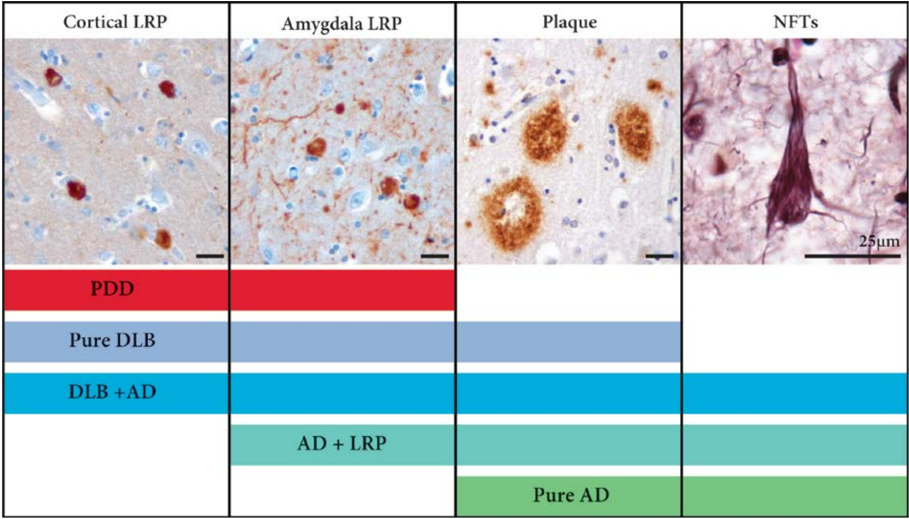
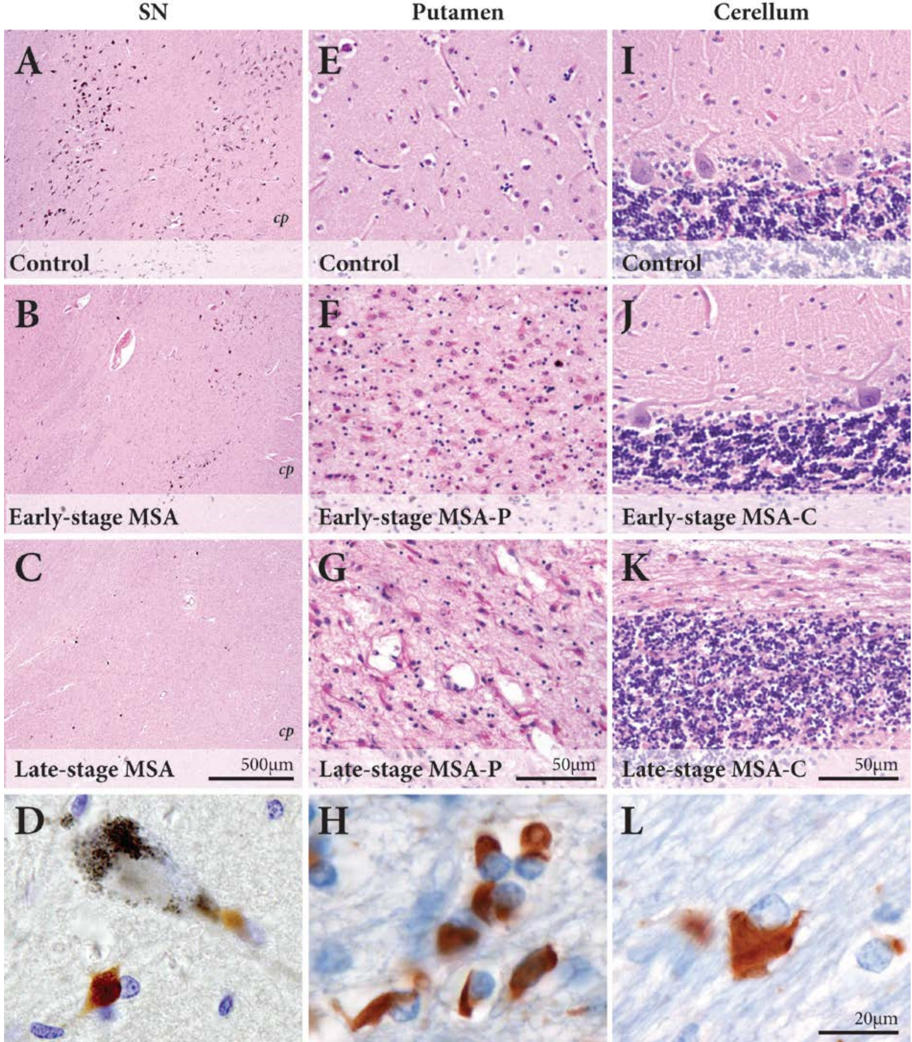
Verification
Claims the paper makes
The claims and statistics of this paper haven’t been checked yet.
Run the check — free, no account needed. It reads the open-access text and checks the sources it cites.
Claims other papers make about this one
Each is checked against this paper’s own text: does it say what the citing paper says it does?
In the citing paper
“In neurological disease and aging, modified proteins are the histopathological hallmarks of a number of diseases, such as SOD1 in amyotrophic lateral sclerosis (ALS) 56,57 , and a class of diseases long referred to as the proteinopathies 57 , including tauopathies in Alzheimer's disease 58 and inclusions of amyloidβ 59 , α -synuclein in Parkinson's 60,61 and multiple secondary ubiquitinopathies”
From How many human proteoforms are there? (2018) · cites this paper as [61]
Self-check
Percentages, sums and reported differences re-computed from the paper’s own numbers.
The self-check needs the paper’s full text.
Citations
Cites
Staging of brain pathology related to sporadic Parkinson’s disease
Braak, H., Tredici, K. D., Rüb, U., de Vos, R. A. I., Jansen Steur, E. N. H., & Braak, E. (2003) · Neurobiology of Aging · doi:10.1016/s0197-4580(02)00065-9 · Cited by 10,777
Diagnosis and management of dementia with Lewy bodies: Third report of the DLB consortium
McKeith, I. G., Dickson, D. W., Lowe, J., Emre, M., O'Brien, J. T., Feldman, H., Cummings, J., Duda, J. E., Lippa, C., Perry, E. K., et al. (2005) · Neurology · doi:10.1212/01.wnl.0000187889.17253.b1 · Cited by 5,069
Self-citationMirra, S. S., Heyman, A., McKeel, D., Sumi, S. M., Crain, B. J., Brownlee, L. M., Vogel, F. S., Hughes, J. P., Belle, G. V., Berg, L., et al. (1991) · Neurology · doi:10.1212/wnl.41.4.479 · Cited by 4,961
Second consensus statement on the diagnosis of multiple system atrophy
Gilman, S., Wenning, G. K., Low, P. A., Brooks, D. J., Mathias, C. J., Trojanowski, J. Q., Wood, N. W., Colosimo, C., Dürr, A., Fowler, C. J., et al. (2008) · Neurology · doi:10.1212/01.wnl.0000324625.00404.15 · Cited by 3,140
Consortium to Establish a Registry for Alzheimer's Disease (CERAD)
Fillenbaum, G., & Heyman, A. (2002) · doi:10.1002/0470846410.ch42(iii · Cited by 2,859
Diagnostic Criteria for Parkinson Disease
Gelb, D. J., Oliver, E., & Gilman, S. (1999) · Archives of Neurology · doi:10.1001/archneur.56.1.33 · Cited by 2,822
The Sydney multicenter study of Parkinson's disease: The inevitability of dementia at 20 years
Hely, M. A., Reid, W. G. J., ADENA, M. A., Halliday, G. M., & Morris, J. G. (2008) · Movement Disorders · doi:10.1002/mds.21956 · Cited by 2,346
Self-citationIdentification of two distinct synucleins from human brain
Jakes, R., Spillantini, M. G., & Goedert, M. (1994) · FEBS Letters · doi:10.1016/0014-5793(94)00395-5 · Cited by 1,080
Hamilton, R. L. (2000) · Brain Pathology · doi:10.1111/j.1750-3639.2000.tb00269.x · Cited by 754
Identifying prodromal Parkinson's disease: Pre‐Motor disorders in Parkinson's disease
Postuma, R. B., Aarsland, D., Barone, P., Burn, D. J., Hawkes, C. H., Oertel, W. H., & Ziemssen, T. (2012) · Movement Disorders · doi:10.1002/mds.24996 · Cited by 615
Cited by
Sorted by citations
How many human proteoforms are there?
Aebersold, R., Agar, J. N., Amster, I. J., Baker, M. S., Bertozzi, C. R., Boja, E. S., Costello, C. E., Cravatt, B. F., Fenselau, C., Garcia, B. A., et al. (2018) · Nature Chemical Biology · doi:10.1038/nchembio.2576 · Cited by 907
Gale, S. A., Acar, D., & Daffner, K. R. (2018) · The American Journal of Medicine · doi:10.1016/j.amjmed.2018.01.022 · Cited by 788
Extracellular vesicles in neurodegenerative disease — pathogenesis to biomarkers
Thompson, A. G., Gray, E., Heman-Ackah, S. M., Mäger, I., Talbot, K., Andaloussi, S. E., Wood, M. J., & Turner, M. R. (2016) · Nature Reviews Neurology · doi:10.1038/nrneurol.2016.68 · Cited by 431
Tunneling nanotubes spread fibrillar α-synuclein by intercellular trafficking of lysosomes
Abounit, S., Bousset, L., Loria, F., Zhu, S., de Chaumont, F., Pieri, L., Olivo‐Marin, J., Melki, R., & Zurzolo, C. (2016) · The EMBO Journal · doi:10.15252/embj.201593411 · Cited by 414
Gut-seeded α-synuclein fibrils promote gut dysfunction and brain pathology specifically in aged mice
Challis, C., Hori, A., Sampson, T. R., Yoo, B. B., Challis, R. C., Hamilton, A. M., Mazmanian, S. K., Volpicelli-Daley, L. A., & Gradinaru, V. (2020) · Nature Neuroscience · doi:10.1038/s41593-020-0589-7 · Cited by 405
Metadata
- Authors
- McCann, H., Stevens, C. H., Cartwright, H., & Halliday, G. M.
- Affiliations
- Neuroscience Research Australia (AU)
- UNSW Sydney (AU)
- Corresponding author
- Halliday, Glenda M.
- Venue
- Parkinsonism & Related Disorders
- Publisher
- Elsevier BV
- Published
- 2014-01
- Volume
- 20
- Pages
- S62-S67
- ISSN
- 1353-8020 (ISSN-L)
- OpenAlex
- W2057784346
- Cited by
- 364
- References
- 32
- Citations by year
- 2026: 8 · 2025: 23 · 2024: 55 · 2023: 28 · 2022: 37 · 2021: 43 · 2020: 37 · 2019: 32 · 2018: 23 · 2017: 27 · 2016: 29 · 2015: 17 · 2014: 5
- FWCI
- 2.22
- Type
- journal article
- Language
- en
- Open access
- green
- hdl.handle.net
- Licence
- cc-by-nc-nd
- www.elsevier.com/tdm/userlicense/1.0/ (tdm)
- Locations
- Parkinsonism & Related Disorders (publishedVersion)
- PubMed (publishedVersion)
- UNSWorks (University of New South Wales, Sydney, Australia) (submittedVersion, cc-by-nc-nd)
- Research Online (University of Wollongong) (submittedVersion)
- UNSWorks (UNSW Sydney) (submittedVersion, cc-by-nc-nd)
- Funders
- National Health and Medical Research Council (630434)
- Topics
- Health Sciences › Medicine › Clinical Neurology › Parkinson's Disease Mechanisms and Treatments
- Life Sciences › Neuroscience › Neurology › Neuroinflammation and Neurodegeneration Mechanisms
- Life Sciences › Biochemistry, Genetics and Molecular Biology › Molecular Biology › Nuclear Receptors and Signaling
- Keywords
- synucleinopathies, alpha-synuclein aggregation
- MeSH terms
- Humans, Parkinson Disease, Phenotype, Multiple System Atrophy, Lewy Body Disease, alpha-Synuclein
About these checks
Registry, retraction, Cites and statistics results are computed, not judged, with one exception: a printed reference that no index lists is read once by a model before it counts as a citation error. Claims are extracted by a model and kept only when their quote appears verbatim in the text; each cited source is then checked, with a model’s help, for whether it says what the claim relies on. Those verdicts can be wrong — read the claim’s quote and the cited source before relying on one.
Statistics and arithmetic are recomputed, not judged.
Confidence bands are shown only for fields calibrated on our annotated test set. None is calibrated yet, so no band is shown.
What counts as a claim ›How we measure confidence ›How we check this ›
Are you an author, or do you see a problem with this page? Request a review
