

The DOI matches its Crossref record; 43 of the 43 references it cites were found in a registry or an index.
Comparison of MAPIE versus MAP in patients with a poor response to preoperative chemotherapy for newly diagnosed high-grade osteosarcoma (EURAMOS-1): an open-label, international, randomised controlled trial
Open accessAbstract
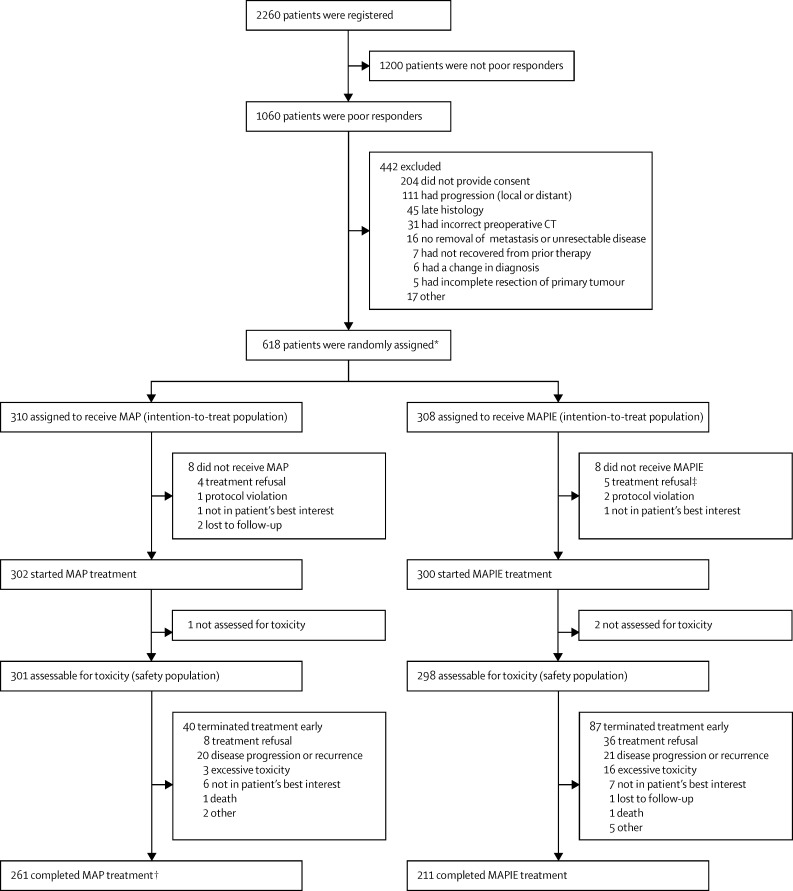
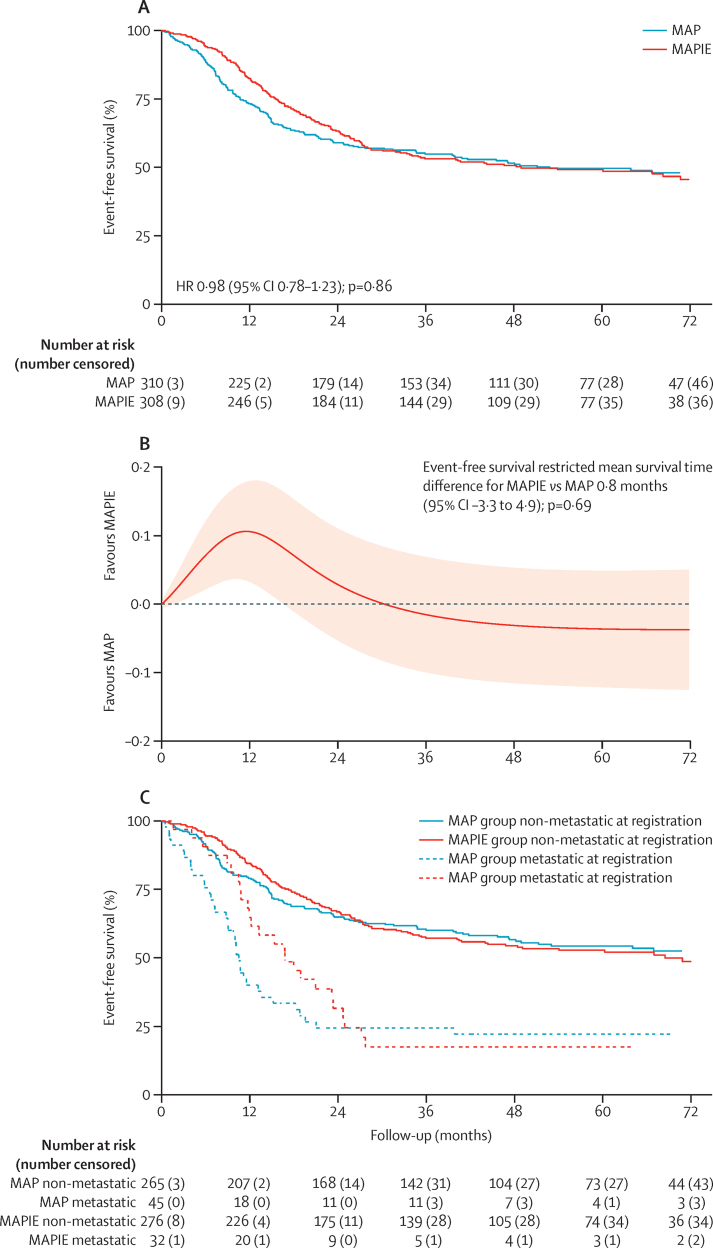
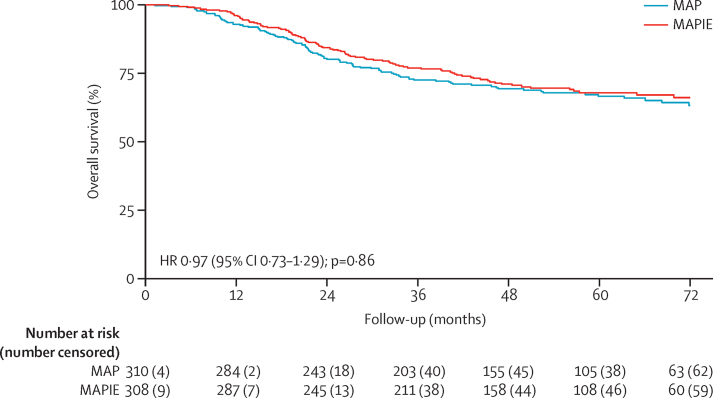
Background We designed the EURAMOS-1 trial to investigate whether intensified postoperative chemotherapy for patients whose tumour showed a poor response to preoperative chemotherapy (≥10% viable tumour) improved event-free survival in patients with high-grade osteosarcoma. Methods EURAMOS-1 was an open-label, international, phase 3 randomised, controlled trial. Consenting patients with newly diagnosed, resectable, high-grade osteosarcoma aged 40 years or younger were eligible for randomisation. Patients were randomly assigned (1:1) to receive either postoperative cisplatin, doxorubicin, and methotrexate (MAP) or MAP plus ifosfamide and etoposide (MAPIE) using concealed permuted blocks with three stratification factors: trial group; location of tumour (proximal femur or proximal humerus vs other limb vs axial skeleton); and presence of metastases (no vs yes or possible). The MAP regimen consisted of cisplatin 120 mg/m 2 , doxorubicin 37·5 mg/m 2 per day on days 1 and 2 (on weeks 1 and 6) followed 3 weeks later by high-dose methotrexate 12 g/m 2 over 4 h. The MAPIE regimen consisted of MAP as a base regimen, with the addition of high-dose ifosfamide (14 g/m 2 ) at 2·8 g/m 2 per day with equidose mesna uroprotection, followed by etoposide 100 mg/m 2 per day over 1 h on days 1–5. The primary outcome measure was event-free survival measured in the intention-to-treat population. This trial is registered with ClinicalTrials.gov, number NCT00134030. Findings Between April 14, 2005, and June 30, 2011, 2260 patients were registered from 325 sites in 17 countries. 618 patients with poor response were randomly assigned; 310 to receive MAP and 308 to receive MAPIE. Median follow-up was 62·1 months (IQR 46·6–76·6); 62·3 months (IQR 46·9–77·1) for the MAP group and 61·1 months (IQR 46·5–75·3) for the MAPIE group. 307 event-free survival events were reported (153 in the MAP group vs 154 in the MAPIE group). 193 deaths were reported (101 in the MAP group vs 92 in the MAPIE group). Event-free survival did not differ between treatment groups (hazard ratio [HR] 0·98 [95% CI 0·78–1·23]); hazards were non-proportional (p=0·0003). The most common grade 3–4 adverse events were neutropenia (268 [89%] patients in MAP vs 268 [90%] in MAPIE), thrombocytopenia (231 [78% in MAP vs 248 [83%] in MAPIE), and febrile neutropenia without documented infection (149 [50%] in MAP vs 217 [73%] in MAPIE). MAPIE was associated with more frequent grade 4 non-haematological toxicity than MAP (35 [12%] of 301 in the MAP group vs 71 [24%] of 298 in the MAPIE group). Two patients died during postoperative therapy, one from infection (although their absolute neutrophil count was normal), which was definitely related to their MAP treatment (specifically doxorubicin and cisplatin), and one from left ventricular systolic dysfunction, which was probably related to MAPIE treatment (specifically doxorubicin). One suspected unexpected serious adverse reaction was reported in the MAP group: bone marrow infarction due to methotrexate. Interpretation EURAMOS-1 results do not support the addition of ifosfamide and etoposide to postoperative chemotherapy in patients with poorly responding osteosarcoma because its administration was associated with increased toxicity without improving event-free survival. The results define standard of care for this population. New strategies are required to improve outcomes in this setting. Funding UK Medical Research Council, National Cancer Institute, European Science Foundation, St Anna Kinderkrebsforschung, Fonds National de la Recherche Scientifique, Fonds voor Wetenschappelijk Onderzoek-Vlaanderen, Parents Organization, Danish Medical Research Council, Academy of Finland, Deutsche Forschungsgemeinschaft, Deutsche Krebshilfe, Federal Ministry of Education and Research, Semmelweis Foundation, ZonMw (Council for Medical Research), Research Council of Norway, Scandinavian Sarcoma Group, Swiss Paediatric Oncology Group, Cancer Research UK, National Institute for Health Research, University College London Hospitals, and Biomedical Research Centre.
Overview
The claims and statistics of this paper haven’t been checked yet.
Run the check — free, no account needed. It reads the open-access text and checks the sources it cites.
Integrity signals
Registry
Cites
Statistics
Figures
Verification
Claims the paper makes
The claims and statistics of this paper haven’t been checked yet.
Run the check — free, no account needed. It reads the open-access text and checks the sources it cites.
Claims other papers make about this one
Each is checked against this paper’s own text: does it say what the citing paper says it does?
In the citing paper
“The response to neoadjuvant chemotherapy, assessed in the definitive resection specimen, has clear prognostic value and has been used in previous clinical trials to stratify patients into good responders and poor responders; however, intensification of treatment did not improve outcomes in the poor responder group 114 .”
From Osteosarcoma (2022) · cites this paper as [114]
In the citing paper
“This prospective, randomized trial, based on the MAP regimen, unequivocally proved that long-term outcomes could not be further improved by postoperative treatment alterations and augmentations for poor responders.”
From Osteosarcoma (2022) · cites this paper as [114]
In the citing paper
“Patients who were and were not randomized to such salvage therapy had event-free survival rates of 53% (95% CI 47-53%) and 55% (95% CI 49-60%), respectively.”
From Osteosarcoma (2022) · cites this paper as [114]
In the citing paper
“This choice of regimen is based on the largest osteosarcoma study ever performed, EURAMOS-1 (ref.114 ).”
From Osteosarcoma (2022) · cites this paper as [114]
In the citing paper
“An international randomized clinical trial fails to show benefit of addition of I/E to MAP chemotherapy in the primary treatment of osteosarcoma.”
From Osteosarcoma (2022) · cites this paper as [114]
Self-check
Percentages, sums and reported differences re-computed from the paper’s own numbers.
The self-check needs the paper’s full text.
Citations
Cites
Pathology and genetics of tumours of soft tissue and bone
Fletcher, C. D. �., Unni, K., & Mertens, F. (2002) · Lund University Publications (Lund University) · Cited by 4,294
Bielack, S. S., Kempf-Bielack, B., Delling, G., Exner, G. U., Flege, S., Helmke, K., Kotz, R., Salzer-Kuntschik, M., Werner, M., Winkelmann, W., et al. (2002) · Journal of Clinical Oncology · doi:10.1200/jco.2002.20.3.776 · Cited by 2,393
Self-citationBielack, S., Kempf-Bielack, B., Delling, G., Exner, G. U., Flege, S., Helmke, K., Kotz, R., Salzer-Kuntschik, M., Werner, M., Winkelmann, W., et al. (2002) · Journal of Clinical Oncology · doi:10.1200/jco.20.3.776 · Cited by 2,391
Self-citationRoyston, P. J., & Parmar, M. (2013) · BMC Medical Research Methodology · doi:10.1186/1471-2288-13-152 · Cited by 1,084
Rosen, G., Caparros, B., Huvos, A. G., Kosloff, C., Nirenberg, A., Cacavio, A., Marcove, R. C., Lane, J. M., Mehta, B. M., & Urban, C. (1982) · Cancer · doi:10.1002/1097-0142(19820315)49:6 · Cited by 1,082
Kager, L., Zoubek, A., Pötschger, U., Kastner, U., Flege, S., Kempf-Bielack, B., Branscheid, D., Kotz, R., Salzer-Kuntschik, M., Winkelmann, W., et al. (2003) · Journal of Clinical Oncology · doi:10.1200/jco.2003.08.132 · Cited by 934
Self-citationMeyers, P. A., Schwartz, C. L., Krailo, M. D., Healey, J. H., Bernstein, M. L., Betcher, D., Ferguson, W. S., Gebhardt, M. C., Goorin, A. M., Harris, M., et al. (2008) · Journal of Clinical Oncology · doi:10.1200/jco.2008.14.0095 · Cited by 752
Self-citationMeyers, P. A., Schwartz, C. L., Krailo, M., Kleinerman, E. S., Betcher, D. L., Bernstein, M. L., Conrad, E. U., Ferguson, W. S., Gebhardt, M. C., Goorin, A. M., et al. (2005) · Journal of Clinical Oncology · doi:10.1200/jco.2005.06.031 · Cited by 717
Self-citationAcute Myeloid Leukemia in Children Treated with Epipodophyllotoxins for Acute Lymphoblastic Leukemia
Pui, C., Ribeiro, R. C., Hancock, M. L., Rivera, G. K., Evans, W. E., Raimondi, S. C., Head, D. R., Behm, F. G., Mahmoud, M. H., Sandlund, J. T., et al. (1991) · New England Journal of Medicine · doi:10.1056/nejm199112123252402 · Cited by 706
Beau, M. M. L., Albain, K. S., Larson, R. A., Vardiman, J., Davis, E. M., Blough, R. R., Golomb, H. M., & Rowley, J. D. (1986) · Journal of Clinical Oncology · doi:10.1200/jco.1986.4.3.325 · Cited by 668
Royston, P. J., & Parmar, M. (2011) · Statistics in Medicine · doi:10.1002/sim.4274 · Cited by 591
Adjuvant Methotrexate and Citrovorum-Factor Treatment of Osteogenic Sarcoma
Jaffe, N., Frei, E., Traggis, D., & Bishop, Y. M. M. (1974) · New England Journal of Medicine · doi:10.1056/nejm197411072911902 · Cited by 482
Perry, J. A., Kiezun, A., Tonzi, P., Van Allen, E. M., Carter, S. L., Baca, S. C., Cowley, G. S., Bhatt, A. S., Rheinbay, E., Pedamallu, C. S., et al. (2014) · Proceedings of the National Academy of Sciences · doi:10.1073/pnas.1419260111 · Cited by 481
Self-citationProvisor, A. J., Ettinger, L. J., Nachman, J. B., Krailo, M., Makley, J. T., Yunis, E. J., Huvos, A. G., Betcher, D. L., Baum, E. S., Kisker, C. T., et al. (1997) · Journal of Clinical Oncology · doi:10.1200/jco.1997.15.1.76 · Cited by 458
Self-citationChemotherapeutic adjuvant treatment for osteosarcoma: Where do we stand?
Anninga, J. K., Gelderblom, H., Fiocco, M., Kroep, J. R., Taminiau, A. H. M., Hogendoorn, P. C. W., & Egeler, R. M. (2011) · European Journal of Cancer · doi:10.1016/j.ejca.2011.05.030 · Cited by 456
Self-citationBielack, S. S., Smeland, S., Whelan, J. S., Marina, N., Jovic, G., Hook, J. M., Krailo, M. D., Gebhardt, M., Pápai, Z., Meyer, J., et al. (2015) · Journal of Clinical Oncology · doi:10.1200/jco.2014.60.0734 · Cited by 422
Self-citationAg, H., Rosen, G., & Marcove, R. C. (1977) · PubMed · Cited by 396
Souhami, R. L., Craft, A. W., van der Eijken, J. W., Nooij, M. A., Spooner, D. A., Bramwell, V. H. C., Wierzbicki, R. F., MALCOLM, A. J., Kirkpatrick, A., Uscinska, B., et al. (1997) · The Lancet · doi:10.1016/s0140-6736(97)02307-6 · Cited by 381
Lewis, I. J., Nooij, M. A., Whelan, J. S., Sydes, M. R., Grimer, R. J., Hogendoorn, P. C. W., Memon, M. A., Weeden, S., Uscinska, B., Glabbeke, M. M. V., et al. (2007) · JNCI Journal of the National Cancer Institute · doi:10.1093/jnci/djk015 · Cited by 344
Self-citationWhelan, J. S., Bielack, S., Marina, N. M., Smeland, S., Jovic, G., Hook, J., Krailo, M., Anninga, J., Butterfaß‐Bahloul, T., Böhling, T., et al. (2014) · Annals of Oncology · doi:10.1093/annonc/mdu526 · Cited by 334
Self-citationAmputation and Adriamycin in Primary Osteosarcoma
Cortes, E. P., Holland, J. F., Wang, J. J., Sinks, L. F., Blom, J., Senn, H. J., Bank, A., & Glidewell, O. J. (1974) · New England Journal of Medicine · doi:10.1056/nejm197411072911903 · Cited by 316
Planning the size and duration of a clinical trial studying the time to some critical event
George, S. L., & Desu, M. M. (1974) · Journal of Chronic Diseases · doi:10.1016/0021-9681(74)90004-6 · Cited by 279
Second cancers in survivors of childhood cancer
Bhatia, R., & Sklar, C. A. (2002) · Nature reviews. Cancer · doi:10.1038/nrc722 · Cited by 270
Morphological grades of regression in osteosarcoma after polychemotherapy ? Study COSS 80
Salzer-Kuntschik, M., Delling, G., Beron, G., & Sigmund, R. (1983) · Journal of Cancer Research and Clinical Oncology · doi:10.1007/bf00625047 · Cited by 265
Canine Osteosarcoma: A Naturally Occurring Disease to Inform Pediatric Oncology
Fenger, J. M., London, C. A., & Kisseberth, W. C. (2014) · ILAR Journal · doi:10.1093/ilar/ilu009 · Cited by 248
Chou, A. J., Kleinerman, E. S., Krailo, M. D., Chen, Z., Betcher, D. L., Healey, J. H., Conrad, E. U., Nieder, M. L., Weiner, M. A., Wells, R. J., et al. (2009) · Cancer · doi:10.1002/cncr.24566 · Cited by 245
Self-citationGoorin, A. M., Harris, M. B., Bernstein, M. L., Ferguson, W., Devidas, M., Siegal, G. P., Gebhardt, M. C., Schwartz, C. L., Link, M. P., & Grier, H. E. (2002) · Journal of Clinical Oncology · doi:10.1200/jco.20.2.426 · Cited by 223
Self-citationOberlin, O., Rey, A., de Toledo, J. S., Martelli, H., Jenney, M. E. M., Scopinaro, M. J., Bergeron, C., Merks, J. H. M., Bouvet, N., Ellershaw, C., et al. (2012) · Journal of Clinical Oncology · doi:10.1200/jco.2011.40.3287 · Cited by 193
Self-citationFerrari, S., Ruggieri, P., Cefalo, G., Tamburini, A., Capanna, R., Fagioli, F., Comandone, A., Bertulli, R., Bisogno, G., Palmerini, E., et al. (2012) · Journal of Clinical Oncology · doi:10.1200/jco.2011.38.4420 · Cited by 192
Goorin, A. M., Harris, M. B., Bernstein, M. L., et al. (2002) · Journal of Clinical Oncology · doi:10.1200/jco.2002.20.2.426 · Cited by 147
Self-citationBhatia, R., Krailo, M., Chen, Z., Burden, L., Askin, F. B., Dickman, P. S., Grier, H. E., Link, M. P., Meyers, P. A., Perlman, E. J., et al. (2006) · Blood · doi:10.1182/blood-2006-01-023101 · Cited by 139
Self-citationHawkins, D. S., Conrad, E. U., Butrynski, J. E., Schuetze, S. M., & Eary, J. F. (2009) · Cancer · doi:10.1002/cncr.24421 · Cited by 118
Self-citationcis-Dichlorodiammineplatinum (II) in advanced osteogenic sarcoma.
Ochs, J. J., Freeman, A. I., Douglass, H. O., Ds, H., Mindell, E. R., & Lf, S. (1978) · PubMed · Cited by 108
International Collaboration is Feasible in Trials for Rare Conditions: The EURAMOS Experience
Marina, N. M., Bielack, S., Whelan, J. S., Smeland, S., Krailo, M., Sydes, M. R., Butterfaß‐Bahloul, T., Calaminus, G., & Bernstein, M. L. (2009) · Cancer treatment and research · doi:10.1007/978-1-4419-0284-9_18 · Cited by 102
Self-citationFerrari, S., Mercuri, M., Picci, P., Bertoni, F., del Prever, A. B., Tienghi, A., Mancini, A. F., Longhi, A., Rimondini, S., Donati, D. M., et al. (1999) · Tumori Journal · doi:10.1177/030089169908500607 · Cited by 79
Results of the Scandinavian Sarcoma Group XIV protocol for classical osteosarcoma
Smeland, S., Bruland, Ø. S., Hjorth, L., Brosjö, O., Bjerkehagen, B., Österlundh, G., Jakobson, Å. M., Hall, K. S., Monge, O. R., Björk, O., et al. (2011) · Acta Orthopaedica · doi:10.3109/17453674.2011.566141 · Cited by 58
Self-citationPhase II trail cisplatin in refractory childhood cancer: Children's Cancer Study Group Report.
Baum, E. S., Gaynon, P. S., Greenberg, L., Krivit, W. A., & Hammond, D. (1981) · PubMed · Cited by 56
Pratt, C. B., Roberts, D., Shanks, E., & Warmath, E. L. (1974) · PubMed · Cited by 45
Pratt, C. B., Howarth, C. L., Ransom, J. L., Bowles, D., Green, A. A., Kumar, A., Rivera, G. K., & Evans, W. E. (1980) · PubMed · Cited by 33
Gasparini, M., Rouëssé, J., van Oosterom, A., Wagener, T., Somers, R., Ja, R., Voûte, P. A., Bramwell, V. H. C., Thomas, D., & Sylvester, R. J. (1985) · PubMed · Cited by 30
Glover, J., Krailo, M., Tello, T., Marina, N. M., Janeway, K. A., Barkauskas, D. A., Fan, T. M., Gorlick, R. G., Khanna, C., & the COG Osteosarcoma Biology Group (2014) · Pediatric Blood & Cancer · doi:10.1002/pbc.25346 · Cited by 22
Self-citationHigh-dose ifosfamide alone and in combination for solid malignancies in childhood
Gasparini, M. (1986) · Cancer Chemotherapy and Pharmacology · doi:10.1007/bf00647442 · Cited by 12
- Self-citation
Cited by
Sorted by citations
Advancing therapy for osteosarcoma
Gill, J., & Gorlick, R. (2021) · Nature Reviews Clinical Oncology · doi:10.1038/s41571-021-00519-8 · Cited by 876
Self-citationSmeland, S., Bielack, S. S., Whelan, J., Bernstein, M., Hogendoorn, P., Krailo, M. D., Gorlick, R., Janeway, K. A., Ingleby, F. C., Anninga, J., et al. (2019) · European Journal of Cancer · doi:10.1016/j.ejca.2018.11.027 · Cited by 704
Self-citationCurrent and future therapeutic approaches for osteosarcoma
Harrison, D. J., Geller, D. S., Gill, J. B., Lewis, V. O., & Gorlick, R. G. (2017) · Expert Review of Anticancer Therapy · doi:10.1080/14737140.2018.1413939 · Cited by 691
Self-citationBeird, H. C., Bielack, S. S., Flanagan, A. M., Gill, J., Heymann, D., Janeway, K. A., Livingston, J. A., Roberts, R. D., Strauss, S. J., & Gorlick, R. (2022) · Nature Reviews Disease Primers · doi:10.1038/s41572-022-00409-y · Cited by 660
Self-citationCasali, P. G., Bielack, S., Abecassis, N., Aro, H. T., Bauer, S., Biagini, R., Bonvalot, S., Boukovinas, I., Bovee, J. V. M. G., Brennan, B., et al. (2018) · Annals of Oncology · doi:10.1093/annonc/mdy310 · Cited by 617
Self-citation
Metadata
- Authors
- Marina, N. M., Smeland, S., Bielack, S. S., Bernstein, M., Jovic, G., Krailo, M. D., Hook, J. M., Arndt, C., van den Berg, H., Brennan, B., Brichard, B., Brown, K. L. B., Butterfass-Bahloul, T., Calaminus, G., Daldrup-Link, H. E., Eriksson, M., Gebhardt, M. C., Gelderblom, H., Gerss, J., Goldsby, R., Goorin, A., Gorlick, R., Grier, H. E., Hale, J. P., Hall, K. S., Hardes, J., Hawkins, D. S., Helmke, K., Hogendoorn, P. C. W., Isakoff, M. S., Janeway, K. A., Jürgens, H., Kager, L., Kühne, T., Lau, C. C., Leavey, P. J., Lessnick, S. L., Mascarenhas, L., Meyers, P. A., Mottl, H., Nathrath, M., Papai, Z., Randall, R. L., Reichardt, P., Renard, M., Safwat, A. A., Schwartz, C. L., Stevens, M. C. G., Strauss, S. J., Teot, L., Werner, M., Sydes, M. R., & Whelan, J. S.
- Affiliations
- Lucile Packard Children's Hospital (US)
- Oslo University Hospital (NO)
- Olgahospital (DE)
- Dalhousie University (CA)
- MRC Clinical Trials Unit at UCL (GB)
- University of Southern California (US)
- University of Leeds (GB)
- Mayo Clinic (US)
- Royal Manchester Children's Hospital (GB)
- Cliniques Universitaires Saint-Luc (BE)
- University of British Columbia (CA)
- University Hospital Bonn (DE)
- Lund University (SE)
- Dana-Farber Cancer Institute (US)
- Leiden University Medical Center (NL)
- University of Münster (DE)
- University of California San Francisco Medical Center (US)
- Children's Hospital at Montefiore (US)
- Seattle Children's Hospital (US)
- Altonaer Kinderkrankenhaus (DE)
- Connecticut Children's Medical Center (US)
- St Anna Children's Hospital (AT)
- University Children’s Hospital Basel (CH)
- Baylor College of Medicine (US)
- Children's Medical Center (US)
- Nationwide Children's Hospital (US)
- Memorial Sloan Kettering Cancer Center (US)
- University Hospital in Motol (CZ)
- Klinikum Kassel (DE)
- Primary Children's Hospital (US)
- Helios Hospital Berlin-Buch (DE)
- Universitair Ziekenhuis Leuven (BE)
- Aarhus University Hospital (DK)
- The University of Texas MD Anderson Cancer Center (US)
- University College Hospital (GB)
- Boston Children's Hospital (US)
- Helios Klinikum Emil von Behring (DE)
- Corresponding author
- Sydes, Matthew R
- ORCID
- Marina, Neyssa M
- Smeland, Sigbjørn
- Bielack, Stefan S
- Bernstein, Mark
- Jovic, Gordana
- Krailo, Mark D
- Brennan, Bernadette
- Brichard, Bénédicte
- Calaminus, Gabriele
- Daldrup-Link, Heike E
- Gelderblom, Hans
- Gerss, Joachim
- Goldsby, Robert
- Gorlick, Richard
- Grier, Holcombe E
- Hall, Kirsten Sundby
- Hardes, Jendrik
- Hawkins, Douglas S
- Hogendoorn, Pancras C W
- Isakoff, Michael S
- Janeway, Katherine A
- Kager, Leo
- Kühne, Thomas
- Lau, Ching C
- Leavey, Patrick J
- Lessnick, Stephen L
- Mascarenhas, Leo
- Meyers, Paul A
- Nathrath, Michaela
- Randall, R Lor
- Reichardt, Peter
- Safwat, Akmal Ahmed
- Schwartz, Cindy L
- Strauss, Sandra J
- Werner, Mathias
- Sydes, Matthew R
- Whelan, Jeremy S
- Venue
- The Lancet Oncology
- Publisher
- Elsevier BV
- Published
- 2016-10
- Volume
- 17
- Issue
- 10
- Pages
- 1396-1408
- ISSN
- 1470-2045 (ISSN-L)
- PMC
- PMC5052459
- OpenAlex
- W2513951655
- Cited by
- 551
- References
- 41
- Citations by year
- 2026: 53 · 2025: 58 · 2024: 74 · 2023: 48 · 2022: 74 · 2021: 69 · 2020: 67 · 2019: 42 · 2018: 26 · 2017: 30 · 2016: 8
- FWCI
- 31.35
- Type
- journal article
- Language
- en
- Open access
- hybrid
- doi.org
- Licence
- Locations
- The Lancet Oncology (publishedVersion, cc-by)
- PubMed Central (publishedVersion, cc-by)
- PubMed (publishedVersion)
- White Rose Research Online (University of Leeds, The University of Sheffield, University of York) (acceptedVersion)
- Leiden Repository (Leiden University) (submittedVersion)
- Data Archiving and Networked Services (DANS) (submittedVersion)
- Data Archiving and Networked Services (DANS) (submittedVersion, other-oa)
- Digital Access to Libraries (submittedVersion)
- DIAL (Catholic University of Leuven) (submittedVersion)
- UCL Discovery (University College London) (submittedVersion)
- Lund University Publications (Lund University) (submittedVersion)
- mediaTUM – the media and publications repository of the Technical University Munich (Technical University Munich) (submittedVersion)
- Pure Amsterdam UMC (submittedVersion)
- Newcastle University ePrints (Newcastle Univesity) (cc-by)
- Funders
- ZonMw
- Academy of Finland
- Bundesministerium für Bildung und Forschung (01KN1105)
- National Cancer Institute (U10CA098413, U10CA098543, U10CA180886, U10CA180899)
- European Science Foundation (ERASCT-2003-980409)
- Deutsche Forschungsgemeinschaft (1-2, GZ BI 1045/1-1, JU 203/2-3)
- Medical Research Council
- Deutsche Krebshilfe
- Cancer Research UK (CRUK/05/013)
- European Commission (MM/NG/EMRC/0202)
- Fonds De La Recherche Scientifique - FNRS
- Sundhed og Sygdom, Det Frie Forskningsråd
- Fonds Wetenschappelijk Onderzoek
- NIHR Biomedical Research Centre, Royal Marsden NHS Foundation Trust/Institute of Cancer Research
- Norges Forskningsråd
- Topics
- Health Sciences › Medicine › Oncology › Sarcoma Diagnosis and Treatment
- Health Sciences › Medicine › Orthopedics and Sports Medicine › Bone Tumor Diagnosis and Treatments
- Health Sciences › Medicine › Oncology › Ovarian cancer diagnosis and treatment
- Keywords
- high-grade osteosarcoma, ifosfamide, etoposide, cisplatin, doxorubicin, methotrexate, postoperative chemotherapy, event-free survival, tumor response assessment, metastasis, proximal femur
- MeSH terms
- Adolescent, Adult, Aged, Antineoplastic Combined Chemotherapy Protocols, Bone Neoplasms, Child, Child, Preschool, Combined Modality Therapy, Female, Humans, Infant, Male, Middle Aged, Osteosarcoma
About these checks
Registry, retraction, Cites and statistics results are computed, not judged, with one exception: a printed reference that no index lists is read once by a model before it counts as a citation error. Claims are extracted by a model and kept only when their quote appears verbatim in the text; each cited source is then checked, with a model’s help, for whether it says what the claim relies on. Those verdicts can be wrong — read the claim’s quote and the cited source before relying on one.
Statistics and arithmetic are recomputed, not judged.
Confidence bands are shown only for fields calibrated on our annotated test set. None is calibrated yet, so no band is shown.
What counts as a claim ›How we measure confidence ›How we check this ›
Are you an author, or do you see a problem with this page? Request a review
