

Prevalence of tuberculosis, hepatitis C virus, and HIV in homeless people: a systematic review and meta-analysis
Open accessThe DOI matches its Crossref record; 76 of the 89 references it cites were found in a registry or an index; 2 of the 35 sources its claims cite were checked for support.
Abstract
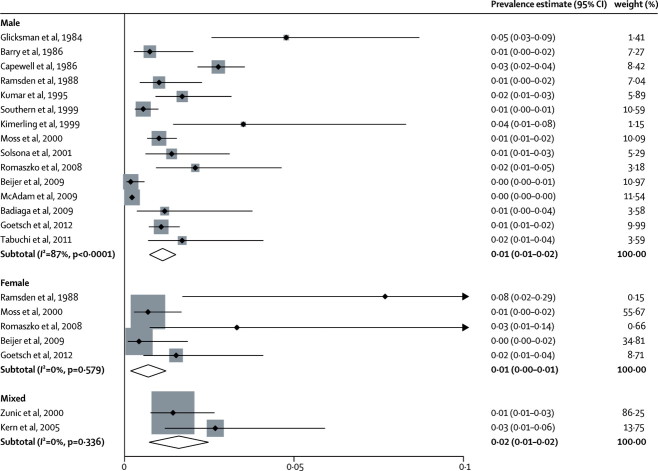
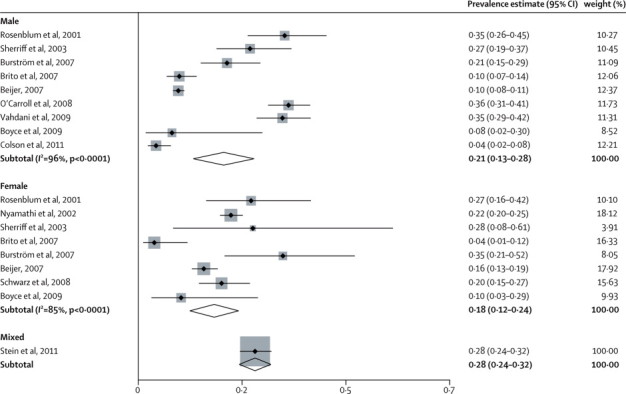
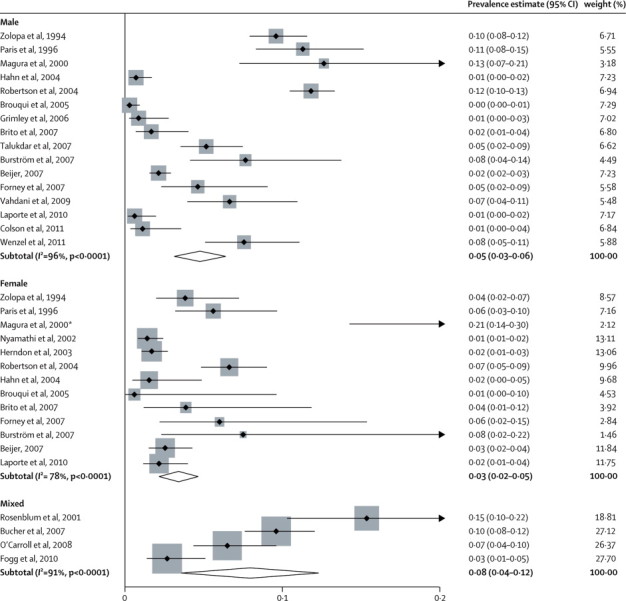
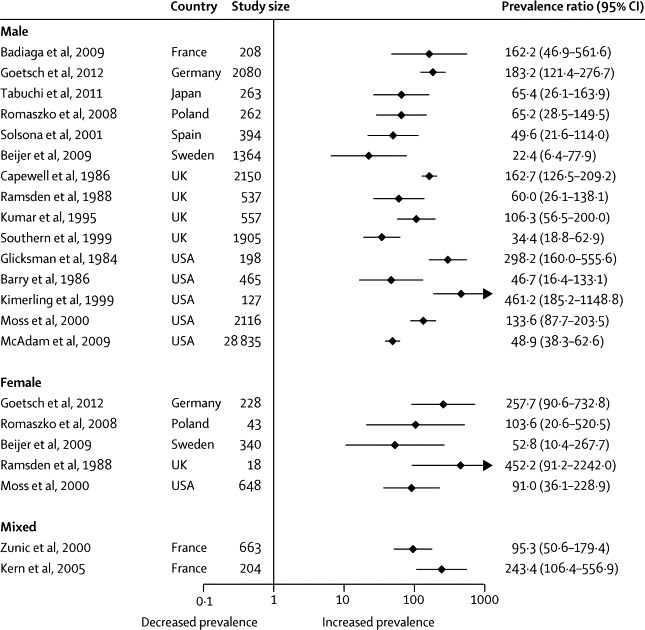
BACKGROUND: 100 million people worldwide are homeless; rates of mortality and morbidity are high in this population. The contribution of infectious diseases to these adverse outcomes is uncertain. Accurate estimates of prevalence data are important for public policy and planning and development of clinical services tailored to homeless people. We aimed to establish the prevalence of tuberculosis, hepatitis C virus, and HIV in homeless people. METHODS: We searched PubMed, Embase, and Cumulative Index to Nursing and Allied Health Literature for studies of the prevalence of tuberculosis, hepatitis C virus, and HIV in homeless populations. We also searched bibliographic indices, scanned reference lists, and corresponded with authors. We explored potential sources of heterogeneity in the estimates by metaregression analysis and calculated prevalence ratios to compare prevalence estimates for homeless people with those for the general population. FINDINGS: We identified 43 eligible surveys with a total population of 63,812 (59 736 homeless individuals when duplication due to overlapping samples was accounted for). Prevalences ranged from 0·2% to 7·7% for tuberculosis, 3·9% to 36·2% for hepatitis C virus infection, and 0·3% to 21·1% for HIV infection. We noted substantial heterogeneity in prevalence estimates for tuberculosis, hepatitis C virus infection, and HIV infection (all Cochran's χ(2) significant at p<0·0001; I(2)=83%, 95% CI 76-89; 95%, 94-96; and 94%, 93-95; respectively). Prevalence ratios ranged from 34 to 452 for tuberculosis, 4 to 70 for hepatitis C virus infection, and 1 to 77 for HIV infection. Tuberculosis prevalence was higher in studies in which diagnosis was by chest radiography than in those which used other diagnostic methods and in countries with a higher general population prevalence than in those with a lower general prevalence. Prevalence of HIV infection was lower in newer studies than in older ones and was higher in the USA than in the rest of the world. INTERPRETATION: Heterogeneity in prevalence estimates for tuberculosis, hepatitis C virus, and HIV suggests the need for local surveys to inform development of health services for homeless people. The role of targeted and population-based measures in the reduction of risks of infectious diseases, premature mortality, and other adverse outcomes needs further examination. Guidelines for screening and treatment of infectious diseases in homeless people might need to be reviewed. FUNDING: The Wellcome Trust.
Overview
CoChat Summary
TL;DR
This systematic review and meta-analysis of 43 surveys found high but highly heterogeneous prevalences of tuberculosis, hepatitis C virus, and HIV among homeless people. Hepatitis C virus had the highest pooled prevalence and tuberculosis the lowest, with prevalence ratios substantially elevated versus general populations.
Key findings
- The review identified 43 eligible surveys with a total population of 63,812, comprising 59,736 homeless individuals after accounting for overlapping samples. Prevalences ranged from 0·2% to 7·7% for tuberculosis, 3·9% to 36·2% for hepatitis C virus, and 0·3% to 21·1% for HIV.
- Random-effects pooled prevalences were 1·1% (95% CI 0·8–1·5) for tuberculosis, 20·3% (15·5–25·2) for hepatitis C virus, and 4·7% (3·6–5·8) for HIV. Heterogeneity was substantial for all three (all Cochran’s χ² p<0·0001; I²=83%, 95%, and 94%, respectively).
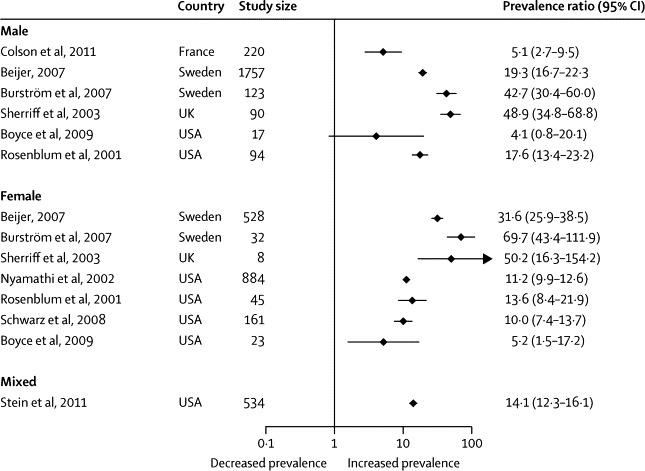
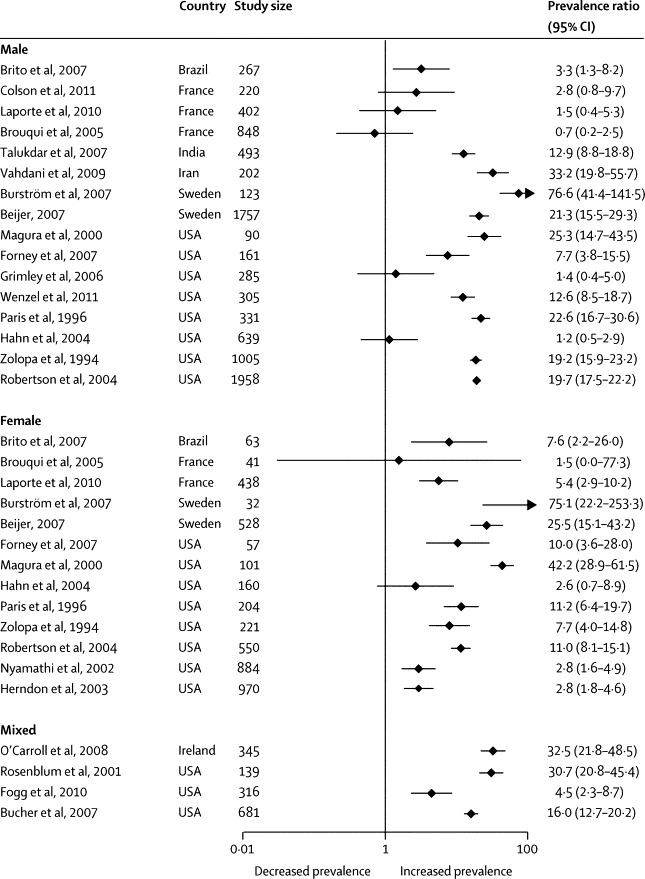
- Prevalence ratios comparing homeless people with same-country general populations ranged from 34 to 452 for tuberculosis, 4 to 70 for hepatitis C virus, and 1 to 77 for HIV.
- In univariate metaregression, tuberculosis prevalence was higher with chest radiography diagnosis (p=0·047) and higher general population prevalence (p=0·039; not significant after multivariate metaregression). HIV prevalence was lower in newer studies (p=0·037) and higher in the USA (p=0·038; not significant after multivariate metaregression). No explored factor was significantly associated with hepatitis C virus heterogeneity.
Methods
- Systematic review and meta-analysis; searched PubMed, Embase, and Cumulative Index to Nursing and Allied Health Literature for “homeless* and (tuberculosis or HIV or hepatitis C or HCV)” from Jan 1, 1980, to Jan 31, 2012, plus reference lists, hand searches, and author correspondence; non-English articles were translated.
- Included studies of adults with no fixed abode, temporary accommodation, institutions/shelters, or rough sleeping that reported extractable prevalences; excluded studies if homeless individuals were not reported separately, infections were grouped, methods were unclear, or the population was homeless drug users only. Final sample: 17 tuberculosis studies (43,605), 12 hepatitis C virus studies (5,391), and 22 HIV studies (14,816).
- Used double arcsine transformation, Wilson 95% CIs, random-effects models because heterogeneity was high, Cochran’s Q and I² for heterogeneity, and metaregression for year of publication, sex, region, study size, diagnostic method, and general population prevalence; prevalence ratios were calculated against general population estimates.
Limitations
- The paper states that it did not include other infections, that included studies were cross-sectional so causality cannot be inferred, that no longitudinal studies were identified, that all but four studies were done in Europe or the USA, and that only eight studies included prevalence estimates for more than one of the diseases investigated.
- The paper notes substantial heterogeneity and cautions that pooled estimates should be used carefully; it also states that characteristics not tested, such as length of homelessness or age at onset of homelessness, might be associated with heterogeneity.
- Evident from the text: diagnostic methods varied and included questionnaires/self-report and oral fluid, which may affect prevalence estimates; chest radiography may miss subclinical tuberculosis, and positive hepatitis C virus serology can indicate past as well as active infection.
Model-written summary. Check it against the paper before relying on it.
Integrity signals
Registry
Cites
Statistics
Figures
Verification
Claims the paper makes
1 Valid · 1 Not valid · 24 Not checked · 59 Own results and interpretations
At least one cited source doesn’t support this claim or points to a different paper, and none confirmed it — see the verdicts below.
In the paper
“when seven questionnaire studies21, 22, 23, 24, 25, 26, 27 and one study based on analysis of oral fluid61 were excluded, estimates of prevalence ranged from 0·3% to 21·1% with substantial heterogeneity (χ2=494, p<0·0001; I2=95·7%, 95% CI 94·6–96·7).”
§ Prevalence of tuberculosis, hepatitis C virus, and HIV in homeless people: a systematic review and meta-analysis > Results
What the sources say
- Not checked yetcites [21] Burström B Schultz A Burström K Hälsa och livsvillkor bland socialt och ekonomiskt utsatta grupper i Stockholms lön 2007 Centrum för Folkhälsa Stockholm
- Disputedcites [22] O'Carroll A O'Reilly F Health of the homeless in Dublin: has anything changed in the context of Ireland's economic boom? Eur J Public Health 18 2008 448 453 18579577 sourceExperimental — accuracy not yet measured
Split into 2 atoms — 1 confirmed, 0 partially supported, 1 disputed, 0 misattributed, 0 unverifiable. Expand the claim to see per-atom verdicts.
Checked by a reasoning model — may be wrong.
- Not checked yetcites [61] Grimley DM Annang L Lewis I Sexually transmitted infections among urban shelter clients Sex Transm Dis 33 2006 666 669 16773034 source
plain- Asserted: passes — The authors put it forward as true.
- Checkable: passes — It can be checked against evidence.
- Load-bearing: unclear — It is unclear whether the paper’s conclusions depend on it.
- Based: passes — The paper gives a reason why it holds.
The cited sources support only part of this claim — read each source’s verdict below.
In the paper
“when two studies were excluded in which diagnosis was based on questionnaires21, 22 and a third in which it was based on analysis of oral fluid,56 estimates of prevalence ranged from 3·9% to 35·3% with substantial heterogeneity (χ2=257, p<0·0001; I2=95·3%, 95% CI 93·5–96·7).”
§ Prevalence of tuberculosis, hepatitis C virus, and HIV in homeless people: a systematic review and meta-analysis > Results
What the sources say
- Not checked yetcites [21] Burström B Schultz A Burström K Hälsa och livsvillkor bland socialt och ekonomiskt utsatta grupper i Stockholms lön 2007 Centrum för Folkhälsa Stockholm
- Partly supportedcites [22] O'Carroll A O'Reilly F Health of the homeless in Dublin: has anything changed in the context of Ireland's economic boom? Eur J Public Health 18 2008 448 453 18579577 sourceExperimental — accuracy not yet measured
Split into 2 atoms — 1 confirmed, 0 partially supported, 0 disputed, 0 misattributed, 1 unverifiable. Expand the claim to see per-atom verdicts.
- Not checked yetcites [56] Sherriff LCH Mayon-White R A survey of hepatitis C prevalence amongst the homeless community of Oxford J Public Health Med 25 2003 358 361 14747596 source
plain- Asserted: passes — The authors put it forward as true.
- Checkable: passes — It can be checked against evidence.
- Load-bearing: unclear — It is unclear whether the paper’s conclusions depend on it.
- Based: passes — The paper gives a reason why it holds.
A result the paper reports from its own data — it cites no other source for it, so there is none to check. The quote shows it is in the paper.
In the paper
“The random-effects pooled prevalence was 4·8% (95% CI 3·6–6·0).”
§ Prevalence of tuberculosis, hepatitis C virus, and HIV in homeless people: a systematic review and meta-analysis > Results
plain- Asserted: passes — The authors put it forward as true.
- Checkable: passes — It can be checked against evidence.
- Load-bearing: unclear — It is unclear whether the paper’s conclusions depend on it.
- Based: passes — The paper gives a reason why it holds.
A result the paper reports from its own data — it cites no other source for it, so there is none to check. The quote shows it is in the paper.
In the paper
“0·3% to 21·1% for HIV infection”
§ Prevalence of tuberculosis, hepatitis C virus, and HIV in homeless people: a systematic review and meta-analysis > Abstract > Findings
plain- Asserted: passes — The authors put it forward as true.
- Checkable: passes — It can be checked against evidence.
- Load-bearing: unclear — It is unclear whether the paper’s conclusions depend on it.
- Based: passes — The paper gives a reason why it holds.
A result the paper reports from its own data — it cites no other source for it, so there is none to check. The quote shows it is in the paper.
In the paper
“the prevalence of tuberculosis was higher in studies in which chest radiography was used for diagnosis (p=0·047) than in those in which other diagnostic methods were used”
- Also stated in: § Findings · plain
“Tuberculosis prevalence was higher in studies in which diagnosis was by chest radiography than in those which used other diagnostic methods”
§ Prevalence of tuberculosis, hepatitis C virus, and HIV in homeless people: a systematic review and meta-analysis > Results
plainstates an association- Asserted: passes — The authors put it forward as true.
- Checkable: passes — It can be checked against evidence.
- Load-bearing: unclear — It is unclear whether the paper’s conclusions depend on it.
- Based: passes — The paper gives a reason why it holds.
- Also stated in: § Findings · plain
43 more claims
Create a free account to see all 85 claims and to verify the 33 references still open.
- It may state two separate claims as one. 21
- Probably not a substantial claim. 22
- The quote only partly states this claim. 3
Claims other papers make about this one
Each is checked against this paper’s own text: does it say what the citing paper says it does?
The source backs part of the claim, not all of it — or backs it for a different population, condition or comparison.
In the citing paper
“The reasons for this are multifactorial and include risk factors that increase individuals’ risk for homelessness and are associated with poor health outcomes, such as early life poverty52 and mental health and substance misuse disorders.49,53”
From The health of homeless people in high-income countries: descriptive epidemiology, health consequences, and clinical and policy recommendations (2014) · cites this paper as [52]
Experimental — accuracy not yet measured
Self-check
Percentages, sums and reported differences re-computed from the paper’s own numbers.
Each contradiction between two passages listed here was confirmed by an independent check.
Rated minor: it would not touch a result — a value no result rests on, a p-value that stays on the same side of the significance level, or a conflict that is clerical, resolved elsewhere in the paper, or outside its own findings.
In the paper
§ Prevalence of tuberculosis, hepatitis C virus, and HIV in homeless people: a systematic review and meta-analysis > Results
“Sample size, continuous | −0·0004”
§ Prevalence of tuberculosis, hepatitis C virus, and HIV in homeless people: a systematic review and meta-analysis > Results
“−0·00009 to 0·001 | 0·139”
Rated minor: it would not touch a result — a value no result rests on, a p-value that stays on the same side of the significance level, or a conflict that is clerical, resolved elsewhere in the paper, or outside its own findings.
In the paper
§ Prevalence of tuberculosis, hepatitis C virus, and HIV in homeless people: a systematic review and meta-analysis > Discussion
“Older studies and those from the USA showed significantly higher prevalences of HIV infection than did newer studies and those from elsewhere.”
§ Prevalence of tuberculosis, hepatitis C virus, and HIV in homeless people: a systematic review and meta-analysis > Results
“Country (USA vs other) | 3·18 | −0·19 to 6·16 | 0·038”
Citations
Cites
Measuring inconsistency in meta-analyses
Higgins, J. P. T., Thompson, S. G., Deeks, J. J., & Altman, D. G. (2003) · BMJ · doi:10.1136/bmj.327.7414.557 · Cited by 63,139
Quantifying heterogeneity in a meta‐analysis
Higgins, J. P. T., & Thompson, S. G. (2002) · Statistics in Medicine · doi:10.1002/sim.1186 · Cited by 36,763
Liberati, A., Altman, D. G., Tetzlaff, J., Mulrow, C., Gøtzsche, P. C., Ioannidis, J. P. A., Clarke, M., Devereaux, P. J., Kleijnen, J., & Moher, D. (2009) · PLoS Medicine · doi:10.1371/journal.pmed.1000100 · Cited by 28,164
Dermyshi, E., Wang, Y., Yan, C., Hong, W., Qiu, G., Gong, X., & Zhang, T. (2017) · Neonatology · doi:10.1159/000454668 · Cited by 24,451
Liberati, A., Altman, D. G., Tetzlaff, J., Mulrow, C., Gøtzsche, P. C., Ioannidis, J. P. A., Clarke, M., Devereaux, P. J., Kleijnen, J., & Moher, D. (2009) · Journal of Clinical Epidemiology · doi:10.1016/j.jclinepi.2009.06.006 · Cited by 10,578
Two-sided confidence intervals for the single proportion: comparison of seven methods
Newcombe, R. G. (1998) · Statistics in Medicine · doi:10.1002/(sici)1097-0258(19980430)17:8<857::aid-sim777>3.0.co;2-e · Cited by 5,107
Probable Inference, the Law of Succession, and Statistical Inference
Wilson, E. B. (1927) · Journal of the American Statistical Association · doi:10.1080/01621459.1927.10502953 · Cited by 4,476
How should meta‐regression analyses be undertaken and interpreted?
Thompson, S. G., & Higgins, J. P. T. (2002) · Statistics in Medicine · doi:10.1002/sim.1187 · Cited by 3,026
(2006) · PsycEXTRA Dataset · doi:10.1037/e545592006-001 · Cited by 2,958
Transformations Related to the Angular and the Square Root
Freeman, M. F., & Tukey, J. W. (1950) · The Annals of Mathematical Statistics · doi:10.1214/aoms/1177729756 · Cited by 2,628
Research works printed but not linked: 1
- Kern T Lardoux C Tartière S Emmanuelli X Laporte Tuberculose chez les sans domicile fixe à Paris: mise en œuvre de la stratégie DOT, Directly Observed Therapy Bull Epidémiologique Hebdomadaire 17 2005 73 74
Cited by
Items 301–366 of 366
Chapter 6. Impact of Medication Effects on Physical Health
Hert, M. D., Detraux, J., & Vancampfort, D. (2021) · American Psychiatric Association Publishing eBooks · doi:10.1176/appi.books.9781615379774.lg06 · Cited by 2
Chapter 2. Research Considerations and Community-Based Participatory Research
Sheehan, L. L., Nieweglowski, K., & Sun, Y. (2021) · American Psychiatric Association Publishing eBooks · doi:10.1176/appi.books.9781615379774.lg02
Chapter 14. Final Thoughts: Moving Forward
Corrigan, P. W., & Ballentine, S. (2021) · American Psychiatric Association Publishing eBooks · doi:10.1176/appi.books.9781615379774.lg14
Said, A., & Akram, S. (2023) · American Public Health Association eBooks · doi:10.2105/9780875533377ch22
Chapter 1. Breadth and Depth of Mortality and Morbidity
Corrigan, P. W., Kundert, C. D., & Catanese, S. (2021) · American Psychiatric Association Publishing eBooks · doi:10.1176/appi.books.9781615379774.lg01
Akingbola, A., Adewole, O. A., Adegbesan, A., & Chuku, J. (2025) · Research Square · doi:10.21203/rs.3.rs-6994675/v1
Molander, O., Bjureberg, J., Sahlin, H., Beijer, U., Gumpert, C., & Ljótsson, B. (2022) · doi:10.21203/rs.3.rs-1560793/v1 · Cited by 7
Self-citation(2021) · American Psychiatric Association Publishing eBooks · doi:10.1176/appi.books.9781615379774.fm01
Response to Alfonso Santamaría‐Gadea and Colleagues
Tong, J. Y., Wong, A., Zhu, D., et al. (2021) · Otolaryngology–Head and Neck Surgery · doi:10.1177/0194599820951135
Heinrich, F., Wong, T. L. E., Graf, W., Dost, K., Brennecke, A., Kowalski, V., van Rüth, V., Hajek, A., Iwersen‐Bergmann, S., König, H., et al. (2025) · SSRN Electronic Journal · doi:10.2139/ssrn.5087382
Sexually transmitted and blood-borne infections profile in a mid-sized Saskatchewan City
Medu, O., Mahajan, P., Bourget, H., Hennink, M., Benz, C., Trecker, M. A., Senecal, A., Siddiqui, M. A., & Diener, T. (2026) · BMC Public Health · doi:10.1186/s12889-026-26388-3
Recours aux soins des populations vulnérables
Féral‐Pierssens, A. (2019) · theses.fr (ABES) · doi:10.70675/b96388f6z0edaz4e08zba1bz23b04ed47cc5 · Cited by 1
Chapter 7. Role of Medical Homes in Primary Care
Chang, E. T., & Young, A. S. (2021) · American Psychiatric Association Publishing eBooks · doi:10.1176/appi.books.9781615379774.lg07
Banimahdi, R., Mohammadzadeh, M., Egan, M. Y., Sylvestre, J. C., & Sauvé-Schenk, K. (2026) · Disability and Rehabilitation · doi:10.1080/09638288.2026.2616148
Liver-related mortality in homeless-experienced adults over a 16-year periodPreprint
Adams, L., Dickins, K. A., Lewis, E., et al. (2024) · Research Square · doi:10.21203/rs.3.rs-5417681/v1
Charakteristiky lidí bez domova
Kliment, P. (2018) · ACC Journal · doi:10.15240/tul/004/2018-3-004
Stubbs, J. L., Jones, A. A., Wolfman, D., Chan, R. C. F., Vertinsky, A., Heran, M., Su, W., Lang, D., Field, T., Gicas, K., et al. (2021) · medRxiv · doi:10.1101/2021.11.03.21265661
Katsounas, A., & Schalk, E. (2022) · Deutsches Ärzteblatt international · doi:10.3238/arztebl.m2022.0083
Chapter 3. Effects of Concurrent Substance Use
Gaba, A., Feman, S. P. C., Clary, K. M., & Smelson, D. A. (2021) · American Psychiatric Association Publishing eBooks · doi:10.1176/appi.books.9781615379774.lg03
Homelessness and solution-oriented pathways and recommendations
Yadawa, S. K. (2024) · Elsevier eBooks · doi:10.1016/b978-0-443-14052-5.00023-9 · Cited by 1
Oskin, D. N., & Varnavsky, A. N. (2017) · Medical academic journal · doi:10.17816/maj17438-43
King, J. J., Temperley, L., Geneen, L. J., Dorée, C., Taylor, R., Wallace, D., Verne, J., Tsochatzis, E., & Thorburn, D. (2026) · BMJ public health · doi:10.1136/bmjph-2025-003877
Chapter 5. Consequences of and Life Choices Related to Living With a Serious Mental Illness
Bink, A. B., & Corrigan, P. W. (2021) · American Psychiatric Association Publishing eBooks · doi:10.1176/appi.books.9781615379774.lg05
Risk factors of tuberculosis (TB) among homeless population in Chennai city
Chinnaraj, M., Logaraj, M., John, K. R., & Ramakrishna, B. S. (2022) · International Journal of Health Sciences · doi:10.53730/ijhs.v6ns2.4976
Brito, E. S. D., Teixeira, M. A. D., Martins, R. S., et al. (2025) · Epidemiologia e Serviços de Saúde · doi:10.1590/s2237-96222025v34e20240014.pt
Lech, S., Schenk, L., Castro, J. D. L. T., & Schindel, D. (2020) · doi:10.21203/rs.3.rs-97693/v1 · Cited by 6
(2022) · doi:10.1101/2022.10.11.22280975
Homelessness and Crime: An Examination of California
Artz, B., & Welsch, D. M. (2026) · The B E Journal of Economic Analysis & Policy · doi:10.1515/bejeap-2025-0011 · Cited by 2
“…such as anemia, asthma, diabetes, heart disease, tuberculosis, HIV, viral hepatitis, and lung and kidney disease, as well as suffer from other health conditions such as dementia, head injuries, epilepsy, and even amputations (Suther-land et al. 2021; Beijer et al. 2012; Stubbs et al. 2020).”
Abbott, M. M., McBain, R., Wagner, L., et al. (2022) · AIDS Care · doi:10.1080/09540121.2021.1894317
Palatucci, J. S., Chakravarty, S., Cole, E. S., Nova, J., Kelly, T., Donohue, J. M., James, A. E., & Cantor, J. C. (2025) · Research Square · doi:10.21203/rs.3.rs-6247440/v1
Chung, E. O., Megerian, C. E., Suen, L. W., Wenger, L. D., Ray, B. R., Lambdin, B. H., & Kral, A. H. (2026) · Substance Use & Addiction Journal · doi:10.1177/29767342261476437 · Cited by 1
Proenca, R., Souza, F. M., Bastos, M. L., Caetano, R., Braga, J. U., Faerstein, E., & Trajman, A. (2019) · doi:10.21203/rs.2.17241/v1 · Cited by 56
Reducing homelessness among persons with HIV: An ecological case study in Delaware
Courtenay–Quirk, C., Mizuno, Y., Roland, K. B., Valentine, S. S., Taylor, R. D., & Zhang, J. (2021) · Journal of HIV/AIDS & Social Services · doi:10.1080/15381501.2021.2015502 · Cited by 2
Infection in people with severe mental illness
Wolf, A., & Fazel, S. (2016) · The Lancet Psychiatry · doi:10.1016/s2215-0366(16)00050-x
Self-citationMatuszewska, Z., Szot, P. M., Waszak, Z., et al. (2026) · BMC Public Health · doi:10.1186/s12889-026-26291-x
The Health of People Experiencing Homelessness
Heerde, J. A., Kelly, A. B., & Toumbourou, J. W. (2023) · Springer eBooks · doi:10.1007/978-3-031-25110-8_117 · Cited by 1
Modelo de atenção à saúde de adultos em situação de rua com tuberculose pulmonar no Distrito Federal
Gallo, L. G. (2016) · RIUnB Institutional Repository (University of Brasília) · doi:10.26512/2016.02.d.20240 · Cited by 3
Who are the homeless and what kind of problems do they have? A review of the literature
Romaszko, J., & Giergielewicz-Januszko, B. (2023) · Acta Elbingensia · doi:10.61785/ael/175588 · Cited by 1
Stubbs, J. L., Jones, A. A., Gicas, K., Field, T. S., Heran, M., Vertinsky, A., Lang, D., Su, W., Thornton, A. E., Macewan, G., et al. (2026) · PLoS ONE · doi:10.1371/journal.pone.0340056
“There is a disproportionately high prevalence of risk factors for neurological health, including substance dependence, infectious disease, and traumatic brain injury among people living without stable housing [4,5].”
The Experience of Being Unsheltered in Atlanta
Smith, I. (2016) · ScholarWorks (Walden University) · Cited by 1
Dierst-Davies, R. (2015) · eScholarship (California Digital Library)
Chapter 13. The COVID-19 Pandemic
Corrigan, P. W., & Qin, S. (2021) · American Psychiatric Association Publishing eBooks · doi:10.1176/appi.books.9781615379774.lg13
Lim, S. (2014) · CUNY Academic Works (City University of New York) · Cited by 2
Oanh, K. T. H., Linh, N. T., Fujita, M., Thuy, L. N., Phuc, N. H., Huong, K. T. M., Anh, L. T. N., Ngoc, P. T., & Murakami, H. (2025) · Global Health & Medicine · doi:10.35772/ghm.2025.01112
Diseño y validación de una escala de conocimientos sobre VIH en población habitante de calle
Fernández, D. Y. B., Cardona, Á. M. S., & Trejos‐Castillo, E. (2020) · CES Enfermería · doi:10.21615/cesenferm.5894
Incontinence and homelessness: A hidden issue
Kelly, A. M. (2024) · British Journal of Community Nursing · doi:10.12968/bjcn.2024.29.sup5.s52
Chronic Infections and Coinfections
Devi, P., & Pandey, R. (2024) · Springer eBooks · doi:10.1007/978-3-031-70088-0_7
Chapter 9. Healthy Living Skills
Kelly, E. L., & Brekke, J. S. (2021) · American Psychiatric Association Publishing eBooks · doi:10.1176/appi.books.9781615379774.lg09
Byamukama, M., & Kizito, M. (2026) · Mathematics Open · doi:10.1142/s2811007226500203
(2021) · American Psychiatric Association Publishing eBooks · doi:10.1176/appi.books.9781615379774.index
Bowen, E. A. (2014) · Figshare
Health and Access to Healthcare in Homeless People: Protocol for a Mixed-methods Study
Pérez, M. A. B., Bennasar-Veny, M., Lelong, B. A., et al. (2021) · doi:10.21203/rs.3.rs-880066/v1
Épidémiologie des maladies infectieuses chez les personnes sans domicile fixe à Marseille, France
Ly, T. D. A. (2020) · theses.fr (ABES) · doi:10.70675/0c08e964zf53ez4b80z8ee5z789b0b7142d8
Mateu-Gelabert, P., Sabounchi, N., Guarino, H., et al. (2021) · doi:10.21203/rs.3.rs-338117/v1
Baliashvili, D., Blumberg, H. M., Gandhi, N. R., Averhoff, F., Benkeser, D., Shadaker, S., Gvinjilia, L., Turdziladze, A., Tukvadze, N., Chincharauli, M., et al. (2023) · PLOS Medicine · doi:10.1371/journal.pmed.1004121
Long-Acting Antiretroviral Therapy for HIV via Drop-in Community-Based Care
Mehtani, N. J., Matzat, S. J., O’Connor, K. B., Cordoba, L., Strieff, S., Strough, A., Philbin, M. M., Johnson, M. O., Gandhi, M., & Zevin, B. (2026) · JAMA Network Open · doi:10.1001/jamanetworkopen.2026.20348 · Cited by 1
Bratcher, A., Waddell, C. J., Kava, C. M., et al. (2025) · MMWR. Morbidity and Mortality Weekly Report · doi:10.15585/mmwr.mm7420a2
Radiological Abnormalities and Length in the Fingers as the Biomarkers for Kashin-Beck Disease
Yu, S.-Y., Zuo, J., Sun, L., et al. (2021) · doi:10.2139/ssrn.3980485
Chapter 10. Health Navigators to Address Wellness
Sheehan, L. L., Kundert, C. D., & Larson, J. E. (2021) · American Psychiatric Association Publishing eBooks · doi:10.1176/appi.books.9781615379774.lg10
Chapter 8. Shared Decision Making
Powell, K. J., & Corrigan, P. W. (2021) · American Psychiatric Association Publishing eBooks · doi:10.1176/appi.books.9781615379774.lg08
Jalil, A. (2021) · Journal of Development and Social Sciences · doi:10.47205/jdss.2021(2-iii)48
Katsikas, A. (2022) · Springer eBooks · doi:10.1007/978-3-031-12063-3_4 · Cited by 1
Active and latent tuberculosis in refugees and asylum seekers: a systematic review and meta-analysis
Proenca, R., Souza, F. M., Bastos, M. L., Caetano, R., Braga, J. U., Faerstein, E., & Trajman, A. (2020) · doi:10.21203/rs.2.17241/v2 · Cited by 56
Metadata
- Authors
- Beijer, U., Wolf, A., & Fazel, S.
- Affiliations
- Karolinska Institutet (SE)
- Warneford Hospital (GB)
- Oxford Health NHS Foundation Trust (GB)
- Corresponding author
- Fazel, Seena
- Venue
- The Lancet Infectious Diseases
- Publisher
- Elsevier BV
- Published
- 2012-11
- Volume
- 12
- Issue
- 11
- Pages
- 859-870
- ISSN
- 1473-3099 (ISSN-L)
- PMC
- PMC3494003
- OpenAlex
- W2123783128
- Semantic Scholar
- 89381f97cf3ffa3fb4a00088b6cc2c2ecac4746d
- Cited by
- 357
- References
- 89
- Citations by year
- 2026: 11 · 2025: 19 · 2024: 10 · 2023: 32 · 2022: 27 · 2021: 68 · 2020: 30 · 2019: 32 · 2018: 29 · 2017: 18 · 2016: 31 · 2015: 15 · 2014: 22 · 2013: 9 · 2012: 3
- FWCI
- 2.38
- Type
- journal article
- Language
- en
- Open access
- hybrid
- doi.org
- Licence
- cc-by
- www.elsevier.com/tdm/userlicense/1.0/ (tdm)
- www.elsevier.com/legal/tdmrep-license (tdm)
- creativecommons.org/licenses/by/4.0/ (vor, 257 d)
- Locations
- The Lancet Infectious Diseases (publishedVersion, cc-by)
- Europe PMC (PubMed Central) (publishedVersion, cc-by)
- PubMed Central (publishedVersion, cc-by)
- PubMed (publishedVersion)
- Funders
- Wellcome Trust (095806)
- Topics
- Social Sciences › Sociology and Political Science › Homelessness and Social Issues
- Health Sciences › Medicine › Public Health, Environmental and Occupational Health › HIV, TB, and STIs Epidemiology
- Health Sciences › Medicine › Epidemiology › HIV, Drug Use, Sexual Risk
- Keywords
- homelessness, tuberculosis, hepatitis C virus, HIV, prevalence, infectious diseases, homeless people, prevalence ratio, health services for homeless people, health disparities, general population comparison
- MeSH terms
- Hepatitis C, Ill-Housed Persons, Humans, Tuberculosis, HIV Infections, Prevalence
About these checks
Registry, retraction, Cites and statistics results are computed, not judged, with one exception: a printed reference that no index lists is read once by a model before it counts as a citation error. Claims are extracted by a model and kept only when their quote appears verbatim in the text; each cited source is then checked, with a model’s help, for whether it says what the claim relies on. Those verdicts can be wrong — read the claim’s quote and the cited source before relying on one.
The claim verdicts this report counts are experimental: their accuracy is not yet measured.
A language model drew the claims from the paper on 2026-10-05, under version 3 of the claim definition (model deepseek-v4.1-flash, prompt extract-v3).
A second model labelled each claim on 2026-10-05 (model jev-1.13-20260917, definition revision gold-guideline-v0.2).
Cited sources are checked with a language model’s help (qwen3.8-omni-flash).
Statistics and arithmetic are recomputed, not judged.
Confidence bands are shown only for fields calibrated on our annotated test set. None is calibrated yet, so no band is shown.
What counts as a claim ›How we measure confidence ›How we check this ›
Are you an author, or do you see a problem with this page? Request a review
Data sources
Bibliographic data: Semantic Scholar, OpenAlex, Crossref.
Contains information from the Semantic Scholar Academic Graph Datasets, made available under the ODC Attribution License (ODC-BY 1.0).
Semantic Scholar’s data is described in: Kinney, R., et al. (2023). The Semantic Scholar Open Data Platform. arXiv:2301.10140.
