

Association of tiered restrictions and a second lockdown with COVID-19 deaths and hospital admissions in England: a modelling study
Open accessThe DOI matches its Crossref record; 11 of the 13 references it cites were found in a registry or an index.
Abstract
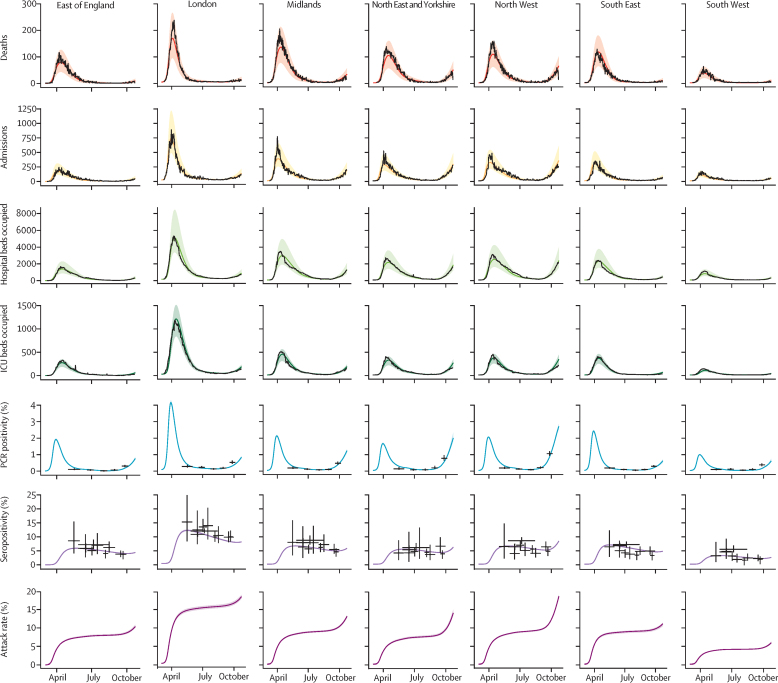
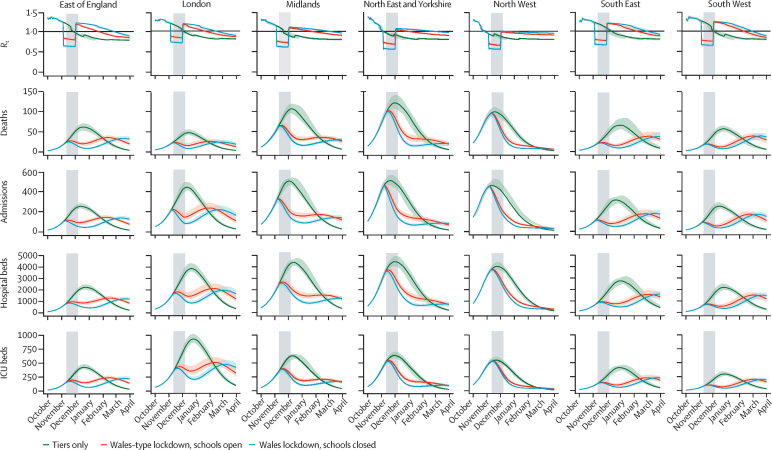
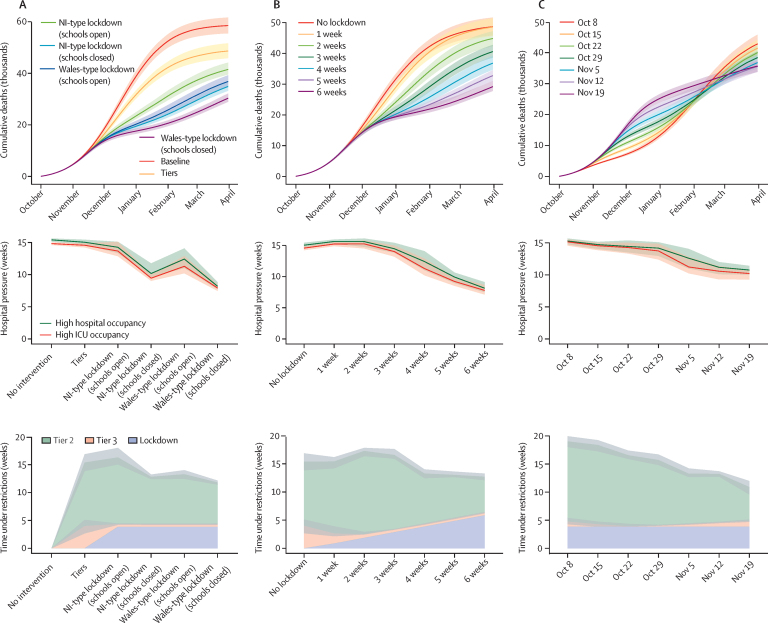
Background A second wave of COVID-19 cases in autumn, 2020, in England led to localised, tiered restrictions (so-called alert levels) and, subsequently, a second national lockdown. We examined the impact of these tiered restrictions, and alternatives for lockdown stringency, timing, and duration, on severe acute respiratory syndrome coronavirus 2 (SARS-CoV-2) transmission and hospital admissions and deaths from COVID-19. Methods We fit an age-structured mathematical model of SARS-CoV-2 transmission to data on hospital admissions and hospital bed occupancy (ISARIC4C/COVID-19 Clinical Information Network, National Health Service [NHS] England), seroprevalence (Office for National Statistics, UK Biobank, REACT-2 study), virology (REACT-1 study), and deaths (Public Health England) across the seven NHS England regions from March 1, to Oct 13, 2020. We analysed mobility (Google Community Mobility) and social contact (CoMix study) data to estimate the effect of tiered restrictions implemented in England, and of lockdowns implemented in Northern Ireland and Wales, in October, 2020, and projected epidemiological scenarios for England up to March 31, 2021. Findings We estimated a reduction in the effective reproduction number ( R t ) of 2% (95% credible interval [CrI] 0–4) for tier 2, 10% (6–14) for tier 3, 35% (30–41) for a Northern Ireland-stringency lockdown with schools closed, and 44% (37–49) for a Wales-stringency lockdown with schools closed. From Oct 1, 2020, to March 31, 2021, a projected COVID-19 epidemic without tiered restrictions or lockdown results in 280 000 (95% projection interval 274 000–287 000) hospital admissions and 58 500 (55 800–61 100) deaths. Tiered restrictions would reduce hospital admissions to 238 000 (231 000–245 000) and deaths to 48 600 (46 400–50 700). From Nov 5, 2020, a 4-week Wales-type lockdown with schools remaining open—similar to the lockdown measures announced in England in November, 2020—was projected to further reduce hospital admissions to 186 000 (179 000–193 000) and deaths to 36 800 (34 900–38 800). Closing schools was projected to further reduce hospital admissions to 157 000 (152 000–163 000) and deaths to 30 300 (29 000–31 900). A projected lockdown of greater than 4 weeks would reduce deaths but would bring diminishing returns in reducing peak pressure on hospital services. An earlier lockdown would have reduced deaths and hospitalisations in the short term, but would lead to a faster resurgence in cases after January, 2021. In a post-hoc analysis, we estimated that the second lockdown in England (Nov 5–Dec 2) reduced R t by 22% (95% CrI 15–29), rather than the 32% (25–39) reduction estimated for a Wales-stringency lockdown with schools open. Interpretation Lockdown measures outperform less stringent restrictions in reducing cumulative deaths. We projected that the lockdown policy announced to commence in England on Nov 5, with a similar stringency to the lockdown adopted in Wales, would reduce pressure on the health service and would be well timed to suppress deaths over the winter period, while allowing schools to remain open. Following completion of the analysis, we analysed new data from November, 2020, and found that despite similarities in policy, the second lockdown in England had a smaller impact on behaviour than did the second lockdown in Wales, resulting in more deaths and hospitalisations than we originally projected when focusing on a Wales-stringency scenario for the lockdown. Funding Horizon 2020, UK Medical Research Council, and the National Institute for Health Research.
Overview
The claims and statistics of this paper haven’t been checked yet.
Free: it reads the open-access text and checks the first 5 claims that cite a source we can check. Create a free account to check every claim.
Integrity signals
Registry
Cites
Statistics
Figures
Verification
Claims the paper makes
The claims and statistics of this paper haven’t been checked yet.
Free: it reads the open-access text and checks the first 5 claims that cite a source we can check. Create a free account to check every claim.
Self-check
Percentages, sums and reported differences re-computed from the paper’s own numbers.
The self-check needs the paper’s full text.
Citations
Cites
Docherty, A. B., Harrison, E. M., Green, C. A., Hardwick, H. E., Pius, R., Norman, L., Holden, K. A., Read, J. M., Dondelinger, F., Carson, G., et al. (2020) · BMJ · doi:10.1136/bmj.m1985 · Cited by 3,481
Self-citationSocial Contacts and Mixing Patterns Relevant to the Spread of Infectious Diseases
Mossong, J., Hens, N., Jit, M., Beutels, P., Auranen, K., Mikolajczyk, R., Massari, M., Salmaso, S., Tomba, G. S., Wallinga, J., et al. (2008) · PLoS Medicine · doi:10.1371/journal.pmed.0050074 · Cited by 2,900 · cited 1×
“To simulate school closure, we reduced contact rates according to the age-specific proportion of contacts made at school, 14 and further reduced all individuals’ contacts by a multiplicative factor we estimated during model fitting that was associated with the reopening of schools in England in…”
Self-citationAge-dependent effects in the transmission and control of COVID-19 epidemics
Davies, N. G., Klepac, P., Liu, Y., Prem, K., Jit, M., CMMID COVID-19 working group, Pearson, C. A. B., Quilty, B. J., Kucharski, A. J., Gibbs, H., et al. (2020) · Nature Medicine · doi:10.1038/s41591-020-0962-9 · Cited by 1,759
Self-citationEstimating the burden of SARS-CoV-2 in France
Salje, H., Tran Kiem, C., Lefrancq, N., Courtejoie, N., Bosetti, P., Paireau, J., Andronico, A., Hozé, N., Richet, J., Dubost, C.-L., et al. (2020) · Science · doi:10.1126/science.abc3517 · Cited by 1,038
Davies, N. G., Kucharski, A. J., Eggo, R. M., Gimma, A., Edmunds, W. J., Jombart, T., O'Reilly, K., Endo, A., Hellewell, J., Nightingale, E. S., et al. (2020) · The Lancet Public Health · doi:10.1016/s2468-2667(20)30133-x · Cited by 848 · cited 2×
“We used this approach both in fitting the model to policy changes over the first wave of the COVID-19 epidemic in England, and in estimating the impact of tiered restrictions in England and of lockdown interventions in Northern Ireland and Wales (appendix pp 1–5).”
Self-citationLevin, A. T., Hanage, W. P., Owusu-Boaitey, N., Cochran, K. B., Walsh, S. P., & Meyerowitz-Katz, G. (2020) · European Journal of Epidemiology · doi:10.1007/s10654-020-00698-1 · Cited by 844 · cited 2×
“The relative age-specific infection fatality risk was adopted from a global meta-analysis, 10 and the relative age-specific infection hospitalisation risk was adopted from a study of the COVID-19 epidemic in France; 11 given these relative age-specific rates, the overall infection fatality risk,…”
Genomic evidence for reinfection with SARS-CoV-2: a case study
Tillett, R. L., Sevinsky, J. R., Hartley, P. D., Kerwin, H., Crawford, N., Gorzalski, A., Laverdure, C., Verma, S. C., Rossetto, C. C., Jackson, D., et al. (2021) · The Lancet Infectious Diseases · doi:10.1016/s1473-3099(20)30764-7 · Cited by 754
Quantifying the impact of physical distance measures on the transmission of COVID-19 in the UK
CMMID COVID-19 working group, Jarvis, C. I., Van Zandvoort, K., Gimma, A., Prem, K., Klepac, P., Rubin, G. J., & Edmunds, W. J. (2020) · BMC Medicine · doi:10.1186/s12916-020-01597-8 · Cited by 720 · cited 2×
“We measured the relationship between anonymised mobility data collected from smart-phone users by Google Community Mobility 12 and fine-grained social-contact survey data from the CoMix study, 13 which has been collecting data on UK residents’ daily interpersonal contacts since late March, 2020.”
Self-citationFour-tier response system and spatial propagation of COVID-19 in China by a network model
Ge, J., He, D., Lin, Z., Zhu, H., & Zhuang, Z. (2020) · Mathematical Biosciences · doi:10.1016/j.mbs.2020.108484 · Cited by 45 · cited 1×
“15 Another study looking at short-term, so-called circuit breaker interventions in the UK found that such interventions have the biggest impact when the growth rate is low.”
Precautionary Breaks: Planned, Limited Duration Circuit Breaks to Control the Prevalence of COVID-19
Keeling, M. J., Guyver‐Fletcher, G., Holmes, A., Dyson, L., Tildesley, M. J., Hill, E. M., & Medley, G. F. (2020) · Epidemics · doi:10.1016/j.epidem.2021.100526 · Cited by 43
Cited by
Items 101–143 of 143
Moss, E. D., Rushton, S. P., Baker, P. N., Bashton, M., Crown, M. R., dos Santos, R. A. N., Nelson, A., O’Brien, S. J., Richards, Z., Sanderson, R., et al. (2024) · Peer Community Journal · doi:10.24072/pcjournal.461 · Cited by 2
“Our findings suggest that the local tier system of interventions was less effective at reducing cases than a long and strict national lockdown, which has also been found in other studies (Davies et al., 2021; Torres et al., 2022).”
InfluentialA Covid-19 Positive Case Prediction and People Movement Restriction Classification
Agastya, I. M. A. (2022) · International Journal of Advanced Computer Science and Applications · doi:10.14569/ijacsa.2022.0130828 · Cited by 2
Modelling COVID-19 mortality at the regional level in ItalyPreprint
Basellini, U., & Camarda, C. G. (2020) · SocArXiv (OSF Preprints) · doi:10.31235/osf.io/ykc6w · Cited by 2
Zhang, X. N., Hungerford, D., Green, M. A., García‐Fiñana, M., Buchan, I. E., & Barr, B. (2025) · BMJ Open · doi:10.1136/bmjopen-2024-086802 · Cited by 1
Wang, X., Chen, Y., Ta, Y., Guo, M., & Fu, H. (2025) · JMIR Public Health and Surveillance · doi:10.2196/69768 · Cited by 2
Unraveling the COVID-19 hospitalization dynamics in Spain using Bayesian inference
Aleta, A., Blas-Laína, J. L., Anglés, G. T., & Moreno, Y. (2023) · BMC Medical Research Methodology · doi:10.1186/s12874-023-01842-7 · Cited by 2
Nguyen, V. G., Liu, Y., Mumford, R., Flanagan, B., Patel, P., Braithwaite, I., Shrotri, M., Byrne, T., Beale, S., Aryee, A., et al. (2023) · JMIR Public Health and Surveillance · doi:10.2196/38072 · Cited by 4
“The UK response to the COVID-19 pandemic has included multiple rounds of restrictions on nonessential movement to reduce contacts and control transmission [1].”
BackgroundMoniz, M., Soares, P., Nunes, B., & Leite, A. (2024) · BMC Public Health · doi:10.1186/s12889-024-18369-1 · Cited by 1
“This suggested that the tiered restrictions system reduced the number of susceptible individuals in opposition to lock-downs as it lowered the infections in the short term, lowering the population’s immunity [16].”
BackgroundResultHourani, A., Abdelsalam, A. G., & Sürmeli, A. D. (2026) · BMC Infectious Diseases · doi:10.1186/s12879-025-12478-x · Cited by 1
“Stringent NPIs are effective tools for acute outbreak con-trol [47, 48], but strategies for their relaxation require careful planning and enhanced surveillance systems capable of detecting and responding to the resurgence of both the target pathogen and other infections.”
Assessment on serum CRP and serum ferritin level in COVID-19 patients of Dehradun Uttarakhand, India
Arya, S., Maqsood, T., Usmani, R., Prakash, V., Biswas, S., & Dar, M. A. (2023) · International Journal of Reproduction Contraception Obstetrics and Gynecology · doi:10.18203/2320-1770.ijrcog20230526
An exploration of the perceived impact of COVID-19 on physical activity of Irish adolescents
Ng, K., Britton, Ú., O’Brien, W., McFlynn, P., Connolly, S., MURPHY, M. H., & Woods, C. B. (2024) · Discover Public Health · doi:10.1186/s12982-024-00351-2 · Cited by 1
“The restrictions in Northern Ireland were outlined by the United Kingdom (UK) government and differed from those in the Republic of Ireland with a “stay at home except for accessing medical care, daily exercise, shopping for essentials, and essential work travel” [4].”
Yperen, J. V., Campillo-Funollet, E., & Madzvamuse, A. (2020) · arXiv (Cornell University) · Cited by 1
Inference of epidemic dynamics in the COVID-19 era and beyondPreprint
Cori, A., & Kucharski, A. J. (2024) · OSF Preprints (OSF Preprints) · doi:10.31219/osf.io/mg497 · Cited by 3
Effectiveness of Lockdown in Reducing the Spread of COVID-19
Puspita, A. S., Sukmana, J., Dewi, L., & Yatmasari, E. (2021) · Indian Journal of Forensic Medicine & Toxicology · doi:10.37506/ijfmt.v15i4.16656
Yılmaz, N., Akıllı, M., & Akdeniz, K. G. (2022) · Türkiye Halk Sağlığı Dergisi · doi:10.20518/tjph.1028261
Effectiveness of Various Prevention Measures in a Pandemic
Mohazzabi, P., Richardson, G., & Richardson, G. (2022) · Journal of Applied Mathematics and Physics · doi:10.4236/jamp.2022.104087
“Lockdowns are also thought to be most effective when implemented early on during the pandemic and not lifted too early [11] [12] [13].”
BackgroundFiler, J. L., Fleming, T. R., Morris, S., Upadhyay, N., Landham, P. R., Katsimihas, M., & Harding, I. (2022) · European Spine Journal · doi:10.1007/s00586-022-07382-w
Modelling plausible scenarios for the Omicron SARS-CoV-2 variant from early-stage surveillance
Banks, C. J., Colman, E. R., Wood, A. J., Doherty, T., & Kao, R. R. (2024) · Epidemics · doi:10.1016/j.epidem.2024.100800
El-Sharkawy, S., Abbas, N. F., & AbdEl-Aal, W. E. (2022) · Journal of The Arab Society for Medical Research · doi:10.4103/jasmr.jasmr_13_22
A Trendline and Predictive Analysis of the First-Wave COVID-19 Infections in Malta
Borg, M. G., & Borg, M. A. (2023) · Epidemiologia · doi:10.3390/epidemiologia4010003
“Studies have indicated that control measures have been effective [9,10], with a full lockdown imposition being the most effectual manner to mitigate the spread of the virus [11].”
BackgroundAvila, R. C. M., Fixsen, A. M., & Nadarzynski, T. (2022) · Graduate Student Journal of Psychology · doi:10.52214/gsjp.v18i.10926 · Cited by 1
Burton, H., & Gordon, K. (2023) · Journal of Applied Research in Intellectual Disabilities · doi:10.1111/jar.13095 · Cited by 1
A hospital demand and capacity intervention approach for COVID-19
Yperen, J. V., Campillo-Funollet, E., Inkpen, R., Memon, A., & Madzvamuse, A. (2023) · PLoS ONE · doi:10.1371/journal.pone.0283350 · Cited by 2
“Throughout the pandemic, the UK government has implemented a combination of non-pharmaceutical and pharmaceutical interventions for England to combat excessive COVID-19 infections in the community [1].”
BackgroundA Comprehensive analysis of covid-19: An overview
Sona, S., Neethu, J., Dilip, K. K. K., & Lal, P. M. L. (2023) · i-manager s Journal on Life Sciences · doi:10.26634/jls.2.1.19757
SERUM FERRITIN AND SERUM LACTATE DEHYDROGENASE LEVELS AMONG COVID-19 PATIENTS
KAPARUWAN, A. (2024) · Asian Journal of Pharmaceutical and Clinical Research · doi:10.22159/ajpcr.2024.v17i1.49572
Zhang, X. N., Hungerford, D., Green, M. A., García‐Fiñana, M., Buchan, I. E., & Barr, B. (2024) · medRxiv · doi:10.1101/2024.02.28.24303487
EpiCURB: Learning to Derive Epidemic Control Policies
Rusu, A. C., Farrahi, K., & Niranjan, M. (2024) · IEEE Pervasive Computing · doi:10.1109/mprv.2023.3329546 · Cited by 2
“9,10 A salient example is the U.K. government ’ s lockdown policy, which has faced frequent criticism for its suboptimal timing, as well as its laxity and inconsistency, that may have ultimately undermined its overall effectiveness.”
BackgroundFinch, E., Nilles, E. J., Paulino, C. T., Skewes-Ramm, R., Lau, C. L., Lowe, R., & Kucharski, A. J. (2024) · The Lancet Regional Health - Americas · doi:10.1016/j.lana.2024.100860 · Cited by 5
“23,29 School contact rates were set to zero during school closures and school holiday periods.”
BackgroundImpact of non-pharmacological interventions on the first wave of COVID-19 in Portugal 2020
Loyens, D. B., Caetano, C., & Dias, C. M. (2025) · Heliyon · doi:10.1016/j.heliyon.2024.e41569
“The half reduction parameter ( ν ) was expected to occur until two days after the start of the intervention and the final impact of the NPI ( η ) was expected to be at least 50 %, based on previous literature [3,4].”
Optimization of school closures during an Omicron epidemic in Hong Kong: a modelling study
Young, B. R., Ho, F. C. S., Lin, Y., Lau, E. H. Y., Wu, P., Cowling, B. J., & Tsang, T. K. (2025) · Interface Focus · doi:10.1098/rsfs.2025.0016
“…[31], adjusted over time for behavioural changes and public health measures using Google mobility data and govern-ment-reported school closures, assuming linear relationships between mobility and contact rates across settings, as detailed in electronic supplementary material appendix [32,33].”
The case for using flexible healthcare capacity constraints to optimise pandemic control strategiesPreprint
Doyle, N. J., Cumming, F., Finnie, T., West, M. A., Thompson, R. N., & Tildesley, M. J. (2025) · medRxiv · doi:10.1101/2025.10.09.25337668
The Three Acts of Pandemic Governance: A Comparison Between France, Germany, Italy, and the UK
Konechni, B. A., & Recchi, E. (2025) · Springer eBooks · doi:10.1007/978-3-031-99349-7_2
Xu, C., Bryzgalov, A., Horn, J., Jarynowski, A. K., Belik, V., Jaeger, V. K., Karch, A., Phuong, H. T., Suer, J., Zambrano, M., et al. (2026) · BMC Infectious Diseases · doi:10.1186/s12879-026-12940-4
Moniz, M., Soares, P., Nunes, B., & Leite, A. (2024) · Figshare · doi:10.6084/m9.figshare.25547100
Aleta, A., Blas-Laína, J. L., Anglés, G. T., & Moreno, Y. (2024) · Figshare · doi:10.6084/m9.figshare.26564148
Scott, S., McGowan, V., Wildman, J., Bidmead, E., Hartley, J., Mathews, C., James, B., Sullivan, C., Bambra, C., & Sowden, S. (2024) · Figshare · doi:10.6084/m9.figshare.24940979
Lindskou, T. A., Bogh, S. B., Kløjgaard, T. A., Fløjstrup, M., Folke, F., Væggemose, U., Christensen, H. C., Christensen, E. F., Brabrand, M., & Mikkelsen, S. (2024) · Figshare · doi:10.6084/m9.figshare.27071842
Moniz, M., Soares, P., Nunes, B., & Leite, A. (2024) · Figshare · doi:10.6084/m9.figshare.25546944
Scott, S., McGowan, V., Wildman, J., Bidmead, E., Hartley, J., Mathews, C., James, B., Sullivan, C., Bambra, C., & Sowden, S. (2024) · Figshare · doi:10.6084/m9.figshare.24940419
Li, T., Hu, Y., Wang, X. J., Li, X., Jia, Y., & Yang, L. (2026) · Nonlinear Dynamics · doi:10.1007/s11071-026-12619-0
“Recent modeling and data driven analyses frame epidemic control around two headline outcomes, how high the outbreak rises at its worst point and how many people are ultimately infected over the entire outbreak period, often reported as peak prevalence and total attack rate [22, 23].”
The case for using flexible healthcare capacity constraints to optimize pandemic control strategies
Doyle, N. J., Cumming, F., Finnie, T., West, M. A., Thompson, R. N., & Tildesley, M. J. (2026) · Journal of The Royal Society Interface · doi:10.1098/rsif.2025.1046
Huang, Z., Liu, W., Zhang, N., Guo, H., Jiang, X., Zheng, C., Ou, S.-H., Hong, C., Ye, J., Yang, X., et al. (2026) · Journal of Medical Virology · doi:10.1002/jmv.71112
“During the pandemic, nations worldwide implemented diverse containment strategies that significantly mitigated disease transmission and alleviated healthcare burdens [4–6].”
Javanmardi, J., Neusser, J., Rubio‐Acero, R., Kachel, S., Wallrafen-Sam, K., Hintze, J., Paunović, I., Schoof, I. C., Kletke, T., Muenchhoff, M., et al. (2026) · Microorganisms · doi:10.3390/microorganisms14102253
Metadata
- Authors
- Davies, N. G., Barnard, R. C., Jarvis, C. I., Russell, T. W., Semple, M. G., Jit, M., & Edmunds, W. J.
- Affiliations
- London School of Hygiene & Tropical Medicine (GB)
- University of Liverpool (GB)
- Corresponding author
- Davies, Nicholas G
- ORCID
- Venue
- The Lancet Infectious Diseases
- Publisher
- Elsevier BV
- Published
- 2021-04
- Volume
- 21
- Issue
- 4
- Pages
- 482-492
- ISSN
- 1473-3099 (ISSN-L)
- PMC
- PMC7758181
- OpenAlex
- W3114268739
- Semantic Scholar
- ce997768ca1111e3e81929e59bbdb8d5636b1898
- Cited by
- 142
- References
- 13
- Citations by year
- 2026: 7 · 2025: 13 · 2024: 28 · 2023: 15 · 2022: 37 · 2021: 38
- FWCI
- 3.70
- Type
- journal article
- Language
- en
- Open access
- hybrid
- doi.org
- Licence
- cc-by
- www.elsevier.com/tdm/userlicense/1.0/ (tdm)
- www.elsevier.com/legal/tdmrep-license (tdm)
- creativecommons.org/licenses/by/4.0/ (vor)
- Locations
- The Lancet Infectious Diseases (publishedVersion, cc-by)
- PubMed Central (publishedVersion, cc-by)
- PubMed (publishedVersion)
- LSHTM Research Online (London School of Hygiene and Tropical Medicine) (acceptedVersion)
- Funders
- Horizon 2020 (101003688)
- Seventh Framework Programme (602525)
- Foreign, Commonwealth and Development Office (215091/Z/18/Z)
- Wellcome Trust (206250/Z/17/Z)
- Medical Research Council (MC_PC_19065, MC_PC_19059)
- Department for International Development, UK Government
- Public Health England
- Research Councils UK
- Department of Health and Social Care
- National Institute for Health and Care Research
- National Institute for Health Research Health Protection Research Unit
- Bill and Melinda Gates Foundation (OPP1209135, INV-003174, INV-016832)
- Oxford University (200927, NIHR200908, 200907)
- Economic and Social Research Council (ES/P010873/1)
- Imperial Experimental Cancer Medicine Centre (C18616/A25153, CO-CIN-01, PR-OD-1017-20002)
- Topics
- Physical Sciences › Mathematics › Modeling and Simulation › COVID-19 epidemiological studies
- Social Sciences › Sociology and Political Science › COVID-19 Prevention and Impact
- Health Sciences › Medicine › Infectious Diseases › SARS-CoV-2 and COVID-19 Research
- Keywords
- COVID-19 pandemic, SARS-CoV-2 transmission, alert levels, lockdown, second wave, hospitalization, COVID-19 mortality, effective reproduction number, non-pharmaceutical interventions, school closures, social contact, epidemic projection, England, Northern Ireland, Wales, age-structured transmission model, seroprevalence, hospital bed occupancy
- MeSH terms
- COVID-19, SARS-CoV-2, Communicable Disease Control, England, Forecasting, Hospital Bed Capacity, Hospitalization, Hospitals, Humans, Intensive Care Units, Northern Ireland, State Medicine, Wales, Models, Statistical, Seroepidemiologic Studies, Basic Reproduction Number, Epidemics
About these checks
Registry, retraction, Cites and statistics results are computed, not judged, with one exception: a printed reference that no index lists is read once by a model before it counts as a citation error. Claims are extracted by a model and kept only when their quote appears verbatim in the text; each cited source is then checked, with a model’s help, for whether it says what the claim relies on. Those verdicts can be wrong — read the claim’s quote and the cited source before relying on one.
Statistics and arithmetic are recomputed, not judged.
Confidence bands are shown only for fields calibrated on our annotated test set. None is calibrated yet, so no band is shown.
What counts as a claim ›How we measure confidence ›How we check this ›
Are you an author, or do you see a problem with this page? Request a review
Data sources
Bibliographic data: Semantic Scholar, OpenAlex, Crossref.
Contains information from the Semantic Scholar Academic Graph Datasets, made available under the ODC Attribution License (ODC-BY 1.0).
Semantic Scholar’s data is described in: Kinney, R., et al. (2023). The Semantic Scholar Open Data Platform. arXiv:2301.10140.
