

Aerobic exercise training during pregnancy reduces depressive symptoms in nulliparous women: a randomised trial
Open accessThe DOI matches its Crossref record; 42 of the 42 references it cites were found in a registry or an index.
Abstract
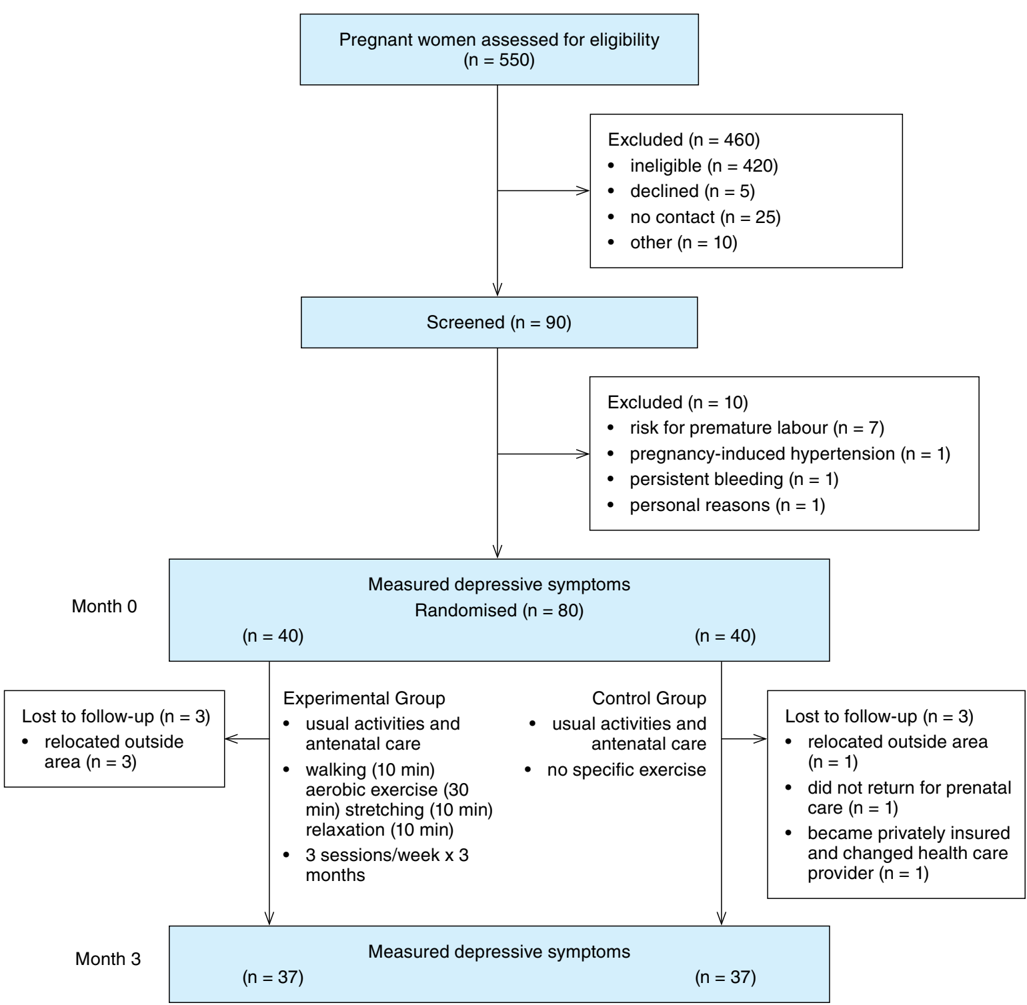
QUESTION: Does supervised aerobic exercise during pregnancy reduce depressive symptoms in nulliparous women? DESIGN: Randomised trial with concealed allocation, blinded assessors, and intention-to-treat analysis. PARTICIPANTS: 80 nulliparous, pregnant women attending for prenatal care at one of three tertiary hospitals in Cali, Colombia. INTERVENTION: The experimental group completed a 3-month supervised exercise program, commencing at 16 to 20 weeks of gestation. Each session included walking (10 min), aerobic exercise (30 min), stretching (10 min), and relaxation (10 min). The control group continued usual activities and performed no specific exercise. OUTCOME MEASURES: The primary outcome was symptoms of depression assessed by the Center for Epidemiological Studies Depression Scale (CES-D) at baseline and immediately after the 3-month intervention. RESULTS: 74 women completed the study. After the 3-month intervention, the experimental group reduced their depressive symptoms on the CES-D questionnaire by 4 points (95% CI 1 to 7) more than the control group. CONCLUSIONS: A supervised 3-month program of primarily aerobic exercise during pregnancy reduces depressive symptoms. TRIAL REGISTRATION: NCT00872365.
Overview
The claims and statistics of this paper haven’t been checked yet.
Free: it reads the open-access text and checks the first 5 claims that cite a source we can check. Create a free account to check every claim.
Integrity signals
Registry
Cites
Statistics
Figures
Verification
Claims the paper makes
The claims and statistics of this paper haven’t been checked yet.
Free: it reads the open-access text and checks the first 5 claims that cite a source we can check. Create a free account to check every claim.
Claims other papers make about this one
Each is checked against this paper’s own text: does it say what the citing paper says it does?
The cited source says what the claim attributes to it.
In the citing paper
“Moderate-to-vigorous-intensity interventions showed improvements in depression symptoms,40 47 52–55 anxiety symptoms,40 47 52 55 59 60 self-esteem40 52 and mood states.52 62”
From Physical activity and exercise in youth mental health promotion: a scoping review (2020) · cites this paper as [54]
In the citing paper
“Studies of both antenatal aerobic exercise [77] and general physical activity [78] in women without MDD, have shown that exercise or physical activity was associated with fewer depressive symptoms in pregnancy.”
From Complementary and alternative medicine therapies for perinatal depression (2014) · cites this paper as [77]
Self-check
Percentages, sums and reported differences re-computed from the paper’s own numbers.
The self-check needs the paper’s full text.
Citations
Cites
Psychophysical bases of perceived exertion
BORG, G. A. V. (1982) · Medicine & Science in Sports & Exercise · doi:10.1249/00005768-198205000-00012 · Cited by 16,580 · cited 1×
“Aerobic activities were prescribed at moderate to vigorous intensity, aiming for 55–75% of maximal heart rate and adjusted according to ratings on the Borg scale (Borg 1982).”
MethodExercise and Physical Activity for Older Adults
Chodzko-Zajko, W. J., Proctor, D. N., Fiatarone Singh, M. A., Minson, C. T., Nigg, C. R., Salem, G. J., & Skinner, J. S. (2009) · Medicine & Science in Sports & Exercise · doi:10.1249/mss.0b013e3181a0c95c · Cited by 5,153
American College of Sports Medicine position stand
Otis, C. L. (1997) · Medical Entomology and Zoology · Cited by 4,407
Physical Activity and Mental Health: Current Concepts
Paluska, S. A., & Schwenk, T. L. (2000) · Sports Medicine · doi:10.2165/00007256-200029030-00003 · Cited by 1,722
The Journal of Mental Health Policy and Economics
(2006) · The Journal of Mental Health Policy and Economics · doi:10.1002/(issn)1099-176x · Cited by 1,243
Exercise for the treatment of depression and anxiety
Carek, P. J., Laibstain, S. E., & Carek, S. M. (2011) · The International Journal of Psychiatry in Medicine · doi:10.2190/pm.41.1.c · Cited by 797 · cited 1×
“Results from review articles and meta-analyses also indicate an inverse relationship between physical activity and depressive symptoms (Paluska and Schwenk 2000, Rethorst et al 2009, Carek et al 2011).”
BackgroundArtal, R., & O'Toole, M. (2003) · British Journal of Sports Medicine · doi:10.1136/bjsm.37.1.6 · Cited by 726
Prenatal depression effects on early development: A review
Field, T. (2011) · Infant Behavior and Development · doi:10.1016/j.infbeh.2010.09.008 · Cited by 592 · cited 1×
“For example, depressed women are more likely to deliver prematurely (Field 2011) and they often have neonates who require intensive care for postnatal complications including growth retardation and bronchopulmonary dysplasia (Chung et al 2001).”
BackgroundThe Antidepressive Effects of Exercise: A Meta-Analysis of Randomized Trials
Rethorst, C. D., Wipfli, B. M., & Landers, D. M. (2009) · Sports Medicine · doi:10.2165/00007256-200939060-00004 · Cited by 541
Jablensky, A. V., Morgan, V., Zubrick, S. R., Bower, C., & Yellachich, L.-A. (2005) · American Journal of Psychiatry · doi:10.1176/appi.ajp.162.1.79 · Cited by 505 · cited 1×
“The importance of prenatal intervention is highlighted by studies showing that depression is associated with increased risk of prenatal and perinatal complications (Jablensky et al 2005, Nakano et al 2004).”
BackgroundAntepartum Depressive Symptomatology Is Associated With Adverse Obstetric and Neonatal Outcomes
Chung, T. K. H., Lau, T. K., Yip, A. S. K., Chiu, H. F. K., & Lee, D. T. S. (2001) · Psychosomatic Medicine · doi:10.1097/00006842-200109000-00017 · Cited by 501 · cited 1×
“For example, depressed women are more likely to deliver prematurely (Field 2011) and they often have neonates who require intensive care for postnatal complications including growth retardation and bronchopulmonary dysplasia (Chung et al 2001).”
BackgroundPsychiatric Disorder in Pregnancy and the First Postnatal Year
Watson, J. P., Elliott, S. A., Rugg, A. J., & Brough, D. I. (1984) · British Journal of Psychiatry · doi:10.1192/bjp.144.5.453 · Cited by 477 · cited 1×
“Journal of Physiotherapy 2012 Vol. 58 – © Australian Physiotherapy Association 201210 depression and psychosis, occur during pregnancy and in the immediate postpartum period (Watson et al 1984).”
BackgroundYonkers, K. A., Wisner, K. L., Stewart, D. E., Oberlander, T. F., Dell, D. L., Stotland, N., Ramin, S., Chaudron, L., & Lockwood, C. (2009) · General Hospital Psychiatry · doi:10.1016/j.genhosppsych.2009.04.003 · Cited by 469 · cited 2×
“Depression is also associated with failure to eat well and seek prenatal care (Yonkers et al 2009).”
BackgroundBrown, D. W., Balluz, L. S., Heath, G. W., Moriarty, D. G., Ford, E. S., Giles, W. H., & Mokdad, A. H. (2003) · Preventive Medicine · doi:10.1016/s0091-7435(03)00179-8 · Cited by 445 · cited 1×
“In particular, social functioning, and mental health are critically affected by the recommended level of physical activity (Brown et al 2003).”
BackgroundDietz, P. M., Williams, S. B., Callaghan, W. M., Bachman, D. J., Whitlock, E. P., & Hornbrook, M. C. (2007) · American Journal of Psychiatry · doi:10.1176/appi.ajp.2007.06111893 · Cited by 351 · cited 1×
“…pregnancy is more common among women with a history of depression or a family history of depression, those in single motherhood or with more than three children, cigarette smokers, low income earners, teenagers, and those in unsupportive social situations (Dietz et al 2007, Yonkers et al 2009).”
BackgroundDempsey, J. C. (2004) · American Journal of Epidemiology · doi:10.1093/aje/kwh091 · Cited by 292 · cited 2×
“…associated with other clinical benefits such as the prevention of maternal hypertension (Yeo et al 2000, Barakat et al 2009) and gestational diabetes (Dempsey et al 2004, Callaway et al 2010), as well as improved wellbeing and quality of life (Ramírez-Vélez 2011a, Montoya Arizabaleta et al 2010).”
BackgroundLeisure Time Physical Activity in Australian Women: Relationship with Well Being and Symptoms
Brown, W. J., Mishra, G., Lee, C., & Bauman, A. (2000) · Research Quarterly for Exercise and Sport · doi:10.1080/02701367.2000.10608901 · Cited by 279 · cited 1×
“Further studies may be needed to explore the relationships among psychological status, physical function, and quality of life during pregnancy with depressive symptoms (Brown et al 2000, Ramírez-Vélez et al 2011a, Montoya Arizabaleta et al 2010).”
BackgroundSusceptibility and precipitating factors in depression: Sex differences and similarities.
Radloff, L. S., & Rae, D. S. (1979) · Journal of Abnormal Psychology · doi:10.1037//0021-843x.88.2.174 · Cited by 198 · cited 1×
“A score of 16 on the CESD is considered the cut-point for depression (Radloff and Rae 1979).”
BackgroundChanges in functional health status during normal pregnancy.
Hueston, W. J., & Kasik-Miller, S. (1998) · PubMed · Cited by 169
Carter, A. S., Baker, C. W., & Brownell, K. D. (2000) · Psychosomatic Medicine · doi:10.1097/00006842-200003000-00019 · Cited by 145 · cited 1×
“Assuming that the standard deviation in this score would be 6, similar to that observed in a similar sample of women during pregnancy (Carter et al 2000), a total sample size of 74 would provide 80% power to detect a difference of 4 points as statistically significant.”
ResultPrevention of Gestational Diabetes
Callaway, L. K., Colditz, P. B., Byrne, N. M., Lingwood, B. E., Rowlands, I. J., Foxcroft, K., McIntyre, H. D., & for the BAMBINO Group (2010) · Diabetes Care · doi:10.2337/dc09-2336 · Cited by 141
Aerobic exercise during pregnancy improves health-related quality of life: a randomised trial
Arizabaleta, A. V. M., Buitrago, L. O., de Plata, A. C. A., Mosquera, M., & Ramírez‐Vélez, R. (2010) · Journal of physiotherapy · doi:10.1016/s1836-9553(10)70008-4 · Cited by 126 · cited 5×
“…to the maternal-foetal unit and may prevent the occurrence of maternal disorders, such as hypertension (Yeo et al 2000, Barakat et al 2009) and gestational diabetes (Dempsey et al 2004, Callaway et al 2010), as well as improving well-being and quality of life (Montoya Arizabaleta et al 2010).”
BackgroundInfluentialSelf-citationDoes exercise training during pregnancy affect gestational age? A randomised controlled trial
Barakat, R., Stirling, J. R., & Lucia, A. (2008) · British Journal of Sports Medicine · doi:10.1136/bjsm.2008.047837 · Cited by 121 · cited 1×
“In addition, several studies over the last decade have reported that physical activity has few negative effects for many pregnant women (Alderman et al 1998, Artal and O’Toole 2003, Barakat et al 2008, Barakat et al 2009).”
BackgroundBarakat, R., Ruiz, J. R., Stirling, J. R., Zakynthinaki, M. S., & Lucía, A. (2009) · American Journal of Obstetrics and Gynecology · doi:10.1016/j.ajog.2009.06.004 · Cited by 115 · cited 3×
“…appears to be beneficial to the maternal-foetal unit and may prevent the occurrence of maternal disorders, such as hypertension (Yeo et al 2000, Barakat et al 2009) and gestational diabetes (Dempsey et al 2004, Callaway et al 2010), as well as improving well-being and quality of life (Montoya…”
BackgroundUsing epidemiological data to model efficiency in reducing the burden of depression
Andrews, G., Sanderson, K., Corry, J., & Lapsley, H. M. (2000) · The Journal of Mental Health Policy and Economics · doi:10.1002/mhp.96 · Cited by 110 · cited 1×
“The worldwide prevalence of depression has been estimated at 10.4% (Andrews et al 2000).”
BackgroundInfluentialThe prevalence of depressive symptoms in college students
Wells, V. E., Klerman, G. L., & Deykin, E. Y. (1987) · Social Psychiatry and Psychiatric Epidemiology · doi:10.1007/bf00583616 · Cited by 105 · cited 1×
“The 20-item scale has adequate test-retest reliability, internal consistency, and concurrent validity (Wells et al 1987).”
Pre- and postnatal depression and coping: a comparative approach
de Tychey, C., Spitz, É., Briançon, S., Lighezzolo‐Alnot, J., Girvan, F., Rosati, A., Thockler, A., & Vincent, S. (2004) · Journal of Affective Disorders · doi:10.1016/j.jad.2004.11.004 · Cited by 98 · cited 2×
“During pregnancy, depression affects 10–50% of women, with the incidence being higher in cohorts with low socioeconomic status (De Tychey et al 2005).”
BackgroundAntenatal depression: a rationale for studying exercise
Shivakumar, G., Brandon, A. R., Snell, P. G., Santiago-Munoz, P. C., Johnson, N. L., Trivedi, M. H., & Freeman, M. P. (2010) · Depression and Anxiety · doi:10.1002/da.20777 · Cited by 83 · cited 1×
“A recent systematic review of the effect of exercise on antenatal depression found a small number of observational studies linking regular physical activity to improved selfesteem and reduced symptoms of anxiety and depression during pregnancy (Shivakumar et al 2011).”
BackgroundYeo, S. A., Steele, N., Chang, M. C., Leclaire, S., Ronis, D. L., & Hayashi, R. (2000) · PubMed · Cited by 81
Maternal Physical Activity in Pregnancy and Infant Size for Gestational Age
Alderman, B. W., Zhao, H., Holt, V. L., Watts, D. H., & Beresford, S. A. A. (1998) · Annals of Epidemiology · doi:10.1016/s1047-2797(98)00020-9 · Cited by 78 · cited 1×
“In addition, several studies over the last decade have reported that physical activity has few negative effects for many pregnant women (Alderman et al 1998, Artal and O’Toole 2003, Barakat et al 2008, Barakat et al 2009).”
BackgroundIntervention Study of Exercise for Depressive Symptoms in Women
Craft, L. L., Freund, K. M., Culpepper, L., & Perna, F. M. (2007) · Journal of Women's Health · doi:10.1089/jwh.2007.0483 · Cited by 75
Physical activity and depressive symptoms among pregnant women: the PIN3 study
Demissie, Z., Siega-Riz, A. M., Evenson, K. R., Herring, A. H., Dole, N., & Gaynes, B. N. (2011) · Archives of Women's Mental Health · doi:10.1007/s00737-010-0193-z · Cited by 64 · cited 1×
“For example, low levels of physical activity, self-care ability, and antenatal support are associated with depression in pregnant women (Demissie et al 2011).”
BackgroundField, T., Deeds, O., Diego, M., Hernandez-Reif, M., Gauler, A., Sullivan, S., Wilson, D., & Nearing, G. (2009) · Journal of Bodywork and Movement Therapies · doi:10.1016/j.jbmt.2008.10.002 · Cited by 62 · cited 3×
“Furthermore, although pregnant women typically report significantly lower rates of tobacco, alcohol, and cannabis use than before pregnancy (Hotham et al 2008), depression increases vulnerability to caffeine, nicotine, drug, and alcohol use in pregnant women (De Tychey et al 2005, Field et al 2009).”
BackgroundNakano, Y., Oshima, M., Sugiura‐Ogasawara, M., Aoki, K., Kitamura, T., & Furukawa, T. A. (2004) · Acta Psychiatrica Scandinavica · doi:10.1111/j.1600-0047.2004.00273.x · Cited by 55 · cited 1×
“The importance of prenatal intervention is highlighted by studies showing that depression is associated with increased risk of prenatal and perinatal complications (Jablensky et al 2005, Nakano et al 2004).”
BackgroundHOTHAM, E., ALI, R., WHITE, J., & ROBINSON, J. (2008) · Australian and New Zealand Journal of Obstetrics and Gynaecology · doi:10.1111/j.1479-828x.2008.00827.x · Cited by 45 · cited 1×
“Furthermore, although pregnant women typically report significantly lower rates of tobacco, alcohol, and cannabis use than before pregnancy (Hotham et al 2008), depression increases vulnerability to caffeine, nicotine, drug, and alcohol use in pregnant women (De Tychey et al 2005, Field et al 2009).”
BackgroundPregnancy and health-related quality of life: A cross sectional study
Ramírez‐Vélez, R. (2019) · Colombia medica · doi:10.25100/cm.v42i4.948 · Cited by 45 · cited 1×
“…associated with other clinical benefits such as the prevention of maternal hypertension (Yeo et al 2000, Barakat et al 2009) and gestational diabetes (Dempsey et al 2004, Callaway et al 2010), as well as improved wellbeing and quality of life (Ramírez-Vélez 2011a, Montoya Arizabaleta et al 2010).”
BackgroundSelf-citationMatthews, M. M., Hsu, F., Walkup, M. P., Barry, L. C., Patel, K. V., & Blair, S. N. (2011) · Journal of the American Geriatrics Society · doi:10.1111/j.1532-5415.2011.03319.x · Cited by 43
The state of the American Journal of Obstetrics & Gynecology: 2009
Garite, T. J., & Kim, M. H. (2009) · American Journal of Obstetrics and Gynecology · doi:10.1016/j.ajog.2009.05.043 · Cited by 37
Pregnancy and health-related quality of life: A cross sectional study
Ramírez‐Vélez, R. (2011) · TSpace (University of Toronto) · Cited by 28
Self-citationRamírez‐Vélez, R., Aguilar, A., Mosquera, M., Garcia, R. G., Reyes, L. M., & López-Jaramillo, P. A. (2009) · Trials · doi:10.1186/1745-6215-10-104 · Cited by 28 · cited 1×
“All subjects wore a heart-rate monitor during the training sessions to ensure that exercise intensity was moderate to vigorous (Ramírez-Vélez et al 2009, RamírezVélez et al 2011b).”
BackgroundSelf-citationRamírez‐Vélez, R., Romero, M., Echeverri, I., Ortega, J. G., Mosquera, M., Salazar, B., Giron, S., Saldarriaga, W., de Plata, A. C. A., & Mateus, J. C. (2011) · Trials · doi:10.1186/1745-6215-12-60 · Cited by 25 · cited 1×
“Further studies may be needed to explore the relationships among psychological status, physical function, and quality of life during pregnancy with depressive symptoms (Brown et al 2000, Ramírez-Vélez et al 2011a, Montoya Arizabaleta et al 2010).”
BackgroundSelf-citationBarakat, R., Ruiz, J. R., Stirling, J. R., Zakynthinaki, M. S., & Lucía, A. (2010) · Obstetrical & Gynecological Survey · doi:10.1097/ogx.0b013e3181d3ddf8 · Cited by 16
Cited by
Cooney, G. M., Dwan, K., Greig, C. A., Lawlor, D. A., Rimer, J., Waugh, F. R., McMurdo, M., & Mead, G. E. (2013) · Cochrane Database of Systematic Reviews · doi:10.1002/14651858.cd004366.pub6 · Cited by 1,834
Exercise as a treatment for depression: A meta-analysis
Kvam, S., Kleppe, C. L., Nordhus, I. H., & Hovland, A. (2016) · Journal of Affective Disorders · doi:10.1016/j.jad.2016.03.063 · Cited by 837
“…et al., 2011; Perna et al., 2010; Pfaff et al., 2014; Pinniger et al., 2012; Pischke et al., 2010; Reid et al., 2010; Rethorst et al., 2011, 2010; Robledo-Colonia et al., 2012; Rosenberg et al., 2010; Sabapathy et al., 2011; Sañudo et al., 2012, 2011, 2010; Scheewe et al., 2013; Setaro, 1985;…”
Physical activity and exercise in youth mental health promotion: a scoping review
Pascoe, M., Bailey, A. P., Craike, M., Carter, T., Patten, R., Stepto, N., & Parker, A. (2020) · BMJ Open Sport & Exercise Medicine · doi:10.1136/bmjsem-2019-000677 · Cited by 332
Physical exercise during pregnancy: a systematic review
Nascimento, S. L., Surita, F. G., & Cecatti, J. G. (2012) · Current Opinion in Obstetrics & Gynecology · doi:10.1097/gco.0b013e328359f131 · Cited by 300
Attitudes, barriers and enablers to physical activity in pregnant women: a systematic review
Harrison, A. L., Taylor, N. F., Shields, N., & Frawley, H. C. (2018) · Journal of Physiotherapy · doi:10.1016/j.jphys.2017.11.012 · Cited by 269
Metadata
- Authors
- Robledo-Colonia, A. F., Sandoval-Restrepo, N., Mosquera-Valderrama, Y. F., Escobar-Hurtado, C., & Ramírez-Vélez, R.
- Affiliations
- Universidad del Valle (CO)
- Venue
- Journal of Physiotherapy
- Publisher
- Elsevier BV
- Published
- 2012-03
- Volume
- 58
- Issue
- 1
- Pages
- 9-15
- ISSN
- 1836-9553 (ISSN-L)
- OpenAlex
- W2001307865
- Cited by
- 156
- References
- 42
- Citations by year
- 2026: 8 · 2025: 6 · 2024: 14 · 2023: 5 · 2022: 15 · 2021: 13 · 2020: 13 · 2019: 9 · 2018: 8 · 2017: 13 · 2016: 11 · 2015: 8 · 2014: 11 · 2013: 13 · 2012: 9
- FWCI
- 12.66
- Type
- journal article
- Language
- en
- Open access
- gold
- doi.org
- Licence
- cc-by-nc-nd
- www.elsevier.com/tdm/userlicense/1.0/ (tdm)
- creativecommons.org/licenses/by-nc-nd/3.0/ (vor, 720 d)
- Locations
- Journal of physiotherapy (publishedVersion, cc-by-nc-nd)
- PubMed (publishedVersion)
- LA Referencia (Red Federada de Repositorios Institucionales de Publicaciones Científicas) (submittedVersion, other-oa)
- Funders
- Departamento Administrativo de Ciencia, Tecnología e Innovación (COLCIENCIAS)
- Instituto Colombiano de Crédito Educativo y Estudios Técnicos en el Exterior
- Topics
- Health Sciences › Medicine › Public Health, Environmental and Occupational Health › Maternal Mental Health During Pregnancy and Postpartum
- Health Sciences › Medicine › Public Health, Environmental and Occupational Health › Physical Activity and Health
- Health Sciences › Medicine › Obstetrics and Gynecology › Pregnancy-related medical research
- Keywords
- aerobic exercise, pregnancy, depressive symptoms, nulliparous women, supervised exercise, prenatal care, exercise during pregnancy, walking, relaxation
- MeSH terms
- Adolescent, Depression, Female, Humans, Parity, Pregnancy, Pregnancy Complications, Exercise, Treatment Outcome, Physical Therapy Modalities, Young Adult
About these checks
Registry, retraction, Cites and statistics results are computed, not judged, with one exception: a printed reference that no index lists is read once by a model before it counts as a citation error. Claims are extracted by a model and kept only when their quote appears verbatim in the text; each cited source is then checked, with a model’s help, for whether it says what the claim relies on. Those verdicts can be wrong — read the claim’s quote and the cited source before relying on one.
Statistics and arithmetic are recomputed, not judged.
Confidence bands are shown only for fields calibrated on our annotated test set. None is calibrated yet, so no band is shown.
What counts as a claim ›How we measure confidence ›How we check this ›
Are you an author, or do you see a problem with this page? Request a review
Data sources
Bibliographic data: Semantic Scholar, OpenAlex, Crossref.
Contains information from the Semantic Scholar Academic Graph Datasets, made available under the ODC Attribution License (ODC-BY 1.0).
Semantic Scholar’s data is described in: Kinney, R., et al. (2023). The Semantic Scholar Open Data Platform. arXiv:2301.10140.
