

National, regional, and state-level all-cause and cause-specific under-5 mortality in India in 2000–15: a systematic analysis with implications for the Sustainable Development Goals
Open accessThe DOI matches its Crossref record; 42 of the 42 references it cites were found in a registry or an index.
Abstract
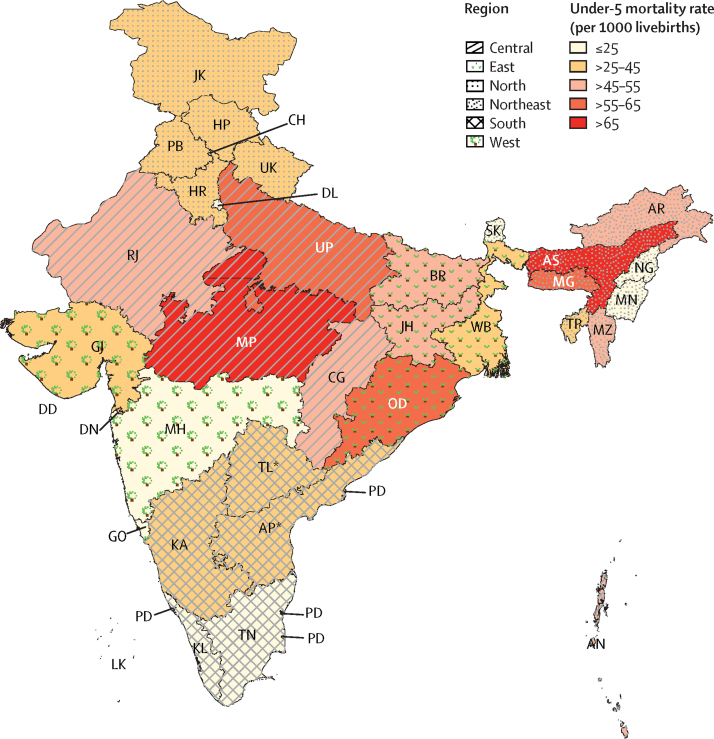
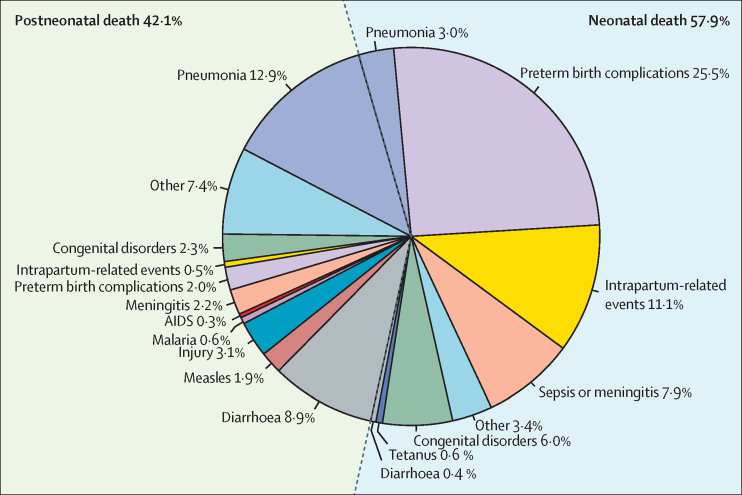
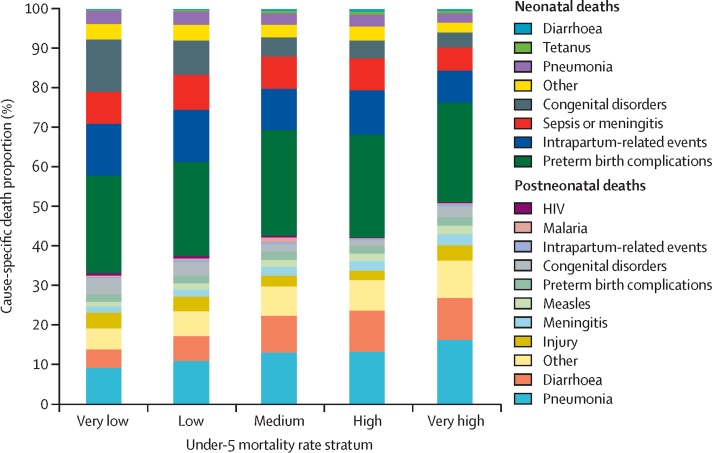
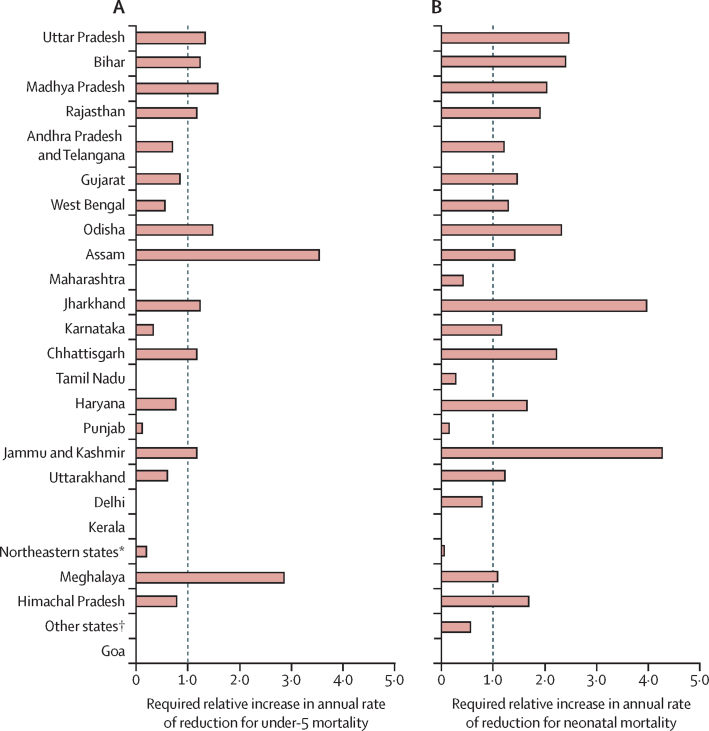
BACKGROUND: India had the largest number of under-5 deaths of all countries in 2015, with substantial subnational disparities. We estimated national and subnational all-cause and cause-specific mortality among children younger than 5 years annually in 2000-15 in India to understand progress made and to consider implications for achieving the Sustainable Development Goal (SDG) child survival targets. METHODS: We used a multicause model to estimate cause-specific mortality proportions in neonates and children aged 1-59 months at the state level, with causes of death grouped into pneumonia, diarrhoea, meningitis, injury, measles, congenital abnormalities, preterm birth complications, intrapartum-related events, and other causes. AIDS and malaria were estimated separately. The model was based on verbal autopsy studies representing more than 100 000 neonatal deaths globally and 16 962 deaths among children aged 1-59 months at the subnational level in India. By applying these proportions to all-cause deaths by state, we estimated cause-specific numbers of deaths and mortality rates at the state, regional, and national levels. FINDINGS: In 2015, there were 25·121 million livebirths in India and 1·201 million under-5 deaths (under-5 mortality rate 47·81 per 1000 livebirths). 0·696 million (57·9%) of these deaths occurred in neonates. There were disparities in child mortality across states (from 9·7 deaths [Goa] to 73·1 deaths [Assam] per 1000 livebirths) and regions (from 29·7 deaths [the south] to 63·8 deaths [the northeast] per 1000 livebirths). Overall, the leading causes of under-5 deaths were preterm birth complications (0·330 million [95% uncertainty range 0·279-0·367]; 27·5% of under-5 deaths), pneumonia (0·191 million [0·168-0·219]; 15·9%), and intrapartum-related events (0·139 million [0·116-0·165]; 11·6%), with cause-of-death distributions varying across states and regions. In states with very high under-5 mortality, infectious-disease-related causes (pneumonia and diarrhoea) were among the three leading causes, whereas the three leading causes were all non-communicable in states with very low mortality. Most states had a slower decline in neonatal mortality than in mortality among children aged 1-59 months. Ten major states must accelerate progress to achieve the SDG under-5 mortality target, while 17 are not on track to meet the neonatal mortality target. INTERPRETATION: Efforts to reduce vaccine-preventable deaths and to reduce geographical disparities should continue to maintain progress achieved in 2000-15. Enhanced policies and programmes are needed to accelerate mortality reduction in high-burden states and among neonates to achieve the SDG child survival targets in India by 2030. FUNDING: Bill & Melinda Gates Foundation.
Overview
The claims and statistics of this paper haven’t been checked yet.
Free: it reads the open-access text and checks the first 5 claims that cite a source we can check. Create a free account to check every claim.
Integrity signals
Registry
Cites
Statistics
Figures
Verification
Claims the paper makes
The claims and statistics of this paper haven’t been checked yet.
Free: it reads the open-access text and checks the first 5 claims that cite a source we can check. Create a free account to check every claim.
Self-check
Percentages, sums and reported differences re-computed from the paper’s own numbers.
The self-check needs the paper’s full text.
Citations
Cites
Transforming Our World: The 2030 Agenda for Sustainable Development
(2018) · A New Era in Global Health · doi:10.1891/9780826190123.ap02 · Cited by 19,351
World Population Prospects The 2006 Revision
Zlotnik, H. (2007) · United Nations eBooks · Cited by 7,971
Naghavi, M., Abajobir, A. A., Abbafati, C., Abbas, K. M., Abd-Allah, F., Abera, S. F., Aboyans, V., Adetokunboh, O., Afshin, A., Agrawal, A., et al. (2017) · The Lancet · doi:10.1016/s0140-6736(17)32152-9 · Cited by 4,821
Liu, L., Johnson, H. L., Cousens, S., Perin, J., Scott, S., Lawn, J. E., Rudan, I., Campbell, H., Cibulskis, R., Li, M., et al. (2012) · The Lancet · doi:10.1016/s0140-6736(12)60560-1 · Cited by 3,934
Self-citationLiu, L., Oza, S., Hogan, D., Chu, Y., Perin, J., Zhu, J., Lawn, J. E., Cousens, S., Mathers, C., & Black, R. E. (2016) · The Lancet · doi:10.1016/s0140-6736(16)31593-8 · Cited by 3,453
Self-citationLiu, L., Oza, S., Hogan, D., Perin, J., Rudan, I., Lawn, J. E., Cousens, S., Mathers, C., & Black, R. E. (2015) · The Lancet · doi:10.1016/s0140-6736(14)61698-6 · Cited by 3,167
Self-citationGlobal, regional, and national causes of child mortality in 2008: a systematic analysis
Black, R. E., Cousens, S., Johnson, H. L., Lawn, J. E., Rudan, I., Bassani, D. G., Jha, P., Campbell, H., Walker, C. F., Cibulskis, R., et al. (2010) · The Lancet · doi:10.1016/s0140-6736(10)60549-1 · Cited by 3,058
Self-citationEvery Newborn: progress, priorities, and potential beyond survival
Lawn, J. E., Blencowe, H., Oza, S., You, D., Lee, A. C., Waiswa, P., Lalli, M., Bhutta, Z., Barros, A. J., Christian, P., et al. (2014) · The Lancet · doi:10.1016/s0140-6736(14)60496-7 · Cited by 1,929
Self-citationBhutta, Z. A., Das, J. K., Bahl, R., Lawn, J. E., Salam, R. A., Paul, V. K., Sankar, M. J., Blencowe, H., Rizvi, A., Chou, V. B., et al. (2014) · The Lancet · doi:10.1016/s0140-6736(14)60792-3 · Cited by 1,367
Self-citationWahl, B., O'Brien, K. L., Greenbaum, A., Majumder, A., Liu, L., Chu, Y., Lukšić, I., Nair, H., McAllister, D. A., Campbell, H., et al. (2018) · The Lancet Global Health · doi:10.1016/s2214-109x(18)30247-x · Cited by 1,118
Self-citation
Research works printed but not linked: 2
- Press Information Bureau, Ministry of Health and Family Welfare, Government of India. Shri JP Nadda launches expansion of rotavirus vaccine under Universal Immunization Programme. http://pib.nic. in/newsite/PrintRelease.aspx?relid=158549 (accessed April 16, 2018).
- Ramachandran SK. Mapping family's health through unvaccinated kids. The Hindu. March 28, 2015. http://www.thehindu.com/sci- tech/health/mapping-familys-health-through-unvaccinated-kids/ article7041516.ece (accessed March 16, 2018).
Cited by
Items 101–143 of 143
Suraksh—Intrapartum Monitoring Application: In the Era of Distancing and Digitalization
Desai, T., Kumari, U., & Vaidyanathan, S. (2021) · Journal of South Asian Federation of Obstetrics and Gynaecology · doi:10.5005/jp-journals-10006-1816 · Cited by 1
Choudhary, M. L., Joshi, P., Murry, L. L., Malhotra, S., & Sankar, M. J. (2021) · International Journal of Community Medicine and Public Health · doi:10.18203/2394-6040.ijcmph20211215 · Cited by 3
“Significant steps have been taken to reduce maternal and child mortality, but we still could not meet target 4 of the Millennium Development Goals (MDG 4) of a two-thirds reduction in under-five mortality rate between 1990 and 2015.(1) Now with Sustainable Development Goals (SDGs), it is aimed to reduce neonatal morta…”
BackgroundReview on Infectious Diseases in India and their respective diagnostic platforms.
Chandranand, P. (2021) · International Journal for Research in Applied Science and Engineering Technology · doi:10.22214/ijraset.2021.39025 · Cited by 1
Vinshula, J., Johnson, A. R., Menezes, A. R., Joseph, M., Srilekha, C., Priya, S., & Jennifer, J. (2022) · Indian Journal of Child Health · doi:10.32677/ijch.v9i5.3427 · Cited by 1
“India accounts for the largest proportion of under-5 mortality in the world with sub-national variations [1].”
BackgroundPrediction and Analysis of Infant Mortality Based on Grey Prediction Model GM(1,1)
黄, 治. (2022) · Advances in Applied Mathematics · doi:10.12677/aam.2022.1111826 · Cited by 1
Magill, N., Shivalli, S., Fazzio, I., Elbourne, D. R., Keddie, S., Reddy, P., Nair, R., Gopal, M., Karnati, S., Reddy, H., et al. (2024) · Trials · doi:10.1186/s13063-024-08056-2 · Cited by 1
Do educated politicians facilitate better public health? Evidence from India
Anil, D. S., Sahoo, S., & Pakrashi, D. (2025) · Social Science & Medicine · doi:10.1016/j.socscimed.2024.117671 · Cited by 1
Satyesh, S., Meena, R. K., Shah, D., Saha, R., & Gupta, P. (2025) · Indian Pediatrics · doi:10.1007/s13312-025-00049-x · Cited by 1
“Diarrheal illnesses are the second leading cause of under-five mortality beyond neonatal age in India [1].”
Understanding health trends in Ladakh region insights into disease patterns and social dynamics
Khanday, A. A., Kumar, M. A., Rather, G. M., & Ahmed, R. (2025) · Discover Public Health · doi:10.1186/s12982-025-00503-y · Cited by 2
Jamison, A., Ganjoo, R., Tharmarajah, S., Panda, B. K., Parida, M., Pandey, S., Pandey, M., Mohanty, S., & Rimal, R. N. (2025) · PLOS Global Public Health · doi:10.1371/journal.pgph.0005157 · Cited by 1
“Since 1985, India’s Universal Immunization Programme (UIP) has provided federally funded vaccines to more than 25 million children annually [17,18].”
Regional mortality variations among older adults in India: Evidence from Demographic Health SurveyPreprint
Akhtar, S. N., & Saikia, N. (2022) · medRxiv · doi:10.1101/2022.05.22.22275427 · Cited by 1
“, 2016; Jain, 1985), child (Bora, 2020; Liu et al., 2019) and adult mortality (Panda & Mishra, 2021; Saikia et al.”
Awasthi, S., & Awasthi, A. (2019) · The Lancet Global Health · doi:10.1016/s2214-109x(19)30160-3
Optimum Duration of Antibiotics in Acute Bacterial Meningitis: Where Do We Stand?
Dash, N., & Sahu, J. K. (2021) · The Indian Journal of Pediatrics · doi:10.1007/s12098-021-03677-w
Birth Defects: A Public Health Approach
Kar, A. (2021) · Springer eBooks · doi:10.1007/978-981-16-1554-2_1
Ghia, C. J., Horn, E. K., Rambhad, G. S., Perdrizet, J. E., Chitale, R., & Wasserman, M. (2021) · Infectious Diseases and Therapy · doi:10.1007/s40121-021-00526-3
A prospective observational study depicting role of lung ultrasound in pediatric pneumonias
Saklani, A., Tomar, A., Kapila, S., Kaushik, S. L., & Mahajan, A. (2021) · International Journal of Contemporary Pediatrics · doi:10.18203/2349-3291.ijcp20213319
Sayed, M., Mithbhavkar, V. D., & Mall, A. (2022) · INTERNATIONAL JOURNAL OF SCIENTIFIC RESEARCH · doi:10.36106/ijsr/9707063
Essays on the economics of childhood vaccinations
Summan, A. (2022) · doi:10.18174/579890
Chandy, P., Criel, B., & Lakshmi, L. (2022) · Manipal Journal of Nursing and Health Sciences · doi:10.55889/2582-7979.1257
Kiplagat, S. J. (2021) · FIU - Digital Commons (Florida International University) · doi:10.25148/etd.fidc010282
Epigenetic vs Proteomic Biomarkers in Preterm Prediction: A Prospective Study
Rangaiah, N., Puttaraju, C. M., Sailakshmi, M. P. A., Rao, H. R. H. M., Somanna, P., & Sampath, R. (2023) · Journal of South Asian Federation of Obstetrics and Gynaecology · doi:10.5005/jp-journals-10006-2206
Beş yaş altı çocuk ölümlerinin nedenleri ve aşılanma durumlarının değerlendirilmesi
Yazıcıoğlu, B., Oruç, M. A., TÜRKAN, S., Yaşayancan, Ö., & Yavuz, E. (2023) · Turkish Journal of Family Medicine & Primary Care · doi:10.21763/tjfmpc.1220680
Baluja, J. R., Ranjalkar, J., Mathew, P., Chandy, S. J., Ranganathan, R., & Thomas, S. A. (2023) · Research Square · doi:10.21203/rs.3.rs-3588733/v1
Tripathy, A., Tripathy, T., Das, S., Singh, D. P., Sahu, D. R., Dwivedi, R. K., & Gautam, M. (2023) · International Journal of Science and Research (IJSR) · doi:10.21275/sr23830104822
Self-citationSocio-demographic variables for child immunisation among Khatik population of Delhi
Sharma, K., Kumar, N., Kshatriya, G. K., & Deb, R. (2024) · Current Medicine Research and Practice · doi:10.4103/cmrp.cmrp_222_23
Singhal, A., Agrawal, A., Parihar, R., Sahu, N., & Upadhyay, J. (2024) · International Journal of Community Medicine and Public Health · doi:10.18203/2394-6040.ijcmph20240930
Washington, M., Macaden, L., Mony, P. K., Selvam, S., & Smith, A. (2025) · PLoS ONE · doi:10.1371/journal.pone.0308738
State of Neonatal Health in India: Where are We and How Do We Improve It?
Maria, A. (2021) · Health and population. Perspectives and issues · doi:10.5005/hppi-11041-44101
Dr. Deepak, K., Dr. Kiran Raj, H., Shetty, D. H. R., Dias, D. E., Naik, D. P., & Dr. Shruthi, M. (2025) · Journal of Population Therapeutics and Clinical Pharmacology · doi:10.53555/kcxdhd16
Jones, J. C. M., Rouamba, T., Bognini, J. D., Camara, B., Nakakana, U. N., Somé, A. M., Beloum, N., Nassa, G. J. W., Sillah, F., Sawadogo, E. Y., et al. (2025) · medRxiv · doi:10.1101/2025.10.25.25338790
Magill, N., Shivalli, S., Fazzio, I., Elbourne, D., Keddie, S., Reddy, P., Nair, R., Gopal, M., Karnati, S., Reddy, H., et al. (2024) · Figshare · doi:10.6084/m9.figshare.26712314
Pal, A., Pawar, D., & Sharma, A. (2024) · International Journal of Pharmaceutical and Clinical Research · doi:10.5281/zenodo.14250977 · Cited by 1
Son, G.-H., Choi, S. Y., Ju, Y.-J., Lee, K.-Y., Lee, J. J., Song, J.-E., Kim, Y., & Park, S. T. (2021) · Figshare · doi:10.6084/m9.figshare.14111216
Son, G.-H., Choi, S. Y., Ju, Y.-J., Lee, K.-Y., Lee, J. J., Song, J.-E., Kim, Y., & Park, S. T. (2021) · Figshare · doi:10.6084/m9.figshare.14111210
Srivastava, K., Yadav, R., Pelly, L., Hamilton, E. R., Kapoor, G. A., Mishra, A. M., Anis, P., & Crockett, M. E. (2021) · Figshare · doi:10.6084/m9.figshare.16944506
Ghosal, J., Bal, M., Das, A., Panda, B., Ranjit, M., Behera, M. R., Kar, S., Satpathy, S. K., Dutta, A., & Pati, S. (2024) · Figshare · doi:10.6084/m9.figshare.26670654
Srivastava, K., Yadav, R., Pelly, L., Hamilton, E. R., Kapoor, G. A., Mishra, A. M., Anis, P., & Crockett, M. E. (2021) · Figshare · doi:10.6084/m9.figshare.16944509
Parvathy, V. R., Thakur, P., Thakur, V., Sharma, V., Bora, I., Ratho, R. K., Angurana, S. K., & Singh, M. P. (2026) · Iranian Journal of Microbiology · doi:10.18502/ijm.v18i1.21031
“%) to mortality in children <5 years, despite a substantial decline in acute respiratory infection prevalence from 5.6% in 2005-2006 to 2.7% in 2015-2016 (2).”
InfluentialNon-communicable Disease Prevention and Control in the Asia–Pacific
Shiu, B. (2026) · Springer eBooks · doi:10.1007/978-981-97-1788-0_47-1
Toward a clean drinking water act for India: A review of drinking water quality standards
Singh, A., Shrinivas, A., Suraj, A., & Naik, G. (2026) · World Development · doi:10.1016/j.worlddev.2026.107433
Non-communicable Disease Prevention and Control in the Asia–Pacific
Shiu, B. (2026) · Springer eBooks · doi:10.1007/978-981-95-2175-3_47
Bahl, A., Sharma, D., Aggarwal, A. K., P, J. K., & Kiran, T. (2021) · International Journal of Health Systems and Implementation Research
Metadata
- Authors
- Liu, L., Chu, Y., Oza, S., Hogan, D., Perin, J., Bassani, D. G., Ram, U., Fadel, S. A., Pandey, A., Dhingra, N., Sahu, D., Kumar, P., Cibulskis, R., Wahl, B., Shet, A., Mathers, C., Lawn, J., Jha, P., Kumar, R., Black, R. E., & Cousens, S.
- Affiliations
- Johns Hopkins University (US)
- United Nations Development Programme (US)
- Corresponding author
- Liu, Li
- ORCID
- Venue
- The Lancet Global Health
- Publisher
- Elsevier BV
- Published
- 2019-06
- Volume
- 7
- Issue
- 6
- Pages
- e721-e734
- ISSN
- 2214-109X (ISSN-L)
- PMC
- PMC6527517
- OpenAlex
- W2945603311
- Semantic Scholar
- 0943bf43875d5e65397a3afd05bc71411378d622
- Cited by
- 134
- References
- 42
- Citations by year
- 2026: 8 · 2025: 11 · 2024: 16 · 2023: 19 · 2022: 24 · 2021: 32 · 2020: 21 · 2019: 3
- FWCI
- 20.80
- Type
- journal article
- Language
- en
- Open access
- gold
- doi.org
- Licence
- cc-by
- www.elsevier.com/tdm/userlicense/1.0/ (tdm)
- www.elsevier.com/legal/tdmrep-license (tdm)
- creativecommons.org/licenses/by/4.0/ (vor)
- Locations
- The Lancet Global Health (publishedVersion, cc-by)
- PubMed Central (publishedVersion, cc-by)
- PubMed (publishedVersion)
- LSHTM Research Online (London School of Hygiene and Tropical Medicine) (acceptedVersion)
- DOAJ (DOAJ: Directory of Open Access Journals) (submittedVersion)
- Funders
- Bill and Melinda Gates Foundation
- Topics
- Health Sciences › Medicine › Pediatrics, Perinatology and Child Health › Global Maternal and Child Health
- Health Sciences › Medicine › Pediatrics, Perinatology and Child Health › Maternal and Neonatal Healthcare
- Health Sciences › Nursing › Nutrition and Dietetics › Child Nutrition and Water Access
- Keywords
- under-five mortality, child mortality, neonatal mortality, subnational disparities, cause-specific mortality, preterm birth complications, pneumonia, verbal autopsy, Sustainable Development Goals, India
- MeSH terms
- Sustainable Development, Cause of Death, Child, Preschool, Humans, India, Infant, Infant Mortality, Child Mortality
About these checks
Registry, retraction, Cites and statistics results are computed, not judged, with one exception: a printed reference that no index lists is read once by a model before it counts as a citation error. Claims are extracted by a model and kept only when their quote appears verbatim in the text; each cited source is then checked, with a model’s help, for whether it says what the claim relies on. Those verdicts can be wrong — read the claim’s quote and the cited source before relying on one.
Statistics and arithmetic are recomputed, not judged.
Confidence bands are shown only for fields calibrated on our annotated test set. None is calibrated yet, so no band is shown.
What counts as a claim ›How we measure confidence ›How we check this ›
Are you an author, or do you see a problem with this page? Request a review
Data sources
Bibliographic data: Semantic Scholar, OpenAlex, Crossref.
Contains information from the Semantic Scholar Academic Graph Datasets, made available under the ODC Attribution License (ODC-BY 1.0).
Semantic Scholar’s data is described in: Kinney, R., et al. (2023). The Semantic Scholar Open Data Platform. arXiv:2301.10140.
