

The DOI matches its Crossref record; 28 of the 32 references it cites were found in a registry or an index.
Frequency and management of maternal infection in health facilities in 52 countries (GLOSS): a 1-week inception cohort study
Open accessAbstract
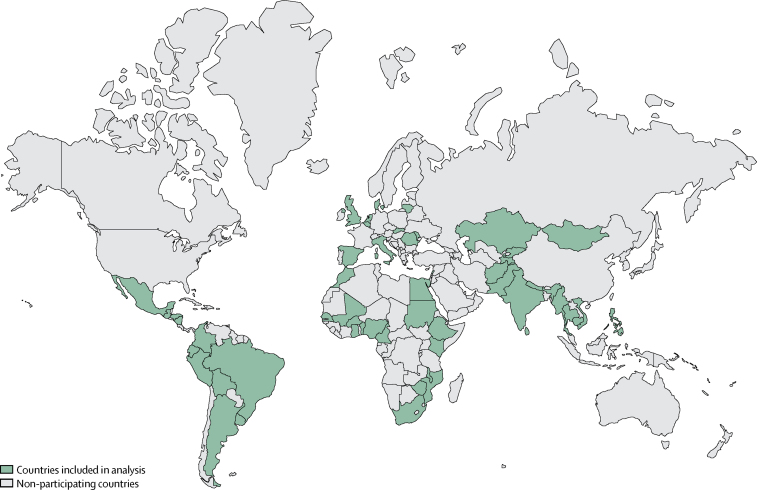
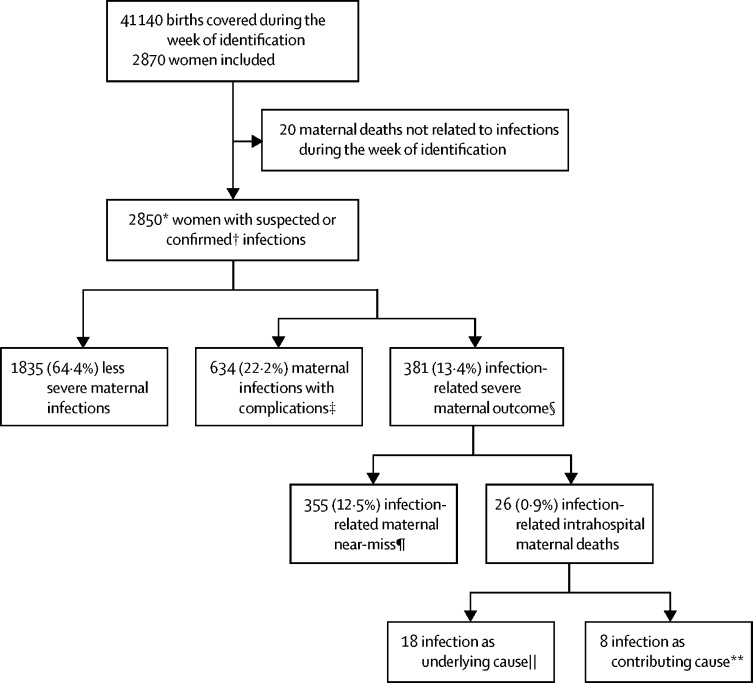
BACKGROUND: Maternal infections are an important cause of maternal mortality and severe maternal morbidity. We report the main findings of the WHO Global Maternal Sepsis Study, which aimed to assess the frequency of maternal infections in health facilities, according to maternal characteristics and outcomes, and coverage of core practices for early identification and management. METHODS: We did a facility-based, prospective, 1-week inception cohort study in 713 health facilities providing obstetric, midwifery, or abortion care, or where women could be admitted because of complications of pregnancy, childbirth, post-partum, or post-abortion, in 52 low-income and middle-income countries (LMICs) and high-income countries (HICs). We obtained data from hospital records for all pregnant or recently pregnant women hospitalised with suspected or confirmed infection. We calculated ratios of infection and infection-related severe maternal outcomes (ie, death or near-miss) per 1000 livebirths and the proportion of intrahospital fatalities across country income groups, as well as the distribution of demographic, obstetric, clinical characteristics and outcomes, and coverage of a set of core practices for identification and management across infection severity groups. FINDINGS: Between Nov 28, 2017, and Dec 4, 2017, of 2965 women assessed for eligibility, 2850 pregnant or recently pregnant women with suspected or confirmed infection were included. 70·4 (95% CI 67·7-73·1) hospitalised women per 1000 livebirths had a maternal infection, and 10·9 (9·8-12·0) women per 1000 livebirths presented with infection-related (underlying or contributing cause) severe maternal outcomes. Highest ratios were observed in LMICs and the lowest in HICs. The proportion of intrahospital fatalities was 6·8% among women with severe maternal outcomes, with the highest proportion in low-income countries. Infection-related maternal deaths represented more than half of the intrahospital deaths. Around two-thirds (63·9%, n=1821) of the women had a complete set of vital signs recorded, or received antimicrobials the day of suspicion or diagnosis of the infection (70·2%, n=1875), without marked differences across severity groups. INTERPRETATION: The frequency of maternal infections requiring management in health facilities is high. Our results suggest that contribution of direct (obstetric) and indirect (non-obstetric) infections to overall maternal deaths is greater than previously thought. Improvement of early identification is urgently needed, as well as prompt management of women with infections in health facilities by implementing effective evidence-based practices. FUNDING: UNDP-UNFPA-UNICEF-WHO-World Bank Special Programme of Research, Development and Research Training in Human Reproduction, WHO, Merck for Mothers, and United States Agency for International Development.
Overview
The claims and statistics of this paper haven’t been checked yet.
Run the check — free, no account needed. It reads the open-access text and checks the sources it cites.
Integrity signals
Registry
Cites
Statistics
Figures
Verification
Claims the paper makes
The claims and statistics of this paper haven’t been checked yet.
Run the check — free, no account needed. It reads the open-access text and checks the sources it cites.
Claims other papers make about this one
Each is checked against this paper’s own text: does it say what the citing paper says it does?
The source backs part of the claim, not all of it — or backs it for a different population, condition or comparison.
In the citing paper
“which overlaps with early manifestations of infection, making early identification difficult”
From Clinical and Pathogenic Characteristics of 45 Cases of Bloodstream Infection in Obstetrics: A Clinical Analysis (2026) · cites this paper as [2]
Experimental — accuracy not yet measuredThe check wasn’t confident either way, so it gives no verdict — never disputed.
In the citing paper
“The global burden of maternal deaths is highest in Sub-Saharan Africa (SSA) [4, 5].”
From The aetiology and antimicrobial resistance of bacterial maternal infections in Sub-Saharan Africa—a systematic review and meta-analysis (2024) · cites this paper as [4]
Experimental — accuracy not yet measured
Self-check
Percentages, sums and reported differences re-computed from the paper’s own numbers.
The self-check needs the paper’s full text.
Citations
Cites
(1954) · doi:10.5694/j.1326-5377.1954.tb66294.x · Cited by 105,830
The third international consensus definitions for sepsis and septic shock (Sepsis-3).
Singer, M., Deutschman, C. S., Seymour, C. W., Shankar-Hari, M., Annane, D., Bauer, M., Bellomo, R., Bernard, G. R., Chiche, J.-D., Coopersmith, C. M., et al. (2016) · JAMA · doi:10.1001/jama.2016.0287 · Cited by 28,250
James, S. L., Abate, D., Abate, K. H., Abay, S. M., Abbafati, C., Abbasi, N., Abbastabar, H., Abd-Allah, F., Abdela, J., Abdelalim, A., et al. (2018) · The Lancet · doi:10.1016/s0140-6736(18)32279-7 · Cited by 13,867
Vos, T., Abajobir, A. A., Abate, K. H., Abbafati, C., Abbas, K. M., Abd-Allah, F., Abdulkader, R. S., Abdulle, A. M., Abebo, T. A., Abera, S. F., et al. (2017) · The Lancet · doi:10.1016/s0140-6736(17)32154-2 · Cited by 13,220
Rudd, K. E., Johnson, S. C., Agesa, K. M., Shackelford, K. A., Tsoi, D., Kievlan, D. R., Colombara, D. V., Ikuta, K. S., Kissoon, N., Finfer, S., et al. (2020) · The Lancet · doi:10.1016/s0140-6736(19)32989-7 · Cited by 7,971
Global causes of maternal death: a WHO systematic analysis
Say, L., Chou, D., Gemmill, A., Tunçalp, Ö., Moller, A.-B., Daniels, J., Gülmezoglu, A. M., Temmerman, M., & Alkema, L. (2014) · The Lancet Global Health · doi:10.1016/s2214-109x(14)70227-x · Cited by 6,582
Self-citationDeveloping a New Definition and Assessing New Clinical Criteria for Septic Shock
Shankar‐Hari, M., Phillips, G. S., Levy, M. L., Seymour, C. W., Liu, V. X., Deutschman, C. S., Angus, D. C., Rubenfeld, G. D., Singer, M., & for the Sepsis Definitions Task Force (2016) · JAMA · doi:10.1001/jama.2016.0289 · Cited by 2,499
Global Guidelines for the Prevention of Surgical Site Infection
Allegranzi, B., Bischoff, P., Kubilay, Z., de Jonge, S. D., Zayed, B., Sudan, R., Allen, T., Carreno, J., Solomkin, J., Egger, M., et al. (2016) · Bern Open Repository and Information System (University of Bern) · doi:10.7892/boris.89831 · Cited by 1,260
Souza, J. P., Gülmezoglu, A. M., Vogel, J., Carroli, G., Lumbiganon, P., Qureshi, Z., Costa, M. J., Fawole, B., Mugerwa, Y., Nafiou, I., et al. (2013) · The Lancet · doi:10.1016/s0140-6736(13)60686-8 · Cited by 757
Self-citationA global view of severe maternal morbidity: moving beyond maternal mortality
GELLER, S. E., Koch, A. R., Garland, C. E., MacDonald, E. J., Storey, F., & LAWTON, B. A. (2018) · Reproductive Health · doi:10.1186/s12978-018-0527-2 · Cited by 426
Research works printed but not linked: 1
- Cebekhulu, 2018, Too little, too late: the recurrent theme in maternal deaths due to sepsis, O&G Forum, 28, 9
Cited by
Sorted by citations
Items 101–123 of 123
Vogel, J. P., Homer, C. S. E., Bruinsma, F., Babona, D., Blackburn, K., Jayaratnam, S., Nguyen, L., Spotswood, N. E., Волошин, А. Р., Bonet, M., et al. (2026) · BMC Public Health · doi:10.1186/s12889-026-26468-4
Self-citationAntiseptic Cleansing to Reduce Vertical Transmission of Pathogens to Neonates
Beales, E. R., Clements, M., Feasey, N., Lissauer, D., Banda, M., Maseko, B., Bielicki, J. A., Lissauer, S., Bennett, A., Kawaza, K., et al. (2026) · JAMA Network Open · doi:10.1001/jamanetworkopen.2026.15665
Self-citationMicrobiology Trends among Postcesarean Surgical Site Infections at a Large Public Hospital
Kurzeja, A., Mulder, I. A., Zofkie, A. C., Taherzadeh, D., Madriz, D., Morgan, K., Roberts, S. W., Gorman, A. R., Pruszynski, J. E., & Adhikari, E. H. (2026) · American Journal of Perinatology · doi:10.1055/a-2952-2152
Seale, A., Kebede, M., Glazik, R., Brhane, M., Berihun, M., Teklemariam, Z., Marami, D., Oundo, J., Admasu, A. Y., Tesfaye, T., et al. (2026) · BMC Pregnancy and Childbirth · doi:10.1186/s12884-026-09068-3
“The recent WHO Global Maternal Sepsis Study (GLOSS), high-lighted the frequency of symptomatic maternal infection, especially in low-and middle-income countries [5], with systematic screening to ascertain clinically-defined cases of possible infection.”
Agampodi, T., Kim, H. Y., Menike, D., Aswaddumage, D., Sewwandi, M., Warnasekara, J. N., Jayasundara, D., Senavirathna, I., Kappagoda, C., Zellweger, R. M., et al. (2026) · BMC Infectious Diseases · doi:10.1186/s12879-026-12650-x
“Global data indicates that 33.9% of infection-related maternal hospital admissions and 27.9% of infection-related severe maternal outcomes occur during the antenatal period [3].”
InfluentialTunn, R., & Knight, M. (2026) · NIHR Open Research · doi:10.3310/nihropenres.14196.1
Self-citationHookham, L., Alger, J., Ramírez, F. A. D., Dissanayake, O., Frem, J. A., Herrera, O., Makanjuola, O., Martin-Jorge, I., Leach, J., Cross, J., et al. (2025) · Wellcome Open Research · doi:10.12688/wellcomeopenres.24905.1
Thompson, K., Yan, S., Low, G., & Henry, A. (2025) · Frontiers in Global Women's Health · doi:10.3389/fgwh.2025.1532500
Editorial: Women in infectious agents and disease: 2024
Holban, A. M., Alva-Murillo, N., Khaiboullina, S. F., & Chen, Z. (2025) · Frontiers in Microbiology · doi:10.3389/fmicb.2025.1694902
Sal-Sarria, S., González‐Pardo, H., & Conejo, N. M. (2025) · Physiology & Behavior · doi:10.1016/j.physbeh.2025.115109
Chapuma, C., Kamchedzera, W., Weeks, A., Jafali, J., Mndala, L., Masoamphambe, E., Kulapani, D., & Otieku, E. (2025) · Wellcome Open Research · doi:10.12688/wellcomeopenres.24007.1
Hirani, F., Ariff, S., Nathwani, A., Peerwani, G., Kalbarczyk, A., Sultana, S., Kazi, A. M., Yousuf, F., Lefevre, A. E., Bhutta, S., et al. (2025) · Reproductive Health · doi:10.1186/s12978-025-01981-8
“…reported that 11/1000 women with PP sepsis or suspected infections suffer from severe maternal outcomes, averaging the case fatality rate to 6.8%, which increases in low-middle-income countries (LMICs) to 15%, with every 15/1000 women having severe maternal complications due to sepsis or death [4].”
InfluentialUnveiling the potential role of the shock index in maternal sepsis: reality or fantasy?
Escobar, M. F., Ramos, I., Guerra, K. M., Franco, N. S., Galindo-Sánchez, J. S., Libreros-Peña, L., Peña-Zarate, E. E., Guevara-Calderón, L. A., Gómez-Moreno, H., & Echavarría, M. (2025) · Journal of Maternal-Fetal & Neonatal Medicine · doi:10.1080/14767058.2025.2453999
“Additionally, the GLOSS study and a secondary analysis of the WHO global maternal sepsis found that variables such as preeclampsia and severe hemorrhage contribute to the development of maternal sepsis [23,24], findings that were also observed in our study (Table 3 and Table S2).”
QUALITY OF CARE AND TREATMENT ON EMERGENT THREATS FOR MATERNAL AND NEWBORN
Iwamizu, Y., Dewi, B. R., Lisnawati, N., & Sriatmi, A. (2024) · Jurnal manajemen kesehatan Indonesia · doi:10.14710/jmki.12.3.2024.275-282
Adherence to sepsis protocol in a high-risk maternity reference center
de Moraes, M. M., dos Santos, A. A. P., Leitão, J. D. D. S. D. S., Farias, K. F. F. D. L., Silva, N. A. D. S., Tavares, N. V. D. S., de Melo, K. O. R. C., & Comassetto, I. (2024) · Revista Brasileira de Enfermagem · doi:10.1590/0034-7167-2023-0453
“With a high fatality rate, it ranks among the top three causes of maternal mortality globally, accounting for approximately 260,000 deaths annually (2) .”
BackgroundWhite Blood Cells Exchange Prevalence among Pregnant Women in Duhok and Zakho Governorate, Iraq
Rasheed, B. (2024) · Ain Shams Medical Journal · doi:10.21608/asmj.2024.269844.1221
“Pregnant women's serum contains inhibitory chemicals that decrease phagocytic activity and neutrophil chemotaxis (4) .”
BackgroundSurviving maternal sepsis: Clinical, laboratory, and treatment features
Ribeiro-do-Valle, C. C., Luz, A., Pacagnella, R., & Cecatti, J. G. (2024) · International journal of gynaecology and obstetrics: the official organ of the International Federation of Gynaecology and Obstetrics · doi:10.1002/ijgo.15440
“We found the same sources of infections as previous studies, 6,8,9,17–19 urinary, genital and respiratory tracts.”
Self-citationStatus Epilepticus Following Labor in a Remote Area: A Case Report of Puerperal Sepsis
Silalahi, A. M., Johansyah, T. K. P., Gusti, A., & Siswantoro, C. (2023) · Jurnal Kesehatan Reproduksi · doi:10.22146/jkr.87457
Kulikov, A. V., Shifman, E. M., Николаевич, П. Д., Ovezov, A. M., Ronenson, A. M., Raspopin, Y. S., Артымук, Н. В., Belokrinitskaya, T. E., Золотухин, К. Н., Щеголев, А. В., et al. (2023) · Annals of critical care · doi:10.21320/1818-474x-2023-2-7-44 · Cited by 1
Chapuma, C., van der Veer, C., Monk, E., Selemani, A., Kulapani, D., Dunlop, C., Feasey, N., & Lissauer, D. (2021) · Research Square · doi:10.21203/rs.3.rs-1194785/v1
“The World Health Organization (WHO) proposes a new definition for maternal sepsis which we will use for this systematic review to describe any “symptomatic maternal bacterial infection”.”
BackgroundInfluentialSelf-citationAntibiotic prophylaxis after operative vaginal birth: the ANODE randomized controlled trial
Knight, M. (2020) · doi:10.1016/j.ogrm.2020.07.004
Self-citationBalestre, M. E., Lino, I. G. T., da Silva, M. E. P., Prata, J., Couto, T. M., Vieira, V. C. D. L., Pizzol, E. D. S. R. D., & Marcon, S. (2026) · Revista Brasileira de Enfermagem · doi:10.1590/0034-7167-2025-0521pt
Adesão ao protocolo de sepse em uma maternidade de referência para alto risco
de Moraes, M. M., dos Santos, A. A. P., Leitão, J. D. D. S. D. S., Farias, K. F. F. D. L., Silva, N. A. D. S., Tavares, N. V. D. S., de Melo, K. O. R. C., & Comassetto, I. (2024) · Revista Brasileira de Enfermagem · doi:10.1590/0034-7167-2023-0453pt
Metadata
- Authors
- Bonet, M., Brizuela, V., Abalos, E., Cuesta, C., Baguiya, A., Chamillard, M., Fawole, B., Knight, M., Kouanda, S., Lumbiganon, P., Nabhan, A., Nadisauskiene, R. J., Abdulkadir, A., Adanu, R. M., Aman, M. I., Arriaga Romero, W. E., Assarag, B., Bloemenkamp, K. W. M., Boobekova, A., Budianu, M. A., Cararach, V., Castro, R., Cebekhulu, S., Cecatti, J. G., Colmorn, L. B., Curteanu, A., Donati, S., Einda, H. M. T., El Deen, Y. S., El Kak, F., Elsheikh, M., Escobar-Vidarte, M. F., Espinoza, M. M., Estrada, M. E., Gadama, L. A., Goufodji, S. B., Hamid, S., Hernandez Munoz, R., Herrera Maldonado, N., Jayaratne, K., Kabylova, S., Kristufkova, A., Kumar, V., Lissauer, D., Mereci, W., Minkauskiene, M., Moreira, P., Munjanja, S., B. Osman, N., Ouedraogo, H. G., Perez, A. M., Pasquale, J., Puscasiu, L., Qureshi, Z., Recidoro, Z., C. Ribeiro-do-Valle, C., Rowel, D., Sangho, H., Shrestha, A. B., Siriwachirachai, T., Tebeu, P. M., Tin, K. N., Tuan, D. A., Tung, R., Vandenberghe, G., Yadamsuren, B., Yunusova, D., Zavaleta Pimentel, N., Noormal, B., Díaz, V., Leroy, C., Roelens, K., Agossou, M. C. U., Tshabu Aguemon, C., Apaza Peralta, P. S., Conde Altamirano, V., Batiene, V., Cisse, K., Cheang, K., Lam, P., Simo, E., Yakana, E. I., Carvajal, J., Fernández, P., Langhoff-Roos, J., Vélez, P., Sultan, A., Teklu, A. M., Worku, D., Govule, P., Noora Lwanga, C., Flores Aceituno, M. G., Bustillo, C., Lara, B., Suri, V., Trikha, S., Cetin, I., Personeni, C., Baimussanova, G., Sagyndykova, B., Gwako, G., Osoti, A., Asylbasheva, R., Seksenbaeva, D., Itani, S. E., Abou Malham, S., Ramašauskaitė, D., Chikhwaza, O., Malunga, E., Dembele, H., Sangho, H., Zerbo, F. E., Dávila Serapio, F., Islas Castañeda, J. I., Cauaus, T., Petrov, V., Khishgee, S., Lkhagvasuren, B.-E., Essolbi, A., Moulki, R., Jaze, Z., Mariano, A., Maung, T. M., Gurung, T., Shrestha, S., Rijken, M. J., Van Den Akker, T., Estrada, M. E., Pavón Gómez, N. J., Adesina, O., Aimakhu, C., Chaudhri, R., Khan, M. A., Huatuco Hernández, M. D. P., Andal, M. L., Martin, C. P., Diouf, L., Guirassy, D., Borovsky, M., Kovac, L., Cornelissen, L., Soma-Pillay, P., López, M., Vidal Benedé, M. J., Jayakody, H., Elsheikh, M., Nabag, W., Omer, S., Tsoy, V., Uzakova, U., Tangsiriwatthana, T., Dunlop, C., Roman, J., Vitureira, G., Truong, L. N., Hanh, N. T. X., Madziyire, M., Magwali, T., Bartlett, L., Bellissimo-Rodrigues, F., Jacob, S. T., Shakoor, S., Yunis, K., Campodónico, L., Gamerro, H., Giordano, D., Althabe, F., Gülmezoglu, A. M., & Souza, J. P.
- Affiliations
- World Health Organization (CH)
- Corresponding author
- Bonet, Mercedes
- ORCID
- Bonet, Mercedes
- Brizuela, Vanessa
- Abalos, Edgardo
- Cuesta, Cristina
- Baguiya, Adama
- Fawole, Bukola
- Knight, Marian
- Lumbiganon, Pisake
- Nabhan, Ashraf
- Assarag, Bouchra
- Bloemenkamp, Kitty W.M.
- Castro, Rigoberto
- Cebekhulu, Sylvia
- Cecatti, José Guilherme
- Colmorn, Lotte Berdiin
- Curteanu, Ala
- Donati, Serena
- Gadama, Luis Aaron
- Hamid, Saima
- Jayaratne, Kapila
- Kabylova, Saule
- Kumar, Vijay
- Lissauer, David
- Moreira, Philippe
- Pasquale, Julia
- Qureshi, Zahida
- Rowel, Dhammica
- Shrestha, Amir Babu
- Tebeu, Pierre Marie
- Tin, Khaing Nwe
- Vandenberghe, Griet
- Díaz, Virginia
- Leroy, Charlotte
- Roelens, Kristien
- Cheang, Kannitha
- Vélez, Paola
- Worku, Dawit
- Govule, Philip
- Suri, Vanita
- Trikha, Sonia
- Cetin, Irene
- Gwako, George
- Osoti, Alfred
- Ramašauskaitė, Diana
- Maung, Thae Maung
- Shrestha, Sangeeta
- Rijken, Marcus J.
- Van Den Akker, Thomas
- Adesina, Olubukola
- Chaudhri, Rizwana
- Khan, M. Adnan
- Cornelissen, Laura
- López, Marta
- Jayakody, Hemali
- Dunlop, Catherine
- Vitureira, Gerardo
- Madziyire, Mugove
- Bartlett, Linda
- Jacob, Shevin T.
- Shakoor, Sadia
- Yunis, Khalid
- Althabe, Fernando
- Souza, João Paulo
- Venue
- The Lancet Global Health
- Publisher
- Elsevier BV
- Published
- 2020-05
- Volume
- 8
- Issue
- 5
- Pages
- e661-e671
- ISSN
- 2214-109X (ISSN-L)
- PMC
- PMC7196885
- OpenAlex
- W3020272230
- Cited by
- 176
- References
- 32
- Citations by year
- 2026: 22 · 2025: 27 · 2024: 40 · 2023: 19 · 2022: 24 · 2021: 30 · 2020: 13
- FWCI
- 16.12
- Type
- journal article
- Language
- en
- Open access
- gold
- doi.org
- Licence
- Locations
- The Lancet Global Health (publishedVersion, cc-by)
- PubMed Central (publishedVersion, cc-by)
- PubMed (publishedVersion)
- Pure Amsterdam UMC (publishedVersion, other-oa)
- LSTM Online Archive (Liverpool School of Tropical Medicine) (acceptedVersion)
- Ghent University Academic Bibliography (Ghent University) (submittedVersion, cc-by)
- Data Archiving and Networked Services (DANS) (submittedVersion, other-oa)
- DOAJ (DOAJ: Directory of Open Access Journals) (submittedVersion, cc-by-sa)
- Utrecht University Repository (Utrecht University) (submittedVersion, other-oa)
- Conicet (submittedVersion, cc-by)
- Funders
- World Bank Group (A65787)
- World Health Organization
- United States Agency for International Development (GHA-G-00-09-00003)
- UNICEF
- United Nations Population Fund
- Merck Sharp and Dohme
- St. Joseph Health Ministries
- United Nations Development Programme
- Topics
- Health Sciences › Medicine › Pediatrics, Perinatology and Child Health › Neonatal and Maternal Infections
- Health Sciences › Medicine › Pediatrics, Perinatology and Child Health › Global Maternal and Child Health
- Health Sciences › Medicine › Critical Care and Intensive Care Medicine › Sepsis Diagnosis and Treatment
- Keywords
- maternal infection, maternal sepsis, severe maternal morbidity, maternal mortality, in-hospital mortality, antimicrobial use, vital signs recording, low- and middle-income countries, obstetric care, abortion services, postpartum infection, post-abortion complications, infection severity, country income groups
- MeSH terms
- Adult, Female, Health Facilities, Humans, Pregnancy, Pregnancy Complications, Infectious, Global Health, Cohort Studies, Incidence
About these checks
Registry, retraction, Cites and statistics results are computed, not judged, with one exception: a printed reference that no index lists is read once by a model before it counts as a citation error. Claims are extracted by a model and kept only when their quote appears verbatim in the text; each cited source is then checked, with a model’s help, for whether it says what the claim relies on. Those verdicts can be wrong — read the claim’s quote and the cited source before relying on one.
Statistics and arithmetic are recomputed, not judged.
Confidence bands are shown only for fields calibrated on our annotated test set. None is calibrated yet, so no band is shown.
What counts as a claim ›How we measure confidence ›How we check this ›
Are you an author, or do you see a problem with this page? Request a review
