

Effect of unmanned aerial vehicle (drone) delivery on blood product delivery time and wastage in Rwanda: a retrospective, cross-sectional study and time series analysis
Open accessThe DOI matches its Crossref record; 18 of the 18 references it cites were found in a registry or an index; 5 of the 17 sources its claims cite were checked for support.
Abstract
BACKGROUND: The accessibility of blood and blood products remains challenging in many countries because of the complex supply chain of short lifetime products, timely access, and demand fluctuation at the hospital level. In an effort to improve availability and delivery times, Rwanda launched the use of drones to deliver blood products to remote health facilities. We evaluated the effect of this intervention on blood product delivery times and wastage. METHODS: We studied data from 20 health facilities between Jan 1, 2015, and Dec 31, 2019, in Rwanda. First, we did a cross-sectional comparison of data on emergency delivery times from the drone operator collected between March 17, 2017, and Dec 31, 2019, with two sources of estimated driving times (Regional Centre for Blood Transfusion estimates and Google Maps). Second, we used interrupted time series analysis and monthly administrative data to assess changes in blood product expirations after the commencement of drone deliveries. FINDINGS: Between March 17, 2017, and Dec 31, 2019, 12 733 blood product orders were delivered by drones. 5517 (43%) of 12 733 were emergency orders. The mean drone delivery time was 49·6 min (95% CI 49·1 to 50·2), which was 79 min faster than existing road delivery methods based on estimated driving times (p<0·0001) and 98 min faster based on Google Maps estimates (p<0·0001). The decrease in mean delivery time ranged from 3 min to 211 min depending on the distance to the facility and road quality. We also found a decrease of 7·1 blood unit expirations per month after the start of drone delivery (95% CI -11·8 to -2·4), which translated to a 67% reduction at 12 months. INTERPRETATION: We found that drone delivery led to faster delivery times and less blood component wastage in health facilities. Future studies should investigate if these improvements are cost-effective, and whether drone delivery might be effective for other pharmaceutical and health supplies that cannot be easily stored at remote facilities. FUNDING: Canadian Institutes for Health Research.
Overview
CoChat Summary
TL;DR
In Rwanda, drone delivery of blood products to 20 health facilities was associated with faster emergency delivery times and reduced blood product expirations. The study estimated drone delivery was 79–98 min faster than road delivery and found a 67% reduction in expirations at 12 months.
Key findings
- Between March 17, 2017, and Dec 31, 2019, 12,733 blood product orders were delivered by drones; 5,517 (43%) were emergency orders, and 14,651 blood units were delivered to 20 district and provincial hospitals.
- Mean drone delivery time was 49.6 min (95% CI 49.1–50.2) including preparation and packaging; median drone time excluding preparation was 41 min (IQR 33–49). Compared with estimated road delivery median 120 min (IQR 120–180) and Google Maps median 139 min (IQR 87–175), drone delivery was 79 min and 98 min faster, respectively (p<0.0001); savings varied from 3 min to 211 min.
- In a best-case one-way road sensitivity analysis, median road time was 60 min; drone delivery was faster by a median of 19 min (p=0.0018) versus estimated driving times and 28.5 min (p=0.0025) versus Google Maps estimates.
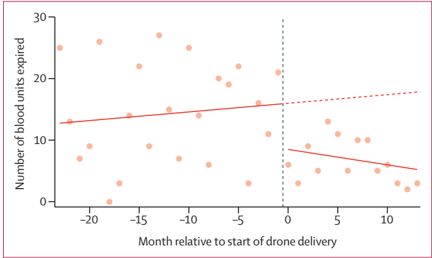
- Pre-intervention, 334 blood product units expired across the 20 facilities. After drone delivery began, there was a level decrease of 7.1 fewer blood unit expirations per facility per month (95% CI −11.8 to −2.4; p=0.0060), translating to a 67% reduction at 12 months and 140 fewer expirations during the post-intervention period; the trend reduction of 0.4 fewer expirations per facility per month was non-significant (95% CI −0.8 to 0.1; p=0.091).
Methods
- Retrospective, cross-sectional comparison of emergency delivery times plus interrupted time series analysis, focused on 20 district and provincial hospitals selected for drone delivery between Dec 21, 2016, and Dec 22, 2018; data covered Jan 1, 2015, to Dec 31, 2019.
- Drone delivery data came from Zipline for March 17, 2017–Dec 31, 2019; road delivery times were estimated from internal BTS documentation and Google Maps because planned manual collection from health facility records was halted by COVID-19; monthly blood component expirations came from Rwanda’s Health Management Information System for January 2015–June 2019.
- Delivery times were compared using a Wilcoxon signed-rank test; expirations were analyzed with segmented linear regression using generalised least squares models including a first-order autocorrelation term; analyses used R version 3.6.2.
Limitations
- The paper states that road delivery times were estimates rather than actual records; planned collection from health facility laboratory registers was halted by COVID-19; there was no control group; findings might not extrapolate to less remote facilities or those with different road connectivity; and health outcome changes could not be collected.
- The paper notes administrative-data limitations and states that future studies should investigate cost-effectiveness and health impacts, since drone delivery is currently more expensive than road delivery in Rwanda.
- Evident from the text: the damage estimate relies on internal Zipline data, and the study did not itself conduct a cost-effectiveness analysis.
Model-written summary. Check it against the paper before relying on it.
Integrity signals
Registry
Cites
Statistics
Figures
Verification
Claims the paper makes
2 Valid · 4 Not valid · 8 Not checked · 27 Own results and interpretations
The paper states this without a source or data behind it here, so there is nothing to check it against. The quote shows it is in the paper.
In the paper
“In these emergency orders, 14 651 blood units were delivered by drones to 20 district and provincial hospitals.”
§ Effect of unmanned aerial vehicle (drone) delivery on blood product delivery time and wastage in Rwanda: a retrospective, cross-sectional study and time series analysis > Results
- Asserted: passes — The authors put it forward as true.
- Checkable: passes — It can be checked against evidence.
- Load-bearing: passes — The paper’s conclusions depend on it.
- Based: unclear — It is unclear why the paper says it holds.
A result the paper reports from its own data — it cites no other source for it, so there is none to check. The quote shows it is in the paper.
In the paper
“The decrease in mean delivery time ranged from 3 min to 211 min depending on the distance to the facility and road quality.”
- Also stated in: § Results · plain
“Notably, the time savings from drone delivery varied widely, from 3 min to 211 min across the facilities we studied.”
§ Effect of unmanned aerial vehicle (drone) delivery on blood product delivery time and wastage in Rwanda: a retrospective, cross-sectional study and time series analysis > Abstract
plainstates a cause- Asserted: passes — The authors put it forward as true.
- Checkable: passes — It can be checked against evidence.
- Load-bearing: passes — The paper’s conclusions depend on it.
- Based: passes — The paper gives a reason why it holds.
- Also stated in: § Results · plain
A result the paper reports from its own data — it cites no other source for it, so there is none to check. The quote shows it is in the paper.
In the paper
“which was 79 min faster than existing road delivery methods based on estimated driving times (p<0•0001)”
- Also stated in: § Results · hedged
“drone delivery was 79 min (p<0•0001) faster using estimated driving times”
§ Effect of unmanned aerial vehicle (drone) delivery on blood product delivery time and wastage in Rwanda: a retrospective, cross-sectional study and time series analysis > Abstract
hedgedstates a cause- Asserted: passes — The authors put it forward as true.
- Checkable: passes — It can be checked against evidence.
- Load-bearing: passes — The paper’s conclusions depend on it.
- Based: passes — The paper gives a reason why it holds.
- Also stated in: § Results · hedged
A result the paper reports from its own data — it cites no other source for it, so there is none to check. The quote shows it is in the paper.
In the paper
“In this case, drone delivery would be faster by a median time of 19 min (p=0•0018).”
§ Effect of unmanned aerial vehicle (drone) delivery on blood product delivery time and wastage in Rwanda: a retrospective, cross-sectional study and time series analysis > Results
hedgedstates a cause- Asserted: passes — The authors put it forward as true.
- Checkable: passes — It can be checked against evidence.
- Load-bearing: unclear — It is unclear whether the paper’s conclusions depend on it.
- Based: passes — The paper gives a reason why it holds.
A result the paper reports from its own data — it cites no other source for it, so there is none to check. The quote shows it is in the paper.
In the paper
“After the start of drone deliveries, we found a level decrease (immediate change post-intervention) of 7•1 fewer blood unit expirations per facility per month in the post-intervention period (95% CI -11•8 to -2•4; p=0•0060).”
§ Effect of unmanned aerial vehicle (drone) delivery on blood product delivery time and wastage in Rwanda: a retrospective, cross-sectional study and time series analysis > Results
plainstates a cause- Asserted: passes — The authors put it forward as true.
- Checkable: passes — It can be checked against evidence.
- Load-bearing: passes — The paper’s conclusions depend on it.
- Based: passes — The paper gives a reason why it holds.
20 more claims
Create a free account to see all 41 claims and to verify the 1 reference still open.
- Probably not a substantial claim. 8
- It may state two separate claims as one. 10
- Borderline: one of the tests for a substantial claim is unclear. 1
Citations
Cites
Segmented regression analysis of interrupted time series studies in medication use research
Wagner, A. K., Soumerai, S. B., Zhang, F., & Ross-Degnan, D. (2002) · Journal of Clinical Pharmacy and Therapeutics · doi:10.1046/j.1365-2710.2002.00430.x · Cited by 3,279
The global need and availability of blood products: a modelling study
Roberts, N., James, S., Delaney, M., & Fitzmaurice, C. (2019) · The Lancet Haematology · doi:10.1016/s2352-3026(19)30200-5 · Cited by 252
Claesson, A., Bäckman, A., Ringh, M., Svensson, L., Nordberg, P., Djärv, T., & Hollenberg, J. (2017) · JAMA · doi:10.1001/jama.2017.3957 · Cited by 230
Drone transportation of blood products
Amukele, T., Ness, P. M., Tobian, A. A. R., Boyd, J., & Street, J. (2017) · Transfusion · doi:10.1111/trf.13900 · Cited by 194
Maternal mortality in sub-Saharan Africa: the contribution of ineffective blood transfusion services
Bates, I., Chapotera, G., McKew, S., & Van Den Broek, N. (2008) · BJOG: An International Journal of Obstetrics & Gynaecology · doi:10.1111/j.1471-0528.2008.01866.x · Cited by 193
Aerial drones for blood delivery
Ling, G. S. F., & Draghic, N. (2019) · Transfusion · doi:10.1111/trf.15195 · Cited by 174
The blood is here: Zipline's medical delivery drones are changing the game in Rwanda
Ackerman, E., & Koziol, M. (2019) · IEEE Spectrum · doi:10.1109/mspec.2019.8701196 · Cited by 140
Amukele, T. K., Sokoll, L. J., Pepper, D., Howard, D. P., & Street, J. (2015) · PLOS ONE · doi:10.1371/journal.pone.0134020 · Cited by 139
Barro, L., Drew, V. J., Poda, G. G., Tagny, C. T., El‐Ekiaby, M., Owusu‐Ofori, S., & Burnouf, T. (2018) · Vox Sanguinis · doi:10.1111/vox.12705 · Cited by 92
Zailani, M. A. H., Sabudin, R. Z. A. R., Rahman, R. A., Saiboon, I. M., Ismail, A., & Mahdy, Z. A. (2020) · Medicine · doi:10.1097/md.0000000000021967 · Cited by 78
Cited by
Artificial intelligence for low income countries
Khan, M. S., Umer, H., & Faruqe, F. (2024) · Humanities and Social Sciences Communications · doi:10.1057/s41599-024-03947-w · Cited by 159
UAV-Based Delivery Systems: A Systematic Review, Current Trends, and Research Challenges
Sorbelli, F. B. (2024) · ACM Journal on Autonomous Transportation Systems · doi:10.1145/3649224 · Cited by 173
Drones in last-mile delivery: a systematic literature review from a logistics management perspective
Jazairy, A., Persson, E., Brho, M., von Haartman, R., & Hilletofth, P. (2024) · The International Journal of Logistics Management · doi:10.1108/ijlm-04-2023-0149 · Cited by 143
Current summary of the evidence in drone-based emergency medical services care
Roberts, N. B., Ager, E., Leith, T. B., Lott, I., Mason-Maready, M., Nix, T., Gottula, A. L., Hunt, N. R., & Brent, C. M. (2023) · Resuscitation Plus · doi:10.1016/j.resplu.2022.100347 · Cited by 111
Facility location decisions for drone delivery: A literature review
Dükkancı, O., Campbell, J. F., & Kara, B. Y. (2023) · European Journal of Operational Research · doi:10.1016/j.ejor.2023.10.036 · Cited by 100
Bleeding, Hemorrhagic Shock, and the Global Blood Supply
Faria, I. M. D. F., Thivalapill, N., Makin, J., Puyana, J. C., & Raykar, N. P. (2022) · Critical Care Clinics · doi:10.1016/j.ccc.2022.06.013 · Cited by 57
Current Advancements in Drone Technology for Medical Sample Transportation
Stierlin, N. R., Risch, M., & Risch, L. (2024) · Logistics · doi:10.3390/logistics8040104 · Cited by 63
Ghouri, A. M., Khan, H. U. R., Mani, V., Haq, M. A. U., & Jabbour, A. B. L. D. S. (2023) · Journal of Business Research · doi:10.1016/j.jbusres.2023.113980 · Cited by 46
Ameh, C., Meka, R. J., West, F., Dickinson, F. M., Allott, H., & Godia, P. (2022) · International Journal of Gynecology & Obstetrics · doi:10.1002/ijgo.14270 · Cited by 24
Manyazewal, T., Davey, G., Hanlon, C., Newport, M. J., Hopkins, M. M., Wilburn, J., Bakhiet, S., Mutesa, L., Semahegn, A., Assefa, E., et al. (2024) · Nature Communications · doi:10.1038/s41467-024-54496-4 · Cited by 50
Challenges for the Routine Application of Drones in Healthcare: A Scoping Review
Silvestri, S. D., Capasso, P. J., Gargiulo, A., Molinari, S., & Sanna, A. (2023) · Drones · doi:10.3390/drones7120685 · Cited by 46
Unmanned Aerial Vehicle Mediated Drug Delivery for First Aid
Sheng, T., Jin, R., Yang, C., Qiu, K., Wang, M., Shi, J., Zhang, J., Gao, Y., Wu, Q., Zhou, X., et al. (2023) · Advanced Materials · doi:10.1002/adma.202208648 · Cited by 38
The Use of Drones to Deliver Rift Valley Fever Vaccines in Rwanda: Perceptions and Recommendations
Griffith, E. F., Schurer, J. M., Mawindo, B., Kwibuka, R., Turibyarive, T., & Amuguni, J. H. (2023) · Vaccines · doi:10.3390/vaccines11030605 · Cited by 47
Connecting Internet of Drones and Urban Computing: Methods, protocols and applications
Bine, L. M. S., Boukerche, A., Ruiz, L. B., & Loureiro, A. A. F. (2023) · Computer Networks · doi:10.1016/j.comnet.2023.110136 · Cited by 33
Unmanned aerial vehicles and pre-hospital emergency medicine
Surman, K., & Lockey, D. (2024) · Scandinavian Journal of Trauma Resuscitation and Emergency Medicine · doi:10.1186/s13049-024-01180-7 · Cited by 39
Dabić, M., Ferreira, J. J., Lopes, J. M., & Gomes, S. (2024) · IEEE Transactions on Engineering Management · doi:10.1109/tem.2024.3494051 · Cited by 41
Meng, Z., Yu, K., & Qiu, R. (2024) · Complex & Intelligent Systems · doi:10.1007/s40747-024-01591-0 · Cited by 31
Using drones to deliver blood products in Rwanda
Amukele, T. (2022) · The Lancet Global Health · doi:10.1016/s2214-109x(22)00095-x · Cited by 31
Snakebite envenoming in Africa remains widely neglected and demands multidisciplinary attention
Berg, P., Theart, F., van Driel, M., Saaiman, E. L., & Mavoungou, L. B. (2024) · Nature Communications · doi:10.1038/s41467-024-54070-y · Cited by 27
A Systematic Literature Review of the Blood Supply Chain through Bibliometric Analysis and Taxonomy
İmamoğlu, G., Topçu, Y. İ., & Aydın, N. (2023) · Systems · doi:10.3390/systems11030124 · Cited by 27
Niglio, F., Comite, P., Cannas, A., Pirri, A., & Tortora, G. (2022) · Drones · doi:10.3390/drones6080195 · Cited by 24
A hierarchical model for strategic and operational planning in blood transportation with drones
Amirsahami, A., Barzinpour, F., & Pishvaee, M. S. (2023) · PLoS ONE · doi:10.1371/journal.pone.0291352 · Cited by 23
Zhu, W., Hu, X., Pei, J., et al. (2024) · Transportation Research Part B Methodological · doi:10.1016/j.trb.2024.102950 · Cited by 19
Kibe, L. W., Kwanya, T., & Nyagowa, H. O. (2023) · Technological Sustainability · doi:10.1108/techs-01-2023-0004 · Cited by 29
Molinari, S., Patriarca, R., & Ducci, M. (2024) · Drones · doi:10.3390/drones8050210 · Cited by 18
Aggarwal, S. S., Balaji, S., Gupta, P., Mahajan, N., Nigam, K., Singh, K. J., Bhargava, B., & Panda, S. (2024) · Preventive Medicine Research & Reviews · doi:10.4103/pmrr.pmrr_73_24 · Cited by 21
Survey of blood collection and transfusion practices among institutions in Africa
Jacobs, J. W., Stephens, L. D., Milner, D. A., Bloch, E. M., Goel, R., Tobian, A. A. R., Shibemba, A. L., Eichbaum, Q. G., & (VPPIGH), T. V. P. P. I. G. H. (2023) · Transfusion · doi:10.1111/trf.17501 · Cited by 15
Spaans, R. H., Drumond, B., van Daalen, K. R., Rorato, A. C., Derbyshire, A., Silva, A. D., Lana, R. M., Vega, M. S., Carrasco‐Escobar, G., Escada, M. I. S., et al. (2024) · PLoS ONE · doi:10.1371/journal.pone.0287270 · Cited by 19
Wang, B., Fu, Q., Yi, X., Wang, L., Li, D., Liu, K., Zheng, Y., Su, X., Wang, D., Jiao, X., et al. (2023) · Journal of Energy Storage · doi:10.1016/j.est.2023.109170 · Cited by 16
Reducing Risks by Transporting Dangerous Cargo in Drones
Bridgelall, R. (2022) · Sustainability · doi:10.3390/su142013044 · Cited by 12
Atiga, O., Tanzubil, B. J., Asaana, J., Ayamba, E. C., Seidu, M. T., & Mohammed, I. (2024) · African Journal Of Applied Research · doi:10.26437/ajar.v10i1.677 · Cited by 13
Nowadly, C. D., Maddry, J. K., Vargas, C. R., MacDonald, A. G., Maksimenko, Y. M., Hewitt, C. W., Silverman, M. B., Sawyer, D. H., & Long, B. (2025) · Military Medicine · doi:10.1093/milmed/usaf189 · Cited by 18
Peltier, G. C., & Meledeo, M. A. (2023) · The Journal of Trauma: Injury, Infection, and Critical Care · doi:10.1097/ta.0000000000004061 · Cited by 12
Bringing underserved communities life-saving aid through aerial logistics
Kremer, P., Leyzerovskaya, A., DuBois, S., Lipsitt, J. M., Haruna, F., & Lebed, O. (2023) · Science Robotics · doi:10.1126/scirobotics.adm7020 · Cited by 17
Lakhwani, T. S., Sinjana, Y., & Kapoor, A. P. (2025) · Journal of Transport & Health · doi:10.1016/j.jth.2025.102053 · Cited by 14
Last-mile Delivery in Health Care: Drone Delivery for Blood Products in RwandaPreprint
Jeon, H. H., Lucarelli, C., Mazarati, J. B., Ngabo, D., & Song, H. (2022) · SSRN Electronic Journal · doi:10.2139/ssrn.4214918 · Cited by 10
Blood delivery by drone: a faltering step in a promising direction
Li, Q., Xia, J., Ge, F., Lü, Q., & Zhang, M. (2022) · The Lancet Global Health · doi:10.1016/s2214-109x(22)00272-8 · Cited by 10
Enhancing primary healthcare delivery in Nigeria through the adoption of advanced technologies
Umar, A., Sani, S. K., Aliyu, L. J., Hassan, M., Imam, M., Haruna, U. A., Ibrahim, A. M., & Lucero‐Prisno, D. E. (2024) · Narra X · doi:10.52225/narrax.v2i3.180 · Cited by 16
What Is Holding Back The Use of Drones for Medication Delivery in Rural Australia?
Hogan, W. J., Harris, M. J., Brock, A., & Rodwell, J. (2022) · Sustainability · doi:10.3390/su142315778 · Cited by 9
Modeling Emergency Medical Service Volunteer Response
van den Berg, P. L., Henderson, S. G., Jagtenberg, C. J., & Li, H. (2021) · Management Science · doi:10.1287/mnsc.2022.04024 · Cited by 13
Inghels, M., Mee, P., Diallo, O. H., Cissé, M., Nelson, D., Tanser, F. C., Asghar, Z. B., Koita, Y., Laborde-Balen, G., & Breton, G. (2023) · BMJ Global Health · doi:10.1136/bmjgh-2023-012522 · Cited by 6
Lakhwani, T. S., Sinjana, Y., & Kapoor, A. P. (2026) · Sustainable Futures · doi:10.1016/j.sftr.2026.101758 · Cited by 8
Ostermann, L., Gobachew, A. M., Schwung, A., & Lier, S. (2025) · Logistics · doi:10.3390/logistics9030111 · Cited by 14
Jeon, H. H., Lucarelli, C., Mazarati, J. B., Ngabo, D., & Song, H. (2026) · Manufacturing & Service Operations Management · doi:10.1287/msom.2025.0055 · Cited by 22
Regulatory Strategies for Fostering Responsible AI Innovation in African Economies
Shao, D. D., Marwa, N. W., & Didas, M. (2023) · International Conference on the Advancements of Artificial Intelligence in African Context (AAIAC) · doi:10.1109/aaiac60008.2023.10465404 · Cited by 6
Dixit, K., Rai, B., Majhi, G., Paudel, R., Dhital, R., Acharya, S., Budhathoki, G., Poudel, P., Gurung, S. C., Subedi, B., et al. (2024) · BMC Health Services Research · doi:10.1186/s12913-024-11824-0 · Cited by 7
Bhattacharya, S., & Singh, A. (2024) · Medical Journal Armed Forces India · doi:10.1016/j.mjafi.2023.11.003 · Cited by 5
O’Sullivan, B., Zhong, A., Litchfield, H., Wong, B. L. H., & Nouvet, É. (2024) · Drones and autonomous vehicles/Drones and Autonomous Vehicles · doi:10.35534/dav.2024.10011 · Cited by 6
Apelseth, T. O., Sigurjónsson, Ó. E., Doyle, B., Evans, R., George, C., Handke, W., Humbrecht, C., Najdovski, T., O'Leary, P., Wiltshire, M. D., et al. (2026) · Vox Sanguinis · doi:10.1111/vox.70168 · Cited by 4
Euchi, J., Sadok, A., & Argoubi, M. (2026) · International Journal of Logistics Research and Applications · doi:10.1080/13675567.2026.2621325 · Cited by 4
Enhancing maternal health in Zambia: a comprehensive approach to addressing postpartum hemorrhage
Mubambe, M., Mwanza, J., Moyo, E., & Dzinamarira, T. (2024) · Frontiers in Global Women s Health · doi:10.3389/fgwh.2024.1362894 · Cited by 6
Autonomous Drones and Smart Containers in Medicine
Pirri, A., Tortora, G., & Niglio, F. (2024) · Management and industrial engineering · doi:10.1007/978-3-031-55571-8_10 · Cited by 4
Acharya, P., Hurson, T., Annesi, C. A., Carico, C., Lammers, D. T., Mann, N. C., Levy, M. J., Jarman, M. P., Kerby, J. D., Jansen, J. O., et al. (2026) · Transfusion · doi:10.1111/trf.70086 · Cited by 3
Zhang, Z., Xiao, C.-Y., Wang, Y., Song, W.-C., Sun, J.-Y., & Zhang, Z.-G. (2025) · Frontiers in Public Health · doi:10.3389/fpubh.2025.1571904 · Cited by 5
Limited Impact of Drone Transport of Blood on Platelet Activation
Callewaert, N., Pareyn, I., Acke, T., Desplinter, B., de Pitte, K. V., Vooren, J. V., Meyer, M. D., Seeldraeyers, E., Peeters, F., Meyer, S. F. D., et al. (2024) · Drones · doi:10.3390/drones8120752 · Cited by 6
Dzisi, E. K. J., Patterson, M., & Iddrisu, S. (2026) · Dialogues in Health · doi:10.1016/j.dialog.2026.100285 · Cited by 8
Atiku, S. O., & Olakotan, O. O. (2026) · Journal of Evaluation in Clinical Practice · doi:10.1111/jep.70372 · Cited by 4
Drone Delivery: Why, Where, and When
(2023) · doi:10.1145/3616394.3618265 · Cited by 3
Quality Analysis of Tuberculosis Specimens Transported by Drones versus Ground Transportation
Malamule, D., Moreira, S., Madeira, C., Lutucuta, C., Ailstock, G., Maxim, L., Bechtel, R., Defawe, O., & Viegas, S. O. (2022) · Drones · doi:10.3390/drones6070155 · Cited by 3
Datta, S. S., Mondal, R., Deb, S., Tortora, G., & Pirri, A. (2026) · Vox Sanguinis · doi:10.1111/vox.70207 · Cited by 2
Myke-Mbata, B. K., Basil, B., Mba, I. N., & Ugwu, A. O. (2026) · Tropical Medicine and Health · doi:10.1186/s41182-026-01038-x · Cited by 3
DEWMINI, J., Fernando, W. M., Nielsen, I. E., Bocewicz, G., Thibbotuwawa, A., & Banaszak, Z. A. (2023) · Applied Computer Science · doi:10.35784/acs-2023-36 · Cited by 2
Spaans, R. H., Drumond, B., van Daalen, K. R., et al. (2023) · medRxiv · doi:10.1101/2023.06.04.23290944 · Cited by 2
Recent Advances in the Prevention and Management of Postpartum Hemorrhage
Sunoqrot, M., Yang, C. J., Obi, N. O., & Ahmadzia, H. K. (2025) · Current Obstetrics and Gynecology Reports · doi:10.1007/s13669-025-00432-2 · Cited by 5
Welfare institutes in sparsely populated areas
Nordregio, & Jokinen, J. C. (2022) · doi:10.6027/wp2022:1.1403-2511 · Cited by 3
After the teleconsultation: getting medicines to patients when pharmacy services are not available
Payne, R. E., Lodge, A., Mackridge, A. J., O'Keeffe, D. T., Swann, N., Clarke, A., Schmidt, J., Allen, T., Sloan, C., & Bond, C. M. (2024) · British Journal of General Practice · doi:10.3399/bjgp24x739401 · Cited by 3
Unmanned aerial vehicles: An inevitable armamentarium in Armed Forces Medical Services
Pandey, G., Manimaran, P., Mishra, A., & Sapra, A. (2025) · Medical Journal Armed Forces India · doi:10.1016/j.mjafi.2025.05.004 · Cited by 3
Moreno, L. A., Adriano, M. A. R., Meza, K., Orellana, J., Tarazona, F. R., & Alta, R. Y. P. (2024) · IEEE International Conference on Aerospace and Signal Processing (INCAS) · doi:10.1109/incas63820.2024.10798553 · Cited by 1
Accident Response Time Enhancement Using Drones: A Case Study in Najm for Insurance Services
Elhag, S., Shaheen, G. H., & Alahmadi, F. (2023) · International Journal of Information Technology and Computer Science · doi:10.5815/ijitcs.2023.06.01 · Cited by 1
Warner, A., Lee, S., Pawlovich, J., Aldred, T., Allard, M., Christie, D., James, A., Kang, D., Kashani, K. N., Lynd, L. D., et al. (2026) · Journal of Participatory Medicine · doi:10.2196/82720 · Cited by 2
Bhandari, D., Kumar, D. T. A., & Sharath, P. C. (2024) · Advances in computational intelligence and robotics book series · doi:10.4018/979-8-3693-2093-8.ch016 · Cited by 1
O’Sullivan, B., Rakotoasy, C. L., Donelle, L., Haggerty, N., & Nouvet, É. (2026) · Drones · doi:10.3390/drones10040228 · Cited by 3
The Boring Fix: Why Digital Health Fails the Last Mile — and How It Does Not Have To
Parikh, A. (2026) · doi:10.33682/6t95-9pex · Cited by 1
Sustainability of Drone-Based Urban Air Mobility: A Systematic Review of Consensus and Controversies
Guo, Y., Zhao, J., Wu, M., Peng, X., Xia, Y., & Yu, Y. (2026) · Drones · doi:10.3390/drones10050334 · Cited by 1
Planning and operational considerations for a drone logistics future
Grote, M., Oakey, A., Pilko, A., Smith, A., Król, J., Blakesley, A., Cherrett, T., Scanlan, J. P., Dickinson, J. E., Marsden, G. R., et al. (2024) · Advances in transport policy and planning · doi:10.1016/bs.atpp.2024.09.004 · Cited by 3
Some organizational technologies for providing medical care in small and hard-to-reach settlements
Kobyakova, О. S., Деев, И. А., Boykov, V. A., Perfileva, D. Y., Шибалков, И. П., Antipov, S. A., & Ladyko, L. (2025) · Сибирский журнал клинической и экспериментальной медицины · doi:10.29001/2073-8552-2025-40-3-194-204 · Cited by 1
Marburg virus disease: a comprehensive review
Woolsey, C. B., & Geisbert, T. W. (2026) · Clinical Microbiology Reviews · doi:10.1128/cmr.00097-23 · Cited by 3
Conducting evaluations using routine health information system data: A researcher’s guide
Grépin, K. A., Hotchkiss, D. R., Feng, S., & Law, M. R. (2026) · SSM - Health Systems · doi:10.1016/j.ssmhs.2026.100214 · Cited by 2
Self-citationThéorêt, O., Barrack, S., & Morgan, H. M. (2022) · medRxiv · doi:10.1101/2022.10.18.22280902 · Cited by 1
Frugality to Functionality: Improving Maternal Outcome in Resource-Limited Settings
Kasodekar, S. V., & Gupta, S. (2025) · Journal of Obstetric Anaesthesia and Critical Care · doi:10.4103/joacc.joacc_58_25 · Cited by 1
Implementing Child Neurology Care in Resource-Limited Settings
Wilmshurst, J. M., Trevathan, E., Koné, Z., Gwer, S., Sebunya, R. K., Saini, A. G., Triki, C., & Patel, A. A. (2025) · Elsevier eBooks · doi:10.1016/b978-0-443-10944-7.00024-x
Metadata
- Authors
- Nisingizwe, M. P., Ndishimye, P., Swaibu, K., Nshimiyimana, L., Karame, P., Dushimiyimana, V., Musabyimana, J. P., Musanabaganwa, C., Nsanzimana, S., & Law, M. R.
- Affiliations
- University of British Columbia (CA)
- Dalhousie University (CA)
- Rwanda Biomedical Center (RW)
- Corresponding author
- Nisingizwe, Marie Paul
- ORCID
- Venue
- The Lancet Global Health
- Publisher
- Elsevier BV
- Published
- 2022-04
- Volume
- 10
- Issue
- 4
- Pages
- e564-e569
- ISSN
- 2214-109X (ISSN-L)
- OpenAlex
- W4220802171
- Semantic Scholar
- 576795ae3d414cf265c70b65f6712eefeabbae52
- Cited by
- 175
- References
- 18
- Citations by year
- 2026: 67 · 2025: 22 · 2024: 43 · 2023: 28 · 2022: 15
- FWCI
- 23.66
- Type
- journal article
- Language
- en
- Open access
- gold
- doi.org
- Licence
- cc-by
- www.elsevier.com/tdm/userlicense/1.0/ (tdm)
- www.elsevier.com/legal/tdmrep-license (tdm)
- creativecommons.org/licenses/by/4.0/ (vor)
- Locations
- The Lancet Global Health (publishedVersion, cc-by)
- PubMed (publishedVersion)
- Ghent University Academic Bibliography (Ghent University) (publishedVersion, other-oa)
- Funders
- Canada Research Chairs
- Canadian Institutes of Health Research (FDN-148412)
- Topics
- Health Sciences › Medicine › Hematology › Blood donation and transfusion practices
- Health Sciences › Medicine › Hematology › Blood transfusion and management
- Physical Sciences › Engineering › Aerospace Engineering › UAV Applications and Optimization
- Keywords
- drone delivery, unmanned aerial vehicles, blood products, blood supply chain, blood product wastage, delivery time, remote health facilities, Rwanda
- MeSH terms
- Unmanned Aerial Devices, Canada, Cross-Sectional Studies, Pharmaceutical Preparations, Humans, Retrospective Studies, Rwanda, Time Factors
About these checks
Registry, retraction, Cites and statistics results are computed, not judged, with one exception: a printed reference that no index lists is read once by a model before it counts as a citation error. Claims are extracted by a model and kept only when their quote appears verbatim in the text; each cited source is then checked, with a model’s help, for whether it says what the claim relies on. Those verdicts can be wrong — read the claim’s quote and the cited source before relying on one.
The claim verdicts this report counts are experimental: their accuracy is not yet measured.
A language model drew the claims from the paper on 2026-09-30, under version 3 of the claim definition (model deepseek-v4.1-flash, prompt extract-v3).
A second model labelled each claim on 2026-09-30 (model jev-1.13-20260917, definition revision gold-guideline-v0.2).
Statistics and arithmetic are recomputed, not judged.
Confidence bands are shown only for fields calibrated on our annotated test set. None is calibrated yet, so no band is shown.
What counts as a claim ›How we measure confidence ›How we check this ›
Are you an author, or do you see a problem with this page? Request a review
Data sources
Bibliographic data: Semantic Scholar, OpenAlex, Crossref.
Contains information from the Semantic Scholar Academic Graph Datasets, made available under the ODC Attribution License (ODC-BY 1.0).
Semantic Scholar’s data is described in: Kinney, R., et al. (2023). The Semantic Scholar Open Data Platform. arXiv:2301.10140.
