

Prevalence of advanced HIV disease in sub-Saharan Africa: a multi-country analysis of nationally representative household surveys
Open accessThe DOI matches its Crossref record; 23 of the 23 references it cites were found in a registry or an index.
Abstract
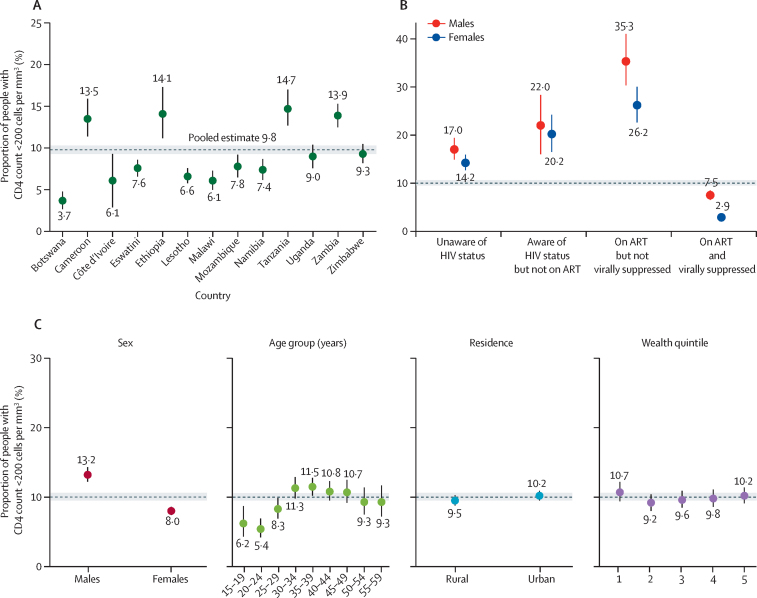
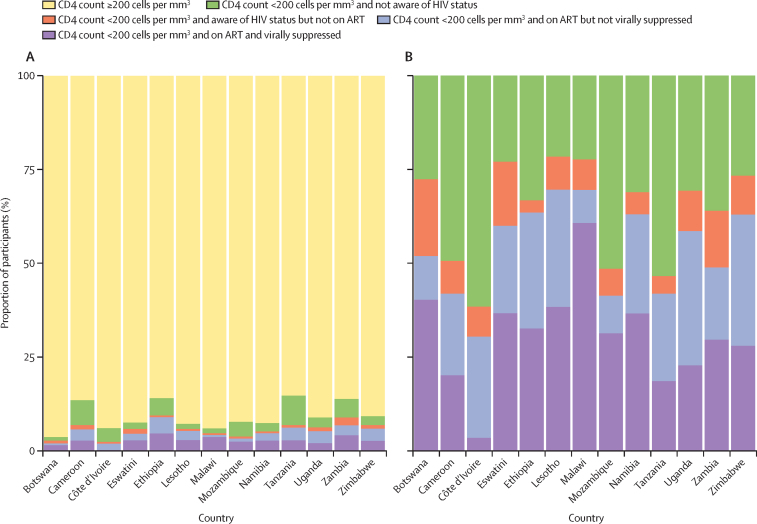
BACKGROUND: Advanced HIV disease (AHD) is a critical stage in the progression of HIV infection and is associated with heightened susceptibility to opportunistic infections, malignancies, and other life-threatening complications. Estimates of the burden of AHD in sub-Saharan Africa are scarce but are needed for programme planning which includes the allocation of resources and the monitoring of outcomes. The aim of the study was to assess the prevalence of and the number of people living with HIV with AHD. METHODS: ). We analysed the prevalence of AHD by various demographic and socioeconomic factors; we then estimated the number of individuals with AHD in sub-Saharan Africa by combining these proportions with the latest UNAIDS HIV estimates for the region by the treatment and care cascade. We also assessed policies related to the provision of the recommended package of care for the diagnosis and management of AHD. FINDINGS: . AHD was more common among males than females (13·2% vs 8·0%) and differed across the treatment cascade: 15·4% among people living with HIV who did not know their HIV status, 20·9% among people who knew their status but were not on antiretroviral treatment (ART), 29·5% among people who were on ART but not virally suppressed, and 4·3% among people who were virally suppressed. Extrapolating these results to sub-Saharan Africa yielded an estimated 1·88 million people living with AHD (uncertainty interval [UI] 1·58-2·20); 920 000 (UI 770 000-1·07 million) females and 970 000 (UI 810 000-1·13 million) males. INTERPRETATION: Despite advances in ART that have transformed HIV into a manageable chronic condition, a substantial number of people continue to develop AHD. These figures highlight the need for urgent and innovative programmatic improvements in monitoring, prevention, testing, and diagnosis of AHD in the context of well-established and maturing ART programmes. FUNDING: None.
Overview
The claims and statistics of this paper haven’t been checked yet.
Free: it reads the open-access text and checks the first 5 claims that cite a source we can check. Create a free account to check every claim.
Integrity signals
Registry
Cites
Statistics
Figures
Verification
Claims the paper makes
The claims and statistics of this paper haven’t been checked yet.
Free: it reads the open-access text and checks the first 5 claims that cite a source we can check. Create a free account to check every claim.
Claims other papers make about this one
Each is checked against this paper’s own text: does it say what the citing paper says it does?
The source backs part of the claim, not all of it — or backs it for a different population, condition or comparison.
In the citing paper
“The current standard of care is highly active antiretroviral therapy, which typically combines multiple drug classes, including nucleoside reverse transcriptase inhibitors (Tenofovir, Lamivudine, Abacavir), non-nucleoside reverse transcriptase inhibitors (Rilpivirine), and integrase strand transfer inhibitors (Dolutegravir) (71, 72). This combination effectively suppresses viral replication, rest”
From Research progress on HIV-1 structural proteins and antiviral therapies (2026) · cites this paper as [70]
Experimental — accuracy not yet measured
Self-check
Percentages, sums and reported differences re-computed from the paper’s own numbers.
The self-check needs the paper’s full text.
Citations
Cites
Fitting Linear Mixed-Effects Models Using lme4
Bates, D., Mächler, M., Bolker, B., & Walker, S. (2015) · Journal of Statistical Software · doi:10.18637/jss.v067.i01 · Cited by 86,835
The global burden of HIV-associated cryptococcal infection in adults in 2020: a modelling analysis
Rajasingham, R., Govender, N. P., Jordan, A., Loyse, A., Shroufi, A., Denning, D. W., Meya, D. B., Chiller, T. M., & Boulware, D. R. (2022) · The Lancet Infectious Diseases · doi:10.1016/s1473-3099(22)00499-6 · Cited by 587
Ford, N., Shubber, Z., Meintjes, G., Grinsztejn, B., Eholie, S., Mills, E. J., Davies, M.-A., Vitoria, M., Penazzato, M., Nsanzimana, S., et al. (2015) · The Lancet HIV · doi:10.1016/s2352-3018(15)00137-x · Cited by 327
Self-citationCarmona, S., Bor, J., Nattey, C., Maughan-Brown, B., Maskew, M., Fox, M. P., Glencross, D. K., Ford, N., & MacLeod, W. B. (2018) · Clinical Infectious Diseases · doi:10.1093/cid/ciy045 · Cited by 169
Self-citationManaging Advanced HIV Disease in a Public Health Approach
Ford, N. P., Meintjes, G., Calmy, A., Bygrave, H., Migone, C., Vitória, M., Penazzato, M., Vojnov, L., Doherty, M. C., Guideline Development Group for Managing Advanced HIV Disease and Rapid Initiation of Antiretroviral Therapy, et al. (2018) · Clinical Infectious Diseases · doi:10.1093/cid/cix1139 · Cited by 104
Self-citationOusley, J., Niyibizi, A. A., Wanjala, S., Vandenbulcke, A., Kirubi, B., Omwoyo, W., Price, J., Salumu, L., Szumilin, E., Spiers, S., et al. (2018) · Clinical Infectious Diseases · doi:10.1093/cid/ciy103 · Cited by 78
Kroeze, S., Ondoa, P., Kityo, C. M., Siwale, M., Akanmu, S. A., Wellington, M., de Jager, M., Ive, P., Mandaliya, K. N., Stevens, W. S., et al. (2018) · AIDS · doi:10.1097/qad.0000000000001801 · Cited by 72
Benzekri, N. A., Sambou, J. F., Ndong, S., Tamba, I. T., Faye, D., Diallo, M. B., Diatta, J. P., Faye, K., Sall, I., Sall, F., et al. (2019) · BMC Infectious Diseases · doi:10.1186/s12879-019-3826-5 · Cited by 55
Quinn, C., Kadengye, D. T., Johnson, C. C., Baggaley, R., & Dalal, S. (2019) · Journal of the International AIDS Society · doi:10.1002/jia2.25398 · Cited by 53
Self-citationMunthali, C., Taegtmeyer, M., Garner, P., Lalloo, D. G., Squire, S. B., Corbett, E. L., Ford, N. P., & MacPherson, P. (2014) · Journal of the International AIDS Society · doi:10.7448/ias.17.1.18932 · Cited by 45
Self-citation
Research works printed but not linked: 2
- WHO Guidelines for managing advanced HIV disease and rapid initiation of antiretroviral therapy 2017 World Health Organization 29341560
- WHO Consolidated guidelines on HIV prevention, testing, treatment, service delivery and monitoring: recommendations for a public health approach 2021 World Health Organization 34370423
Cited by
Orlando, S., Silaghi, L. A., Cicala, M., Lowole, M. W., Massango, C., Lunghi, R., Sangaré, H. M., Ciccacci, F., & Scarcella, P. (2025) · Frontiers in Public Health · doi:10.3389/fpubh.2025.1665666 · Cited by 26
Lateral flow assay-based CD4 cell count testing for advanced HIV disease
Ndlovu, Z., Moore, A., Casas, E. C., & Fatti, G. (2025) · The Lancet HIV · doi:10.1016/s2352-3018(25)00094-3 · Cited by 10
Reducing HIV incidence and mortality: two sides of the same coin in the approach to ending AIDS
Jarvis, J. N., Ehrenkranz, P. D., Lawrence, D. S., Keene, C., Reid, M. J. A., Katz, I. T., Shodell, D., Casas, C. P., Mupeli, K., Sivile, S., et al. (2025) · The Lancet HIV · doi:10.1016/s2352-3018(25)00265-6 · Cited by 9
Self-citationChow, D. Y., Blythe, R. D., Tay, J. R. H., Nascimento, G. G., & Romandini, M. (2026) · Journal of Periodontal Research · doi:10.1111/jre.70104 · Cited by 8
Ndlovu, Z., Nhandara, R. B. C., Govender, K., Mpande-Nyasulu, F., Kabwe, E., Flores, A., Mekiedje, C., Kyembe, L., Bimansha, C., Tomas, T. C., et al. (2026) · PLoS ONE · doi:10.1371/journal.pone.0339469 · Cited by 3
“Evidence from population-based survey data shows that nearly two-thirds of people with AHD are on ART [11].”
Advanced HIV disease and epidemic control in sub-Saharan Africa
Justman, J. E., & Syowai, M. (2025) · The Lancet Global Health · doi:10.1016/s2214-109x(25)00020-8 · Cited by 3
Research progress on HIV-1 structural proteins and antiviral therapies
Wang, H., Yuan, J., & Wang, H. (2026) · Frontiers in Immunology · doi:10.3389/fimmu.2026.1805597 · Cited by 2
Falconer, J., Mmotsa, T. M., Govender, N. P., & Jarvis, J. N. (2025) · Expert Review of Anti-infective Therapy · doi:10.1080/14787210.2025.2554999 · Cited by 3
Self-citationIzudi, J., Ssentongo, S. M., Appeli, S., & Bajunirwe, F. (2025) · BMC Infectious Diseases · doi:10.1186/s12879-025-12488-9 · Cited by 2
“Additionally, the region has an estimated 1.8 million PWH with AHD based on the analysis of 13 Population-based HIV Impact Assessment household survey data conducted between 2016 and 2021 [8].”
InfluentialLangendorf, C., Bossard, C., Nackers, F., Comelli, A., Berghmans, M., Molay, G., Gomez, F. G., Dicko, A., Bangwen, E., Kalwangila, T., et al. (2026) · International Journal of Infectious Diseases · doi:10.1016/j.ijid.2026.108383 · Cited by 2
Cryptococcosis in Colombia: Analysis of Data from Laboratory-Based Surveillance 2017–2024
Lizarazo, J., Agudelo, C. I., Escandón, P., & Castañeda, E. (2026) · Journal of Fungi · doi:10.3390/jof12010067 · Cited by 2
“[29,30].”
Haumba, S., Maseko, T., Khumalo, F., Mndzebele, N., Dlamini, M., & Ojoo, S. A. (2026) · Frontiers in Public Health · doi:10.3389/fpubh.2026.1816639 · Cited by 2
“However, emerging data suggests that even in community settings, certain high-risk groups, particularly men and older adults, continue to present with advanced disease (14, 15).”
Pita, T. P., Misra, S., Madonsela, T., Tshazi, A., Bosman, S., Ayakaka, I., Vlieghe, E., Decroo, T., Reither, K., van Heerden, A. C., et al. (2025) · BMC Public Health · doi:10.1186/s12889-025-23588-1 · Cited by 2
“[2].”
InfluentialMondi, A., Cozzi‐Lepri, A., Mazzotta, V., Nozza, S., Cingolani, A., Taramasso, L., Giacomelli, A., Lanini, S., Bono, V., Ianniello, A., et al. (2025) · International Journal of Infectious Diseases · doi:10.1016/j.ijid.2025.108016 · Cited by 1
West, C. A., Mungai, E. A., Birhanu, S., Laws, R. L., Agyemang, E. A., Godfrey, C. C., Stafford, K. A., Mahlalela, K., Li, M., Pasipamire, M., et al. (2025) · Open Forum Infectious Diseases · doi:10.1093/ofid/ofaf753 · Cited by 1
Ndlovu, Z., Tomas, T. C., Tauro, M. J., da Silva, M., Piquete, L., Barrios, M., Catacutan-Joyce, C., Assane, M. I., Manusso, P. D., Baciquetane, L., et al. (2026) · AIDS Care · doi:10.1080/09540121.2026.2669031 · Cited by 1
Behrens, G. M. N., Assoumou, L., Liégeon, G., Antinori, A., Micán, R., Genderini, F., Post, F. A., Rockstroh, J. K., Hamzah, L., Domingo, P., et al. (2025) · The Lancet Infectious Diseases · doi:10.1016/s1473-3099(25)00681-4 · Cited by 1
“The rates of serious adverse events or adverse events leading to study discontinuation did not differ between groups (12 [5”
Lerango, T. L., Lerango, S. L., Abebe, M., Tebeje, T. M., Hareru, H. E., Sisay, D., Zenebe, G. A., Addisu, Y., & Bogale, B. (2026) · PLoS ONE · doi:10.1371/journal.pone.0341162 · Cited by 1
“In SSA, an estimated 1.88 million people are living with AHD [10].”
InfluentialNwofe, J. O., Offie, D. C., Ibeagha, I., Ugwu, C. O., Ojo, E. A., Adeniyi, D. S., Oguh, D., Awolola, A., Osho, O. S., Okonkwo, P. C., et al. (2026) · AIDS Research and Therapy · doi:10.1186/s12981-026-00851-y · Cited by 1
“Despite significant progress in expanding access to anti-retroviral therapy (ART), advanced HIV disease (AHD) remains a major contributor to HIV-associated morbidity and mortality, particularly in sub-Saharan Africa [1].”
Branda, F., Okesanya, O. J., Ahmed, M. M., Scarpa, F., Maruotti, A., Ukoaka, B. M., Oso, T. A., Wagwula, P. M., Othman, Z. K., Ogaya, J. B., et al. (2026) · Infectious Disease Modelling · doi:10.1016/j.idm.2026.05.003 · Cited by 1
“…pronounced regional disparities and epidemiological heterogeneity of HIV across Africa, with important differences in levels and trends between regions and over time (Awad et al., 2018; Gedefie et al., 2025; G € okengin et al., 2016; Kumah et al., 2023; Ouyang et al., 2025; Stelzle et al., 2025).”
HIV treatment default in sub-Saharan Africa: issues and possible solutions
Vento, S., Mbi, M., & Lanzafame, M. (2025) · Frontiers in Medicine · doi:10.3389/fmed.2025.1688749
COVID-19 Pandemic’s Negative Effect on the Lives of People Living with HIV
Modeste, R. R. M., & Akimanimpaye, F. (2025) · Springer eBooks · doi:10.1007/978-981-95-0618-7_6
Nurye, T., Tequare, M. H., Vallejos, G. B., Kim, C. Y., Gebremariam, S. A., Gebreegziabher, A., Desta, K. G., Holroyd, K. B., & Thakur, K. T. (2026) · Open Forum Infectious Diseases · doi:10.1093/ofid/ofag058
“Advanced HIV disease (AHD), defined by WHO as a CD4 count 200 cells/mm 3 , is associated with a markedly increased risk of opportunistic infections (OI) [1].”
Alsuhaibani, M., Albokhadaim, I., Almofti, Y. A., Al‐Rasheed, M., Mahmoud, M., Bukhari, K., & Kandeel, M. K. (2026) · International journal of Nutrition Pharmacology Neurological Diseases · doi:10.4103/ijnpnd.ijnpnd_167_25
Picconi, O., Sgadari, C., Tripiciano, A., Moretti, S., Maggiorella, M. T., Francavilla, V., Casabianca, A., Orlandi, C., Belli, R., Palladino, C., et al. (2026) · Frontiers in Immunology · doi:10.3389/fimmu.2026.1769223
Asiedu, C., Nabe, B., Lanyo, G. S., Battanis, Y. Y., & Asiedu, E. F. O. (2026) · Discover Public Health · doi:10.1186/s12982-026-01950-x
Analytical performance of the VITA™ point-of-care CD4 enumeration assay
Ong, C. M., Henriquez-Trujillo, A. R., Alamillo, M., Huang, W., Goldberg, E., den Bossche, D. V., Gils, T., & Wu, A. H. B. (2026) · Clinica Chimica Acta · doi:10.1016/j.cca.2026.121047
Jarvis, J. N., & Sivile, S. (2026) · AIDS · doi:10.1097/qad.0000000000004494
Self-citationEpidu, C., Ssebunya, R. N., Makumbi, F., Sserunkuma, E., Tumwine, E., Kizza, P., Juma, M., Balwa, H., Kintu, B. N., Maganda, A., et al. (2026) · PLoS ONE · doi:10.1371/journal.pone.0338360
“The proportion of CALHIV with AHD in this study is similar to those of other studies [14,15] among 15–19 year olds but higher among younger age groups than what has been reported elsewhere [16] and unacceptable in this era of test-and-treat for all PLHIV.”
The impact of HIV coinfection on mpox patients: a systematic review and meta-analysis
Ji, L., Yuan, D., Wang, F., Hong, W., Li, Z., Jiang, T., & Su, B. (2026) · Emerging Microbes & Infections · doi:10.1080/22221751.2026.2706348
“Advanced HIV disease (AHD): We extracted the proportion of participants per study with a CD4 + T-cell count < 200 cells/μL and grouped studies with proportions ≤ 5% or > 5% [19–21].”
Boyles, T. H., Ellis, J. P., Feasey, N., Heysell, S. K., Jacob, S. T., Jarvis, J. N., Moore, C. C., Nuwagira, E., & Mpagama, S. G. (2026) · The Lancet Infectious Diseases · doi:10.1016/s1473-3099(26)00351-8
Self-citationPathways Linking Climate Change to Advanced HIV Disease: A Narrative Review
Kurniawan, D. E., Rifai, A., Afandi, A. T., & Khamid, M. N. (2026) · Health Access Journal. · doi:10.31290/haj.v3i2.6540
Chaudhari, P., Basavaraj, B. V., & Mallya, P. (2026) · Nanomedicine and nanotoxicology · doi:10.1007/978-3-032-29006-9_13
Simplifying CD4 Testing to Support Advanced HIV Disease Care
Rangaraj, A., & Ford, N. (2026) · The Journal of Infectious Diseases · doi:10.1093/infdis/jiag438
Self-citationEkat, M. H., Adoua Doukaga, T., Aloumba, G. A., Amona, M., & Ibara, B. R. O. (2026) · Case Reports in Clinical Medicine · doi:10.4236/crcm.2026.1510054
Metadata
- Authors
- Stelzle, D., Rangaraj, A., Jarvis, J. N., Razakasoa, N. H., Perrin, G., Low-Beer, D., Doherty, M., Ford, N., & Dalal, S.
- Affiliations
- World Health Organization (CH)
- London School of Hygiene & Tropical Medicine (GB)
- University of Cape Town (ZA)
- Corresponding author
- Dalal, Shona
- Venue
- The Lancet Global Health
- Publisher
- Elsevier BV
- Published
- 2025-03
- Volume
- 13
- Issue
- 3
- Pages
- e437-e446
- ISSN
- 2214-109X (ISSN-L)
- PMC
- PMC11868778
- OpenAlex
- W4407946916
- Cited by
- 35
- References
- 23
- Citations by year
- 2026: 22 · 2025: 13
- FWCI
- 26.70
- Type
- journal article
- Language
- en
- Open access
- gold
- doi.org
- Licence
- cc-by
- www.elsevier.com/tdm/userlicense/1.0/ (tdm)
- www.elsevier.com/legal/tdmrep-license (tdm)
- creativecommons.org/licenses/by/3.0/igo/ (vor)
- Locations
- The Lancet Global Health (publishedVersion, cc-by)
- PubMed Central (publishedVersion, cc-by)
- PubMed (publishedVersion)
- LSHTM Research Online (London School of Hygiene and Tropical Medicine) (acceptedVersion)
- Funders
- World Health Organization
- Topics
- Health Sciences › Medicine › Infectious Diseases › HIV/AIDS Research and Interventions
- Social Sciences › Economics, Econometrics and Finance › Economics and Econometrics › HIV/AIDS Impact and Responses
- Health Sciences › Medicine › Infectious Diseases › HIV-related health complications and treatments
- Keywords
- advanced HIV disease, HIV prevalence, sub-Saharan Africa, antiretroviral therapy, viral suppression, treatment cascade, people living with HIV, sex differences, opportunistic infections
- MeSH terms
- Adolescent, Adult, Female, Humans, Male, Middle Aged, Surveys and Questionnaires, HIV Infections, Prevalence, Africa South of the Sahara, CD4 Lymphocyte Count, Young Adult
About these checks
Registry, retraction, Cites and statistics results are computed, not judged, with one exception: a printed reference that no index lists is read once by a model before it counts as a citation error. Claims are extracted by a model and kept only when their quote appears verbatim in the text; each cited source is then checked, with a model’s help, for whether it says what the claim relies on. Those verdicts can be wrong — read the claim’s quote and the cited source before relying on one.
Statistics and arithmetic are recomputed, not judged.
Confidence bands are shown only for fields calibrated on our annotated test set. None is calibrated yet, so no band is shown.
What counts as a claim ›How we measure confidence ›How we check this ›
Are you an author, or do you see a problem with this page? Request a review
Data sources
Bibliographic data: Semantic Scholar, OpenAlex, Crossref.
Contains information from the Semantic Scholar Academic Graph Datasets, made available under the ODC Attribution License (ODC-BY 1.0).
Semantic Scholar’s data is described in: Kinney, R., et al. (2023). The Semantic Scholar Open Data Platform. arXiv:2301.10140.
