

The DOI matches its Crossref record; 49 of the 52 references it cites were found in a registry or an index.
Efficacy of cognitive behavioural therapy for sleep improvement in patients with persistent delusions and hallucinations (BEST): a prospective, assessor-blind, randomised controlled pilot trial
Open accessAbstract
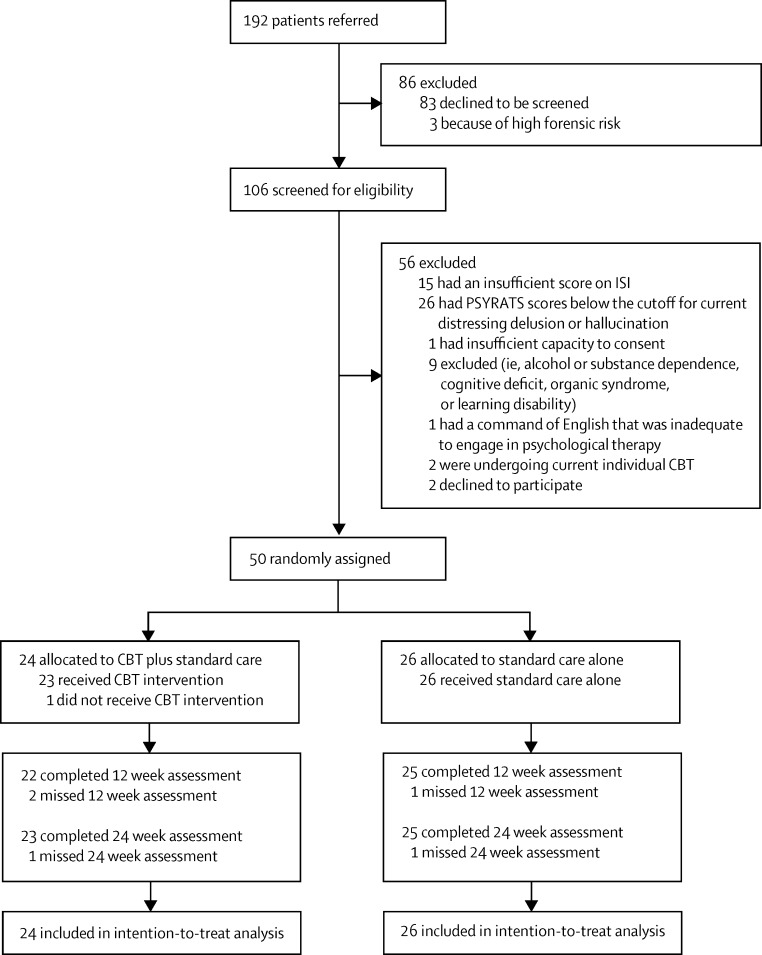
BACKGROUND: Sleep disturbance occurs in most patients with delusions or hallucinations and should be treated as a clinical problem in its own right. However, cognitive behavioural therapy (CBT)-the best evidence-based treatment for insomnia-has not been tested in this patient population. We aimed to pilot procedures for a randomised trial testing CBT for sleep problems in patients with current psychotic experiences, and to provide a preliminary assessment of potential benefit. METHODS: We did this prospective, assessor-blind, randomised controlled pilot trial (Better Sleep Trial [BEST]) at two mental health centres in the UK. Patients (aged 18-65 years) with persistent distressing delusions or hallucinations in the context of insomnia and a schizophrenia spectrum diagnosis were randomly assigned (1:1), via a web-based randomisation system with minimisation to balance for sex, insomnia severity, and psychotic experiences, to receive either eight sessions of CBT plus standard care (medication and contact with the local clinical team) or standard care alone. Research assessors were masked to group allocation. Assessment of outcome was done at weeks 0, 12 (post-treatment), and 24 (follow-up). The primary efficacy outcomes were insomnia assessed by the Insomnia Severity Index (ISI) and delusions and hallucinations assessed by the Psychotic Symptoms Rating Scale (PSYRATS) at week 12. We did analysis by intention to treat, with an aim to provide confidence interval estimation of treatment effects. This study is registered with ISRCTN, number 33695128. FINDINGS: Between Dec 14, 2012, and May 22, 2013, and Nov 7, 2013, and Aug 26, 2014, we randomly assigned 50 patients to receive CBT plus standard care (n=24) or standard care alone (n=26). The last assessments were completed on Feb 10, 2015. 48 (96%) patients provided follow-up data. 23 (96%) patients offered CBT took up the intervention. Compared with standard care, CBT led to reductions in insomnia in the large effect size range at week 12 (adjusted mean difference 6.1, 95% CI 3.0-9.2, effect size d=1.9). By week 12, nine (41%) of 22 patients receiving CBT and one (4%) of 25 patients receiving standard care alone no longer had insomnia, with ISI scores lower than the cutoff for insomnia. The treatment effect estimation for CBT covered a range from reducing but also increasing delusions (adjusted mean difference 0.3, 95% CI -2.0 to 2.6) and hallucinations (-1.9, -6.5 to 2.7). Three patients, all in the CBT group, had five adverse events, although none were regarded as related to study treatment. INTERPRETATION: Our findings show that CBT for insomnia might be highly effective for improving sleep in patients with persistent delusions or hallucinations. A larger, suitably powered phase 3 study is now needed to provide a precise estimate of the effects of CBT for sleep problems, both on sleep and psychotic experiences. FUNDING: Research for Patient Benefit Programme, National Institute for Health Research.
Overview
The claims and statistics of this paper haven’t been checked yet.
Run the check — free, no account needed. It reads the open-access text and checks the sources it cites.
Integrity signals
Registry
Cites
Statistics
Figures
Verification
Claims the paper makes
The claims and statistics of this paper haven’t been checked yet.
Run the check — free, no account needed. It reads the open-access text and checks the sources it cites.
Claims other papers make about this one
Each is checked against this paper’s own text: does it say what the citing paper says it does?
The cited source says what the claim attributes to it.
In the citing paper
“but the trial was underpowered to establish with sufficient precision the consequences for psychotic experiences.”
From The effects of improving sleep on mental health (OASIS): a randomised controlled trial with mediation analysis (2017) · cites this paper as [13]
The cited source says what the claim attributes to it.
In the citing paper
“A subsequent single-blind randomised controlled trial testing the efficacy of CBT for sleep problems in 50 patients with persistent delusions and hallucinations has been completed (Freeman & Waite et al., 2015). CBT was highly efficacious in improving insomnia in this population (Cohen's d effect size = 1.9), but was inconclusive about the impact of this treatment on psychotic experiences because”
From The role of sleep dysfunction in the occurrence of delusions and hallucinations: A systematic review (2015) · cites this paper as Freeman & Waite et al., 2015
The cited source says what the claim attributes to it.
In the citing paper
“since it is an important problem in its own right, for which effective treatments exist (Freeman & Waite et al., 2015).”
From The role of sleep dysfunction in the occurrence of delusions and hallucinations: A systematic review (2015) · cites this paper as Freeman & Waite et al., 2015
In the citing paper
“Serious adverse events were reported by Freeman et al. in patients with psychosis [44] and Sheaves et al. in psychiatric inpatients [45].The events were suicide attempts and violent incidents.All serious adverse events were considered unrelated to the study intervention.”
From Cognitive behavioral therapy for insomnia in patients with mental disorders and comorbid insomnia: A systematic review and meta-analysis (2022) · cites this paper as [44]
In the citing paper
“Sleep disorders have also been shown to be common and severe, but treatable, among individuals with psychotic disorders (Freeman et al., 2009, Freeman et al., 2015).”
From Sleep duration and psychotic experiences in patients at risk of psychosis: a secondary analysis of the EDIE-2 trial (2019) · cites this paper as Freeman et al., 2015
In the citing paper
“In patients with current delusions and hallucinations, results of our pilot randomised controlled trial13 have shown that insomnia can be substantially reduced with CBT”
From The effects of improving sleep on mental health (OASIS): a randomised controlled trial with mediation analysis (2017) · cites this paper as [13]
In the citing paper
“but was inconclusive about the impact of this treatment on psychotic experiences because of the sample size.”
From The role of sleep dysfunction in the occurrence of delusions and hallucinations: A systematic review (2015) · cites this paper as Freeman & Waite et al., 2015
In the citing paper
“Sleep dysfunction is treatable in clinical populations experiencing hallucinations.”
From Towards an Integrative Account of Potential Mechanisms Mediating the Path From Sleep Dysfunction to Hallucinations (2025) · cites this paper as [112]
Self-check
Percentages, sums and reported differences re-computed from the paper’s own numbers.
The self-check needs the paper’s full text.
Citations
Cites
Validation of the Insomnia Severity Index as an outcome measure for insomnia research
Bastien, C. (2001) · Sleep Medicine · doi:10.1016/s1389-9457(00)00065-4 · Cited by 8,067
The Warwick-Edinburgh Mental Well-being Scale (WEMWBS): development and UK validation
Tennant, R., Hiller, L., Fishwick, R., Platt, S., Joseph, S., Weich, S., Parkinson, J., Secker, J., & Stewart-Brown, S. (2007) · Health and Quality of Life Outcomes · doi:10.1186/1477-7525-5-63 · Cited by 5,031
Smets, E. M. A., Garssen, B., Bonke, B., & de Haes, J. C. J. M. (1995) · Journal of Psychosomatic Research · doi:10.1016/0022-3999(94)00125-o · Cited by 3,622
Design and analysis of pilot studies: recommendations for good practice
Lancaster, G. A., Dodd, S., & Williamson, P. R. (2004) · Journal of Evaluation in Clinical Practice · doi:10.1111/j..2002.384.doc.x · Cited by 2,572
HADDOCK, G., McCARRON, J., TARRIER, N., & FARAGHER, E. B. (1999) · Psychological Medicine · doi:10.1017/s0033291799008661 · Cited by 1,461
Recommendations for a standard research assessment of insomnia
Buysse, D. J., Ancoli-Israel, S., Edinger, J. D., Lichstein, K. L., & Morin, C. M. (2006) · Sleep · doi:10.1093/sleep/29.9.1155 · Cited by 1,206
On the use of a pilot sample for sample size determination
Browne, R. H. (1995) · Statistics in Medicine · doi:10.1002/sim.4780141709 · Cited by 1,007
Morin, C. M., & Benca, R. (2012) · The Lancet · doi:10.1016/s0140-6736(11)60750-2 · Cited by 976
The Measurement and Valuation of Health Status Using EQ-5D: A European Perspective
Brooks, R. G., Rabin, R., & de Charro, F. (2003) · Springer eBooks · doi:10.1007/978-94-017-0233-1 · Cited by 780
Costing psychiatric interventions.
Beecham, J. K., & Knapp, M. R. J. (1992) · Kent Academic Repository (University of Kent) · Cited by 710
Research works printed but not linked: 1
- Edinger, 2009, Reliability and validity of the DUKE structured interview for sleep disorders for insomnia screening, Sleep, 32, 0810
Cited by
Sorted by citations
Items 101–200 of 219
Waite, F., Kabir, T., Johns, L., Mollison, J., Tsiachristas, A., Petit, A., Černis, E., Maughan, D. L., & Freeman, D. H. (2020) · BMJ Open · doi:10.1136/bmjopen-2020-045235 · Cited by 12
Fekih‐Romdhane, F., Stambouli, M., Malaeb, D. N., Farah, N., Cheour, M., Obeïd, S., & Hallit, S. R. (2023) · BMC Psychiatry · doi:10.1186/s12888-023-05019-w · Cited by 12
Sleep and socio-occupational functioning in adults with serious mental illness: A systematic review
Stafford, A., Oduola, S., & Reeve, S. (2024) · Psychiatry Research · doi:10.1016/j.psychres.2024.116111 · Cited by 13
Understanding factors relevant to poor sleep and coping methods in people with schizophrenia
Chang, Y., Chang, M., Chang, Y.-J., & Chen, M. (2021) · BMC Psychiatry · doi:10.1186/s12888-021-03384-y · Cited by 11
Farah, N., Obeïd, S., Malaeb, D. N., Haddad, C., Fekih‐Romdhane, F., & Hallit, S. R. (2023) · BMC Psychiatry · doi:10.1186/s12888-023-04778-w · Cited by 11
Sleep problems and worrying precede psychotic symptoms during an online intervention for psychosis
Lüdtke, T., Pfuhl, G., Moritz, S., Rüegg, N., Berger, T., & Westermann, S. (2020) · British Journal of Clinical Psychology · doi:10.1111/bjc.12270 · Cited by 10
Treating insomnia in patients with comorbid psychiatric disorders: A focused review.
Garland, S. N., Vargas, I., Grandner, M. A., & Perlis, M. L. (2018) · Canadian Psychology/Psychologie canadienne · doi:10.1037/cap0000141 · Cited by 12
Boland, C., Gallagher, P., & Clarke, M. (2020) · Irish Journal of Psychological Medicine · doi:10.1017/ipm.2019.58 · Cited by 10
Sleep Interventions in the Treatment of Schizophrenia and Bipolar Disorder
Gıca, Ş., & Selvı, Y. (2021) · Nöro Psikiyatri Arşivi · doi:10.29399/npa.27467 · Cited by 10
Griffiths, C., & Hina, F. (2021) · International Journal of Prisoner Health · doi:10.1108/ijph-01-2021-0014 · Cited by 10
Reed, Z. E., Jones, H. J., Hemani, G., Zammit, S., & Davis, O. S. P. (2019) · Wellcome Open Research · doi:10.12688/wellcomeopenres.15060.1 · Cited by 10
Behavioral Interventions to Reduce Cardiovascular Risk Among People with Severe Mental Disorder
Baker, A. L., Forbes, E., Pohlman, S., & McCarter, K. (2022) · Annual Review of Clinical Psychology · doi:10.1146/annurev-clinpsy-072720-012042 · Cited by 9
de Verville, P. L. S., Etchecopar‐Etchart, D., Richieri, R. M., Godin, O., Schürhoff, F., Berna, F. S., Aouizerate, B., Capdevielle, D., Chéreau, I., d’Amato, T., et al. (2021) · Progress in Neuro-Psychopharmacology and Biological Psychiatry · doi:10.1016/j.pnpbp.2021.110275 · Cited by 9
Marin, L., Guàrdia, A., González-Rodríguez, A., Haba‐Rubio, J., Natividad, M., Bosch, E., Domínguez, N. P., & Monreal, J. A. (2023) · Clocks & Sleep · doi:10.3390/clockssleep5020020 · Cited by 12
van der Tuin, S., Booij, S. H., Oldehinkel, A. J., van den Berg, D. P. G., Wigman, J. T. W., Lång, U., & Kelleher, I. (2023) · Psychological Medicine · doi:10.1017/s0033291723001459 · Cited by 10
Successful treatment of nightmares may reduce psychotic symptoms in schizophrenia
Seeman, M. V. (2018) · World Journal of Psychiatry · doi:10.5498/wjp.v8.i3.75 · Cited by 9
Nuzum, E., Hammoud, R., Spencer, T. J., Akande, I., & Tognin, S. (2021) · Early Intervention in Psychiatry · doi:10.1111/eip.13210 · Cited by 10
Low-intensity sleep intervention in a youth mental health service: A case series analysis
Rollinson, R., Price, I., Gee, B., Lyons, J., Carroll, B., Wilson, J., & Clarke, T. (2021) · Behavioural and Cognitive Psychotherapy · doi:10.1017/s135246582000051x · Cited by 8
Huang, Z., Huang, Z., Du, Z., Gao, X., Jiang, Y., Zhou, Z., & Zhu, H. (2025) · Gut Microbes · doi:10.1080/19490976.2025.2607817 · Cited by 9
González-Rodríguez, A., Labad, J., & Seeman, M. V. (2020) · Clocks & Sleep · doi:10.3390/clockssleep2040030 · Cited by 8
Batalla-Martín, D., Martorell‐Poveda, M., Eraso, Á. G. B., Gordo, A. M., Lleal, H. B., Melendez, R., Girona, R. Q., & López‐Ruiz, M. (2023) · Journal of Clinical Medicine · doi:10.3390/jcm12196147 · Cited by 7
Reed, Z. E., Jones, H. J., Hemani, G., Zammit, S., & Davis, O. S. P. (2019) · Wellcome Open Research · doi:10.12688/wellcomeopenres.15060.2 · Cited by 7
Gao, Z., Xiao, Y., Zhang, Y., Zhu, F., Tao, B., Tang, X., & Lui, S. (2022) · Schizophrenia · doi:10.1038/s41537-022-00291-3 · Cited by 7
Beattie, L., Robb, F. M., Spanswick, M., Henry, A. L., Waxmonsky, J. A., & Gumley, A. I. (2023) · Early Intervention in Psychiatry · doi:10.1111/eip.13388 · Cited by 7
Psychotic-like experiences and happiness in the English general population
Koyanagi, A. (2017) · Journal of Affective Disorders · doi:10.1016/j.jad.2017.07.013 · Cited by 8
Klingaman, E. A., Lucksted, A. A., Crosby, E. S., Blank, Y., & Schwartz, E. K. (2019) · Journal of Sleep Research · doi:10.1111/jsr.12833 · Cited by 7
Cognitive Behavioural Therapy in Treating Persons with Learning Disabilities.
Bekiroğulları, Z. (2018) · Cited by 7
Cognitive Behavioural Therapies for Psychosis
Johns, L., Isham, L., & Manser, R. (2019) · Elsevier eBooks · doi:10.1016/b978-0-12-815012-2.00015-8 · Cited by 10
Sheaves, B., Cropley, V. L., Moseley, P., Woodruff, P. W. R., Punton, G., Speth, C., Speth, J., Meerlo, P., & Brederoo, S. G. (2025) · Schizophrenia Bulletin · doi:10.1093/schbul/sbaf107 · Cited by 6
Schütz, A., Salahuddin, N. H., Priller, J., Bighelli, I., & Leucht, S. (2024) · Psychiatry Research · doi:10.1016/j.psychres.2024.116069 · Cited by 6
Peña-Falcón, M. R., Nagore, C. P., & Garcelán, S. P. (2018) · Cognitive Neuropsychiatry · doi:10.1080/13546805.2018.1439733 · Cited by 6
Fekih‐Romdhane, F., Malaeb, D. N., Loch, A. A., Farah, N., Obeïd, S., & Hallit, S. R. (2023) · International Journal of Mental Health and Addiction · doi:10.1007/s11469-023-01044-8 · Cited by 5
Monistrol-Mula, A., Félez-Nóbrega, M., Oh, H. Y., Haro, J. M., & Koyanagi, A. (2024) · Journal of Global Health · doi:10.7189/jogh.14.04005 · Cited by 6
Sleep and paranoia: A systematic review and meta-analysis
Brown, P., Reeve, S., Hotton, M., Steer, N., & Steel, C. (2024) · Clinical Psychology Review · doi:10.1016/j.cpr.2024.102503 · Cited by 5
Trinca, E., Hertenstein, E., Wunderlin, M., Schneider, C. L., Züst, M. A., Fehér, K. D., Su, T., van Straten, A., Berger, T., Riemann, D. W., et al. (2022) · Sleep Medicine · doi:10.1016/j.sleep.2022.05.311 · Cited by 5
Formica, M., Fuller‐Tyszkiewicz, M., Hickie, I. B., OLIVE, L. S., Wood, S. J., Purcell, R., Yung, A. R., Phillips, L., Nelson, B., Pantelis, C., et al. (2023) · Schizophrenia Research · doi:10.1016/j.schres.2023.07.019 · Cited by 5
Sleep quality and cognitive impairments in remitted patients with schizophrenia in Nigeria
Esan, O., & Ephraim‐Oluwanuga, O. T. (2021) · L Encéphale · doi:10.1016/j.encep.2020.12.004 · Cited by 5
Tanskanen, T. E., Wegelius, A., Härkönen, T., Gummerus, E.-M., Stenberg, J., Selinheimo, S., Alakuijala, A., Tenhunen, M. L., Paajanen, T. I., Järnefelt, H., et al. (2024) · BMJ Open · doi:10.1136/bmjopen-2023-076129 · Cited by 4
Faulkner, S., Drake, R., Ogden, M., Gardani, M., & Bee, P. (2022) · PLoS ONE · doi:10.1371/journal.pone.0269453 · Cited by 7
Wood, L., Morrison, A. P., Lay, B., Williams, C., & Johnson, S. (2024) · Psychosis · doi:10.1080/17522439.2024.2386176 · Cited by 5
de Crom, S. A. M., de Haan, L., & Schirmbeck, F. N. (2021) · Psychiatry Research · doi:10.1016/j.psychres.2021.113728 · Cited by 4
Pant, K., Garg, S., Mishra, P., & Tikka, S. K. (2022) · Archives of Mental Health · doi:10.4103/amh.amh_116_22 · Cited by 4
Walker, K., Griffiths, C., & Willis, A. (2024) · Advances in Mental Health · doi:10.1080/18387357.2024.2302118 · Cited by 5
Waite, F., Evans, S., Rebello, A., Sharpe, T., Otaiku, J., Iredale, E., Kabir, T., Černis, E., & Freeman, D. H. (2025) · British Journal of Clinical Psychology · doi:10.1111/bjc.70002 · Cited by 3
Varese, F., Sudell, M., Morrison, A. P., Longden, E., & Smith, C. T. (2024) · Health Technology Assessment · doi:10.3310/ncfr5074 · Cited by 4
Chaurasia, N., Dhyani, M., Garg, S., & Mishra, P. (2024) · Annals of Indian Psychiatry · doi:10.4103/aip.aip_79_22 · Cited by 3
Harvey, A. G. (2016) · International Journal of Cognitive Therapy · doi:10.1521/ijct.2016.9.2.171 · Cited by 4
Tolmeijer, E., Waite, F., Isham, L., Bringmann, L. F., Timmers, R., van den Berg, A., Schuurmans, H., Staring, A. B. P., de Bont, P. A. J. M., van Grunsven, R., et al. (2023) · Trials · doi:10.1186/s13063-023-07661-x · Cited by 4
Faulkner, S., Didikoğlu, A., Byrne, R. E., Drake, R., & Bee, P. (2023) · Clocks & Sleep · doi:10.3390/clockssleep5040048 · Cited by 3
Una revisión de los trastornos del sueño en la esquizofrenia
Anmella, G., Costanzo, M. C., Meneses, M. E. R., & Bernardo, M. (2017) · Psiquiatría Biológica · doi:10.1016/j.psiq.2017.05.005 · Cited by 3
The Role of Sleep in Mental Illness in Veterans and Active Service Members
Talbot, L. S., Klingaman, E. A., Primeau, M. M., Kawai, M., Pirog, S., Jordan, J. T., & O'Hara, R. M. (2018) · Springer eBooks · doi:10.1007/978-1-4939-7438-2_25 · Cited by 3
Izuhara, M., Matsuda, H., Saito, A., Hayashida, M., Miura, S., Oh‐Nishi, A., Azis, I. A., Abdullah, R. A., Tsuchie, K., Araki, T., et al. (2018) · Frontiers in Psychiatry · doi:10.3389/fpsyt.2018.00260 · Cited by 3
CBT‐I Protocols for Insomnia Co‐morbid with Other Mental Disorders
Hertenstein, E., Nissen, C., & Freeman, D. H. (2022) · doi:10.1002/9781119891192.ch13 · Cited by 3
Wilkinson, H. R., Johns, L., Batchelor, R., & Lau‐Zhu, A. (2025) · The British Journal of Psychiatry · doi:10.1192/bjp.2025.86 · Cited by 3
Changqing, S., Xue, W., Zhang, P., Zhu, Z., Hu, B., Wang, P., Li, Y., Zhao, M., Hao, J., Zhou, Q., et al. (2025) · Scientific Reports · doi:10.1038/s41598-025-14305-4 · Cited by 2
CBT-I for patients with schizophrenia and other psychotic disorders
Tubbs, A. S., & Grandner, M. A. (2021) · Elsevier eBooks · doi:10.1016/b978-0-12-822872-2.00015-3 · Cited by 2
Yuen, S. C.-S., Chua, K. K., Zhong, L. L. D., Chan, K. W., Chan, C. K. H., Chan, K. L., Lin, Z., Mok, V., Lau, A. Y. L., & Li, M. (2022) · Chinese Medicine · doi:10.1186/s13020-022-00572-0 · Cited by 2
Raffard, S., de Connor, A., Freeman, D. H., & Bortolon, C. (2023) · L Encéphale · doi:10.1016/j.encep.2023.08.004 · Cited by 2
Franz Kafka: An emblematic case of co-occurrence of sleep and psychiatryc disorders
Coralli, A., & Perciaccante, A. (2016) · Sleep Science · doi:10.1016/j.slsci.2016.02.177 · Cited by 2
Treatment of Sleep Disorders in Specific Psychiatric Diseases
Wetter, T. C., & Steiger, A. (2022) · Springer eBooks · doi:10.1007/978-3-030-62059-2_451 · Cited by 2
Digital Therapies for Insomnia
Jackson, M. L., Meaklim, H., & Mason, E. C. (2023) · Springer eBooks · doi:10.1007/978-3-031-10698-9_6 · Cited by 2
Correlation analysis between insomnia symptoms and language function in patients with schizophrenia
Linlin, W., Ruofei, J., Hudan, C., Ruxuan, T., & Yao, J. (2023) · Schizophrenia Research Cognition · doi:10.1016/j.scog.2023.100292 · Cited by 2
Klingaman, E. A., Lucksted, A. A., Crosby, E. S., Kacmarek, C. N., Peeples, A., Hack, S. M., Blank, Y., & Schwartz, E. K. (2024) · Journal of Sleep Research · doi:10.1111/jsr.14227 · Cited by 1
Hałabuda, Z., & Rynkiewicz, K. (2026) · International Journal of Innovative Technologies in Social Science · doi:10.31435/ijitss.1(49).2026.4925 · Cited by 1
Mehl, S., Hautmann, C., Schlier, B., Dorn, L. M.-L., Ludwig, L., Teismann, T., Franz, M., Rief, W., Stark, R. M., & Lincoln, T. M. (2026) · Schizophrenia · doi:10.1038/s41537-026-00737-y · Cited by 1
Knitting up the ravelled sleeve of care: sleep and psychosis
Birchwood, M. J. (2015) · The Lancet Psychiatry · doi:10.1016/s2215-0366(15)00371-5 · Cited by 1
Psychological therapies for psychosis: a view from the hills
Kuipers, E., Onwumere, J., & PETERS, E. R. (2016) · The Lancet Psychiatry · doi:10.1016/s2215-0366(15)00570-2 · Cited by 1
Better Sleep: Evidence-Based Interventions
Waite, F., & Sheaves, B. (2019) · Elsevier eBooks · doi:10.1016/b978-0-12-815012-2.00020-1 · Cited by 1
How do US military veterans with serious mental illness manage insomnia? A phenomenological analysis
Klingaman, E. A., Lucksted, A. A., Crosby, E. S., Hack, S. M., Peeples, A., Blank, Y., & Schwartz, E. K. (2022) · Journal of Sleep Research · doi:10.1111/jsr.13570 · Cited by 1
[Status of Health Economics Research on Cognitive Behavioral Therapy for Insomnia].
Zhang, J., & Yuan, C. (2023) · PubMed Central · doi:10.12182/20230360102 · Cited by 1
Cognitive Behavioural Therapy for Psychosis
Manser, R., & Johns, L. (2023) · Springer eBooks · doi:10.1007/978-3-031-27003-1_9 · Cited by 1
Farcas, A., & Iftene, F. (2023) · International Journal of Nursing and Health Care Research · doi:10.29011/2688-9501.101433 · Cited by 1
Gannon, L., Pearson, N., Tsiglopoulos, J., Mifsud, N. G., Castagnini, E., Thompson, A. D., Langstone, A., Killackey, E. J., McGorry, P. D., & O'Donoghue, B. N. (2023) · Schizophrenia Research · doi:10.1016/j.schres.2023.07.023 · Cited by 1
Mehl, S. (2023) · Springer eBooks · doi:10.1007/978-3-662-64465-2_32 · Cited by 1
Update kognitive Verhaltenstherapie bei Psychosen
Pillny, M., & Lincoln, T. M. (2020) · Psychotherapie · doi:10.30820/2364-1517-2020-1-67 · Cited by 1
Scott, A. J., Rowse, G., & Webb, T. L. (2020) · Health Psychology Bulletin · doi:10.5334/hpb.6 · Cited by 1
Treatment of Sleep Disorders in Specific Psychiatric Diseases
Wetter, T. C., & Steiger, A. (2021) · Springer eBooks · doi:10.1007/978-3-319-56015-1_451-1 · Cited by 1
The role of sleep in predicting paranoia in non-affective psychosis: an experience sampling studyPreprint
Rehman, A., Lee, A. J., Biello, S. M., & Gumley, A. I. (2019) · doi:10.31234/osf.io/83bt5 · Cited by 1
Schizofreniespectrum- en andere psychotische stoornissen
van Deth, R. (2017) · Bohn Stafleu van Loghum eBooks · doi:10.1007/978-90-368-1045-6_2
Schlaf bei psychischen Erkrankungen
Göder, R., Weinhold, S. L., Drews, H. J., & Baier, P. C. (2017) · Somnologie - Schlafforschung und Schlafmedizin · doi:10.1007/s11818-017-0141-5
Sleep disruption as a pathway to mania in bipolar disorder
Lewis, K. S. (2017) · ORCA Online Research @Cardiff (Cardiff University)
Psychodynamic Brief Intervention Program (PBIP) Management of Mid-Life Crisis in the Workplace
Valero, M. J. M., & Agnes, M. C. (2019) · Journal of Depression & Anxiety
Comment utiliser les thérapies cognitives et comportementales ?
Yazbek, H., Bortolon, C., de Connor, A., & Raffard, S. (2019) · Elsevier eBooks · doi:10.1016/b978-2-294-76179-9.00012-7
Behandlung unter besonderen Bedingungen (Modul 4c)
Gäebel, W., Hasan, A., & Falkai, P. (2019) · Springer eBooks · doi:10.1007/978-3-662-59380-6_7
Troubles psychotiques et troubles du sommeil : revue de la littérature
Lussier-Valade, M., Désautels, A., & Godbout, R. (2019) · Santé mentale au Québec · doi:10.7202/1073528ar
Báthori, N., Moustafa, A. A., & Polner, B. (2021) · Elsevier eBooks · doi:10.1016/b978-0-12-820005-6.00010-4
Sarfan, L. D., & Harvey, A. G. (2021) · Elsevier eBooks · doi:10.1016/b978-0-12-818697-8.00133-3
透明文字盤コミュニケーションを支援する機器の開発案件に関して(福祉情報工学一般,地域コミュニティと福祉)
伊藤, 和. (2013) · 電子情報通信学会技術研究報告. WIT, 福祉情報工学
Особенности строительства берегозащитных сооружений в городе
Новиков, В. Ю. (2014) · Интернет-журнал Науковедение
Tikka, S. K., & Garg, S. (2022) · Springer eBooks · doi:10.1007/978-981-16-0123-1_20
Schizofreniespectrum- en andere psychotische stoornissen
Peters, A., Brakema, L., van de Hoeve, M., Spoelstra, K., & Knegtering, H. (2020) · Bohn Stafleu van Loghum eBooks · doi:10.1007/978-90-368-2524-5_10
SINTOMAS POSITIVOS E NEGATIVOS DA ESQUIZOFRENIA COMO FATOR PREDISPONENTE PARA DISTÚRBIOS DO SONO
Frutuoso, L. P., Porto, R. D. M., & de Sousa, M. N. A. (2022) · Revista Contemporânea · doi:10.56083/rcv2n3-010
Lu, M., Zhang, Y., Zhang, J., Huang, S., Huang, F., Si, L., Wang, T., Wu, F. Q., Mao, H., & Huang, Z. (2022) · SSRN Electronic Journal · doi:10.2139/ssrn.4172078
khanlou, M. M., Bazazian, S., & Vatankhah, H. R. (2022) · Iranian Evolutionary Educational Psychology Journal · doi:10.52547/ieepj.4.2.388
Gotts, Z. M., & Christodoulides, T. (2019) · Clinical Psychology Forum · doi:10.53841/bpscpf.2019.1.322.39
Cukanovas, A., Kazlauskaitė, Ž., & Viliūnienė, R. (2023) · Health Sciences · doi:10.35988/sm-hs.2023.024
Sleep and Circadian Rhythm Disorders
Bisdounis, L., Kyle, S. D., Saunders, K., Hill, E. A., & Espie, C. A. (2023) · Oxford University Press eBooks · doi:10.1093/med-psych/9780197542521.003.0023 · Cited by 1
Rakitzi, S. (2023) · Springer eBooks · doi:10.1007/978-3-031-27837-2_20
Metadata
- Authors
- Freeman, D., Waite, F., Startup, H., Myers, E., Lister, R., McInerney, J., Harvey, A. G., Geddes, J., Zaiwalla, Z., Luengo-Fernandez, R., Foster, R., Clifton, L., & Yu, L.-M.
- Affiliations
- Warneford Hospital (GB)
- Sussex Partnership NHS Foundation Trust (GB)
- University of California, Berkeley (US)
- John Radcliffe Hospital (GB)
- University of Oxford (GB)
- Corresponding author
- Freeman, Daniel
- ORCID
- Venue
- The Lancet Psychiatry
- Publisher
- Elsevier BV
- Published
- 2015-11
- Volume
- 2
- Issue
- 11
- Pages
- 975-983
- ISSN
- 2215-0366 (ISSN-L)
- PMC
- PMC4641164
- OpenAlex
- W2165478117
- Cited by
- 219
- References
- 52
- Citations by year
- 2026: 12 · 2025: 13 · 2024: 14 · 2023: 29 · 2022: 21 · 2021: 21 · 2020: 21 · 2019: 18 · 2018: 22 · 2017: 25 · 2016: 18 · 2015: 3
- FWCI
- 34.17
- Type
- journal article
- Language
- en
- Open access
- hybrid
- doi.org
- Locations
- The Lancet Psychiatry (publishedVersion, cc-by)
- PubMed Central (publishedVersion, cc-by)
- PubMed (publishedVersion)
- Funders
- National Health Service (NHS) National Institute for Health Research (NIHR) Research for Patient Benefit Programme (reference PB-PG-0211-10007)
- Wellcome Trust Strategic Award (098461/Z/12/Z)
- Topics
- Social Sciences › Psychology › Experimental and Cognitive Psychology › Sleep and related disorders
- Health Sciences › Medicine › Psychiatry and Mental health › Schizophrenia research and treatment
- Social Sciences › Psychology › Clinical Psychology › Psychological Treatments and Assessments
- Keywords
- cognitive behavioral therapy, insomnia, sleep disorders, delusions, hallucinations, psychotic experiences, schizophrenia spectrum disorders, psychosis, treatment efficacy, Insomnia Severity Index, treatment acceptability, medication adherence, adverse events
- MeSH terms
- Adult, Delusions, Double-Blind Method, Female, Hallucinations, Humans, Male, Middle Aged, Prospective Studies, Sleep Wake Disorders, Cognitive Behavioral Therapy, Treatment Outcome
About these checks
Registry, retraction, Cites and statistics results are computed, not judged, with one exception: a printed reference that no index lists is read once by a model before it counts as a citation error. Claims are extracted by a model and kept only when their quote appears verbatim in the text; each cited source is then checked, with a model’s help, for whether it says what the claim relies on. Those verdicts can be wrong — read the claim’s quote and the cited source before relying on one.
Statistics and arithmetic are recomputed, not judged.
Confidence bands are shown only for fields calibrated on our annotated test set. None is calibrated yet, so no band is shown.
What counts as a claim ›How we measure confidence ›How we check this ›
Are you an author, or do you see a problem with this page? Request a review
