

The DOI matches its Crossref record; 49 of the 52 references it cites were found in a registry or an index.
Efficacy of cognitive behavioural therapy for sleep improvement in patients with persistent delusions and hallucinations (BEST): a prospective, assessor-blind, randomised controlled pilot trial
Open accessAbstract
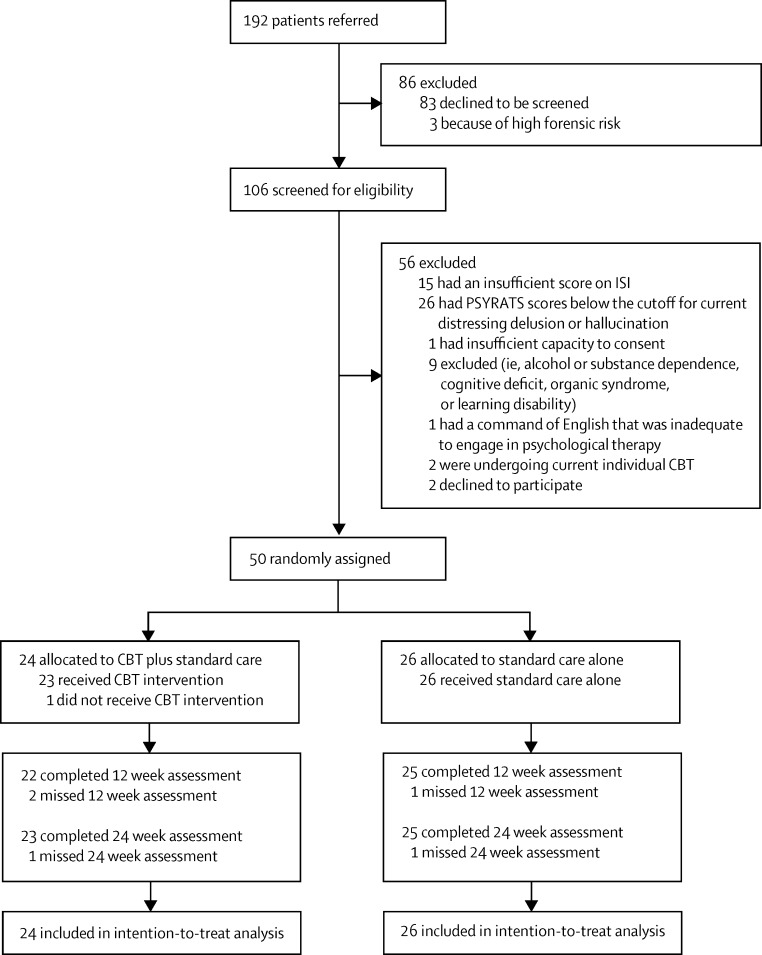
BACKGROUND: Sleep disturbance occurs in most patients with delusions or hallucinations and should be treated as a clinical problem in its own right. However, cognitive behavioural therapy (CBT)-the best evidence-based treatment for insomnia-has not been tested in this patient population. We aimed to pilot procedures for a randomised trial testing CBT for sleep problems in patients with current psychotic experiences, and to provide a preliminary assessment of potential benefit. METHODS: We did this prospective, assessor-blind, randomised controlled pilot trial (Better Sleep Trial [BEST]) at two mental health centres in the UK. Patients (aged 18-65 years) with persistent distressing delusions or hallucinations in the context of insomnia and a schizophrenia spectrum diagnosis were randomly assigned (1:1), via a web-based randomisation system with minimisation to balance for sex, insomnia severity, and psychotic experiences, to receive either eight sessions of CBT plus standard care (medication and contact with the local clinical team) or standard care alone. Research assessors were masked to group allocation. Assessment of outcome was done at weeks 0, 12 (post-treatment), and 24 (follow-up). The primary efficacy outcomes were insomnia assessed by the Insomnia Severity Index (ISI) and delusions and hallucinations assessed by the Psychotic Symptoms Rating Scale (PSYRATS) at week 12. We did analysis by intention to treat, with an aim to provide confidence interval estimation of treatment effects. This study is registered with ISRCTN, number 33695128. FINDINGS: Between Dec 14, 2012, and May 22, 2013, and Nov 7, 2013, and Aug 26, 2014, we randomly assigned 50 patients to receive CBT plus standard care (n=24) or standard care alone (n=26). The last assessments were completed on Feb 10, 2015. 48 (96%) patients provided follow-up data. 23 (96%) patients offered CBT took up the intervention. Compared with standard care, CBT led to reductions in insomnia in the large effect size range at week 12 (adjusted mean difference 6.1, 95% CI 3.0-9.2, effect size d=1.9). By week 12, nine (41%) of 22 patients receiving CBT and one (4%) of 25 patients receiving standard care alone no longer had insomnia, with ISI scores lower than the cutoff for insomnia. The treatment effect estimation for CBT covered a range from reducing but also increasing delusions (adjusted mean difference 0.3, 95% CI -2.0 to 2.6) and hallucinations (-1.9, -6.5 to 2.7). Three patients, all in the CBT group, had five adverse events, although none were regarded as related to study treatment. INTERPRETATION: Our findings show that CBT for insomnia might be highly effective for improving sleep in patients with persistent delusions or hallucinations. A larger, suitably powered phase 3 study is now needed to provide a precise estimate of the effects of CBT for sleep problems, both on sleep and psychotic experiences. FUNDING: Research for Patient Benefit Programme, National Institute for Health Research.
Overview
The claims and statistics of this paper haven’t been checked yet.
Run the check — free, no account needed. It reads the open-access text and checks the sources it cites.
Integrity signals
Registry
Cites
Statistics
Figures
Verification
Claims the paper makes
The claims and statistics of this paper haven’t been checked yet.
Run the check — free, no account needed. It reads the open-access text and checks the sources it cites.
Claims other papers make about this one
Each is checked against this paper’s own text: does it say what the citing paper says it does?
The cited source says what the claim attributes to it.
In the citing paper
“but the trial was underpowered to establish with sufficient precision the consequences for psychotic experiences.”
From The effects of improving sleep on mental health (OASIS): a randomised controlled trial with mediation analysis (2017) · cites this paper as [13]
The cited source says what the claim attributes to it.
In the citing paper
“A subsequent single-blind randomised controlled trial testing the efficacy of CBT for sleep problems in 50 patients with persistent delusions and hallucinations has been completed (Freeman & Waite et al., 2015). CBT was highly efficacious in improving insomnia in this population (Cohen's d effect size = 1.9), but was inconclusive about the impact of this treatment on psychotic experiences because”
From The role of sleep dysfunction in the occurrence of delusions and hallucinations: A systematic review (2015) · cites this paper as Freeman & Waite et al., 2015
The cited source says what the claim attributes to it.
In the citing paper
“since it is an important problem in its own right, for which effective treatments exist (Freeman & Waite et al., 2015).”
From The role of sleep dysfunction in the occurrence of delusions and hallucinations: A systematic review (2015) · cites this paper as Freeman & Waite et al., 2015
In the citing paper
“Serious adverse events were reported by Freeman et al. in patients with psychosis [44] and Sheaves et al. in psychiatric inpatients [45].The events were suicide attempts and violent incidents.All serious adverse events were considered unrelated to the study intervention.”
From Cognitive behavioral therapy for insomnia in patients with mental disorders and comorbid insomnia: A systematic review and meta-analysis (2022) · cites this paper as [44]
In the citing paper
“Sleep disorders have also been shown to be common and severe, but treatable, among individuals with psychotic disorders (Freeman et al., 2009, Freeman et al., 2015).”
From Sleep duration and psychotic experiences in patients at risk of psychosis: a secondary analysis of the EDIE-2 trial (2019) · cites this paper as Freeman et al., 2015
In the citing paper
“In patients with current delusions and hallucinations, results of our pilot randomised controlled trial13 have shown that insomnia can be substantially reduced with CBT”
From The effects of improving sleep on mental health (OASIS): a randomised controlled trial with mediation analysis (2017) · cites this paper as [13]
In the citing paper
“but was inconclusive about the impact of this treatment on psychotic experiences because of the sample size.”
From The role of sleep dysfunction in the occurrence of delusions and hallucinations: A systematic review (2015) · cites this paper as Freeman & Waite et al., 2015
In the citing paper
“Sleep dysfunction is treatable in clinical populations experiencing hallucinations.”
From Towards an Integrative Account of Potential Mechanisms Mediating the Path From Sleep Dysfunction to Hallucinations (2025) · cites this paper as [112]
Self-check
Percentages, sums and reported differences re-computed from the paper’s own numbers.
The self-check needs the paper’s full text.
Citations
Cites
Validation of the Insomnia Severity Index as an outcome measure for insomnia research
Bastien, C. (2001) · Sleep Medicine · doi:10.1016/s1389-9457(00)00065-4 · Cited by 8,067
The Warwick-Edinburgh Mental Well-being Scale (WEMWBS): development and UK validation
Tennant, R., Hiller, L., Fishwick, R., Platt, S., Joseph, S., Weich, S., Parkinson, J., Secker, J., & Stewart-Brown, S. (2007) · Health and Quality of Life Outcomes · doi:10.1186/1477-7525-5-63 · Cited by 5,031
Smets, E. M. A., Garssen, B., Bonke, B., & de Haes, J. C. J. M. (1995) · Journal of Psychosomatic Research · doi:10.1016/0022-3999(94)00125-o · Cited by 3,622
Design and analysis of pilot studies: recommendations for good practice
Lancaster, G. A., Dodd, S., & Williamson, P. R. (2004) · Journal of Evaluation in Clinical Practice · doi:10.1111/j..2002.384.doc.x · Cited by 2,572
HADDOCK, G., McCARRON, J., TARRIER, N., & FARAGHER, E. B. (1999) · Psychological Medicine · doi:10.1017/s0033291799008661 · Cited by 1,461
Recommendations for a standard research assessment of insomnia
Buysse, D. J., Ancoli-Israel, S., Edinger, J. D., Lichstein, K. L., & Morin, C. M. (2006) · Sleep · doi:10.1093/sleep/29.9.1155 · Cited by 1,206
On the use of a pilot sample for sample size determination
Browne, R. H. (1995) · Statistics in Medicine · doi:10.1002/sim.4780141709 · Cited by 1,007
Morin, C. M., & Benca, R. (2012) · The Lancet · doi:10.1016/s0140-6736(11)60750-2 · Cited by 976
The Measurement and Valuation of Health Status Using EQ-5D: A European Perspective
Brooks, R. G., Rabin, R., & de Charro, F. (2003) · Springer eBooks · doi:10.1007/978-94-017-0233-1 · Cited by 780
Costing psychiatric interventions.
Beecham, J. K., & Knapp, M. R. J. (1992) · Kent Academic Repository (University of Kent) · Cited by 710
Slade, M., & Thornicroft, G. (2025) · doi:10.1093/med/9780198898818.003.0007 · Cited by 679
Edinger, J. D., Wohlgemuth, W. K., Radtke, R. A., Marsh, G. R., & Quillian, R. E. (2001) · JAMA · doi:10.1001/jama.285.14.1856 · Cited by 625
Sleep disturbance as transdiagnostic: Consideration of neurobiological mechanisms
Harvey, A. G., Murray, G., Chandler, R. A., & Soehner, A. (2011) · Clinical Psychology Review · doi:10.1016/j.cpr.2010.04.003 · Cited by 609
The revised cognitive therapy scale (CTS-R): psychometric properties.
Blackburn, I.-M., James, I. A., Milne, D. L., Baker, C., Standart, S., Garland, A., & Reichelt, F. K. (2001) · Behavioural and Cognitive Psychotherapy · doi:10.1017/s1352465801004040 · Cited by 568
Sleep and circadian rhythm disruption in schizophrenia
Wulff, K., Dijk, D.-J., Middleton, B., Foster, R. G., & Joyce, E. M. (2012) · British Journal of Psychiatry · doi:10.1192/bjp.bp.111.096321 · Cited by 426
The statistical interpretation of pilot trials: should significance thresholds be reconsidered?
Lee, E. C., Whitehead, A. L., Jacques, R. M., & Julious, S. A. (2014) · BMC Medical Research Methodology · doi:10.1186/1471-2288-14-41 · Cited by 423
Green, C. E. L., Freeman, D., Kuipers, E., Bebbington, P., Fowler, D., Dunn, G., & Garety, P. A. (2008) · Psychological Medicine · doi:10.1017/s0033291707001638 · Cited by 401
Birchwood, M., Smith, J., Macmillan, F., Hogg, B., Prasad, R., Harvey, C., & Bering, S. (1989) · Psychological Medicine · doi:10.1017/s0033291700024247 · Cited by 334
Cognitive Behavioral Therapy in Persons with Comorbid Insomnia: A Meta-Analysis
Geiger-Brown, J. M., Rogers, V. E., Liu, W., Ludeman, E. M., Downton, K. D., & Diaz-Abad, M. (2015) · Sleep Medicine Reviews · doi:10.1016/j.smrv.2014.11.007 · Cited by 331
OKAJIMA, I., KOMADA, Y., & INOUE, Y. (2011) · Sleep and Biological Rhythms · doi:10.1111/j.1479-8425.2010.00481.x · Cited by 306
Espie, C. A., Macmahon, K., Kelly, H.-L., Broomfield, N. M., Douglas, N. J., Engleman, H. M., McKinstry, B., Morin, C. M., Walker, A., & Wilson, P. (2007) · SLEEP · doi:10.1093/sleep/30.5.574 · Cited by 302
Freeman, D., Dunn, G., Startup, H., Pugh, K., Cordwell, J., Mander, H., Černis, E., Wingham, G., Shirvell, K., & Kingdon, D. (2015) · The Lancet Psychiatry · doi:10.1016/s2215-0366(15)00039-5 · Cited by 295
Self-citationConcomitants of paranoia in the general population
Freeman, D., McManus, S., Brugha, T., Meltzer, H., Jenkins, R., & Bebbington, P. (2011) · Psychological Medicine · doi:10.1017/s0033291710001546 · Cited by 294
Sleep in Untreated Patients With Schizophrenia: A Meta-Analysis
Chouinard, S., Poulin, J., Stip, É., & Godbout, R. (2004) · Schizophrenia Bulletin · doi:10.1093/oxfordjournals.schbul.a007145 · Cited by 275
Harvey, A. G., Soehner, A. M., Kaplan, K., Hein, K., Lee, J., Kanady, J. C., Li, D., Rabe‐Hesketh, S., Ketter, T. A., Neylan, T. C., et al. (2015) · Journal of Consulting and Clinical Psychology · doi:10.1037/a0038655 · Cited by 271
Freeman, D., Stahl, D., McManus, S., Meltzer, H., Brugha, T., Wiles, N., & Bebbington, P. (2012) · Social Psychiatry and Psychiatric Epidemiology · doi:10.1007/s00127-011-0433-1 · Cited by 246
Sleep and Circadian Rhythm Disruption in Social Jetlag and Mental Illness
Foster, R. G., Peirson, S. N., Wulff, K., Winnebeck, E., Vetter, C., & Roenneberg, T. (2013) · Progress in Molecular Biology and Translational Science · doi:10.1016/b978-0-12-396971-2.00011-7 · Cited by 224
An open trial of cognitive therapy for chronic insomnia
Harvey, A. G., Sharpley, A. L., Ree, M. J., Stinson, K., & Clark, D. M. (2007) · Behaviour Research and Therapy · doi:10.1016/j.brat.2007.04.007 · Cited by 219
Harvey, A. G., Bélanger, L., Talbot, L., Eidelman, P., Beaulieu-Bonneau, S., Fortier-Brochu, É., Ivers, H., Lamy, M., Hein, K., Soehner, A. M., et al. (2014) · Journal of Consulting and Clinical Psychology · doi:10.1037/a0036606 · Cited by 215
Self-citationInterventionist causal models in psychiatry: repositioning the mind–body problem
Kendler, K. S., & Campbell, J. (2009) · Psychological Medicine · doi:10.1017/s0033291708004467 · Cited by 173
Myers, E., Startup, H., & Freeman, D. (2011) · Journal of Behavior Therapy and Experimental Psychiatry · doi:10.1016/j.jbtep.2011.02.004 · Cited by 170
Freeman, D., Pugh, K., Vorontsova, N., & Southgate, L. (2009) · Schizophrenia Research · doi:10.1016/j.schres.2008.12.001 · Cited by 158
Self-citationGreenwood, K., Sweeney, A., Williams, S., Garety, P. A., Kuipers, E., Scott, J. L., & PETERS, E. R. (2009) · Schizophrenia Bulletin · doi:10.1093/schbul/sbp117 · Cited by 136
Sheaves, B., Porcheret, K., Tsanas, A., Espie, C. A., Foster, R. G., Freeman, D., Harrison, P. J., Wulff, K., & Goodwin, G. M. (2016) · SLEEP · doi:10.5665/sleep.5342 · Cited by 129
Lunsford-Avery, J. R., LeBourgeois, M. K., Gupta, T., & Mittal, V. A. (2015) · Schizophrenia Research · doi:10.1016/j.schres.2015.03.013 · Cited by 119
Evaluating the links between schizophrenia and sleep and circadian rhythm disruption
Pritchett, D., Wulff, K., Oliver, P. L., Bannerman, D. M., Davies, K. E., Harrison, P. J., Peirson, S. N., & Foster, F. (2012) · Journal of Neural Transmission · doi:10.1007/s00702-012-0817-8 · Cited by 111
Treating Sleep Problems in Patients with Schizophrenia
Waite, F., Myers, E., Harvey, A. G., Espie, C. A., Startup, H., Sheaves, B., & Freeman, D. H. (2015) · Behavioural and Cognitive Psychotherapy · doi:10.1017/s1352465815000430 · Cited by 103
Freeman, D., Brugha, T., Meltzer, H., Jenkins, R., Stahl, D., & Bebbington, P. (2010) · Journal of Psychiatric Research · doi:10.1016/j.jpsychires.2010.03.018 · Cited by 99
Taylor, M. J., Gregory, A. M., Freeman, D., & Ronald, A. (2015) · Journal of Abnormal Psychology · doi:10.1037/abn0000057 · Cited by 85
Waite, F., Evans, N., Myers, E., Startup, H., Lister, R., Harvey, A. G., & Freeman, D. (2016) · Psychology and Psychotherapy Theory Research and Practice · doi:10.1111/papt.12073 · Cited by 85
Jeppesen, P., Clemmensen, L., Munkholm, A., Rimvall, M. K., Rask, C. U., Jørgensen, T., Larsen, J. T., Petersen, L., van Os, J., & Skovgaard, A. M. (2015) · Journal of Child Psychology and Psychiatry · doi:10.1111/jcpp.12319 · Cited by 84
Freeman, D., Thompson, C., Vorontsova, N., Dunn, G., Carter, L.-A., Garety, P., Kuipers, E., Slater, M., Antley, A., Glucksman, E., et al. (2013) · Psychological Medicine · doi:10.1017/s003329171300038x · Cited by 79
Tek, C., Palmese, L. B., Krystal, A. D., Srihari, V. H., DeGeorge, P. C., Reutenauer, E. L., & Guloksuz, S. (2014) · Schizophrenia Research · doi:10.1016/j.schres.2014.10.002 · Cited by 59
Poulin, J., Chouinard, S., Pampoulova, T., Lecomte, Y., Stip, É., & Godbout, R. (2010) · Psychiatry Research · doi:10.1016/j.psychres.2009.08.009 · Cited by 38
Positive and negative syndromes in schizophrenia
Tandon, R., & Greden, J. F. (1989) · American Journal of Psychiatry · doi:10.1176/ajp.146.3.407 · Cited by 38
Freeman, D. H., Startup, H. M., Myers, E., Harvey, A. G., Geddes, J. R., Yu, L., Zaiwalla, Z., Luengo-Fernández, R., Foster, F., & Lister, R. (2013) · Trials · doi:10.1186/1745-6215-14-214 · Cited by 25
Predicting Relapse in Schizophrenia
Bebbington, P., & Kuipers, E. (1995) · International Journal of Mental Health · doi:10.1080/00207411.1995.11449309 · Cited by 20
Have the potential benefits of CBT for severe mental disorders been undersold?
Mueser, K. T., & Glynn, S. M. (2014) · World Psychiatry · doi:10.1002/wps.20160 · Cited by 6
Research works printed but not linked: 1
- Edinger, 2009, Reliability and validity of the DUKE structured interview for sleep disorders for insomnia screening, Sleep, 32, 0810
Cited by
Sorted by citations
Scott, A. J., Webb, T. L., Martyn-St James, M., Rowse, G., & Weich, S. (2021) · Sleep Medicine Reviews · doi:10.1016/j.smrv.2021.101556 · Cited by 1,094
Sleep and mental disorders: a meta-analysis of polysomnographic research
Baglioni, C., Nanovska, S., Regen, W., Spiegelhalder, K., Feige, B., Nissen, C., Reynolds, C. F., & Riemann, D. (2016) · Psychological Bulletin · doi:10.1037/bul0000053 · Cited by 1,074
Sleep disturbance and psychiatric disorders
Freeman, D., Sheaves, B., Waite, F., Harvey, A. G., & Harrison, P. J. (2020) · The Lancet Psychiatry · doi:10.1016/s2215-0366(20)30136-x · Cited by 843
Freeman, D., Sheaves, B., Goodwin, G. M., Yu, L.-M., Nickless, A., Harrison, P. J., Emsley, R., Luik, A. I., Foster, R. G., Wadekar, V., et al. (2017) · The Lancet Psychiatry · doi:10.1016/s2215-0366(17)30328-0 · Cited by 652
Perlis, M. L., Posner, D. A., Riemann, D. W., Bastien, C., Teel, J., & Thase, M. (2022) · The Lancet · doi:10.1016/s0140-6736(22)00879-0 · Cited by 428
Metadata
- Authors
- Freeman, D., Waite, F., Startup, H., Myers, E., Lister, R., McInerney, J., Harvey, A. G., Geddes, J., Zaiwalla, Z., Luengo-Fernandez, R., Foster, R., Clifton, L., & Yu, L.-M.
- Affiliations
- Warneford Hospital (GB)
- Sussex Partnership NHS Foundation Trust (GB)
- University of California, Berkeley (US)
- John Radcliffe Hospital (GB)
- University of Oxford (GB)
- Corresponding author
- Freeman, Daniel
- ORCID
- Venue
- The Lancet Psychiatry
- Publisher
- Elsevier BV
- Published
- 2015-11
- Volume
- 2
- Issue
- 11
- Pages
- 975-983
- ISSN
- 2215-0366 (ISSN-L)
- PMC
- PMC4641164
- OpenAlex
- W2165478117
- Cited by
- 219
- References
- 52
- Citations by year
- 2026: 12 · 2025: 13 · 2024: 14 · 2023: 29 · 2022: 21 · 2021: 21 · 2020: 21 · 2019: 18 · 2018: 22 · 2017: 25 · 2016: 18 · 2015: 3
- FWCI
- 34.17
- Type
- journal article
- Language
- en
- Open access
- hybrid
- doi.org
- Locations
- The Lancet Psychiatry (publishedVersion, cc-by)
- PubMed Central (publishedVersion, cc-by)
- PubMed (publishedVersion)
- Funders
- National Health Service (NHS) National Institute for Health Research (NIHR) Research for Patient Benefit Programme (reference PB-PG-0211-10007)
- Wellcome Trust Strategic Award (098461/Z/12/Z)
- Topics
- Social Sciences › Psychology › Experimental and Cognitive Psychology › Sleep and related disorders
- Health Sciences › Medicine › Psychiatry and Mental health › Schizophrenia research and treatment
- Social Sciences › Psychology › Clinical Psychology › Psychological Treatments and Assessments
- Keywords
- cognitive behavioral therapy, insomnia, sleep disorders, delusions, hallucinations, psychotic experiences, schizophrenia spectrum disorders, psychosis, treatment efficacy, Insomnia Severity Index, treatment acceptability, medication adherence, adverse events
- MeSH terms
- Adult, Delusions, Double-Blind Method, Female, Hallucinations, Humans, Male, Middle Aged, Prospective Studies, Sleep Wake Disorders, Cognitive Behavioral Therapy, Treatment Outcome
About these checks
Registry, retraction, Cites and statistics results are computed, not judged, with one exception: a printed reference that no index lists is read once by a model before it counts as a citation error. Claims are extracted by a model and kept only when their quote appears verbatim in the text; each cited source is then checked, with a model’s help, for whether it says what the claim relies on. Those verdicts can be wrong — read the claim’s quote and the cited source before relying on one.
Statistics and arithmetic are recomputed, not judged.
Confidence bands are shown only for fields calibrated on our annotated test set. None is calibrated yet, so no band is shown.
What counts as a claim ›How we measure confidence ›How we check this ›
Are you an author, or do you see a problem with this page? Request a review
