

The DOI matches its Crossref record; 32 of the 32 references it cites were found in a registry or an index.
Cognitive behavioural therapy and short-term psychoanalytical psychotherapy versus a brief psychosocial intervention in adolescents with unipolar major depressive disorder (IMPACT): a multicentre, pragmatic, observer-blind, randomised controlled superiority trial
Open accessAbstract
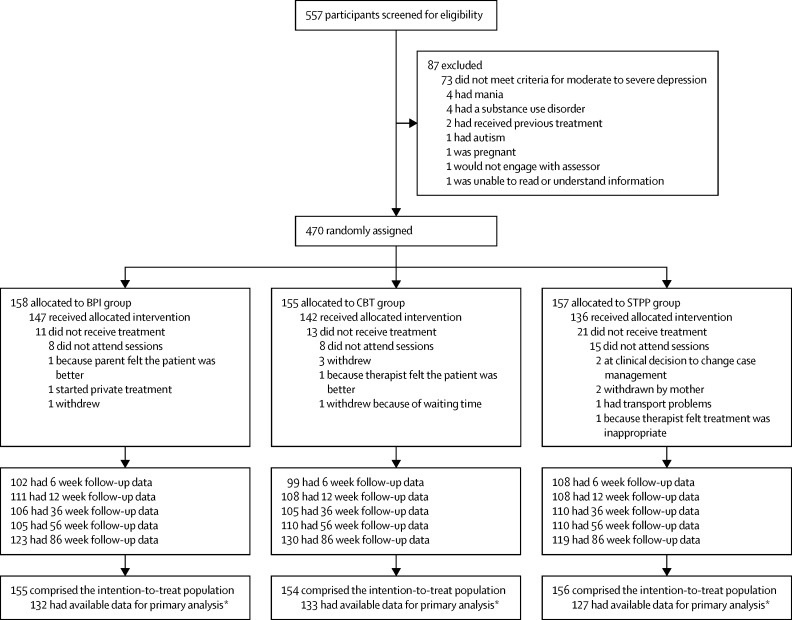
BACKGROUND: Psychological treatments for adolescents with unipolar major depressive disorder are associated with diagnostic remission within 28 weeks in 65-70% of patients. We aimed to assess the medium-term effects and costs of psychological therapies on maintenance of reduced depression symptoms 12 months after treatment. METHODS: We did this multicentre, pragmatic, observer-blind, randomised controlled superiority trial (IMPACT) at 15 National Health Service child and adolescent mental health service (CAMHS) clinics in three regions in England. Adolescent patients (aged 11-17 years) with a diagnosis of DSM IV major depressive disorder were randomly assigned (1:1:1), via a web-based randomisation service, to receive cognitive behavioural therapy (CBT) or short-term psychoanalytical therapy versus a reference brief psychological intervention. Randomisation was stochastically minimised by age, sex, self-reported depression sum score, and region. Patients and clinicians were aware of group allocation, but allocation was concealed from outcome assessors. Patients were followed up and reassessed at weeks 6, 12, 36, 52, and 86 post-randomisation. The primary outcome was self-reported depression symptoms at weeks 36, 52, and 86, as measured with the self-reported Mood and Feelings Questionnaire (MFQ). Because our aim was to compare the two psychological therapies with the brief psychosocial intervention, we first established whether CBT was inferior to short-term psychoanalytical psychotherapy for the same outcome. Primary analysis was by intention to treat. This trial is registered with Current Controlled Trials, number ISRCTN83033550. FINDINGS: Between June 29, 2010, and Jan 17, 2013, we randomly assigned 470 patients to receive the brief psychosocial intervention (n=158), CBT (n=155), or short-term psychoanalytical therapy (n=157); 465 patients comprised the intention-to-treat population. 392 (84%) patients had available data for primary analysis by the end of follow-up. Treatment fidelity and differentiation were established between the three interventions. The median number of treatment sessions differed significantly between patients in the brief psychosocial intervention group (n=6 [IQR 4-11]), CBT group (n=9 [5-14]), and short-term psychoanalytical therapy group (n=11 [5-23]; p<0·0001), but there was no difference between groups in the average duration of treatment (27·5 [SD 21·5], 24·9 [17·7], 27·9 [16·8] weeks, respectively; Kruskal-Wallis p=0·238). Self-reported depression symptoms did not differ significantly between patients given CBT and those given short-term psychoanalytical therapy at weeks 36 (treatment effect 0·179, 95% CI -3·731 to 4·088; p=0·929), 52 (0·307, -3·161 to 3·774; p=0·862), or 86 (0·578, -2·948 to 4·104; p=0·748). These two psychological treatments had no superiority effect compared with brief psychosocial intervention at weeks 36 (treatment effect -3·234, 95% CI -6·611 to 0·143; p=0·061), 52 (-2·806, -5·790 to 0·177; p=0·065), or 86 (-1·898, -4·922 to 1·126; p=0·219). Physical adverse events (self-reported breathing problems, sleep disturbances, drowsiness or tiredness, nausea, sweating, and being restless or overactive) did not differ between the groups. Total costs of the trial interventions did not differ significantly between treatment groups. INTERPRETATION: We found no evidence for the superiority of CBT or short-term psychoanalytical therapy compared with a brief psychosocial intervention in maintenance of reduced depression symptoms 12 months after treatment. Short-term psychoanalytical therapy was as effective as CBT and, together with brief psychosocial intervention, offers additional patient choice for psychological therapy, alongside CBT, for adolescents with moderate to severe depression who are attending routine specialist CAMHS clinics. FUNDING: National Institute for Health Research (NIHR) Health Technology Assessment (HTA) programme, and the Department of Health.
Overview
The claims and statistics of this paper haven’t been checked yet.
Run the check — free, no account needed. It reads the open-access text and checks the sources it cites.
Integrity signals
Registry
Cites
Statistics
Figures
Verification
Claims the paper makes
The claims and statistics of this paper haven’t been checked yet.
Run the check — free, no account needed. It reads the open-access text and checks the sources it cites.
Claims other papers make about this one
Each is checked against this paper’s own text: does it say what the citing paper says it does?
The source backs part of the claim, not all of it — or backs it for a different population, condition or comparison.
In the citing paper
“The average rating on each on the CBT subscale was 5.42 out of 6 indicating high adherence to the CBT therapeutic model.81”
From Acceptance and commitment therapy for mild traumatic brain injury (ACTion-mTBI): a quasiexperimental feasibility study (2025) · cites this paper as [81]
Experimental — accuracy not yet measuredThe source backs part of the claim, not all of it — or backs it for a different population, condition or comparison.
In the citing paper
“Beyond this, there is a growing body of literature showing that different psychological interventions (for both migraine and other disorders) lead to similar improvements, (19, 54) which is in line with the present results.”
From Efficacy of Cognitive-Behavioral Therapy for the Prophylaxis of Migraine in Adults: A Three-Armed Randomized Controlled Trial (2022) · cites this paper as [54]
Experimental — accuracy not yet measuredThe source backs part of the claim, not all of it — or backs it for a different population, condition or comparison.
In the citing paper
“Evidence suggests that short-term therapies—often 8-12 weeks in length—are as effective as longer-term treatments in terms of both immediate and longitudinal outcomes [20].”
From Technology enabled clinical care (TECC): Protocol for a prospective longitudinal cohort study of smartphone-augmented mental health treatment (2021) · cites this paper as [20]
Experimental — accuracy not yet measured
Self-check
Percentages, sums and reported differences re-computed from the paper’s own numbers.
The self-check needs the paper’s full text.
Citations
Cites
Diagnostic and Statistical Manual of Mental Disorders
Williams, J. B. W., & First, M. B. (2013) · Oxford University Press eBooks · doi:10.1093/acrefore/9780199975839.013.104 · Cited by 109,845
KAUFMAN, J., BIRMAHER, B., BRENT, D., RAO, U., FLYNN, C., MORECI, P., WILLIAMSON, D., & RYAN, N. (1997) · Journal of the American Academy of Child & Adolescent Psychiatry · doi:10.1097/00004583-199707000-00021 · Cited by 10,148
Whiteford, H. A., Degenhardt, L., Rehm, J., Baxter, A. J., Ferrari, A. J., Erskine, H. E., Charlson, F. J., Norman, R. E., Flaxman, A. D., Johns, N., et al. (2013) · The Lancet · doi:10.1016/s0140-6736(13)61611-6 · Cited by 6,006
Posner, K., Brown, G. K., Stanley, B., Brent, D. A., Yershova, K. V., Oquendo, M. A., Currier, G. W., Melvin, G. A., Greenhill, L., Shen, S., et al. (2011) · American Journal of Psychiatry · doi:10.1176/appi.ajp.2011.10111704 · Cited by 5,157
What I Think and Feel: A Revised Measure of Children's Manifest Anxiety
Reynolds, C. R., & Richmond, B. O. (1997) · Research on Child and Adolescent Psychopathology · doi:10.1023/a:1025751206600 · Cited by 1,946
Representing uncertainty: the role of cost‐effectiveness acceptability curves
Fenwick, E. A. L., Claxton, K., & Sculpher, M. J. (2001) · Health Economics · doi:10.1002/hec.635 · Cited by 1,112
Effects of psychotherapy for depression in children and adolescents: A meta-analysis
Weisz, J. R., McCarty, C. A., & Valeri, S. M. (2006) · Psychological Bulletin · doi:10.1037/0033-2909.132.1.132 · Cited by 942
Clinical Outcome After Short-term Psychotherapy for Adolescents With Major Depressive Disorder
Birmaher, B. B., Brent, D. A., Kolko, D. J., BAUGHER, M., Bridge, J. A., Holder, D., Iyengar, S., & Ulloa, R. E. (2000) · Archives of General Psychiatry · doi:10.1001/archpsyc.57.1.29 · Cited by 374
Burleson Daviss, W., Birmaher, B., Melhem, N. A., Axelson, D. A., Michaels, S. M., & Brent, D. A. (2006) · Journal of Child Psychology and Psychiatry · doi:10.1111/j.1469-7610.2006.01646.x · Cited by 370
Research works printed but not linked: 1
- Byford, 2007, Cost-effectiveness of selective serotonin reuptake inhibitors and routine specialist care with and without cognitive behavioural therapy in adolescents with major depression, Br J Psychiatry, 191, 521, 10.1192/bjp.bp.107.038984 · DOI
Cited by
Sorted by citations
Items 201–259 of 259
Making Progress in Psychopharmacology for Challenges in Treating Depression in Youth
Hare, E., & Singh, M. K. (2025) · Psychiatric Annals · doi:10.3928/00485713-20250730-02 · Cited by 1
Mental Health in the Young and Anger in Depression
Henriksen, A. K., Ulberg, R., Tallberg, B. P. U., & Løvgren, A. (2023) · Springer eBooks · doi:10.1007/978-3-031-31547-3_156 · Cited by 1
TAKE-HOME NOTES: Depression in children and adolescents: Part 1
Kelvin, R. G. (2016)
Self-citationIs a Psychosocial Intervention as Effective as Specialized Therapies for Pediatric Depression
Geller, B. (2016) · Journal watch · doi:10.1056/nejm-jw.na43014
Here/In This Issue and There/Abstract Thinking: Adolescence: Challenges and Opportunities
Kieling, C. (2017) · Journal of the American Academy of Child & Adolescent Psychiatry · doi:10.1016/j.jaac.2017.04.002
Volz, M., Ehrenthal, J. C., & Seiffge‐Krenke, I. (2021) · Psychotherapy Research · doi:10.1080/10503307.2021.1939457
Emotionale und depressive Störungen bei Kindern und Jugendlichen
Lincke, L., & Kölch, M. G. (2021) · Kinder- und Jugendmedizin · doi:10.1055/a-1404-6527
Tiefenpsychologische Psychotherapie bei Kindern und Jugendlichen
Krischer, M. (2021) · Psychiatrie und Psychotherapie des Kindes- und Jugendalters · doi:10.1007/978-3-662-49289-5_73-1
New discoveries in child psychotherapy: findings from qualitative research
Rhode, M. (2021) · Journal of Child Psychotherapy · doi:10.1080/0075417x.2021.1945127
Kaminska, N., Oppetit, A., Gallien, M., Vachez-Gatecel, A., Aouidad, A., & Cohen, D. (2022) · Neuropsychiatrie de l Enfance et de l Adolescence · doi:10.1016/j.neurenf.2022.01.005
NICE: digital therapy advice for depressed children
National Institute for Health and Care Excellence (2019) · British Journal of Healthcare Assistants · doi:10.12968/bjha.2019.13.3.151
Manning, C. (2017) · London Journal of Primary Care · doi:10.1080/17571472.2017.1415188
Steinhausen, H. (2019) · Elsevier eBooks · doi:10.1016/b978-3-437-21083-9.00014-3
A practical psychoanalytic guide to reflexive research: the reverie research method
Papadima, M. (2022) · Journal of Child Psychotherapy · doi:10.1080/0075417x.2022.2090020
Precision therapeutics—personalizing psychological therapy for depression in adolescents
Aitken, M., Durber, C. M., & Goodyer, I. M. (2022) · Elsevier eBooks · doi:10.1016/b978-0-323-91709-4.00006-8
Self-citationEspada, A. Á. (2022) · Clínica e Investigación Relacional · doi:10.21110/19882939.2021.160215
Zavlis, O., Parsons, S. D., Fox, E., Booth, C., Songco, A., & Vincent, J. P. (2022) · doi:10.31234/osf.io/wsn4x
Exploring Parental Perspectives on Dropout from Treatment for Adolescent Depression
Lord, H., O’Keeffe, S., Panagiotopoulou, E., & Midgley, N. (2023) · Journal of Infant Child and Adolescent Psychotherapy · doi:10.1080/15289168.2023.2191167
Self-citationCourtney, D., Aitken, M., Wang, W., Chen, S., Wilkinson, P. O., Szatmári, P., & Goodyer, I. M. (2023) · Journal of Child and Adolescent Psychopharmacology · doi:10.1089/cap.2022.0078
Self-citationMental Health in the Young and Anger in Depression
Henriksen, A. K., Ulberg, R., Tallberg, B. P. U., & Løvgren, A. (2022) · Springer eBooks · doi:10.1007/978-3-030-98711-4_156-1
Do, M. T., Nguyen, T. T., & Tran, H. T. T. (2023) · Journal of Behavioral and Cognitive Therapy · doi:10.1016/j.jbct.2023.09.002 · Cited by 1
Zavlis, O., Ebrahimi, O. V., Puhlmann, L. M. C., Zerban, M., Lassri, D., Desatnik, A., Lorenzini, N., Kiselnikova, N. V., Fonagy, P., Kalisch, R., et al. (2024) · PsyArXiv (OSF Preprints) · doi:10.31234/osf.io/37uxp
Self-citationOutcomes that matter to depressed adolescents can be identified with large language modelsPreprint
Xin, A. W., Lossio-Ventura, J. A., Krause, K. R., Fiorini, G., Midgley, N., Pereira, F., & Nielson, D. M. (2024) · doi:10.31234/osf.io/t9fcp
Self-citationDo, M. T., Pham, A. T., Nguyen, L. T. T., Nguyen, T. T., Lê, N. M., & Tran, H. T. T. (2024) · Journal of Behavioral and Cognitive Therapy · doi:10.1016/j.jbct.2024.100501
Tiefenpsychologische Psychotherapie bei Kindern und Jugendlichen
Krischer, M. (2024) · Springer Reference Medizin · doi:10.1007/978-3-662-66744-6_73
Energetic activity for depression in young people aged 13–17 years: the READY feasibility RCT
Smith, M., James, R., Howlett, N., Mengoni, S. E., Jones, J., Sims, E. J., Turner, D., Grant, K., Clark, A., Murdoch, J., et al. (2024) · Health Technology Assessment · doi:10.3310/kwnh4507
Clery, A., Cavallaro, F. L., Kennedy, E., Gilbert, R. E., & Harron, K. L. (2025) · Archives of Disease in Childhood · doi:10.1136/archdischild-2024-327654
Wang, Y., Chen, X.-X., Li, S., & Yan, H.-P. (2025) · World Journal of Psychiatry · doi:10.5498/wjp.v15.i3.101190
Midgley, N., Calderón, A., Cirasola, A., & Fiorini, G. (2025) · Child and Adolescent Psychiatric Clinics of North America · doi:10.1016/j.chc.2025.03.001
Self-citationWang, S.-W., Mi, W., Hao, X.-N., Liu, X., Wen, X., Zhao, M., Jiang, H., Wang, W., Li, T., Tan, Z.-L., et al. (2025) · Depression and Anxiety · doi:10.1155/da/6130764 · Cited by 2
Elsey, N., & Avdi, E. (2025) · Journal of Child Psychotherapy · doi:10.1080/0075417x.2025.2503368
Rice, F. J., Powell, V. E., Eyre, O., Jones, R. B., Michelson, D., Airdrie, J. N., Collishaw, S., Thapar, A., Grozeva, D., Munnery, K., et al. (2025) · BMJ Open · doi:10.1136/bmjopen-2025-100692
Zavlis, O., Ebrahimi, O. V., Puhlmann, L. M. C., Zerban, M., Lassri, D., Desatnik, A., Lorenzini, N., Kiselnikova, N. V., Fonagy, P., Kalisch, R., et al. (2025) · Journal of Affective Disorders · doi:10.1016/j.jad.2025.119776
Self-citationTreatment-resistant depression in children and adolescents
DeFilippis, M., & Wagner, K. D. (2022) · Elsevier eBooks · doi:10.1016/b978-0-12-824067-0.00027-x
Mood Disorders in Young People
McCulloch, A., Adams, S., Sharma, A., & Dubicka, B. (2025) · Cambridge University Press eBooks · doi:10.1017/9781009110266.013
Self-citationCirasola, A., Hess, E., Impact Consortium, Goodyer, I. M., Reynolds, S., Barrett, B., Byford, S., Dubicka, B., Hill, J., Holland, F., et al. (2025) · Journal of Infant Child and Adolescent Psychotherapy · doi:10.1080/15289168.2025.2600932 · Cited by 1
Self-citationCourtney, D. B., Barwick, M. A., Amani, B., Greenblatt, A. T., Aitken, M., Krause, K. R., Andrade, B. F., BENNETT, K. J., Cleverley, K., Uliaszek, A. A., et al. (2024) · Figshare · doi:10.6084/m9.figshare.26690899
Courtney, D. B., Barwick, M. A., Amani, B., Greenblatt, A. T., Aitken, M., Krause, K. R., Andrade, B. F., BENNETT, K. J., Cleverley, K., Uliaszek, A. A., et al. (2024) · Figshare · doi:10.6084/m9.figshare.26690893
Ulberg, R., Hummelen, B., Hersoug, A. G., Midgley, N., Høglend, P., & Dahl, H.-S. J. (2021) · Figshare · doi:10.6084/m9.figshare.14053740
Self-citationCourtney, D. B., Barwick, M. A., Amani, B., Greenblatt, A. T., Aitken, M., Krause, K. R., Andrade, B. F., BENNETT, K. J., Cleverley, K., Uliaszek, A. A., et al. (2024) · Figshare · doi:10.6084/m9.figshare.26690902
Wang, L., Wang, Q., Jiang, W., Luo, J., Tong, J., Li, X., Fang, F., Wang, H., Zhao, W., Koszycki, D., et al. (2020) · Figshare · doi:10.6084/m9.figshare.12703893
Courtney, D. B., Barwick, M. A., Amani, B., Greenblatt, A. T., Aitken, M., Krause, K. R., Andrade, B. F., BENNETT, K. J., Cleverley, K., Uliaszek, A. A., et al. (2024) · Figshare · doi:10.6084/m9.figshare.26690887
O’Keeffe, S., Weitkamp, K., Isaacs, D., Target, M., Eatough, V., & Midgley, N. (2020) · Figshare · doi:10.6084/m9.figshare.13279140
Self-citationCourtney, D. B., Barwick, M. A., Amani, B., Greenblatt, A. T., Aitken, M., Krause, K. R., Andrade, B. F., BENNETT, K. J., Cleverley, K., Uliaszek, A. A., et al. (2024) · Figshare · doi:10.6084/m9.figshare.26690890
Courtney, D. B., Barwick, M. A., Amani, B., Greenblatt, A. T., Aitken, M., Krause, K. R., Andrade, B. F., BENNETT, K. J., Cleverley, K., Uliaszek, A. A., et al. (2024) · Figshare · doi:10.6084/m9.figshare.26690896
Steinhausen, H.-C. (2026) · Elsevier eBooks · doi:10.1016/b978-3-437-21294-9.00014-4
The experience of parent work in short-term psychoanalytic psychotherapy
Riley, E., & Avdi, E. (2026) · Journal of Child Psychotherapy · doi:10.1080/0075417x.2026.2621386
Ding, J., Chiu, J. C., Moon, S., Ren, Y., Turner, D., Shoval, G., Niv, Y., & Berwian, I. M. (2026) · Frontiers in Psychiatry · doi:10.3389/fpsyt.2026.1774560
Lindqvist, K., Mechler, J., Peristera, P., Carlbring, P., Falkenström, F., Lilliengren, P., Andersson, G., Johansson, R., Midgley, N., Edbrooke-Childs, J. H., et al. (2026) · Frontiers in Psychiatry · doi:10.3389/fpsyt.2026.1794684
Self-citationHudson, F., Read-Williams, C., Williamson, G., Lobo, S., Hardman, A., Patel, H., & Pile, V. (2026) · BMJ Open · doi:10.1136/bmjopen-2025-111993
Johansen, R., Dahl, H. J., Lunde, A. G., Sem, R. T., Thorkildsen, M. S., Fahs, S. C., & Ulberg, R. (2026) · Frontiers in Child and Adolescent Psychiatry · doi:10.3389/frcha.2026.1789526
Standley, E., Ellison, R., Bee, P., Bhardwaj, A., Blackwell, J., Carter, L., Çokamay, G., Cowling, A., Elvins, R., Hewitt, C. E., et al. (2026) · Trials · doi:10.1186/s13063-026-09695-3
Self-citationHigson‐Sweeney, N., Dunn, B. D., Marshall, N., Cooper, K., Reynolds, S. A., Goodyer, I. M., & Loades, M. E. (2026) · BMC Psychology · doi:10.1186/s40359-026-04942-3
Self-citationMechler, J., Lindqvist, K., Falkenström, F., Carlbring, P., Lilliengren, P., Andersson, G., & Philips, B. (2026) · Psychotherapy Research · doi:10.1080/10503307.2026.2686693
Li, E. T., Dudley, K., & Lecchi, T. (2026) · Counselling Psychology Quarterly · doi:10.1080/09515070.2026.2741574
Beyond effectiveness: orienting youth mental health research towards population impact
Loades, M. E., Weisz, J. R., & Beidas, R. S. (2026) · Frontiers in Child and Adolescent Psychiatry · doi:10.3389/frcha.2026.1952905
Metadata
- Authors
- Goodyer, I. M., Reynolds, S., Barrett, B., Byford, S., Dubicka, B., Hill, J., Holland, F., Kelvin, R., Midgley, N., Roberts, C., Senior, R., Target, M., Widmer, B., Wilkinson, P., & Fonagy, P.
- Affiliations
- University of Cambridge (GB)
- University of Reading (GB)
- King's College London (GB)
- University of Manchester (GB)
- Anna Freud Centre (GB)
- The Tavistock and Portman NHS Foundation Trust (GB)
- University College London (GB)
- Corresponding author
- Goodyer, Ian M
- ORCID
- Venue
- The Lancet Psychiatry
- Publisher
- Elsevier BV
- Published
- 2017-02
- Volume
- 4
- Issue
- 2
- Pages
- 109-119
- ISSN
- 2215-0366 (ISSN-L)
- PMC
- PMC5285447
- OpenAlex
- W2558778675
- Cited by
- 259
- References
- 32
- Citations by year
- 2026: 12 · 2025: 24 · 2024: 32 · 2023: 18 · 2022: 30 · 2021: 42 · 2020: 34 · 2019: 34 · 2018: 17 · 2017: 13
- FWCI
- 29.87
- Type
- journal article
- Language
- en
- Open access
- hybrid
- doi.org
- Licence
- Locations
- The Lancet Psychiatry (publishedVersion, cc-by-nc-nd)
- PubMed Central (publishedVersion, cc-by-nc-nd)
- PubMed (publishedVersion)
- Staff Publications Online (The Tavistock and Portman) (acceptedVersion)
- CentAUR (University of Reading) (submittedVersion)
- Research Portal (King's College London) (submittedVersion, cc-by-nc-nd)
- Apollo (University of Cambridge) (submittedVersion, cc-by-nc-nd)
- UCL Discovery (University College London) (submittedVersion)
- Research Explorer (The University of Manchester) (submittedVersion, other-oa)
- Apollo
- Funders
- National Institute for Health and Care Research (97/29/01, 06-05-01, NF-SI-0514-10157)
- Topics
- Social Sciences › Psychology › Clinical Psychology › Psychotherapy Techniques and Applications
- Social Sciences › Psychology › Experimental and Cognitive Psychology › Anxiety, Depression, Psychometrics, Treatment, Cognitive Processes
- Health Sciences › Medicine › Pharmacology (medical) › Treatment of Major Depression
- Keywords
- adolescent depression, unipolar major depression, cognitive behavioral therapy, brief psychosocial intervention, remission maintenance, intervention fidelity, child and adolescent mental health services, treatment costs, IMPACT trial, Mood and Feelings Questionnaire
- MeSH terms
- Adolescent, Child, Cost-Benefit Analysis, Major Depressive Disorder, England, Female, Humans, Male, Psychiatric Status Rating Scales, State Medicine, Cognitive Behavioral Therapy, Linear Models, Treatment Outcome, Self Report
About these checks
Registry, retraction, Cites and statistics results are computed, not judged, with one exception: a printed reference that no index lists is read once by a model before it counts as a citation error. Claims are extracted by a model and kept only when their quote appears verbatim in the text; each cited source is then checked, with a model’s help, for whether it says what the claim relies on. Those verdicts can be wrong — read the claim’s quote and the cited source before relying on one.
Statistics and arithmetic are recomputed, not judged.
Confidence bands are shown only for fields calibrated on our annotated test set. None is calibrated yet, so no band is shown.
What counts as a claim ›How we measure confidence ›How we check this ›
Are you an author, or do you see a problem with this page? Request a review
