

The DOI matches its Crossref record; 32 of the 32 references it cites were found in a registry or an index.
Cognitive behavioural therapy and short-term psychoanalytical psychotherapy versus a brief psychosocial intervention in adolescents with unipolar major depressive disorder (IMPACT): a multicentre, pragmatic, observer-blind, randomised controlled superiority trial
Open accessAbstract
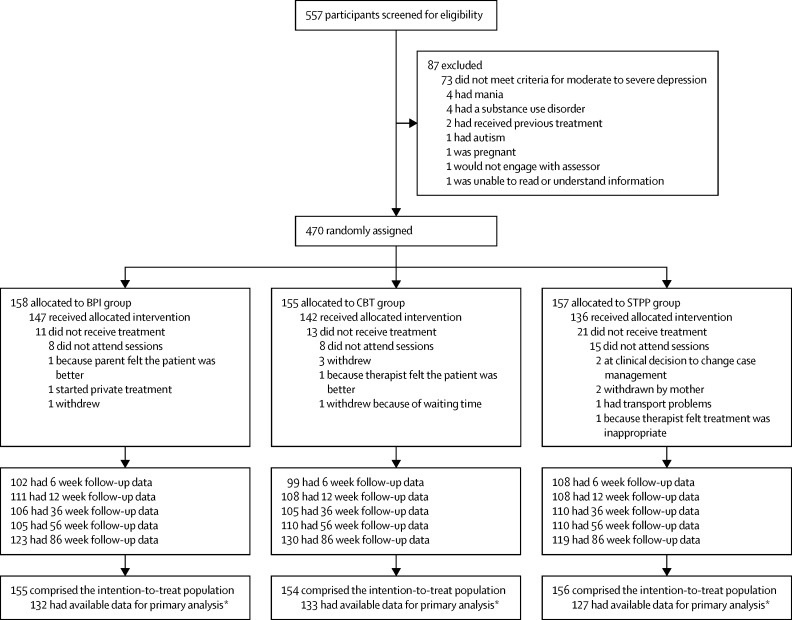
BACKGROUND: Psychological treatments for adolescents with unipolar major depressive disorder are associated with diagnostic remission within 28 weeks in 65-70% of patients. We aimed to assess the medium-term effects and costs of psychological therapies on maintenance of reduced depression symptoms 12 months after treatment. METHODS: We did this multicentre, pragmatic, observer-blind, randomised controlled superiority trial (IMPACT) at 15 National Health Service child and adolescent mental health service (CAMHS) clinics in three regions in England. Adolescent patients (aged 11-17 years) with a diagnosis of DSM IV major depressive disorder were randomly assigned (1:1:1), via a web-based randomisation service, to receive cognitive behavioural therapy (CBT) or short-term psychoanalytical therapy versus a reference brief psychological intervention. Randomisation was stochastically minimised by age, sex, self-reported depression sum score, and region. Patients and clinicians were aware of group allocation, but allocation was concealed from outcome assessors. Patients were followed up and reassessed at weeks 6, 12, 36, 52, and 86 post-randomisation. The primary outcome was self-reported depression symptoms at weeks 36, 52, and 86, as measured with the self-reported Mood and Feelings Questionnaire (MFQ). Because our aim was to compare the two psychological therapies with the brief psychosocial intervention, we first established whether CBT was inferior to short-term psychoanalytical psychotherapy for the same outcome. Primary analysis was by intention to treat. This trial is registered with Current Controlled Trials, number ISRCTN83033550. FINDINGS: Between June 29, 2010, and Jan 17, 2013, we randomly assigned 470 patients to receive the brief psychosocial intervention (n=158), CBT (n=155), or short-term psychoanalytical therapy (n=157); 465 patients comprised the intention-to-treat population. 392 (84%) patients had available data for primary analysis by the end of follow-up. Treatment fidelity and differentiation were established between the three interventions. The median number of treatment sessions differed significantly between patients in the brief psychosocial intervention group (n=6 [IQR 4-11]), CBT group (n=9 [5-14]), and short-term psychoanalytical therapy group (n=11 [5-23]; p<0·0001), but there was no difference between groups in the average duration of treatment (27·5 [SD 21·5], 24·9 [17·7], 27·9 [16·8] weeks, respectively; Kruskal-Wallis p=0·238). Self-reported depression symptoms did not differ significantly between patients given CBT and those given short-term psychoanalytical therapy at weeks 36 (treatment effect 0·179, 95% CI -3·731 to 4·088; p=0·929), 52 (0·307, -3·161 to 3·774; p=0·862), or 86 (0·578, -2·948 to 4·104; p=0·748). These two psychological treatments had no superiority effect compared with brief psychosocial intervention at weeks 36 (treatment effect -3·234, 95% CI -6·611 to 0·143; p=0·061), 52 (-2·806, -5·790 to 0·177; p=0·065), or 86 (-1·898, -4·922 to 1·126; p=0·219). Physical adverse events (self-reported breathing problems, sleep disturbances, drowsiness or tiredness, nausea, sweating, and being restless or overactive) did not differ between the groups. Total costs of the trial interventions did not differ significantly between treatment groups. INTERPRETATION: We found no evidence for the superiority of CBT or short-term psychoanalytical therapy compared with a brief psychosocial intervention in maintenance of reduced depression symptoms 12 months after treatment. Short-term psychoanalytical therapy was as effective as CBT and, together with brief psychosocial intervention, offers additional patient choice for psychological therapy, alongside CBT, for adolescents with moderate to severe depression who are attending routine specialist CAMHS clinics. FUNDING: National Institute for Health Research (NIHR) Health Technology Assessment (HTA) programme, and the Department of Health.
Overview
The claims and statistics of this paper haven’t been checked yet.
Run the check — free, no account needed. It reads the open-access text and checks the sources it cites.
Integrity signals
Registry
Cites
Statistics
Figures
Verification
Claims the paper makes
The claims and statistics of this paper haven’t been checked yet.
Run the check — free, no account needed. It reads the open-access text and checks the sources it cites.
Claims other papers make about this one
Each is checked against this paper’s own text: does it say what the citing paper says it does?
The source backs part of the claim, not all of it — or backs it for a different population, condition or comparison.
In the citing paper
“The average rating on each on the CBT subscale was 5.42 out of 6 indicating high adherence to the CBT therapeutic model.81”
From Acceptance and commitment therapy for mild traumatic brain injury (ACTion-mTBI): a quasiexperimental feasibility study (2025) · cites this paper as [81]
Experimental — accuracy not yet measuredThe source backs part of the claim, not all of it — or backs it for a different population, condition or comparison.
In the citing paper
“Beyond this, there is a growing body of literature showing that different psychological interventions (for both migraine and other disorders) lead to similar improvements, (19, 54) which is in line with the present results.”
From Efficacy of Cognitive-Behavioral Therapy for the Prophylaxis of Migraine in Adults: A Three-Armed Randomized Controlled Trial (2022) · cites this paper as [54]
Experimental — accuracy not yet measuredThe source backs part of the claim, not all of it — or backs it for a different population, condition or comparison.
In the citing paper
“Evidence suggests that short-term therapies—often 8-12 weeks in length—are as effective as longer-term treatments in terms of both immediate and longitudinal outcomes [20].”
From Technology enabled clinical care (TECC): Protocol for a prospective longitudinal cohort study of smartphone-augmented mental health treatment (2021) · cites this paper as [20]
Experimental — accuracy not yet measured
Self-check
Percentages, sums and reported differences re-computed from the paper’s own numbers.
The self-check needs the paper’s full text.
Citations
Cites
Diagnostic and Statistical Manual of Mental Disorders
Williams, J. B. W., & First, M. B. (2013) · Oxford University Press eBooks · doi:10.1093/acrefore/9780199975839.013.104 · Cited by 109,845
KAUFMAN, J., BIRMAHER, B., BRENT, D., RAO, U., FLYNN, C., MORECI, P., WILLIAMSON, D., & RYAN, N. (1997) · Journal of the American Academy of Child & Adolescent Psychiatry · doi:10.1097/00004583-199707000-00021 · Cited by 10,148
Whiteford, H. A., Degenhardt, L., Rehm, J., Baxter, A. J., Ferrari, A. J., Erskine, H. E., Charlson, F. J., Norman, R. E., Flaxman, A. D., Johns, N., et al. (2013) · The Lancet · doi:10.1016/s0140-6736(13)61611-6 · Cited by 6,006
Posner, K., Brown, G. K., Stanley, B., Brent, D. A., Yershova, K. V., Oquendo, M. A., Currier, G. W., Melvin, G. A., Greenhill, L., Shen, S., et al. (2011) · American Journal of Psychiatry · doi:10.1176/appi.ajp.2011.10111704 · Cited by 5,157
What I Think and Feel: A Revised Measure of Children's Manifest Anxiety
Reynolds, C. R., & Richmond, B. O. (1997) · Research on Child and Adolescent Psychopathology · doi:10.1023/a:1025751206600 · Cited by 1,946
Representing uncertainty: the role of cost‐effectiveness acceptability curves
Fenwick, E. A. L., Claxton, K., & Sculpher, M. J. (2001) · Health Economics · doi:10.1002/hec.635 · Cited by 1,112
Effects of psychotherapy for depression in children and adolescents: A meta-analysis
Weisz, J. R., McCarty, C. A., & Valeri, S. M. (2006) · Psychological Bulletin · doi:10.1037/0033-2909.132.1.132 · Cited by 942
Clinical Outcome After Short-term Psychotherapy for Adolescents With Major Depressive Disorder
Birmaher, B. B., Brent, D. A., Kolko, D. J., BAUGHER, M., Bridge, J. A., Holder, D., Iyengar, S., & Ulloa, R. E. (2000) · Archives of General Psychiatry · doi:10.1001/archpsyc.57.1.29 · Cited by 374
Burleson Daviss, W., Birmaher, B., Melhem, N. A., Axelson, D. A., Michaels, S. M., & Brent, D. A. (2006) · Journal of Child Psychology and Psychiatry · doi:10.1111/j.1469-7610.2006.01646.x · Cited by 370
Research works printed but not linked: 1
- Byford, 2007, Cost-effectiveness of selective serotonin reuptake inhibitors and routine specialist care with and without cognitive behavioural therapy in adolescents with major depression, Br J Psychiatry, 191, 521, 10.1192/bjp.bp.107.038984 · DOI
Cited by
Sorted by citations
Thapar, A., Eyre, O., Patel, V., & Brent, D. (2022) · The Lancet · doi:10.1016/s0140-6736(22)01012-1 · Cited by 869
Oud, M., de Winter, L., Vermeulen-Smit, E., Bodden, D., Nauta, M., Stone, L., van den Heuvel, M., Taher, R. A., de Graaf, I., Kendall, T., et al. (2019) · European Psychiatry · doi:10.1016/j.eurpsy.2018.12.008 · Cited by 319
Walter, H. J., Abright, A. R., Bukstein, O. G., Diamond, J., Keable, H., Ripperger-Suhler, J. A., & Rockhill, C. (2022) · Journal of the American Academy of Child & Adolescent Psychiatry · doi:10.1016/j.jaac.2022.10.001 · Cited by 221
Orchard, F., Gregory, A. M., Gradisar, M., & Reynolds, S. (2020) · Journal of Child Psychology and Psychiatry · doi:10.1111/jcpp.13288 · Cited by 175
Self-citationAnnual Research Review: Defining and treating pediatric treatment‐resistant depression
Dwyer, J. B., Stringaris, A. K., Brent, D. A., & Bloch, M. H. (2020) · Journal of Child Psychology and Psychiatry · doi:10.1111/jcpp.13202 · Cited by 158
Diamond, G. S., Kobak, R. R., Krauthamer Ewing, E. S., Levy, S. A., Herres, J. L., Russon, J. M., & Gallop, R. J. (2019) · Journal of the American Academy of Child & Adolescent Psychiatry · doi:10.1016/j.jaac.2018.10.006 · Cited by 147
“The failure to confirm the superiority of ABFT over FE-NST is consistent with many RCTs of 2 active treatments that fail to demonstrate the superiority of a specific treatment.(41,42) However, there are several notable limitations to the present findings.”
ResultWatson, R., Harvey, K., McCabe, C., & Reynolds, S. A. (2019) · European Child & Adolescent Psychiatry · doi:10.1007/s00787-019-01364-y · Cited by 145
Self-citationJuul, S., Gluud, C., Simonsen, S., Frandsen, F. W., Kirsch, I., & Jakobsen, J. C. (2021) · BMJ Evidence-Based Medicine · doi:10.1136/bmjebm-2020-111407 · Cited by 135
Sleep’s role in the development and resolution of adolescent depression
Gradisar, M., Kahn, M., Micic, G., Short, M. A., Reynolds, C. M., Orchard, F., Bauducco, S., Bartel, K., & Richardson, C. E. (2022) · Nature Reviews Psychology · doi:10.1038/s44159-022-00074-8 · Cited by 141
Zhang, A., Borhneimer, L. A., Weaver, A., Franklin, C., Hai, A. H., Guz, S., & Li, S. (2019) · Journal of Behavioral Medicine · doi:10.1007/s10865-019-00046-z · Cited by 135
Schweren, L., van Borkulo, C. D., Fried, E. I., & Goodyer, I. M. (2017) · JAMA Psychiatry · doi:10.1001/jamapsychiatry.2017.3561 · Cited by 114
Self-citationO’Keeffe, S., Martin, P., Target, M., & Midgley, N. (2019) · Frontiers in Psychology · doi:10.3389/fpsyg.2019.00075 · Cited by 114
Self-citationSequeira, L., Perrotta, S., LaGrassa, J., Merikangas, K. R., Kreindler, D. M., Kundur, D., Courtney, D., Szatmári, P., Battaglia, M., & Strauss, J. (2019) · Journal of Affective Disorders · doi:10.1016/j.jad.2019.11.156 · Cited by 113
Positive memory specificity is associated with reduced vulnerability to depression
Askelund, A. D., Schweizer, S., Goodyer, I. M., & van Harmelen, A. (2019) · Nature Human Behaviour · doi:10.1038/s41562-018-0504-3 · Cited by 102
Self-citationLindqvist, K., Mechler, J., Carlbring, P., Lilliengren, P., Falkenström, F., Andersson, G., Johansson, R., Edbrooke-Childs, J. H., Dahl, H. J., Bergsten, K. L., et al. (2020) · Journal of Medical Internet Research · doi:10.2196/18047 · Cited by 106
Self-citationGoodyer, I. M., Reynolds, S. A., Barrett, B. M., Byford, S., Dubicka, B., Hill, J., Holland, F., Kelvin, R. G., Midgley, N., Roberts, C., et al. (2017) · Health Technology Assessment · doi:10.3310/hta21120 · Cited by 91
Self-citationSmith, E. M., Reynolds, S., Orchard, F., Whalley, H. C., & Chan, S. W. (2018) · Journal of Affective Disorders · doi:10.1016/j.jad.2018.08.051 · Cited by 83
Halldorsson, B., Hill, C., Waite, P., Partridge, K., Freeman, D., & Creswell, C. (2021) · Journal of Child Psychology and Psychiatry · doi:10.1111/jcpp.13400 · Cited by 84
“…outcomes to an alternative, face-to-face counseling treatment (Merry et al., 2012), with both interventions achieving medium to large within-group effects, which are similar to the effects found for other face-to-face psychological interventions for adolescent depression (Goodyer et al., 2017).”
Midgley, N., O’Keeffe, S., French, L., & Kennedy, E. (2017) · Journal of Child Psychotherapy · doi:10.1080/0075417x.2017.1323945 · Cited by 85
Self-citationO’Keeffe, S., Martin, P., & Midgley, N. (2020) · Psychotherapy · doi:10.1037/pst0000279 · Cited by 78
Self-citationPredicting dropout in adolescents receiving therapy for depression
O’Keeffe, S., Martin, P., Goodyer, I. M., Wilkinson, P. O., Impact Consortium, & Midgley, N. (2017) · Psychotherapy Research · doi:10.1080/10503307.2017.1393576 · Cited by 77
Self-citationNegative view of the self and symptoms of depression in adolescents
Hards, E., Ellis, J. A., Fisk, J., & Reynolds, S. A. (2019) · Journal of Affective Disorders · doi:10.1016/j.jad.2019.11.012 · Cited by 76
Self-citationCourtney, D. B., Watson, P., Krause, K. R., Chan, B. W. C., Bennett, K., Gunlicks-Stoessel, M., Rodak, T., Neprily, K., Zentner, T., & Szatmari, P. (2022) · JAMA Network Open · doi:10.1001/jamanetworkopen.2021.46331 · Cited by 63
A Brief Home-Based Parenting Intervention to Reduce Behavior Problems in Young Children
O’Farrelly, C., Watt, H., Babalis, D. S., Bakermans‐Kranenburg, M. J., Barker, B., Byford, S., Ganguli, P., Grimås, E., Iles, J. E., Mattock, H., et al. (2021) · Archives of Pediatrics and Adolescent Medicine · doi:10.1001/jamapediatrics.2020.6834 · Cited by 61
Self-citationBahji, A., Pierce, M., Wong, J., Roberge, J. N., Ortega, I., & Patten, S. (2021) · JAMA Network Open · doi:10.1001/jamanetworkopen.2021.6614 · Cited by 60
Wilmots, E., Midgley, N., Thackeray, L. A., Reynolds, S. A., & Loades, M. E. (2019) · Psychology and Psychotherapy Theory Research and Practice · doi:10.1111/papt.12232 · Cited by 64
Self-citationBrief Behavioural Activation (Brief BA) for Adolescent Depression: A Pilot Study
Pass, L., Lejuez, C. W., & Reynolds, S. A. (2017) · Behavioural and Cognitive Psychotherapy · doi:10.1017/s1352465817000443 · Cited by 57
Self-citationAdolescent depression beyond DSM definition: a network analysis
Manfro, P. H., Pereira, R. B., Rosa, M., Cogo‐Moreira, H., Fisher, H. L., Kohrt, B. A., Mondelli, V., & Kieling, C. (2021) · European Child & Adolescent Psychiatry · doi:10.1007/s00787-021-01908-1 · Cited by 59
Webb, C. A., Murray, L., Tierney, A. O., Forbes, E. E., & Pizzagalli, D. A. (2022) · Neuropsychopharmacology · doi:10.1038/s41386-022-01481-4 · Cited by 52
Krause, K. R., Midgley, N., Edbrooke-Childs, J. H., & Wolpert, M. (2020) · European Child & Adolescent Psychiatry · doi:10.1007/s00787-020-01648-8 · Cited by 54
Self-citationMechler, J., Lindqvist, K., Carlbring, P., Topooco, N., Falkenström, F., Lilliengren, P., Andersson, G., Johansson, R., Midgley, N., Edbrooke-Childs, J. H., et al. (2022) · The Lancet Digital Health · doi:10.1016/s2589-7500(22)00095-4 · Cited by 61
Self-citationEzegbe, B. N., Eseadi, C., Ede, M. O., Igbo, J. N., Anyanwu, J. I., Ede, K. R., Egenti, N. T., Nwokeoma, B. N., Mezieobi, D. I., Oforka, T. O., et al. (2019) · Medicine · doi:10.1097/md.0000000000014935 · Cited by 49
Armitage, S., Parkinson, M., Halligan, S., & Reynolds, S. (2020) · Journal of Child and Family Studies · doi:10.1007/s10826-020-01705-5
Self-citationCirasola, A., Midgley, N., Fonagy, P., Impact Consortium, & Martin, P. (2021) · Psychotherapy Research · doi:10.1080/10503307.2020.1765041 · Cited by 42
Self-citationLøvgren, A., Røssberg, J. I., Nilsen, L., Engebretsen, E., & Ulberg, R. (2019) · BMC Psychiatry · doi:10.1186/s12888-019-2080-0 · Cited by 47
Pile, V., Smith, P. A., Leamy, M. C., Oliver, A., Bennett, E., Blackwell, S. E., Meiser‐Stedman, R., Stringer, D., Dunn, B. D., Holmes, E. A., et al. (2021) · Behaviour Research and Therapy · doi:10.1016/j.brat.2021.103876 · Cited by 42
Clinical utility of the CBCL Dysregulation Profile in children with disruptive behavior
Aitken, M., Battaglia, M., Marino, C., Mahendran, N., & Andrade, B. F. (2019) · Journal of Affective Disorders · doi:10.1016/j.jad.2019.04.034 · Cited by 36
L’évaluation et l’efficacité des psychothérapies psychanalytiques et de la psychanalyse
Rabeyron, T. (2020) · L Évolution Psychiatrique · doi:10.1016/j.evopsy.2020.07.003 · Cited by 43
Findling, R. L., DelBello, M. P., Zuddas, A., Emslie, G. J., Ettrup, A., Petersen, M. L., Schmidt, S. N., & Rosén, M. (2022) · Journal of the American Academy of Child & Adolescent Psychiatry · doi:10.1016/j.jaac.2022.01.004 · Cited by 38
Davies, S., Neufeld, S., van Sprang, E. D., Schweren, L., Keivit, R., Fonagy, P., Dubicka, B., Kelvin, R. G., Midgley, N., Reynolds, S. A., et al. (2019) · Journal of Child Psychology and Psychiatry · doi:10.1111/jcpp.13145 · Cited by 36
Self-citationLin, K., Stubbs, B., Zou, W., Zheng, W., Lu, W., Gao, Y., Chen, K., Wang, S., Liu, J., Huang, Y., et al. (2020) · Translational Psychiatry · doi:10.1038/s41398-020-0840-8 · Cited by 37
Aitken, M., Haltigan, J. D., Szatmári, P., Dubicka, B., Fonagy, P., Kelvin, R. G., Midgley, N., Reynolds, S. A., Wilkinson, P. O., & Goodyer, I. M. (2020) · Journal of Child Psychology and Psychiatry · doi:10.1111/jcpp.13194 · Cited by 38
Self-citationPile, V., Smith, P. A., Leamy, M. C., Oliver, A., Blackwell, S. E., Meiser‐Stedman, R., Dunn, B. D., Holmes, E. A., & Lau, J. Y. F. (2020) · Cognitive Therapy and Research · doi:10.1007/s10608-020-10130-3 · Cited by 33
Shearer, J., Papanikolaou, N., Meiser‐Stedman, R., McKinnon, A., Dalgleish, T., Smith, P., Dixon, C., & Byford, S. (2018) · Journal of Child Psychology and Psychiatry · doi:10.1111/jcpp.12851 · Cited by 32
Self-citationYuan, S. N. V., Kwok, R. K. H., & Ougrin, D. (2019) · Frontiers in Psychology · doi:10.3389/fpsyg.2019.00104 · Cited by 34
Reynolds, S. A., Orchard, F., Midgley, N., Kelvin, R. G., & Goodyer, I. M. (2019) · Journal of Affective Disorders · doi:10.1016/j.jad.2019.10.029 · Cited by 32
Self-citationPsychological Treatments for Depression in Adolescents: More Than Three Decades Later
Méndez, X., Sánchez-Hernández, Ó., Garber, J., Espada, J. P., & Orgilés, M. (2021) · International Journal of Environmental Research and Public Health · doi:10.3390/ijerph18094600 · Cited by 33
O’Keeffe, S., Martin, P., Goodyer, I. M., Kelvin, R. G., Dubicka, B., Goodyer, I. M., Reynolds, S. A., Barrett, B. M., Byford, S., Dubicka, B., et al. (2019) · Journal of the American Academy of Child & Adolescent Psychiatry · doi:10.1016/j.jaac.2018.11.019 · Cited by 33
Self-citationParhiala, P., Ranta, K., Gergov, V., Kontunen, J., Law, R., Greca, A. M. L., Torppa, M., & MARTTUNEN, M. J. (2019) · School Mental Health · doi:10.1007/s12310-019-09346-w · Cited by 33
Asarnow, J. R., Tompson, M. C., Klomhaus, A. M., Babeva, K. N., Langer, D. A., & Sugar, C. A. (2019) · Journal of Child Psychology and Psychiatry · doi:10.1111/jcpp.13162 · Cited by 30
Ulberg, R., Hummelen, B., Hersoug, A. G., Midgley, N., Høglend, P. A., & Dahl, H. J. (2021) · BMC Psychiatry · doi:10.1186/s12888-021-03055-y · Cited by 29
Self-citationPractitioner Review: Therapeutics of unipolar major depressions in adolescents
Goodyer, I. M., & Wilkinson, P. O. (2018) · Journal of Child Psychology and Psychiatry · doi:10.1111/jcpp.12940 · Cited by 28
Self-citationWatson, R., McCabe, C., Harvey, K., & Reynolds, S. A. (2021) · Psychological Assessment · doi:10.1037/pas0000977 · Cited by 29
Self-citationTherapists’ techniques in the treatment of adolescent depression.
Midgley, N., Reynolds, S. A., Kelvin, R. G., Loades, M. E., Calderón, A., Martin, P., & O’Keeffe, S. (2018) · Journal of Psychotherapy Integration · doi:10.1037/int0000119 · Cited by 26
Self-citationTreatment of depression in children and adolescents
Diener, M. J., Gottdiener, W. H., Keefe, J. R., Levy, K. N., & Midgley, N. (2021) · The Lancet Psychiatry · doi:10.1016/s2215-0366(20)30518-6 · Cited by 26
Self-citationEvidence-Base Update of Psychosocial and Combination Treatments for Child and Adolescent Depression
Weersing, V. R., Goger, P., Schwartz, K. T. G., Baca, S. A., Angulo, F., & Kado-Walton, M. (2024) · Journal of Clinical Child & Adolescent Psychology · doi:10.1080/15374416.2024.2384022 · Cited by 24
Common Factors in Psychotherapy
Nahum, D. D., Alfonso, C. A., & Sönmez, E. (2018) · Springer eBooks · doi:10.1007/978-3-319-70554-5_29 · Cited by 24
Recent developments in the treatment of major depressive disorder in children and adolescents
Hussain, H., Dubicka, B., & Wilkinson, P. O. (2018) · Evidence-Based Mental Health · doi:10.1136/eb-2018-102937 · Cited by 24
Self-citationThe alliance–outcome association in the treatment of adolescent depression.
Cirasola, A., Midgley, N., Fonagy, P., & Martin, P. (2021) · Psychotherapy · doi:10.1037/pst0000366 · Cited by 22
Self-citationKlan, T., Gaul, C., Liesering-Latta, E., Both, B., Held, I., Hennemann, S., & Witthöft, M. (2022) · Frontiers in Neurology · doi:10.3389/fneur.2022.852616 · Cited by 22
“Beyond this, there is a growing body of literature showing that different psychological interventions (for both migraine and other disorders) lead to similar improvements, (19, 54) which is in line with the present results.”
ResultFacing Shadows: working with young people to coproduce a short film about depression
Dunn, V. J., O’Keeffe, S., Stapley, E., & Midgley, N. (2018) · Research Involvement and Engagement · doi:10.1186/s40900-018-0126-y · Cited by 22
Self-citationAchieving Mental Health Equity
Harris, T. B., Udoetuk, S. C., Webb, S., Tatem, A., Nutile, L. M., & Al-Mateen, C. S. (2020) · Psychiatric Clinics of North America · doi:10.1016/j.psc.2020.06.001 · Cited by 23
Watson, R., Harvey, K., Pass, L., McCabe, C., & Reynolds, S. A. (2020) · Psychology and Psychotherapy Theory Research and Practice · doi:10.1111/papt.12307 · Cited by 22
Self-citationBelski, N., Abdul‐Rahman, Z., Youn, E., Balasundaram, V., & Diep, D. (2022) · Child and Adolescent Mental Health · doi:10.1111/camh.12526 · Cited by 21
Maroun, R. A., Thackeray, L. A., & Midgley, N. (2018) · BMC Psychiatry · doi:10.1186/s12888-018-1961-y · Cited by 21
Self-citationEgenti, N. T., Ede, M. O., Nwokenna, E. N., Oforka, T. O., Nwokeoma, B. N., Mezieobi, D. I., Onah, S. O., Ede, K. R., Amoke, C. V., Offordile, E. E., et al. (2019) · Medicine · doi:10.1097/md.0000000000016495 · Cited by 22
RetractedAdapting Brief CBT-I for Depressed Adolescents: A Case Illustration of the Sleeping Better Program
Orchard, F., Pass, L., Chessell, C., Moody, A., Ellis, J. G., & Reynolds, S. A. (2019) · Cognitive and Behavioral Practice · doi:10.1016/j.cbpra.2019.07.010 · Cited by 20
Self-citationRikard-Bell, C. J., Hunt, C. J., McAulay, C., Hay, P., Morad, A., Cunich, M. M., & Touyz, S. W. (2022) · International Journal of Environmental Research and Public Health · doi:10.3390/ijerph192316029 · Cited by 19
Webb, C. A., Murray, L., Tierney, A. O., & Gates, K. M. (2023) · Journal of Consulting and Clinical Psychology · doi:10.1037/ccp0000830 · Cited by 20
Housby, H., Thackeray, L. A., & Midgley, N. (2021) · PLoS ONE · doi:10.1371/journal.pone.0257334 · Cited by 25
Self-citationRosa, M., Metcalf, E., Rocha, T. B.-M., & Kieling, C. (2018) · Trends in Psychiatry and Psychotherapy · doi:10.1590/2237-6089-2017-0019 · Cited by 18
Calderón, A., Schneider, C., Target, M., Midgley, N., Goodyer, I. M., Reynolds, S. A., Barrett, B. M., Byford, S., Dubicka, B., Hill, J., et al. (2018) · Clinical Child Psychology and Psychiatry · doi:10.1177/1359104518807734 · Cited by 18
Self-citationDhanak, D., Thackeray, L. A., Dubicka, B., Kelvin, R. G., Goodyer, I. M., & Midgley, N. (2019) · Clinical Child Psychology and Psychiatry · doi:10.1177/1359104519857222 · Cited by 18
Self-citationVilla, L. M., Goodyer, I. M., Tait, R. J., Kelvin, R. G., Reynolds, S. A., Wilkinson, P. O., & Suckling, J. (2020) · Journal of Affective Disorders · doi:10.1016/j.jad.2020.01.103 · Cited by 19
Self-citationMcPherson, S., Rost, F., Town, J. M., & Abbass, A. A. (2018) · Psychoanalytic Psychotherapy · doi:10.1080/02668734.2018.1458331 · Cited by 18
Can Understanding Reward Help Illuminate Anhedonia?
Kaya, S., & McCabe, C. (2019) · Current Behavioral Neuroscience Reports · doi:10.1007/s40473-019-00186-1 · Cited by 16
Kehinde, F., Bharmal, A. V., Goodyer, I. M., Kelvin, R. G., Dubicka, B., Midgley, N., Fonagy, P., Jones, P. B., & Wilkinson, P. O. (2021) · European Child & Adolescent Psychiatry · doi:10.1007/s00787-020-01704-3 · Cited by 20
Self-citationThe experience of cognitive behavioural therapy in depressed adolescents who are fatigued
Herring, G. T., Loades, M. E., Higson‐Sweeney, N., Hards, E., Reynolds, S. A., & Midgley, N. (2021) · Psychology and Psychotherapy Theory Research and Practice · doi:10.1111/papt.12365 · Cited by 17
Self-citationKong, S., Chen, Y., Huang, H., Yang, W., Lyu, D., Wang, F., Huang, Q., Zhang, M., Chen, S., Wei, Z., et al. (2024) · Journal of Affective Disorders · doi:10.1016/j.jad.2024.01.041 · Cited by 18
Rosa, E. D., & Midgley, N. (2017) · Journal of Infant Child and Adolescent Psychotherapy · doi:10.1080/15289168.2017.1378531 · Cited by 17
Self-citationExploring silence in short-term psychoanalytic psychotherapy with adolescents with depression
Acheson, R., Verdenhalven, N., Avdi, E., & Midgley, N. (2020) · Journal of Child Psychotherapy · doi:10.1080/0075417x.2020.1830297 · Cited by 17
Self-citationUnpacking the active ingredients of internet-based psychodynamic therapy for adolescents
Leibovich, L., Mechler, J., Lindqvist, K., Mortimer, R., Edbrooke-Childs, J. H., & Midgley, N. (2022) · Psychotherapy Research · doi:10.1080/10503307.2022.2050829 · Cited by 17
Self-citationJarbin, H., Höglund, K., Skarphéðinsson, G., & Bremander, A. (2021) · Clinical Child Psychology and Psychiatry · doi:10.1177/13591045211000782 · Cited by 19
Assessment of dynamic change in psychotherapy with asdolescents
Ness, E., Dahl, H., Tallberg, P., Amlo, S., Høglend, P., Thorén, A., Egeland, J., & Ulberg, R. (2018) · Child and Adolescent Psychiatry and Mental Health · doi:10.1186/s13034-018-0246-z · Cited by 15
Pile, V., Shammas, D., & Smith, P. A. (2019) · Clinical Child Psychology and Psychiatry · doi:10.1177/1359104519858112 · Cited by 16
O’Keeffe, S., Weitkamp, K., Isaacs, D., Target, M., Eatough, V., & Midgley, N. (2020) · Trials · doi:10.1186/s13063-020-04857-3 · Cited by 16
Self-citationLi, M., Patel, J., & Katapally, T. R. (2025) · PLoS ONE · doi:10.1371/journal.pone.0315313 · Cited by 15
O’Farrelly, C., Barker, B., Watt, H., Babalis, D. S., Bakermans‐Kranenburg, M. J., Byford, S., Ganguli, P., Grimås, E., Iles, J. E., Mattock, H., et al. (2021) · Health Technology Assessment · doi:10.3310/hta25290 · Cited by 15
Self-citationHigson‐Sweeney, N., Cooper, K., Dunn, B. D., & Loades, M. E. (2023) · European Child & Adolescent Psychiatry · doi:10.1007/s00787-023-02243-3 · Cited by 15
Yilmaz, M., Psychogiou, L., Javaid, M., Ford, T. J., & Dunn, B. D. (2019) · Behaviour Research and Therapy · doi:10.1016/j.brat.2019.103476 · Cited by 15
Fiorini, G., Saunders, R., Fonagy, P., The Impact Consortium, & Midgley, N. (2022) · Psychotherapy Research · doi:10.1080/10503307.2022.2040751 · Cited by 15
Self-citationDepression in children: offer digital CBT as first line treatment, says NICE
Wise, J. (2019) · BMJ · doi:10.1136/bmj.l364 · Cited by 15
Feasibility study of a new behavioural activation programme for young people with depressed mood
Dubicka, B., Marwedel, S., Banares, S. A., McCulloch, A., Tahoun, T., Hearn, J. H., & Kroll, L. (2021) · Child and Adolescent Mental Health · doi:10.1111/camh.12474 · Cited by 14
Self-citationAnhedonia in Relation to Reward and Effort Learning in Young People with Depression Symptoms
Frey, A.-L., Kaya, M., Adeniyi, I., & McCabe, C. (2023) · Brain Sciences · doi:10.3390/brainsci13020341 · Cited by 14
Do Sleep Disturbances Improve Following Psychoanalytic Psychotherapy for Adolescent Depression?
Schønning, T., Dahl, H. J., Hummelen, B., & Ulberg, R. (2022) · International Journal of Environmental Research and Public Health · doi:10.3390/ijerph19031790 · Cited by 14
Cirasola, A., Martin, P., Fonagy, P., Eubanks, C. F., Muran, J. C., & Midgley, N. (2022) · Psychotherapy Research · doi:10.1080/10503307.2022.2061314 · Cited by 18
Self-citationDauvermann, M. R., Schmaal, L., Čolić, L., van Velzen, L. S., Bellow, S., Ford, T. J., Suckling, J., Goodyer, I. M., Blumberg, H. P., & van Harmelen, A. (2022) · Journal of Affective Disorders · doi:10.1016/j.jad.2022.12.087 · Cited by 13
Self-citationMalkomsen, A., Wilberg, T., Bull-Hansen, B., Dammen, T., Evensen, J. H., Hummelen, B., Løvgren, A., Osnes, K., Ulberg, R., & Røssberg, J. I. (2025) · BMC Psychiatry · doi:10.1186/s12888-025-06544-6 · Cited by 25
Kitchen, C. E. W., Tiffin, P. A., Lewis, S., Gega, L., & Ekers, D. (2020) · Child and Adolescent Mental Health · doi:10.1111/camh.12415 · Cited by 13
Marotti, J., Thackeray, L. A., & Midgley, N. (2020) · Journal of Infant Child and Adolescent Psychotherapy · doi:10.1080/15289168.2020.1832836 · Cited by 13
Self-citation
Metadata
- Authors
- Goodyer, I. M., Reynolds, S., Barrett, B., Byford, S., Dubicka, B., Hill, J., Holland, F., Kelvin, R., Midgley, N., Roberts, C., Senior, R., Target, M., Widmer, B., Wilkinson, P., & Fonagy, P.
- Affiliations
- University of Cambridge (GB)
- University of Reading (GB)
- King's College London (GB)
- University of Manchester (GB)
- Anna Freud Centre (GB)
- The Tavistock and Portman NHS Foundation Trust (GB)
- University College London (GB)
- Corresponding author
- Goodyer, Ian M
- ORCID
- Venue
- The Lancet Psychiatry
- Publisher
- Elsevier BV
- Published
- 2017-02
- Volume
- 4
- Issue
- 2
- Pages
- 109-119
- ISSN
- 2215-0366 (ISSN-L)
- PMC
- PMC5285447
- OpenAlex
- W2558778675
- Cited by
- 259
- References
- 32
- Citations by year
- 2026: 12 · 2025: 24 · 2024: 32 · 2023: 18 · 2022: 30 · 2021: 42 · 2020: 34 · 2019: 34 · 2018: 17 · 2017: 13
- FWCI
- 29.87
- Type
- journal article
- Language
- en
- Open access
- hybrid
- doi.org
- Licence
- Locations
- The Lancet Psychiatry (publishedVersion, cc-by-nc-nd)
- PubMed Central (publishedVersion, cc-by-nc-nd)
- PubMed (publishedVersion)
- Staff Publications Online (The Tavistock and Portman) (acceptedVersion)
- CentAUR (University of Reading) (submittedVersion)
- Research Portal (King's College London) (submittedVersion, cc-by-nc-nd)
- Apollo (University of Cambridge) (submittedVersion, cc-by-nc-nd)
- UCL Discovery (University College London) (submittedVersion)
- Research Explorer (The University of Manchester) (submittedVersion, other-oa)
- Apollo
- Funders
- National Institute for Health and Care Research (97/29/01, 06-05-01, NF-SI-0514-10157)
- Topics
- Social Sciences › Psychology › Clinical Psychology › Psychotherapy Techniques and Applications
- Social Sciences › Psychology › Experimental and Cognitive Psychology › Anxiety, Depression, Psychometrics, Treatment, Cognitive Processes
- Health Sciences › Medicine › Pharmacology (medical) › Treatment of Major Depression
- Keywords
- adolescent depression, unipolar major depression, cognitive behavioral therapy, brief psychosocial intervention, remission maintenance, intervention fidelity, child and adolescent mental health services, treatment costs, IMPACT trial, Mood and Feelings Questionnaire
- MeSH terms
- Adolescent, Child, Cost-Benefit Analysis, Major Depressive Disorder, England, Female, Humans, Male, Psychiatric Status Rating Scales, State Medicine, Cognitive Behavioral Therapy, Linear Models, Treatment Outcome, Self Report
About these checks
Registry, retraction, Cites and statistics results are computed, not judged, with one exception: a printed reference that no index lists is read once by a model before it counts as a citation error. Claims are extracted by a model and kept only when their quote appears verbatim in the text; each cited source is then checked, with a model’s help, for whether it says what the claim relies on. Those verdicts can be wrong — read the claim’s quote and the cited source before relying on one.
Statistics and arithmetic are recomputed, not judged.
Confidence bands are shown only for fields calibrated on our annotated test set. None is calibrated yet, so no band is shown.
What counts as a claim ›How we measure confidence ›How we check this ›
Are you an author, or do you see a problem with this page? Request a review
