

Clinical relevance of appraisals of persistent psychotic experiences in people with and without a need for care: an experimental study
Open accessThe DOI matches its Crossref record; 29 of the 31 references it cites were found in a registry or an index; 24 of the 35 sources its claims cite were checked for support.
Abstract
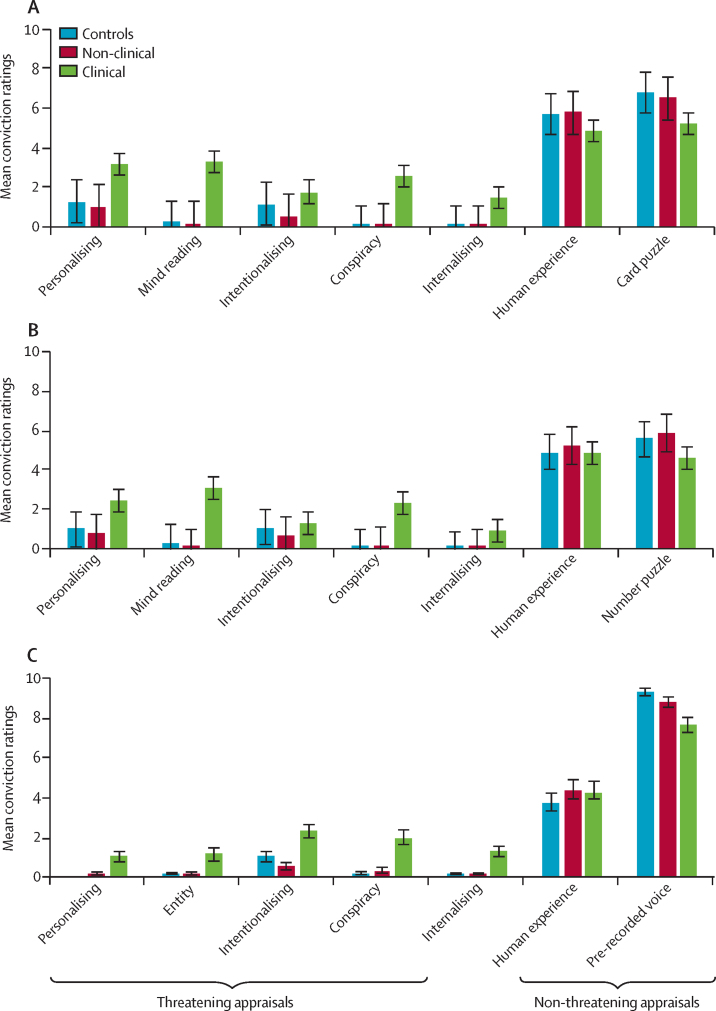
BACKGROUND: Cognitive models of psychosis propose that appraisals (ie, the interpretation and meaning attributed to experiences) are central to the transition from anomalous experiences to psychotic symptoms. In the Unusual Experiences Enquiry (UNIQUE) study, we investigated the role of appraisals by comparing individuals with persistent psychotic experiences without a need for care with patients and people without psychotic experiences. METHOD: Eligible participants were patients with diagnosed psychotic disorders (clinical group) and adults in the general population with persistent psychotic experiences (non-clinical group) and without psychotic experiences (controls). The appraisals of psychotic experiences among people in the non-clinical and clinical groups were assessed by an in-depth interview, and appraisals of anomalous experiences induced by three experimental tasks were compared between all groups. FINDINGS: We recruited 259 participants, 84 in the clinical group, 92 in the non-clinical group, and 83 controls. The clinical group was more likely than the non-clinical group to display paranoid, personalising interpretations of their psychotic experiences (p<0·008; p values are Sidak adjusted to account for multiple testing) and less likely to have normalising (p<0·008) and supernatural (p=0·039) explanations. The clinical group also appraised their psychotic experiences as being more negative, dangerous, and abnormal and less controllable than the non-clinical group (all p<0·005), but groups did not differ for attributions of general externality (p=0·44). For experimentally induced anomalous experiences, the clinical group endorsed more threatening appraisals on all tasks than the non-clinical group (p<0·003), who did not differ from the control group (p=0·07-0·6). The pattern was similar for ratings of salience, distress, personal relevance, global threat, and incorporation of the induced experiences into participants' own psychotic experiences. INTERPRETATION: We provide robust evidence that the way psychotic experiences are appraised differs between individuals with and without a need for care, supporting cognitive models of psychosis. Specifically, the absence of paranoid and threatening appraisals might protect against persistent psychotic experiences becoming clinically relevant. FUNDING: UK Medical Research Council.
Overview
CoChat Summary
TL;DR
In a large UK experimental study, appraisals of persistent psychotic experiences differed between people with a need for care and those without, supporting cognitive models of psychosis. The clinical group made more paranoid, threatening, negative, dangerous, abnormal, and less controllable appraisals, while non-clinical participants resembled controls on experimentally induced anomalous experiences.
Key findings
- Among 259 participants (84 clinical, 92 non-clinical, 83 controls), the clinical group was more likely than the non-clinical group to make “other people” appraisals (OR 10·13, 95% CI 3·79–27·09; p<0·008) and less likely to make normalising (OR 0·09, 95% CI 0·04–0·21; p<0·008) and supernatural (OR 0·37, 95% CI 0·18–0·74; p=0·039) appraisals.
- The clinical group appraised their psychotic experiences as more negative, dangerous, abnormal, and less controllable than the non-clinical group (all p<0·005), but groups did not differ for general externality (p=0·44).
- On three experimentally induced anomalous experience tasks, the clinical group endorsed more threatening appraisals than the non-clinical group (all p<0·003; effect sizes r=0·51–0·54), while the non-clinical group did not differ from controls (p=0·07–0·6).
- The clinical group also rated induced experiences as more striking, distressing, globally threatening, personally relevant, and more often incorporated them into their own psychotic experiences; the non-clinical and control groups generally did not differ.
Methods
- Three groups were recruited in the UK from London and Gwynedd: patients with diagnosed psychotic disorders (ICD-10 F20–39) and positive symptoms (clinical), general-population adults with persistent psychotic experiences but no need for care (non-clinical), and people without psychotic experiences (controls).
- Appraisals of participants’ own psychotic experiences were assessed in the clinical and non-clinical groups with the AANEX in-depth interview; all groups completed three experimental tasks designed to induce anomalous experiences (cards task, Telepath smartphone application, and Virtual Acoustic Space Paradigm).
- Group differences were tested with Kruskal-Wallis and Mann-Whitney U tests, χ² or Fisher’s exact tests, and binary logistic or ordinal regressions, with Sidak-adjusted p values; analyses controlled for AANEX-Inventory factor scores on which groups differed.
Limitations
- The paper states that the non-clinical group was highly selected, high-functioning, and often from subcultural groups that validated their experiences, so it may not represent people with psychotic experiences in the general population; the groups also differed on demographic variables, which the authors deliberately did not control because they considered them inherent to need-for-care status or established risk factors.
- The paper states that a substantial minority guessed the VASP manipulation, potentially compromising its validity as an auditory hallucination analogue, and that causality cannot be determined from the findings.
- The text makes evident that the agency appraisal dimension was dropped because of poor inter-rater reliability (κ=0·38), and that the experimental tasks were deliberately mild, with non-threatening appraisals rated as most likely overall.
Model-written summary. Check it against the paper before relying on it.
Integrity signals
Registry
Cites
Statistics
Figures
Verification
Claims the paper makes
17 Valid · 1 Not valid · 4 Not checked · 65 Own results and interpretations
Every source the paper cites for this claim was checked and supports it.
In the paper
“The Unusual Experiences Enquiry (UNIQUE) study3 has shown that these individuals present with hallucinations in all sensory modalities, including first-rank symptoms.”
§ Clinical relevance of appraisals of persistent psychotic experiences in people with and without a need for care: an experimental study > Introduction
What the sources say
- Supportedcites [3] Peters E Ward T Jackson M Clinical, socio-demographic and psychological characteristics in individuals with persistent psychotic experiences with and without a “need for care” World Psychiatry 15 2016 41 52 26833608 PMC4780307 source
The “Types of PE (see Table 1)” section (World Psychiatry 2016;15:41–52) reports that the non-clinical group had hallucinations in all modalities and commonly reported first-rank symptoms. The paper identifies these participants as people with persistent psychotic experiences without a need for care, recruited for the UNIQUE study. (LLM, conf=0.94)
plain- Asserted: passes — The authors put it forward as true.
- Checkable: passes — It can be checked against evidence.
- Load-bearing: unclear — It is unclear whether the paper’s conclusions depend on it.
- Based: passes — The paper gives a reason why it holds.
- Supported
The cited sources support only part of this claim — read each source’s verdict below.
In the paper
“Our clinical and non-clinical groups also differed in several demographic variables, which is typical for these samples.3, 10, 14”
§ Clinical relevance of appraisals of persistent psychotic experiences in people with and without a need for care: an experimental study > Discussion
What the sources say
- Supportedcites [3] Peters E Ward T Jackson M Clinical, socio-demographic and psychological characteristics in individuals with persistent psychotic experiences with and without a “need for care” World Psychiatry 15 2016 41 52 26833608 PMC4780307 source
The Results section, under “Socio-demographic and environmental factors” (Table 2), reports differences between the clinical and non-clinical groups on 16 of 25 measured factors. The discussion in the same section describes the groups as “highly distinct demographically,” directly supporting the attributed claim. The provided passages do not specify page numbers. (LLM, conf=0.94)
- Partly supportedcites [10] Brett CMC Peters EP Johns LC Tabraham P Valmaggia LR McGuire P Appraisals of Anomalous Experiences Interview (AANEX): a multidimensional measure of psychological responses to anomalies associated with psychosis Br J Psychiatry Suppl 191 2007 S23 S30 18055934 sourceExperimental — accuracy not yet measured
The Method (Sample) reports that the at-risk group was younger than the undiagnosed group and that the undiagnosed group had a higher estimated IQ than both clinical groups. It reports no significant group differences in gender ratio or the ratio of British White to other ethnic categories. These findings provide an example of demographic differences, but this single study does not establish that such differences are typical of these samples. (LLM, conf=0.84)
- Supportedcites [14] Ward T Gaynor K Hunter M Woodruff P Garety P Peters E Appraisals and responses to experimental symptom analogues in clinical and nonclinical individuals with psychotic experiences Schizophr Bull 40 2014 845 855 23858493 PMC4059432 source
The Materials and Methods section (Table 1; page not provided) reports significant differences between the clinical and nonclinical groups in IQ, ethnicity, employment, and marital status. The Discussion describes several demographic differences as likely intrinsic to group status or related to risk factors for needing care, consistent with the citing sentence’s characterization of such differences as typical for these samples. (LLM, conf=0.90)
plainstates an association- Asserted: passes — The authors put it forward as true.
- Checkable: passes — It can be checked against evidence.
- Load-bearing: unclear — It is unclear whether the paper’s conclusions depend on it.
- Based: passes — The paper gives a reason why it holds.
- Supported
Every source the paper cites for this claim was checked and supports it.
In the paper
“we have previously shown that non-clinical groups (ie, without a need for care) typically endorse normalising and spiritual or supernatural explanations of their psychotic experiences”
§ Clinical relevance of appraisals of persistent psychotic experiences in people with and without a need for care: an experimental study > Introduction
What the sources say
- Supportedcites [10] Brett CMC Peters EP Johns LC Tabraham P Valmaggia LR McGuire P Appraisals of Anomalous Experiences Interview (AANEX): a multidimensional measure of psychological responses to anomalies associated with psychosis Br J Psychiatry Suppl 191 2007 S23 S30 18055934 source
The Method’s Sample section describes an undiagnosed group with psychosis-associated experiences who had never received treatment for a psychotic disorder. The Categories of appraisal section finds that this group was more likely than the clinical groups to make normalising appraisals. The Discussion reports an excess of spiritual appraisals before adjustment for the types of experiences described and says undiagnosed participants also reported supernatural appraisals; the claim does not assert that supernatural appraisals were more common than in clinical groups. (LLM, conf=0.83)
plain- Asserted: passes — The authors put it forward as true.
- Checkable: passes — It can be checked against evidence.
- Load-bearing: passes — The paper’s conclusions depend on it.
- Based: passes — The paper gives a reason why it holds.
- Supported
Every source the paper cites for this claim was checked and supports it.
In the paper
“In pilot studies that used analogues of hearing voices and thought interference, patients scored higher on maladaptive appraisals than did non-clinical groups with persistent psychotic experiences,14 even when their symptoms had remitted.15”
§ Clinical relevance of appraisals of persistent psychotic experiences in people with and without a need for care: an experimental study > Introduction
What the sources say
- Supportedcites [14] Ward T Gaynor K Hunter M Woodruff P Garety P Peters E Appraisals and responses to experimental symptom analogues in clinical and nonclinical individuals with psychotic experiences Schizophr Bull 40 2014 845 855 23858493 PMC4059432 source
The Abstract and Discussion report that the clinical group scored higher than the nonclinical group on maladaptive appraisals after analogues of thought interference and auditory hallucinations. In the citing sentence, the separate claim about remitted symptoms is attached to citation 15, not this source. (LLM, conf=0.94)
- Supportedcites [15] Underwood R Kumari V Peters E Appraisals of psychotic experiences: an experimental investigation of symptomatic, remitted and non-need-for-care individuals Psychol Med 46 2016 1249 1263 26806684 PMC4825099 source
The Results (VASP) report higher threatening-appraisal scores in remitted patients than in non-clinical participants. The Discussion (Summary of findings) reports the same comparison for the Telepath task; it does not report a higher appraisal score for remitted patients on the Cards task. These findings support the claim that the difference persisted after symptoms remitted. (LLM, conf=0.91)
plainstates an association- Asserted: passes — The authors put it forward as true.
- Checkable: passes — It can be checked against evidence.
- Load-bearing: passes — The paper’s conclusions depend on it.
- Based: passes — The paper gives a reason why it holds.
- Supported
The cited sources support only part of this claim — read each source’s verdict below.
In the paper
“People without a need for care were differentiated from patients by an absence of paranoia, cognitive difficulties, and negative symptoms, which is in line with evidence that these issues are more predictive of transition to psychosis and poor functional outcomes than perceptual disturbances in ultra-high-risk individuals.5, 6”
§ Clinical relevance of appraisals of persistent psychotic experiences in people with and without a need for care: an experimental study > Introduction
What the sources say
- Partly supportedcites [5] Valmaggia LR Stahl D Yung AR Negative psychotic symptoms and impaired role functioning predict transition outcomes in the at-risk mental state: a latent class cluster analysis study Psychol Med 43 2013 2311 2325 23442767 sourceExperimental — accuracy not yet measured
The Introduction (p. 2) says negative and cognitive symptoms may predict psychosis better than positive symptoms, and Differences between risk classes (p. 11) links negative symptoms to transition and poor long-term outcomes. The paper does not support the full comparison attributed to it: it does not identify paranoia as more predictive than perceptual disturbances, or establish that all three named issues outperform perceptual disturbances for poor functional outcomes. The opening comparison between people without a need for care and patients is the citing authors’ own finding, not a finding attributed to this source. (LLM, conf=0.85)
- Not checked — no full text of the sourcecites [6] Demjaha A Valmaggia L Stahl D Byrne M McGuire P Disorganization/cognitive and negative symptom dimensions in the at-risk mental state predict subsequent transition to psychosis Schizophrenia Bull 38 2012 351 359 PMC3283152 20705805 source
plainstates an association- Asserted: passes — The authors put it forward as true.
- Checkable: passes — It can be checked against evidence.
- Load-bearing: passes — The paper’s conclusions depend on it.
- Based: passes — The paper gives a reason why it holds.
- Partly supported
60 more claims · 7 with their cited sources checked
Create a free account to see all 87 claims and every source verdict.
- It may state two separate claims as one. 16
- Probably not a substantial claim. 7
Claims other papers make about this one
Each is checked against this paper’s own text: does it say what the citing paper says it does?
The source backs part of the claim, not all of it — or backs it for a different population, condition or comparison.
In the citing paper
“the literature on schizotypal traits and psychosis suggests that experiences which are usually categorized as anomalous can be offered positive appraisals, in which case they will not become distressing and harmful (117, 118).”
From Adverse events in meditation practices and meditation‐based therapies: a systematic review (2020) · cites this paper as [117]
Experimental — accuracy not yet measured
Self-check
Percentages, sums and reported differences re-computed from the paper’s own numbers.
Each contradiction between two passages listed here was confirmed by an independent check.
Rated minor: it would not touch a result — a value no result rests on, a p-value that stays on the same side of the significance level, or a conflict that is clerical, resolved elsewhere in the paper, or outside its own findings.
In the paper
§ Clinical relevance of appraisals of persistent psychotic experiences in people with and without a need for care: an experimental study > Discussion
“The clinical group also rated the induced anomalous experiences as more striking, distressing, globally threatening, personally relevant, and likely to be related to their own psychotic experiences than the non-clinical group, who again did not differ from controls.”
§ Clinical relevance of appraisals of persistent psychotic experiences in people with and without a need for care: an experimental study > Results
“The control and non-clinical groups did not differ from each other on any measure, apart from the non-clinical group rating the Telepath application task as less striking than the control group (table 3).”
Citations
Cites
Scale for Assessment of Positive Symptoms (SAPS) 1984
Andreasen, N. C. (1995) · Open Scholarship Institutional Repository (Washington University in St. Louis) · Cited by 2,423
van Os, J., Linscott, R. J., Myin-Germeys, I., Delespaul, P., & Krabbendam, L. (2009) · Psychological Medicine · doi:10.1017/s0033291708003814 · Cited by 2,343
Misunderstanding analysis of covariance.
Miller, G. A., & Chapman, J. P. (2001) · Journal of Abnormal Psychology · doi:10.1037/0021-843x.110.1.40 · Cited by 2,136
Scale for the Assessment of Negative Symptoms
Andreasen, N. C. (2014) · PsycTESTS Dataset · doi:10.1037/t12696-000 · Cited by 1,866
Schizophrenia: an integrated sociodevelopmental-cognitive model
Howes, O. D., & Murray, R. M. (2014) · The Lancet · doi:10.1016/s0140-6736(13)62036-x · Cited by 864
Morrison, A. P. (2001) · Behavioural and Cognitive Psychotherapy · doi:10.1017/s1352465801003010 · Cited by 673 · cited 1×
“Citation for published version (APA): Peters, E., Ward, T., Jackson, M., Woodruff, P., Morgan, C., McGuire, P., & Garety, P. A. (2017). Clinical relevance of appraisals of persistent psychotic experiences in people with and without a need for care: an experimental study.”
BackgroundPsychosis Screening Questionnaire
Bebbington, P., & Nayani, T. (2014) · PsycTESTS Dataset · doi:10.1037/t30040-000 · Cited by 541
Kaymaz, N., Drukker, M., Lieb, R., Wittchen, H.-U., Werbeloff, N., Weiser, M., Lataster, T., & van Os, J. (2012) · Psychological Medicine · doi:10.1017/s0033291711002911 · Cited by 420
Mason, O., & Claridge, G. (2006) · Schizophrenia Research · doi:10.1016/j.schres.2005.12.845 · Cited by 379 · cited 1×
“The four subtest scaled scores were summed and divided by the total number of subtests (11) to generate a”
MethodImplications for neurobiological research of cognitive models of psychosis: a theoretical paper
GARETY, P. A., BEBBINGTON, P., FOWLER, D., FREEMAN, D., & KUIPERS, E. (2007) · Psychological Medicine · doi:10.1017/s003329170700013x · Cited by 347
Self-citation
Research works printed but not linked: 1
- Wechsler D Wechsler Adult Intelligence Scale®—third edition (WAIS®-III) 1997 Psychological Corporation San Antonio, TX
Cited by
Adverse events in meditation practices and meditation‐based therapies: a systematic review
Farias, M., Maraldi, E., Wallenkampf, K. C., & Lucchetti, G. (2020) · Acta Psychiatrica Scandinavica · doi:10.1111/acps.13225 · Cited by 262
“For example, the literature on schizotypal traits and psychosis suggests that experiences which are usually categorized as anomalous can be offered positive appraisals, in which case they will not become distressing and harmful (117, 118).”
BackgroundRelationships between psychiatric symptoms, functioning and personal recovery in psychosis
Best, M. W., Law, H., Pyle, M., & Morrison, A. P. (2020) · Schizophrenia Research · doi:10.1016/j.schres.2020.06.026 · Cited by 96
Wüsten, C., Schlier, B., Jaya, E. S., Genetic Risk and Outcome of Psychosis (GROUP) Investigators, Alizadeh, B. Z., Bartels-Velthuis, A. A., van Beveren, N. J., Bruggeman, R., Cahn, W., de Haan, L., et al. (2018) · Schizophrenia Bulletin · doi:10.1093/schbul/sby087 · Cited by 77
Self-citationStaines, L., Healy, C., Murphy, F., Byrne, J. F., Murphy, J., Kelleher, I., Cotter, D., & Cannon, M. D. (2023) · Schizophrenia Bulletin · doi:10.1093/schbul/sbad056 · Cited by 82
Overgeneral autobiographical memory bias in clinical and non-clinical voice hearers
Jacobsen, P. C., PETERS, E. R., Ward, T., Garety, P. A., Jackson, M. C., & Chadwick, P. (2018) · Psychological Medicine · doi:10.1017/s0033291718000570 · Cited by 33
“…work comparing clinical and non-clinical groups of people with psychotic experiences in order to highlight key processes which may protect against the development of need-for-care (Lovatt et al. 2010; Daalman et al. 2013; Gaynor et al. 2013, Brett et al. 2014, Ward et al. 2014; Peters et al. 2017).”
Self-citationInsight and Dissociation in Lucid Dreaming and Psychosis
Voss, U., D’Agostino, A., Kolibius, L. D., Klimke, A., Scarone, S., & Hobson, J. A. (2018) · Frontiers in Psychology · doi:10.3389/fpsyg.2018.02164 · Cited by 35
Moseley, P., Alderson-Day, B., Common, S., Dodgson, G., Lee, R., Mitrenga, K., Moffatt, J., & Fernyhough, C. (2022) · Clinical Psychological Science · doi:10.1177/21677026211059802 · Cited by 30
“Such non-clinical voice hearers (NCVHs) tend to report fewer negative symptoms and less threatening appraisals (Peters et al., 2017), and their experiences tend to be less distressing and more controllable than in psychosis (Daalman, Boks, et al., 2011; Powers, Kelley, & Corlett, 2017).”
Khaled, S. M., Wilkins, S. S., & Woodruff, P. W. R. (2019) · Psychological Medicine · doi:10.1017/s0033291719000977 · Cited by 31
“They argued that supernatural explanations were a protective mechanism against seeking treatment in those with PEs (Peters et al., 2016, 2017).”
BackgroundSelf-citationModality-general and modality-specific processes in hallucinations
Fernyhough, C. (2019) · Psychological Medicine · doi:10.1017/s0033291719002496 · Cited by 27
Young people's narratives of hearing voices: Systemic influences and conceptual challenges
Parry, S. L., Loren, E., & Varese, F. (2020) · Clinical Psychology & Psychotherapy · doi:10.1002/cpp.2532 · Cited by 32
Núñez, D., Monjes, P., Campos, S., & Wigman, J. T. W. (2021) · Frontiers in Psychiatry · doi:10.3389/fpsyt.2020.552343 · Cited by 28
“Because these strategies may prevent PEs from becoming persistent PE (90) which increases the risk for later mental health problems (91), timely detection of PE should be routinely included in mental health services (10).”
BackgroundTrauma and Social Pathways to Psychosis, and Where the Two Paths Meet
Heriot-Maitland, C., Wykes, T., & PETERS, E. R. (2022) · Frontiers in Psychiatry · doi:10.3389/fpsyt.2021.804971 · Cited by 32
Self-citationRauschenberg, C., Reininghaus, U., ten Have, M., de Graaf, R., van Dorsselaer, S., Simons, C. J. P., Günther, N., Henquet, C., Pries, L.-K., Gülöksüz, S., et al. (2020) · Psychological Medicine · doi:10.1017/s0033291720000446 · Cited by 25
“Specifically, individuals’ appraisal of, and response to (Garety & Freeman, 1999; Peters et al., 2017; Ward, Garety, Jackson, & Peters, 2019), these excessively vivid and intense experiences, which may be mediated by dysregulated dopaminergic signalling (Howes & Murray, 2014; Howes, McCutcheon, Owen, & Murray, 2017),…”
Núñez, D., Godoy, M. I., Gaete, J., Faúndez, M. J., Campos, S., Fresno, A., & Spencer, R. (2021) · PLOS ONE · doi:10.1371/journal.pone.0256686 · Cited by 20
“PE are associated with a wide range of psychiatric symptoms [6,7] and negative outcomes, including poor functioning [8–10], increased use of mental health services and psychotropic medication [11,12], poor treatment response [13,14], and suicidal behavior [15,16].”
BackgroundTolmeijer, E., Kumari, V., PETERS, E. R., Williams, S., & Mason, L. (2018) · NeuroImage Clinical · doi:10.1016/j.nicl.2018.10.011 · Cited by 23
“Evidence suggests that patients with psychosis appraise even mildly anomalous experiences as more threatening compared to healthy individuals, remitted patients, and individuals with similar psychotic experiences but without a need for care (Ward et al., 2014; Underwood et al., 2016b; Peters et al., 2017).”
BackgroundSelf-citationMaraldi, E. D. O., Taves, A., Moll, J., Hartle, L., Moreira‐de‐Oliveira, M. E., Bortolini, T., & Fischer, R. D. (2023) · Journal of Religion and Health · doi:10.1007/s10943-023-01875-8 · Cited by 24
“General population samples also tend to report less threatening (e.g., paranoid, personalizing) appraisals in comparison with psychotic patients (Peters et al., 2017; Underwood et al., 2016, 2021).”
Richards, S. E., Hughes, M. E., Woodward, T. S., Rossell, S. L., & Carruthers, S. P. (2021) · Neuroscience & Biobehavioral Reviews · doi:10.1016/j.neubiorev.2021.09.006 · Cited by 19
Collins, L. C., Semino, E., Demjén, Z., Hardie, A., Moseley, P., Woods, A., & Alderson‐Day, B. (2020) · Cognitive Neuropsychiatry · doi:10.1080/13546805.2020.1842727 · Cited by 20
“…status are also likely to be related – for example, due to positive appraisals of voices and expectations regarding controllability of the experience that form part of the spiritualist worldview (Peters et al., 2017) – so it is difficult to characterise a participant as either one or the other.”
BackgroundInfluentialNúñez, D., Ordóñez-Carrasco, J. L., Fuentes-Ferrada, R., & Langer, A. I. (2021) · Journal of Psychiatric Research · doi:10.1016/j.jpsychires.2021.05.028 · Cited by 18
Self‐interpretation and meaning‐making processes: re‐humanizing research on early psychosis
Ritunnano, R., Stanghellini, G., & Broome, M. R. (2021) · World Psychiatry · doi:10.1002/wps.20878 · Cited by 20
What is the frequency and nature of visual hallucinations in non‐clinical participants?
Aynsworth, C., Rolinson, J., Pervez, M., Collerton, D., & Dudley, R. E. J. (2022) · Psychology and Psychotherapy Theory Research and Practice · doi:10.1111/papt.12440 · Cited by 19
Nelson, B., Yuen, H. P., Amminger, G. P., Berger, G. E., Chen, E. Y. H., de Haan, L., Hartmann, J., Hickie, I. B., Lavoie, S., Markulev, C., et al. (2020) · Schizophrenia Bulletin Open · doi:10.1093/schizbullopen/sgaa006 · Cited by 17
Kuranova, A., Booij, S. H., de Jonge, P., Jeronimus, B. F., Lin, A. P., Wardenaar, K. J., Wichers, M., & Wigman, J. T. W. (2020) · Schizophrenia Research · doi:10.1016/j.schres.2020.05.019 · Cited by 16
Appraising appraisals: role of belief in psychotic experiences
Woods, A., & Wilkinson, S. (2017) · The Lancet Psychiatry · doi:10.1016/s2215-0366(17)30434-0 · Cited by 13
Ritunnano, R., Littlemore, J., Nelson, B., Humpston, C. S., & Broome, M. R. (2026) · The Lancet Psychiatry · doi:10.1016/s2215-0366(25)00341-4 · Cited by 18
Birkenæs, V., Bakken, N. R., Frei, E., Jaholkowski, P. P., Smeland, O. B., Tesfaye, M., Agartz, I., Susser, E., Bresnahan, M. A., Røysamb, E., et al. (2023) · Schizophrenia Bulletin · doi:10.1093/schbul/sbad074 · Cited by 9
Fernández, I., Vallina-Fernández, Ó., Alonso-Bada, S., Rus‐Calafell, M., & Paíno, M. (2024) · Journal of Psychiatric Research · doi:10.1016/j.jpsychires.2024.11.058 · Cited by 9
Damiano, R. F., Machado, L., Loch, A. A., Moreira-Almeida, A., & Machado, L. (2021) · Journal of Nervous & Mental Disease · doi:10.1097/nmd.0000000000001290 · Cited by 8
Ward, T., Garety, P. A., Jackson, M. C., & PETERS, E. R. (2019) · Psychological Medicine · doi:10.1017/s0033291719000576 · Cited by 9
“Consistent with earlier studies (Peters et al., 2017; Ward et al., 2018), we therefore report group differences on our hypothesised variables, without including as covariates in the analysis clinical and demographic variables in which the groups naturally differ.”
BackgroundMethodResultInfluentialSelf-citationAssessing Youth with Psychotic Experiences: A Phenomenological Approach
Tyson, J. W., House, E. M., & Donovan, A. L. (2019) · Child and Adolescent Psychiatric Clinics of North America · doi:10.1016/j.chc.2019.08.002 · Cited by 10
Mourgues, C., Hammer, A., Fisher, V., Kafadar, E., Quagan, B., Bien, C., Jaeger, H., Thomas, R., Sibarium, E., Negreira, A. M., et al. (2022) · Schizophrenia Bulletin · doi:10.1093/schbul/sbab144 · Cited by 11
Khaled, S. M., Brederoo, S., Alabdulla, M., Sommer, I. E., & Woodruff, P. W. R. (2022) · Schizophrenia Research · doi:10.1016/j.schres.2022.11.003 · Cited by 12
Self-citationBortolon, C., Dorahy, M. J., Brand, R. M., Dondé, C., Slovak, S., & Raffard, S. (2021) · Cognitive Neuropsychiatry · doi:10.1080/13546805.2021.1962265 · Cited by 9
“Following the cognitive models of psychosis, the way individuals make sense of and respond to psychotic experiences play a key role in maintaining psychotic symptoms and associated distress (Peters et al., 2017).”
MethodInfluentialPappa, E., PETERS, E. R., & Bell, V. (2020) · European Archives of Psychiatry and Clinical Neuroscience · doi:10.1007/s00406-020-01166-3 · Cited by 8
“The fact that insight-related beliefs measured by the PSYRATS-AH (perceived location and belief about origin) contributed almost nothing to the overall network structure either in terms of centrality of predictability raises additional questions about the clinical utility of these criteria in distinguishing ‘clinicall…”
BackgroundSelf-citationNeed for care, adversity exposure and perceived stress in clinical and healthy voice-hearers
Baumeister, D., Ward, T., Garety, P. A., Jackson, M. C., Morgan, C., Charalambides, M., Chadwick, P., Howes, O. D., & PETERS, E. R. (2020) · Psychological Medicine · doi:10.1017/s0033291720002433 · Cited by 7
“A novel line of research has identified and investigated the phenomenon of psychotic experiences, particularly auditory verbal hallucinations (AVHs), in otherwise healthy populations (Baumeister, Sedgwick, Howes, & Peters, 2017; Johns et al., 2014; Peters et al., 2016).”
BackgroundSelf-citationMoseley, P., Alderson‐Day, B., Common, S., Dodgson, G., Lee, R., Mitrenga, K. J., Moffatt, J. A., & Fernyhough, C. (2020) · PsyArXiv (OSF Preprints) · doi:10.31234/osf.io/pgaz2 · Cited by 7
Underwood, R., Mason, L., O’Daly, O., Dalton, J., Simmons, A., Barker, G. J., PETERS, E. R., & Kumari, V. (2021) · Schizophrenia · doi:10.1038/s41537-021-00173-0 · Cited by 6
Self-citationUnderwood, R., Redfern, A., Plant, D., Bracegirdle, K., Browning, S., & Jolley, S. (2021) · Child and Adolescent Mental Health · doi:10.1111/camh.12524 · Cited by 4
Radež, J., Johns, L., & Waite, F. (2023) · Child and Adolescent Mental Health · doi:10.1111/camh.12651 · Cited by 6
“…personalising, distressing and threatening appraisals of USE lead to higher levels of impact and distress, whereas normalising and supernat-ural appraisals of USE tend to be associated with a more favourable outcome (Gaynor, Ward, Garety, & Peters, 2013; Peters et al., 2017; Ward et al., 2014).”
BackgroundRaposo‐Almeida, E., van der Tuin, S., Muller, M. K., van den Berg, D. P. G., Wang, Y., Veling, W., Booij, S. H., & Wigman, J. T. W. (2024) · Early Intervention in Psychiatry · doi:10.1111/eip.13537 · Cited by 7
“Future research should investigate the links between daily loneliness, psychotic experiences, and potentially, the moderating role of, for example, depression or distress that is secondary to the PEs themselves (Peters et al., 2017).”
Lorente-Rovira, E., Grasa, E., Ochoa, S., Corripio, I., Peláez, T., López‐Carrilero, R., Guillén, M. M., Gutiérrez-Gea, Á., Moreno, J. M. V., Llácer, B., et al. (2020) · The Journal of Nervous and Mental Disease · doi:10.1097/nmd.0000000000001183 · Cited by 7
“As the cognitive model states, it is not the content or other formal characteristics that make the voices be perceived as either positive or useful but rather the appraisals or the attributes that patients assign to them (Chadwick and Birchwood, 1994; Peters et al., 2012; Peters et al., 2017).”
BackgroundInfluentialConnell, M., Scott, J. G., McGrath, J. J., Waters, F., Larøi, F., Alati, R., Najman, J. M., & Betts, K. S. (2019) · Psychiatry Research · doi:10.1016/j.psychres.2019.01.079 · Cited by 5
Shame and Experiences of Psychosis: A Qualitative Inquiry
Davies, K., Isobel, S., Steel, Z., Morgan, S., & Lappin, J. (2025) · International Journal of Mental Health Nursing · doi:10.1111/inm.70070 · Cited by 5
“Psychosis-related distress can arise from the nature of the experiences themselves (e.g., fears of persecution), or the way in which a person understands and feels about their experiences (Peters et al. 2017).”
Investigating associations between self‐compassion, self‐criticism and psychotic‐like experiences
Collman, S., Heriot-Maitland, C., PETERS, E. R., & Mason, O. J. (2023) · Psychology and Psychotherapy Theory Research and Practice · doi:10.1111/papt.12500 · Cited by 4
“• The self-hating subtype of self-criticism may be particularly deserving of clinical attention. experiences themselves, but rather the way they are thought about, that leads to distress and disability (Peters et al., 2017).”
Self-citationGranö, N., Lintula, S. J., Therman, S., MARTTUNEN, M. J., Edlund, V., & Ranta, K. (2024) · Nordic Journal of Psychiatry · doi:10.1080/08039488.2024.2412036 · Cited by 3
“In another study [36], the authors suggested that a key feature of this finding might be the difference in the way people interpret and explain PLEs and anomalous experiences: if the person is giving a less distressing explanation for the odd experience, the psychotic experience itself becomes less…”
Educational Strategies for Clinical Supervision of Artificial Intelligence Use
Firoz, F., Srivastava, J., & Anwar, F. (2025) · New England Journal of Medicine · doi:10.1056/nejmc2513937 · Cited by 3
From diagnostic conformity to co-narration of self-insight in mental health care
Ermers, N. J., Franssen, G., Scheepers, F. E., van Sambeek, N., & van Geelen, S. M. (2024) · Nature Mental Health · doi:10.1038/s44220-024-00284-4 · Cited by 4
“…who did not require care (nonclinical group) were compared with patients diagnosed with psychotic disorders (clinical group), the clinical group was found to exhibit more paranoid and personalizing appraisals of their psychotic experiences (and less normalizing and supernatural explanations) 90 .”
Murray, A. (2021) · Perspectives In Psychiatric Care · doi:10.1111/ppc.12901 · Cited by 3
Pappa, E., PETERS, E. R., & Bell, V. (2019) · doi:10.31234/osf.io/9k6ty · Cited by 2
Self-citationThere and back again: a dynamical perspective on psychological resilience
Kuranova, A. (2022) · University of Groningen research database (University of Groningen / Centre for Information Technology) · doi:10.33612/diss.223532259 · Cited by 3
(2019) · Elsevier eBooks · doi:10.1016/b978-0-12-815012-2.00001-8 · Cited by 2
Verdaasdonk, I., Charalambides, M., Baumeister, D., Jackson, M., Garety, P. A., Morgan, C., Ward, T., & PETERS, E. R. (2025) · Social Psychiatry and Psychiatric Epidemiology · doi:10.1007/s00127-025-02917-0 · Cited by 1
“Although individuals with (i.e. clinical) and without (i.e. non-clinical) a need-for-care show similarities in PE-phenomenology, those with dis - tress exhibit more cognitive difficulties, paranoia, negative symptoms, and threat-based appraisals [ 4 – 7 ].”
Self-citationLee, B. D., Davis, L., Bailliard, A., Gori, Y., Gertsch, W., Comulada, W. S., Cuddeback, G. S., Resnick, J., Bennett, J., Jackson, L. T., et al. (2025) · Community Mental Health Journal · doi:10.1007/s10597-025-01520-6 · Cited by 1
“Neither the presence of a diagnosis nor the level of symptom severity alone predict an individual’s functional capacity to perform activities of daily living (Bromley & Brekke, 2010; Kharawala et al., 2022; Peters et al., 2017).”
Austin, S. F., Strandberg‐Larsen, K., Ineson, K. M., Nordentoft, M., & Madsen, T. (2025) · Schizophrenia Bulletin · doi:10.1093/schbul/sbaf187 · Cited by 1
Bahlinger, K., Clamor, A., & Lincoln, T. M. (2023) · Cognitive Therapy and Research · doi:10.1007/s10608-023-10443-z · Cited by 3
“Correspondingly, believing that anomalous experiences are uncontrollable was found to differentiate between individuals with persistent psychotic symptoms who required treat-ment and those who did not (Peters et al., 2017).”
Reischer, H. N., Cowan, H. R., Johnson, K. M., & Mittal, V. A. (2024) · Early Intervention in Psychiatry · doi:10.1111/eip.13638 · Cited by 4
“…may directly impact the extent of related harm (Maraldi et al. 2023); individuals who regularly experience psychotic-like symptoms but do not require clinical care tend to interpret these experiences as non-threatening spiritual events (Powers, Kelley, and Corlett 2017; Peters et al. 2017).”
The Concept and Definition of Mental Illness
Fountoulakis, K. Ν. (2021) · Springer eBooks · doi:10.1007/978-3-030-86541-2_13 · Cited by 2
Hunter, N. (2018) · Springer eBooks · doi:10.1007/978-3-319-91752-8_5
Cafferkey, K. (2018) · Ulster University Research Portal (Ulster University)
Dreaming and psychiatric disorders
Hardin, K. A., Hussanuddin, H., Husaini, S. S., & Stamm, D. (2022) · Elsevier eBooks · doi:10.1016/b978-0-12-822963-7.00375-3
Reischer, H. N., Cowan, H. R., Johnson, K., & Mittal, V. A. (2024) · doi:10.31234/osf.io/ajzwv
Maraldi, E. D. O. (2023) · Revista Fragmentos de Cultura - Revista Interdisciplinar de Ciências Humanas · doi:10.18224/frag.v33iesp.13488 · Cited by 1
Swyer, A., Woods, A., Ellison, A., & Alderson‐Day, B. (2024) · Psychosis · doi:10.1080/17522439.2024.2407138 · Cited by 1
Ostojic, D., Quilligan, F., Cannon, D. M., Madden, M. G., Donohoe, G. J., & Morris, D. W. (2025) · Psychiatry Research · doi:10.1016/j.psychres.2025.116854 · Cited by 1
Exploring Experiences of People With Siblings Who Hear Voices During Adolescence: A Narrative Study
Rodell, S., & Parry, S. L. (2026) · Clinical Child Psychology and Psychiatry · doi:10.1177/13591045251410319
“…in a distressed and threatening manner (often through the lens of a mental illness) leads to higher levels of distress for the voice-hearer (Peters et al., 2017; Tsang et al., 2021), whereas normalising and calm reactions tend to be associated with more favourable outcomes (Parry & Varese,…”
Crawford, M., Terry, R., & Jameel, L. (2026) · Psychology and Psychotherapy Theory Research and Practice · doi:10.1111/papt.70080
Hartle, L., & Fischer, R. D. (2026) · Research Square · doi:10.21203/rs.3.rs-10438216/v1
Metadata
- Authors
- Peters, E., Ward, T., Jackson, M., Woodruff, P., Morgan, C., McGuire, P., & Garety, P. A.
- Affiliations
- King's College London (GB)
- Betsi Cadwaladr University Health Board (GB)
- University of Sheffield (GB)
- Corresponding author
- Peters, Emmanuelle
- ORCID
- Venue
- The Lancet Psychiatry
- Publisher
- Elsevier BV
- Published
- 2017-12
- Volume
- 4
- Issue
- 12
- Pages
- 927-936
- ISSN
- 2215-0366 (ISSN-L)
- PMC
- PMC5714590
- OpenAlex
- W2768464980
- Semantic Scholar
- ecfa30b9af156b0f12623d6b8ca3f2a266f678bd
- Cited by
- 66
- References
- 31
- Citations by year
- 2026: 4 · 2025: 6 · 2024: 7 · 2023: 7 · 2022: 6 · 2021: 12 · 2020: 11 · 2019: 6 · 2018: 6 · 2017: 1
- FWCI
- 5.38
- Type
- journal article
- Language
- en
- Open access
- hybrid
- doi.org
- Licence
- cc-by
- www.elsevier.com/tdm/userlicense/1.0/ (tdm)
- creativecommons.org/licenses/by/4.0/ (vor)
- Locations
- The Lancet Psychiatry (publishedVersion, cc-by)
- Europe PMC (PubMed Central) (publishedVersion, cc-by)
- PubMed Central (publishedVersion, cc-by)
- PubMed (publishedVersion)
- Research Portal (King's College London) (publishedVersion, cc-by)
- Funders
- National Institute for Health and Care Research (NF-SI-0510-10121)
- King's College London
- Bangor University
- Medical Research Council (G1100568, MR/N026063/1)
- Topics
- Health Sciences › Medicine › Psychiatry and Mental health › Schizophrenia research and treatment
- Social Sciences › Arts and Humanities › Philosophy › Mental Health and Psychiatry
- Life Sciences › Neuroscience › Cognitive Neuroscience › Hallucinations in medical conditions
- Keywords
- anomalous experiences, psychosis, transition to psychosis, threat appraisal
- MeSH terms
- Adult, Cognition, Female, Hallucinations, Humans, Male, Middle Aged, Paranoid Disorders, Psychotic Disorders, Symptom Assessment
About these checks
Registry, retraction, Cites and statistics results are computed, not judged, with one exception: a printed reference that no index lists is read once by a model before it counts as a citation error. Claims are extracted by a model and kept only when their quote appears verbatim in the text; each cited source is then checked, with a model’s help, for whether it says what the claim relies on. Those verdicts can be wrong — read the claim’s quote and the cited source before relying on one.
The claim verdicts this report counts are experimental: their accuracy is not yet measured.
A language model drew the claims from the paper on 2026-10-10, under version 3 of the claim definition (model deepseek-v4.1-flash, prompt extract-v3).
A second model labelled each claim on 2026-10-10 (model jev-1.13-20260917, definition revision gold-guideline-v0.2).
Cited sources are checked with a language model’s help (gpt-6-sol).
Statistics and arithmetic are recomputed, not judged.
Confidence bands are shown only for fields calibrated on our annotated test set. None is calibrated yet, so no band is shown.
What counts as a claim ›How we measure confidence ›How we check this ›
Are you an author, or do you see a problem with this page? Request a review
Data sources
Bibliographic data: Semantic Scholar, OpenAlex, Crossref.
Contains information from the Semantic Scholar Academic Graph Datasets, made available under the ODC Attribution License (ODC-BY 1.0).
Semantic Scholar’s data is described in: Kinney, R., et al. (2023). The Semantic Scholar Open Data Platform. arXiv:2301.10140.
