

Therapist-assisted online psychological therapies differing in trauma focus for post-traumatic stress disorder (STOP-PTSD): a UK-based, single-blind, randomised controlled trial
Open accessThe DOI matches its Crossref record; 32 of the 34 references it cites were found in a registry or an index.
Abstract
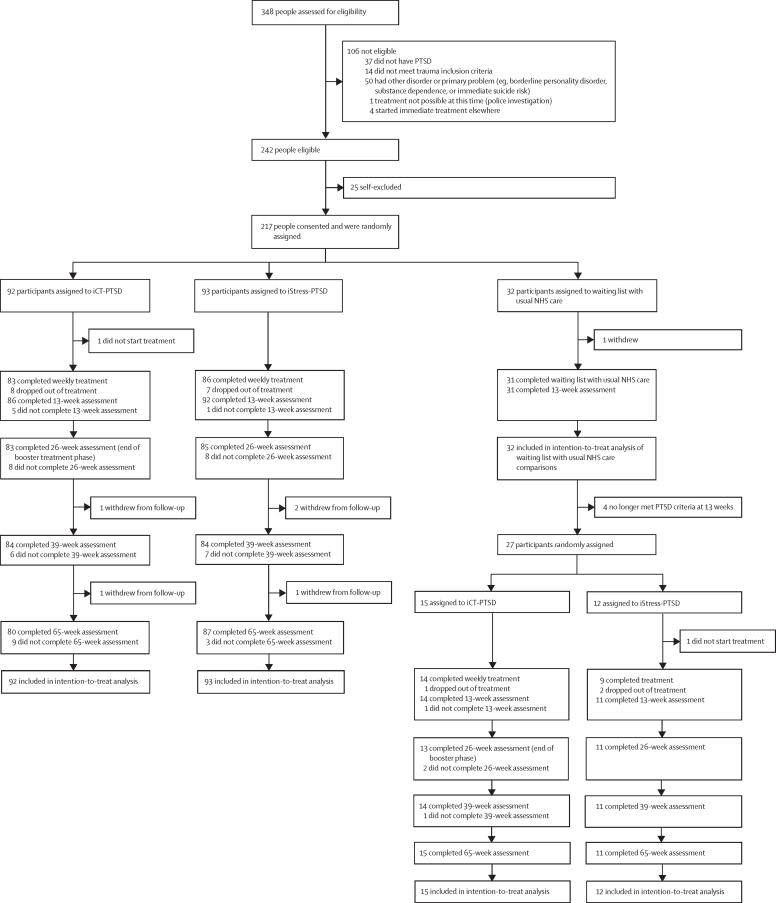
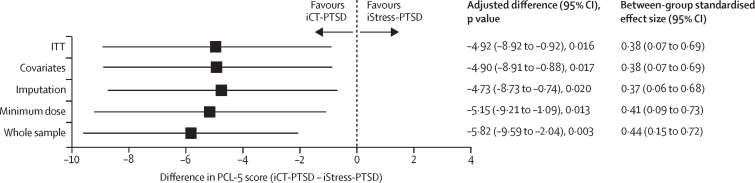
BACKGROUND: Many patients are currently unable to access psychological treatments for post-traumatic stress disorder (PTSD), and it is unclear which types of therapist-assisted internet-based treatments work best. We aimed to investigate whether a novel internet-delivered cognitive therapy for PTSD (iCT-PTSD), which implements all procedures of a first-line, trauma-focused intervention recommended by the UK National Institute for Health and Care Excellence (NICE) for PTSD, is superior to internet-delivered stress management therapy for PTSD (iStress-PTSD), a comprehensive cognitive behavioural treatment programme focusing on a wide range of coping skills. METHODS: We did a single-blind, randomised controlled trial in three locations in the UK. Participants (≥18 years) were recruited from UK National Health Service (NHS) Improving Access to Psychological Therapies (IAPT) services or by self-referral and met DSM-5 criteria for PTSD to single or multiple events. Participants were randomly allocated by a computer programme (3:3:1) to iCT-PTSD, iStress-PTSD, or a 3-month waiting list with usual NHS care, after which patients who still met PTSD criteria were randomly allocated (1:1) to iCT-PTSD or iStress-PTSD. Randomisation was stratified by location, duration of PTSD (<18 months or ≥18 months), and severity of PTSD symptoms (high vs low). iCT-PTSD and iStress-PTSD were delivered online with therapist support by messages and short weekly phone calls over the first 12 weeks (weekly treatment phase), and three phone calls over the next 3 months (booster phase). The primary outcome was the severity of PTSD symptoms at 13 weeks after random assignment, measured by self-report on the PTSD Checklist for DSM-5 (PCL-5), and analysed by intention-to-treat. Safety was assessed in all participants who started treatment. Process analyses investigated acceptability and compliance with treatment, and candidate moderators and mediators of outcome. The trial was prospectively registered with the ISRCTN registry, ISRCTN16806208. FINDINGS: Of the 217 participants, 158 (73%) self-reported as female, 57 (26%) as male, and two (1%) as other; 170 (78%) were White British, 20 (9%) were other White, six (3%) were Asian, ten (5%) were Black, eight (4%) had a mixed ethnic background, and three (1%) had other ethnic backgrounds. Mean age was 36·36 years (SD 12·11; range 18-71 years). 52 (24%) participants met self-reported criteria for ICD-11 complex PTSD. Fewer than 10% of participants dropped out of each treatment group. iCT-PTSD was superior to iStress-PTSD in reducing PTSD symptoms, showing an adjusted difference on the PCL-5 of -4·92 (95% CI -8·92 to -0·92; p=0·016; standardised effect size d=0·38 [0·07 to 0·69]) for immediate allocations and -5·82 (-9·59 to -2·04; p=0·0027; d=0·44 [0·15 to 0·72]) for all treatment allocations. Both treatments were superior to the waiting list for PCL-5 at 13 weeks (d=1·67 [1·23 to 2·10] for iCT-PTSD and 1·29 [0·85 to 1·72] for iStress-PTSD). The advantages in outcome for iCT-PTSD were greater for participants with high dissociation or complex PTSD symptoms, and mediation analyses showed both treatments worked by changing negative meanings of the trauma, unhelpful coping, and flashback memories. No serious adverse events were reported. INTERPRETATION: Trauma-focused iCT-PTSD is effective and acceptable to patients with PTSD, and superior to a non-trauma-focused cognitive behavioural stress management therapy, suggesting that iCT-PTSD is an effective way of delivering the contents of CT-PTSD, one of the NICE-recommended first-line treatments for PTSD, while reducing therapist time compared with face-to-face therapy. FUNDING: Wellcome Trust, UK National Institute for Health and Care Research Oxford Health Biomedical Research Centre.
Overview
The claims and statistics of this paper haven’t been checked yet.
Free: it reads the open-access text and checks the first 5 claims that cite a source we can check. Create a free account to check every claim.
Integrity signals
Registry
Cites
Statistics
Figures
Verification
Claims the paper makes
The claims and statistics of this paper haven’t been checked yet.
Free: it reads the open-access text and checks the first 5 claims that cite a source we can check. Create a free account to check every claim.
Self-check
Percentages, sums and reported differences re-computed from the paper’s own numbers.
The self-check needs the paper’s full text.
Citations
Cites
The PHQ-9: Validity of a brief depression severity measure
Kroenke, K., Spitzer, R. L., & Williams, J. B. W. (2001) · Journal of General Internal Medicine · doi:10.1046/j.1525-1497.2001.016009606.x · Cited by 44,910
A Brief Measure for Assessing Generalized Anxiety Disorder: The GAD-7
Spitzer, R. L., Kroenke, K., Williams, J. B. W., & Löwe, B. (2006) · Archives of Internal Medicine · doi:10.1001/archinte.166.10.1092 · Cited by 31,765
Posttraumatic Stress Disorder in the National Comorbidity Survey
Kessler, R. C. (1995) · Archives of General Psychiatry · doi:10.1001/archpsyc.1995.03950240066012 · Cited by 10,379 · cited 15×
“AE, NG, JW, EW-P, HM, and DMC occasionally give paid workshops on CT-PTSD. iStress was developed by GA’s team.”
InfluentialDevelopment and preliminary testing of the new five-level version of EQ-5D (EQ-5D-5L)
Herdman, M., Gudex, C., Lloyd, A., Janssen, M., Kind, P., Parkin, D., Bonsel, G., & Badia, X. (2011) · Quality of Life Research · doi:10.1007/s11136-011-9903-x · Cited by 9,795 · cited 2×
“We also report measures from the EuroQol 5 dimensions 5 levels questionnaire (EQ-5D-5L), 29 a standard measure of health-related quality of life.”
MethodResultJacobson, N. S., & Truax, P. (1991) · Journal of Consulting and Clinical Psychology · doi:10.1037/0022-006x.59.1.12 · Cited by 7,770
A cognitive model of posttraumatic stress disorder
Ehlers, A., & Clark, D. M. (2000) · Behaviour Research and Therapy · doi:10.1016/s0005-7967(99)00123-0 · Cited by 6,147 · cited 4×
“1,2 The treatment builds on Ehlers’ and Clark’s model of PTSD 19 and focuses on changing problematic appraisals of trauma and its aftermath, which induce a sense of current threat, as well as on updating trauma memories, identifying and discriminating triggers of re-experiencing symptoms, and…”
BackgroundMethodResultInfluentialSelf-citationThe WHO-5 well-being index: A systematic review of the literature
Topp, C. W., Østergaard, S. D., Søndergaard, S., & Bech, P. (2015) · Psychotherapy and Psychosomatics · doi:10.1159/000376585 · Cited by 4,708
Morin, C. M., Belleville, G., Bélanger, L., & Ivers, H. (2011) · Sleep · doi:10.1093/sleep/34.5.601 · Cited by 4,620 · cited 2×
“Secondary measures of other outcomes included the Patient Health Questionnaire (PHQ-9) 23 for symptoms of depression; the Generalized Anxiety Disorder Scale (GAD-7) 24 for symptoms of anxiety; the Work and Social Adjustment Scale (WSAS) 25 for disability and interference with functioning; the WHO-5 Well-Being Index 26…”
MethodDevelopment and validation of the working alliance inventory
Horvath, A. O., & Greenberg, L. S. (1989) · Journal of Counseling Psychology · doi:10.1037//0022-0167.36.2.223 · Cited by 3,520 · cited 1×
“Treatment credibility (participant and therapist ratings) 17 and working alliance 18 were assessed by self-report questionnaires in week 2 of treatment.”
MethodThe Work and Social Adjustment Scale: a simple measure of impairment in functioning
Mundt, J. C., Marks, I. M., Shear, M. K., & Greist, J. M. (2002) · British Journal of Psychiatry · doi:10.1192/bjp.180.5.461 · Cited by 2,515
Research works printed but not linked: 2
- National Institute for Health and Care Excellence Post-traumatic stress disorder https://www.nice.org.uk/guidance/ng116 2018 31211536
- Babor TF Higgins-Biddle JC Saunders JB Monteiro MG The Alcohol Use Disorders Identification Test: Guidelines for Use in Primary Care 2nd edn. 2001 Department of Mental Health and Substance Dependence, World Health Organization Geneva
Cited by
Olff, M., Hein, I. M., Amstadter, A. B., Armour, C., Birkeland, M. S., Bui, É., Cloître, M., Ehlers, A., Ford, J. D., Greene, T., et al. (2025) · European Journal of Psychotraumatology · doi:10.1080/20008066.2025.2458406 · Cited by 76
Self-citationFreeman, D., Lister, R., Waite, F., Galal, U., Yu, L.-M., Lambe, S., Beckley, A., Bold, E., Jenner, L., Diamond, R., et al. (2023) · The Lancet Psychiatry · doi:10.1016/s2215-0366(23)00257-2 · Cited by 40
“40 Another limitation in the trial was the low participant sample size, which means that potential smaller differences between the conditions could not be detected.”
Self-citationThew, G. R., Wild, J., & Ehlers, A. (2023) · British Journal of Clinical Psychology · doi:10.1111/bjc.12419 · Cited by 29
Self-citationAnser, M. K., Nabi, A. A., Ahmad, I., Abro, M. M. Q., & Zaman, K. (2025) · Health care science · doi:10.1002/hcs2.70018 · Cited by 46
Schulte, C. E., Harrer, M., Sachser, C., Weiss, J., & Zarski, A. (2024) · npj Digital Medicine · doi:10.1038/s41746-024-01042-7 · Cited by 21
Behr, S., Garcia, L. M., Lucas, J., Kohlhase, E., Puetz, M., Boettcher, J., Schaeuffele, C., & Knaevelsrud, C. (2025) · Internet Interventions · doi:10.1016/j.invent.2025.100821 · Cited by 27
McCall, H. C., Dear, B. F., Landry, C. A., Beahm, J. D., Gregory, J., Titov, N., Carleton, R. N., & Hadjistavropoulos, H. D. (2023) · Internet Interventions · doi:10.1016/j.invent.2023.100656 · Cited by 24
Kanstrup, M., Singh, L., Leehr, E. J., Göransson, K. E., Pihlgren, S. A., Iyadurai, L., Dahl, O., Falk, A., Lindström, V., Hadziosmanovic, N., et al. (2024) · BMC Medicine · doi:10.1186/s12916-024-03569-8 · Cited by 20
Kehyayan, A., Thiel, J. P., Unterberg, K., Salja, V., Meyer-Wehrmann, S., Holmes, E. A., Matura, J.-M., Dieris-Hirche, J., Timmesfeld, N., Herpertz, S., et al. (2024) · European Journal of Psychotraumatology · doi:10.1080/20008066.2024.2331402 · Cited by 17
Wiedemann, M., Janecka, M., Wild, J., Warnock‐Parkes, E., Stott, R. B., Grey, N., Clark, D. M., & Ehlers, A. (2023) · Behaviour Research and Therapy · doi:10.1016/j.brat.2023.104407 · Cited by 14
Self-citationBragesjö, M., Ivanov, V. Z., Andersson, E., & Rück, C. (2024) · European Journal of Psychotraumatology · doi:10.1080/20008066.2024.2320607 · Cited by 13
Hadjistavropoulos, H. D., McCall, H. C., Dear, B. F., Beahm, J. D., Carleton, R. N., & Titov, N. (2024) · Journal of Anxiety Disorders · doi:10.1016/j.janxdis.2024.102861 · Cited by 14
Schulte, C. E., Sachser, C., Rosner, R., Ebert, D. D., & Zarski, A. (2024) · European Journal of Psychotraumatology · doi:10.1080/20008066.2024.2364469 · Cited by 9
Lundin, J., Jansson‐Fröjmark, M., Gustafsson-Björverud, L., Grey, N., Santoft, F., Ehlers, A., Carlbring, P., Lundgren, T., Bragesjö, M., & Salomonsson, S. (2024) · Frontiers in Psychiatry · doi:10.3389/fpsyt.2024.1447651 · Cited by 11
Self-citationStein, J., Vöhringer, M., Wagner, B., Stammel, N., Nesterko, Y., Böttche, M., & Knaevelsrud, C. (2023) · JMIR Mental Health · doi:10.2196/48689 · Cited by 13
Purnell, L. R., Graham, A., Chiu, K., Trickey, D., & Meiser‐Stedman, R. (2024) · Journal of Anxiety Disorders · doi:10.1016/j.janxdis.2024.102925 · Cited by 9
Kip, A., Ritter, L., Hoppen, T. H., Papola, D., Ostuzzi, G., Barbui, C., & Morina, N. (2025) · Journal of Anxiety Disorders · doi:10.1016/j.janxdis.2025.103017 · Cited by 17
A 6-month supported online program for the treatment of persecutory delusions: Feeling Safer
Freeman, D. H., Isham, L., Freeman, J. D., Rosebrock, L. E., Kabir, T., Kenny, A., Diamond, R., Beckley, A., Rouse, N., Ahmed, M., et al. (2025) · Psychological Medicine · doi:10.1017/s0033291725100676 · Cited by 7
Beckenstrom, A. C., Bonsall, M. B., Markham, A., Slade, O., Ramineni, V., Iyadurai, L., Islam, Z., Highfield, J. A., Jaki, T., Goodwin, G. M., et al. (2026) · The Lancet Psychiatry · doi:10.1016/s2215-0366(25)00397-9 · Cited by 7
Penington, E., Wild, J., Warnock‐Parkes, E., Grey, N., Murray, H., Kerr, A., Stott, R. B., Rozental, A., Andersson, G., Clark, D. M., et al. (2024) · The Lancet Psychiatry · doi:10.1016/s2215-0366(24)00055-5 · Cited by 8
Self-citationNijdam, M. J., Goorden, P., Martens, I. J. M., de Haart, R., Klein, N. S., Peeters, S. B., Waagemans, M. L., Roijen, L. H., de Groot, D., & Vermetten, E. H. G. J. M. (2025) · Psychotherapy and Psychosomatics · doi:10.1159/000549158 · Cited by 7
Highfield, J. A., Iyadurai, L., & Holmes, E. A. (2025) · Discover Mental Health · doi:10.1007/s44192-025-00205-6 · Cited by 10
Horstmann, R. H., Seefeld, L., Schellong, J., & Garthus‐Niegel, S. (2024) · BMC Pregnancy and Childbirth · doi:10.1186/s12884-024-07061-2 · Cited by 5
Smith, P. A., Ehlers, A., Carr, E., Clark, D. M., Dalgleish, T., Forbes, G., Goldsmith, K., Griffiths, H., Gupta, M., King, D. X., et al. (2025) · Journal of Child Psychology and Psychiatry · doi:10.1111/jcpp.14124 · Cited by 8
Self-citationPsychometric Evaluation of a Measure of Posttraumatic Safety Behaviors
Foulser, A. A., Rubin, M., & Telch, M. J. (2024) · Cognitive and Behavioral Practice · doi:10.1016/j.cbpra.2024.03.003 · Cited by 4
Geležėlytė, O., Guogaitė, G., Nomeikaitė, A., Bisson, J. I., Lewis, C., & Kazlauskas, E. (2024) · BMC Psychiatry · doi:10.1186/s12888-024-06097-0 · Cited by 6
Schulte, C. E., Sachser, C., Rosner, R., Ebert, D. D., & Zarski, A. (2025) · European Journal of Psychotraumatology · doi:10.1080/20008066.2025.2480040 · Cited by 4
Novaković, I. Z., Streicher, A., Ajduković, D., Ajduković, M., Lacković, J. K., Lotzin, A., & Lueger‐Schuster, B. (2023) · International Journal of Environmental Research and Public Health · doi:10.3390/ijerph20196861 · Cited by 4
How to treat someone suffering with PTSD following rape in adulthood
Young, K., Akbar, S., Brady, F., Burrows, S., Chessell, Z. J., Chisholm, A., Dixon, L., Ellison, M. R., Grey, N., Hall, E., et al. (2025) · The Cognitive Behaviour Therapist · doi:10.1017/s1754470x25000078 · Cited by 6
Self-citationSingla, D. R., Berenbaum, T. S., Silver, R. K., Vigod, S. N., Li, S., Anand, A., Shelly, S., Kiss, A., Lawson, A., Barker, L. C., et al. (2025) · Nature Mental Health · doi:10.1038/s44220-025-00509-0 · Cited by 3
Guided, internet-based interventions for post-traumatic stress disorder
Bisson, J. I., Kitchiner, N., Lewis, C., & Roberts, N. P. (2023) · The Lancet Psychiatry · doi:10.1016/s2215-0366(23)00226-2 · Cited by 3
Behr, S., García, L. M., Lucas, J., Kohlhase, E., Puetz, M., Boettcher, J., Schaeuffele, C., & Knaevelsrud, C. (2024) · doi:10.31234/osf.io/28knb · Cited by 3
Hosono, T., Tsutsumi, R., Niwa, Y., & Kondoh, M. (2025) · Journal of Medical Internet Research · doi:10.2196/74905 · Cited by 4
Molander, O., Kolaas, K., Jayaram‐Lindström, N., Pontén, M., Särnholm, J., & Bragesjö, M. (2025) · European Journal of Psychotraumatology · doi:10.1080/20008066.2025.2520637 · Cited by 3
Warner, G., & Raslescu, A. (2025) · BJPsych Advances · doi:10.1192/bja.2025.10175 · Cited by 2
Çimen, F., Seçer, İ., Pakiş, A. K., & Alberici, A. (2026) · Psychology and Psychotherapy Theory Research and Practice · doi:10.1111/papt.70073 · Cited by 2
Brunner, I. C., Støme, L. N., & Kenter, R. M. F. (2026) · Internet Interventions · doi:10.1016/j.invent.2026.100983 · Cited by 2
Evidenzbasierte Psychotherapie posttraumatischer Belastungsstörungen – ein Update
Steil, R., Maercker, A., Jaworski, L., Bachem, R., & Eberle, D. J. (2024) · Der Nervenarzt · doi:10.1007/s00115-024-01694-6 · Cited by 4
Behdinan, T., Truuvert, A. K., Adekunte, A., McCallum, N., Vigod, S. N., Butt, A., Rojas, D., Soklaridis, S., & Ross, D. (2024) · Telemedicine Reports · doi:10.1089/tmr.2024.0020 · Cited by 2
Efficacy of stimulus discrimination training for reducing unwanted memories in student journalists
Tyson, G., Ehlers, A., & Wild, J. (2025) · European Journal of Psychotraumatology · doi:10.1080/20008066.2025.2558385 · Cited by 2
Self-citationHierarchical taxonomy of psychopathology and personalized mental health treatment selection
Argyriou, E., Prestigiacomo, C. J., Samuel, D. B., Stewart, J. C., Wu, W., & Cyders, M. A. (2025) · Frontiers in Psychiatry · doi:10.3389/fpsyt.2025.1597879 · Cited by 4
deBettencourt, M. T., Sakthivel, S., Holmes, E. A., & Chevillet, M. (2025) · npj Digital Medicine · doi:10.1038/s41746-025-02145-5 · Cited by 2
Tsang, A., Clements, C., Robinson, C., & Taylor, P. J. (2026) · Systematic Reviews · doi:10.1186/s13643-025-03065-x · Cited by 1
From research to routine care: implementation of guided digital therapy with Spring PTSD
Lewis, C., Kitchiner, N., Roberts, N. P., & Bisson, J. I. (2026) · European Journal of Psychotraumatology · doi:10.1080/20008066.2026.2665893 · Cited by 1
Health economics of psychological interventions in PTSD
Dams, J. (2024) · The Lancet Psychiatry · doi:10.1016/s2215-0366(24)00094-4 · Cited by 1
Like a Punch in the Gut: A Novel Perspective On Annual Recurrences of Ulcerative Colitis
Johnston, S., Fraser, A., Biddle, C., & Wild, J. (2024) · Crohn s & Colitis 360 · doi:10.1093/crocol/otae050
Self-citationJungbluth, N. J., Bolden, C. R., Schoenfelder, E. N., Metzger, I. W., & Blossom, J. B. (2024) · Cognitive and Behavioral Practice · doi:10.1016/j.cbpra.2024.10.003
Ghosh, C. C., McVicar, D., Davidson, G., Shannon, C., & Armour, C. (2024) · Network Science · doi:10.1017/nws.2024.10 · Cited by 1
Enhancing your delivery of cognitive therapy for PTSD: a celebration of the work of Hannah Murray
Thew, G. R., Warnock‐Parkes, E., El‐Leithy, S., Young, K., Grey, N., Smith, K. V., Tyson, G., Daraei, F., Wild, J., Graham, B., et al. (2024) · The Cognitive Behaviour Therapist · doi:10.1017/s1754470x24000370
Self-citationRuzek, J. I. (2024) · CBT: science into practice · doi:10.1007/978-3-031-72720-7_3
Patel, S. V., Saavedra, L. M., Borja, I. R., Philbrick, S. M., Coker-Schwimmer, M. J. L., Ruwala, R., & Viswanathan, M. (2025) · Medical Care · doi:10.1097/mlr.0000000000002098
Cognitive Therapy for PTSD in Children and Adolescents
Perrin, S. G., Leigh, E., Smith, P. A., Yule, W., Ehlers, A., & Clark, D. M. (2024) · Springer eBooks · doi:10.1007/978-3-031-77215-3_9 · Cited by 2
Self-citationLeppin, J., Szota, K., Schulte, C. E., & Zarski, A. (2025) · Kindheit und Entwicklung · doi:10.1026/0942-5403/a000486
Traumafokussierte Psychotherapie der (komplexen) Posttraumatischen Belastungsstörung
Priebe, K. (2025) · Die Psychotherapie · doi:10.1007/s00278-025-00818-w
Bragesjö, M., Ivanov, V. Z., Andersson, E., & Rück, C. (2025) · Trials · doi:10.1186/s13063-025-09361-0
Laing, J., McKinnon, A. I., Creswell, C., Ehlers, A., & Wild, J. (2025) · Trials · doi:10.1186/s13063-025-09341-4
Self-citationKanstrup, M., Singh, L., Leehr, E. J., Göransson, K. E., Pihlgren, S. A., Iyadurai, L., Dahl, O., Falk, A.-C., Lindström, V., Hadziosmanovic, N., et al. (2024) · Figshare · doi:10.6084/m9.figshare.27071854
Thew, G. R., Lee, M., Wolsey, I., Giles, F., Hayden, E., Jell, G., Peacock, J., Pimm, J., Ryder, J., Salvadori, A., et al. (2026) · JMIR Human Factors · doi:10.2196/68671 · Cited by 1
Self-citationWild, J., Tyson, G., Thew, G. R., Wilkins, A., Beierl, E. T., El-Salahi, S., Lorenz, H., Storch, C., Browne, H., Morris, D. A., et al. (2026) · JAMA Network Open · doi:10.1001/jamanetworkopen.2025.57241
Self-citationInternet Cognitive Therapy for Prolonged Grief Disorder (iCT-PG): a developmental case series
Smith, K. V., Wild, J., Stonciute, S., & Ehlers, A. (2026) · European Journal of Psychotraumatology · doi:10.1080/20008066.2026.2627050 · Cited by 4
Self-citationHosono, T., Tsutsumi, R., Niwa, Y., & Kondoh, M. (2026) · Journal of Medical Internet Research · doi:10.2196/preprints.100426
Nasith, A., Anwar, D. F. F., Hibatulloh, M. F., Salma, Z. N., & Pambudi, M. F. N. (2025) · Mental Health Religion & Culture · doi:10.1080/13674676.2025.2585327
Ross, D., Sayrafizadeh, N., Waliji, L. A., Farhat, K., Truuvert, A. K., Musheer, M., Vigod, S. N., Chu, C., Soklaridis, S., Rojas, D., et al. (2026) · EClinicalMedicine · doi:10.1016/j.eclinm.2026.104003
Cognitive Therapy Approaches for Posttraumatic Stress Disorder (PTSD) in Adults
Littleton, H., Zamundu, A., Higgins, M., & Mohamed, N. (2026) · Elsevier eBooks · doi:10.1016/b978-0-443-29009-1.00073-1
Ea, C., & Ukraintseva, Y. V. (2026) · S S Korsakov Journal of Neurology and Psychiatry · doi:10.17116/jnevro202612605287
Lundin, J., Rozental, A., Gustafsson-Björverud, L., Jansson‐Fröjmark, M., Carlbring, P., Lundgren, T., & Salomonsson, S. (2026) · European Journal of Psychotraumatology · doi:10.1080/20008066.2026.2727212
Self-citation
Metadata
- Authors
- Ehlers, A., Wild, J., Warnock-Parkes, E., Grey, N., Murray, H., Kerr, A., Rozental, A., Thew, G., Janecka, M., Beierl, E. T., Tsiachristas, A., Perera-Salazar, R., Andersson, G., & Clark, D. M.
- Affiliations
- Oxford Health NHS Foundation Trust (GB)
- The University of Melbourne (AU)
- Sussex Partnership NHS Foundation Trust (GB)
- King's College London (GB)
- Uppsala University (SE)
- Icahn School of Medicine at Mount Sinai (US)
- University of Oxford (GB)
- Linköping University (SE)
- Corresponding author
- Ehlers, Anke
- ORCID
- Venue
- The Lancet Psychiatry
- Publisher
- Elsevier BV
- Published
- 2023-08
- Volume
- 10
- Issue
- 8
- Pages
- 608-622
- ISSN
- 2215-0366 (ISSN-L)
- PMC
- PMC10789612
- OpenAlex
- W4385064764
- Cited by
- 68
- References
- 34
- Citations by year
- 2026: 14 · 2025: 23 · 2024: 24 · 2023: 7
- FWCI
- 19.82
- Type
- journal article
- Language
- en
- Open access
- hybrid
- doi.org
- Licence
- cc-by
- www.elsevier.com/tdm/userlicense/1.0/ (tdm)
- www.elsevier.com/legal/tdmrep-license (tdm)
- creativecommons.org/licenses/by/4.0/ (vor)
- Locations
- The Lancet Psychiatry (publishedVersion, cc-by)
- PubMed Central (publishedVersion, cc-by)
- PubMed (publishedVersion)
- KTH Publication Database DiVA (KTH Royal Institute of Technology) (submittedVersion, cc-by)
- Uppsala University Publications (Uppsala University) (submittedVersion, cc-by)
- Funders
- National Institute for Health and Care Research
- University of Oxford
- Wellcome Trust (200796)
- Topics
- Social Sciences › Psychology › Clinical Psychology › Posttraumatic Stress Disorder Research
- Social Sciences › Psychology › Applied Psychology › Digital Mental Health Interventions
- Social Sciences › Psychology › Experimental and Cognitive Psychology › Sleep and related disorders
- Keywords
- post-traumatic stress disorder, internet-based cognitive behavioral therapy, treatment acceptability, medication adherence, waitlist control, access to psychological treatment, treatment safety
- MeSH terms
- Adolescent, Adult, Aged, Female, United Kingdom, Humans, Male, Middle Aged, State Medicine, Stress Disorders, Post-Traumatic, Cognitive Behavioral Therapy, Single-Blind Method, Young Adult
About these checks
Registry, retraction, Cites and statistics results are computed, not judged, with one exception: a printed reference that no index lists is read once by a model before it counts as a citation error. Claims are extracted by a model and kept only when their quote appears verbatim in the text; each cited source is then checked, with a model’s help, for whether it says what the claim relies on. Those verdicts can be wrong — read the claim’s quote and the cited source before relying on one.
Statistics and arithmetic are recomputed, not judged.
Confidence bands are shown only for fields calibrated on our annotated test set. None is calibrated yet, so no band is shown.
What counts as a claim ›How we measure confidence ›How we check this ›
Are you an author, or do you see a problem with this page? Request a review
Data sources
Bibliographic data: Semantic Scholar, OpenAlex, Crossref.
Contains information from the Semantic Scholar Academic Graph Datasets, made available under the ODC Attribution License (ODC-BY 1.0).
Semantic Scholar’s data is described in: Kinney, R., et al. (2023). The Semantic Scholar Open Data Platform. arXiv:2301.10140.
