

The DOI matches its Crossref record; 2 of the 2 references it cites were found in a registry or an index.
Prevalence of occult hepatitis B virus infection in adults: a systematic review and meta-analysis
Open accessAbstract
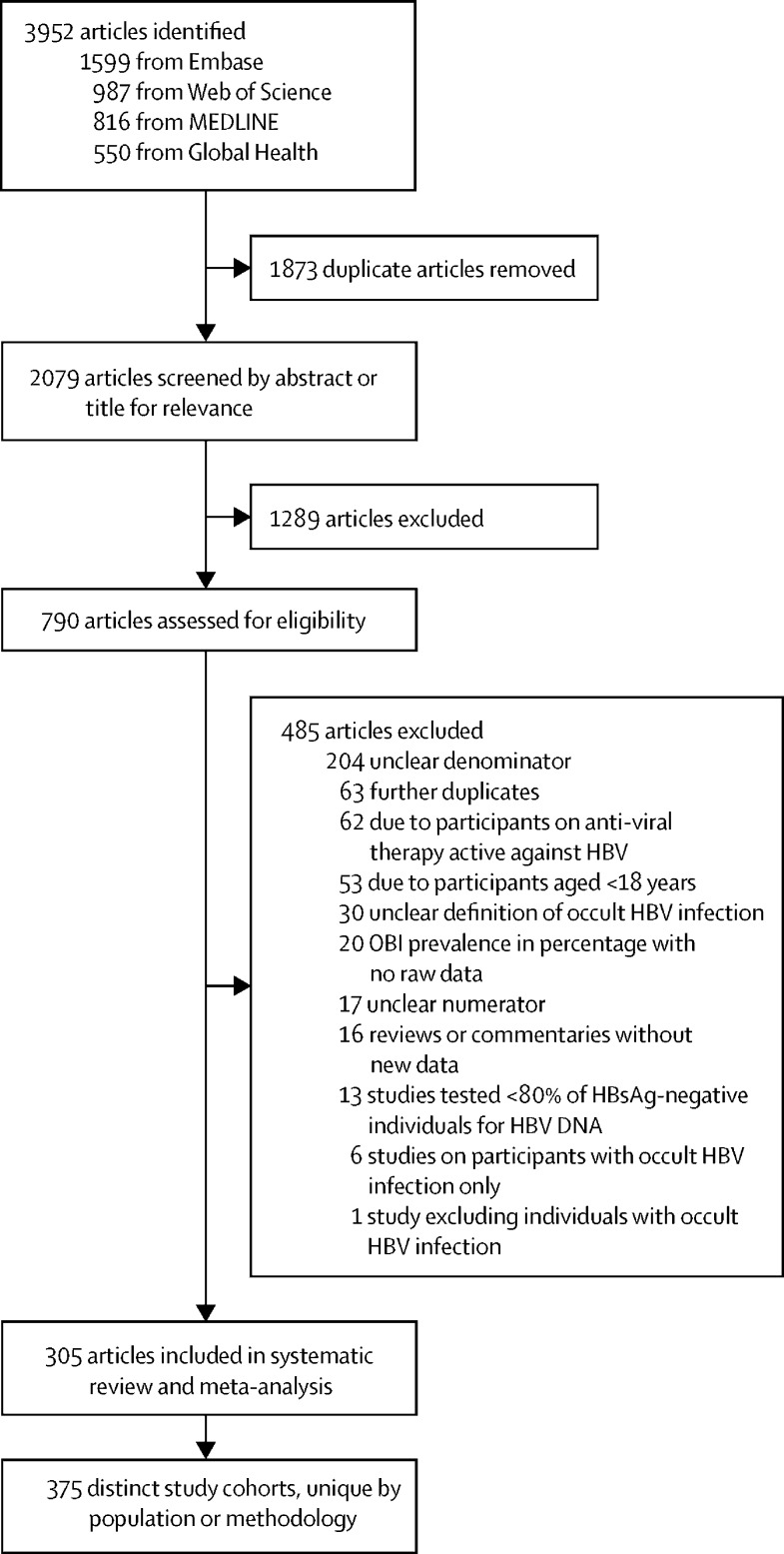
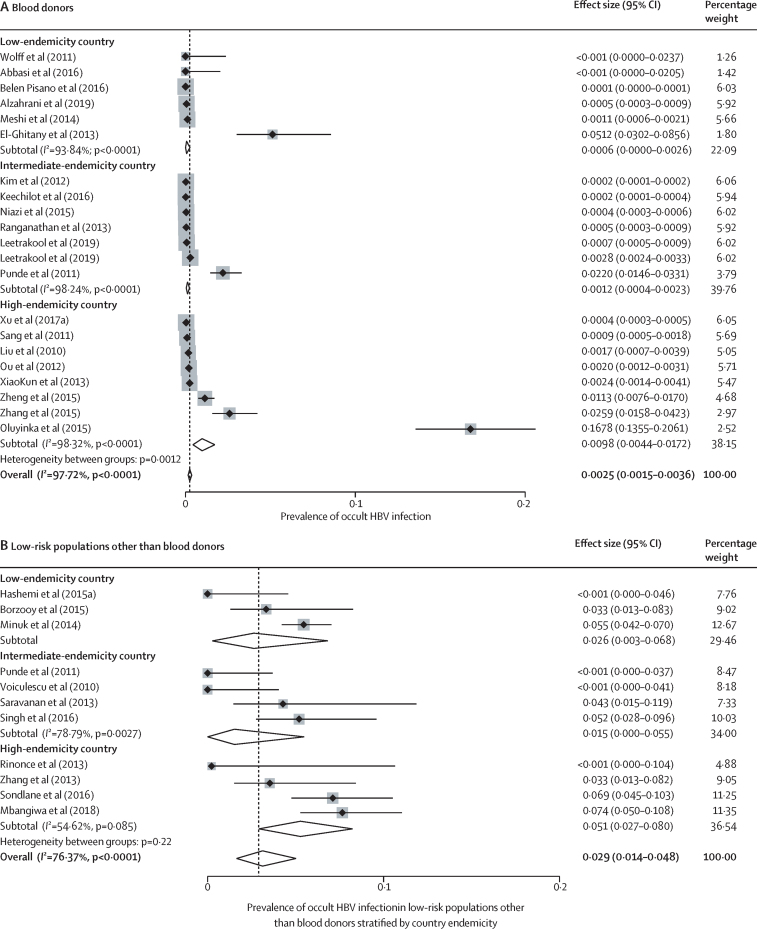
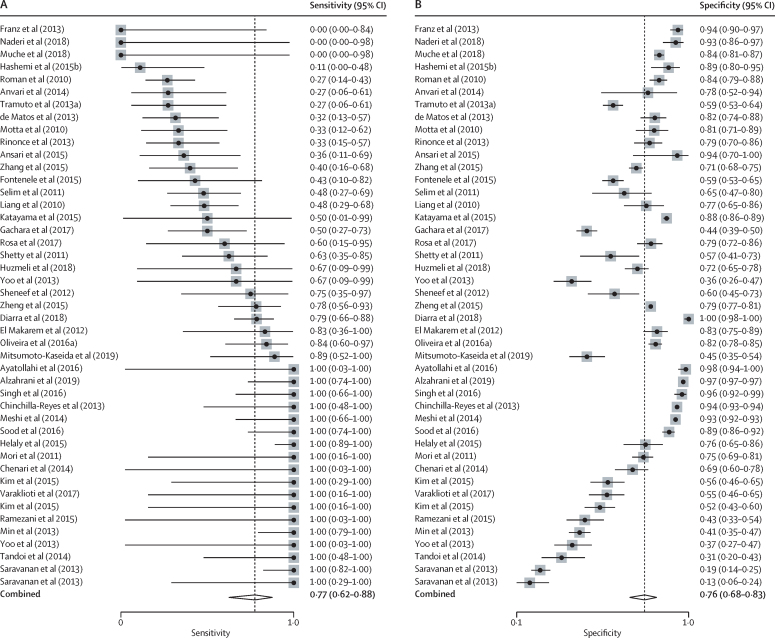
BACKGROUND: Despite growing concerns about transmissibility and clinical impact, occult hepatitis B virus (HBV) infection has received little attention in the hepatitis elimination agenda. We aimed to estimate the prevalence of occult HBV infection at a global and regional scale and in specific populations. METHODS: For this systematic review and meta-analysis, we searched the MEDLINE, Embase, Global Health, and Web of Science databases for articles published in any language between Jan 1, 2010, and Aug 14, 2019. We included original articles and conference abstracts of any study design that reported the proportion of HBsAg-negative adults (aged ≥18 years) who are positive for HBV DNA (ie, people with occult HBV infection). The prevalence of occult HBV infection was pooled, using the DerSimonian-Laird random-effects model, in the general population and specific groups defined by the type of study participants (blood donors; other low-risk populations; high-risk populations; and people with advanced chronic liver disease), and stratified by HBV endemicity in each country. We also assessed the performance of anti-HBc as an alternative biomarker to detect occult HBV infection. The study was registered with PROSPERO, CRD42019115490. FINDINGS: 305 of 3962 articles were eligible, allowing a meta-analysis of 140 521 993 individuals tested for HBV DNA. Overall, only two studies evaluated occult HBV infection in the general population, precluding unbiased global and regional estimates of occult HBV infection prevalence. In blood donors, occult HBV infection prevalence mirrored HBV endemicity: 0·06% (95% CI 0·00-0·26) in low-endemicity countries, 0·12% (0·04-0·23) in intermediate-endemicity countries, and 0·98% (0·44-1·72), in high-endemicity countries (p=0·0012). In high-risk groups, occult HBV infection prevalence was substantial, irrespective of endemicity: 5·5% (95% CI 2·9-8·7) in low-endemicity countries, 5·2% (2·5-8·6) in intermediate-endemicity countries, and 12·0% (3·4-24·7) in high-endemicity countries. The pooled sensitivity of anti-HBc to identify occult HBV infection was 77% (95% CI 62-88) and its specificity was 76% (68-83). INTERPRETATION: A substantial proportion of people carry occult HBV infection, especially among high-risk groups across the globe and people living in highly endemic countries. Occult HBV infection should be part of the global viral hepatitis elimination strategy. FUNDING: None.
Overview
The claims and statistics of this paper haven’t been checked yet.
Run the check — free, no account needed. It reads the open-access text and checks the sources it cites.
Integrity signals
Registry
Cites
Statistics
Figures
Verification
Claims the paper makes
The claims and statistics of this paper haven’t been checked yet.
Run the check — free, no account needed. It reads the open-access text and checks the sources it cites.
Claims other papers make about this one
Each is checked against this paper’s own text: does it say what the citing paper says it does?
The source backs part of the claim, not all of it — or backs it for a different population, condition or comparison.
In the citing paper
“up to 20% of OBIs may be negative for both HBsAg and hepatitis B core antibody (anti-HBc) with existing assays [67, 68]”
From Etiology-Based Treatment for Unresectable/Advanced Hepatocellular Carcinoma: Focus on Viral Hepatitis and Metabolic Dysfunction-Associated Steatohepatitis (2025) · cites this paper as [67]
Experimental — accuracy not yet measured
Self-check
Percentages, sums and reported differences re-computed from the paper’s own numbers.
The self-check needs the paper’s full text.
Citations
Cites
Metaprop: a Stata command to perform meta-analysis of binomial data
Nyaga, V. N., Arbyn, M., & Aerts, M. (2014) · Archives of Public Health · doi:10.1186/2049-3258-72-39 · Cited by 2,139
Hunter, J. P., Saratzis, A., Sutton, A. J., Boucher, R. H., Sayers, R. D., & Bown, M. J. (2014) · Journal of Clinical Epidemiology · doi:10.1016/j.jclinepi.2014.03.003 · Cited by 786
Research works printed but not linked: 27
- Raimondo, 2019, Update of the statements on biology and clinical impact of occult hepatitis B virus infection, J Hepatol, 71, 397, 10.1016/j.jhep.2019.03.034 · DOI · Paper page
- Raimondo, 2008, Statements from the Taormina expert meeting on occult hepatitis B virus infection, J Hepatol, 49, 652, 10.1016/j.jhep.2008.07.014 · DOI
- Yamamoto, 1994, Naturally occurring escape mutants of hepatitis B virus with various mutations in the S gene in carriers seropositive for antibody to hepatitis B surface antigen, J Virol, 68, 2671, 10.1128/jvi.68.4.2671-2676.1994 · DOI
- Hass, 2005, Functional analysis of hepatitis B virus reactivating in hepatitis B surface antigen-negative individuals, Hepatology, 42, 93, 10.1002/hep.20748 · DOI
- Cohen, 2020, Hepatitis B virus preS2Δ38-55 variants: a newly identified risk factor for hepatocellular carcinoma, JHEP Rep, 2
- Allain, 2016, Global epidemiology of occult HBV infection, Ann Blood, 2, 7, 10.21037/aob.2017.06.01 · DOI
- Mak, 2020, Occult hepatitis B infection and hepatocellular carcinoma: epidemiology, virology, hepatocarcinogenesis and clinical significance, J Hepatol, 73, 952, 10.1016/j.jhep.2020.05.042 · DOI · Paper page
- Weng, 2021, Occult hepatitis B virus infection and the risk of hepatocellular carcinoma: a systematic review and meta-analysis, Dig Med Res, 4, 46, 10.21037/dmr-21-50 · DOI
- Candotti, 2019, Multiple HBV transfusion transmissions from undetected occult infections: revising the minimal infectious dose, Gut, 68, 313, 10.1136/gutjnl-2018-316490 · DOI
- Harvala, 2021, Hepatitis B infections among blood donors in England between 2009 and 2018: is an occult hepatitis B infection a risk for blood safety?, Transfusion, 61, 2402, 10.1111/trf.16543 · DOI
- Chevaliez, 2010, Performance of version 2.0 of the Cobas AmpliPrep/Cobas TaqMan real-time PCR assay for hepatitis B virus DNA quantification, J Clin Microbiol, 48, 3641, 10.1128/JCM.01306-10 · DOI
- Hoy, 2012, Assessing risk of bias in prevalence studies: modification of an existing tool and evidence of interrater agreement, J Clin Epidemiol, 65, 934, 10.1016/j.jclinepi.2011.11.014 · DOI · Paper page
- Schweitzer, 2015, Estimations of worldwide prevalence of chronic hepatitis B virus infection: a systematic review of data published between 1965 and 2013, Lancet, 386, 1546, 10.1016/S0140-6736(15)61412-X · DOI
- 2018, Global prevalence, treatment, and prevention of hepatitis B virus infection in 2016: a modelling study, Lancet Gastroenterol Hepatol, 3, 383, 10.1016/S2468-1253(18)30056-6 · DOI
- Zhang, 2013, Epidemiological and clinical features of occult hepatitis B in HIV infection without antiretroviral treatment, Zhonghua Gan Zang Bing Za Zhi, 21, 189
- Minuk, 2014, Establishing diagnostic criteria for occult hepatitis B virus infections in community based populations, J Med Virol, 86, 156, 10.1002/jmv.23813 · DOI
- Candotti, 2012, Occult hepatitis B infection in blood donors from South East Asia: molecular characterisation and potential mechanisms of occurrence, Gut, 61, 1744, 10.1136/gutjnl-2011-301281 · DOI
- Taira, 2013, Residual risk of transfusion-transmitted hepatitis B virus (HBV) infection caused by blood components derived from donors with occult HBV infection in Japan, Transfusion, 53, 1393, 10.1111/j.1537-2995.2012.03909.x · DOI
- Yuen, 2011, Transmissibility of hepatitis B virus (HBV) infection through blood transfusion from blood donors with occult HBV infection, Clin Infect Dis, 52, 624, 10.1093/cid/ciq247 · DOI
- Cooke, 2019, Accelerating the elimination of viral hepatitis: a Lancet Gastroenterology & Hepatology Commission, Lancet Gastroenterol Hepatol, 4, 135, 10.1016/S2468-1253(18)30270-X · DOI
- Oluyinka, 2015, Occult hepatitis B virus infection in Nigerian blood donors and hepatitis B virus transmission risks, PLoS One, 10, 10.1371/journal.pone.0131912 · DOI
- Ndow, 2021, Prevalence and clinical significance of occult hepatitis B infection in The Gambia, West Africa, J Infect Dis
- Shi, 2012, Association between occult hepatitis B infection and the risk of hepatocellular carcinoma: a meta-analysis, Liver Int, 32, 231, 10.1111/j.1478-3231.2011.02481.x · DOI
- Chen, 2017, Hepatitis B reactivation in hepatitis B and C coinfected patients treated with antiviral agents: a systematic review and meta-analysis, Hepatology, 66, 13, 10.1002/hep.29109 · DOI
- Wong, 2022, Detection of the hepatitis B surface antigen in patients with occult hepatitis B by use of an assay with enhanced sensitivity, J Clin Microbiol, 60, 10.1128/jcm.02204-21 · DOI
- Whittle, 1990, The pattern of childhood hepatitis B infection in two Gambian villages, J Infect Dis, 161, 1112, 10.1093/infdis/161.6.1112 · DOI
- Shahmoradi, 2012, High prevalence of occult hepatitis B virus infection in children born to HBsAg-positive mothers despite prophylaxis with hepatitis B vaccination and HBIG, J Hepatol, 57, 515, 10.1016/j.jhep.2012.04.021 · DOI
Cited by
Sorted by citations
Sun, F. S. K., Wong, J. S. L., Mak, L.-Y., Wong, C. C.-L., Chew, V., Li, B. C. W., Leung, R., Cheung, T. T., & Yau, T. (2025) · Liver Cancer · doi:10.1159/000548536 · Cited by 3
“In fact, up to 20% of OBIs may be negative for both HBsAg and hepatitis B core antibody (anti-HBc) with existing assays [67, 68].”
Metadata
- Authors
- Im, Y. R., Jagdish, R., Leith, D., Kim, J. U., Yoshida, K., Majid, A., Ge, Y., Ndow, G., Shimakawa, Y., & Lemoine, M.
- Affiliations
- Imperial College London (GB)
- Chelsea and Westminster Hospital (GB)
- Glasgow Royal Infirmary (GB)
- The Royal Free Hospital (GB)
- Tokyo Medical and Dental University (JP)
- West Middlesex University Hospital (GB)
- Chelsea and Westminster Hospital NHS Foundation Trust (GB)
- London School of Hygiene & Tropical Medicine (GB)
- Institut Pasteur (FR)
- Corresponding author
- Lemoine, Maud
- ORCID
- Venue
- The Lancet Gastroenterology & Hepatology
- Publisher
- Elsevier BV
- Published
- 2022-10
- Volume
- 7
- Issue
- 10
- Pages
- 932-942
- ISSN
- 2468-1156 (ISSN-L)
- 2468-1253
- PMC
- PMC9630161
- OpenAlex
- W4291286539
- Cited by
- 92
- References
- 2
- Citations by year
- 2026: 25 · 2025: 26 · 2024: 23 · 2023: 16 · 2022: 2
- FWCI
- 2.66
- Type
- journal article
- Language
- en
- Open access
- hybrid
- doi.org
- Licence
- Locations
- The Lancet. Gastroenterology & hepatology (publishedVersion, cc-by)
- PubMed Central (publishedVersion, cc-by)
- PubMed (publishedVersion)
- Discovery Research Portal (University of Dundee) (publishedVersion, cc-by)
- LSHTM Research Online (London School of Hygiene and Tropical Medicine) (acceptedVersion)
- HAL (submittedVersion, cc-by)
- Funders
- Wellcome Trust
- Medical Research Council
- Gilead Sciences
- Topics
- Health Sciences › Medicine › Epidemiology › Hepatitis B Virus Studies
- Health Sciences › Medicine › Hepatology › Hepatitis C virus research
- Health Sciences › Medicine › Hepatology › Liver Disease and Transplantation
- Keywords
- occult hepatitis B infection, HBV DNA, HBsAg-negative, prevalence, blood donors, HBV endemicity, anti-HBc, HBV reactivation, chronic liver disease, HBV elimination, vulnerable populations, hepatitis B screening, HBV genotypes, HBV genotyping
- MeSH terms
- Adolescent, Adult, DNA, Viral, Hepatitis B, Hepatitis B Antibodies, Hepatitis B virus, Humans, Prevalence, Hepatitis B, Chronic
About these checks
Registry, retraction, Cites and statistics results are computed, not judged, with one exception: a printed reference that no index lists is read once by a model before it counts as a citation error. Claims are extracted by a model and kept only when their quote appears verbatim in the text; each cited source is then checked, with a model’s help, for whether it says what the claim relies on. Those verdicts can be wrong — read the claim’s quote and the cited source before relying on one.
Statistics and arithmetic are recomputed, not judged.
Confidence bands are shown only for fields calibrated on our annotated test set. None is calibrated yet, so no band is shown.
What counts as a claim ›How we measure confidence ›How we check this ›
Are you an author, or do you see a problem with this page? Request a review
