

The DOI matches its Crossref record; 17 of the 19 references it cites were found in a registry or an index.
Effects on mental health of a UK welfare reform, Universal Credit: a longitudinal controlled study
Open accessAbstract
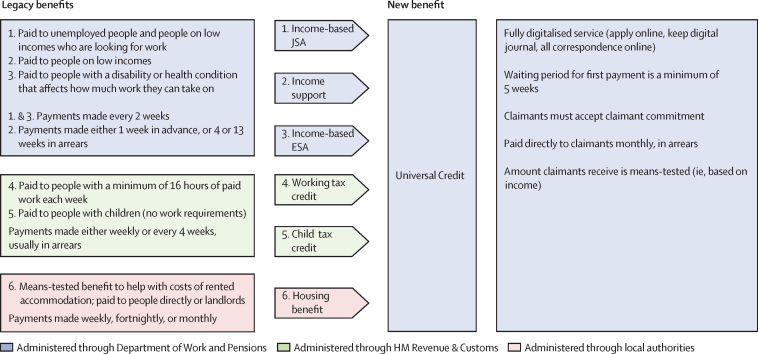
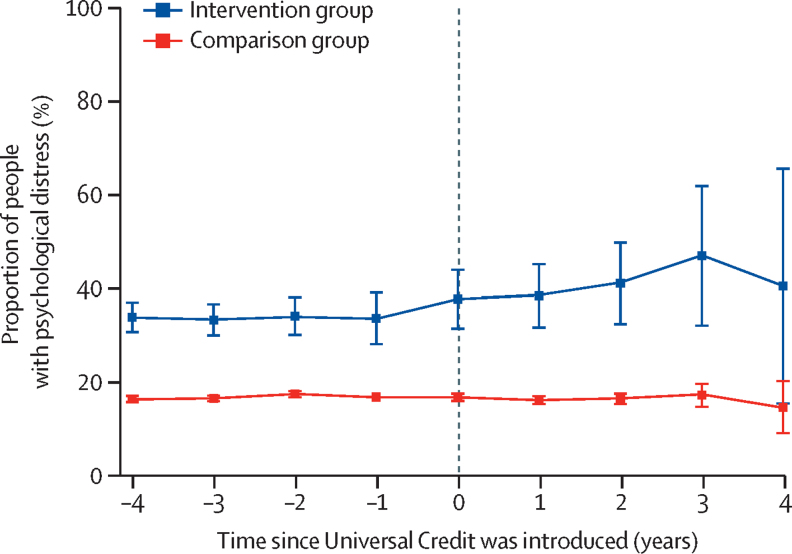
BACKGROUND: Universal Credit, a welfare benefit reform in the UK, began to replace six existing benefit schemes in April, 2013, starting with the income-based Job Seekers Allowance. We aimed to determine the effects on mental health of the introduction of Universal Credit. METHODS: In this longitudinal controlled study, we linked 197 111 observations from 52 187 individuals of working age (16-64 years) in England, Wales, and Scotland who participated in the Understanding Society UK Longitudinal Household Panel Study between 2009 and 2018 with administrative data on the month when Universal Credit was introduced into the area in which each respondent lived. We included participants who had data on employment status, local authority area of residence, psychological distress, and confounding variables. We excluded individuals from Northern Ireland and people out of work with a disability. We used difference-in-differences analysis of this nationally representative, longitudinal, household survey and separated respondents into two groups: unemployed people who were eligible for Universal Credit (intervention group) and people who were not unemployed and therefore would not have generally been eligible for Universal Credit (comparison group). Using the phased roll-out of Universal Credit, we compared the change in psychological distress (self-reported via General Health Questionnaire-12) between the intervention group and the comparison group over time as the reform was introduced in the area in which each respondent lived. We defined clinically significant psychological distress as a score of greater than 3 on the General Health Questionnaire-12. We tested whether there were differential effects across subgroups (age, sex, and education). FINDINGS: The prevalence of psychological distress increased in the intervention group by 6·57 percentage points (95% CI 1·69-11·42) after the introduction of Universal Credit relative to the comparison group, after accounting for potential confounders. We estimate that between April 29, 2013, and Dec 31, 2018, an additional 63 674 (95% CI 10 042-117 307) unemployed people will have experienced levels of psychological distress that are clinically significant due to the introduction of Universal Credit; 21 760 of these individuals might reach the diagnostic threshold for depression. INTERPRETATION: Our findings suggest that the introduction of Universal Credit led to an increase in psychological distress, a measure of mental health difficulties, among those affected by the policy. Future changes to government welfare systems should be evaluated not only on a fiscal basis but on their potential to affect health and wellbeing. FUNDING: Wellcome Trust, UK National Institute for Health Research, and Medical Research Council.
Overview
The claims and statistics of this paper haven’t been checked yet.
Run the check — free, no account needed. It reads the open-access text and checks the sources it cites.
Integrity signals
Registry
Cites
Statistics
Figures
Verification
Claims the paper makes
The claims and statistics of this paper haven’t been checked yet.
Run the check — free, no account needed. It reads the open-access text and checks the sources it cites.
Claims other papers make about this one
Each is checked against this paper’s own text: does it say what the citing paper says it does?
In the citing paper
“However, this “proportional” policy means that trustees receiving less will have reduced capacity to reciprocate, further diminishing their subsequent allocation – and thus locking them into a cycle of ever-diminishing resources.”
From Deep reinforcement learning can promote sustainable human behaviour in a common-pool resource problem (2025) · cites this paper as [31]
In the citing paper
“For example, cutting unemployment benefits may itself create circumstances unfavourable to reemployment30, such as long-term ill-health31, leading to workers being permanently excluded from the labour market.”
From Deep reinforcement learning can promote sustainable human behaviour in a common-pool resource problem (2025) · cites this paper as [31]
Self-check
Percentages, sums and reported differences re-computed from the paper’s own numbers.
The self-check needs the paper’s full text.
Citations
Cites
A scaled version of the General Health Questionnaire
Goldberg, D. P., & Hillier, V. F. (1979) · Psychological Medicine · doi:10.1017/s0033291700021644 · Cited by 5,639
The Validity of Two Versions of the GHQ in the WHO Study of Mental Illness in General Health Care
GOLDBERG, D. P., GATER, R., SARTORIUS, N., USTUN, T. B., PICCINELLI, M., GUREJE, O., & RUTTER, C. (1997) · Psychological Medicine · doi:10.1017/s0033291796004242 · Cited by 3,657
Craig, P., Cooper, C. C., Gunnell, D., Haw, S. J., Lawson, K. D., Macintyre, S., Ogilvie, D., Petticrew, M. P., Reeves, B. C., Sutton, M., et al. (2012) · Journal of Epidemiology & Community Health · doi:10.1136/jech-2011-200375 · Cited by 966
Puhani, P. A. (2011) · Economics Letters · doi:10.1016/j.econlet.2011.11.025 · Cited by 623
Austerity and health: the impact in the UK and Europe
Stückler, D., Reeves, A., Loopstra, R., Karanikolos, M., & McKee, M. (2017) · European Journal of Public Health · doi:10.1093/eurpub/ckx167 · Cited by 408
Barr, B., Taylor-Robinson, D. C., Stückler, D., Loopstra, R., Reeves, A., & Whitehead, M. M. (2015) · Journal of Epidemiology & Community Health · doi:10.1136/jech-2015-206209 · Cited by 267
Self-citationVilagut, G., Forero, C. G., Pinto‐Meza, A., Haro, J. M., de Graaf, R., Bruffaerts, R., Kovess–Masféty, V., de Girolamo, G., Matschinger, H., Ferrer, M., et al. (2013) · Value in Health · doi:10.1016/j.jval.2013.01.006 · Cited by 261
Barr, B., Kinderman, P., & Whitehead, M. (2015) · Social Science & Medicine · doi:10.1016/j.socscimed.2015.11.009 · Cited by 198
Self-citationThe structure of the General Health Questionnaire (GHQ-12): two meta-analytic factor analyses
Gnambs, T., & Staufenbiel, T. (2018) · Health Psychology Review · doi:10.1080/17437199.2018.1426484 · Cited by 137
Austerity and old-age mortality in England: a longitudinal cross-local area analysis, 2007–2013
Loopstra, R., McKee, M., Katikireddi, S. V., Taylor-Robinson, D. C., Barr, B., & Stückler, D. (2016) · Journal of the Royal Society of Medicine · doi:10.1177/0141076816632215 · Cited by 126
Self-citationImpact of Universal Credit in North East England: a qualitative study of claimants and support staff
Cheetham, M., Moffatt, S., Addison, M. T., & Wiseman, A. (2019) · BMJ Open · doi:10.1136/bmjopen-2019-029611 · Cited by 122
Katikireddi, S. V., Molaodi, O. R., Gibson, M., Dundas, R., & Craig, P. (2018) · The Lancet Public Health · doi:10.1016/s2468-2667(18)30109-9 · Cited by 52
Barr, B., Taylor-Robinson, D. C., Stückler, D., Loopstra, R., Reeves, A., Wickham, S. L., & Whitehead, M. (2015) · Journal of Epidemiology & Community Health · doi:10.1136/jech-2015-206333 · Cited by 36
Self-citationThe effectiveness of case-finding for mental health problems in primary care.
(2005) · PubMed · Cited by 20
Doctors’ concerns over universal credit are mounting
Arie, S., journalist, F., London, & UK (2018) · BMJ · doi:10.1136/bmj.k5131 · Cited by 11
Introduction: Universal Credit: the story so far…
Sainsbury, R. (2014) · Journal of Poverty and Social Justice · doi:10.1332/175982714x13875306538881 · Cited by 7
Universal Credit : the story so far ...
Sainsbury, R. (2014) · White Rose Research Online (University of Leeds, The University of Sheffield, University of York) · Cited by 3
Cited by
Sorted by citations
Simpson, J., Albani, V., Bell, Z., Bambra, C. L., & Brown, H. (2021) · Social Science & Medicine · doi:10.1016/j.socscimed.2021.113717 · Cited by 132
Local government funding and life expectancy in England: a longitudinal ecological study
Alexiou, A., Fahy, K., Mason, K., Bennett, D. L., Brown, H., Bambra, C. L., Taylor-Robinson, D. C., & Barr, B. (2021) · The Lancet Public Health · doi:10.1016/s2468-2667(21)00110-9 · Cited by 114
Self-citationSaunders, K. R. K., McGuinness, E., Barnett, P., Foye, U., Sears, J., Carlisle, S., Allman, F., Tzouvara, V., Schlief, M., Juan, N. V. S., et al. (2023) · BMC Psychiatry · doi:10.1186/s12888-023-05016-z · Cited by 100
“Clinical staff should also understand that issues relating to housing and welfare benefits, for example, can exacerbate mental health problems and responses to previous traumas, or even constitute traumatic experiences themselves [106, 107].”
BackgroundCOVID-19 and Subjective Well-Being: Separating the Effects of Lockdowns from the PandemicPreprint
Foa, R., Gilbert, S., & Fabian, M. (2020) · SSRN Electronic Journal · doi:10.2139/ssrn.3674080 · Cited by 81
“6% increase in psychological distress among the unemployed from 2013 to 2018 (Wickham et al. 2020).”
InfluentialIs austerity a cause of slower improvements in mortality in high-income countries? A panel analysis
McCartney, G., McMaster, R., Popham, F., Dundas, R., & Walsh, D. (2022) · Social Science & Medicine · doi:10.1016/j.socscimed.2022.115397 · Cited by 72
Metadata
- Authors
- Wickham, S., Bentley, L., Rose, T., Whitehead, M., Taylor-Robinson, D., & Barr, B.
- Affiliations
- University of Liverpool (GB)
- University of Copenhagen (DK)
- Corresponding author
- Wickham, Sophie
- Venue
- The Lancet Public Health
- Publisher
- Elsevier BV
- Published
- 2020-03
- Volume
- 5
- Issue
- 3
- Pages
- e157-e164
- ISSN
- 2468-2667 (ISSN-L)
- PMC
- PMC7208537
- OpenAlex
- W3007476043
- Cited by
- 151
- References
- 19
- Citations by year
- 2026: 17 · 2025: 21 · 2024: 21 · 2023: 28 · 2022: 26 · 2021: 18 · 2020: 20
- FWCI
- 24.01
- Type
- journal article
- Language
- en
- Open access
- gold
- doi.org
- Licence
- Locations
- The Lancet Public Health (publishedVersion, cc-by)
- PubMed Central (publishedVersion, cc-by)
- PubMed (publishedVersion)
- Research at the University of Copenhagen (University of Copenhagen) (publishedVersion, cc-by)
- DOAJ (DOAJ: Directory of Open Access Journals) (submittedVersion, cc-by-sa)
- Funders
- Wellcome Trust (200335/Z/15/Z)
- Medical Research Council (MR/P008577/1)
- Topics
- Health Sciences › Medicine › Public Health, Environmental and Occupational Health › Employment and Welfare Studies
- Social Sciences › Political Science and International Relations › Social Policy and Reform Studies
- Health Sciences › Medicine › Public Health, Environmental and Occupational Health › Food Security and Health in Diverse Populations
- Keywords
- Universal Credit, welfare reform, psychological distress, mental health, unemployment, welfare benefits, policy impact, depression, working-age adults, GHQ-12, policy evaluation
- MeSH terms
- Psychological Distress, Adolescent, Adult, Female, United Kingdom, Humans, Longitudinal Studies, Male, Mental Health, Middle Aged, Social Welfare, Young Adult
About these checks
Registry, retraction, Cites and statistics results are computed, not judged, with one exception: a printed reference that no index lists is read once by a model before it counts as a citation error. Claims are extracted by a model and kept only when their quote appears verbatim in the text; each cited source is then checked, with a model’s help, for whether it says what the claim relies on. Those verdicts can be wrong — read the claim’s quote and the cited source before relying on one.
Statistics and arithmetic are recomputed, not judged.
Confidence bands are shown only for fields calibrated on our annotated test set. None is calibrated yet, so no band is shown.
What counts as a claim ›How we measure confidence ›How we check this ›
Are you an author, or do you see a problem with this page? Request a review
