

The DOI matches its Crossref record; 17 of the 19 references it cites were found in a registry or an index.
Effects on mental health of a UK welfare reform, Universal Credit: a longitudinal controlled study
Open accessAbstract
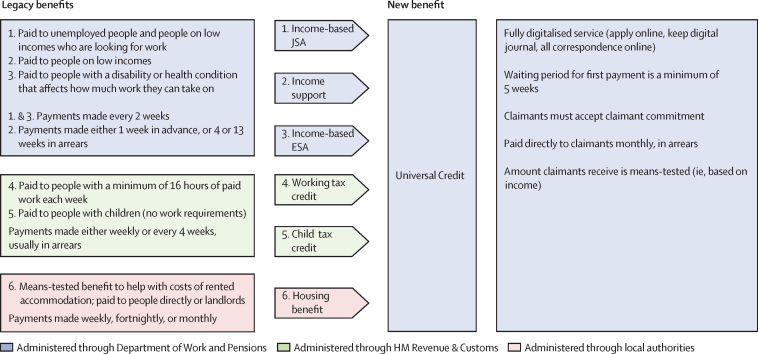
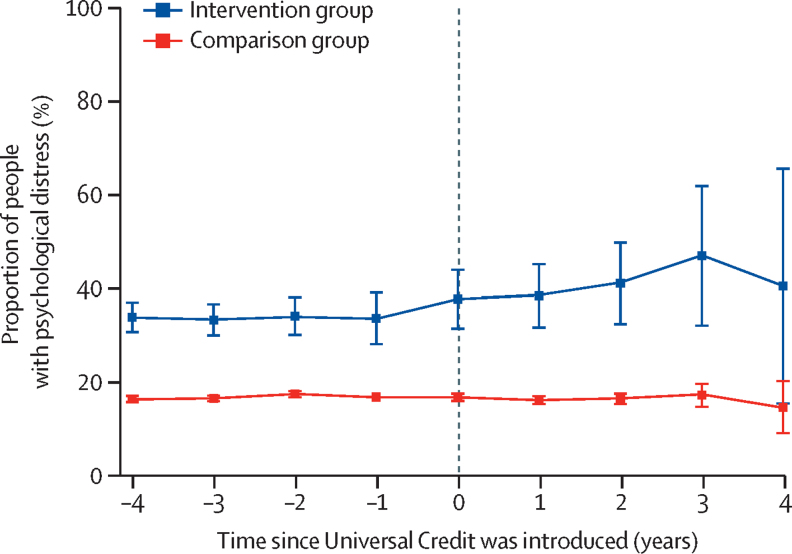
BACKGROUND: Universal Credit, a welfare benefit reform in the UK, began to replace six existing benefit schemes in April, 2013, starting with the income-based Job Seekers Allowance. We aimed to determine the effects on mental health of the introduction of Universal Credit. METHODS: In this longitudinal controlled study, we linked 197 111 observations from 52 187 individuals of working age (16-64 years) in England, Wales, and Scotland who participated in the Understanding Society UK Longitudinal Household Panel Study between 2009 and 2018 with administrative data on the month when Universal Credit was introduced into the area in which each respondent lived. We included participants who had data on employment status, local authority area of residence, psychological distress, and confounding variables. We excluded individuals from Northern Ireland and people out of work with a disability. We used difference-in-differences analysis of this nationally representative, longitudinal, household survey and separated respondents into two groups: unemployed people who were eligible for Universal Credit (intervention group) and people who were not unemployed and therefore would not have generally been eligible for Universal Credit (comparison group). Using the phased roll-out of Universal Credit, we compared the change in psychological distress (self-reported via General Health Questionnaire-12) between the intervention group and the comparison group over time as the reform was introduced in the area in which each respondent lived. We defined clinically significant psychological distress as a score of greater than 3 on the General Health Questionnaire-12. We tested whether there were differential effects across subgroups (age, sex, and education). FINDINGS: The prevalence of psychological distress increased in the intervention group by 6·57 percentage points (95% CI 1·69-11·42) after the introduction of Universal Credit relative to the comparison group, after accounting for potential confounders. We estimate that between April 29, 2013, and Dec 31, 2018, an additional 63 674 (95% CI 10 042-117 307) unemployed people will have experienced levels of psychological distress that are clinically significant due to the introduction of Universal Credit; 21 760 of these individuals might reach the diagnostic threshold for depression. INTERPRETATION: Our findings suggest that the introduction of Universal Credit led to an increase in psychological distress, a measure of mental health difficulties, among those affected by the policy. Future changes to government welfare systems should be evaluated not only on a fiscal basis but on their potential to affect health and wellbeing. FUNDING: Wellcome Trust, UK National Institute for Health Research, and Medical Research Council.
Overview
The claims and statistics of this paper haven’t been checked yet.
Run the check — free, no account needed. It reads the open-access text and checks the sources it cites.
Integrity signals
Registry
Cites
Statistics
Figures
Verification
Claims the paper makes
The claims and statistics of this paper haven’t been checked yet.
Run the check — free, no account needed. It reads the open-access text and checks the sources it cites.
Claims other papers make about this one
Each is checked against this paper’s own text: does it say what the citing paper says it does?
In the citing paper
“However, this “proportional” policy means that trustees receiving less will have reduced capacity to reciprocate, further diminishing their subsequent allocation – and thus locking them into a cycle of ever-diminishing resources.”
From Deep reinforcement learning can promote sustainable human behaviour in a common-pool resource problem (2025) · cites this paper as [31]
In the citing paper
“For example, cutting unemployment benefits may itself create circumstances unfavourable to reemployment30, such as long-term ill-health31, leading to workers being permanently excluded from the labour market.”
From Deep reinforcement learning can promote sustainable human behaviour in a common-pool resource problem (2025) · cites this paper as [31]
Self-check
Percentages, sums and reported differences re-computed from the paper’s own numbers.
The self-check needs the paper’s full text.
Citations
Cites
A scaled version of the General Health Questionnaire
Goldberg, D. P., & Hillier, V. F. (1979) · Psychological Medicine · doi:10.1017/s0033291700021644 · Cited by 5,639
The Validity of Two Versions of the GHQ in the WHO Study of Mental Illness in General Health Care
GOLDBERG, D. P., GATER, R., SARTORIUS, N., USTUN, T. B., PICCINELLI, M., GUREJE, O., & RUTTER, C. (1997) · Psychological Medicine · doi:10.1017/s0033291796004242 · Cited by 3,657
Craig, P., Cooper, C. C., Gunnell, D., Haw, S. J., Lawson, K. D., Macintyre, S., Ogilvie, D., Petticrew, M. P., Reeves, B. C., Sutton, M., et al. (2012) · Journal of Epidemiology & Community Health · doi:10.1136/jech-2011-200375 · Cited by 966
Puhani, P. A. (2011) · Economics Letters · doi:10.1016/j.econlet.2011.11.025 · Cited by 623
Austerity and health: the impact in the UK and Europe
Stückler, D., Reeves, A., Loopstra, R., Karanikolos, M., & McKee, M. (2017) · European Journal of Public Health · doi:10.1093/eurpub/ckx167 · Cited by 408
Barr, B., Taylor-Robinson, D. C., Stückler, D., Loopstra, R., Reeves, A., & Whitehead, M. M. (2015) · Journal of Epidemiology & Community Health · doi:10.1136/jech-2015-206209 · Cited by 267
Self-citationVilagut, G., Forero, C. G., Pinto‐Meza, A., Haro, J. M., de Graaf, R., Bruffaerts, R., Kovess–Masféty, V., de Girolamo, G., Matschinger, H., Ferrer, M., et al. (2013) · Value in Health · doi:10.1016/j.jval.2013.01.006 · Cited by 261
Barr, B., Kinderman, P., & Whitehead, M. (2015) · Social Science & Medicine · doi:10.1016/j.socscimed.2015.11.009 · Cited by 198
Self-citationThe structure of the General Health Questionnaire (GHQ-12): two meta-analytic factor analyses
Gnambs, T., & Staufenbiel, T. (2018) · Health Psychology Review · doi:10.1080/17437199.2018.1426484 · Cited by 137
Austerity and old-age mortality in England: a longitudinal cross-local area analysis, 2007–2013
Loopstra, R., McKee, M., Katikireddi, S. V., Taylor-Robinson, D. C., Barr, B., & Stückler, D. (2016) · Journal of the Royal Society of Medicine · doi:10.1177/0141076816632215 · Cited by 126
Self-citation
Cited by
Sorted by citations
Simpson, J., Albani, V., Bell, Z., Bambra, C. L., & Brown, H. (2021) · Social Science & Medicine · doi:10.1016/j.socscimed.2021.113717 · Cited by 132
Local government funding and life expectancy in England: a longitudinal ecological study
Alexiou, A., Fahy, K., Mason, K., Bennett, D. L., Brown, H., Bambra, C. L., Taylor-Robinson, D. C., & Barr, B. (2021) · The Lancet Public Health · doi:10.1016/s2468-2667(21)00110-9 · Cited by 114
Self-citationSaunders, K. R. K., McGuinness, E., Barnett, P., Foye, U., Sears, J., Carlisle, S., Allman, F., Tzouvara, V., Schlief, M., Juan, N. V. S., et al. (2023) · BMC Psychiatry · doi:10.1186/s12888-023-05016-z · Cited by 100
“Clinical staff should also understand that issues relating to housing and welfare benefits, for example, can exacerbate mental health problems and responses to previous traumas, or even constitute traumatic experiences themselves [106, 107].”
BackgroundCOVID-19 and Subjective Well-Being: Separating the Effects of Lockdowns from the PandemicPreprint
Foa, R., Gilbert, S., & Fabian, M. (2020) · SSRN Electronic Journal · doi:10.2139/ssrn.3674080 · Cited by 81
“6% increase in psychological distress among the unemployed from 2013 to 2018 (Wickham et al. 2020).”
InfluentialIs austerity a cause of slower improvements in mortality in high-income countries? A panel analysis
McCartney, G., McMaster, R., Popham, F., Dundas, R., & Walsh, D. (2022) · Social Science & Medicine · doi:10.1016/j.socscimed.2022.115397 · Cited by 72
Jia, Z., Xu, S., Zhang, Z., Cheng, Z., Han, H., Xu, H., Wang, M., Zhang, H., Zhou, Y., & Zhou, Z. (2021) · Journal of Rural Studies · doi:10.1016/j.jrurstud.2021.01.015 · Cited by 77
Walsh, D., Dundas, R., McCartney, G., Gibson, M., & Seaman, R. (2022) · Journal of Epidemiology & Community Health · doi:10.1136/jech-2022-219645 · Cited by 89
Mental Health Challenges Related to Neoliberal Capitalism in the United States
Zeira, A. (2021) · Community Mental Health Journal · doi:10.1007/s10597-021-00840-7 · Cited by 86
“Economic policies such as deregulation of industry and decreased public sector spending starting in the 1980s have spawned wealth inequality, mass incarceration, and job insecurity, which all can contribute to emotional distress (Case & Deaton, 2020; Wilkinson & Pickett, 2011).”
BackgroundResultInfluentialMaking better use of natural experimental evaluation in population health
Craig, P., Campbell, M., Bauman, A. E., Deidda, M., Dundas, R., Fitzgerald, N., Green, J., Katikireddi, S. V., Lewsey, J., Ogilvie, D., et al. (2022) · BMJ · doi:10.1136/bmj-2022-070872 · Cited by 56
Trends in healthy life expectancy in the age of austerity
Walsh, D., Wyper, G. M. A., & McCartney, G. (2022) · Journal of Epidemiology & Community Health · doi:10.1136/jech-2022-219011 · Cited by 47
“This bias would particularly overestimate HLE among those living in the most deprived areas, and in the later time periods, meaning that our interpretation of inequality in HLE trends, and the scale of the decline, are both likely to be understated.”
Craig, P., Campbell, M., Deidda, M., Dundas, R., Green, J., Katikireddi, S. V., Lewsey, J., Ogilvie, D., de Vocht, F., & White, M. (2025) · BMJ · doi:10.1136/bmj-2024-080505 · Cited by 43
“36 37 A fourth is when randomisation is built into the policy, as in the case of a lottery used to allocate housing places.”
Children are being sidelined by covid-19
Sinha, I. P., Bennett, D. L., & Taylor-Robinson, D. C. (2020) · BMJ · doi:10.1136/bmj.m2061 · Cited by 45
Self-citationShah, N., Walker, I., Naik, Y., Rajan, S., O’Hagan, K., Black, M., Cartwright, C., Tillmann, T., Pearce‐Smith, N., & Stansfield, J. (2021) · BMC Public Health · doi:10.1186/s12889-021-12145-1 · Cited by 43
“Other social determinants associated with mental health include crime [21], violence [22–24], education [25–27], social protection mechanisms such as welfare benefits [28, 29] and access to the natural environment (particularly in urban areas) [30, 31].”
BackgroundKelly‐Irving, M., Ball, W., Bambra, C. L., Delpierre, C., Dundas, R., Lynch, J. F., McCartney, G., & Smith, K. E. (2022) · Critical Public Health · doi:10.1080/09581596.2022.2036701 · Cited by 48
“For example, Wickham et al. (2020) used a difference-in-differences analysis on observational data to show a causal relationship between the roll-out of Universal Credit and increased socioeconomic inequalities in mental health in England (Wickham et al., 2020).”
A cure for everything and nothing? Local partnerships for improving health in England
Alderwick, H., Hutchings, A., & Mays, N. (2022) · BMJ · doi:10.1136/bmj-2022-070910 · Cited by 42
Bennett, D. L., Mason, K., Schlüter, D. K., Wickham, S. L., Lai, E. T. C., Alexiou, A., Barr, B., & Taylor-Robinson, D. C. (2020) · BMJ Open · doi:10.1136/bmjopen-2020-041774 · Cited by 37
Self-citationShi, J., Huang, J., Guo, M., Tian, L., Wang, J. P., Wong, T. W., Webster, C. J., Leung, G. M., & Ni, M. Y. (2023) · Environmental Pollution · doi:10.1016/j.envpol.2023.122641 · Cited by 41
Guo, X., Rao, Y., Mao, R., Cui, L., & Fang, Y. (2020) · Neuropharmacology · doi:10.1016/j.neuropharm.2020.108336 · Cited by 35
Williams, E. (2020) · Social Policy and Administration · doi:10.1111/spol.12628 · Cited by 32
“Indeed, recent evidence links the introduction of UC to an increase in psychological distress and depression amongst claimants, with UC sanctions policy identified as a potential driver (Wickham et al., 2020).”
BackgroundAlexiou, A., Mason, K., Fahy, K., Taylor-Robinson, D. C., & Barr, B. (2021) · International Journal of Housing Policy · doi:10.1080/19491247.2021.2002660 · Cited by 35
“Other policies introduced or rolled out during this period, such as welfare reforms (Barr et al., 2016; Wickham et al., 2020), may have affected mortality.”
Self-citationZhang, A., Gagné, T., Walsh, D., Ciancio, A., Proto, E., & McCartney, G. (2023) · Journal of Epidemiology & Community Health · doi:10.1136/jech-2022-219660 · Cited by 30
Douglas, F., MacIver, E., & Yuill, C. (2020) · BMC Public Health · doi:10.1186/s12889-020-09299-9 · Cited by 33
Adjei, N. K., Schlüter, D. K., Melis, G., Straatmann, V. S., Fleming, K. M., Wickham, S. L., Munford, L. A., McGovern, R., Howard, L. M., Kaner, E., et al. (2023) · Journal of Adolescent Health · doi:10.1016/j.jadohealth.2023.07.029 · Cited by 27
Self-citationReece, S., Sheldon, T., Dickerson, J., & Pickett, K. E. (2022) · Social Science & Medicine · doi:10.1016/j.socscimed.2022.114746 · Cited by 25
Nettle, D., Chevallier, C., de Courson, B., Johnson, E., Johnson, M., & Pickett, K. E. (2024) · Social Policy and Administration · doi:10.1111/spol.13065 · Cited by 33
Closs-Davies, S. C., Merkl‐Davies, D. M., & Bartels, K. P. R. (2021) · Accounting Auditing & Accountability Journal · doi:10.1108/aaaj-12-2018-3798 · Cited by 24
Darlington‐Pollock, F., Green, M. A., & Simpson, L. (2021) · Journal of Public Health · doi:10.1093/pubmed/fdab023 · Cited by 22
Cost of living crisis: we cannot ignore the human cost of living in poverty
Patrick, R., & Pybus, K. J. (2022) · BMJ · doi:10.1136/bmj.o925 · Cited by 22
Fawcett, R., Gray, E., & Nunn, A. (2023) · Social Politics International Studies in Gender State & Society · doi:10.1093/sp/jxad018 · Cited by 21
“Mental health problems are widely noted in the literature in relation to UC (Cheetham et al. 2019; Mahase 2019; Wickham et al. 2020; Xue and McMunn 2021).”
BackgroundWhen Having a Pet Becomes a Luxury You Can No Longer Afford
Muldoon, J. C., & Williams, J. M. (2024) · Anthrozoös · doi:10.1080/08927936.2024.2351276 · Cited by 20
“These experiences, alongside system failures and delays in payments, have led to increases in mental health problems (Wickham et al., 2020).”
Clay, J. M., Stafford, L. D., & Parker, M. O. (2021) · International Journal of Mental Health and Addiction · doi:10.1007/s11469-021-00599-8 · Cited by 17
Seaman, R., Walsh, D., Beatty, C., McCartney, G., & Dundas, R. (2023) · Journal of Epidemiology & Community Health · doi:10.1136/jech-2023-220328 · Cited by 17
“27 All these studies demonstrate a negative association between reductions in social security and population health outcomes.”
BackgroundThornton, I. T. S., & Iacoella, F. (2022) · Journal of Social Policy · doi:10.1017/s0047279422000241 · Cited by 16
Popay, J., Halliday, E. C., Mead, R., Townsend, A. F., Akhter, N., Bambra, C. L., Barr, B., de Cuevas, R. A., Daras, K., Egan, M., et al. (2023) · Public Health Research · doi:10.3310/grma6711 · Cited by 18
Self-citationHoliday Hunger and Parental Stress: Evidence from North East England
Stretesky, P. B., Defeyter, M. A., Long, M. A., Ritchie, L. A., & Gill, D. A. (2020) · Sustainability · doi:10.3390/su12104141 · Cited by 15
“Recent mental health studies also suggest that universal credit has produced serious psychological distress among those unemployed who use the system [14].”
BackgroundJohnson, E., Johnson, M., Kypridemos, C., Villadsen, A., & Pickett, K. E. (2023) · Pilot and Feasibility Studies · doi:10.1186/s40814-023-01276-4 · Cited by 16
“Receipt in high-income countries is associated with worse health outcomes [100], increased psychological distress prevalence [119] and reduction in activity [1, 48].”
BackgroundHardie, I. (2022) · Social Policy and Society · doi:10.1017/s1474746422000379 · Cited by 14
“…suggests UC has reduced household incomes amongst the poorest 10 per cent of adults (Brewer et al ., 2019), and is associated with negative outcomes related to mental health (Wickham et al ., 2020), food bank usage (Reeves and Loopstra, 2021) and acquisitive crime (d ’ Este and Harvey, 2020).”
The Unintended Consequences of Welfare Reforms: Universal Credit, Financial Insecurity, and Crime
D'Este, R., & Harvey, A. (2020) · The Journal of Law Economics and Organization · doi:10.1093/jleo/ewac009 · Cited by 27
Wright, S., Robertson, L., & Stewart, A. B. R. (2022) · Journal of Poverty and Social Justice · doi:10.1332/175982721x16437383460256 · Cited by 13
Weerdesteijn, K. H. N., Schaafsma, F. G., Bonefaas-Groenewoud, K., Heymans, M. W., van der Beek, A. J., & Anema, J. R. (2020) · BMC Public Health · doi:10.1186/s12889-020-09203-5 · Cited by 13
Machin, R. J., & McCormack, F. (2021) · Disability & Society · doi:10.1080/09687599.2021.1972409 · Cited by 13
“This study supports previous research which has emphasised that income from welfare benefits is vital for people with mental health problems (Cooper and Stewart 2015), but that the social security system can cause psychological distress (Wickham et al. 2020).”
ResultKoster, R., Pîslar, M., Tacchetti, A., Balaguer, J., Liu, L., Elie, R., Hauser, O. P., Tuyls, K., Botvinick, M., & Summerfield, C. (2025) · Nature Communications · doi:10.1038/s41467-025-58043-7 · Cited by 12
“For example, cutting unemployment bene fi ts mayitselfcreatecircumstancesunfavourabletoreemployment 30 ,such as long-term ill-health 31 , leading to workers being permanently excluded from the labour market.”
Moro, M. T. D. H., Schofield, L., Munoz-Arroyo, R., McCartney, G., & Walsh, D. (2025) · European Journal of Public Health · doi:10.1093/eurpub/ckaf008 · Cited by 12
Reed, H. R., Nettle, D., Mujica, F. P., Stark, G., Wilkinson, R. G., Johnson, M., & Johnson, E. (2025) · PLoS ONE · doi:10.1371/journal.pone.0316792 · Cited by 16
“While welfare systems conditional on means and needs in high-income countries are associated with increased psychological distress prevalence [40] and below average health outcomes [41], Gibson, Hearty and Craig’s [42] systematic review of cash transfer schemes that resemble Basic Income indicated…”
Fahy, K., Alexiou, A., Daras, K., Mason, K., Bennett, D. L., Taylor-Robinson, D. C., & Barr, B. (2023) · BMC Public Health · doi:10.1186/s12889-023-16340-0 · Cited by 12
“This is a small but significant proportion given the number of other factors that have negatively impacted mental health over the period, such as falling incomes, increasing unemployment and changes to the welfare system [76, 77].”
BackgroundSelf-citationWhy are the highly educated more sympathetic towards welfare recipients?
McArthur, D. (2021) · European Journal of Political Research · doi:10.1111/1475-6765.12496 · Cited by 11
Patrick, R., & Andersen, K. (2022) · Social Policy and Administration · doi:10.1111/spol.12877 · Cited by 11
Villadsen, A., Johnson, E., Cookson, R., & Johnson, M. (2024) · Journal of Prevention and Health Promotion · doi:10.1177/26320770231204993 · Cited by 12
“While there are likely other risk factors involved, receipt of welfare in high-income countries is associated with worse health outcomes (Shahidi et al., 2019) and increased psychological distress prevalence (Wickham et al., 2020).”
BackgroundEarly impacts of Universal Credit: the tip of the iceberg?
Craig, P., & Katikireddi, S. V. (2020) · The Lancet Public Health · doi:10.1016/s2468-2667(20)30036-0 · Cited by 11
Universal Credit and CrimePreprint
D'Este, R., & Harvey, A. (2020) · SSRN Electronic Journal · doi:10.2139/ssrn.3642502 · Cited by 11
“Second, other countries are evaluating possible reforms to their benefit schemes mirroring the new practices adopted by Universal Credit (Wickham et al., 2020).”
BackgroundMethodEvaluation of the mental health impacts of Universal Credit: protocol for a mixed methods study
Craig, P., Barr, B., Baxter, A. J., Brown, H., Cheetham, M., Gibson, M., Katikireddi, S. V., Moffatt, S. M., Morris, S. L., Munford, L. A., et al. (2022) · BMJ Open · doi:10.1136/bmjopen-2022-061340 · Cited by 10
Self-citationRichardson, E. A., Taulbut, M., Robinson, M., Pulford, A., & McCartney, G. (2020) · Journal of Epidemiology & Community Health · doi:10.1136/jech-2020-214770 · Cited by 8
To get Britain working we need to get Britain healthy
Bambra, C. L., McNamara, C. L., Munford, L. A., & Wickham, S. L. (2025) · BMJ · doi:10.1136/bmj.r76 · Cited by 8
Self-citationEffects of digitalization on the human centricity of social security administration and services
Archer, B. J., & ILO Regional Office for Asia and the Pacific (2023) · International Labour Office eBooks · doi:10.54394/pmpd3825 · Cited by 8
Social care for adults aged 18-64
(2020) · doi:10.37829/hf-2020-p02 · Cited by 8
Akanni, L., Lenhart, O., & Morton, A. (2024) · Journal of Policy Analysis and Management · doi:10.1002/pam.22592 · Cited by 7
Universal Credit: Welfare reform and mental health
Brewer, M., Dang, T., & Tominey, E. (2024) · Journal of Health Economics · doi:10.1016/j.jhealeco.2024.102940 · Cited by 7
Carey, M., & Bell, S. (2021) · Ethics and Social Welfare · doi:10.1080/17496535.2021.1939756 · Cited by 7
Reconsidering economic interventions to reduce oral health inequalities
Aida, J., Ishimaru, M., & Kino, S. (2023) · Community Dentistry And Oral Epidemiology · doi:10.1111/cdoe.12883 · Cited by 7
Song, H., Zhang, A., Barr, B., & Wickham, S. L. (2024) · Journal of Epidemiology & Community Health · doi:10.1136/jech-2024-222293 · Cited by 7
“11 The findings were strengthened by the robustness tests showing similar effects from different model specifications.”
Self-citationNguyen, T., & O’Neill, C. (2025) · Journal of Affective Disorders · doi:10.1016/j.jad.2025.02.049 · Cited by 11
Burden and benefits-related suicides: “misperception” or state crafted reality?
Mills, C. (2022) · Journal of Public Mental Health · doi:10.1108/jpmh-09-2021-0124 · Cited by 7
Nicolaou, M., Shields-Zeeman, L. S., van der Wal, J. M., & Stronks, K. (2025) · PLOS One · doi:10.1371/journal.pone.0323378 · Cited by 7
Wamsley, D. (2024) · Critical Sociology · doi:10.1177/08969205241229412 · Cited by 6
“…literature has emphasised the deleterious effects of such reforms on the health and well-being of working-class and particularly disabled populations (Cheetham et al., 2019; Wickham et al., 2020), highlighting its gendered and racialised components (Fawcett et al., 2023; Reeves and Loopstra, 2017).”
Methodological approaches to measuring mental health in a cost-of-living crisis: A rapid review
England, C. Y., Jarrom, D., Washington, J., Hasler, E., Batten, L. M., Lewis, R., Edwards, R. T., Davies, J., Collins, B., Cooper, A., et al. (2024) · Health Policy · doi:10.1016/j.healthpol.2024.105062 · Cited by 6
“In addition, we identified nine further peer-reviewed primary studies [3,12-19] and two reports from grey literature [20,21].”
Families of austerity: benefit cutbacks and family stress in the UK
Mari, G., & Keizer, R. (2024) · Social Forces · doi:10.1093/sf/soae126 · Cited by 7
Health-justice partnerships: innovation in service delivery to support mental health
Beardon, S., Woodhead, C., Cooper, S., Raine, R., & Genn, H. G. (2020) · Journal of Public Mental Health · doi:10.1108/jpmh-03-2020-0018 · Cited by 6
Guo, X., Mao, R., Cui, L., Wang, F., Zhou, R., Wang, Y., Huang, J., Zhu, Y., Yao, Y., Zhao, G., et al. (2021) · General Psychiatry · doi:10.1136/gpsych-2020-100440 · Cited by 6
Adams, R., Atkin, H., Lee, R. P., Hackett, S., & Hackett, K. L. (2022) · British Journal of Occupational Therapy · doi:10.1177/03080226221092689 · Cited by 7
“The United Nations and Human Rights Watch have declared the inequality in Britain an abuse of human rights (Human-RightsWatch, 2019; OHCHR, 2012) with its effects linked to a crisis in mental health (Wickham et al., 2020).”
BackgroundDomestic violence and depression among Chinese adolescents: The role of self-evaluation
Fu, W., Zhang, S., Zhu, Y., & Liu, R. (2025) · International Journal of Social Psychiatry · doi:10.1177/00207640241288215 · Cited by 5
“…including depressive symptoms, subsyndromal clinical depression, and depressive disorders, usually manifests as significant and persistent low mood (Wickham et al., 2020), accompanied by somatic and cognitive changes, which seriously affects their mental health as well as the formation and…”
Marimpi, M., Barr, B., Baxter, A. J., Hugh-Jones, S., Taylor-Robinson, D. C., Katikireddi, S. V., Brown, H., Cheetham, M., Morris, S. L., Munford, L. A., et al. (2025) · Public Health · doi:10.1016/j.puhe.2025.105821 · Cited by 5
Self-citationCraig, P., Campbell, M., Deidda, M., Dundas, R., Green, J., Katikireddi, S. V., Lewsey, J., Ogilvie, D., de Vocht, F., & White, M. J. (2025) · Public Health Research · doi:10.3310/jtyw6582 · Cited by 5
Cash Welfare and Health Spending
Hicks, J. (2026) · The Journal of Human Resources · doi:10.3368/jhr.0623-12964r2 · Cited by 4
Wickham, S. L. (2023) · Nature Medicine · doi:10.1038/s41591-023-02508-z · Cited by 6
Self-citationBeck, D., Peters, R., Bridge, G., Poitier, F. K., & Pearson, B. (2024) · Social Policy and Administration · doi:10.1111/spol.13002 · Cited by 4
Stevelink, S. A. M., Bakolis, I., Dorrington, S., Downs, J. M., Leal, R., Madan, I., Phillips, A., Geiger, B. B., Hotopf, M. H., & Fear, N. T. (2024) · Journal of Epidemiology & Community Health · doi:10.1136/jech-2023-221593 · Cited by 4
“30 The initial analyses presented here outline the mental disorders UC claimants have been diagnosed with, and the extent to which mental health service users are subject to conditionality.”
BackgroundKerr, R., Lightfoot, K., Moss, R. H., Sawsaa, A. F., McEachan, R., & Dogra, S. A. (2025) · Journal of Poverty · doi:10.1080/10875549.2025.2548774 · Cited by 4
Bai, Y., Kim, C., Xia, X., & Chum, A. (2024) · Journal of Epidemiology & Community Health · doi:10.1136/jech-2024-222651 · Cited by 3
Greenburgh, A., Baldwin, H., Weir, H., Asif, Z., Laporte, D., Bertram, M., Crawford, A., Duberry, G., Lauter, S., Lloyd‐Evans, B., et al. (2025) · Social Psychiatry and Psychiatric Epidemiology · doi:10.1007/s00127-025-02984-3 · Cited by 7
“These interventions spanned the domains of vic - timisation, debt and finances, employment, and family relationships; and sample sizes ranged from 166 to 250.”
Albani, V., Brown, H., Vera‐Toscano, E., Kingston, A., Eikemo, T. A., & Bambra, C. L. (2022) · Social Science & Medicine · doi:10.1016/j.socscimed.2022.115316 · Cited by 3
“This approach has been widely applied to study the impact of policy reforms to estimate causal effects in observational studies, i.e., when it is not possible to randomly assign individuals to a new policy/policy change (treatment) (Wickham et al., 2020; Wing et al., 2018).”
InfluentialCommunity mental health through a complex systems lens
Adisa, O., & McManus, S. (2023) · The Lancet Public Health · doi:10.1016/s2468-2667(23)00080-4 · Cited by 3
Gascoigne, C., Jeffery, A., Shao, Z., Geneletti, S., Kirkbride, J. B., Baio, G., & Blangiardo, M. (2024) · Spatial and Spatio-temporal Epidemiology · doi:10.1016/j.sste.2024.100662 · Cited by 7
“Nevertheless, our results are overall in line with Wickham et al. (2020), which reported a 1.28 (0.61 – 1.95) increase in GHQ-12 score in the exposed due to an introduction to UC.”
InfluentialExploring the mental health effects of Universal Credit: a journey of co-production
Cheetham, M., Atkinson, P., Gibson, M., Katikireddi, S. V., Moffatt, S. M., Morris, S. L., Munford, L. A., Shenton, F., Wickham, S. L., & Craig, P. (2022) · Perspectives in Public Health · doi:10.1177/17579139221103178 · Cited by 3
Self-citationSimpson, J., Bambra, C. L., & Brown, H. (2023) · International Journal of Social Determinants of Health and Health Services · doi:10.1177/27551938231185948 · Cited by 2
Cheetham, M., Zerbi, C. E., Bidmead, E., Morris, S. L., & Dodd, T. (2024) · Journal of Social Policy · doi:10.1017/s0047279424000333 · Cited by 2
“Overall UC has been shown to increase psychological distress and decrease life satisfaction among claimants, particularly those not in paid work (Wickham et al., 2022; Thornton & Iacoella, 2024).”
Guide to recent advances in difference-in-differences methodology for population health studies
Sutton, M., Francetic, I. N. ;., O’Neill, S., Hugh-Jones, S., & Munford, L. A. (2026) · Journal of Epidemiology & Community Health · doi:10.1136/jech-2025-225449 · Cited by 2
Tzanou, M. (2022) · IEEE Technology and Society Magazine · doi:10.1109/mts.2022.3173347 · Cited by 2
Gebremariam, A. G., Piroddi, R., Daras, K., Rachel, A. D. C., Abba, K., Gabbay, M., Corcoran, R., Granger, R., Ezeofor, V. ‘., Edwards, R. T., et al. (2025) · SSM - Population Health · doi:10.1016/j.ssmph.2025.101785 · Cited by 2
“Several national welfare policies and cuts to public services in the UK have also increased the risk of poverty for some groups, adversely affecting health (Barr et al., 2016; Taylor-Robinson et al., 2019; The Living Standards Outlook, 2022, 2022, 2022; Wickham et al., 2020).”
Self-citationPybus, K. J., Page, G., Dalton, L., & Patrick, R. (2021) · Journal of Poverty and Social Justice · doi:10.1332/175982721x16184951904307 · Cited by 2
“The impact on mental health of welfare reforms has been well-documented prior to COVID-19 (see for example, Dwyer et al, 2018; Wickham et al, 2020).”
Wickham, S. L., & Fancourt, D. E. (2021) · Frontiers in Public Health · doi:10.3389/fpubh.2021.764559 · Cited by 2
Self-citationSimpson, J., Bambra, C. L., & Brown, H. (2022) · SSRN Electronic Journal · doi:10.2139/ssrn.4114495 · Cited by 1
Changing social and political attitudes in Ireland and Northern Ireland
ESRI, Laurence, J., Sprong, S. L., McGinnity, F., Russell, H., & Hingre, G. (2023) · doi:10.26504/rs170 · Cited by 2
Jordan, U., & Sage, D. J. (2023) · Critical Social Policy · doi:10.1177/02610183231199674 · Cited by 1
“The intensi fi cation of sanctioning has also been associated with an increase in psychological distress amongst bene fi t claimants (Wickham et al., 2020).”
Phillips, A., Leal, R., Jewell, A., Madan, I., Downs, J. M., Broadbent, M. T. M., Hotopf, M. H., Dorrington, S., Fear, N. T., & Stevelink, S. A. M. (2024) · International Journal for Population Data Science · doi:10.23889/ijpds.v9i1.2377 · Cited by 1
“Research has shown that people experience further distress and, therefore, a reduced likelihood of employment [6, 7].”
Sutton, M., Hugh-Jones, S., & Wilding, A. (2025) · Social Science & Medicine · doi:10.1016/j.socscimed.2025.117952 · Cited by 1
Price, T. (2025) · Social Science & Medicine · doi:10.1016/j.socscimed.2025.118451 · Cited by 1
“…that has documented how post-2010 welfare reforms, particularly the rollout of Universal Credit and the expansion of benefit sanctions, have not only deepened poverty but intensified stigma and psychological distress (Wickham et al., 2020; Barr et al., 2016; Beatty et al., 2013; Wamsley, 2024).”
Mansfield, R., Richards, M., Ploubidis, G. B., Henderson, M., & Patalay, P. (2026) · Social Psychiatry and Psychiatric Epidemiology · doi:10.1007/s00127-025-03041-9 · Cited by 1
Chen, Y., Black, M., Bennett, D. L., McGovern, R., Sharp, H. M., Rehkopf, D. H., Taylor-Robinson, D. C., & Adjei, N. K. (2026) · Child and Adolescent Psychiatry and Mental Health · doi:10.1186/s13034-026-01023-6 · Cited by 2
“Moreover, findings from income support and anti-poverty initiatives suggest that improving household finances can enhance parental mental health and children’s emotional well-being [57, 58], which may in turn help reduce the risk of self-harm behaviours.”
Self-citationSong, H., Piroddi, R., McHale, P., & Barr, B. (2026) · Journal of Epidemiology & Community Health · doi:10.1136/jech-2025-225477 · Cited by 1
Self-citationBaxter, A. J., Tindall, M., Wickham, S. L., Marimpi, M., Brown, H., Munford, L. A., Sutton, M., Richiardi, M. G., Cheetham, M., Amo-Agyei, S., et al. (2026) · BMJ Public Health · doi:10.1136/bmjph-2025-003762 · Cited by 1
Self-citation
Metadata
- Authors
- Wickham, S., Bentley, L., Rose, T., Whitehead, M., Taylor-Robinson, D., & Barr, B.
- Affiliations
- University of Liverpool (GB)
- University of Copenhagen (DK)
- Corresponding author
- Wickham, Sophie
- Venue
- The Lancet Public Health
- Publisher
- Elsevier BV
- Published
- 2020-03
- Volume
- 5
- Issue
- 3
- Pages
- e157-e164
- ISSN
- 2468-2667 (ISSN-L)
- PMC
- PMC7208537
- OpenAlex
- W3007476043
- Cited by
- 151
- References
- 19
- Citations by year
- 2026: 17 · 2025: 21 · 2024: 21 · 2023: 28 · 2022: 26 · 2021: 18 · 2020: 20
- FWCI
- 24.01
- Type
- journal article
- Language
- en
- Open access
- gold
- doi.org
- Licence
- Locations
- The Lancet Public Health (publishedVersion, cc-by)
- PubMed Central (publishedVersion, cc-by)
- PubMed (publishedVersion)
- Research at the University of Copenhagen (University of Copenhagen) (publishedVersion, cc-by)
- DOAJ (DOAJ: Directory of Open Access Journals) (submittedVersion, cc-by-sa)
- Funders
- Wellcome Trust (200335/Z/15/Z)
- Medical Research Council (MR/P008577/1)
- Topics
- Health Sciences › Medicine › Public Health, Environmental and Occupational Health › Employment and Welfare Studies
- Social Sciences › Political Science and International Relations › Social Policy and Reform Studies
- Health Sciences › Medicine › Public Health, Environmental and Occupational Health › Food Security and Health in Diverse Populations
- Keywords
- Universal Credit, welfare reform, psychological distress, mental health, unemployment, welfare benefits, policy impact, depression, working-age adults, GHQ-12, policy evaluation
- MeSH terms
- Psychological Distress, Adolescent, Adult, Female, United Kingdom, Humans, Longitudinal Studies, Male, Mental Health, Middle Aged, Social Welfare, Young Adult
About these checks
Registry, retraction, Cites and statistics results are computed, not judged, with one exception: a printed reference that no index lists is read once by a model before it counts as a citation error. Claims are extracted by a model and kept only when their quote appears verbatim in the text; each cited source is then checked, with a model’s help, for whether it says what the claim relies on. Those verdicts can be wrong — read the claim’s quote and the cited source before relying on one.
Statistics and arithmetic are recomputed, not judged.
Confidence bands are shown only for fields calibrated on our annotated test set. None is calibrated yet, so no band is shown.
What counts as a claim ›How we measure confidence ›How we check this ›
Are you an author, or do you see a problem with this page? Request a review
