

Impact of delays on effectiveness of contact tracing strategies for COVID-19: a modelling study
Open accessPublished version of a preprint
The DOI matches its Crossref record; 38 of the 38 references it cites were found in a registry or an index.
Abstract
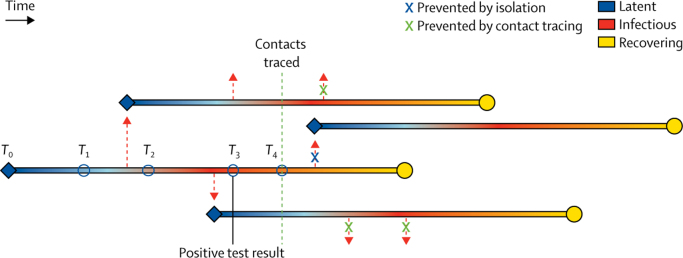
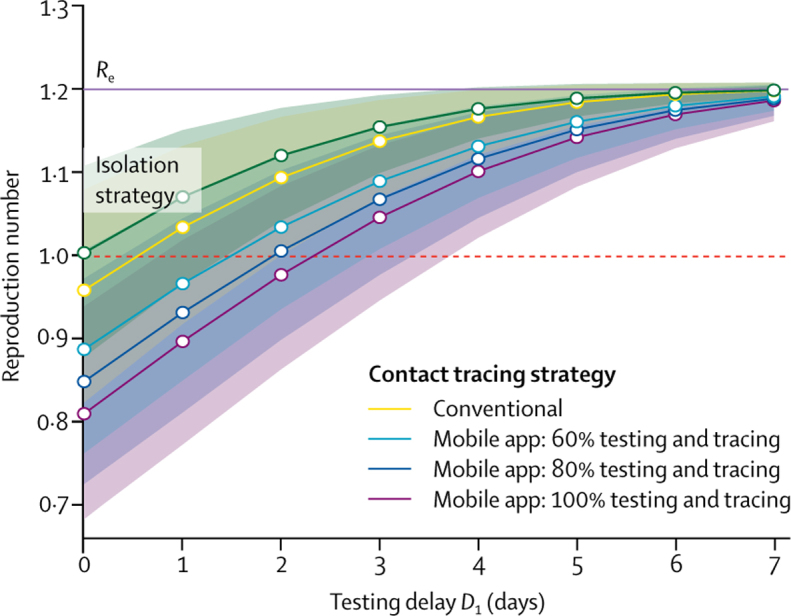
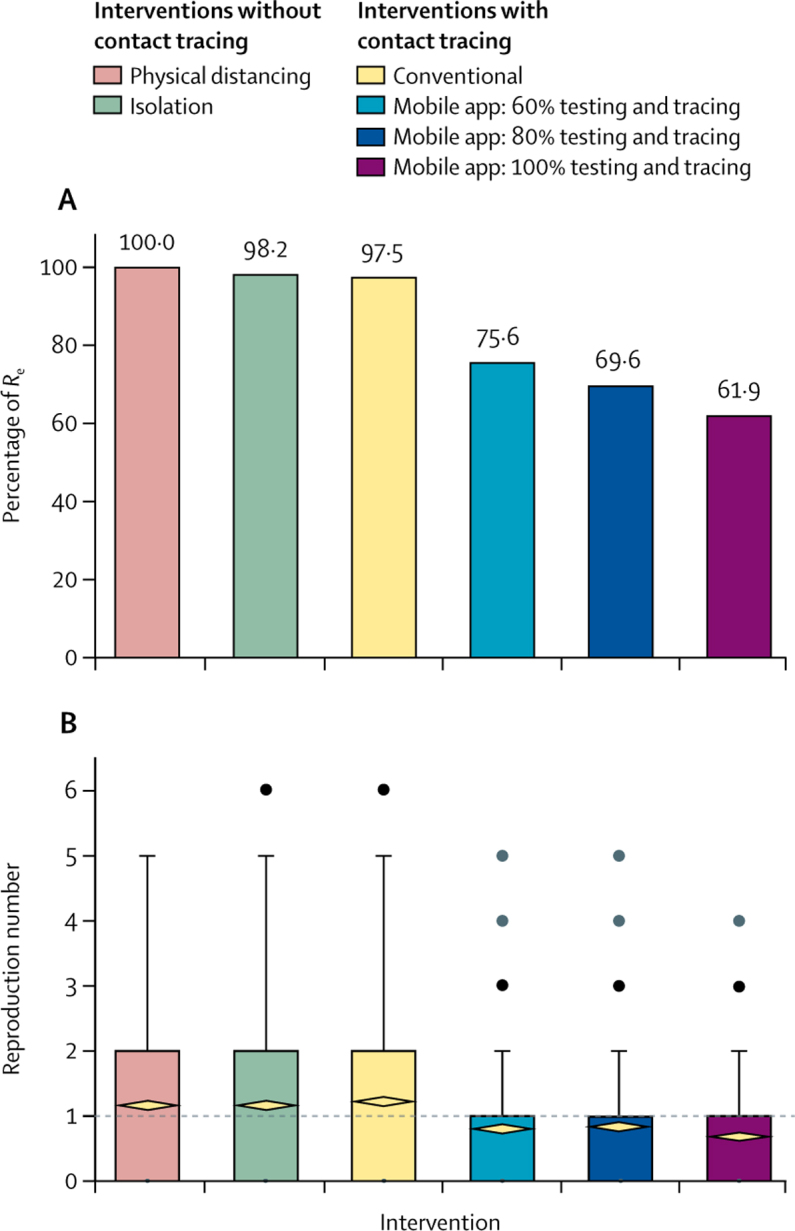
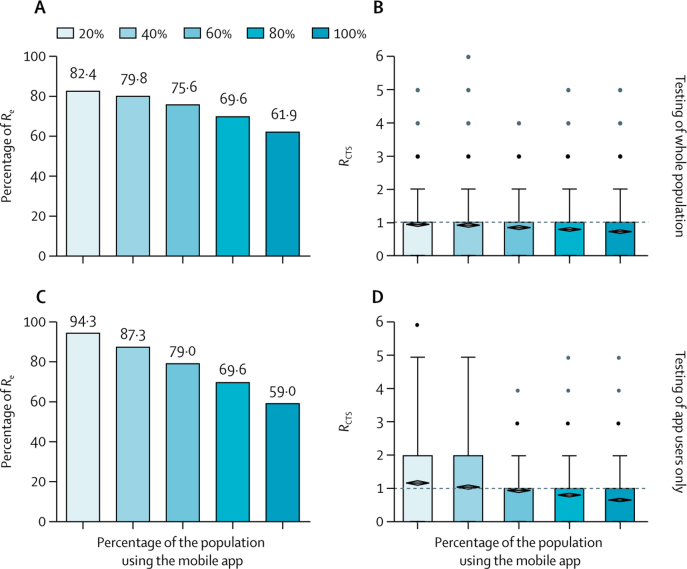
Background In countries with declining numbers of confirmed cases of COVID-19, lockdown measures are gradually being lifted. However, even if most physical distancing measures are continued, other public health measures will be needed to control the epidemic. Contact tracing via conventional methods or mobile app technology is central to control strategies during de-escalation of physical distancing. We aimed to identify key factors for a contact tracing strategy to be successful. Methods We evaluated the impact of timeliness and completeness in various steps of a contact tracing strategy using a stochastic mathematical model with explicit time delays between time of infection and symptom onset, and between symptom onset, diagnosis by testing, and isolation (testing delay). The model also includes tracing of close contacts (eg, household members) and casual contacts, followed by testing regardless of symptoms and isolation if testing positive, with different tracing delays and coverages. We computed effective reproduction numbers of a contact tracing strategy ( R CTS ) for a population with physical distancing measures and various scenarios for isolation of index cases and tracing and quarantine of their contacts. Findings For the most optimistic scenario (testing and tracing delays of 0 days and tracing coverage of 100%), and assuming that around 40% of transmissions occur before symptom onset, the model predicts that the estimated effective reproduction number of 1·2 (with physical distancing only) will be reduced to 0·8 (95% CI 0·7–0·9) by adding contact tracing. The model also shows that a similar reduction can be achieved when testing and tracing coverage is reduced to 80% ( R CTS 0·8, 95% CI 0·7–1·0). A testing delay of more than 1 day requires the tracing delay to be at most 1 day or tracing coverage to be at least 80% to keep R CTS below 1. With a testing delay of 3 days or longer, even the most efficient strategy cannot reach R CTS values below 1. The effect of minimising tracing delay (eg, with app-based technology) declines with decreasing coverage of app use, but app-based tracing alone remains more effective than conventional tracing alone even with 20% coverage, reducing the reproduction number by 17·6% compared with 2·5%. The proportion of onward transmissions per index case that can be prevented depends on testing and tracing delays, and given a 0-day tracing delay, ranges from up to 79·9% with a 0-day testing delay to 41·8% with a 3-day testing delay and 4·9% with a 7-day testing delay. Interpretation In our model, minimising testing delay had the largest impact on reducing onward transmissions. Optimising testing and tracing coverage and minimising tracing delays, for instance with app-based technology, further enhanced contact tracing effectiveness, with the potential to prevent up to 80% of all transmissions. Access to testing should therefore be optimised, and mobile app technology might reduce delays in the contact tracing process and optimise contact tracing coverage. Funding ZonMw, Fundação para a Ciência e a Tecnologia, and EU Horizon 2020 RECOVER.
Overview
The claims and statistics of this paper haven’t been checked yet.
Free: it reads the open-access text and checks the first 5 claims that cite a source we can check. Create a free account to check every claim.
Integrity signals
Registry
Cites
Statistics
Figures
Verification
Claims the paper makes
The claims and statistics of this paper haven’t been checked yet.
Free: it reads the open-access text and checks the first 5 claims that cite a source we can check. Create a free account to check every claim.
Self-check
Percentages, sums and reported differences re-computed from the paper’s own numbers.
The self-check needs the paper’s full text.
Citations
Cites
Chen, N., Zhou, M., Dong, X., Qu, J., Gong, F., Han, Y., Qiu, Y., Wang, J., Liu, Y., Wei, Y., et al. (2020) · The Lancet · doi:10.1016/s0140-6736(20)30211-7 · Cited by 21,415
Wang, D., Hu, B., Hu, C., Zhu, F., Liu, X., Zhang, J., Wang, B., Xiang, H., Cheng, Z., Xiong, Y., et al. (2020) · JAMA · doi:10.1001/jama.2020.1585 · Cited by 20,148
La certeza de lo impredecible: Cultura Educación y Sociedad en tiempos de COVID19
Martínez González, M. (2020) · DSPACE System - Metalibrary (University of the Coast) · Cited by 18,463
Martínez–González, M. B. (2020) · DSPACE System - Metalibrary (University of the Coast) · Cited by 18,294
Chan, J. F.-W., Yuan, S., Kok, K.-H., To, K. K.-W., Chu, H., Yang, J., Xing, F., Liu, J., Yip, C. C.-Y., Poon, R. W.-S., et al. (2020) · The Lancet · doi:10.1016/s0140-6736(20)30154-9 · Cited by 8,944
Temporal dynamics in viral shedding and transmissibility of COVID-19
He, X., Lau, E. H. Y., Wu, P., Deng, X., Wang, J., Hao, X., Lau, Y. C., Wong, J. Y., Guan, Y., Tan, X., et al. (2020) · Nature Medicine · doi:10.1038/s41591-020-0869-5 · Cited by 4,247
Social Contacts and Mixing Patterns Relevant to the Spread of Infectious Diseases
Mossong, J., Hens, N., Jit, M., Beutels, P., Auranen, K., Mikolajczyk, R., Massari, M., Salmaso, S., Tomba, G. S., Wallinga, J., et al. (2008) · PLoS Medicine · doi:10.1371/journal.pmed.0050074 · Cited by 2,900
Feasibility of controlling COVID-19 outbreaks by isolation of cases and contacts
Hellewell, J., Abbott, S., Gimma, A., Bosse, N. I., Jarvis, C. I., Russell, T. W., Munday, J. D., Kucharski, A. J., Edmunds, W. J., Sun, F., et al. (2020) · The Lancet Global Health · doi:10.1016/s2214-109x(20)30074-7 · Cited by 2,550
Quantifying SARS-CoV-2 transmission suggests epidemic control with digital contact tracing
Ferretti, L., Wymant, C., Kendall, M., Zhao, L., Nurtay, A., Abeler-Dörner, L., Parker, M., Bonsall, D., & Fraser, C. (2020) · Science · doi:10.1126/science.abb6936 · Cited by 2,512
Prevalence of Asymptomatic SARS-CoV-2 Infection: A Narrative Review
Oran, D. P., & Topol, E. J. (2020) · Annals of Internal Medicine · doi:10.7326/m20-3012 · Cited by 2,279
Bi, Q., Wu, Y., Mei, S., Ye, C., Zou, X., Zhang, Z., Liu, X., Wei, L., Truelove, S. A., Zhang, T., et al. (2020) · The Lancet Infectious Diseases · doi:10.1016/s1473-3099(20)30287-5 · Cited by 1,958
Backer, J. A., Klinkenberg, D., & Wallinga, J. (2020) · Eurosurveillance · doi:10.2807/1560-7917.es.2020.25.5.2000062 · Cited by 1,500
Kucirka, L. M., Lauer, S. A., Laeyendecker, O., Boon, D., & Lessler, J. (2020) · Annals of Internal Medicine · doi:10.7326/m20-1495 · Cited by 1,414
Tang, B., Wang, X., Li, Q., Bragazzi, N. L., Tang, S., Xiao, Y., & Wu, J. (2020) · Journal of Clinical Medicine · doi:10.3390/jcm9020462 · Cited by 1,368
Factors that make an infectious disease outbreak controllable
Fraser, C., Riley, S., Anderson, R. M., & Ferguson, N. M. (2004) · Proceedings of the National Academy of Sciences · doi:10.1073/pnas.0307506101 · Cited by 1,144
Demographic science aids in understanding the spread and fatality rates of COVID-19
Dowd, J. B., Andriano, L., Brazel, D. M., Rotondi, V., Block, P., Ding, X., Liu, Y., & Mills, M. C. (2020) · Proceedings of the National Academy of Sciences · doi:10.1073/pnas.2004911117 · Cited by 905
Projecting social contact matrices in 152 countries using contact surveys and demographic data
Prem, K., Cook, A. R., & Jit, M. (2017) · PLOS Computational Biology · doi:10.1371/journal.pcbi.1005697 · Cited by 889
Kamel Boulos, M. N., & Geraghty, E. M. (2020) · International Journal of Health Geographics · doi:10.1186/s12942-020-00202-8 · Cited by 749
COVID-19 epidemic in Switzerland: on the importance of testing, contact tracing and isolation
Salathé, M., Althaus, C. L., Neher, R., Stringhini, S., Hodcroft, E., Fellay, J., Zwahlen, M., Senti, G., Battegay, M., Wilder-Smith, A., et al. (2020) · Swiss Medical Weekly · doi:10.4414/smw.2020.20225 · Cited by 481
How to improve adherence with quarantine: rapid review of the evidence
Webster, R. K., Brooks, S. K., Smith, L. E., Woodland, L., Wessely, S., & Rubin, G. J. (2020) · Public Health · doi:10.1016/j.puhe.2020.03.007 · Cited by 422
Efficacy of contact tracing for the containment of the 2019 novel coronavirus (COVID-19)
Keeling, M. J., Hollingsworth, T. D., & Read, J. M. (2020) · Journal of Epidemiology and Community Health · doi:10.1136/jech-2020-214051 · Cited by 406
Estimation of the Transmission Risk of 2019-nCov and Its Implication for Public Health Interventions
Tang, B., Wang, X., Li, Q., Bragazzi, N. L., Tang, S., Xiao, Y., & Wu, J. (2020) · SSRN Electronic Journal · doi:10.2139/ssrn.3525558 · Cited by 276
The Effectiveness of Contact Tracing in Emerging Epidemics
Klinkenberg, D., Fraser, C., & Heesterbeek, H. (2006) · PLoS ONE · doi:10.1371/journal.pone.0000012 · Cited by 261
Parker, M. J., Fraser, C., Abeler-Dörner, L., & Bonsall, D. (2020) · Journal of Medical Ethics · doi:10.1136/medethics-2020-106314 · Cited by 226
Peak, C. M., Kahn, R., Grad, Y. H., Childs, L. M., Li, R., Lipsitch, M., & Buckee, C. O. (2020) · The Lancet Infectious Diseases · doi:10.1016/s1473-3099(20)30361-3 · Cited by 220
Ring Vaccination and Smallpox Control
Kretzschmar, M., van den Hof, S., Wallinga, J., & van Wijngaarden, J. (2004) · Emerging infectious diseases · doi:10.3201/eid1005.030419 · Cited by 147
Self-citationContact tracing in stochastic and deterministic epidemic models
Müller, J., Kretzschmar, M., & Dietz, K. (2000) · Mathematical Biosciences · doi:10.1016/s0025-5564(99)00061-9 · Cited by 122
Self-citationKretzschmar, M., Rozhnova, G., & van Boven, M. (2020) · Frontiers in Physics · doi:10.3389/fphy.2020.622485 · Cited by 89
Self-citationQuantifying Reporting Timeliness to Improve Outbreak Control
Marinović, A. B., Swaan, C. M., van Steenbergen, J., & Kretzschmar, M. (2015) · Emerging infectious diseases · doi:10.3201/eid2102.130504 · Cited by 77
Self-citationShow evidence that apps for COVID-19 contact-tracing are secure and effective
(2020) · Nature · doi:10.1038/d41586-020-01264-1 · Cited by 67
Summary of the COVID-19 outbreak in Vietnam – Lessons and suggestions
Nguyen, T. H. D., & Vu, D. C. (2020) · Travel Medicine and Infectious Disease · doi:10.1016/j.tmaid.2020.101651 · Cited by 64
Analysis of timeliness of infectious disease reporting in the Netherlands
Reijn, E., Swaan, C. M., Kretzschmar, M., & van Steenbergen, J. (2011) · BMC Public Health · doi:10.1186/1471-2458-11-409 · Cited by 48
Self-citationKretzschmar, M., Rozhnova, G., & van Boven, M. (2020) · medRxiv · doi:10.1101/2020.03.10.20033738 · Cited by 40
Self-citationNew Measures for the Coronavirus Disease 2019 Response: A Lesson From the Wenzhou Experience
Ruan, L., Wen, M., Zeng, Q., Chen, C., Huang, S., Yang, S., Yang, J., Wang, J., Hu, Y., Ding, S., et al. (2020) · Clinical Infectious Diseases · doi:10.1093/cid/ciaa386 · Cited by 33
COVID-19 epidemic in Switzerland: on the importance of testing, contact tracing and isolation
Salathé, M., Althaus, C. L., Neher, R. A., Stringhini, S., Hodcroft, E. B., Fellay, J., Zwahlen, M., Senti, G., Battegay, M., Wilder-Smith, A., et al. (2020) · edoc (University of Basel) · doi:10.5451/unibas-ep79826 · Cited by 31
What neurological and psychiatric effects does COVID-19 have on its survivors?
Mentis, A. A. (2021) · BMC Medicine · doi:10.1186/s12916-021-01986-7 · Cited by 25
Timeliness of contact tracing among flight passengers for influenza A/H1N1 2009
Swaan, C. M., Appels, R., Kretzschmar, M., & van Steenbergen, J. (2011) · BMC Infectious Diseases · doi:10.1186/1471-2334-11-355 · Cited by 18
Self-citationSpeed versus coverage trade off in targeted interventions during an outbreak
Marinović, A. A. B., Koopmans, M., Dittrich, S., Teunis, P. F. M., Swaan, C. M., van Steenbergen, J., & Kretzschmar, M. (2014) · Epidemics · doi:10.1016/j.epidem.2014.05.003 · Cited by 8
Self-citation
Research works printed but not linked: 1
- Ruan, 2020, New measures for COVID-19 response: a lesson from the Wenzhou experience, Clin Infect Dis
Cited by
Cevik, M., Tate, M., Lloyd, O., Maraolo, A. E., Schafers, J., & Ho, A. (2021) · The Lancet Microbe · doi:10.1016/s2666-5247(20)30172-5 · Cited by 1,350
Rapid, point-of-care antigen and molecular-based tests for diagnosis of SARS-CoV-2 infection
Dinnes, J., Deeks, J. J., Adriano, A., Berhane, S., Davenport, C., Dittrich, S., Emperador, D., Takwoingi, Y., Cunningham, J., Beese, S., et al. (2020) · Cochrane Database of Systematic Reviews · doi:10.1002/14651858.cd013705 · Cited by 1,156
Covasim: An agent-based model of COVID-19 dynamics and interventions
Kerr, C. C., Stuart, R. M., Mistry, D., Abeysuriya, R. G., Rosenfeld, K., Hart, G. R., Núñez, R. C., Cohen, J. A., Selvaraj, P., Hagedorn, B., et al. (2021) · PLOS Computational Biology · doi:10.1371/journal.pcbi.1009149 · Cited by 685
Rapid, point-of-care antigen tests for diagnosis of SARS-CoV-2 infection
Dinnes, J., Deeks, J. J., Berhane, S., Taylor, M., Adriano, A., Davenport, C., Dittrich, S., Emperador, D., Takwoingi, Y., Cunningham, J., et al. (2021) · Cochrane Database of Systematic Reviews · doi:10.1002/14651858.cd013705.pub2 · Cited by 591
Socioeconomic status determines COVID-19 incidence and related mortality in Santiago, Chile
Mena, G. E., Martinez, P. P., Mahmud, A. S., Marquet, P. A., Buckee, C. O., & Santillana, M. (2021) · Science · doi:10.1126/science.abg5298 · Cited by 431
Metadata
- Authors
- Kretzschmar, M. E., Rozhnova, G., Bootsma, M. C. J., van Boven, M., van de Wijgert, J. H. H. M., & Bonten, M. J. M.
- Affiliations
- Utrecht University (NL)
- University of Lisbon (PT)
- Corresponding author
- Kretzschmar, Mirjam E
- Venue
- The Lancet Public Health
- Publisher
- Elsevier BV
- Published
- 2020-08
- Volume
- 5
- Issue
- 8
- Pages
- e452-e459
- ISSN
- 2468-2667 (ISSN-L)
- PMC
- PMC7365652
- OpenAlex
- W3042453924
- Cited by
- 697
- References
- 37
- Citations by year
- 2026: 34 · 2025: 29 · 2024: 48 · 2023: 77 · 2022: 166 · 2021: 277 · 2020: 64
- FWCI
- 23.03
- Type
- journal article
- Language
- en
- Open access
- gold
- doi.org
- Licence
- cc-by-nc-nd
- www.elsevier.com/tdm/userlicense/1.0/ (tdm)
- www.elsevier.com/legal/tdmrep-license (tdm)
- creativecommons.org/licenses/by-nc-nd/4.0/ (vor)
- Locations
- The Lancet Public Health (publishedVersion, cc-by-nc-nd)
- medRxiv (acceptedVersion, cc-by-nc-nd)
- PubMed Central (publishedVersion, cc-by-nc-nd)
- PubMed (publishedVersion)
- DOAJ (DOAJ: Directory of Open Access Journals) (submittedVersion, cc-by-sa)
- Utrecht University Repository (Utrecht University) (submittedVersion, other-oa)
- Utrecht University Repository (Utrecht University) (submittedVersion, cc-by-nc-nd)
- Funders
- ZonMw (91216062, 10430022010001)
- Horizon 2020 (101003589, H2020-101003589)
- Fundação para a Ciência e a Tecnologia (131_596787873)
- Topics
- Physical Sciences › Mathematics › Modeling and Simulation › COVID-19 epidemiological studies
- Physical Sciences › Computer Science › Information Systems › COVID-19 Digital Contact Tracing
- Physical Sciences › Mathematics › Applied Mathematics › Mathematical and Theoretical Epidemiology and Ecology Models
- Keywords
- COVID-19 pandemic, contact tracing, effective reproduction number, social distancing, quarantine, isolation, pre-symptomatic transmission, stochastic epidemic model, epidemic control measures, household contacts, casual contact, SARS-CoV-2 transmission prevention
- MeSH terms
- COVID-19, COVID-19 Testing, Humans, Models, Theoretical, Pneumonia, Viral, Quarantine, Time Factors, Public Health Practice, Contact Tracing, Coronavirus Infections, Clinical Laboratory Techniques, Pandemics, Mobile Applications
About these checks
Registry, retraction, Cites and statistics results are computed, not judged, with one exception: a printed reference that no index lists is read once by a model before it counts as a citation error. Claims are extracted by a model and kept only when their quote appears verbatim in the text; each cited source is then checked, with a model’s help, for whether it says what the claim relies on. Those verdicts can be wrong — read the claim’s quote and the cited source before relying on one.
Statistics and arithmetic are recomputed, not judged.
Confidence bands are shown only for fields calibrated on our annotated test set. None is calibrated yet, so no band is shown.
What counts as a claim ›How we measure confidence ›How we check this ›
Are you an author, or do you see a problem with this page? Request a review
Data sources
Bibliographic data: Semantic Scholar, OpenAlex, Crossref.
Contains information from the Semantic Scholar Academic Graph Datasets, made available under the ODC Attribution License (ODC-BY 1.0).
Semantic Scholar’s data is described in: Kinney, R., et al. (2023). The Semantic Scholar Open Data Platform. arXiv:2301.10140.
