

Sociodemographic characteristics of women who died by suicide in India from 2014 to 2020: findings from surveillance data
Open accessThe DOI matches its Crossref record; 38 of the 39 references it cites were found in a registry or an index.
Abstract
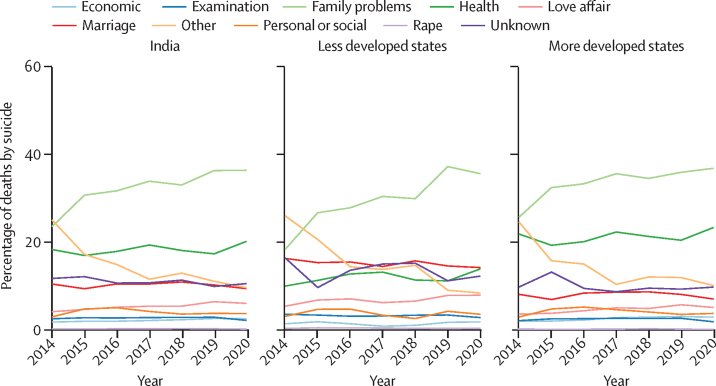
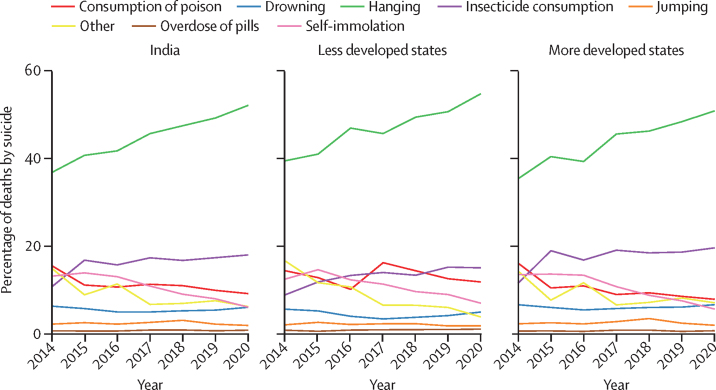
BACKGROUND: Women in India have twice the suicide death rate (SDR) compared with the global average for women. The aim of this study is to present a systematic understanding of sociodemographic risk factors, reasons for suicide deaths, and methods of suicide among women in India at the state level over time. METHODS: Administrative data on suicide deaths among women by education level, marital status, and occupation, and reason for and method of suicide were extracted from the National Crimes Record Bureau reports for years 2014 to 2020. We extrapolated SDR at the population level for Indian women by education, marital status, and occupation to understand the sociodemography of these suicide deaths for India and its states. We reported the reasons for and methods of suicide deaths among Indian women at the state level over this period. FINDINGS: SDR was higher among women with education of class 6 or more (10·2; 95% CI 10·1-10·4) than those with no education (3·8; 3·7-3·9) or education until class 5 (5·4; 5·2-5·5) in India in 2020, with similar patterns in most states. SDR declined between 2014 and 2020 for women with education until class 5. Women currently married accounted for 28 085 (63·1%) of 44 498 suicide deaths in India, 8336 (56·2%) of 14 840 in less developed states, and 19 661 (66·9%) of 29 407 in more developed states in 2020. For India, women currently married had a significantly higher SDR (8·1; 8·0-8·2) than those never married in 2014. However, women who never married had a significantly higher SDR (8·4; 8·2-8·5) in 2020 than those who were currently married. Many individual states in 2020 had similar SDR for women who never married and those who are currently married. Housewife as an occupation accounted for 50% or more of suicide deaths from 2014 to 2020 in India and its states. Family problems was the most common reason for suicide from 2014 to 2020, accounting for 16 140 (36·3%) of 44 498 suicide deaths in India, 5268 (35·5%) of 14 840 in less developed states, and 10 803 (36·7%) of 29 407 in more developed states in 2020. Hanging was the leading mean of suicide from 2014 to 2020. Insecticide or poison consumption was the second leading cause of suicide, accounting for 2228 (15·0%) of all 14 840 suicide deaths in less developed states and 5753 (19·6%) of 29 407 in more developed states, with a near 70·0% increase in the use of this method from 2014 to 2020. INTERPRETATION: The higher SDR among women who have received an education, similar SDR between women currently married and never married, and variations in the reasons for and means of suicide at the state level highlight the need to incorporate sociological insights into how the external social environment can matter for women to better understand the complexity of suicide and determine how to effectively intervene. FUNDING: Bill & Melinda Gates Foundation.
Overview
The claims and statistics of this paper haven’t been checked yet.
Free: it reads the open-access text and checks the first 5 claims that cite a source we can check. Create a free account to check every claim.
Integrity signals
Registry
Cites
Statistics
Figures
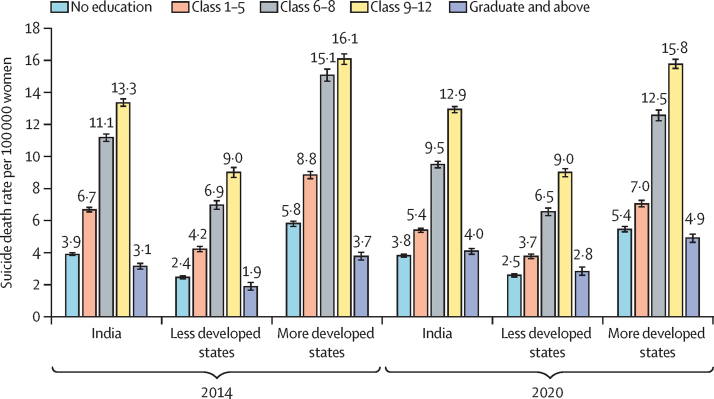
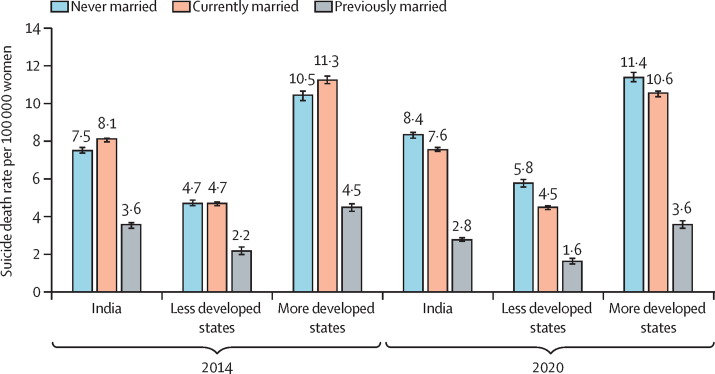
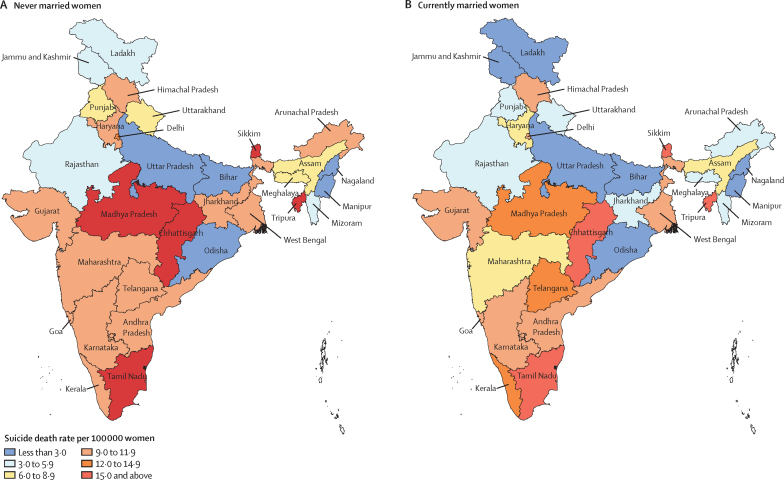
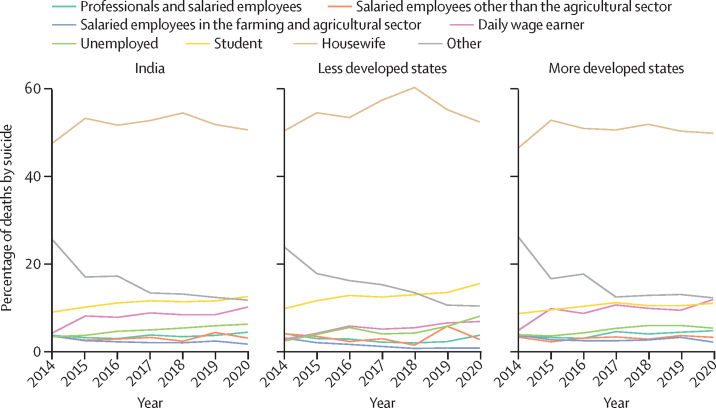
Verification
Claims the paper makes
The claims and statistics of this paper haven’t been checked yet.
Free: it reads the open-access text and checks the first 5 claims that cite a source we can check. Create a free account to check every claim.
Claims other papers make about this one
Each is checked against this paper’s own text: does it say what the citing paper says it does?
In the citing paper
“In 2020, in India, the highest suicide death rates were among educated women, with family problems being the most commonly cited contributing factor.43”
From Global, regional, and national burden of suicide, 1990–2021: a systematic analysis for the Global Burden of Disease Study 2021 (2025) · cites this paper as [43]
Self-check
Percentages, sums and reported differences re-computed from the paper’s own numbers.
The self-check needs the paper’s full text.
Citations
Cites
Interval estimation for the difference between independent proportions: comparison of eleven methods
Newcombe, R. G. (1998) · Statistics in Medicine · doi:10.1002/(sici)1097-0258(19980430)17:8<873::aid-sim779>3.0.co;2-i · Cited by 1,851
Devries, K. M., Mak, J. Y., Bacchus, L. J., Child, J. C., Falder, G., Petzold, M., Astbury, J., & Watts, C. H. (2013) · PLoS Medicine · doi:10.1371/journal.pmed.1001439 · Cited by 1,258
Suicide mortality in India: a nationally representative survey
Patel, V., Ramasundarahettige, C., Vijayakumar, L., Thakur, J., Gajalakshmi, V., Gururaj, G., Suraweera, W., & Jha, P. (2012) · The Lancet · doi:10.1016/s0140-6736(12)60606-0 · Cited by 936
Sagar, R., Dandona, R., Gururaj, G., Dhaliwal, R. S., Singh, A., Ferrari, A., Dua, T., Ganguli, A., Varghese, M., Chakma, J. K., et al. (2020) · The Lancet Psychiatry · doi:10.1016/s2215-0366(19)30475-4 · Cited by 886
Self-citationHeise, L. L., & Kotsadam, A. (2015) · The Lancet Global Health · doi:10.1016/s2214-109x(15)00013-3 · Cited by 605
The global burden of fatal self-poisoning with pesticides 2006-15: Systematic review
Mew, E. J., Padmanathan, P., Konradsen, F., Eddleston, M., Chang, S.-S., Phillips, M. R., & Gunnell, D. (2017) · Journal of Affective Disorders · doi:10.1016/j.jad.2017.05.002 · Cited by 530
Confidence Intervals for a binomial proportion and asymptotic expansions
Brown, L. D., Cai, T. T., & DasGupta, A. (2002) · The Annals of Statistics · doi:10.1214/aos/1015362189 · Cited by 318
Parental education and inequalities in child mortality: a global systematic review and meta-analysis
Balaj, M., York, H. W., Sripada, K., Besnier, E., Vonen, H. D., Aravkin, A., Friedman, J., Griswold, M., Jensen, M. R., Mohammad, T., et al. (2021) · The Lancet · doi:10.1016/s0140-6736(21)00534-1 · Cited by 274
Dandona, R., Kumar, G. A., Dhaliwal, R. S., Naghavi, M., Vos, T., Shukla, D. K., Vijayakumar, L., Gururaj, G., Thakur, J. S., Ambekar, A., et al. (2018) · The Lancet Public Health · doi:10.1016/s2468-2667(18)30138-5 · Cited by 247
Self-citationGunnell, D., Knipe, D., Chang, S.-S., Pearson, M., Konradsen, F., Lee, W. J., & Eddleston, M. (2017) · The Lancet Global Health · doi:10.1016/s2214-109x(17)30299-1 · Cited by 246
Mueller, A. S., Abrutyn, S., Pescosolido, B., & Diefendorf, S. (2021) · Frontiers in Psychology · doi:10.3389/fpsyg.2021.621569 · Cited by 216
Does economic empowerment protect women from intimate partner violence?
Dalal, K. (2011) · Journal of Injury and Violence Research · doi:10.5249/jivr.v3i1.76 · Cited by 192
Evidence for causal links between education and maternal and child health: systematic review
Mensch, B. S., Chuang, E. K., Melnikas, A. J., & Psaki, S. R. (2019) · Tropical Medicine & International Health · doi:10.1111/tmi.13218 · Cited by 190
Suicide and mental disorders: A discourse of politics, power, and vested interests
Hjelmeland, H., & Knizek, B. L. (2017) · Death Studies · doi:10.1080/07481187.2017.1332905 · Cited by 170
(2016) · Cited by 156
Kazan, D., Calear, A. L., & Batterham, P. J. (2016) · Journal of Affective Disorders · doi:10.1016/j.jad.2015.11.003 · Cited by 142
Stöckl, H., Hassan, A., Ranganathan, M., & Hatcher, A. M. (2021) · BMC Women s Health · doi:10.1186/s12905-021-01363-9 · Cited by 126
The national suicide prevention strategy in India: context and considerations for urgent action
Vijayakumar, L., Chandra, P. S., Kumar, M. S., Pathare, S., Banerjee, D., Goswami, T., & Dandona, R. (2021) · The Lancet Psychiatry · doi:10.1016/s2215-0366(21)00152-8 · Cited by 116
Self-citationAdvancing Prevention Research on the Role of Culture in Suicide Prevention
Joe, S., Canetto, S. S., & Romer, D. (2008) · Suicide and Life-Threatening Behavior · doi:10.1521/suli.2008.38.3.354 · Cited by 113
Maselko, J., & Patel, V (2008) · Journal of Epidemiology and Community Health · doi:10.1136/jech.2007.069351 · Cited by 100
Amudhan, S., Gururaj, G., Varghese, M., Benegal, V., Rao, G. N., Sheehan, D. V., Kokane, A. M., Chavan, B. S., Dalal, P. K., Ram, D., et al. (2020) · The Lancet Psychiatry · doi:10.1016/s2215-0366(19)30404-3 · Cited by 98
Role of Education in the Empowement of Women in India.
Bhat, R. A. (2015) · Cited by 83
Lessons from a decade of suicide surveillance in India: who, why and how?
Dandona, R., Bertozzi-Villa, A., Kumar, G. A., & Dandona, L. (2016) · International Journal of Epidemiology · doi:10.1093/ije/dyw113 · Cited by 80
Self-citationAlves, F. J. O., Machado, D. B., & Barreto, M. L. (2018) · Social Psychiatry and Psychiatric Epidemiology · doi:10.1007/s00127-018-1627-6 · Cited by 74
Aggarwal, S. (2015) · British Medical Bulletin · doi:10.1093/bmb/ldv018 · Cited by 71
Domestic violence in Indian women: lessons from nearly 20 years of surveillance
Dandona, R., Gupta, A., George, S., Kishan, S., & Kumar, G. A. (2022) · BMC Women s Health · doi:10.1186/s12905-022-01703-3 · Cited by 62
Self-citationA Critical Look at Current Suicide Research
Hjelmeland, H. (2015) · University of British Columbia Press eBooks · doi:10.59962/9780774830317-003 · Cited by 59
Karlsson, O., Neve, J. D., & Subramanian, S. V. (2018) · International Journal of Epidemiology · doi:10.1093/ije/dyy158 · Cited by 55
Social determinants of health in India: progress and inequities across states
Cowling, K., Dandona, R., & Dandona, L. (2014) · International Journal for Equity in Health · doi:10.1186/s12939-014-0088-0 · Cited by 51
Self-citationArya, V., Page, A., Armstrong, G., Kumar, G. A., & Dandona, R. (2020) · Journal of Epidemiology & Community Health · doi:10.1136/jech-2020-215260 · Cited by 50
Self-citationWhy is suicide the leading killer of older adolescent girls?
Petroni, S., Patel, V., & Patton, G. C. (2015) · The Lancet · doi:10.1016/s0140-6736(15)01019-3 · Cited by 47
Arya, V., Page, A., Gunnell, D., Dandona, R., Mannan, H. R., Eddleston, M., & Armstrong, G. (2019) · Journal of Affective Disorders · doi:10.1016/j.jad.2019.07.005 · Cited by 46
Self-citationCai, Z., Canetto, S. S., Chang, Q., & Yip, P. S. F. (2021) · Social Science & Medicine · doi:10.1016/j.socscimed.2021.114035 · Cited by 44
Cross-Cultural Research Widens Suicide Prevention Horizons
Leo, D. D. (2009) · Crisis · doi:10.1027/0227-5910.30.2.59 · Cited by 20
The quality of police data on RTC fatalities in India
Raban, M. Z., Dandona, L., & Dandona, R. (2014) · Injury Prevention · doi:10.1136/injuryprev-2013-041011 · Cited by 20
Self-citationDandona, R., Gupta, A., George, S., Kishan, S., & Kumar, G. A. (2022) · BMC Public Health · doi:10.1186/s12889-022-13182-0 · Cited by 19
Self-citationUsing Observational Data to Calibrate Simulation Models
Murray, E. J., Robins, J. M., Seage, G. R., Lodi, S., Hyle, E. P., Reddy, K. P., Freedberg, K. A., & Hernán, M. Á. (2017) · Medical Decision Making · doi:10.1177/0272989x17738753 · Cited by 16
Fertility, economic development, and suicides among women in India
Singh, P., Das, A., William, J., & Bruckner, T. A. (2021) · Social Psychiatry and Psychiatric Epidemiology · doi:10.1007/s00127-021-02054-4 · Cited by 6
Cited by
Davis Weaver, N., Bertolacci, G. J., Rosenblad, E., Ghoba, S., Cunningham, M., Ikuta, K. S., Moberg, M. E., Mougin, V., Han, C., Wool, E. E., et al. (2025) · The Lancet Public Health · doi:10.1016/s2468-2667(25)00006-4 · Cited by 181
Self-citationSinyor, M., Silverman, M. M., Pirkis, J., & Hawton, K. E. (2024) · The Lancet Public Health · doi:10.1016/s2468-2667(24)00152-x · Cited by 89
Restriction of access to means used for suicide
Hawton, K. E., Knipe, D. W., & Pirkis, J. (2024) · The Lancet Public Health · doi:10.1016/s2468-2667(24)00157-9 · Cited by 69
Kim, S., Park, J., Lee, H., Lee, H., Woo, S., Kwon, R., Kim, S., Koyanagi, A., Smith, L., Rahmati, M., et al. (2024) · World Journal of Pediatrics · doi:10.1007/s12519-024-00828-9 · Cited by 57
Changing pattern of suicide deaths in India
Yadav, S., Aathavan, K. K., Cunningham, S. A., Bhandari, P., Mishra, U. S., Aditi, A., & Yadav, R. (2023) · The Lancet Regional Health - Southeast Asia · doi:10.1016/j.lansea.2023.100265 · Cited by 35
Metadata
- Authors
- Dandona, R., George, S., & Kumar, G. A.
- Affiliations
- University of Washington (US)
- Public Health Foundation of India (IN)
- Corresponding author
- Dandona, Rakhi
- Venue
- The Lancet Public Health
- Publisher
- Elsevier BV
- Published
- 2023-05
- Volume
- 8
- Issue
- 5
- Pages
- e347-e355
- ISSN
- 2468-2667 (ISSN-L)
- PMC
- PMC10165469
- OpenAlex
- W4367186022
- Cited by
- 22
- References
- 39
- Citations by year
- 2026: 9 · 2025: 3 · 2024: 7 · 2023: 3
- FWCI
- 6.39
- Type
- journal article
- Language
- en
- Open access
- gold
- doi.org
- Licence
- cc-by
- www.elsevier.com/tdm/userlicense/1.0/ (tdm)
- www.elsevier.com/legal/tdmrep-license (tdm)
- creativecommons.org/licenses/by/4.0/ (vor)
- Locations
- The Lancet Public Health (publishedVersion, cc-by)
- PubMed (publishedVersion)
- PubMed Central (publishedVersion, cc-by)
- Greater South Information System
- Funders
- Bill and Melinda Gates Foundation
- Topics
- Social Sciences › Psychology › Clinical Psychology › Suicide and Self-Harm Studies
- Social Sciences › Sociology and Political Science › Homicide, Infanticide, and Child Abuse
- Health Sciences › Medicine › Psychiatry and Mental health › Mental Health Treatment and Access
- Keywords
- female suicide, suicide mortality, sociodemographic risk factors, educational attainment, marital status, never-married women, housewives, suicide methods, suicide motives, family problems, economic hardship, state-level variation, India, suicide prevention policy
- MeSH terms
- Educational Status, Female, Humans, India, Suicide
About these checks
Registry, retraction, Cites and statistics results are computed, not judged, with one exception: a printed reference that no index lists is read once by a model before it counts as a citation error. Claims are extracted by a model and kept only when their quote appears verbatim in the text; each cited source is then checked, with a model’s help, for whether it says what the claim relies on. Those verdicts can be wrong — read the claim’s quote and the cited source before relying on one.
Statistics and arithmetic are recomputed, not judged.
Confidence bands are shown only for fields calibrated on our annotated test set. None is calibrated yet, so no band is shown.
What counts as a claim ›How we measure confidence ›How we check this ›
Are you an author, or do you see a problem with this page? Request a review
Data sources
Bibliographic data: Semantic Scholar, OpenAlex, Crossref.
Contains information from the Semantic Scholar Academic Graph Datasets, made available under the ODC Attribution License (ODC-BY 1.0).
Semantic Scholar’s data is described in: Kinney, R., et al. (2023). The Semantic Scholar Open Data Platform. arXiv:2301.10140.
