

Effect of evacuation and displacement on the association between flooding and mental health outcomes: a cross-sectional analysis of UK survey data
Open accessThe DOI matches its Crossref record; 26 of the 27 references it cites were found in a registry or an index.
Abstract
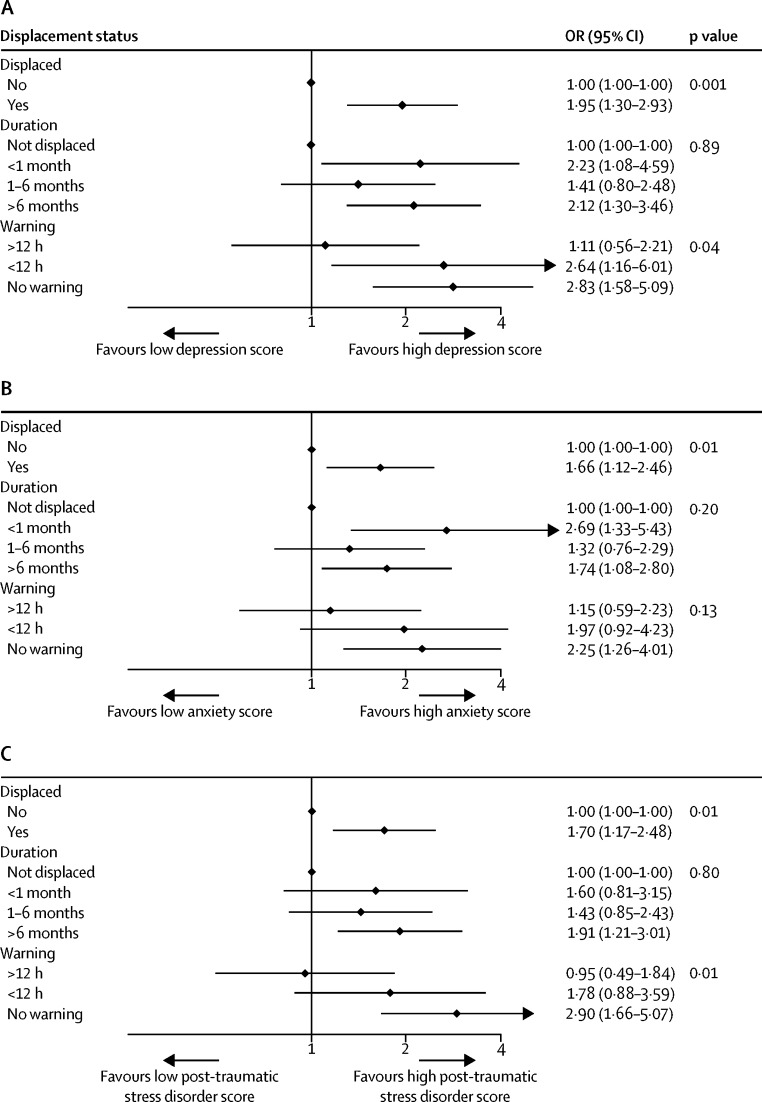
BACKGROUND: Extensive flooding occurred during the winter of 2013-14 in England. Previous studies have shown that flooding affects mental health. Using data from the 2013-14 Public Health England National Study of Flooding and Health, we compared the prevalence of symptoms of depression, anxiety, and post-traumatic stress disorder between participants displaced by flooding and those flooded, but not displaced, 1 year after flooding. METHODS: In this multivariable ordinal regression analysis, we collected data from a cross-sectional survey collected 1 year after the flooding event from flood-affected postcodes in five counties in England. The analysis was restricted to individuals whose homes were flooded (n=622) to analyse displacement due to flooding. The primary outcome measures were depression (measured by the PHQ-2 depression scale) and anxiety (measured by the two-item Generalised Anxiety Disorder [GAD]-2 anxiety scale), and post-traumatic stress disorder (measured by the Post-Traumatic Stress Disorder Checklist [PCL]-6 scale). We adjusted analyses for recorded potential confounders. We also analysed duration of displacement and amount of warning received. FINDINGS: People who were displaced from their homes were significantly more likely to have higher scores on each scale; odds ratio (OR) for depression 1·95 (95% CI 1·30-2·93), for anxiety 1·66 (1·12-2·46), and for post-traumatic stress disorder 1·70 (1·17-2·48) than people who were not displaced. The increased risk of depression was significant even after adjustment for severity of flooding. Scores for depression and post-traumatic stress disorder were higher in people who were displaced and reported receiving no warning than those who had received a warning more than 12 h in advance of flooding (p=0·04 for depression, p=0·01 for post-traumatic stress disorder), although the difference in anxiety scores was not significant. INTERPRETATION: Displacement after flooding was associated with higher reported symptoms of depression, anxiety, and post-traumatic stress disorder 1 year after flooding. The amount of warning received showed evidence of being protective against symptoms of the three mental illnesses studied, and the severity of flooding might be the reason for some, but not all, of the differences between the groups. FUNDING: National Institute for Health Research Health Protection Research Units (HPRU) in Emergency Preparedness and Response at King's College London, Environmental Change and Health at the London School of Hygiene and Tropical Medicine, and Evaluation of Interventions at the University of Bristol, Public Health England.
Overview
The claims and statistics of this paper haven’t been checked yet.
Free: it reads the open-access text and checks the first 5 claims that cite a source we can check. Create a free account to check every claim.
Integrity signals
Registry
Cites
Statistics
Figures
Verification
Claims the paper makes
The claims and statistics of this paper haven’t been checked yet.
Free: it reads the open-access text and checks the first 5 claims that cite a source we can check. Create a free account to check every claim.
Claims other papers make about this one
Each is checked against this paper’s own text: does it say what the citing paper says it does?
The source backs part of the claim, not all of it — or backs it for a different population, condition or comparison.
In the citing paper
“In addition, these often rely on binary diagnostic measures for mental health indicators, which may not capture subtle variations in symptom severity [10].”
From Understanding the impact of natural disasters on post-traumatic stress disorder and depression symptoms: An examination of counterfactual displacement scenarios (2026) · cites this paper as [10]
Experimental — accuracy not yet measuredThe source backs part of the claim, not all of it — or backs it for a different population, condition or comparison.
In the citing paper
“Even among studies that have considered more representative samples, most studies have not used methods that estimate the causal effect of displacement on such mental health indicators [10,14].”
From Understanding the impact of natural disasters on post-traumatic stress disorder and depression symptoms: An examination of counterfactual displacement scenarios (2026) · cites this paper as [10]
Experimental — accuracy not yet measured
Self-check
Percentages, sums and reported differences re-computed from the paper’s own numbers.
The self-check needs the paper’s full text.
Citations
Cites
The Patient Health Questionnaire-2: Validity of a Two-Item Depression Screener
Kroenke, K., Spitzer, R. L., & Williams, J. B. W. (2003) · Medical Care · doi:10.1097/01.mlr.0000093487.78664.3c · Cited by 6,359
An Ultra-Brief Screening Scale for Anxiety and Depression: The PHQ–4
Kroenke, K., Spitzer, R. L., Williams, J. B. W., & Löwe, B. (2009) · Psychosomatics · doi:10.1016/s0033-3182(09)70864-3 · Cited by 4,261
Floods and human health: A systematic review
Alderman, K., Turner, L. R., & Tong, S. (2012) · Environment International · doi:10.1016/j.envint.2012.06.003 · Cited by 766
An abbreviated PTSD checklist for use as a screening instrument in primary care
Lang, A. J., & Stein, M. B. (2005) · Behaviour Research and Therapy · doi:10.1016/j.brat.2004.04.005 · Cited by 584
Flooding and Mental Health: A Systematic Mapping Review
Fernandez, A., Black, J., Jones, M., Wilson, L., Salvador-Carulla, L., Astell-Burt, T., & Black, D. (2015) · PLOS ONE · doi:10.1371/journal.pone.0119929 · Cited by 382
Du, W., FitzGerald, G. J., Clark, M., & Hou, X.-Y. (2010) · Prehospital and Disaster Medicine · doi:10.1017/s1049023x00008141 · Cited by 340
Reacher, M. H., McKenzie, K. J., Lane, C., Nichols, T., Kedge, I., Iversen, A., Hepple, P., Walter, T., Laxton, C. E., & Simpson, J. (2004) · PubMed · doi:10.17863/cam.70739 · Cited by 244
Postdisaster PTSD over four waves of a panel study of Mexico's 1999 flood
Norris, F. H., Murphy, A. D., Baker, C. K., & Perilla, J. L. (2004) · Journal of Traumatic Stress · doi:10.1023/b:jots.0000038476.87634.9b · Cited by 232
Extreme Weather Events and Public Health Responses
(2005) · Springer eBooks · doi:10.1007/3-540-28862-7 · Cited by 219
The psychological impact of exposure to floods
Mason, V., Andrews, H., & Upton, D. (2010) · Psychology, Health & Medicine · doi:10.1080/13548500903483478 · Cited by 218
Research works printed but not linked: 2
- Foresight, Government Office for Science Future flooding: mid-term review. Foresight project: flood and coastal defence 2011 Government Office for Science London
- Pitt M. The Pitt Review: learning lessons from the 2007 floods. London: UK, 2008.
Cited by
Extreme Weather and Climate Change: Population Health and Health System Implications
Ebi, K. L., Vanos, J., Baldwin, J. W., Bell, J. E., Hondula, D. M., Errett, N. A., Hayes, K., Reid, C. E., Saha, S., Spector, J., et al. (2021) · Annual Review of Public Health · doi:10.1146/annurev-publhealth-012420-105026 · Cited by 1,213
Lawrance, E. L., Thompson, R., Newberry Le Vay, J., Page, L., & Jennings, N. (2022) · International Review of Psychiatry · doi:10.1080/09540261.2022.2128725 · Cited by 500
“On the basis of this reading and expert consultation, the following climate change and mental health-related terms were included to identify relevant literature on this topic: temperature, heat, heatwave, warming, season, hot, flooding, floods, hurricane, drought, forest fire, thunderstorm, cyclone, tornado, bushfire,…”
BackgroundInfluentialThe case for systems thinking about climate change and mental health
Berry, H. L., Waite, T. D., Dear, K. B. G., Capon, A. G., & Murray, V. (2018) · Nature Climate Change · doi:10.1038/s41558-018-0102-4 · Cited by 485
Self-citationRethinking flood risk communication
Rollason, E., Bracken, L. J., Hardy, R. J., & Large, A. R. G. (2018) · Natural Hazards · doi:10.1007/s11069-018-3273-4 · Cited by 164
“For example, Munro et al. (2017) demonstrate that receiving timely warning prior to a flood was the only factor likely to limit the impact of flooding on mental health.”
BackgroundChen, S., Bagrodia, R., Pfeffer, C. C., Meli, L., & Bonanno, G. A. (2020) · Journal of Anxiety Disorders · doi:10.1016/j.janxdis.2020.102297 · Cited by 161
Transmission of climate risks across sectors and borders
Challinor, A. J., Adger, W. N., Benton, T. G., Conway, D., Joshi, M., & Frame, D. (2018) · Philosophical Transactions of the Royal Society A: Mathematical, Physical and Engineering Sciences · doi:10.1098/rsta.2017.0301 · Cited by 158
The effects of climate change on mental health
Walinski, A., Sander, J., Gerlinger, G., Clemens, V., Meyer-Lindenberg, A., & Heinz, A. (2023) · Deutsches Ärzteblatt international · doi:10.3238/arztebl.m2022.0403 · Cited by 154
Cruz, J., White, P. C. L., Bell, A., & Coventry, P. A. (2020) · International Journal of Environmental Research and Public Health · doi:10.3390/ijerph17228581 · Cited by 147
“[27] study and 269 or 444 responses for the Mason et al.”
BackgroundInfluentialCreating effective flood warnings: A framework from a critical review
Kuller, M., Schoenholzer, K., & Lienert, J. (2021) · Journal of Hydrology · doi:10.1016/j.jhydrol.2021.126708 · Cited by 165
Impact of Natural Disasters on Mental Health: Evidence and Implications
Heanoy, E. Z., & Brown, N. R. (2024) · Healthcare · doi:10.3390/healthcare12181812 · Cited by 124
“These factors included property loss, injury, loss of loved ones, economic loss, displacement, lower social support, and pre-existing mental health conditions [23,53,101,129].”
BackgroundMental Health Disorders Due to Disaster Exposure: A Systematic Review and Meta-Analysis
Keya, T. A., Leela, A., Habib, N., Rashid, M., & Bakthavatchalam, P. (2023) · Cureus · doi:10.7759/cureus.37031 · Cited by 111
“The point effect estimates from nine studies [19,21,22,24-26,28,32,41] of flood affected people, nine studies [23,27,29-31,33-36] of storm/cyclone , and four studies [37-40] of earthquake were 0.”
Background(IPCC), I. P. O. C. C. (2023) · Cambridge University Press eBooks · doi:10.1017/9781009325844.015 · Cited by 185
Enhancing Disaster Resilience by Reducing Stress-Associated Health Impacts
Sandifer, P. A., & Walker, A. H. (2018) · Frontiers in Public Health · doi:10.3389/fpubh.2018.00373 · Cited by 104
Kurata, Y. B., Prasetyo, Y. T., Ong, A. K. S., Nadlifatin, R., & Chuenyindee, T. (2021) · International Journal of Disaster Risk Reduction · doi:10.1016/j.ijdrr.2021.102670 · Cited by 107
French, C. E., Waite, T. D., Armstrong, B., Rubin, G. J., English National Study of Flooding and Health Study Group, Beck, C. R., & Oliver, I. (2019) · BMJ Open · doi:10.1136/bmjopen-2019-031562 · Cited by 82
Self-citationFlood- and Weather-Damaged Homes and Mental Health: An Analysis Using England’s Mental Health Survey
Graham, H., White, P., Cotton, J., & McManus, S. (2019) · International Journal of Environmental Research and Public Health · doi:10.3390/ijerph16183256 · Cited by 79
“Studies of the mental health of individuals exposed to flooding often rely on area-level measures, for example, patient lists from GP practices and local authority lists of residential addresses in flood-affected areas [54,60].”
BackgroundPrevalence of Post-traumatic Stress Disorder After Flood: A Systematic Review and Meta-Analysis
Golitaleb, M., Mazaheri, E., Bonyadi, M., & Sahebi, A. (2022) · Frontiers in Psychiatry · doi:10.3389/fpsyt.2022.890671 · Cited by 118
Matthews, V., Longman, J., Berry, H. L., Passey, M., Bennett-Levy, J., Morgan, G. G., Pit, S., Rolfe, M., & Bailie, R. S. (2019) · Frontiers in Public Health · doi:10.3389/fpubh.2019.00367 · Cited by 75
“These people have extensive immediate and medium-term social and health needs and are at elevated risk of long-term psychological morbidity (32).”
BackgroundInfluentialJermacane, D., Waite, T. D., Beck, C. R., Bone, A., Amlôt, R., Reacher, M., Kovats, S., Armstrong, B., Leonardi, G., James Rubin, G., et al. (2018) · BMC Public Health · doi:10.1186/s12889-018-5236-9 · Cited by 74
Self-citationMulchandani, R., Armstrong, B., Beck, C. R., Waite, T. D., Amlôt, R., Kovats, S., Leonardi, G., Rubin, G. J., & Oliver, I. (2020) · BMC Public Health · doi:10.1186/s12889-020-8424-3 · Cited by 73
Self-citationTselios, V., & Tompkins, E. L. (2018) · International Journal of Disaster Risk Reduction · doi:10.1016/j.ijdrr.2018.10.003 · Cited by 82
“After major disasters depression and post-traumatic stress disorder are common, affecting people’s ability to get on with their lives and return to work (Munro et al. 2017).”
BackgroundParrish, R., Colbourn, T., Lauriola, P., Leonardi, G., Hajat, S., & Zeka, A. (2020) · International Journal of Environmental Research and Public Health · doi:10.3390/ijerph17176036 · Cited by 62
“For example, an older population may result in a reduced willingness to move and increased mental health burden of doing so [68].”
BackgroundSelf-citationWildfire evacuation experiences of band members of Whitefish Lake First Nation 459, Alberta, Canada
459, W. L. F. N., Christianson, A. C., & McGee, T. K. (2019) · Natural Hazards · doi:10.1007/s11069-018-3556-9 · Cited by 76
Williams, R., Ntontis, E., Alfadhli, K., Drury, J., & Amlôt, R. (2021) · International Journal of Disaster Risk Reduction · doi:10.1016/j.ijdrr.2021.102436 · Cited by 69
Self-citationEbi, K. L., Balbus, J. M., Luber, G., Bole, A., Crimmins, A. R., Glass, G. E., Saha, S., Shimamoto, M. M., Trtanj, J. M., & White-Newsome, J. L. (2018) · doi:10.7930/nca4.2018.ch14 · Cited by 104
Rothschild, J., & Haase, E. (2022) · International Journal of Gynecology & Obstetrics · doi:10.1002/ijgo.14514 · Cited by 75
Climate Change, Floods, and Human Health
Wu, Y. Y., Wen, B., Gašević, D., Patz, J. A., Haines, A., Ebi, K. L., Murray, V. S. G., Li, S., & Guo, Y. (2024) · New England Journal of Medicine · doi:10.1056/nejmsr2402457 · Cited by 63
Bouchard, J., Pretorius, T. B., Kramers-Olen, A. L., Padmanabhanunni, A., & Stiegler, N. (2022) · Annales Médico-psychologiques revue psychiatrique · doi:10.1016/j.amp.2022.07.004 · Cited by 55
Budhathoki, N. K., & Zander, K. K. (2019) · International Journal of Environmental Research and Public Health · doi:10.3390/ijerph16091578 · Cited by 47
Systematic Review of Displacement and Health Impact From Natural Disasters in Southeast Asia
Jang, S., Ekyalongo, Y. Y., & Kim, H. (2020) · Disaster Medicine and Public Health Preparedness · doi:10.1017/dmp.2019.125 · Cited by 49
Bailie, J., Matthews, V., Bailie, R. S., Villeneuve, M. A., & Longman, J. M. (2022) · BMJ Open · doi:10.1136/bmjopen-2021-056210 · Cited by 54
Wu, J., Huang, C., Pang, M., Wang, Z., Yang, L., FitzGerald, G., & Zhong, S. (2019) · The Science of The Total Environment · doi:10.1016/j.scitotenv.2019.133586 · Cited by 50
Drivers of migration intentions in coastal Vietnam under increased flood risk from sea level rise
Duijndam, S., Botzen, W. J. W., Hagedoorn, L., Bubeck, P., Haer, T., Pham, T. D. M., & Aerts, J. C. J. H. (2023) · Climatic Change · doi:10.1007/s10584-022-03479-9 · Cited by 49
Flood Risk Evaluation in Urban Spaces: The Study Case of Tormes River (Salamanca, Spain)
Criado, M., Martínez-Graña, A. M., Román, J. S. S., & Santos-Francés, F. (2018) · International Journal of Environmental Research and Public Health · doi:10.3390/ijerph16010005 · Cited by 43
Klimawandel und psychische Gesundheit. Positionspapier einer Task-Force der DGPPN
Heinz, A., Meyer-Lindenberg, A., Psyche“, D.-T.-F. „. U., Heinz, A., Meyer-Lindenberg, A., Adli, M., Bornheimer, B., Brandt, L., Hurlemann, R., Karl, S., et al. (2023) · Der Nervenarzt · doi:10.1007/s00115-023-01457-9 · Cited by 34
“Die Flucht an sich, die daraus folgende Unterbrechung sozialerNetzwerkeundArbeitsplatzunsicherheit stellen erhebliche Belastungsfaktoren dar, die die psychische Gesundheit gefährden und das Risiko für Angststörungen und affektive Erkrankungen erhöhen [34, 35].”
BackgroundAbu, M., Heath, S. C., Adger, W. N., Codjoe, S. N. A., Butler, C., & Quinn, T. (2024) · Scientific Reports · doi:10.1038/s41598-024-53277-9 · Cited by 55
“The collective and relational dimensions of such changes are manifest in group identity issues and, importantly, the outcomes of dislocation and displacement can be manifest in reduced well-being or exacerbated in symptoms of mental ill-health (as documented for evacuees from flood events) 15 .”
BackgroundPRIMARY HEALTH CARE ACTIONS IN NATURAL DISASTERS
Manfrini, G. C., Treich, R. S., Rumor, P. C. F., Magagnin, A. B., Moncada, M. J. A., & Furtado, J. R. (2020) · Texto & Contexto - Enfermagem · doi:10.1590/1980-265x-tce-2018-0256 · Cited by 35
Can parkland mitigate mental health burden imposed by the COVID-19? A national study in China
Yao, Y., Lü, Y., Guan, Q., & Wang, R. (2021) · Urban forestry & urban greening · doi:10.1016/j.ufug.2021.127451 · Cited by 37
Mental wellbeing following landslides and residential displacement in Indonesia
Burrows, K., Desai, M. U., Pelupessy, D. C., & Bell, M. L. (2021) · SSM - Mental Health · doi:10.1016/j.ssmmh.2021.100016 · Cited by 41
Groundwater flooding: Ecosystem structure following an extreme recharge event
Reiss, J., Perkins, D. M., Fussmann, K. E., Krause, S., Canhoto, C., Romeijn, P. P., & Robertson, A. L. (2018) · The Science of The Total Environment · doi:10.1016/j.scitotenv.2018.10.216 · Cited by 31
Auswirkungen von Extremwetterereignissen auf die psychische Gesundheit von Kindern und Jugendlichen
Mambrey, V., Wermuth, I., & Böse-O’Reilly, S. (2019) · Bundesgesundheitsblatt - Gesundheitsforschung - Gesundheitsschutz · doi:10.1007/s00103-019-02937-7 · Cited by 30
Displacement and mental health after natural disasters
Schwartz, R. M., Liu, B., Lieberman‐Cribbin, W., & Taioli, E. (2017) · The Lancet Planetary Health · doi:10.1016/s2542-5196(17)30138-9 · Cited by 30
Longman, J. M., Bennett–Levy, J., Matthews, V., Berry, H. L., Passey, M. E., Rolfe, M. I., Morgan, G. G., Braddon, M., & Bailie, R. S. (2019) · BMC Public Health · doi:10.1186/s12889-019-7501-y · Cited by 34
Asfaw, H. W., McGee, T. K., & Christianson, A. C. (2020) · Society & Natural Resources · doi:10.1080/08941920.2020.1745976 · Cited by 43
Effect of Insurance-Related Factors on the Association between Flooding and Mental Health Outcomes
Mulchandani, R., Smith, M., Armstrong, B., English National Study of Flooding and Health Study Group, Beck, C. R., & Oliver, I. (2019) · International Journal of Environmental Research and Public Health · doi:10.3390/ijerph16071174 · Cited by 29
“The NSFH has also found a higher prevalence of adverse mental health outcomes in those who were displaced from their homes as a result of flooding, in particular those with no prior warning of evacuation [9].”
BackgroundSelf-citationAnxiety, Depression, and Post-traumatic Stress a month after 2019 Cyclone Fani in Odisha, India
Kar, N., Samantaray, N. N., Kar, S., & Kar, B. (2022) · Disaster Medicine and Public Health Preparedness · doi:10.1017/dmp.2020.368 · Cited by 26
Flooding-related displacement and mental health
Tong, S. (2017) · The Lancet Planetary Health · doi:10.1016/s2542-5196(17)30062-1 · Cited by 32
Understanding the long-term impact of flooding on the wellbeing of residents: A mixed methods study
Twiddy, M., Trump, B., & Ramsden, S. (2022) · PLoS ONE · doi:10.1371/journal.pone.0274890 · Cited by 34
Life satisfaction during temporary housing after an earthquake: comparing three cases in Italy.
Di Bucci, D., Del Missier, F., Dolce, M., Galvagni, A., Giordano, F., Patacca, A., Pezzi, E., Scurci, G., & Savadori, L. (2023) · International Journal of Disaster Risk Reduction · doi:10.1016/j.ijdrr.2023.103697 · Cited by 25
Narratives of recovery after floods: Mental health, institutions, and intervention
Butler, C., Walker-Springett, K., & Adger, W. N. (2018) · Social Science & Medicine · doi:10.1016/j.socscimed.2018.09.024 · Cited by 38
Fothergill, L., Disney, A., & Wilson, E. (2021) · Public Health · doi:10.1016/j.puhe.2021.07.016 · Cited by 29
Wei, Q., Zhang, X., Yi, W., Pan, R., Gao, J., Duan, J., Xu, Z., Cheng, Q., Bai, L., Zhang, Y., et al. (2019) · The Science of The Total Environment · doi:10.1016/j.scitotenv.2019.134179 · Cited by 26
Effects of riverbank erosion on mental health of the affected people in Bangladesh
Hossain, A., Alam, M. J., & Haque, M. R. (2021) · PLoS ONE · doi:10.1371/journal.pone.0254782 · Cited by 31
“The result with the displacement was consistent with the findings of previous studies conducted in Norway among the refugees [54] and in the United Kingdom among the flood-affected individuals [42].”
ResultBorah, G., Saikia, N., Das, S., & Sharma, S. (2023) · Wellbeing Space and Society · doi:10.1016/j.wss.2023.100147 · Cited by 27
Leveraging Technology in Post-Disaster Settings: the Role of Digital Health/Telemental Health
Augusterfer, E. F., Mollica, R. F., & Lavelle, J. (2018) · Current Psychiatry Reports · doi:10.1007/s11920-018-0953-4 · Cited by 25
Burden of infant mortality associated with flood in 37 African countries
Zhu, Y., He, C., Bachwenkizi, J., Fatmi, Z., Zhou, L., Lei, J., Liu, C., Kan, H., & Chen, R. (2024) · Nature Communications · doi:10.1038/s41467-024-54561-y · Cited by 28
“Mothers with limited educationmay facechallenges in providing adequate care for their children during extreme weather conditions 38 , while they also experience higher levels of stress and mental health problems during fl ood events 39,40 .”
Introducing climate-related counterurbanisation: Individual adaptation or societal maladaptation?
Scott, M. J., Gkartzios, M., & Halfacree, K. H. (2023) · Habitat International · doi:10.1016/j.habitatint.2023.102970 · Cited by 24
Gerő, K., Hikichi, H., Aida, J., Kondo, K., & Kawachi, I. I. (2020) · American Journal of Epidemiology · doi:10.1093/aje/kwaa085 · Cited by 24
Gebhardt, N., van Bronswijk, K., Bunz, M., Müller, T., Niessen, P., & Nikendei, C. (2023) · PubMed Central · doi:10.25646/11656 · Cited by 26
Focus on climate change and mental health
(2018) · Nature Climate Change · doi:10.1038/s41558-018-0128-7 · Cited by 19
COVID-19 to go? The role of disasters and evacuation in the COVID-19 pandemic
Page-Tan, C. M., & Fraser, T. (2022) · Global Environmental Change · doi:10.1016/j.gloenvcha.2022.102471 · Cited by 20
Impact of River Bank Erosion on Mental Health and Coping Capacity in Bangladesh
SarzamArobi, Naher, J., & Soron, T. R. (2019) · GLOBAL PSYCHIATRY ARCHIVES · doi:10.2478/gp-2019-0011 · Cited by 23
“Moreover, river erosion exposure can elicit pre-existing psychological distress, somatic complaints, sleep problems and psychosocial behavioural problems (Neria et al., 2009; Norris & Elrod, 2006; Norris et al., 2002).”
BackgroundFirst, J. M., Ellis, K. N., Held, M. L., & Glass, F. (2021) · International Journal of Environmental Research and Public Health · doi:10.3390/ijerph18168609 · Cited by 21
Environmental Displacement and Mental Well-Being in Banjarnegara, Indonesia
Burrows, K., Pelupessy, D. C., Khoshnood, K., & Bell, M. L. (2021) · Environmental Health Perspectives · doi:10.1289/ehp9391 · Cited by 18
“This is consistent with extant research that shows an increased risk of adverse mental health outcomes among those who were unstably housed after fl oods (Munro et al. 2017) and hurricanes (Fussell and Lowe 2014).”
InfluentialFan, X., Ning, K., Ma, T. S. W., Aung, Y., Tun, H. M., Zaw, P. P. T., Flores, F. P., Chow, M. S. C., Leung, C. M. C., Lun, P., et al. (2024) · The Lancet Regional Health - Southeast Asia · doi:10.1016/j.lansea.2024.100396 · Cited by 23
“24,25 Internal consistency for PCL-C and PHQ-2 remained satisfactory for in our full sample but not for GAD-2.”
MethodZhong, S., Pang, M., Ho, H. C., Jegasothy, E., Clayton, S., Wang, Z., & Huang, C. (2020) · Environmental Research Letters · doi:10.1088/1748-9326/abc446 · Cited by 18
Tan, S. B., Waters, M. C., & Arcaya, M. C. (2022) · International Journal of Disaster Risk Reduction · doi:10.1016/j.ijdrr.2021.102765 · Cited by 19
Zahlawi, T., Roome, A. B., Chan, C. W., Campbell, J. J., Tosiro, B., Malanga, M., Tagaro, M., Obed, J., Iaruel, J., Taleo, G. K., et al. (2018) · International Health · doi:10.1093/inthealth/ihy099 · Cited by 21
Flooding and the risk of PTSD, depression, and anxiety: A systematic review and meta-analysis
Yakubu, S., Mousavi, S. R., Palade, V., Eden, J., Kabajulizi, J., Salari, N., Far, A. H., Ali, H. A., & Daneshkhah, A. (2026) · Environmental Research · doi:10.1016/j.envres.2026.124063 · Cited by 22
Well-being and Mental Health Impact of Household Flooding in Guyana, the Caribbean
Akpinar‐Elci, M., Rose, S., & Kekeh, M. A. (2018) · Marine Technology Society Journal · doi:10.4031/mtsj.52.2.3 · Cited by 13
Extreme Weather Events in the UK and Resulting Public Health Outcomes
Dickinson, N., Spencer, L. H., Shu-hua, Y., Miller, C., Hursthouse, A. S., & Lynch, M. (2025) · International Journal of Public Health · doi:10.3389/ijph.2025.1607904 · Cited by 12
Association between climate related hazards and depression among coastal communities in Indonesia
Maharani, A., Sujarwoto, S., Susanti, H., Brooks, H. L., & Bee, P. (2025) · Scientific Reports · doi:10.1038/s41598-025-89298-1 · Cited by 17
“Munro and colleagues found a strong link between displacement following the 2013-14 floods in the UK and the prevalence of depression, anxiety, and PTSD one year later 43 .”
Sairam, N., Buch, A., Zenker, M., Dillenardt, L., Coenen, M., Thieken, A. H., & Jung‐Sievers, C. (2025) · GeoHealth · doi:10.1029/2024gh001135 · Cited by 16
“…• Psychological burden of people from being affected by flooding is strongly associated with decline in health‐ related Quality of Life (QoL) and functioning • Household income and the status of repair of flood damages are associated with health‐related QoL and functioning in flood‐affected people”
Expert judgement reveals current and emerging UK climate-mortality burden
Mitchell, D., Lo, Y. T. E., Ball, E., Godwin, J. L., Andrews, O., Barciela, R. M., Berrang‐Ford, L., Napoli, C. D., Ebi, K. L., Fučkar, N. S., et al. (2024) · The Lancet Planetary Health · doi:10.1016/s2542-5196(24)00175-x · Cited by 18
“57,58 The explicit link to mortality has not been made yet, as reflected in the size of the circle, possibly because the exposure timescales are of the order of many months, or perhaps because we have not yet reached that part of the hazard–health relationship.”
Howkins, J., Schmidt, D. N., Thomas, J., Hayward, R. C., Lo, Y. T. E., Neal, J. C., Lewis, J. D., Carruthers, E., Coleborn, S., Murray, V. S. G., et al. (2024) · Public Health in Practice · doi:10.1016/j.puhip.2024.100549 · Cited by 10
“Flooding incidents can pose acute risks to life and are associated with a major impact on mental health and wellbeing [4], which can persist for years after the event [5].”
BackgroundSelf-citationClimate change and mental health: time for action and advocacy
Power, E., McCarthy, N., Kelly, I., Cannon, M. D., & Cotter, D. (2022) · Irish Journal of Psychological Medicine · doi:10.1017/ipm.2021.70 · Cited by 11
“Flooding, an event we are likely to experience in Ireland, comes with risks of chronic mental distress and Post Traumatic Stress Disorder (PTSD) (Jermacane et al. 2018; Munro et al. 2017; Reacher et al. 2004).”
BackgroundGero, K., Aida, J., Kondo, K., & Kawachi, I. (2020) · JAMA Network Open · doi:10.1001/jamanetworkopen.2020.21166 · Cited by 10
“Social Trust To measure perceived changes in trust in others in the wake of the earthquake, in the JAGES 2013 survey study participants from Iwanuma City were asked the following questions: (1) ”How did your trust in people in your community change from before the earthquake?” and (2) “How did your trust in people fro…”
BackgroundRückle, K., Rohrer, M., Mihók, B., Johansson, M., Andersson, H., Pomee, M. S., Vergadi, E., Rouva, G., Agrawal, A., Balázs, B., et al. (2025) · Frontiers in Psychiatry · doi:10.3389/fpsyt.2025.1601871 · Cited by 11
Saúde mental das pessoas em situação de desastre natural sob a ótica dos trabalhadores envolvidos
Rafaloski, A. R., Zeferino, M. T., Forgearini, B. A. O., Manfrini, G. C., & Menegon, F. A. (2020) · Saúde em Debate · doi:10.1590/0103-11042020e216 · Cited by 9
The impact of residential greenness on psychological distress among Hurricane Katrina survivors
Burrows, K., Fong, K. C., Lowe, S. R., Fussell, E., & Bell, M. L. (2023) · PLoS ONE · doi:10.1371/journal.pone.0285510 · Cited by 8
“Last, we controlled for distance between residential locations at each the time of each survey to adjust for the role of residential mobility, which may be associated with mental health after environmental disasters [43].”
BackgroundClimate Anxiety in Perspective: A Look at Dominant Stressors in Youth Mental Health and Sleep
Ogunbode, C. A., Player, L., Lu, S., Park, M. S., & Doran, R. (2025) · Annals of the New York Academy of Sciences · doi:10.1111/nyas.70057 · Cited by 15
“People who were displaced or evacuated due to the flooding had especially high odds of showing signs of psychological morbidity [35].”
Psychological Issues of People affected with Flood: A Systematic Review
Parel, J. T., & Balamurugan, G. (2021) · International Journal of Nursing Education · doi:10.37506/ijone.v13i2.14644 · Cited by 14
Bi-stability and critical transitions in mental health care systems: a model-based analysis
Skinner, A., Occhipinti, J., Prodan, A., Song, Y. J. C., & Hickie, I. B. (2023) · International Journal of Mental Health Systems · doi:10.1186/s13033-023-00573-y · Cited by 8
Merdjanoff, A. A., Friedman, S., Piltch-Loeb, R. N., & Abramson, D. M. (2023) · International Journal of Mass Emergencies & Disasters · doi:10.1177/02807270231171630 · Cited by 9
“…from poor mental health because of the unexpected and forced loss of their homes, the loss of ties with friends and family, or the need to find new employment in an unfamiliar area (Carl et al. 2020; Morrow-Jones and Morrow-Jones 1991; Munro et al. 2017; Schwartz et al. 2017a; Taioli et al. 2018).”
BackgroundEvacuating Flash Flood Victims: Key Drivers and Psychological Burden
Sairam, N., Sánchez, D. M. J., Dillenardt, L., & Thieken, A. H. (2025) · Journal of Flood Risk Management · doi:10.1111/jfr3.70065 · Cited by 13
Depression and Anxiety Symptoms in Adults Displaced by Natural Disasters
Aung, T. W., O'Donnell, K., Luca, S. M. D., & Gunzler, D. D. (2025) · JAMA Network Open · doi:10.1001/jamanetworkopen.2025.28546 · Cited by 6
Freeston, M. H., Sermin‐Reed, L., Whittaker, S. J., Worbey, J., & Jopling, C. (2024) · The Cognitive Behaviour Therapist · doi:10.1017/s1754470x24000205 · Cited by 10
“For example, significantly higher rates of depression and PTSD were detected one year later among those who had not received a warning compared with those who had at least 12 hours warning; worse outcomes were reported when the initial event had greater uncertainty (Munro et al ., 2017).”
InfluentialBorah, G., & Saikia, N. (2025) · Journal of Biosocial Science · doi:10.1017/s0021932025000136 · Cited by 10
Xiao, X., Matsunaga, H., Orita, M., Kashiwazaki, Y., Taira, Y., Win, T. Z., Lochard, J., Schneider, T., & Takamura, N. (2023) · International Journal of Environmental Research and Public Health · doi:10.3390/ijerph20032690 · Cited by 6
Findlater, L., Robin, C., Hopgood, K., Waite, T., National Study of Flooding and Health Study Group, Waite, T., Beck, C., Oliver, I., Amlôt, R., Bone, A., et al. (2023) · European Journal of Public Health · doi:10.1093/eurpub/ckad082 · Cited by 5
Self-citationGarcía, L., Hafezi, M., Lima, L. L., Millett, C. J., Thompson, J., Wang, R., Akaraci, S., Goel, R., Reis, R. S., Nice, K. A., et al. (2025) · The Lancet Planetary Health · doi:10.1016/s2542-5196(25)00026-9 · Cited by 7
Ntontis, E., Monkhouse, J., Stokes‐Guizani, N., Malovic, A., & Saavedra, P. (2025) · British Journal of Social Psychology · doi:10.1111/bjso.12856 · Cited by 4
“For example, relationship problems, loss of sentimental items, lacking insurance or warnings, or being displaced were associated with increased odds of anxiety, depression and PTSD (Mulchandani et al., 2019; Munro et al., 2017; Tempest et al., 2017).”
da Fonseca, M. N., da Silva, L. P., & Garcias, C. M. (2023) · Mercator · doi:10.4215/rm2022.e21027 · Cited by 7
Ryan, S. C., Sugg, M. M., Runkle, J. D., Wertis, L., Singh, D., & Green, S. (2024) · Social Science & Medicine · doi:10.1016/j.socscimed.2024.116843 · Cited by 6
Ntontis, E., Williams, R., Luzynska, K., Wright, A. C., & Rousaki, A. (2025) · BJPsych Open · doi:10.1192/bjo.2025.51 · Cited by 4
Caruana, T. (2024) · International Journal of Disaster Risk Reduction · doi:10.1016/j.ijdrr.2024.104244 · Cited by 4
Health effects of flooding in Limburg
de Jong, A. E. E., van Beek, J., Fischer, A. C., Geurts, M.-L., Mos, J., Geerling, G., Koopmans, M., & Boelee, E. (2023) · Journal of Coastal and Riverine Flood Risk · doi:10.59490/jcrfr.2023.0004 · Cited by 6
do Lago, C. A. F., Mendiondo, E. M., Olivera, F., & Giocomoni, M. (2019) · MATEC Web of Conferences · doi:10.1051/matecconf/201927104002 · Cited by 4
Asfaw, H. W. (2018) · ERA: Education and Research Archive (University of Alberta) · doi:10.7939/r3nk36m28 · Cited by 4
COVID-19 To Go? The Role of Disasters and Evacuation in the COVID-19 PandemicPreprint
Page-Tan, C. M., & Fraser, T. (2021) · SSRN Electronic Journal · doi:10.2139/ssrn.3836258 · Cited by 4
Metadata
- Authors
- Munro, A., Kovats, R. S., Rubin, G. J., Waite, T. D., Bone, A., Armstrong, B., Waite, T. D., Beck, C. R., Bone, A., Amlôt, R., Kovats, R. S., Armstrong, B., Leonardi, G., Rubin, G. J., & Oliver, I.
- Affiliations
- National Institute for Health and Care Research (GB)
- Corresponding author
- Munro, Alice
- Venue
- The Lancet Planetary Health
- Publisher
- Elsevier BV
- Published
- 2017-07
- Volume
- 1
- Issue
- 4
- Pages
- e134-e141
- ISSN
- 2542-5196 (ISSN-L)
- PMC
- PMC5597543
- OpenAlex
- W2710466380
- Semantic Scholar
- 3a7a643913f20be5d332bc3b2be868dac89023f1
- Cited by
- 165
- References
- 27
- Citations by year
- 2026: 20 · 2025: 27 · 2024: 19 · 2023: 19 · 2022: 12 · 2021: 17 · 2020: 18 · 2019: 12 · 2018: 17 · 2017: 4
- FWCI
- 17.30
- Type
- journal article
- Language
- en
- Open access
- gold
- doi.org
- Licence
- cc-by-nc-nd
- www.elsevier.com/tdm/userlicense/1.0/ (tdm)
- creativecommons.org/licenses/by-nc-nd/4.0/ (vor)
- Locations
- The Lancet Planetary Health (publishedVersion, cc-by-nc-nd)
- Europe PMC (PubMed Central) (publishedVersion, cc-by-nc-nd)
- PubMed Central (publishedVersion, cc-by-nc-nd)
- PubMed (publishedVersion)
- LSHTM Research Online (London School of Hygiene and Tropical Medicine) (acceptedVersion)
- DOAJ (DOAJ: Directory of Open Access Journals) (submittedVersion, cc-by-sa)
- Funders
- Natural Environment Research Council (NE/K006835/1)
- Topics
- Social Sciences › Psychology › Clinical Psychology › Posttraumatic Stress Disorder Research
- Health Sciences › Medicine › Psychiatry and Mental health › Mental Health Treatment and Access
- Physical Sciences › Environmental Science › Global and Planetary Change › Flood Risk Assessment and Management
- Keywords
- floods, mental health, displacement, depression, anxiety, post-traumatic stress disorder, flood warning, flood intensity, flood-affected communities, emergency preparedness and response, winter flooding
About these checks
Registry, retraction, Cites and statistics results are computed, not judged, with one exception: a printed reference that no index lists is read once by a model before it counts as a citation error. Claims are extracted by a model and kept only when their quote appears verbatim in the text; each cited source is then checked, with a model’s help, for whether it says what the claim relies on. Those verdicts can be wrong — read the claim’s quote and the cited source before relying on one.
Statistics and arithmetic are recomputed, not judged.
Confidence bands are shown only for fields calibrated on our annotated test set. None is calibrated yet, so no band is shown.
What counts as a claim ›How we measure confidence ›How we check this ›
Are you an author, or do you see a problem with this page? Request a review
Data sources
Bibliographic data: Semantic Scholar, OpenAlex, Crossref.
Contains information from the Semantic Scholar Academic Graph Datasets, made available under the ODC Attribution License (ODC-BY 1.0).
Semantic Scholar’s data is described in: Kinney, R., et al. (2023). The Semantic Scholar Open Data Platform. arXiv:2301.10140.
