

Effect of evacuation and displacement on the association between flooding and mental health outcomes: a cross-sectional analysis of UK survey data
Open accessThe DOI matches its Crossref record; 26 of the 27 references it cites were found in a registry or an index.
Abstract
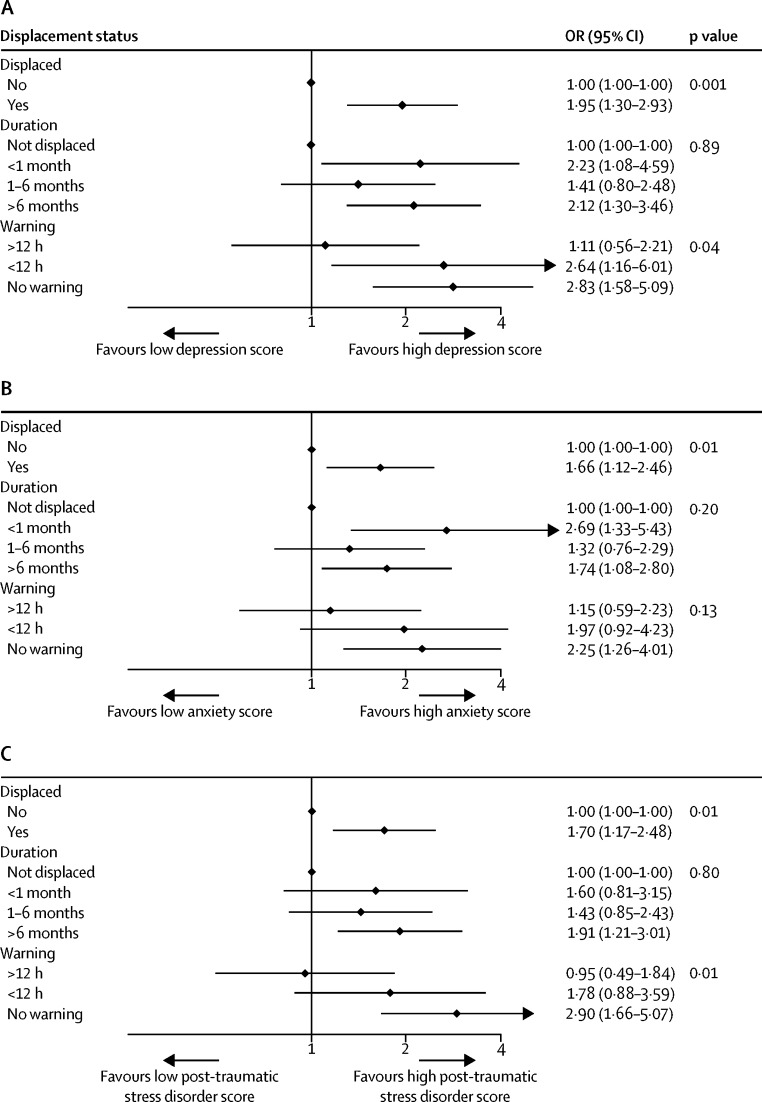
BACKGROUND: Extensive flooding occurred during the winter of 2013-14 in England. Previous studies have shown that flooding affects mental health. Using data from the 2013-14 Public Health England National Study of Flooding and Health, we compared the prevalence of symptoms of depression, anxiety, and post-traumatic stress disorder between participants displaced by flooding and those flooded, but not displaced, 1 year after flooding. METHODS: In this multivariable ordinal regression analysis, we collected data from a cross-sectional survey collected 1 year after the flooding event from flood-affected postcodes in five counties in England. The analysis was restricted to individuals whose homes were flooded (n=622) to analyse displacement due to flooding. The primary outcome measures were depression (measured by the PHQ-2 depression scale) and anxiety (measured by the two-item Generalised Anxiety Disorder [GAD]-2 anxiety scale), and post-traumatic stress disorder (measured by the Post-Traumatic Stress Disorder Checklist [PCL]-6 scale). We adjusted analyses for recorded potential confounders. We also analysed duration of displacement and amount of warning received. FINDINGS: People who were displaced from their homes were significantly more likely to have higher scores on each scale; odds ratio (OR) for depression 1·95 (95% CI 1·30-2·93), for anxiety 1·66 (1·12-2·46), and for post-traumatic stress disorder 1·70 (1·17-2·48) than people who were not displaced. The increased risk of depression was significant even after adjustment for severity of flooding. Scores for depression and post-traumatic stress disorder were higher in people who were displaced and reported receiving no warning than those who had received a warning more than 12 h in advance of flooding (p=0·04 for depression, p=0·01 for post-traumatic stress disorder), although the difference in anxiety scores was not significant. INTERPRETATION: Displacement after flooding was associated with higher reported symptoms of depression, anxiety, and post-traumatic stress disorder 1 year after flooding. The amount of warning received showed evidence of being protective against symptoms of the three mental illnesses studied, and the severity of flooding might be the reason for some, but not all, of the differences between the groups. FUNDING: National Institute for Health Research Health Protection Research Units (HPRU) in Emergency Preparedness and Response at King's College London, Environmental Change and Health at the London School of Hygiene and Tropical Medicine, and Evaluation of Interventions at the University of Bristol, Public Health England.
Overview
The claims and statistics of this paper haven’t been checked yet.
Free: it reads the open-access text and checks the first 5 claims that cite a source we can check. Create a free account to check every claim.
Integrity signals
Registry
Cites
Statistics
Figures
Verification
Claims the paper makes
The claims and statistics of this paper haven’t been checked yet.
Free: it reads the open-access text and checks the first 5 claims that cite a source we can check. Create a free account to check every claim.
Claims other papers make about this one
Each is checked against this paper’s own text: does it say what the citing paper says it does?
The source backs part of the claim, not all of it — or backs it for a different population, condition or comparison.
In the citing paper
“In addition, these often rely on binary diagnostic measures for mental health indicators, which may not capture subtle variations in symptom severity [10].”
From Understanding the impact of natural disasters on post-traumatic stress disorder and depression symptoms: An examination of counterfactual displacement scenarios (2026) · cites this paper as [10]
Experimental — accuracy not yet measuredThe source backs part of the claim, not all of it — or backs it for a different population, condition or comparison.
In the citing paper
“Even among studies that have considered more representative samples, most studies have not used methods that estimate the causal effect of displacement on such mental health indicators [10,14].”
From Understanding the impact of natural disasters on post-traumatic stress disorder and depression symptoms: An examination of counterfactual displacement scenarios (2026) · cites this paper as [10]
Experimental — accuracy not yet measured
Self-check
Percentages, sums and reported differences re-computed from the paper’s own numbers.
The self-check needs the paper’s full text.
Citations
Cites
The Patient Health Questionnaire-2: Validity of a Two-Item Depression Screener
Kroenke, K., Spitzer, R. L., & Williams, J. B. W. (2003) · Medical Care · doi:10.1097/01.mlr.0000093487.78664.3c · Cited by 6,359
An Ultra-Brief Screening Scale for Anxiety and Depression: The PHQ–4
Kroenke, K., Spitzer, R. L., Williams, J. B. W., & Löwe, B. (2009) · Psychosomatics · doi:10.1016/s0033-3182(09)70864-3 · Cited by 4,261
Floods and human health: A systematic review
Alderman, K., Turner, L. R., & Tong, S. (2012) · Environment International · doi:10.1016/j.envint.2012.06.003 · Cited by 766
An abbreviated PTSD checklist for use as a screening instrument in primary care
Lang, A. J., & Stein, M. B. (2005) · Behaviour Research and Therapy · doi:10.1016/j.brat.2004.04.005 · Cited by 584
Flooding and Mental Health: A Systematic Mapping Review
Fernandez, A., Black, J., Jones, M., Wilson, L., Salvador-Carulla, L., Astell-Burt, T., & Black, D. (2015) · PLOS ONE · doi:10.1371/journal.pone.0119929 · Cited by 382
Du, W., FitzGerald, G. J., Clark, M., & Hou, X.-Y. (2010) · Prehospital and Disaster Medicine · doi:10.1017/s1049023x00008141 · Cited by 340
Reacher, M. H., McKenzie, K. J., Lane, C., Nichols, T., Kedge, I., Iversen, A., Hepple, P., Walter, T., Laxton, C. E., & Simpson, J. (2004) · PubMed · doi:10.17863/cam.70739 · Cited by 244
Postdisaster PTSD over four waves of a panel study of Mexico's 1999 flood
Norris, F. H., Murphy, A. D., Baker, C. K., & Perilla, J. L. (2004) · Journal of Traumatic Stress · doi:10.1023/b:jots.0000038476.87634.9b · Cited by 232
Extreme Weather Events and Public Health Responses
(2005) · Springer eBooks · doi:10.1007/3-540-28862-7 · Cited by 219
The psychological impact of exposure to floods
Mason, V., Andrews, H., & Upton, D. (2010) · Psychology, Health & Medicine · doi:10.1080/13548500903483478 · Cited by 218
Research works printed but not linked: 2
- Foresight, Government Office for Science Future flooding: mid-term review. Foresight project: flood and coastal defence 2011 Government Office for Science London
- Pitt M. The Pitt Review: learning lessons from the 2007 floods. London: UK, 2008.
Cited by
Items 101–164 of 164
Oe, S., Nakai, H., Nagayama, Y., Oe, M., & Yamaguchi, C. (2025) · Psychiatry International · doi:10.3390/psychiatryint6010014 · Cited by 3
The Medium-Term Psychosocial Impact of the 2021 Floods in Belgium: A Survey-Based Study
Maeyer, N. D., Nagabhatla, N., Toles, O. M., Reubens, D. G., & Scheerens, C. (2025) · Climate · doi:10.3390/cli13030061 · Cited by 5
“In economically disadvantaged communities, the prevalence of psychological disorders can even continue to increase over the long term, as structural vulnerabilities compound the mental health burden [39].”
Siddik, M. A. B., Ali, A., Shakil, M. R., Syfullah, M. K., Hoque, M. S., Islam, M. A., Guo, H., & Ali, S. (2025) · Climatic Change · doi:10.1007/s10584-025-03916-5 · Cited by 6
“For instance, climate-induced migration increased English adults’ risks of depression along with the risks of anxiety, and PTSD (Post-Traumatic Stress Disorder) nearly twice that of non-migrants (Munro et al. 2017).”
Flooding and elevated prenatal depression in rural Bangladesh: A mixed methods study
Hanif, S., Momo, J.-E.-T., Jahan, F., Goldberg, L., Herbert, N., Yeamin, A., Shoab, A. K., Akhter, R., Roy, S. K., Heitmann, G. B., et al. (2025) · PLOS Global Public Health · doi:10.1371/journal.pgph.0004792 · Cited by 10
Using an Ecological and Biological Framing for an Anti-racist Covid-19 ApproachPreprint
Camargo, A., Hossain, E., Aliko, S., Akinola-Odusola, D., Artus, J., & Kelman, I. (2021) · medRxiv · doi:10.1101/2021.01.24.21250397 · Cited by 4
Hanif, S., Momo, J.-E.-T., Jahan, F., Goldberg, L., Herbert, N., Yeamin, A., Shoab, A. K., Akhter, R., Roy, S. K., Heitmann, G. B., et al. (2024) · medRxiv · doi:10.1101/2024.11.25.24317922 · Cited by 3
“In high income settings, flooding is positively associated with perinatal depression 5 ; children born to women who experienced natural disasters, including flooding, during pregnancy performed relatively poorly in elementary school 6 .”
Yamamoto, C., Sawano, T., Matsumoto, C., Nonaka, S., Fukasawa, S., Zhao, T., & Tsubokura, M. (2025) · Journal of Radiological Protection · doi:10.1088/1361-6498/ae1e04 · Cited by 4
Liu, J., Wu, J., Huang, X., Yu, D., Huang, Z., Chen, H. X., Wang, C., Tian, T., & He, F. (2026) · Environment International · doi:10.1016/j.envint.2026.110103 · Cited by 3
Connecting Hazard and Impact: A Partnership between Physical and Human Science
Robbins, J., Ruin, I., Golding, B. W., Dankers, R., Nairn, J., & Millington, S. C. (2022) · Springer eBooks · doi:10.1007/978-3-030-98989-7_5 · Cited by 3
Psychological Effect on children at Secondary Level after Flood Disaster District RajanPur
Shoqat, I., Zafar, J., Kanwal, T., & Kausar, F. (2023) · VFAST Transactions on Education and Social Sciences · doi:10.21015/vtess.v11i1.1410 · Cited by 3
LeBlanc, J.-A., Jones, W., & Harewood, H. C. (2024) · Frontiers in Psychiatry · doi:10.3389/fpsyt.2024.1372971 · Cited by 2
“Several studies (USA and England) demonstrate higher levels of mental health effects including PTSD linked to internal displacement (43 – 45).”
BackgroundGudeta, N. S., & Seyeneh, M. M. (2025) · SSM - Mental Health · doi:10.1016/j.ssmmh.2025.100399 · Cited by 4
From ethical dilemmas to ethical cascading failure in disaster evacuation planning
Xu, J., Nair, D. J., & Waller, S. T. (2025) · Natural Hazards Research · doi:10.1016/j.nhres.2025.10.002 · Cited by 2
Mental health of people involved in natural disasters from the perspective of the workers involved
Rafaloski, A. R., Zeferino, M. T., Forgearini, B. A. O., Manfrini, G. C., & Menegon, F. A. (2020) · Saúde em Debate · doi:10.1590/0103-11042020e216i · Cited by 2
“But also individuals who were already under mental health treatment, with or without psychiatric medication, must have guaranteed care after the occurrence of the disaster 23 .”
BackgroundGambaran Tingkat Kecemasan pada Korban Banjir Bandang di Kabupaten Magelang
Widhayanti, D. A. M. D., Warsini, S., & Sutono, S. (2018) · Jurnal Keperawatan Klinis dan Komunitas (Clinical and Community Nursing Journal) · doi:10.22146/jkkk.44240 · Cited by 5
Floods of movement: Drivers of human migration under sea-level rise and flood risk
Duijndam, S. (2024) · doi:10.5463/thesis.705 · Cited by 7
Kunda, J. J., Jajere, A. A., Otabe, E. A., Chindo, M. M., Bibi, U. M., & Maina-Bukar, Y. (2021) · Environment and Pollution · doi:10.5539/ep.v10n2p20 · Cited by 1
“Flood has a significant influence on vector-borne diseases, including malaria, dengue, yellow fever, and West Nile fever (WHO, 2001; Tapsell et al., 2012; Munro et al., 2017; Paavola, 2017).”
BackgroundEconomic Impacts: The Economic Consequences of the Climate Crisis
Wenz, L., & Kuik, F. (2024) · Springer eBooks · doi:10.1007/978-3-031-58144-1_5 · Cited by 1
The Climate Formulation: Addressing Climate Change in Mental Health Practice
Wang, R., Seritan, A. L., Hatcher, A., & Asghar‐Ali, A. A. (2024) · Academic Psychiatry · doi:10.1007/s40596-024-02040-3 · Cited by 2
“For example, experiencing anxiety related to displacement from one’s home might be a secondary impact of flooding [21].”
Scherer, J. N., Dipp, T., Schaefer, R., Mosmann, C. P., & Ornell, F. R. (2025) · Journal of Prevention · doi:10.1007/s10935-025-00839-w · Cited by 8
“Other high-risk groups include children, older adults, women, and individuals with disabilities, who often experience heightened fear and confusion due to rapid environmental changes (Bei et al., 2013; Lowe et al., 2013; Munro et al., 2017).”
Wantim, M. N., & NGEH, H. N. (2025) · Journal of Coastal Conservation · doi:10.1007/s11852-025-01113-1 · Cited by 1
“A study by Munro et al. (2017) in the United Kingdom revealed that there was a rise in the rates of uneasiness, desolation and chronic mental health disorder for individuals who were displaced due to flooding compared to those who experienced flooding but were not displaced.”
Khayamim, R., Moses, R., Özgüven, E. E., Borowska-Stefańska, M., Wiśniewski, S., Ozkul, S., & Dulebenets, M. A. (2025) · Heliyon · doi:10.1016/j.heliyon.2025.e43633 · Cited by 4
Shembesh, R. H., Beshr, M. S., Almasheeti, A. A., Sheltami, A. T., & -, A. E.-O. (2025) · Cambridge Prisms Global Mental Health · doi:10.1017/gmh.2025.10039 · Cited by 4
“Nevertheless, our findings highlight key demographic predictors – genderforanxietyanddisplacementstatusfordepression – that align with patterns in disaster-related mental health literature (Munro et al. 2017; McKinzie and Clay-Warner 2021).”
Birgisdóttir, Á. G., Zelinski, L., Ólafsson, R. P., & Höller, Y. (2025) · Scandinavian Journal of Psychology · doi:10.1111/sjop.70023 · Cited by 2
Viola, T., Giuberti, P., Garcia, M. G., Baldi, B. B., Berlaver, S. T., Lodi, M., Machado, G., & Grassi-Oliveira, R. (2025) · International Journal of Child Abuse & Neglect · doi:10.1016/j.chiabu.2025.107765 · Cited by 1
Violent deaths following disasters: A retrospective analysis
Scales, S. E., Camphausen, L. C., Horney, J. A., & Kintziger, K. W. (2025) · PLoS ONE · doi:10.1371/journal.pone.0337968 · Cited by 1
“Both evacuation and shelter-in-place orders – as well as any disaster-related displacement – contribute to stress, exacerbated poor mental health, and new-onset mental illness [8,37].”
Flood exposure during pregnancy and risk of preterm birth: A study of 25 countries from Africa
ZHENG, Y., Wang, H.-J., HUANG, Y.-X., Wan, P. E. N. G., Yi-Lin, L. I., Ya-Yi, L. I., Xin-Jie, X. I. A. O., Wei, Y.-J., Ye, Z., He, G.-H., et al. (2026) · Advances in Climate Change Research · doi:10.1016/j.accre.2026.04.003 · Cited by 1
Kheiri, F. K., Noor, S. K., Alharthi, S. S., Alharbi, H. Y., Alwabili, A., & Adam, I. (2026) · Healthcare · doi:10.3390/healthcare14152248 · Cited by 1
“In England, people who were displaced by flooding were at higher risk for depression than those flooded, but not displaced [17].”
A Statistical Analysis of Japanese Inter-Prefectural Migration After Disasters
Okumura, M., & Ito, W. (2018) · Journal of Disaster Research · doi:10.20965/jdr.2018.p1072 · Cited by 1
“According to Munro et al. [8], evacuation and displacement management are highly necessary for dealing with mental health problems after disasters.”
Towards More Advanced, Equitable Natural Hazard Risk Metrics
Wu, T., & Koh, K. B. (2023) · Academic Journal of Science and Technology · doi:10.54097/ajst.v7i3.13275 · Cited by 1
Mental Resilience: Navigating Mental Well-Being Amidst Environmental Deterioration
Sharma, B. (2024) · Advances in psychology, mental health, and behavioral studies (APMHBS) book series · doi:10.4018/979-8-3693-3272-6.ch011 · Cited by 2
Chown, G. (2024) · Burns Open · doi:10.1016/j.burnso.2024.04.001 · Cited by 1
Bahall, M. U., Legall, G., Rampersad, R., Chatoorie, N., Youksee, A., Wallace, E., Choutie, R.-A., & Singh, Y. (2025) · Cureus · doi:10.7759/cureus.80045 · Cited by 1
“…relatively high compared to general anxiety levels reported in other studies, such as the Munro et al. study, which found that only 22% of participants who were flooded but not displaced had probable anxiety, whereas only 30% of participants who were flooded and displaced had probable anxiety [15].”
InfluentialThe Health Costs of Hydrometeorological Extreme Events
Martínez, G. S., & Hudson, P. (2022) · Wiley eBooks · doi:10.1002/9781119259350.ch7 · Cited by 1
Puechlong, C. (2020) · theses.fr (ABES) · doi:10.70675/1fd7541dzdb86z459az8a55zbb63305c5fdb · Cited by 1
Abba-Aji, M., Cohen, G., Abdalla, S., Wang, R., Gradus, J., & Galea, S. (2026) · PLOS Mental Health · doi:10.1371/journal.pmen.0000317
“For example, a few cross sectional studies have shown that displaced persons are more likely to experience mental health issues—specifically, depression, PTSD, and anxiety symptoms— compared to those who were not displaced [9,10].”
InfluentialRichler, J. (2017) · Nature Climate Change · doi:10.1038/nclimate3364
Evakuierungen durch Überschwemmungen erfordern psychische Versorgung Betroffener
Müller, M. (2017) · Pflegezeitschrift · doi:10.1007/s41906-017-0255-1
Santos, M. A. D. L., & Módena, C. M. (2020) · doi:10.21203/rs.2.22430/v1
The Impact of Hurricane Harvey on the Wellbeing of Hospitalized Children and Their Families
Vonasek, B. J., Greeley, C. S., Bocchini, C. E., & Lopez, M. (2021) · Journal of Applied Research on Children Informing Policy for Children at Risk · doi:10.58464/2155-5834.1424
Exploring Relevant Research Fields
Dufty, N. (2020) · Wiley eBooks · doi:10.1002/9781119569817.ch5
Murray, V. S. G., Waite, T., & Sutton, P. (2021) · doi:10.1093/med/9780198816805.003.0105
Self-citationFreshwater: Groundwater and Aquifers
Suring, L. H. (2020) · Elsevier eBooks · doi:10.1016/b978-0-12-409548-9.12440-6
(2022) · Proceedings of WCSE 2022 Spring Event: 2022 9th International Conference on Industrial Engineering and Applications · doi:10.18178/wcse.2022.04.154 · Cited by 3
Bystron, J. M., Dziekiewicz, A., Kobiałka, J., & Giordano, U. (2023) · Environmental Medicine · doi:10.26444/ms/170262
Gümüşsoy, S., Keskin, G., & Öztürk, R. (2024) · Work · doi:10.3233/wor-230306
The Interface of Climate and Psychiatry
Pinsky, E. G. (2024) · Elsevier eBooks · doi:10.1016/b978-0-443-11844-9.00087-4
Karim, M. Z., Al‐Mamun, M., Parvin, M., Eva, M. A., & Kalam, A. (2026) · Natural Hazards · doi:10.1007/s11069-026-08400-6
“…found that 27.72% of individuals reported their diminished mental well-being following riverbank erosion in Kushtia District and other countries (Doherty & Clayton 2011; Munro et al. 2017 ), which have consistently reported that exposure to environmental disasters increases psychological distress.”
InfluentialAyonrinde, O., & Mngoma, N. F. (2025) · Cambridge University Press eBooks · doi:10.1017/9781108963763.003
Mulchandani, R., Armstrong, B., Beck, C. R., Waite, T. D., Amlôt, R., Kovats, S., Leonardi, G. S., Rubin, G. J., & Oliver, I. (2020) · Figshare · doi:10.6084/m9.figshare.12045693
Self-citationWhen the evacuation is a disaster: Evacuation behavior in the absence of disaster preparednessPreprint
Maombi, E. N., Lunanga, E., Stoop, N., & Verpoorten, M. (2026) · SSRN Electronic Journal · doi:10.2139/ssrn.6170198
Kaewvijit, R., Chanpiwat, P., Sithisarankul, P., Sirinara, P., & Ingviya, T. (2026) · Journal of Occupational Medicine and Toxicology · doi:10.1186/s12995-026-00504-w
Aliu, G., Serbeh, R., Nyaaba, E., Mortey, H., Elloin, G. J., Salifu, A., Slimbil, P. B., Gyasi, R. M., Dumedah, G., & Abass, K. (2026) · Urban Water Journal · doi:10.1080/1573062x.2026.2648231
“In this context, our findings contribute to an emerging body of literature (Abass et al. 2023; Munro et al. 2017) that calls for a more nuanced and inclusive framing of disaster-related health outcomes-one that integrates both physiological and psychological impacts.”
Sarsour, A., Nagabhatla, N., & Okamoto, S. (2026) · United Nations University series on regionalism · doi:10.1007/978-3-032-10550-9_8
Linking health risks, social vulnerability and response pathways in climate-driven floods
Tavella, R. A., & Furlan, J. P. R. (2026) · Frontiers in Water · doi:10.3389/frwa.2026.1806478
Vasiliauskienė, E., Andriulė, A., Pargaliauskytė, B., Skiotytė-Radienė, K., & Dailidienė, I. (2026) · Sustainability · doi:10.3390/su18073627
Engelhard, E. S., Gabyzon, M. E., & Sassy, N. (2026) · The Arts in Psychotherapy · doi:10.1016/j.aip.2026.102473
Thermal stress across the Indus-Ganges-Brahmaputra basins: UTCI-based trends analysis
Khanam, Z., Sharma, A., Maharana, P., & Mal, S. (2026) · Theoretical and Applied Climatology · doi:10.1007/s00704-026-06302-y · Cited by 1
Adsuara, M., Ventura, G., & Baviera, T. (2026) · International Journal of Disaster Risk Reduction · doi:10.1016/j.ijdrr.2026.106314
Shi, H., Wang, T., Bai, C., Wang, P., Kwok, F., Li, W., Jing, L., Zhu, Q., Wang, R., Chen, J., et al. (2026) · The Lancet Regional Health - Western Pacific · doi:10.1016/j.lanwpc.2026.101930
“12,13 However, most studies relied on cross-sectional surveys, self-reported symptom measures, or single-hazard case studies, 13–15 which provide limited evidence on the timing of risk trajectories and clinical health care.”
Climate change, environmental extremes, and human health
Yu, P., Liu, Y., Xing, Y., He, C., Huang, Y., Huang, L., Li, T., Alahmad, B., Phung, D. T., Chen, B., et al. (2026) · The Innovation Medicine · doi:10.59717/j.xinn-med.2026.100235
Acute Mental Health Impacts and Mid-Term Symptom Trajectories Following Wildfire Exposure
Gigoyan, L., Dossett, M. L., Conlon, K. C., Chen, S., Raffuse, S. M., & Hertz‐Picciotto, I. (2026) · International Journal of Environmental Research and Public Health · doi:10.3390/ijerph23081005
“Evacuation and displacement resulting from disasters often exacerbate mental health issues, particularly among vulnerable populations, manifesting in conditions such as post-traumatic stress disorder (PTSD), anxiety, and general mental distress [5–8].”
İklim Değişikliği Kaynaklı Orman Yangınlarının Halk Sağlığı Üzerindeki Etkileri
Calayır, F., Kaptanoğlu, S., & Kul, A. R. (2026) · Özgür Yayınları eBooks · doi:10.58830/ozgur.pub1416.c5687
Development of flood fear scale and investigation of psychometric properties
Torpuş, K., & CENGİZ, S. (2026) · Safety Science · doi:10.1016/j.ssci.2026.107504
Metadata
- Authors
- Munro, A., Kovats, R. S., Rubin, G. J., Waite, T. D., Bone, A., Armstrong, B., Waite, T. D., Beck, C. R., Bone, A., Amlôt, R., Kovats, R. S., Armstrong, B., Leonardi, G., Rubin, G. J., & Oliver, I.
- Affiliations
- National Institute for Health and Care Research (GB)
- Corresponding author
- Munro, Alice
- Venue
- The Lancet Planetary Health
- Publisher
- Elsevier BV
- Published
- 2017-07
- Volume
- 1
- Issue
- 4
- Pages
- e134-e141
- ISSN
- 2542-5196 (ISSN-L)
- PMC
- PMC5597543
- OpenAlex
- W2710466380
- Semantic Scholar
- 3a7a643913f20be5d332bc3b2be868dac89023f1
- Cited by
- 165
- References
- 27
- Citations by year
- 2026: 20 · 2025: 27 · 2024: 19 · 2023: 19 · 2022: 12 · 2021: 17 · 2020: 18 · 2019: 12 · 2018: 17 · 2017: 4
- FWCI
- 17.30
- Type
- journal article
- Language
- en
- Open access
- gold
- doi.org
- Licence
- cc-by-nc-nd
- www.elsevier.com/tdm/userlicense/1.0/ (tdm)
- creativecommons.org/licenses/by-nc-nd/4.0/ (vor)
- Locations
- The Lancet Planetary Health (publishedVersion, cc-by-nc-nd)
- Europe PMC (PubMed Central) (publishedVersion, cc-by-nc-nd)
- PubMed Central (publishedVersion, cc-by-nc-nd)
- PubMed (publishedVersion)
- LSHTM Research Online (London School of Hygiene and Tropical Medicine) (acceptedVersion)
- DOAJ (DOAJ: Directory of Open Access Journals) (submittedVersion, cc-by-sa)
- Funders
- Natural Environment Research Council (NE/K006835/1)
- Topics
- Social Sciences › Psychology › Clinical Psychology › Posttraumatic Stress Disorder Research
- Health Sciences › Medicine › Psychiatry and Mental health › Mental Health Treatment and Access
- Physical Sciences › Environmental Science › Global and Planetary Change › Flood Risk Assessment and Management
- Keywords
- floods, mental health, displacement, depression, anxiety, post-traumatic stress disorder, flood warning, flood intensity, flood-affected communities, emergency preparedness and response, winter flooding
About these checks
Registry, retraction, Cites and statistics results are computed, not judged, with one exception: a printed reference that no index lists is read once by a model before it counts as a citation error. Claims are extracted by a model and kept only when their quote appears verbatim in the text; each cited source is then checked, with a model’s help, for whether it says what the claim relies on. Those verdicts can be wrong — read the claim’s quote and the cited source before relying on one.
Statistics and arithmetic are recomputed, not judged.
Confidence bands are shown only for fields calibrated on our annotated test set. None is calibrated yet, so no band is shown.
What counts as a claim ›How we measure confidence ›How we check this ›
Are you an author, or do you see a problem with this page? Request a review
Data sources
Bibliographic data: Semantic Scholar, OpenAlex, Crossref.
Contains information from the Semantic Scholar Academic Graph Datasets, made available under the ODC Attribution License (ODC-BY 1.0).
Semantic Scholar’s data is described in: Kinney, R., et al. (2023). The Semantic Scholar Open Data Platform. arXiv:2301.10140.
