

Chat-based instant messaging support integrated with brief interventions for smoking cessation: a community-based, pragmatic, cluster-randomised controlled trial
Open accessThe DOI matches its Crossref record; 33 of the 33 references it cites were found in a registry or an index.
Abstract
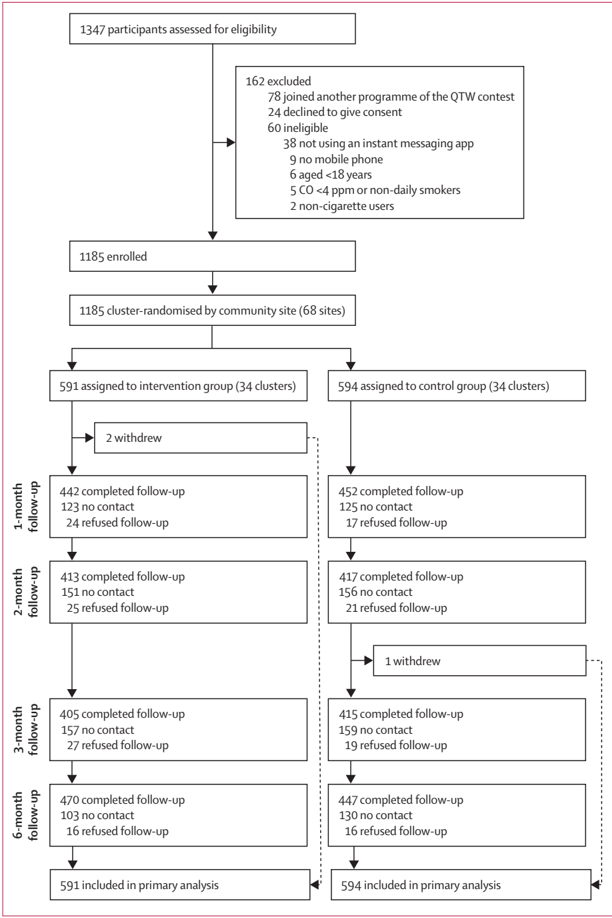
BACKGROUND: Mobile instant messaging apps offer a modern way to deliver personalised smoking cessation support through real-time, interactive messaging (chat). In this trial, we aimed to assess the effect of chat-based instant messaging support integrated with brief interventions on smoking cessation in a cohort of smokers proactively recruited from the community. METHODS: In this two-arm, pragmatic, cluster-randomised controlled trial, we recruited participants aged 18 years or older who smoked at least one cigarette per day from 68 community sites in Hong Kong, China. Community sites were computer randomised (1:1) to the intervention group, in which participants received chat-based instant messaging support for 3 months, offers of referral to external smoking cessation services, and brief advice, or to the control group, in which participants received brief advice alone. The chat-based intervention included personalised behavioural support and promoted use of smoking cessation services. Masking of participants and the research team was not possible, but outcome assessors were masked to group assignment. The primary outcome was smoking abstinence validated by exhaled carbon monoxide concentrations lower than 4 parts per million and salivary cotinine concentrations lower than 10 ng/mL at 6 months after treatment initiation (3 months after the end of treatment). The primary analysis was by intention to treat and accounted for potential clustering effect by use of generalised estimating equation models. This trial is registered with ClinicalTrials.gov, number NCT03182790. FINDINGS: Between June 18 and Sept 30, 2017, 1185 participants were randomly assigned to either the intervention (n=591) or control (n=594) groups. At the 6-month follow-up (77% of participants retained), the proportion of validated abstinence was significantly higher in the intervention group than in the control group (48 [8%] of 591 in intervention vs 30 [5%] of 594 in control group, unadjusted odds ratio 1·68, 95% CI 1·03-2·74; p=0·040). Engagement in the chat-based support in the intervention group was low (17%), but strongly predicted abstinence with or without use of external smoking cessation services. INTERPRETATION: Chat-based instant messaging support integrated with brief cessation interventions increased smoking abstinence and could complement existing smoking cessation services. FUNDING: Hong Kong Council on Smoking and Health.
Overview
The claims and statistics of this paper haven’t been checked yet.
Free: it reads the open-access text and checks the first 5 claims that cite a source we can check. Create a free account to check every claim.
Integrity signals
Registry
Cites
Statistics
Figures
Verification
Claims the paper makes
The claims and statistics of this paper haven’t been checked yet.
Free: it reads the open-access text and checks the first 5 claims that cite a source we can check. Create a free account to check every claim.
Claims other papers make about this one
Each is checked against this paper’s own text: does it say what the citing paper says it does?
The source backs part of the claim, not all of it — or backs it for a different population, condition or comparison.
In the citing paper
“Our cluster RCT involving 1185 community smokers showed that chat-based IM support guided by ACT plus brief cessation interventions significantly increased 6-month validated smoking abstinence rates (8% vs. 5%, P < 0.001) than control [14].”
From Personalized chat‐based support for smoking cessation among smokers with mental health symptoms in the workplace: A randomized controlled trial. (2025) · cites this paper as [14]
Experimental — accuracy not yet measuredThe cited source says what the claim attributes to it.
In the citing paper
“Engagement in the chat-based IM intervention in this trial (36.1%) was higher than our chat-based trial in the community (17%) [14] and workplace (17.4%) [22] settings.”
From Personalized chat‐based support for smoking cessation among smokers with mental health symptoms in the workplace: A randomized controlled trial. (2025) · cites this paper as [14]
The cited source says what the claim attributes to it.
In the citing paper
“The observed effect for self-reported 7-day PPA at 6 months (16%) in this trial was comparable to our previous chat-based IM support in the community (19%) [14], although direct comparison is not feasible owing to the differences in study”
From Personalized chat‐based support for smoking cessation among smokers with mental health symptoms in the workplace: A randomized controlled trial. (2025) · cites this paper as [14]
The cited source says what the claim attributes to it.
In the citing paper
“The drop-out rate (36% at 6 months) in this study was slightly higher than those in our previous community trial (23%) [14] and workplace trial (29%) [22].”
From Personalized chat‐based support for smoking cessation among smokers with mental health symptoms in the workplace: A randomized controlled trial. (2025) · cites this paper as [14]
The cited source says what the claim attributes to it.
In the citing paper
“These findings align with those from other smoking cessation trials, which have shown that smokers less motivated to quit were less likely to use mHealth for quitting [14,39].”
From Personalized chat‐based support for smoking cessation among smokers with mental health symptoms in the workplace: A randomized controlled trial. (2025) · cites this paper as [14]
Self-check
Percentages, sums and reported differences re-computed from the paper’s own numbers.
The self-check needs the paper’s full text.
Citations
Cites
Acceptance and commitment therapy: model, processes and outcomes
Hayes, S. C., Luoma, J. B., Bond, F. W., Masuda, A., & Lillis, J. (2006) · Behaviour Research and Therapy · doi:10.1016/j.brat.2005.06.006 · Cited by 6,587
Treating Tobacco Use and Dependence: 2008 Update: (566222009-001)
(2009) · PsycEXTRA Dataset · doi:10.1037/e566222009-001 · Cited by 3,046
Eysenbach, G. (2005) · Journal of Medical Internet Research · doi:10.2196/jmir.7.1.e11 · Cited by 2,524
Biochemical verification of tobacco use and cessation
Benowitz, N. L., III, P. J., Ahijevych, K., Jarvis, M. J., Hall, S., LeHouezec, J., Hansson, A., Lichtenstein, E., Henningfield, J., Tsoh, J., et al. (2002) · Nicotine & Tobacco Research · doi:10.1080/14622200210123581 · Cited by 1,800
Outcome criteria in smoking cessation trials: proposal for a common standard
West, R., Hajek, P., Stead, L., & Stapleton, J. (2005) · Addiction · doi:10.1111/j.1360-0443.2004.00995.x · Cited by 1,285
Understanding and Promoting Effective Engagement With Digital Behavior Change Interventions
Yardley, L., Spring, B. J., Riper, H., Morrison, L. G., Crane, D. H., Curtis, K., Merchant, G. C., Naughton, F., & Blandford, A. (2016) · American Journal of Preventive Medicine · doi:10.1016/j.amepre.2016.06.015 · Cited by 1,118
Mobile phone-based interventions for smoking cessation
Whittaker, R., McRobbie, H., Bullen, C., Rodgers, A., & Gu, Y. (2016) · Cochrane Database of Systematic Reviews · doi:10.1002/14651858.cd006611.pub4 · Cited by 1,079
Free, C., Knight, R., Robertson, S., Whittaker, R., Edwards, P., Zhou, W., Rodgers, A., Cairns, J., Kenward, M. G., & Roberts, I. (2011) · The Lancet · doi:10.1016/s0140-6736(11)60701-0 · Cited by 728
Vangeli, E., Stapleton, J., Smit, E. S., Borland, R., & West, R. (2011) · Addiction · doi:10.1111/j.1360-0443.2011.03565.x · Cited by 607
Michie, S., Hyder, N., Walia, A., & West, R. (2011) · Addictive Behaviors · doi:10.1016/j.addbeh.2010.11.016 · Cited by 459
Cited by
Xu, L., Sanders, L., Li, K., & Chow, J. C. L. (2021) · JMIR Cancer · doi:10.2196/27850 · Cited by 571
“The benefit of using chatbots for smoking cessation across various age groups has been highlighted in numerous studies showing improved motivation, accessibility, and adherence to treatment, which have led to increased smoking abstinence [89-91].”
Li, S., Qu, Z., Li, Y., & Ma, X. (2024) · EClinicalMedicine · doi:10.1016/j.eclinm.2023.102412 · Cited by 62
Zhou, X., Wei, X., Cheng, A., Liu, Z., Su, Z., Li, J., Qin, R., Zhao, L., Xie, Y., Huang, Z., et al. (2023) · JMIR mhealth and uhealth · doi:10.2196/48253 · Cited by 42
Powell‐Wiley, T. M., Brewer, L. C., Burke, L. E., Hernández, R., Kaar, J. L., Kepper, M. M., Kline, C. E., Lopez, K. N., Roberson, S. L., Spees, C., et al. (2025) · Circulation · doi:10.1161/cir.0000000000001314 · Cited by 38
Weng, X., Luk, T. T., Suen, Y. N., Wu, Y. S., Li, W. H. C., Cheung, Y. T. D., Kwong, A. C. S., Lai, V., Chan, S. S. C., Lam, T., et al. (2020) · Addiction · doi:10.1111/add.15029 · Cited by 28
Self-citationWeng, X., Wu, Y. S., Luk, T. T., Li, W. H. C., Cheung, Y. T. D., Tong, H. S. C., Lai, V., Lam, T. H., & Wang, M. P. (2021) · The Lancet Regional Health - Western Pacific · doi:10.1016/j.lanwpc.2021.100189 · Cited by 28
“10 , 11 , 17 , 23 , 24 The trial protocol approved by the Institutional Review Board (IRB) of the University of Hong Kong/Hospital Authority Hong Kong West Cluster (UW18–318) has been registered with ClinicalTrials.gov ( NCT03565796 ) and published elsewhere.”
Self-citationLuk, T. T., Weng, X., Wu, Y. S., Chan, H. L., Lau, C. Y., Kwong, A., Lai, V., Lam, T. H., & Wang, M. P. (2020) · Tobacco Control · doi:10.1136/tobaccocontrol-2020-055857 · Cited by 24
Self-citationWeng, X., Lau, O. S., Ng, C. H., Li, W. H. C., Lam, T. H., & Wang, M. P. (2022) · Addiction · doi:10.1111/add.15804 · Cited by 19
Self-citationLuk, T. T., Lam, T. H., Leung, W. C., Leung, K. Y., Cheung, K. W., Kwa, C., Siong, K.-H., Tang, K.-K., Lee, K.-W., Hsieh, C. J., et al. (2021) · JAMA Internal Medicine · doi:10.1001/jamainternmed.2021.2757 · Cited by 20
Self-citationSun, Y., Wang, M. P., Cheung, Y. T. D., Ho, S. Y., Luk, T. T., Zhao, S. Z., Wu, Y. S., Wong, B. Y.-M., Weng, X., Chen, J., et al. (2022) · Tobacco Induced Diseases · doi:10.18332/tid/145935 · Cited by 18
Self-citationHow to manage cigarette smoking in kidney transplant candidates and recipients?
Devresse, A., Gohy, S. T., Robert, A., & Kanaan, N. (2021) · Clinical Kidney Journal · doi:10.1093/ckj/sfab072 · Cited by 16
“Advancing faster than evidence, the efficacy seems moderate (due also to low engagement) and probably lower than medications but may help some smokers (100,101).”
BackgroundGuo, N., Guo, Z., Zhao, S. Z., Ho, S. Y., Fong, D., Lai, A. Y. K., Chan, S. S. C., Wang, M. P., & Lam, T. H. (2021) · PLoS ONE · doi:10.1371/journal.pone.0249400 · Cited by 21
“Our randomized controlled trials supported the efficacy of IM chat with health counselors for smokers in smoking cessation [11] and SNS group discussion for exsmokers in relapse prevention [12].”
MethodSelf-citationJiang, N., Nguyen, N. T., Siman, N., Cleland, C. M., Nguyen, T., Doan, H. T., Abroms, L. C., & Shelley, D. (2021) · JMIR mhealth and uhealth · doi:10.2196/27478 · Cited by 17
Associations between older adults’ social media use behaviors and psychosocial well-being
Ho, M., Lee, J. J., & Yen, H. (2023) · Aging Clinical and Experimental Research · doi:10.1007/s40520-023-02486-9 · Cited by 17
Chen, N.-J., Huang, C., Fan, C.-C., Lu, L.-T., Lin, F.-H., Liao, J., & Guo, J. (2023) · JMIR Formative Research · doi:10.2196/45484 · Cited by 19
Weng, X., Luk, T. T., Lau, O. S., Suen, Y. N., Lee, J. J., Li, W. H. C., Kwok, J. Y. Y., Lam, T. H., & Wang, M. P. (2020) · Addictive Behaviors · doi:10.1016/j.addbeh.2020.106677 · Cited by 16
Self-citationLuk, T. T., Cheung, Y. T. D., Chan, H. C.-H., Fok, P., Ho, K. S., Sze, C. D., Lam, T. H., & Wang, M. P. (2022) · Nicotine & Tobacco Research · doi:10.1093/ntr/ntac045 · Cited by 15
Self-citationEffectiveness of digital tools for smoking cessation in Asian countries: a systematic review
Goh, K. W., Ming, L. C., Al‐Worafi, Y. M., Tan, C. S., Hermansyah, A., Rehman, I. U., & Ali, Z. (2024) · Annals of Medicine · doi:10.1080/07853890.2023.2271942 · Cited by 21
“Of the included 25 studies, n = 9 were from China [2,27–34]; n = 3 were from Hong Kong [10,35,36]; n = 3 were from Turkey [37–39]; n = 3 from Thailand [40–42]; n = 2 were from Taiwan [43,44]; n = 2 from Japan [45,46]; n = 1 from South Korea [47]; n = 1 from Indonesia [48]; n = 1 from Jordon [23] as…”
BackgroundInfluentialZhao, S. Z., Wu, Y. S., Chau, S. L., Fong, D., Lam, T., & Wang, M. P. (2021) · Tobacco Induced Diseases · doi:10.18332/tid/133373 · Cited by 14
Self-citationLi, Y., Luk, T. T., Cheung, Y. T. D., Zhao, S., Zeng, Y., Tong, H. S. C., Lai, V. W. Y., & Wang, M. P. (2024) · JAMA Network Open · doi:10.1001/jamanetworkopen.2024.17796 · Cited by 13
Self-citationKrishnan, N., Berg, C. J., Le, D., Ahluwalia, J. S., Graham, A. L., & Abroms, L. C. (2023) · Tobacco Prevention & Cessation · doi:10.18332/tpc/157598 · Cited by 14
Chau, S. L., Luk, T. T., Wong, B. Y. C., Wu, Y. S., Cheung, Y. T. D., Ho, S. Y., Kim, J. H., Lo, H. H. M., Lam, T. H., & Wang, M. P. (2024) · JAMA Internal Medicine · doi:10.1001/jamainternmed.2024.0343 · Cited by 10
Self-citationKruse, G. R., Park, E. R., Chang, Y., Haberer, J. E., Abroms, L. C., Shahid, N. N., Howard, S., Haas, J. S., & Rigotti, N. A. (2020) · Nicotine & Tobacco Research · doi:10.1093/ntr/ntaa050 · Cited by 11
Zhao, S. Z., Weng, X., Luk, T. T., Wu, Y. S., Cheung, Y. T. D., Li, W. H. C., Tong, H. S. C., Lai, V., Lam, T. H., & Wang, M. P. (2022) · Trials · doi:10.1186/s13063-022-06502-7 · Cited by 11
“8% (44/63) of responders at 1 month remained smoking and abstinence at 6 months, respectively [6].”
BackgroundMethodInfluentialSelf-citationEfficacy of digital therapeutics in smoking cessation: A systematic review and meta-analysis
Liu, L., Zhao, Y., Li, J., Zhang, N., Lan, Z., & Liu, X. (2023) · Medicine in Novel Technology and Devices · doi:10.1016/j.medntd.2023.100209 · Cited by 11
Yang, S.-J., & Kim, H. (2022) · International Journal of Environmental Research and Public Health · doi:10.3390/ijerph192214947 · Cited by 12
Health Promotion Among Cancer Patients: Innovative Interventions
López, V., & Klainin‐Yobas, P. (2021) · Springer eBooks · doi:10.1007/978-3-030-63135-2_17 · Cited by 14
Im, E., Sakashita, R., Lin, C., Lee, T. W., Tsai, H., & Inouye, J. (2020) · Journal of Nursing Scholarship · doi:10.1111/jnu.12592 · Cited by 10
Weng, X., Luk, T. T., Wu, Y. S., Zhao, S. Z., Cheung, Y. T. D., Tong, H. S. C., Lai, V., Lam, T. H., & Wang, M. P. (2023) · Tobacco Induced Diseases · doi:10.18332/tid/163176 · Cited by 8
Self-citationHe, W. J. A., Wang, Q., Lam, T. H., Chan, C. H. H., Luk, T. T., Wang, M. P., Chan, S. C. S., & Cheung, Y. T. D. (2024) · International Journal of Mental Health and Addiction · doi:10.1007/s11469-024-01239-7 · Cited by 9
“Third, although quit rates from different trials cannot be directly compared, the quit rates in the present trial appeared to be quite high, as validated quit rate in the SMS group in our previous trial was 8% at 6-month follow-up (Wang et al. 2019).”
Self-citationGuo, N., Luk, T. T., Wu, Y. S., Guo, Z., Chu, J. C. L., Cheung, Y. T. D., Chan, C. H. H., Kwok, T. T.-O., Wong, V. Y. L., Wong, C. K. H., et al. (2023) · Tobacco Induced Diseases · doi:10.18332/tid/160168 · Cited by 13
Self-citationWeng, X., Wang, M. P., Li, W. H. C., Cheung, Y. T. D., Lau, C. Y., Kwong, A. C. S., Lai, V., Chan, S. S. C., & Lam, T. H. (2020) · BMJ Open · doi:10.1136/bmjopen-2020-038351 · Cited by 7
Self-citationTobacco quitlines: Opportunities for innovation to increase reach and effectiveness
Sheffer, C. E. (2022) · Preventive Medicine · doi:10.1016/j.ypmed.2022.107319 · Cited by 28
Zhang, X., Sun, Y., Cheung, Y. T. D., Wang, M. P., Wu, Y. S., Chak, K. Y., Chen, J., Leung, L. T., Li, W. H. C., Lam, T. H., et al. (2022) · Nicotine & Tobacco Research · doi:10.1093/ntr/ntac147 · Cited by 6
Self-citationIncrease of unmotivated and hardened smokers in Hong Kong: a repeated cross-sectional trend analysis
Zhao, S. Z., Wu, Y. S., Cheung, Y. T. D., Luk, T. T., Weng, X., Tong, H. S. C., Lai, V., Chan, S. S. C., Lam, T. H., & Wang, M. P. (2023) · Tobacco Control · doi:10.1136/tc-2022-057724 · Cited by 7
Self-citationCartujano‐Barrera, F., Rodríguez-Bolaños, R., Arana‐Chicas, E., Gallegos-Carrillo, K., Flóres, Y. N., Pérez-Rubio, G., Falfán‐Valencia, R., Ellerbeck, E. F., Reynales-Shigematsu, L. M., & Cupertino, A. P. (2020) · Tobacco Induced Diseases · doi:10.18332/tid/120076 · Cited by 6
“Wang et al.(41) found that engagement in a chat-based cessation support (interacting with”
BackgroundJiang, N., Zhao, A., Rogers, E. S., Cupertino, A. P., Zhao, X., Cartujano-Barrera, F., Siu, K., & Sherman, S. E. (2024) · JMIR mHealth and uHealth · doi:10.2196/59496 · Cited by 5
“[21].”
BackgroundMethodResultInfluentialMapping the Process of Engagement With Digital Health Interventions: A Cross-Case Synthesis
Milne‐Ives, M., Homer, S. R., Andrade, J., & Meinert, E. (2025) · Mayo Clinic Proceedings Innovations Quality & Outcomes · doi:10.1016/j.mayocpiqo.2025.100625 · Cited by 8
Li, M., Luk, T. T., Cheung, Y. T. D., Guo, Z. Q., Siu, K. K., Guo, J., Chan, S. S. C., Lam, T. H., Ho, S. Y., Zhao, S. Z., et al. (2025) · EClinicalMedicine · doi:10.1016/j.eclinm.2025.103420 · Cited by 9
Self-citationBehavioral Support by Ex-Smoking Peers Using Instant Messaging for Smoking Cessation
Guo, Z., Luk, T. T., Weng, X., Wu, Y. S., Zhao, S. Z., Lai, Y. K., Cheung, Y. T. D., Tong, H. S. C., Lai, V., Lam, T. H., et al. (2025) · CHEST Journal · doi:10.1016/j.chest.2025.07.4110 · Cited by 5
Self-citationSu, Z., Wei, X., Cheng, A., Zhou, X., Li, J., Qin, R., Liu, Y., Xia, X., Song, Q., Liu, Z., et al. (2023) · Journal of Medical Internet Research · doi:10.2196/44840 · Cited by 7
“…for example, biochemically verified continuous abstinence at 6 months in studies in the United Kingdom [7], the United States [8], Hong Kong [9,10], and mainland China [11]; self-reported, 7-day point prevalence abstinence (PPA) at 6 months in Norway and Hong Kong [12,13]; 1-month PPA in…”
Zhao, S. Z., Xue, W., Wu, Y. S., Derek, C., Luk, T. T., Tong, H. S. C., Lai, V., Hing, L. T., & Ping, W. M. (2024) · International Journal of Mental Health and Addiction · doi:10.1007/s11469-024-01328-7 · Cited by 5
“(Wang et al., 2019), we assumed 64 (600*10.7”
InfluentialSelf-citationWu, Y. S., Cheung, Y. T. D., Lee, J. J., Wong, C. K. H., Ho, S. Y., Li, W. H. C., Yao, Y., Lam, T., & Wang, M. P. (2024) · Journal of Medical Internet Research · doi:10.2196/44973 · Cited by 5
“A lower motivation to quit has been found to be associated with less desire to use mHealth interventions for quitting [13,50].”
BackgroundMethodResultInfluentialSelf-citationYao, Y., Luk, T. T., Lau, O. S., Wu, Y. S., Weng, X., Ng, C. H., Cheung, Y. T. D., Lam, T. H., & Wang, M. P. (2025) · Addiction · doi:10.1111/add.70013 · Cited by 3
Self-citationGuo, Z., Wu, Y. S., & Wang, M. P. (2024) · JMIR XR and spatial computing. · doi:10.2196/52893 · Cited by 3
“…approached smokers using a “foot-in-the-door” technique, which is commonly used in SC trials in the context of smokers with low intention to quit [1,2,23] Briefly, the research staff initiated a conversation by asking about small and simple questions like their daily cigarette consumption and quit…”
BackgroundMethodInfluentialSelf-citationWeng, X., Yang, H., Song, C., Tu, J., Liu, K., & Wang, M. P. (2025) · Digital Health · doi:10.1177/20552076241311055 · Cited by 5
“20,24,25 The personalized chat support, tailored according to participants ’ readiness to quit, provided a strong therapeutic alliance.”
Self-citationChan, S.-K., Mak, T.-S. T., Yu, O. Y., Lee, V. H.-F., Chu, C.-H., Chan, S. Y., & Choi, C. (2025) · Vaccines · doi:10.3390/vaccines13030242 · Cited by 4
“The use of chat-based instant messaging support for smoking cessation interventions is an example of a successful measure in primary health-care settings [64,65].”
Self-citationCheung, Y. T. D., Zhang, M. J., Luk, T. T., Ho, S. Y., Lam, T. H., & Wang, M. P. (2025) · JAMA Network Open · doi:10.1001/jamanetworkopen.2025.0764 · Cited by 5
Self-citationHou, T., Ho, M., Li, H., & Lin, C. (2025) · Worldviews on Evidence-Based Nursing · doi:10.1111/wvn.70066 · Cited by 6
Guo, Z., Weng, X., Lau, A. O. S., Ng, M. C. H., Wu, Y., Lam, T. H., & Wang, M. P. (2022) · Tobacco Induced Diseases · doi:10.18332/tid/156455 · Cited by 3
Self-citationWeng, X., Yin, H., Liu, K., Song, C., Xie, J., Guo, N., & Wang, M. P. (2024) · JMIR Research Protocols · doi:10.2196/58636 · Cited by 4
“Second, the intervention design built on our previous mHealth trials in China [12,18,27], which showed the effectiveness of real-time counselor support on smoking cessation.”
Self-citationAlghzawi, H. M., & Storr, C. L. (2021) · Journal of the American Psychiatric Nurses Association · doi:10.1177/10783903211008248 · Cited by 3
“, 2020), group interventions (Naslund et al., 2017; Wang et al., 2019), one-on-one counseling (Byaruhanga et al.”
BackgroundKamarudin, S. K., Yasin, S. M., Ismail, N. B., & Isa, M. R. (2023) · Malaysian Journal of Medicine and Health Sciences · doi:10.47836/mjmhs.19.6.44 · Cited by 2
Johnson, A. L., Avila, J. C., Christensen, L., Fahey, M. C., Jang, J., Jarvis, S., Rojewski, A. M., Rubenstein, D., & Kleykamp, B. A. (2025) · Nicotine & Tobacco Research · doi:10.1093/ntr/ntaf122 · Cited by 6
Seo, Y. B., Lee, H., Paek, Y., Lee, H., Lee, C. M., Lee, E. S., Kimm, H., An, H.-J., Bae, E.-J., Kim, J. S., et al. (2025) · Journal of Korean Medical Science · doi:10.3346/jkms.2025.40.e299 · Cited by 4
Zhao, S. Z., Li, M. Y., Li, Y. J., Luk, T. T., Cheung, D. Y. T., Lai, A. Y. K., Tong, H. S. C., Lai, V., Lam, T. H., & Wang, M. P. (2026) · Thorax · doi:10.1136/thorax-2025-224130 · Cited by 3
“24 25 Integrating mobile health (mHealth) support in exercise interventions enhanced remote supervision, facilitated real-time feedback and improved adherence in participants with cardiovascular disease 26 and general populations.”
Self-citationMobile Chat Messaging for Smoking Relapse Prevention
Luk, T. T., Su, X., Wong, V., Chan, H. C.-H., Wong, G. N.-T., Lee, J. K. H., Ho, S. Y., Lam, T. H., Cheung, Y. T. D., & Wang, M. P. (2026) · JAMA Internal Medicine · doi:10.1001/jamainternmed.2025.7439 · Cited by 2
Self-citationCommunity based interventions to increase use of Quitline services
Wang, M. P. (2021) · The Lancet Regional Health - Western Pacific · doi:10.1016/j.lanwpc.2021.100238 · Cited by 2
Self-citationZhang, M. J., He, W. J. A., Luk, T. T., Wang, M. P., Chan, S. S. C., & Cheung, Y. T. D. (2023) · Frontiers in Public Health · doi:10.3389/fpubh.2023.1147096 · Cited by 3
Self-citationExperiences of quitting smoking in prisons: A qualitative study of people in custody
Weng, X., Ching, E., Song, C. Y., Lee, J. J., Tong, H. S. C., Lai, V., Lam, T. H., & Wang, M. P. (2024) · Tobacco Induced Diseases · doi:10.18332/tid/183604 · Cited by 5
Self-citationWeng, X., Song, C., Liu, K., Zhao, S. Z., Yang, H., & Wang, M. P. (2024) · Nicotine & Tobacco Research · doi:10.1093/ntr/ntae230 · Cited by 3
Self-citationHow to facilitate smoking cessation
Colivicchi, F., Fusco, S. A. D., Ad, V. G., Castelletti, S., Pollarolo, L., Canale, M. L., Giubilato, S., Rossini, R., Oliva, S., Tedeschi, A., et al. (2025) · Progress in Cardiovascular Diseases · doi:10.1016/j.pcad.2025.07.007 · Cited by 3
Zhao, S. Z., Chan, S. K., Luk, T. T., Tong, H. S. C., Lai, V., Lam, T. H., Cheung, Y. T. D., & Wang, M. P. (2025) · International Journal of Drug Policy · doi:10.1016/j.drugpo.2025.104742 · Cited by 1
Self-citationThe development of community-based smoking cessation interventions in Hong Kong
Zhao, S. Z., & Wang, M. P. (2025) · The Journal of Smoking Cessation · doi:10.48130/jsc-0025-0003 · Cited by 1
Self-citationWeng, X., Guo, N., Liu, K., Xia, Y., Song, C., & Wang, M. P. (2025) · Nicotine & Tobacco Research · doi:10.1093/ntr/ntaf260 · Cited by 1
Self-citationYao, Y., Cheung, Y. T. D., Wu, Y. S., Guo, Z., Chan, S. K., Zhao, S. Z., Tong, H. S. C., Lai, V., Lam, T. H., Ho, S. Y., et al. (2024) · Tobacco Control · doi:10.1136/tc-2023-058393 · Cited by 1
Self-citationLuk, T. T., Hsieh, C. J., Leung, W., Leung, K. Y., Cheung, K. W., Kwa, C., Siong, K.-H., Tang, K.-K., Lee, K.-W., Li, W. H. C., et al. (2020) · Contemporary Clinical Trials · doi:10.1016/j.cct.2020.106006 · Cited by 1
Self-citationmHealth solutions for engaging smokers unmotivated to quit
Kruse, G. R. (2019) · The Lancet Digital Health · doi:10.1016/s2589-7500(19)30089-5
Kumar, R., Kant, R., Yadav, P., Rodney, T. W., & Bairwa, M. C. (2021) · Research Square · doi:10.21203/rs.3.rs-318627/v2
Kumar, R., Kant, R., Yadav, P., Rodney, T. W., & Bairwa, M. C. (2021) · Research Square · doi:10.21203/rs.3.rs-318627/v1
Xia, X., Gong, C., Li, Y., Yin, L., Yang, Q., Zhang, X., & Liao, L. (2025) · International Journal of Nursing Studies · doi:10.1016/j.ijnurstu.2025.105147
Cheng, X., Ho, M., Chan, C. K., & Cheung, D. S. T. (2025) · Journal of Medical Internet Research · doi:10.2196/73934 · Cited by 1
Self-citationZeng, Y., Wu, Y. S., Luk, T. T., Zhao, S. Z., Guo, Z., Li, Y., Tong, H. S. C., Lai, V., Cheung, Y. T. D., Lam, T. H., et al. (2026) · Addiction · doi:10.1111/add.70328
Self-citationZuo, Y., Cheung, Y. T. D., Chan, T. H. R., Zhang, M., Zhang, G., He, W., Wang, M. P. K., Luk, T. T., & Chan, S. C. S. (2026) · BMC Family Practice · doi:10.1186/s12875-026-03211-x
“The ‘5As model’, which was initially developed for smoking cessation [36], has been widely used in high-quality clinical trials delivering brief PHC intervention [37].”
Self-citationHo, L. L. K., Chan, D. N. S., Chung, J. O. K., Choi, K. C., Xia, W., & Li, W. H. C. (2026) · npj Digital Medicine · doi:10.1038/s41746-026-02578-6
“The increasing ubiquity of mobile instant messaging tools could be a solution, offering a promising avenue to the success of attempts to abstain from smoking, especially among hard-to-reach individuals 10,11 .”
Self-citationScalability of Chat-Based Cessation—Reply
Luk, T. T., & Su, X. (2026) · JAMA Internal Medicine · doi:10.1001/jamainternmed.2026.1634
Self-citationGuo, Z., Luk, T. T., Weng, X., Lee, J. J., Wu, Y. S., Zhao, S., Cheung, D. Y. T., Lai, A. Y. K., Tong, H. S. C., Lai, V., et al. (2026) · Nursing Reports · doi:10.3390/nursrep16050170
“Although these services are accessible and free, only a small proportion of smokers use the services. mHealth modalities have been shown to be an effective means of delivering continuous and personalized SC support to expand cessation services [8].”
Self-citationBoobalan, S., Soundararajan, H., & Indiran, M. A. (2026) · Journal of Addictive Diseases · doi:10.1080/10550887.2026.2752352
Metadata
- Authors
- Wang, M. P., Luk, T. T., Wu, Y., Li, W. H., Cheung, D. Y., Kwong, A. C., Lai, V., Chan, S. S., & Lam, T. H.
- Affiliations
- University of Hong Kong (HK)
- Hong Kong Council on Smoking and Health (CN)
- Corresponding author
- Wang, Man Ping
- Venue
- The Lancet Digital Health
- Publisher
- Elsevier BV
- Published
- 2019-08
- Volume
- 1
- Issue
- 4
- Pages
- e183-e192
- ISSN
- 2589-7500 (ISSN-L)
- OpenAlex
- W2964961436
- Cited by
- 78
- References
- 33
- Citations by year
- 2026: 8 · 2025: 17 · 2024: 13 · 2023: 11 · 2022: 8 · 2021: 12 · 2020: 8 · 2019: 1
- FWCI
- 4.97
- Type
- journal article
- Language
- en
- Open access
- gold
- doi.org
- Licence
- cc-by
- www.elsevier.com/tdm/userlicense/1.0/ (tdm)
- www.elsevier.com/legal/tdmrep-license (tdm)
- creativecommons.org/licenses/by/4.0/ (vor)
- Locations
- The Lancet Digital Health (publishedVersion, cc-by)
- PubMed (publishedVersion)
- DOAJ (DOAJ: Directory of Open Access Journals) (submittedVersion, cc-by-sa)
- Topics
- Health Sciences › Medicine › Public Health, Environmental and Occupational Health › Smoking Behavior and Cessation
- Health Sciences › Health Professions › General Health Professions › Mobile Health and mHealth Applications
- Health Sciences › Medicine › Epidemiology › Substance Abuse Treatment and Outcomes
- Keywords
- smoking cessation, instant messaging, brief intervention, mobile health, smoking abstinence, exhaled carbon monoxide, salivary cotinine, community-based recruitment, behavioral support
- MeSH terms
- Adult, Carbon Monoxide, Cotinine, Female, Hong Kong, Humans, Male, Referral and Consultation, Smoking Cessation, Intention, Mobile Applications
About these checks
Registry, retraction, Cites and statistics results are computed, not judged, with one exception: a printed reference that no index lists is read once by a model before it counts as a citation error. Claims are extracted by a model and kept only when their quote appears verbatim in the text; each cited source is then checked, with a model’s help, for whether it says what the claim relies on. Those verdicts can be wrong — read the claim’s quote and the cited source before relying on one.
Statistics and arithmetic are recomputed, not judged.
Confidence bands are shown only for fields calibrated on our annotated test set. None is calibrated yet, so no band is shown.
What counts as a claim ›How we measure confidence ›How we check this ›
Are you an author, or do you see a problem with this page? Request a review
Data sources
Bibliographic data: Semantic Scholar, OpenAlex, Crossref.
Contains information from the Semantic Scholar Academic Graph Datasets, made available under the ODC Attribution License (ODC-BY 1.0).
Semantic Scholar’s data is described in: Kinney, R., et al. (2023). The Semantic Scholar Open Data Platform. arXiv:2301.10140.
