

Healthy ageing through internet counselling in the elderly (HATICE): a multinational, randomised controlled trial
Open accessThe DOI matches its Crossref record; 30 of the 30 references it cites were found in a registry or an index.
Abstract
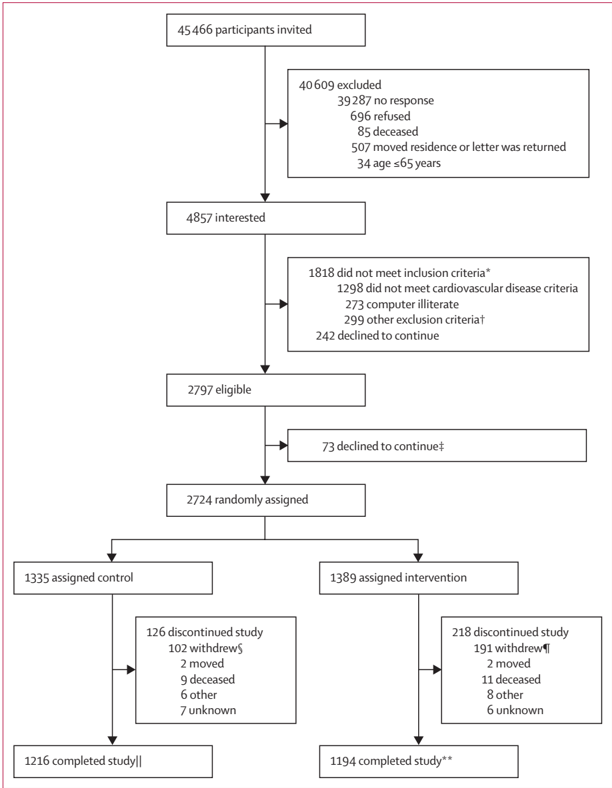
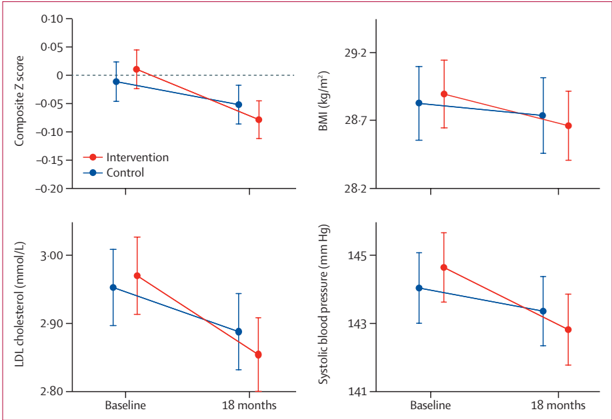
Background Although web-based interventions have been promoted for cardiovascular risk management over the past decade, there is limited evidence for effectiveness of these interventions in people older than 65 years. The healthy ageing through internet counselling in the elderly (HATICE) trial aimed to determine whether a coach-supported internet intervention for self-management can reduce cardiovascular risk in community-dwelling older people. Methods This prospective open-label, blinded endpoint clinical trial among people age 65 years or over at increased risk of cardiovascular disease randomly assigned participants in the Netherlands, Finland, and France to an interactive internet intervention stimulating coach-supported self-management or a control platform. Primary outcome was the difference from baseline to 18 months on a standardised composite score (Z score) of systolic blood pressure, LDL cholesterol, and body-mass index (BMI). Secondary outcomes included individual risk factors and cardiovascular endpoints. This trial is registered with the ISRCTN registry, 48151589, and is closed to accrual. Findings Among 2724 participants, complete primary outcome data were available for 2398 (88%). After 18 months, the primary outcome improved in the intervention group versus the control group (0·09 vs 0·04, respectively; mean difference −0·05, 95% CI −0·08 to −0·01; p=0·008). For individual components of the primary outcome, mean differences (intervention vs control) were systolic blood pressure −1·79 mm Hg versus −0·67 mm Hg (−1·12, −2·51 to 0·27); BMI −0·23 kg/m 2 versus −0·08 kg/m 2 (−0·15, −0·28 to −0·01); and LDL −0·12 mmol/L versus −0·07 mmol/L (−0·05, −0·11 to 0·01). Cardiovascular disease occurred in 30 (2·2%) of 1382 patients in the intervention versus 32 (2·4%) of 1333 patients in the control group (hazard ratio 0·86, 95% CI 0·52 to 1·43). Interpretation Coach-supported self-management of cardiovascular risk factors using an interactive internet intervention is feasible in an older population, and leads to a modest improvement of cardiovascular risk profile. When implemented on a large scale this could potentially reduce the burden of cardiovascular disease. Funding European Commission Seventh Framework Programme.
Overview
The claims and statistics of this paper haven’t been checked yet.
Free: it reads the open-access text and checks the first 5 claims that cite a source we can check. Create a free account to check every claim.
Integrity signals
Registry
Cites
Statistics
Figures
Verification
Claims the paper makes
The claims and statistics of this paper haven’t been checked yet.
Free: it reads the open-access text and checks the first 5 claims that cite a source we can check. Create a free account to check every claim.
Claims other papers make about this one
Each is checked against this paper’s own text: does it say what the citing paper says it does?
The source backs part of the claim, not all of it — or backs it for a different population, condition or comparison.
In the citing paper
“This composite Z-score reduction of −0.09 was associated with hazard ratios (95% CIs) of 0.86 (0.52–1.43) and 0.30 (0.10–0.93) for incident total CVD and stroke risk, respectively, compared to the control group in 2724 older adults”
From Aerobic, resistance, or combined exercise training and cardiovascular risk profile in overweight or obese adults: the CardioRACE trial (2024) · cites this paper as [39]
Experimental — accuracy not yet measuredThe cited source says what the claim attributes to it.
In the citing paper
“A small improvement in the cardiovascular risk composite primary outcome was observed in the intervention group compared with the control group at 18 months, mainly through weight loss”
From Dementia prevention, intervention, and care: 2020 report of the Lancet Commission (2020) · cites this paper as [158]
The cited source says what the claim attributes to it.
In the citing paper
“A larger effect was observed in the younger age group (65–70 years) and those with the lowest level of education, who had a higher baseline risk”
From Dementia prevention, intervention, and care: 2020 report of the Lancet Commission (2020) · cites this paper as [158]
The cited source says what the claim attributes to it.
In the citing paper
“and the dementia risk score was slightly lower in those who received the intervention (mean difference −0·15, 95% CI −0·3 to −0·0).”
From Dementia prevention, intervention, and care: 2020 report of the Lancet Commission (2020) · cites this paper as [158]
The cited source says what the claim attributes to it.
In the citing paper
“The Healthy Ageing through Internet Counselling in the Elderly (HATICE) trial observed a reduction of −0.09 in their composite average Z-score, derived from systolic blood pressure, LDL-C, and BMI after an 18-month healthy lifestyle intervention including physical activity counselling.39”
From Aerobic, resistance, or combined exercise training and cardiovascular risk profile in overweight or obese adults: the CardioRACE trial (2024) · cites this paper as [39]
Self-check
Percentages, sums and reported differences re-computed from the paper’s own numbers.
The self-check needs the paper’s full text.
Citations
Cites
In search of how people change: Applications to addictive behaviors.
Prochaska, J. O., DiClemente, C. C., & Norcross, J. C. (1992) · American Psychologist · doi:10.1037/0003-066x.47.9.1102 · Cited by 8,596
Forouzanfar, M. H., Afshin, A., Alexander, L. T., Anderson, H. R., Bhutta, Z. A., Biryukov, S., Brauer, M., Burnett, R., Cercy, K., Charlson, F. J., et al. (2016) · The Lancet · doi:10.1016/s0140-6736(16)31679-8 · Cited by 7,698
Self-citationA Randomized Trial of Intensive versus Standard Blood-Pressure Control
The SPRINT Research Group (2015) · New England Journal of Medicine · doi:10.1056/nejmoa1511939 · Cited by 6,325
Naghavi, M., Abajobir, A. A., Abbafati, C., Abbas, K. M., Abd-Allah, F., Abera, S. F., Aboyans, V., Adetokunboh, O., Afshin, A., Agrawal, A., et al. (2017) · The Lancet · doi:10.1016/s0140-6736(17)32152-9 · Cited by 4,821
Gorelick, P. B., Scuteri, A., Black, S. E., DeCarli, C., Greenberg, S. M., Iadecola, C., Launer, L. J., Laurent, S., Lopez, O. L., Nyenhuis, D., et al. (2011) · Stroke · doi:10.1161/str.0b013e3182299496 · Cited by 3,811
Ngandu, T., Lehtisalo, J., Solomon, A., Levälahti, E., Ahtiluoto, S., Antikainen, R., Bäckman, L., Hänninen, T., Jula, A., Laatikainen, T., et al. (2015) · The Lancet · doi:10.1016/s0140-6736(15)60461-5 · Cited by 3,689
Self-citationPatient Self-management of Chronic Disease in Primary Care
Bodenheimer, T. (2002) · JAMA · doi:10.1001/jama.288.19.2469 · Cited by 3,598
Health promotion from the perspective of Social Cognitive Theory
Bandura, A. (1998) · Psychology & Health · doi:10.1080/08870449808407422 · Cited by 3,087
Cardiovascular effects of intensive lifestyle intervention in type 2 diabetes
The Look AHEAD Research Group (2013) · New England Journal of Medicine · doi:10.1056/nejmoa1212914 · Cited by 2,908
Gakidou, E., Afshin, A., Abajobir, A. A., Abate, K. H., Abbafati, C., Abbas, K. M., Abd-Allah, F., Abdulle, A. M., Abera, S. F., Aboyans, V., et al. (2017) · The Lancet · doi:10.1016/s0140-6736(17)32366-8 · Cited by 2,406
Cited by
Items 101–150 of 150
Yan, M., Hu, B., Tse, L. A., Zhu, Y., Liu, Z., Wang, D., & Li, W. (2024) · Preventive Medicine · doi:10.1016/j.ypmed.2024.108009 · Cited by 6
Klöppel, S., Brill, E., Frisoni, G. B., Aarsland, D., & Klusmann, V. (2024) · The Lancet Healthy Longevity · doi:10.1016/s2666-7568(24)00069-2 · Cited by 3
Zülke, A. E., Blotenberg, I., Luppa, M., Löbner, M., Döhring, J., Williamson, M., Kosilek, R. P., Michel, I., Oey, A., Brettschneider, C., et al. (2024) · European Journal of Nutrition · doi:10.1007/s00394-024-03563-z · Cited by 4
“The multidomain Healthy Ageing Through Internet Coun-seling in the Elderly (HATICE)-trial did not find intervention effects on adherence to a Mediterranean diet ([33]).”
Lau, A., Young, A., Han, C. Y., Miller, E. M., Heim, M. E., & Miller, M. (2025) · Advances in Nutrition · doi:10.1016/j.advnut.2025.100401 · Cited by 5
“…evaluating the educational nutrition intervention or prototype in various ways, such as through qualitative interviews [39], a Think-Aloud method [37,38,40,41,46], a pilot trial [32,42,43,45,56,58], a feasibility trial [47,62], usability testing [38,41], and/or an effectiveness trial [43,44,61,59].”
Determining factors on active aging in Asia and Oceania: a systematic review
Liu, Y., Verma, R., & Theng, Y. (2022) · Elsevier eBooks · doi:10.1016/b978-0-12-823761-8.00023-9 · Cited by 3
Experiences and Psychosocial Issues Among the Elderly Population in the Digital Era
Paul, F. A., Ali, A., Bora, D., & Ganie, A. U. R. (2023) · Springer eBooks · doi:10.1007/978-3-030-68127-2_370-1 · Cited by 4
Chen, Y., Luo, F., Han, L., Qin, Q., Zeng, Q., Zhou, X., Huang, Y., Gao, Q., Wang, W., Shi, Q., et al. (2023) · International Journal of Biometeorology · doi:10.1007/s00484-023-02558-5 · Cited by 3
“…with few desirable enhancements (Sun et al. 2020; Koeder et al. 2022; Rathnayake et al. 2019; Hwang and Kim 2019; Williams et al. 2014; Pettman et al. 2009; Arao et al. 2007; Chen et al. 2013; Alert et al. 2013; Ijzelenberg et al. 2012; Azar et al. 2016; Richard et al. 2019; Trento et al. 2020).”
Tee, L. Y., Tan, L. F., Seetharaman, S. K., Low, L. L., Ong, Z. P., Bashil, M., & Teo, H. (2025) · Mayo Clinic Proceedings Digital Health · doi:10.1016/j.mcpdig.2025.100252 · Cited by 2
Davison, N., Waddell, A., Chandrasekara, D., Tran, T. D., Hammarberg, K., Kirkman, M., Nimesh, S., Lowthian, J. A., Olivier, P. L., Romero, L., et al. (2024) · BMJ Open · doi:10.1136/bmjopen-2024-085304 · Cited by 2
Maity, K., Lal, P., Jyoti, S., Bali, P., Thakur, U. K., Singh, G., Majumdar, V., Patra, S., Arya, J., & Anand, A. (2024) · Annals of Neurosciences · doi:10.1177/09727531231208292 · Cited by 2
“90 Even though several treatment modalities are available to improve mental health in the elderly, there is a need to give more priority to the patient by implementing patient-friendly humanistic and holistic strategies to improve the mental health of the elderly during the post-COVID era, 91 where…”
Digital health for cardiovascular disease and diabetes
Shan, R., Kim, C. H., Spaulding, E. M., Marvel, F. A., & Martin, S. S. (2025) · Elsevier eBooks · doi:10.1016/b978-0-443-15728-8.00004-5 · Cited by 2
Household-level lifestyle interventions for the prevention of cognitive decline; A Systematic review
Costello, M. M., McCarthy, C., Judge, C. S., Dennehy, K., McDermott, C., Flatharta, T. Ó., O'Donnell, M. J., & Canavan, M. D. (2021) · Archives of Gerontology and Geriatrics · doi:10.1016/j.archger.2021.104565 · Cited by 2
Durgante, H. B., & Dell’Aglio, D. D. (2022) · Ciencias Psicológicas · doi:10.22235/cp.v16i2.2250 · Cited by 2
Kwon, S., Shin, O., & Hernández, R. (2023) · Educational Gerontology · doi:10.1080/03601277.2023.2216090 · Cited by 2
“PA interventions for older adults, especially when combined with online eHealth tools, play a significant role in improving CVH (Beishuizen et al., 2016; Richard et al., 2019) and physical function (Broekhuizen et al., 2016; Mouton & Cloes, 2014; Ratz et al., 2020).”
BackgroundØbro, L. F., Heiselberg, K., Krogh, P. G., Handberg, C., Ammentorp, J., Pihl, G. T., & Osther, P. J. S. (2021) · Patient Education and Counseling · doi:10.1016/j.pec.2021.06.035 · Cited by 1
Zhang, J., Eggink, E., Zhang, X., Li, X., Jiang, B., Liu, H., Ge, S., Zhang, W., Lyu, J., Niu, Y., et al. (2021) · doi:10.2196/preprints.27684 · Cited by 2
Self-citationSchultz, A., Luppa, M., Bleckwenn, M., Riedel-Heller, S. G., & Zülke, A. E. (2025) · JMIR Formative Research · doi:10.2196/56310 · Cited by 1
“Digital interventions aimed at enhancing brain health and mitigating dementia risk factors are currently an important focus of research [13-15], which explores potential benefits and challenges of digital apps for dementia risk reduction, highlighting their capacity to deliver personalized…”
Lavoie, A., & Dubé, V. (2025) · JMIR Research Protocols · doi:10.2196/67678 · Cited by 3
“Web-based secondary prevention interventions for people with CHD tend to be tailored rather than individualized to needs [32] and often lack interaction with health care professionals [33,34], factors that are critical for sustained engagement [35,36].”
Tullipan, M., George, J., Magin, P. J., Godbee, K., Ferns, J., & Frewin, C. (2025) · The Journal of Prevention of Alzheimer s Disease · doi:10.1016/j.tjpad.2025.100187 · Cited by 3
“Evidence from large multidomain intervention trials such as FINGER [ 8 ] and HATICE [ 9 ] suggests preventive efforts may be more effective when targeting middle-aged people with multiple risk factors for dementia.”
Ding, Z., Pang, T. W.-Y., & Chan, A. S.-Y. (2025) · Journal of Alzheimer s Disease · doi:10.1177/13872877251360209 · Cited by 1
“11,12,14 In contrast, other studies did not observe intervention-induced signi fi cant changes in cognitive performances 9,10,13,15 or the incidence of dementia.”
Multinational Comparisons of Factors Associated with Internet Use Among Older Adults
Gu, D., Feng, Q., Wang, K., Zhu, H., & Chen, S. X. (2025) · Advances in studies of aging and health · doi:10.1007/978-3-031-98964-3_8 · Cited by 1
van der Endt, A. R., Lindhout, J. E., van Apeldoorn, J. A. N., Amponsah, R., Ramkishun, R., Sert, E., Craamer, C., Richard, E., Hoevenaar‐Blom, M. P., & van Charante, E. P. M. (2025) · Journal of Participatory Medicine · doi:10.2196/76094 · Cited by 1
“In the Healthy Aging through Internet Counseling of the Elderly (HATICE) [9] and Prevention of Dementia by Mobile Phone Applications (PRODEMOS) trials [10], our research team focused on self-management of lifestyle-related cardiovascular and dementia risk factors through interventions delivered via…”
Self-citationDoes Multidomain Intervention Reduce The Risk Of Developing Dementia In MCI Patients?
Bonvicini, M., Cannizzaro, S. G., Giudice, E. D., Volpe, M. S., Minnetti, A., & Palleschi, L. (2022) · International Journal of Psychiatry Research · doi:10.33425/2641-4317.1144 · Cited by 1
“The Healthy Ageing Through Internet Counselling in the Elderly (HATICE)) [32] investigated the effectiveness of multidomain intervention but they had inconclusive results [33].”
BackgroundWittich, W., Kröger, E., Aubin, G., Fadhlaoui, A., Anderson, N. D., Gaied, N. B., Itzhak, I., & Belleville, S. (2023) · BMJ Open · doi:10.1136/bmjopen-2023-074555 · Cited by 2
“Although some studies have shown that older adults can benefit from online interventions, 13 20 there are challenges in using and implementing these interventions.”
BackgroundCatalano, A., Gilcrease, G. W., Macciotta, A., Milani, L., Aimaretti, G., Torbica, A., Sciascia, S., & Ricceri, F. (2025) · The Journals of Gerontology Series B · doi:10.1093/geronb/gbaf209 · Cited by 1
“…al., 2015; Jennings et al., 2020; Kolind et al., 2023; Kujawski S et al., 2018; New-man et al., 2016; Noh et al., 2022; Oh et al., 2017; Rao et al., 2016; Richard et al., 2016, 2019; Sala Vila et al., 2020; Stief-vatter et al., 2022; Thom et al., 2021; Wernicke et al., 2023; Withall et al., 2020).”
Beyer, F., Kleine, L., Zülke, A. E., Luppa, M., Mildner, T., Frese, T., Gensichen, J. S., Czock, D., Wiese, B., König, H., et al. (2024) · Research Square · doi:10.21203/rs.3.rs-5303457/v1 · Cited by 1
Aplicativos móveis para a promoção de hábitos saudáveis de alimentação em idosos
Prado, A. R. C. D., Silva, K. H. C. V. E., & Carvalho, G. A. (2021) · Revista Gestão do Conhecimento e Tecnologia da Informação · doi:10.31501/rgcti.v4i1.12024
Web-based Interventions to Promote Healthy Lifestyle for Older Adults: A Scoping Review (Preprint)Preprint
Lavoie, A., & Dubé, V. (2022) · doi:10.2196/preprints.37315
Costello, M. M., Carthy, C. E. M., Bosch, J., Robinson, S., McDermott, C., Canavan, M. D., & O'Donnell, M. J. (2022) · BMC Geriatrics · doi:10.1186/s12877-022-02941-8
Ohmann, C., Canham, S., Majcen, K., Meloni, V., Pireddu, L., Sulis, A., Delussu, G., Frexia, F., & Holub, P. (2024) · Open Research Europe · doi:10.12688/openreseurope.17131.1
Lavoie, A., Truchot-Cardot, D., & Dubé, V. (2025) · CIN Computers Informatics Nursing · doi:10.1097/cin.0000000000001339
Feasibility study of a digital NHS Health Check
Gidlow, C. J., Sams, L., Riley, V., Ellis, N., Povey, R. C., Nolan, A., Walsh, G., Green, H., & Thompson, K. (2025) · BMC Digital Health · doi:10.1186/s44247-025-00161-9
“For example, Healthy Ageing through Internet Counselling in the Elderly (HATICE) uses an internet-based platform to reduce CVD risk through a coach trained in motivational interviewing providing remote support for older people [24].”
Moreno, M., Cuadrado, C. T., Palomo, M. S. M., Delgado‐Álvarez, A., Ortiz, M. E., Ribas, G. G., Luque, M. L., Dolado, A. M., Matías‐Guiu, J., Lopez, C. O., et al. (2025) · Neurología · doi:10.1016/j.nrl.2025.501918 · Cited by 1
“Otros ensayos como Healthy Aging Through Internet Counseling in the Elderly (HATICE), fue el primero en evaluar mediante una intervención guiada interactiva basada en Internet 42 , y Pre-vención con Dieta Mediterránea (PREDIMED), el más extenso nacional sobre dieta mediterránea y suplementos de aceite de oliva y nuece…”
Wang, D., Hu, K., McGill, B., Marshall, S. K., & Allman-Farinelli, M. A. (2025) · International Journal of Health Promotion and Education · doi:10.1080/14635240.2025.2588180
Tsai, Y. I., Beh, J., Ganderton, C. L., & Pranata, A. (2024) · Figshare · doi:10.6084/m9.figshare.26688206
Rosenberg, A., Coley, N., Soulier, A., Kulmala, J., Soininen, H., Andrieu, S., Kivipelto, M., & Barbera, M. (2020) · Figshare · doi:10.6084/m9.figshare.11978574
Self-citationZhao, Y., Marder, K. S., & Wang, Y. (2026) · medRxiv · doi:10.64898/2026.02.10.26345240
Handels, R. L. H., Hoevenaar‐Blom, M. P., Song, M., Brayne, C., van Charante, E. P. M., Matthews, F. E., Xu, J., Jönsson, L., Coley, N., Brooks, R. L., et al. (2026) · The Journal of Prevention of Alzheimer s Disease · doi:10.1016/j.tjpad.2026.100526
“…and control arm in CAIDE score of (cid:0) 0.16 (Multidomain Alzheimer Preventive Trial (MAPT) [45]), ‑ 0.19 (preDIVA [46]), ‑ 0.11 (Healthy ageing through internet counselling in the elderly (HATICE) [47]), and (cid:0) 0.16 (FINGER [48]), as compared to (cid:0) 0.16 in the PRODEMOS study [6].”
InfluentialSelf-citationGil‐Moreno, M. J., Cuadrado, C. T., Palomo, M. S. M., Alvarez, A. D., Ortiz, M. E., Ribas, G. G., Luque, M. L., Dolado, A. M., Matías‐Guiu, J., Lopez, C. O., et al. (2026) · Neurología (English Edition) · doi:10.1016/j.nrleng.2026.501918
Welmer, A., Leavy, B., Thunborg, C., Holleman, J., Karlsson, P., Hallinder, H., Aspö, M., Bergström, C. D., Åkesson, E., Kulmala, J., et al. (2026) · BMJ Open · doi:10.1136/bmjopen-2025-111346
Self-citationLavoie, A., & Dubé, V. (2026) · Canadian Journal of Nursing Research · doi:10.1177/08445621261452849
“…from broader research, for such interventions to be effective, they would need to be tailored to older adults ’ speci fi c needs (Ligthart et al., 2015; Richard et al., 2019), include professional support (Pols, 2017; van Middelaar et al., 2018), and be grounded in behavioral change theory…”
Sakurai, T. (2026) · Nippon Ronen Igakkai Zasshi Japanese Journal of Geriatrics · doi:10.3143/geriatrics.63.86
Omkar, A., Bertrand, J. K., Sadasivan, C., Osness, E., Vandermeer, B., Ding, X., Dennett, L., Mansour, J., Ezeugwu, V. E., Hyde, A. M., et al. (2026) · Digital Health · doi:10.1177/20552076261473804
Singh, M. (2025) · Integrative Medicine Case Reports · doi:10.5005/imcr-11021-0010
Towards the Prevention of Freezing of Gait in Parkinson's Disease
Tosserams, A., Nonnekes, J. H., Bloem, B. R., & Postma, E. M. (2026) · European Journal of Neuroscience · doi:10.1111/ejn.70636 · Cited by 1
Korthauer, L. E., Rosen, R., Arias, I., Tremont, G., & Davis, J. D. (2026) · Aging & Mental Health · doi:10.1080/13607863.2026.2726340 · Cited by 1
Experiences and Psychosocial Issues Among the Elderly Population in the Digital Era
Paul, F. A., Ali, A., Bora, D., & Ganie, A. U. R. (2026) · Springer eBooks · doi:10.1007/978-3-032-35691-8_370
Zhang, Y., Merchant, A. T., Yang, C., Xu, H., Schulz, P. E., Crump, C., & Wei, J. (2026) · Alzheimer s & Dementia Translational Research & Clinical Interventions · doi:10.1002/trc2.70307
“37 41 While multidomain programs require more resources than single-component advice, cost-effectiveness evidence isemergingforFINGER-basedinterventions.”
Zülke, A. E., Schultz, A., Luppa, M., Weise, S., Bauer, A., Döhring, J., Wolf, C., Kosilek, R. P., Ziegler, J., Brettschneider, C., et al. (2026) · BMC Geriatrics · doi:10.1186/s12877-026-08492-6
“Our results differ from previous studies testing lifestyle interventions for dementia risk reduction, i.e., the FIN- GER-and HATICE-trials, reporting beneficial effects of interventions delivered in-person (FINGER) or remotely (HATICE) on weight loss [2, 17].”
Metadata
- Authors
- Richard, E., Moll van Charante, E. P., Hoevenaar-Blom, M. P., Coley, N., Barbera, M., van der Groep, A., Meiller, Y., Mangialasche, F., Beishuizen, C. B., Jongstra, S., van Middelaar, T., Van Wanrooij, L. L., Ngandu, T., Guillemont, J., Andrieu, S., Brayne, C., Kivipelto, M., Soininen, H., & Van Gool, W. A.
- Affiliations
- Radboud University Nijmegen (NL)
- Inserm (FR)
- University of Eastern Finland (FI)
- ESCP Business School (FR)
- Stockholm University (SE)
- Amsterdam University Medical Centers (NL)
- Karolinska Institutet (SE)
- University of Cambridge (GB)
- Corresponding author
- Richard, Edo
- ORCID
- Venue
- The Lancet Digital Health
- Publisher
- Elsevier BV
- Published
- 2019-12
- Volume
- 1
- Issue
- 8
- Pages
- e424-e434
- ISSN
- 2589-7500 (ISSN-L)
- OpenAlex
- W2985616448
- Semantic Scholar
- 8600201cf1863f6da0267e36a2c6e622077f0742
- Cited by
- 150
- References
- 30
- Citations by year
- 2026: 14 · 2025: 28 · 2024: 25 · 2023: 18 · 2022: 32 · 2021: 23 · 2020: 9 · 2019: 1
- FWCI
- 22.26
- Type
- journal article
- Language
- en
- Open access
- gold
- doi.org
- Licence
- cc-by
- www.elsevier.com/tdm/userlicense/1.0/ (tdm)
- www.elsevier.com/legal/tdmrep-license (tdm)
- creativecommons.org/licenses/by/4.0/ (vor)
- Locations
- The Lancet Digital Health (publishedVersion, cc-by)
- PubMed (publishedVersion)
- Pure Amsterdam UMC (publishedVersion, other-oa)
- HAL (submittedVersion, other-oa)
- Data Archiving and Networked Services (DANS) (submittedVersion, other-oa)
- DOAJ (DOAJ: Directory of Open Access Journals) (submittedVersion)
- Pure Amsterdam UMC (submittedVersion, other-oa)
- Radboud Repository (Radboud University) (submittedVersion)
- STM:n Hallinnonalan avoin julkaisuarkisto (Julkari) (submittedVersion)
- Radboud Repository (Radboud University) (submittedVersion, other-oa)
- Funders
- Seventh Framework Programme (305374)
- Topics
- Health Sciences › Health Professions › General Health Professions › Mobile Health and mHealth Applications
- Social Sciences › Psychology › Applied Psychology › Digital Mental Health Interventions
- Health Sciences › Medicine › Geriatrics and Gerontology › Technology Use by Older Adults
- Keywords
- healthy aging, online intervention, cardiovascular risk management, self-management, older adults, systolic blood pressure, LDL cholesterol, body mass index, cardiovascular disease prevention, community-dwelling older adults, cardiovascular risk profile, Finland, France, lifestyle modification, feasibility and acceptability, cost-effectiveness
- MeSH terms
- Self-Management, Healthy Aging, Aged, Cardiovascular Diseases, Female, Finland, France, Humans, Male, Netherlands, Prospective Studies, Risk, Internet, Directive Counseling
About these checks
Registry, retraction, Cites and statistics results are computed, not judged, with one exception: a printed reference that no index lists is read once by a model before it counts as a citation error. Claims are extracted by a model and kept only when their quote appears verbatim in the text; each cited source is then checked, with a model’s help, for whether it says what the claim relies on. Those verdicts can be wrong — read the claim’s quote and the cited source before relying on one.
Statistics and arithmetic are recomputed, not judged.
Confidence bands are shown only for fields calibrated on our annotated test set. None is calibrated yet, so no band is shown.
What counts as a claim ›How we measure confidence ›How we check this ›
Are you an author, or do you see a problem with this page? Request a review
Data sources
Bibliographic data: Semantic Scholar, OpenAlex, Crossref.
Contains information from the Semantic Scholar Academic Graph Datasets, made available under the ODC Attribution License (ODC-BY 1.0).
Semantic Scholar’s data is described in: Kinney, R., et al. (2023). The Semantic Scholar Open Data Platform. arXiv:2301.10140.
