

Effectiveness, reach, uptake, and feasibility of digital health interventions for adults with hypertension: a systematic review and meta-analysis of randomised controlled trials
Open accessThe DOI matches its Crossref record; 87 of the 87 references it cites were found in a registry or an index.
Abstract
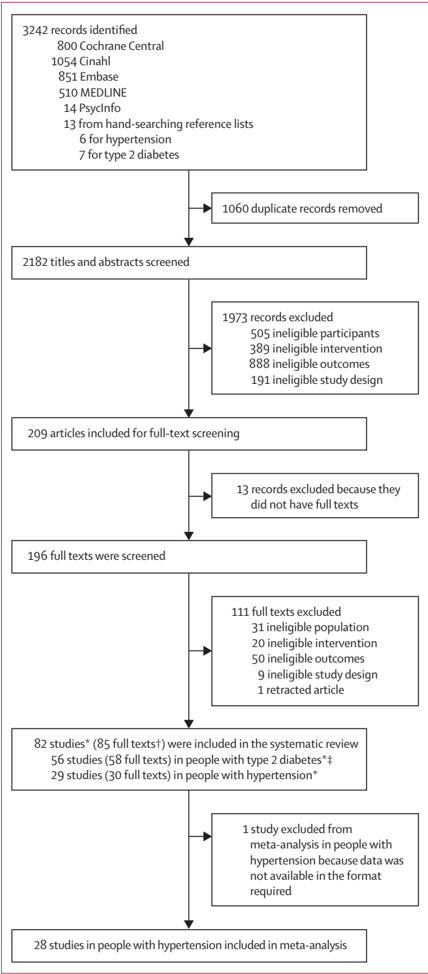
BACKGROUND: Digital health interventions are effective for hypertension self-management, but a comparison of the effectiveness and implementation of the different modes of interventions is not currently available. This study aimed to compare the effectiveness of SMS, smartphone application, and website interventions on improving blood pressure in adults with hypertension, and to report on their reach, uptake, and feasibility. METHODS: In this systematic review and meta-analysis we searched CINAHL Complete, Cochrane Central Register of Controlled Trials, Ovid Embase, Ovid MEDLINE, and APA PsycInfo on May 25, 2022, for randomised controlled trials (RCTs) published in English from Jan 1, 2009, that examined the effectiveness of digital health interventions on reducing blood pressure in adults with hypertension. Screening was carried out using Covidence, and data were extracted following Cochrane's guidelines. The primary endpoint was change in the mean of systolic blood pressure. Risk of bias was assessed with Cochrane Risk of Bias 2. Data on systolic and diastolic blood pressure reduction were synthesised in a meta-analysis, and data on reach, uptake and feasibility were summarised narratively. Grading of Recommendations, Assessment, Development, and Evaluation criteria were used to evaluate the level of evidence. The study was registered with PROSPERO CRD42021247845. FINDINGS: Of the 3235 records identified, 29 RCTs from 13 regions (n=7592 participants) were included in the systematic review, and 28 of these RCTs (n=7092 participants) were included in the meta-analysis. 11 studies used SMS as the primary mode of delivery of the digital health intervention, 13 used smartphone applications, and five used websites. Overall, digital health intervention group participants had a -3·62 mm Hg (95% CI -5·22 to -2·02) greater reduction in systolic blood pressure, and a -2·45 mm Hg (-3·83 to -1·07) greater reduction in diastolic blood pressure, compared with control group participants. No statistically significant differences between the three different modes of delivery were observed for both the systolic (p=0·73) and the diastolic blood pressure (p=0·80) outcomes. Smartphone application interventions had a statistically significant reduction in diastolic blood pressure (-2·45 mm Hg [-4·15 to -0·74]); however, there were no statistically significant reductions for SMS interventions (-1·80 mm Hg [-4·60 to 1·00]) or website interventions (-3·43 mm Hg [-7·24 to 0·38]). Due to the considerable heterogeneity between included studies and the high risk of bias in some, the level of evidence was assigned a low overall score. Interventions were more effective among people with greater severity of hypertension at baseline. SMS interventions reported higher reach and smartphone application studies reported higher uptake, but differences were not statistically significant. INTERPRETATION: SMS, smartphone application, and website interventions were associated with statistically and clinically significant systolic and diastolic blood pressure reductions, compared with usual care, regardless of the mode of delivery of the intervention. This conclusion is tempered by the considerable heterogeneity of included studies and the high risk of bias in most. Future studies need to describe in detail the mediators and moderators of the effectiveness and implementation of these interventions, to both further improve their effectiveness as well as increase their reach, uptake, and feasibility. FUNDING: European Union's Horizon 2020 Research and Innovation Programme.
Overview
The claims and statistics of this paper haven’t been checked yet.
Free: it reads the open-access text and checks the first 5 claims that cite a source we can check. Create a free account to check every claim.
Integrity signals
Registry
Cites
Statistics
Figures
Verification
Claims the paper makes
The claims and statistics of this paper haven’t been checked yet.
Free: it reads the open-access text and checks the first 5 claims that cite a source we can check. Create a free account to check every claim.
Claims other papers make about this one
Each is checked against this paper’s own text: does it say what the citing paper says it does?
The source backs part of the claim, not all of it — or backs it for a different population, condition or comparison.
In the citing paper
“Several meta-analyses reported that digital health interventions reduced both systolic BP and diastolic BP in individuals with hypertension compared with face-to-face delivery.”
From Effectiveness of digital health interventions on blood pressure control, lifestyle behaviours and adherence to medication in patients with hypertension in low-income and middle-income countries: a systematic review and meta-analysis of randomised controlled trials (2024) · cites this paper as [16]
Experimental — accuracy not yet measuredThe source backs part of the claim, not all of it — or backs it for a different population, condition or comparison.
In the citing paper
“Since a minimum of 92% of the worldwide population has access to several digital health devices”
From Effectiveness of digital health interventions on blood pressure control, lifestyle behaviours and adherence to medication in patients with hypertension in low-income and middle-income countries: a systematic review and meta-analysis of randomised controlled trials (2024) · cites this paper as [16]
Experimental — accuracy not yet measuredThe source backs part of the claim, not all of it — or backs it for a different population, condition or comparison.
In the citing paper
“Data show that out of 6.9 billion of the global population, 86% have access to smartphones, 92% use orthodox mobile phones, and 64% have internet access.”
From Effectiveness of digital health interventions on blood pressure control, lifestyle behaviours and adherence to medication in patients with hypertension in low-income and middle-income countries: a systematic review and meta-analysis of randomised controlled trials (2024) · cites this paper as [16]
Experimental — accuracy not yet measuredThe source backs part of the claim, not all of it — or backs it for a different population, condition or comparison.
In the citing paper
“Similarly, a study with global individual data (n = 7092 respondents) confirmed that digital health intervention provides a notable reduction in SBP by 3.62 and DBP by 2.45 mm Hg compared with the control.16”
From Effectiveness of digital health interventions on blood pressure control, lifestyle behaviours and adherence to medication in patients with hypertension in low-income and middle-income countries: a systematic review and meta-analysis of randomised controlled trials (2024) · cites this paper as [16]
Experimental — accuracy not yet measuredThe source backs part of the claim, not all of it — or backs it for a different population, condition or comparison.
In the citing paper
“Second, due to challenges in accessing internet services, more people in LMICs own a telephone with SMS capacity compared to smartphones.16”
From Effectiveness of digital health interventions on blood pressure control, lifestyle behaviours and adherence to medication in patients with hypertension in low-income and middle-income countries: a systematic review and meta-analysis of randomised controlled trials (2024) · cites this paper as [16]
Experimental — accuracy not yet measured
4 more claims about this paper
Create a free account to see every claim other papers make about this one.
Self-check
Percentages, sums and reported differences re-computed from the paper’s own numbers.
The self-check needs the paper’s full text.
Citations
Cites
The PRISMA 2020 statement: An updated guideline for reporting systematic reviews
Page, M. J., McKenzie, J. E., Bossuyt, P. M., Boutron, I., Hoffmann, T. C., Mulrow, C. D., Shamseer, L., Tetzlaff, J. M., Akl, E. A., Brennan, S. E., et al. (2021) · BMJ · doi:10.1136/bmj.n71 · Cited by 108,283
Measuring inconsistency in meta-analyses
Higgins, J. P. T., Thompson, S. G., Deeks, J. J., & Altman, D. G. (2003) · BMJ · doi:10.1136/bmj.327.7414.557 · Cited by 63,139
Meta-analysis in clinical trials
DerSimonian, R., & Laird, N. (1986) · Controlled Clinical Trials · doi:10.1016/0197-2456(86)90046-2 · Cited by 39,552
RoB 2: a revised tool for assessing risk of bias in randomised trials
Sterne, J. A. C., Savović, J., Page, M. J., Elbers, R. G., Blencowe, N. S., Boutron, I., Cates, C. J., Cheng, H.-Y., Corbett, M. S., Eldridge, S. M., et al. (2019) · BMJ · doi:10.1136/bmj.l4898 · Cited by 34,787
Murray, C. J. L., Aravkin, A. Y., Zheng, P., Abbafati, C., Abbas, K. M., Abbasi-Kangevari, M., Abd-Allah, F., Abdelalim, A., Abdollahi, M., Abdollahpour, I., et al. (2020) · The Lancet · doi:10.1016/s0140-6736(20)30752-2 · Cited by 9,854
GRADE guidelines: 3. Rating the quality of evidence
Balshem, H., Helfand, M., Schünemann, H. J., Oxman, A. D., Kunz, R., Brozek, J., Vist, G. E., Falck-Ytter, Y., Meerpohl, J., & Norris, S. (2011) · Journal of Clinical Epidemiology · doi:10.1016/j.jclinepi.2010.07.015 · Cited by 8,285
Process evaluation of complex interventions: Medical Research Council guidance
Moore, G. F., Audrey, S., Barker, M., Bond, L., Bonell, C., Hardeman, W., Moore, L., O'Cathain, A., Tinati, T., Wight, D., et al. (2015) · BMJ · doi:10.1136/bmj.h1258 · Cited by 6,204
Skivington, K., Matthews, L., Simpson, S. A., Craig, P., Baird, J., Blazeby, J. M., Boyd, K. A., Craig, N., French, D. P., McIntosh, E., et al. (2021) · BMJ · doi:10.1136/bmj.n2061 · Cited by 5,808
2020 International Society of Hypertension Global Hypertension Practice Guidelines
Unger, T., Borghi, C., Charchar, F., Khan, N. A., Poulter, N. R., Prabhakaran, D., Ramirez, A., Schlaich, M., Stergiou, G. S., Tomaszewski, M., et al. (2020) · Hypertension · doi:10.1161/hypertensionaha.120.15026 · Cited by 4,132
Self-citationGRADE guidelines 6. Rating the quality of evidence—imprecision
Guyatt, G. H., Oxman, A. D., Kunz, R., Brozek, J., Alonso-Coello, P., Rind, D., Devereaux, P. J., Montori, V. M., Freyschuss, B., Vist, G., et al. (2011) · Journal of Clinical Epidemiology · doi:10.1016/j.jclinepi.2011.01.012 · Cited by 2,693
Research works printed but not linked: 2
- Moschonis G, Siopis G, Jung J, et al. Effectiveness, reach, uptake, and feasibility of digital health interventions for adults with type 2 diabetes: a systematic review and meta-analysis of randomised controlled trials. Lancet Digit Health 2023; 5: e144-59.
- Moore JO, Marshall MA, Judge DC, et al. Technology-supported apprenticeship in the management of hypertension: a randomized controlled trial. J Clin Outcomes Manag 2014; 21: 110-12.
Cited by
Moschonis, G., Siopis, G., Jung, J., Eweka, E., Willems, R., Kwasnicka, D., Asare, B. Y.-A., Kodithuwakku, V., Verhaeghe, N., Vedanthan, R., et al. (2023) · The Lancet Digital Health · doi:10.1016/s2589-7500(22)00233-3 · Cited by 149
Self-citationBoima, V., Doku, A., Agyekum, F., Tuglo, L. S., & Agyemang, C. (2024) · EClinicalMedicine · doi:10.1016/j.eclinm.2024.102432 · Cited by 82
“In contrast, a study by Siopis et al., 16 comparing the ef fi cacy of SMS, smartphone app, and website interventions on improving BP in adult patients with hypertension found that smartphone app and website interventions provided a greater remarkable reduction in SBP and DBP compared with SMS…”
BackgroundResultInfluentialOhya, Y., Arakawa, K., Arata, N., Arima, S., Arima, H., Asayama, K., Dohi, Y., Fukami, A., Furuhashi, M., Goto, K., et al. (2026) · Hypertension Research · doi:10.1038/s41440-025-02462-y · Cited by 107
Thomas, S. A., Browning, C. J., Charchar, F. J., Klein, B., Ory, M. G., Bowden‐Jones, H., & Chamberlain, S. R. (2023) · Frontiers in Public Health · doi:10.3389/fpubh.2023.1248254 · Cited by 97
Ambrosi, E., Mezzalira, E., Canzan, F., Leardini, C., Vita, G., Marini, G., & Longhini, J. (2025) · International Journal of Medical Informatics · doi:10.1016/j.ijmedinf.2025.105820 · Cited by 50
Muse, E. D., & Topol, E. J. (2024) · Cell Metabolism · doi:10.1016/j.cmet.2024.02.002 · Cited by 50
Kario, K., Williams, B., Tomitani, N., McManus, R. J., Schutte, A. E., Avolio, A. P., Shimbo, D., Wang, J., Khan, N. A., Picone, D. S., et al. (2024) · Journal of Hypertension · doi:10.1097/hjh.0000000000003827 · Cited by 43
Self-citationZhou, Y. J., Li, S., Huang, R.-Q., Ma, H., Wang, A., Tang, X., Pei, R., & Piao, M. (2024) · Journal of Medical Internet Research · doi:10.2196/54978 · Cited by 56
“For example, a meta-analysis including SMS text messaging, smartphone apps, and website interventions showed that mHealth interventions, particularly smartphone apps, were associated with clinical reductions in systolic BP (SBP) [10].”
Sakima, A., Akagi, Y., Akasaki, Y., Fujii, T., Haze, T., Kawakami-Mori, F., Kitajima, K., Kobayashi, Y., Matayoshi, T., Sakaguchi, T., et al. (2024) · Hypertension Research · doi:10.1038/s41440-024-01792-7 · Cited by 42
“The majority of individuals have access to a digital communication device and several digital health devices are available for hypertension management [15, 141]; thus, the choice of delivery mode should be based on patient preference, feasibility, and socioeconomic status.”
Influentialdo Nascimento, I. J. B., Abdulazeem, H. M., Weerasekara, I., Marquez, J. L., Vasanthan, L., Deeken, G., Morgan, R., Tan, H.-L., Aguirre, I. Y., Østengaard, L., et al. (2025) · The Lancet Digital Health · doi:10.1016/j.landig.2025.01.014 · Cited by 56
Willems, R. P., Annemans, L., Siopis, G., Moschonis, G., Vedanthan, R., Jung, J., Kwaśnicka, D., Oldenburg, B. F., D’Antonio, C., Girolami, S., et al. (2023) · npj Digital Medicine · doi:10.1038/s41746-023-00876-x · Cited by 34
Self-citationGong, E., Wang, H., Zhu, W., Galea, G., Xu, J., Yan, L. L., & Shao, R. (2024) · BMJ · doi:10.1136/bmj-2023-076768 · Cited by 24
Self-citationDigital interventions for self-management of prediabetes: A scoping review
Stowell, M., Dobson, R., Garner, K., Baig, M. M., Nehren, N., & Whittaker, R. (2024) · PLoS ONE · doi:10.1371/journal.pone.0303074 · Cited by 21
“The need for more evidence regarding multimodal digital health interventions and their mechanisms of impact has been highlighted by others [57–60].”
Digital hypertension – what we need for the high-quality management of hypertension in the new era
Kario, K., Asayama, K., Arima, H., Matsumoto, C., Nakagawa, N., Nomura, A., Satoh, M., Shinohara, K., Tomitani, N., Yamamoto, K. I., et al. (2025) · Hypertension Research · doi:10.1038/s41440-025-02307-8 · Cited by 17
“Emerging evidence has supported this direction, with studies reporting successful BP reduction through BP management applications and digital interventions [38, 105, 106].”
Mezzalira, E., Canzan, F., Marini, G. M. F., Longhini, J., Leardini, C., Saiani, L., & Ambrosi, E. (2024) · Health Policy and Technology · doi:10.1016/j.hlpt.2024.100896 · Cited by 24
Effects of a Digital Intervention to Improve DASH and Blood Pressure Among US Adults
Miller, H., Askew, S., Berger, M. B., Kay, M. C., Palipana, A., Trefney, E., Carr, L. T. B., Barnes, C. N., Tyson, C. C., Svetkey, L. P., et al. (2024) · Hypertension · doi:10.1161/hypertensionaha.124.23887 · Cited by 12
“27 However, the success of the interventions varied by baseline blood pressure, and whether participants with controlled blood pressure were included.”
Sukpattanasrikul, S., Singha-Dong, N., Sitthimongkol, Y., & Anonjarn, K. (2025) · International Journal of Nursing Sciences · doi:10.1016/j.ijnss.2025.04.001 · Cited by 18
“Several systematic reviews and meta-analyses reported the effects of DHIs on BP compared to traditional care [14,15,17].”
Zhao, D. H., Zhang, Y., Wang, J., He, L., He, Y., & Ma, C. (2025) · Nature Reviews Cardiology · doi:10.1038/s41569-025-01222-2 · Cited by 15
Targeting better hypertension control with the usage of the ESH smartphone application
Konstantinidis, D., Siafi, E. P., Iliakis, P., Mihas, C. C., Tatakis, F., Tsioufis, P., Kasiakogias, A., Dimitriadis, K. S., Protogerou, A. D., Κόλλιας, Α., et al. (2025) · European Journal of Preventive Cardiology · doi:10.1093/eurjpc/zwaf240 · Cited by 14
Schuuring, M. J., Man, J. P., & Chamuleau, S. A. J. (2023) · JACC Advances · doi:10.1016/j.jacadv.2023.100545 · Cited by 10
Hui, M., Zhang, D., Ye, L., Lv, J., & Yang, L. (2024) · Journal of Clinical Medicine · doi:10.3390/jcm13020364 · Cited by 13
“Siopis et al. and Kwan et al. [34,35], who examined the impact of a clinical decision support system (CDSS) on desired care, reported substantial heterogeneity (I 2 = 76% to 89%), with sub-group analyses unable to clarify the underlying causes.”
ResultChu, Z., Jin, X., Ye, Z., Zhu, Y.-Y., Huang, X., Wang, H., Chen, Y.-K., An, Y.-J., Wu, Z., Jiang, Y., et al. (2025) · npj Digital Medicine · doi:10.1038/s41746-025-01743-7 · Cited by 10
Pati, S., Menon, J. C., Rehman, T., Agrawal, R., Kshatri, J. S., Palo, S. K., Janakiram, C., Mitra, S., Sreedevi, A., & Anand, T. (2025) · BMC Public Health · doi:10.1186/s12889-024-20922-x · Cited by 15
“Other studies found that SMS, smartphone applications, and websites all significantly reduced BP levels [86, 87], while digital health programs targeting diabetes showed significant HbA1c reductions [88].”
Gehder, S., & Goeldner, M. (2025) · Journal of Medical Internet Research · doi:10.2196/66356 · Cited by 11
“The complexity is driven by factors such as the involvement of diverse stakeholders in highly regulated markets [1,2], the need to address “wicked problems,” complex issues without straightforward solutions [3], and substantial “system inertia,” meaning resistance to change, which is especially…”
Wang, Q., Huo, X., Cui, J., Li, J., Bai, X., Wu, C., Zhang, Q., Sun, D., & Zhao, J. (2025) · npj Digital Medicine · doi:10.1038/s41746-025-01637-8 · Cited by 8
McManus, R. J., Smith, A., Temple, E., Yu, L., Allen, J., Doogue, R., Ford, G. A., Glynn, L. G., Guthrie, B., Hall, P. S., et al. (2024) · BMC Cardiovascular Disorders · doi:10.1186/s12872-024-04320-0 · Cited by 10
Mandyam, N. K., Lau, J., Keck, C., Chen, E., & Yip, A. W. (2025) · Digital Health · doi:10.1177/20552076251337032 · Cited by 8
Motta-Yanac, E., Riley, V., Ellis, N. J., Mankoo, A., & Gidlow, C. J. (2025) · International Journal of Medical Informatics · doi:10.1016/j.ijmedinf.2024.105755 · Cited by 5
Liu, Y., Qin, Y., Chen, Q., Liu, Y., Wang, Z., Jia, A., Liu, M., Ji, N., Zhang, Z., Shao, R., et al. (2025) · International Journal of Nursing Studies · doi:10.1016/j.ijnurstu.2025.105225 · Cited by 7
Sood, E., Canter, K. S., Battisti, S., Nees, S. N., Srivastava, S., Osorio, A. M., Feinson, J. A., Gallo, A., Jung, S., Riegel, E., et al. (2024) · Journal of Patient Experience · doi:10.1177/23743735241229374 · Cited by 5
Xiao, S. D., Dong, Y., Xia, Y., Xu, H., Weng, F., Liang, G., Yi, Q., & Ai, C. (2024) · Journal of Multidisciplinary Healthcare · doi:10.2147/jmdh.s482427 · Cited by 7
“56,57 During public health crises, such as the COVID-19 pandemic, digital health plays a critical role in effectively managing high-risk populations with chronic conditions, particularly in regions with limited medical resources.”
BackgroundBolmsjö, B. B., Bredfelt, J., Calling, S., Glock, H., Nymberg, V. M., Boström, K. B., Jakobsson, U., Nymberg, P., Pallon, J., Rööst, M., et al. (2025) · PLoS ONE · doi:10.1371/journal.pone.0314868 · Cited by 5
Tadese, F., Shifti, D. M., Veerman, L. J., Aminde, L. N., Ahmed, K. Y., Mesfin, Y. M., Kibret, K. T., Bizuayehu, H. M., Ketema, D. B., Odo, D. B., et al. (2025) · Annals of Behavioral Medicine · doi:10.1093/abm/kaaf043 · Cited by 5
Hamasaki, T., Briand, C., Mahroug, A., & Sauvageau, A. (2025) · Disability and Rehabilitation Assistive Technology · doi:10.1080/17483107.2025.2526175 · Cited by 9
“…healthcare providers. these conditions include acquired brain injuries [29–31], cancer [32,33], sepsis [34], chronic diseases (e.g., diabetes, hypertension) [35–39], musculoskeletal conditions [40–42], dermatological conditions [43,44], cognitive impairments [45] and mental health issues [46,47].”
Glock, H., Javanshiri, A. B., Bolmsjö, B. B., Jakobsson, U., Nymberg, V. M., Wolff, M., & Calling, S. (2025) · Preventive Medicine Reports · doi:10.1016/j.pmedr.2025.103009 · Cited by 4
Jat, M., Gupta, M., & Prinja, S. (2025) · JMIR Formative Research · doi:10.2196/69824 · Cited by 3
“As reported in various studies, the use of DHIs in primary health care has shown promising results in areas such as mental health issues, tobacco cessation programs, maintaining the vaccine supply chain, and hypertension management [10-12].”
Liu, Q., Yang, Y., Ys, H., Yang, X., Liu, S., Bao, R., & Wu, Y. (2026) · Frontiers in Public Health · doi:10.3389/fpubh.2026.1773974 · Cited by 3
Wang, Y., Tyagi, S., Ng, D. W. L., Teo, V. H. Y., Kok, D., Foo, D. H. P., & Koh, G. C. (2025) · Journal of Medical Internet Research · doi:10.2196/59275 · Cited by 7
“Moreover, such interventions are reported to be relatively more effective among patients with more severe hypertension at baseline [6].”
Glock, H., Bolmsjö, B. B., Nymberg, V. M., Wolff, M., & Calling, S. (2023) · Scandinavian Journal of Primary Health Care · doi:10.1080/02813432.2023.2271042 · Cited by 4
“…care. existing studies have indicated that engagement with and personalization of content play a role, but more research has been called for [12–16]. cognitive behavioral theories can be used to develop and interpret digital interventions for cardio-vascular prevention [17]. an often cited…”
BackgroundResultHuang, Y., Yan, Y., Kwok, J. Y. Y., Chau, P. H., Ho, M., O’Connor, S., & Lee, J. J. (2025) · Journal of Clinical Nursing · doi:10.1111/jocn.17858 · Cited by 4
Telemonitoring and self-management for digital hypertension management: is there a preferred method?
Postel‐Vinay, N., Asmar, R. G., & Steichen, O. (2025) · mHealth · doi:10.21037/mhealth-24-104 · Cited by 3
“…meta-analysis found that digital health intervention to assist patients, such as short message services (SMS), smartphone apps, and websites, led to a larger BP decrease compared to usual care, of 3.62 mmHg (95% CI: 2.02–5.22) for systolic BP, and 2.45 mmHg (95% CI: 1.07–3.83) for diastolic BP (9).”
InfluentialFundoiano-Hershcovitz, ., ASHER, I. B., Ritholz, M. D., Horwitz, D. L., Manejwala, O., Levi, C., & Goldstein, P. (2025) · JMIR Cardio · doi:10.2196/76275 · Cited by 3
“In recent years, due to the fact that 86% of the global population has access to a smartphone, digital interventions allow a more convenient and accessible form of health care delivery, resulting in effective hypertension self-management [21].”
InfluentialKalbarczyk, A., Saksena, K., Carras, M. C., Gomes, I., Zon, J., Zhou, X., & Agarwal, S. (2025) · BMC Digital Health · doi:10.1186/s44247-025-00231-y · Cited by 5
“The body of evidence on the effectiveness of DHIs in improving health and equity outcomes is growing across a range of intervention types and geographies [10–12].”
Digital Health Technologies for Chronic Disease Prevention: A Narrative Review
Almohammadi, A. A. (2026) · Current Medical Issues · doi:10.4103/cmi.cmi_227_25 · Cited by 4
Kraselnik, A., McGowan, H., Amiali, I. A., Gibson, I., Joshi, S., Magero, N., Miller, C. H., Oulousian, S., Sharma, A., Sonyuy, M. F., et al. (2026) · Global Heart · doi:10.5334/gh.1561 · Cited by 2
“…for numerous DHIs that support CVD primary and secondary prevention, from physical activity promotion (3–7), healthy eating (8–11), weight management (7, 12, 13), and smoking cessation (14–17) to the management of hypertension (11, 18–22), prediabetes (23, 24), and type 2 diabetes (25, 26).”
Duan, Y., Liu, J., Lin, S., Li, X., Luo, D., & Zhu, L. (2026) · Frontiers in Medicine · doi:10.3389/fmed.2026.1840258 · Cited by 2
Smartphone use and cerebro-cardio-vascular health: opportunity or public health threat?
Devaux, Y., Fagherazzi, G., & Montag, C. (2024) · European Heart Journal - Digital Health · doi:10.1093/ehjdh/ztae032 · Cited by 3
Estrela, M., Ferreira, P. L., Roque, F., & Herdeiro, M. T. (2025) · International Journal of Medical Informatics · doi:10.1016/j.ijmedinf.2025.105962 · Cited by 6
Raj, M., Peters, H., Terán-García, M., Khan, N. A., Zhou, F., Gatzke, L., & Brooks, I. S. (2025) · JAMIA Open · doi:10.1093/jamiaopen/ooaf043 · Cited by 2
“41,69,70 For instance, even though respondents in this study reported being likely to use a web-based tool, this survey provides preliminary evidence of RDNs’ likelihood of using a conceptual web-based tool; subsequent assessments are required as such a tool is developed iteratively, to continually…”
König, L. M. (2025) · Springer series on epidemiology and public health · doi:10.1007/978-3-031-90154-6_19 · Cited by 1
Sakima, A., Abe, M., & Arima, H. (2025) · Hypertension Research · doi:10.1038/s41440-025-02325-6 · Cited by 2
“…of variability have been reported in prior meta-analyses evaluating the effectiveness of DHIs for BP control, such as those by Siopis et al. [3], Katz et al. [4], and Kuan et al. [5] which re fl ect the rapidly evolving and inherently diverse nature of DHI technologies rather than…”
Using Digital Health Technology to Prevent and Treat Diabetes
Clements, M. A., Kaufman, N., & Mel, E. (2024) · Diabetes Technology & Therapeutics · doi:10.1089/dia.2024.2506 · Cited by 2
Ambesange, A., Khomane, A. L., Parikh, J., Aswal, D., Gharia, M., Sharma, P., Trivedi, V., Maheshwari, T., Mishra, A., Bhavsar, B., et al. (2024) · Frontiers in Clinical Diabetes and Healthcare · doi:10.3389/fcdhc.2024.1494009 · Cited by 1
Amghar, S., Bärnighausen, T., & Jani, A. R. (2025) · Panminerva Medica · doi:10.23736/s0031-0808.25.05298-x · Cited by 3
Beger, C., Lehmann, M., Kaup, M., Jones, L., Mijušković, A., & Limbourg, F. P. (2025) · Frontiers in Digital Health · doi:10.3389/fdgth.2025.1672553 · Cited by 3
Liu, W. C., (15202), L. W., Zhang, Q. Y., & Yang, J. H. (2026) · Journal of Medical Internet Research · doi:10.2196/85949 · Cited by 4
Lee, H., Oh, J., & Lee, J.-S. (2026) · BMC Public Health · doi:10.1186/s12889-026-26974-5 · Cited by 1
Attar, E. T. (2026) · Frontiers in Cardiovascular Medicine · doi:10.3389/fcvm.2026.1655897 · Cited by 1
“…have emphasized the growing role of wrist—based wearable devices for longitudinal BP trend monitoring, early risk screening, and out—of—clinic assessment, while also highlighting persistent challenges related to measurement accuracy, inter—individual variability, and regulatory validation (12, 13).”
Vasiloglou, M. F., Kotzakioulafi, E., Mainardi, F., Ahmed, M., Staiano, A. E., Dimidi, E., Salathé, M., Maher, C., Vandelanotte, C., & Mantzoros, C. S. (2026) · The Lancet Digital Health · doi:10.1016/j.landig.2026.101009 · Cited by 1
Zhang, B., Liu, Y., Li, S. X., Zhang, L. L., & Guo, L. (2026) · Healthcare · doi:10.3390/healthcare14152254 · Cited by 1
“The prevailing narrative within the gerontological and public health literature suggests that digital interventions, such as electronic blood pressure (BP) monitoring, yield substantial clinical benefits by enabling timely medical responses and enhancing long-term medication adherence [5].”
Qiu, R., Feng, H., Li, X., & Zhou, H. (2026) · Journal of Medical Internet Research · doi:10.2196/90458 · Cited by 1
“By combining remote monitoring, feedback, education, reminders, mobile apps, web-based platforms, and teleconsultation, DHIs may extend care beyond episodic clinical encounters and support more continuous management [8,9].”
InfluentialBarry, S. M., Forton, J. T., Davies, G., Davies, G. A., Pink, K., Whittaker, A., Donagh, J., Menzies, D., Andrews, M., Moore, G., et al. (2025) · npj Primary Care Respiratory Medicine · doi:10.1038/s41533-025-00433-x · Cited by 1
“The World Health Organisation advocates digital health technologies to advance population health 19 and digital support tools have been shown to improve blood pressure control 20 .”
Zhang, P., Yang, M., He, S., Li, X., Lang, B., Zeng, L., & Zhang, L. (2025) · Journal of Medical Internet Research · doi:10.2196/64073 · Cited by 4
“For hypertension, our study and that of Siopis et al [68] similarly displayed that TPS could achieve better management of SBP (mean difference –3.62 and –5.03 mm Hg) and DBP (mean difference –2.45 and –4.13 mm Hg).”
InfluentialAnalisis kinerja keuangan PT Kereta Api Indonesia (Persero) dengan metode DuPont system
Rabbani, R. A., Yasmin, A., Nurita, D., & Lestari, L. (2023) · Implementasi Manajemen & Kewirausahaan · doi:10.38156/imka.v3i1.173 · Cited by 16
“Putri (2022) dan Siopis et al. (2023) menyatakan ROE adalah rasio yang digunakan untuk menilai sejauh mana kemampuan perusahaan dalam mengelola aset perusahaannya untuk mendapatkan laba bersih.”
BackgroundLiu, Y., Chen, Q., Liu, Y., Wang, Z., Jia, A., Liu, M., Ji, N., Zhang, Z., Shao, R., & Bai, Y. (2024) · SSRN Electronic Journal · doi:10.2139/ssrn.4826086
Alzahrani, A., Gay, V. C., Alturki, R., & Alanazi, F. (2025) · Communications in computer and information science · doi:10.1007/978-3-031-79086-7_5
The future and digital transformation of hypertension care: results from the ESH CARE app trial
Ortega-Aviles, L. M., Medina‐Inojosa, B. J., & Medina‐Inojosa, J. R. (2025) · European Journal of Preventive Cardiology · doi:10.1093/eurjpc/zwaf572
Laranjo, L., O’Hagan, E. T., Klimis, H., Marschner, S. L., & Chow, C. K. (2026) · Open Heart · doi:10.1136/openhrt-2025-003819 · Cited by 1
Ni, X., Xue, H., Fan, L., Li, M., Yang, J., & Du, W. D. (2025) · npj Digital Medicine · doi:10.1038/s41746-025-02064-5 · Cited by 1
“This study also revealed the variation of incremental bene fi ts in hypertension management across different HCPs involved in the patient self-care DHIs, encouraging additional discussion of the contribution of healthcare provider engagement based on previous studies 15,62,63 .”
Oso, O. V., Adebayo, U. O., Ajayi, D. T., Oluwasusi, E. A., Jegede, T. O., Onyeaghala, E. O., Agun, P. D., Oyetunji, S. O., & Wagwula, P. M. (2025) · SN Comprehensive Clinical Medicine · doi:10.1007/s42399-025-02208-4 · Cited by 1
“However, their long-term clinical significance and durability are debated [67, 68 ].”
Race and Patient-Physician Communication on Blood Pressure Management: Helping Improve Care
Nasser, S. A., Pender, A., Ali, A., Tobb, K., & Ferdinand, K. C. (2026) · Current Cardiology Reports · doi:10.1007/s11886-025-02294-9
“For example, among patients who have limited access to transportation, supplementation with telemedicine and digital technologies in-between the in-person visits increase opportunities for patient engagement [46–48 ].”
Arima, H., Itoh, H., Ohkubo, T., Ohya, Y., Kabayama, M., Kishi, T., Hirawa, N., Miura, K., Miura, S.-I., Yamamoto, K., et al. (2026) · Hypertension Research · doi:10.1038/s41440-025-02509-0 · Cited by 2
The EU Safe Hearts Plan: from policy to real-world implementation
Tavares, S., Ingram, S., Jones, H., & Gibson, I. (2026) · European Journal of Cardiovascular Nursing · doi:10.1093/eurjcn/zvag069 · Cited by 1
Kattamuri, L. P. V., Deoker, S., Sharma, K. M., & Deoker, A. (2026) · Current Cardiology Reports · doi:10.1007/s11886-026-02360-w
Impact of a mobile health education program on blood pressure and lipid profiles: a cohort study
Jang, J.-S., Chung, J., Kim, K. H., Lee, E. M., Park, J. S., Jeong, H.-S., Kim, J., Chun, K.-M., Kwon, Y.-C., & Rhee, M. (2026) · BMC Public Health · doi:10.1186/s12889-026-27656-y
Management Strategies for Treatment-Resistant Hypertension: Current Status and Future Outlook
Thakare, S. B., Anandh, U., & Dasgupta, I. (2026) · Indian Journal of Nephrology · doi:10.25259/ijn_658_2025
Mahant, A., Maguire, J., Sanders, M., Sridhar, S. B., & Fiscella, K. A. (2026) · Research Square · doi:10.21203/rs.3.rs-9569560/v1
Digital Marketing Tools and Preventive Health Behaviors
Hoti, F., Al-Obaidi, S. J. M., Kamberi, F., Terziqi, H. A. B., Mouloudj, K., & Ukehaxhaj, A. D. (2026) · IGI Global eBooks · doi:10.4018/979-8-3373-8894-6.ch007
Sanders, M., Harrington, D., Sass, E., Thomas, M., Holder, T., Tian, Y., Johnson, B. A., Cassells, A. N., Tobin, J. N., & Fiscella, K. A. (2026) · JMIR Cardio · doi:10.2196/69098
“Compared with other types of engagement, texting offers potentially higher reach relative to cost and is scalable due to its low marginal costs once established [10-13].”
Sutton, S. R., Beardsell, K., Bhattacharya, D., Brimicombe, J. D., Cadorna, G., Conceição, R., Simoni, A. D., Eborall, H., Griffin, S. J., Gupta, P., et al. (2026) · Programme Grants for Applied Research · doi:10.3310/gjss0929
Shu, P., Gong, Y., & Zhu, R. (2026) · Frontiers in Medicine · doi:10.3389/fmed.2026.1876586
Chong, P. L., Yong, A. M. L., Musa, S., Mulok, M. A., Salleh, N. M., Azmi, I., Tey, J., Lee, Y., Jaafar, W., & Yung, C. K. (2026) · doi:10.2196/preprints.108620
Sakima, A., Arima, H., Arakawa, K., Hirohama, D., Kitada, K., Mizuta, E., Nagata, S., Nakano, H., Ogura, S., Sasaki, K., et al. (2026) · Hypertension Research · doi:10.1038/s41440-026-02794-3 · Cited by 1
Wiktorzak, N., Stasiak, O., Gawior, B., Klimas, P., Laskus, J., Koźma, G., Rudnicki, L., Kochan-Olszewska, D., Prządka, J., Lipska, J., et al. (2026) · International Journal of Innovative Technologies in Social Science · doi:10.31435/ijitss.3(51).2026.6451
“The greatest improvements are observed when digital monitoring is combined with behavioral interventions and regular interaction with healthcare professionals, pointing out that technology should complement rather than replace clinical care [30,31].”
InfluentialEvidence and Future Directions for Pediatric Health Care Chatbots: Systematic Review
Yang, S., Jin, J. H., You, S. C., Kim, S. Y., & Kim, K. W. (2026) · Journal of Medical Internet Research · doi:10.2196/98432
Bruch, D., Seifert, F., Schröter, F., Wengemuth, E., May, S., Muehlensiepen, F., Hübner, J., Lehnen, M., Krage, B., Chen, X., et al. (2026) · doi:10.2196/preprints.113474
Campoverde, F. M. T., & Torres-Campoverde, B. (2026) · Telemedicine Journal and e-Health · doi:10.1177/15305627261497215
Metadata
- Authors
- Siopis, G., Moschonis, G., Eweka, E., Jung, J., Kwasnicka, D., Asare, B. Y.-A., Kodithuwakku, V., Willems, R., Verhaeghe, N., Annemans, L., Vedanthan, R., Oldenburg, B., Manios, Y., Oldenburg, B., Kwasnicka, D., Gong, E., Jung, J., Asare, B. Y.-A., Kodithuwakku, V., Votis, K., Segkouli, S., Triantafyllidis, A., Kyparissis, O., Paliokas, I., Polychroniou, E., Annemans, L., Verhaeghe, N., Willems, R., De Craemer, D., Manios, Y., Anastasiou, K., Tserpes, K., Mavrogianni, C., Karaglani, E., Kalogerakou, E., Maragkoudaki, M., Ntzouvani, A., Kontochristopoulou, K., Dupont, S., Dupont, E., Dauzon, L., Roskams, M., Lennox-Chhugani, N., Perrin, M., Day, N. D., Ferrer, G., Snook, O., Aldasoro, E., Gil-Salmerón, A., Peiró, P. G., Curran, D., Lyne, F., Curreri, N. A., Moschonis, G., Siopis, G., Pierantozzi, N., D'Antonio, C., Vespasiani, G., Almonti, T., Skouteris, H., Taylor, T., Savaglio, M., Makrilakis, K., Stergiou, G., Liatis, S., Karamanakos, G., Koliaki, C., Kollias, A., Zikou, E., Dimosthenopoulos, H., Vedanthan, R., Huang, K.-Y., Adhikari, S., Qian, K., Dickhaus, J., Carney, K., Eweka, E., Sahito, F., Pavlovic, D., Djokic, D., Sahito, A., Battalova, G., Seghieri, C., Nutti, S., Vanieri, M., Belle, N., Bertarelli, G., Cantarelli, P., Ferre, F., Noci, A., Tortu, C., Bozzi, N., Ferrari, D., Borelli, R., Iotova, V., Yotov, Y., Usheva, N., Kozhuharova, A., Russeva, V., Marinova, V., Koleva, S., Atanasova, V., Stefanova, T., Tsochev, K., Aznar, L. M., Botaya, R. M., Lozano, G. B., De Miguel-Etayo, P., Gonzalez-Gil, E. M., Miguel-Berges, M. L., Pérez, S., Blázquez, B. O., Giménez-Legarre, N., Toti, F., Prifti, S., Bombaj, B., Doracaj, D., Laze, O., Lapardhaja, A., & Bruka, L.
- Affiliations
- Baker Heart and Diabetes Institute (AU)
- Ghent University (BE)
- International Diabetes Federation (BE)
- International Foundation for Integrated Care (GB)
- La Trobe University (AU)
- National and Kapodistrian University of Athens (GR)
- York University (US)
- Monash University (AU)
- Centre for Research and Technology Hellas (GR)
- Medical University of Varna (BG)
- Deakin University (AU)
- University of Medicine Tirana (AL)
- ORCID
- Gong, Enying
- Votis, Konstantinos
- Segkouli, Sofia
- Triantafyllidis, Andreas
- Paliokas, Ioannis
- Mavrogianni, Christina
- Karaglani, Eva
- Ntzouvani, Agathi
- Lennox-Chhugani, Niamh
- Aldasoro, Edelweiss
- Gil-Salmerón, Alejandro
- Curreri, Nereide A.
- Vespasiani, Giacomo
- Skouteris, Helen
- Savaglio, Melissa
- Makrilakis, Konstantinos
- Stergiou, George
- Liatis, Stavros
- Koliaki, Chrysi
- Zikou, Eva
- Huang, Keng-Yen
- Adhikari, Samrachana
- Qian, Kun
- Seghieri, Chiara
- Belle, Nicola
- Bertarelli, Gaia
- Iotova, Violeta
- Yotov, Yoto
- Botaya, Rosa Magallón
- Giménez-Legarre, Natalia
- Doracaj, Ditila
- Venue
- The Lancet Digital Health
- Publisher
- Elsevier BV
- Published
- 2023-03
- Volume
- 5
- Issue
- 3
- Pages
- e144-e159
- ISSN
- 2589-7500 (ISSN-L)
- OpenAlex
- W4321485344
- Semantic Scholar
- 1a5abac758b1c9d87767cf60cfa29213a71aa642
- Cited by
- 87
- References
- 75
- Citations by year
- 2026: 28 · 2025: 35 · 2024: 17 · 2023: 7
- FWCI
- 4.43
- Type
- journal article
- Language
- en
- Open access
- gold
- doi.org
- Licence
- cc-by
- www.elsevier.com/tdm/userlicense/1.0/ (tdm)
- www.elsevier.com/legal/tdmrep-license (tdm)
- creativecommons.org/licenses/by/4.0/ (vor)
- Locations
- The Lancet Digital Health (publishedVersion, cc-by)
- PubMed (publishedVersion)
- Ghent University Academic Bibliography (Ghent University) (submittedVersion, cc-by)
- ARCA (Università Ca' Foscari Venezia) (submittedVersion, other-oa)
- Lirias (KU Leuven) (submittedVersion, cc-by)
- Deakin Research Online (Deakin University) (cc-by)
- Funders
- National Health and Medical Research Council (APP2007006)
- Deakin University
- European Union's Research and Innovation (945246)
- European Commission
- Topics
- Health Sciences › Health Professions › General Health Professions › Mobile Health and mHealth Applications
- Health Sciences › Medicine › Cardiology and Cardiovascular Medicine › Blood Pressure and Hypertension Studies
- Social Sciences › Psychology › Applied Psychology › Digital Mental Health Interventions
- Keywords
- hypertension, digital health interventions, blood pressure reduction, text messaging intervention, mobile application, hypertension self-management, feasibility, systolic blood pressure, diastolic blood pressure, mode of delivery comparison, health behavior change, patient-centered care
- MeSH terms
- Adult, Blood Pressure, Feasibility Studies, Humans, Hypertension, Randomized Controlled Trials as Topic
About these checks
Registry, retraction, Cites and statistics results are computed, not judged, with one exception: a printed reference that no index lists is read once by a model before it counts as a citation error. Claims are extracted by a model and kept only when their quote appears verbatim in the text; each cited source is then checked, with a model’s help, for whether it says what the claim relies on. Those verdicts can be wrong — read the claim’s quote and the cited source before relying on one.
Statistics and arithmetic are recomputed, not judged.
Confidence bands are shown only for fields calibrated on our annotated test set. None is calibrated yet, so no band is shown.
What counts as a claim ›How we measure confidence ›How we check this ›
Are you an author, or do you see a problem with this page? Request a review
Data sources
Bibliographic data: Semantic Scholar, OpenAlex, Crossref.
Contains information from the Semantic Scholar Academic Graph Datasets, made available under the ODC Attribution License (ODC-BY 1.0).
Semantic Scholar’s data is described in: Kinney, R., et al. (2023). The Semantic Scholar Open Data Platform. arXiv:2301.10140.
