

The DOI matches its Crossref record; 27 of the 27 references it cites were found in a registry or an index.
WHO global antimicrobial resistance surveillance for Neisseria gonorrhoeae 2017–18: a retrospective observational study
Open accessAbstract
BACKGROUND: Gonorrhoea and antimicrobial resistance (AMR) in Neisseria gonorrhoeae are major health concerns globally. Increased global surveillance of gonococcal AMR is essential. We aimed to describe the 2017-18 data from WHO's global gonococcal AMR surveillance, and to discuss priorities essential for the effective management and control of gonorrhoea. METHODS: We did a retrospective observational study of the AMR data of gonococcal isolates reported to WHO by 73 countries in 2017-18. WHO recommends that each country collects at least 100 gonococcal isolates per year, and that quantitative methods to determine the minimum inhibitory concentration of antimicrobials, interpreted by internationally standardised resistance breakpoints, are used. FINDINGS: In 2017-18, 73 countries provided AMR data for one or more drug. Decreased susceptibility or resistance to ceftriaxone was reported by 21 (31%) of 68 reporting countries and to cefixime by 24 (47%) of 51 reporting countries. Resistance to azithromycin was reported by 51 (84%) of 61 reporting countries and to ciprofloxacin by all 70 (100%) reporting countries. The annual proportion of decreased susceptibility or resistance across countries was 0-21% to ceftriaxone and 0-22% to cefixime, and that of resistance was 0-60% to azithromycin and 0-100% to ciprofloxacin. The number of countries reporting gonococcal AMR and resistant isolates, and the number of examined isolates, have increased since 2015-16. Surveillance remains scarce in central America and the Caribbean and eastern Europe, and in the WHO African, Eastern Mediterranean, and South-East Asian regions. INTERPRETATION: In many countries, ciprofloxacin resistance was exceedingly high, azithromycin resistance was increasing, and decreased susceptibility or resistance to ceftriaxone and cefixime continued to emerge. WHO's global surveillance of gonococcal AMR needs to expand internationally to provide imperative data for national and international management guidelines and public health policies. Improved prevention, early diagnosis, treatment of index patients and partners, enhanced surveillance (eg, infection, AMR, treatment failures, and antimicrobial use or misuse), and increased knowledge on antimicrobial selection, stewardship, and pharmacokinetics or pharmacodynamics are essential. The development of rapid, accurate, and affordable point-of-care gonococcal diagnostic tests, new antimicrobials, and gonococcal vaccines is imperative. FUNDING: None.
Overview
The claims and statistics of this paper haven’t been checked yet.
Run the check — free, no account needed. It reads the open-access text and checks the sources it cites.
Integrity signals
Registry
Cites
Statistics
Figures
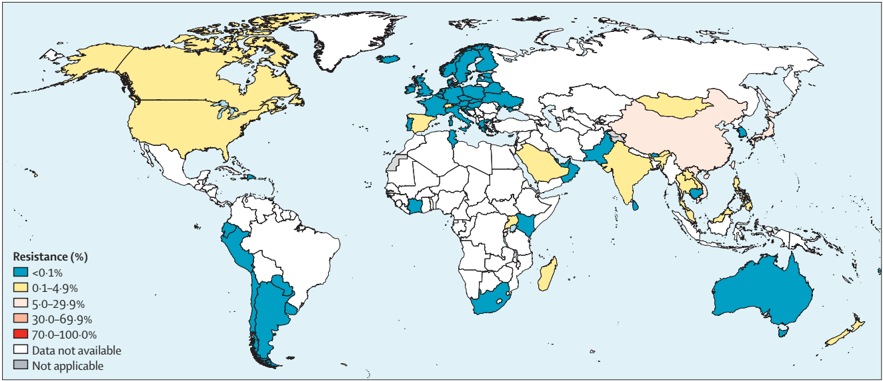
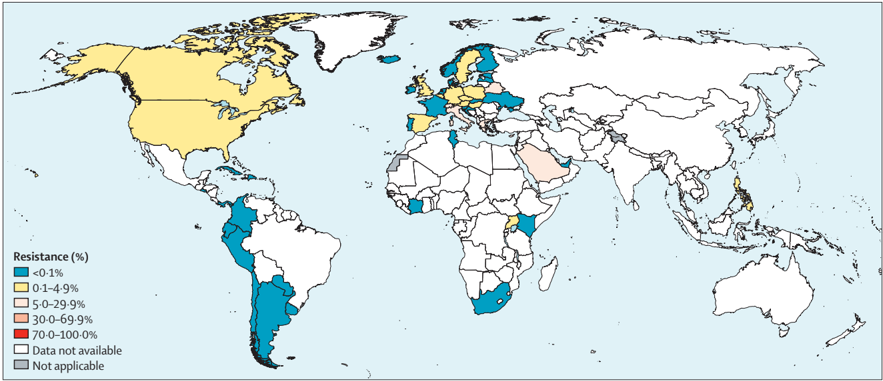
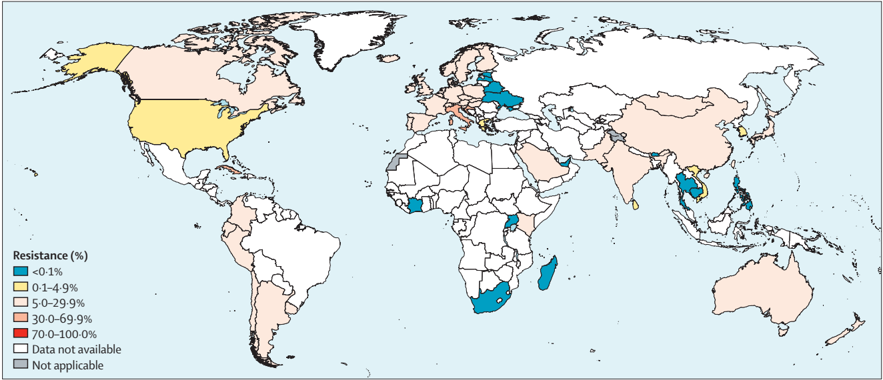
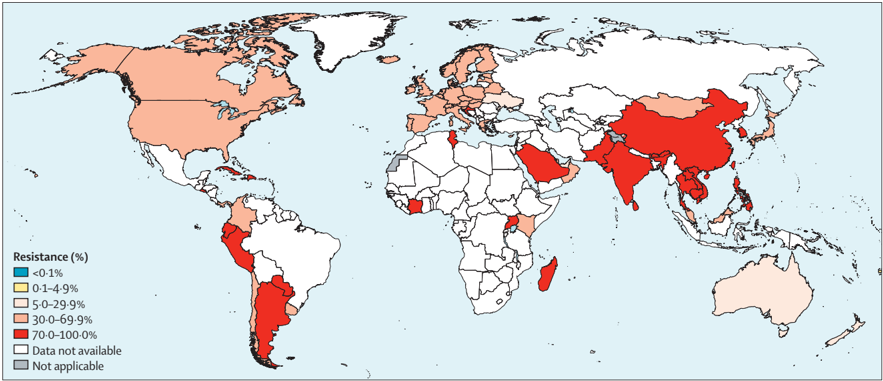
Verification
Claims the paper makes
The claims and statistics of this paper haven’t been checked yet.
Run the check — free, no account needed. It reads the open-access text and checks the sources it cites.
Claims other papers make about this one
Each is checked against this paper’s own text: does it say what the citing paper says it does?
In the citing paper
“Antimicrobial resistance in N. gonorrhoeae has emerged for all medicines used for empirical first-line treatment.”
In the citing paper
“In 2019–2020, 20 out of 59 countries (34%) reported isolates with reduced susceptibility or resistance to ceftriaxone”
In the citing paper
“resistance to ciprofloxacin was reported by all 58 reporting countries (100%”
In the citing paper
“11 of 41 countries (27%) reported reduced susceptibility or resistance to cefixime”
In the citing paper
“Isolates with resistance to azithromycin were reported by 42 of 47 countries (89%”
In the citing paper
“Data from systematic reviews of the literature and from the WHO Gonococcal Antimicrobial Surveillance Programme (GASP) found that ceftriaxone resistance is increasing in most countries, except in Europe, where introducing a ceftriaxone 500 mg dose in 2013 and subsequently increasing to ceftriaxone 1 g was associated with a decrease in reported ceftriaxone resistance (6, 9, 12, 32).”
Self-check
Percentages, sums and reported differences re-computed from the paper’s own numbers.
The self-check needs the paper’s full text.
Citations
Cites
Chlamydia, gonorrhoea, trichomoniasis and syphilis: global prevalence and incidence estimates, 2016
Rowley, J., Vander Hoorn, S., Korenromp, E., Low, N., Unemo, M., Abu-Raddad, L. J., Chico, R. M., Smolak, A., Newman, L., Gottlieb, S., et al. (2019) · Bulletin of the World Health Organization · doi:10.2471/blt.18.228486 · Cited by 1,665
Self-citationSexually transmitted infections: challenges ahead
Unemo, M., Bradshaw, C. S., Hocking, J. S., de Vries, H. J. C., Francis, S. C., Mabey, D. C. W., Marrazzo, J. M., Sonder, G. J. B., Schwebke, J. R., Hoornenborg, E., et al. (2017) · The Lancet Infectious Diseases · doi:10.1016/s1473-3099(17)30310-9 · Cited by 776
Self-citationWi, T., Lahra, M. M., Ndowa, F. J., Bala, M., Dillon, J. R., Ramón-Pardo, P., Eremin, S., BOLAN, G. A., & Unemo, M. (2017) · PLoS Medicine · doi:10.1371/journal.pmed.1002344 · Cited by 621
Self-citationUnemo, M., Seifert, H. S., Hook, E. W., Hawkes, S., Ndowa, F. J., & Dillon, J. R. (2019) · Nature Reviews Disease Primers · doi:10.1038/s41572-019-0128-6 · Cited by 558
Self-citationUnemo, M., Golparian, D., Sánchez-Busó, L., Grad, Y. H., Jacobsson, S., Ohnishi, M., Lahra, M. M., Limnios, A. E., Sikora, A. E., Wi, T., et al. (2016) · Journal of Antimicrobial Chemotherapy · doi:10.1093/jac/dkw288 · Cited by 300
Self-citationUnemo, M., Lahra, M. M., Cole, M., Galarza, P., Ndowa, F., Martin, I., Dillon, J.-A. R., Ramon-Pardo, P., Bolan, G., & Wi, T. (2019) · Sexual Health · doi:10.1071/sh19023 · Cited by 262
Self-citationLahra, M. M., Martin, I., Demczuk, W., Jennison, A. V., Lee, K.-I., Nakayama, S.-I., Lefebvre, B., Longtin, J., Ward, A., Mulvey, M. R., et al. (2018) · Emerging Infectious Diseases · doi:10.3201/eid2404.171873 · Cited by 239
Self-citationHarris, S. R., Cole, M. J., Spiteri, G., Sánchez-Busó, L., Golparian, D., Jacobsson, S., Goater, R., Abudahab, K., Yeats, C., Berçot, B., et al. (2018) · The Lancet Infectious Diseases · doi:10.1016/s1473-3099(18)30225-1 · Cited by 205
Self-citationCephalosporin MIC creep among gonococci: time for a pharmacodynamic rethink?
Chisholm, S., Mouton, J. W., Lewis, D. A., Nichols, T., ISON, C. A., & Livermore, D. M. (2010) · Journal of Antimicrobial Chemotherapy · doi:10.1093/jac/dkq289 · Cited by 174
Sánchez-Busó, L., Yeats, C., Taylor, B., Goater, R., Underwood, A. P., Abudahab, K., Argimón, S., Ma, K. C., Mortimer, T. D., Golparian, D., et al. (2021) · Genome Medicine · doi:10.1186/s13073-021-00858-2 · Cited by 128
Self-citation
Cited by
Sorted by citations
Items 101–101 of 101
Metadata
- Authors
- Unemo, M., Lahra, M. M., Escher, M., Eremin, S., Cole, M. J., Galarza, P., Ndowa, F., Martin, I., Dillon, J.-A. R., Galas, M., Ramon-Pardo, P., Weinstock, H., & Wi, T.
- Affiliations
- Örebro University (SE)
- NSW Health Pathology (AU)
- World Health Organization (CH)
- Public Health England (GB)
- Administración Nacional de Laboratorios e Institutos de Salud (AR)
- University of Saskatchewan (CA)
- World Health Organization Regional Office for the Americas (US)
- Centers for Disease Control and Prevention (US)
- Corresponding author
- Unemo, Magnus
- ORCID
- Venue
- The Lancet Microbe
- Publisher
- Elsevier BV
- Published
- 2021-11
- Volume
- 2
- Issue
- 11
- Pages
- e627-e636
- ISSN
- 2666-5247 (ISSN-L)
- OpenAlex
- W3197926693
- Cited by
- 272
- References
- 27
- Citations by year
- 2026: 41 · 2025: 55 · 2024: 73 · 2023: 66 · 2022: 35 · 2021: 2
- FWCI
- 31.05
- Type
- journal article
- Language
- en
- Open access
- gold
- doi.org
- Licence
- Locations
- The Lancet Microbe (publishedVersion, cc-by)
- PubMed (publishedVersion)
- DOAJ (DOAJ: Directory of Open Access Journals) (submittedVersion, cc-by-sa)
- Funders
- World Health Organization
- Topics
- Life Sciences › Immunology and Microbiology › Microbiology › Reproductive tract infections research
- Health Sciences › Medicine › Infectious Diseases › Antibiotic Use and Resistance
- Health Sciences › Medicine › Microbiology (medical) › Antibiotic Resistance in Bacteria
- Keywords
- resistance, Neisseria gonorrhoeae, gonorrhea, global surveillance, ciprofloxacin resistance, azithromycin resistance, ceftriaxone resistance, cefixime resistance, resistance breakpoints, minimum inhibitory concentration, surveillance coverage, antimicrobial susceptibility trends, infection control, partner notification, public health policy
- MeSH terms
- Anti-Bacterial Agents, Ceftriaxone, Ciprofloxacin, Gonorrhea, Humans, Neisseria gonorrhoeae, World Health Organization, Azithromycin, Cefixime, Drug Resistance, Bacterial
About these checks
Registry, retraction, Cites and statistics results are computed, not judged, with one exception: a printed reference that no index lists is read once by a model before it counts as a citation error. Claims are extracted by a model and kept only when their quote appears verbatim in the text; each cited source is then checked, with a model’s help, for whether it says what the claim relies on. Those verdicts can be wrong — read the claim’s quote and the cited source before relying on one.
Statistics and arithmetic are recomputed, not judged.
Confidence bands are shown only for fields calibrated on our annotated test set. None is calibrated yet, so no band is shown.
What counts as a claim ›How we measure confidence ›How we check this ›
Are you an author, or do you see a problem with this page? Request a review
