

Assessment of common infections and incident dementia using UK primary and secondary care data: a historical cohort study
Open accessThe DOI matches its Crossref record; 38 of the 38 references it cites were found in a registry or an index.
Abstract
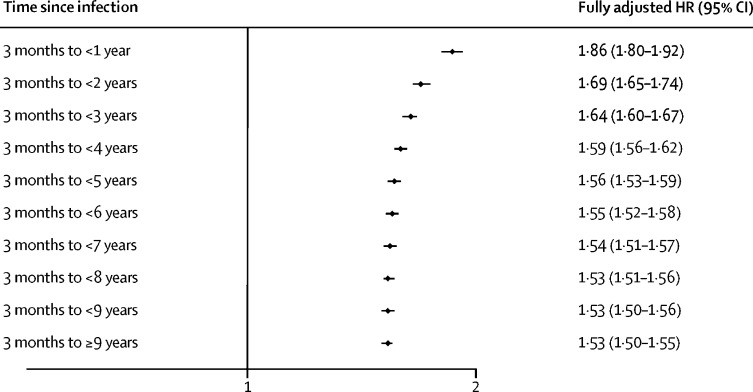
BACKGROUND: Common infections have been associated with dementia risk; however, evidence is scarce. We aimed to investigate the association between common infections and dementia in adults (≥65 years) in a UK population-based cohort study. METHODS: We did a historical cohort study of individuals who were 65 years and older with no history of dementia or cognitive impairment using the Clinical Practice Research Datalink linked to Hospital Episode Statistics between Jan 1, 2004, and Dec 31, 2018. Multivariable Cox proportional hazard regression models were used to estimate the association between time-updated previous common infections (sepsis, pneumonia, other lower respiratory tract infections, urinary tract infections, and skin and soft tissue infections) and incident dementia diagnosis. We also tested for effect modification by diabetes since it is an independent risk factor for dementia and co-occurs with infection. FINDINGS: Between Jan 1, 2004, and Dec 31, 2018, our study included 989 800 individuals (median age 68·6 years [IQR 65·0-77·0]; 537 602 [54·3%] women) of whom 402 204 (40·6%) were diagnosed with at least one infection and 56 802 (5·7%) had incident dementia during a median follow-up of 5·2 years (IQR 2·3-9·0). Dementia risk increased in those with any infection (adjusted hazard ratio [HR] 1·53 [95% CI 1·50-1·55]) compared with those without infection. HRs were highest for sepsis (HR 2·08 [1·89-2·29]) and pneumonia (HR 1·88 [1·77-1·99]) and for infections leading to hospital admission (1·99 [1·94-2·04]). HRs were also higher in individuals with diabetes compared with those without diabetes. INTERPRETATION: Common infections, particularly those resulting in hospitalisation, were associated with an increased risk of dementia persisting over the long term. Whether reducing infections lowers the risk of subsequent dementia warrants evaluation. FUNDING: Alzheimer's Society, Wellcome Trust, and the Royal Society.
Overview
The claims and statistics of this paper haven’t been checked yet.
Free: it reads the open-access text and checks the first 5 claims that cite a source we can check. Create a free account to check every claim.
Integrity signals
Registry
Cites
Statistics
Figures
Verification
Claims the paper makes
The claims and statistics of this paper haven’t been checked yet.
Free: it reads the open-access text and checks the first 5 claims that cite a source we can check. Create a free account to check every claim.
Claims other papers make about this one
Each is checked against this paper’s own text: does it say what the citing paper says it does?
The source backs part of the claim, not all of it — or backs it for a different population, condition or comparison.
In the citing paper
“A subsequent electronic register study of almost 1 million UK adults, showed that infections resulting in hospitalisation, but not those treated in primary care, were associated with a higher risk of dementia or AD. (340)”
From Dementia prevention, intervention, and care: 2024 report of the Lancet standing Commission (2024) · cites this paper as [340]
Experimental — accuracy not yet measuredThe source backs part of the claim, not all of it — or backs it for a different population, condition or comparison.
In the citing paper
“Sepsis, pneumonia, lower respiratory tract infections, skin and soft tissue infections and urinary tract infections are all associated with higher rates of dementia in people and animal studies. (340)”
From Dementia prevention, intervention, and care: 2024 report of the Lancet standing Commission (2024) · cites this paper as [340]
Experimental — accuracy not yet measuredThe source backs part of the claim, not all of it — or backs it for a different population, condition or comparison.
In the citing paper
“As hospital-treated infections are more strongly associated with vascular than Alzheimer's dementia, mechanisms may involve vascular inflammatory pathways. (337, 340)”
From Dementia prevention, intervention, and care: 2024 report of the Lancet standing Commission (2024) · cites this paper as [340]
Experimental — accuracy not yet measuredThe source backs part of the claim, not all of it — or backs it for a different population, condition or comparison.
In the citing paper
“Additionally, a large-scale epidemiological study demonstrated that infectious diseases, including pulmonary infections, increase the risk of AD and PD dementia (PDD).266,267”
From Antiageing strategy for neurodegenerative diseases: from mechanisms to clinical advances (2025) · cites this paper as [266]
Experimental — accuracy not yet measured
Self-check
Percentages, sums and reported differences re-computed from the paper’s own numbers.
The self-check needs the paper’s full text.
Citations
Cites
Long-term cognitive impairment after critical illness
Pandharipande, P. P., Girard, T. D., Jackson, J. C., Morandi, A., Thompson, J. L., Pun, B. T., Brummel, N. E., Hughes, C. G., Vasilevskis, E. E., Shintani, A. K., et al. (2013) · New England Journal of Medicine · doi:10.1056/nejmoa1301372 · Cited by 2,842
Data Resource Profile: Clinical Practice Research Datalink (CPRD)
Herrett, E., Gallagher, A. M., Bhaskaran, K., Forbes, H., Mathur, R., van Staa, T., & Smeeth, L. (2015) · International Journal of Epidemiology · doi:10.1093/ije/dyv098 · Cited by 2,667
Self-citationRisk of dementia in diabetes mellitus: a systematic review
Biessels, G. J., Staekenborg, S., Brunner, E., Brayne, C., & Scheltens, P. (2006) · The Lancet Neurology · doi:10.1016/s1474-4422(05)70284-2 · Cited by 2,187
Self-citationDementia: a public health priority
Acosta, D. M., Krishnamoorthy, E. S., Wortmann, M., Prince, M. J., & Saxena, S. (2012) · Cited by 1,955
Hernán, M. A. (2010) · Epidemiology · doi:10.1097/ede.0b013e3181c1ea43 · Cited by 1,370
Systemic inflammation and disease progression in Alzheimer disease
Holmes, C., Cunningham, C., Zotova, E., Woolford, J., Dean, C., Kerr, S., Culliford, D., & Perry, V. H. (2009) · Neurology · doi:10.1212/wnl.0b013e3181b6bb95 · Cited by 1,139
Long-Term Cognitive Impairment After Critical Illness
Pandharipande, P. P., Girard, T. D., Jackson, J. C., Morandi, A., Thompson, J. L., Pun, B. T., Brummel, N. E., Hughes, C. G., Vasilevskis, E. E., Shintani, A. K., et al. (2014) · Survey of Anesthesiology · doi:10.1097/sa.0000000000000071 · Cited by 1,114
White, I. R., & Carlin, J. B. (2010) · Statistics in Medicine · doi:10.1002/sim.3944 · Cited by 744
Data Resource Profile: Hospital Episode Statistics Admitted Patient Care (HES APC)
Herbert, A., Wijlaars, L., Zylbersztejn, A., Cromwell, D., & Hardelid, P. (2017) · International Journal of Epidemiology · doi:10.1093/ije/dyx015 · Cited by 742
Carey, I. M., Critchley, J. A., DeWilde, S., Harris, T., Hosking, F. J., & Cook, D. G. (2018) · Diabetes Care · doi:10.2337/dc17-2131 · Cited by 604
Cited by
Dementia prevention, intervention, and care: 2024 report of the Lancet standing Commission
Livingston, G., Huntley, J., Liu, K. Y., Costafreda, S. G., Selbæk, G., Alladi, S., Ames, D., Banerjee, S., Burns, A., Brayne, C., et al. (2024) · The Lancet · doi:10.1016/s0140-6736(24)01296-0 · Cited by 3,860
Self-citationCerebral dysfunctions caused by sepsis during ageing
Manabe, T., & Heneka, M. T. (2022) · Nature Reviews Immunology · doi:10.1038/s41577-021-00643-7 · Cited by 191
Antiageing strategy for neurodegenerative diseases: from mechanisms to clinical advances
Jiang, Q., Liu, J., Huang, S., Wang, X.-Y., Chen, X., Liu, G.-H., Ye, K., Song, W., Masters, C. L., Wang, J., et al. (2025) · Signal Transduction and Targeted Therapy · doi:10.1038/s41392-025-02145-7 · Cited by 165
“266,267 Additionally, a special type of pathogen, M. tuberculosis , which primarily targets the lung, increases the risk of PD by 1.38 times.”
InfluentialThe role of peripheral inflammatory insults in Alzheimer’s disease: a review and research roadmap
Walker, K. A., Le Page, L. M., Terrando, N., Duggan, M. R., Heneka, M. T., & Bettcher, B. M. (2023) · Molecular Neurodegeneration · doi:10.1186/s13024-023-00627-2 · Cited by 113
“, 2021 [53] CPRD (n = 989,800) Sepsis Pneumonia Other lower respiratory tract infections Urinary tract infections Skin/soft tissue infections (present/absent; frequency) HER ACD AD VaD Other dem.”
BackgroundBukhbinder, A. S., Ling, Y., Hasan, O., Jiang, X., Kim, Y., Phelps, K. N., Schmandt, R. E., Amran, A., Coburn, R., Ramesh, S., et al. (2022) · Journal of Alzheimer's Disease · doi:10.3233/jad-220361 · Cited by 103
“A diverse range of microorganisms and infectious diseases have been associated with an increased risk and/or rate of cognitive decline, particularly among older adults, including influenzal respiratory infections [5, 6], pneumonia [4, 7], herpes infections [7], chronic periodontitis [8], urinary tract infections [4],…”
BackgroundZhao, Y., Zheng, Q., Hong, Y., Gao, Y., Hu, J., Lang, M., Zhang, H., Zhou, Y., Luo, H., Zhang, X., et al. (2023) · Nature Neuroscience · doi:10.1038/s41593-023-01352-1 · Cited by 80
Plasma proteomic evidence for increased β-amyloid pathology after SARS-CoV-2 infection
Duff, E. P., Zetterberg, H., Heslegrave, A., Dehghan, A., Elliott, P., Allen, N., Runz, H., Laban, R., Veleva, E., Whelan, C. D., et al. (2025) · Nature Medicine · doi:10.1038/s41591-024-03426-4 · Cited by 57
“Viral encephalitis or meningitis, influenza, pneumonia and viral intestinal infections have been linked to risk for Alzheimer’s disease (AD) 1–3 , and vaccinations to prevent these diseases may have protective effects 4 .”
Sun, J., Ludvigsson, J. F., Ingre, C., Piehl, F., Wirdefeldt, K., Zagai, U., Ye, W., & Fang, F. (2022) · PLoS Medicine · doi:10.1371/journal.pmed.1004092 · Cited by 57
“Two studies used the same datasets from the UK reported an increased risk of dementia [18] or AD [20] among individuals with infectious diseases, without, however, reporting a clear dose–response relationship.”
BackgroundWhat SARS-CoV-2 does to our brains
Aschman, T., Mothes, R., Heppner, F. L., & Radbruch, H. (2022) · Immunity · doi:10.1016/j.immuni.2022.06.013 · Cited by 53
“…to note that systemic inflammation during sepsis can induce an associated encephalopathy with cognitive impairment, especially in ICU patients (Sonneville et al., 2017), and, additionally, increases the risk of dementia, especially in older patients (Iwashyna et al., 2010; Muzambi et al., 2021).”
Duggan, M. R., Peng, Z., Sipilä, P. N., Lindbohm, J. V., Chen, J., Lu, Y., Davatzikos, C., Erus, G., Hohman, T. J., Andrews, S. J., et al. (2024) · Nature Aging · doi:10.1038/s43587-024-00682-4 · Cited by 45
“Differences in annual changes of cognitive scores related to protein levels (β) were derived from linear mixed-effect models ( n = 1,233) adjusted for the aforementioned covariates. h , Heatmap showing associations of candidate proteins with cognitive performance in the GenS cohort.”
Ma, L.-Z., Zhang, Y.-R., Li, Y.-Z., Ou, Y.-N., Yang, L., Chen, S.-D., Dong, Q., Feng, J.-F., Cheng, W., Tan, L., et al. (2023) · Biological Psychiatry · doi:10.1016/j.biopsych.2022.06.005 · Cited by 46
Infectious diseases and cognition: do we have to worry?
Hernández‐Ruiz, V., Letenneur, L., Fülöp, T., Helmer, C., Baudron, C. R., Ávila‐Funes, J. A., & Amieva, H. (2022) · Neurological Sciences · doi:10.1007/s10072-022-06280-9 · Cited by 49
“, the underlying severity of inflammation) and the risk of dementia has been suggested [26, 27].”
BackgroundSystemic inflammation induced the delayed reduction of excitatory synapses in the CA3 during ageing
Manabe, T., Rácz, I., Schwartz, S., Oberle, L., Santarelli, F., Emmrich, J. V., Neher, J. J., & Heneka, M. T. (2021) · Journal of Neurochemistry · doi:10.1111/jnc.15491 · Cited by 44
“Further, recent large- scale epidemiological studies have shown that both infection and sepsis can increase the risk of dementia among elderly individuals for two years (Fritze et al., 2021) or more than nine years post- infection (Muzambi et al., 2021).”
BackgroundBacterial pneumonia and subsequent dementia risk: A nationwide cohort study
Chu, C., Liang, C., Tsai, S., Bai, Y., Su, T., Chen, T., & Chen, M. (2022) · Brain Behavior and Immunity · doi:10.1016/j.bbi.2022.04.002 · Cited by 43
Comprehensive management of pneumonia in older patients
Putot, A., Garin, N., Rello, J., & Prendki, V. (2025) · European Journal of Internal Medicine · doi:10.1016/j.ejim.2025.02.025 · Cited by 42
Cardiovascular health, infection burden, and incident dementia in the UK Biobank
Beydoun, H. A., Beydoun, M. A., Meirelles, O., Erickson, L. D., Gamaldo, A. A., Weiss, J., Launer, L. J., Evans, M. K., & Zonderman, A. B. (2023) · Alzheimer s & Dementia · doi:10.1002/alz.13405 · Cited by 40
“32 Finally, Makli et al. used infections identified by the UKB along with IgG data and dementia determinations using primary care linkage.”
InfluentialHospital-Diagnosed Infections, Autoimmune Diseases, and Subsequent Dementia Incidence
Janbek, J., Laursen, T. M., Frimodt‐Møller, N., Magyari, M., Haas, J., Lathe, R., & Waldemar, G. (2023) · JAMA Network Open · doi:10.1001/jamanetworkopen.2023.32635 · Cited by 42
Han, Y., Xie, X., Qiu, J., Tang, Y., Song, Z., Li, W., & Wu, X. (2025) · Frontiers in Cellular and Infection Microbiology · doi:10.3389/fcimb.2025.1545979 · Cited by 40
“Additionally, it has been reported that even among elderly patients who survive sepsis, many develop long-term cognitive de fi cits during recovery (Iwashyna et al., 2010; Muzambi et al., 2021).”
Wang, H., Xu, L., Tang, X., Jiang, Z., & Feng, X. (2024) · Lipids in Health and Disease · doi:10.1186/s12944-024-02116-x · Cited by 35
“…retrospective cohort study spanning a 14-year follow-up period reported that the risk of senile sepsis patients developing dementia, especially vascular cognitive impairment, doubled, with the highest risk occurring at 3–12 months after infection and lasting for up to 9 years after infection [19].”
BackgroundDo vaccinations influence the development of Alzheimer disease?
Bukhbinder, A. S., Ling, Y., Harris, K., Jiang, X., & Schulz, P. E. (2023) · Human Vaccines & Immunotherapeutics · doi:10.1080/21645515.2023.2216625 · Cited by 35
“6,7 Importantly, many lines of evidence have demonstrated that infections have a negative influence on the development or progression of AD in a subset of patients, 8–11 perhaps through causing a further increase in proinflammatory immunologic activity.”
The 2021 yearbook of Neurorestoratology
Sharma, H. S., Chopp, M., Chen, L., Sarnowska, A., Xue, M., Ao, Q., Siniscalco, D., Chen, L., Hawamdeh, Z. M., & Huang, H. (2022) · Journal of Neurorestoratology · doi:10.1016/j.jnrt.2022.100008 · Cited by 34
Associations of hospital-treated infections with subsequent dementia: nationwide 30-year analysis
Richmond‐Rakerd, L. S., Iyer, M. T., D’Souza, S., Khalifeh, L., Caspi, A., Moffitt, T. E., & Milne, B. J. (2024) · Nature Aging · doi:10.1038/s43587-024-00621-3 · Cited by 23
Acute and long-term cognitive impairment following sepsis: mechanism and prevention
Ji, M., Gao, Y.-Z., Shi, C., Wu, X., & Yang, J. (2023) · Expert Review of Neurotherapeutics · doi:10.1080/14737175.2023.2250917 · Cited by 24
Benyumiza, D., Kumakech, E., Gutu, J., Banihani, J., Mandap, J., Talib, Z. M., Wakida, E. K., Maling, S., & Obua, C. (2023) · BMC Geriatrics · doi:10.1186/s12877-023-04174-9 · Cited by 22
Aronoff, J. E., & Trumble, B. C. (2025) · Evolution Medicine and Public Health · doi:10.1093/emph/eoaf010 · Cited by 17
“While lifestyle factors such as caloric excess and limited physical activity contribute to ADRD risk through their effect on cardiometabolic functioning [139, 140], infections and immune function have also been implicated [141, 142].”
Liu, X., Guan, Z., Liang, S., Feng, S., & Zhou, Y. (2023) · European Journal of Clinical Investigation · doi:10.1111/eci.14113 · Cited by 16
Muzambi, R., Bhaskaran, K., Rentsch, C. T., Smeeth, L. L., Brayne, C., Garfield, V., Williams, D. M., Chaturvedi, N., & Warren‐Gash, C. (2022) · Translational Psychiatry · doi:10.1038/s41398-022-02145-z · Cited by 16
“INTRODUCTION Growing evidence from longitudinal studies supports the role of common infections such as sepsis [1–4], pneumonia [4, 5], other lower respiratory tract infections (LRTIs) [4], urinary tract infections (UTIs) [4, 5], and skin and soft tissue infections (SSTIs) [4, 5], in increasing the risk of dementia, th…”
ResultSelf-citationHerpesviruses, antiviral treatment, and the risk of dementia – systematic review and meta-analysis
Drinkall, N. J., Siersma, V., Lathe, R., Waldemar, G., & Janbek, J. (2025) · Alzheimer s Research & Therapy · doi:10.1186/s13195-025-01838-z · Cited by 14
“Studies show that severe infections requiring hospitalization significantly increase dementia risk [44], while common infections in primary care show no evidence [45].”
COVID-19 infection associated with increased risk of new-onset vascular dementia in adults ≥50 years
Shan, D., Xu, Y., Yang, C., Crawford, T. J., & Holland, C. (2025) · npj Dementia · doi:10.1038/s44400-025-00034-y · Cited by 14
“…irrespective of outcome status within that period, to mitigate misclassi fi cation of delirium or transient cognitive changes as incident dementia 8,61,62 ; (ii) adjusting for competing risk of death using Fine-Gray models, which estimate the sub-distribution hazard while accounting for the…”
Zhou, J., Liu, W., Zhou, H., Lau, K. K., Wong, G. H. Y., Chan, W. C., Zhang, Q., Knapp, M. R. J., Wong, I. C. K., & Luo, H. (2024) · The Lancet Regional Health - Western Pacific · doi:10.1016/j.lanwpc.2024.101060 · Cited by 15
“34,35 This fi nding might be explained by immunosenescence and in fl ammaging, which re-sults in an increased susceptibility of recurrent and more severe infections and in turn a greater chance of developing dementia caused by accumulated systematic in fl ammation or vascular damage.”
BackgroundMerlino, L., Rainone, F., Chinnadurai, R., Hernandez, G., Tollitt, J., Battini, G. G., Colombo, P. M., Trivelli, M., Stewart, S., Dunne, R. A., et al. (2024) · Clinical Kidney Journal · doi:10.1093/ckj/sfae401 · Cited by 16
Ko, Y. K., Kim, E., Lee, E., Nam, S. J., Kim, Y., Kim, S., Choi, S., Kim, H. Y., & Choi, Y. (2024) · PLoS ONE · doi:10.1371/journal.pone.0296307 · Cited by 13
Duggan, M. R., Yang, S., Gómez, G., Cui, Y., Capuano, A. W., Chen, J., Yang, Z., Wen, J., Erus, G., Drouin, S. M., et al. (2025) · Science Advances · doi:10.1126/sciadv.adt7176 · Cited by 13
Wu, W., Alexander, J. S., Booth, J. L., Miller, C., Metcalf, J. P., & Drevets, D. A. (2024) · Immunity & Ageing · doi:10.1186/s12979-024-00447-y · Cited by 10
“Recent studies demonstrate that a variety of non-neu-rotropic infections in humans significantly increase the risk of serious, post-acute neuro-cognitive complications such as dementia [12–14 , 48 ].”
BackgroundTeipel, S. J., Akmatov, M. K., Michalowsky, B., Riedel-Heller, S. G., Bohlken, J., & Holstiege, J. (2025) · Alzheimer s Research & Therapy · doi:10.1186/s13195-024-01662-x · Cited by 10
“Other known risk factors include sleep disorders [19, 20], migraine [21], autonomic dysfunction [22], pain [23], cardiovascular disease [24], sensory impairment [25], infections [26], and gastrointestinal disorders [27].”
Cognitive Health and Quality of Life After Surviving Sepsis: A Narrative Review
Ackermann, K., Aryal, N. R., Westbrook, J. I., & Li, L. (2025) · Journal of Intensive Care Medicine · doi:10.1177/08850666251340631 · Cited by 10
“42 Similarly, a cohort study in the United Kingdom 43 reported adult sepsis survivors aged 65 and above had over double the risk of an incident dementia diagnosis compared to adults with no hospitalisation for infection.”
Yang, L., Li, J., Liu, F., Chai, X., Fang, Z., & Zhang, X. (2024) · Current Neuropharmacology · doi:10.2174/1570159x23666241028105746 · Cited by 10
“Several large population-based epidemiologic studies, both prospective and retrospective, have shown that sepsis can lead to a substantially increased risk of dementia [6, 7].”
Do infections have a role in Alzheimer’s disease?
Eisenstein, M. S. (2025) · Nature · doi:10.1038/d41586-025-01104-0 · Cited by 10
Pneumonia and subsequent risk of dementia: Evidence from the Japan Gerontological evaluation study
Khairan, P., Shirai, K., Shobugawa, Y., Cadar, D., Saito, T., Kondo, K., Sobue, T., & Iso, H. (2022) · International Journal of Geriatric Psychiatry · doi:10.1002/gps.5825 · Cited by 8
Severe infections as a gateway to dementia
Kivimäki, M., & Walker, K. A. (2024) · Nature Aging · doi:10.1038/s43587-024-00643-x · Cited by 9
Ma, L.-Y., Ou, Y., Gao, P., Fu, Y., Zhang, D., Liu, Y., Feng, J., Cheng, W., Tan, L., & Yu, J. (2024) · Journal of Affective Disorders · doi:10.1016/j.jad.2024.01.029 · Cited by 7
Schütze, S., Döpke, A., Kellert, B., Seele, J., Ballüer, M., Bunkowski, S., Kreutzfeldt, M., Brück, W., & Nau, R. (2022) · Journal of Alzheimer s Disease Reports · doi:10.3233/adr-210049 · Cited by 8
Wang, J., Huang, Y., Zhu, Q., Huang, C., Lin, R., Peng, Y., Jiang, Z., Tang, D., Yao, Y., Zheng, X., et al. (2025) · Brain Behavior and Immunity · doi:10.1016/j.bbi.2025.01.027 · Cited by 7
Untersteiner, H., Wurm, R., Reichardt, B., Goeschl, S., Berger–Sieczkowski, E., König, T., Parvizi, T., Silvaieh, S., & Stögmann, E. (2024) · The Journal of Prevention of Alzheimer s Disease · doi:10.14283/jpad.2024.92 · Cited by 6
“However, most existing data are in line with our results, showing significant associations of dementia with prior UTIs and influenza (18, 21, 22, 28).”
BackgroundResultInfluentialSipilä, P. N., Pentti, J., Frank, P., Duggan, M. R., Walker, K. A., Strandberg, T. E., Lindbohm, J. V., & Kivimäki, M. (2026) · The Lancet Healthy Longevity · doi:10.1016/j.lanhl.2026.100826 · Cited by 6
Holmes, C. (2021) · The Lancet Healthy Longevity · doi:10.1016/s2666-7568(21)00147-1 · Cited by 6
Risk of developing Alzheimer disease in relation to common infections
Camacho‐Soto, A., Faust, I. M., Laurido-Soto, O., Killion, J. A., Senini, N., Krzyzanowski, B., & Racette, B. A. (2025) · Neurodegenerative Diseases · doi:10.1159/000546589 · Cited by 6
“As a sensitivity analysis, we examined whether certain medical conditions, included in other studies examining infections and AD/dementia risk, acted as potential confounders if we observed a 10% change or greater in the OR between exposure of interest and AD [13, 14].”
InfluentialSong, Y., Lin, W., Yuan, H., Hu, H., Wu, S., Lu, Y., Li, D., Liang, J., Sheng-hao, T., & Zhu, W. M. (2025) · Journal of Ethnopharmacology · doi:10.1016/j.jep.2025.120731 · Cited by 5
Berry, E., Nally, C. S. M., Barbosa, A., Mason, C., & Jones, D. (2024) · Radiography · doi:10.1016/j.radi.2024.09.057 · Cited by 5
Strohl, J. J., Carrión, J., & Huerta, P. T. (2024) · Scientific Reports · doi:10.1038/s41598-024-79259-5 · Cited by 6
Logue, E. M., Hilsabeck, R. C., & Melamed, E. (2024) · The Clinical Neuropsychologist · doi:10.1080/13854046.2024.2335115 · Cited by 5
“With regard to bacterial pneumonia, large cohort studies have found a dose–response relationship between risk for dementia and numbers of infections (Muzambi et al., 2021; Sipilä et al., 2021) and hospitalizations (Chu et al., 2022).”
Postoperative sepsis and its sequential impact on dementia
Sun, M., Li, F., Wang, Y., Miao, M., Lu, Z., Chen, W., Wu, S., & Zhang, J. (2025) · Critical Care · doi:10.1186/s13054-025-05276-z · Cited by 5
“The results of this study align with previous research demonstrating the severe consequences of sepsis [9–12], but this is one of the first studies to show a clear association between postoperative sepsis and dementia in a large, population-based cohort.”
InfluentialGore‐Langton, G. R., Mansfield, K. E., Ravi, P., Doubatty, A., Alladi, S., Kinra, S., & Warren‐Gash, C. (2025) · BMC Public Health · doi:10.1186/s12889-025-23490-w · Cited by 4
“…infection associated with impaired cognition, may have more accurate recall considering it is a longer-term infection requiring extensive drug regimens, than recall of shorter-term more acute infections such as UTIs, which have previously been found to be associated with increased dementia [7].”
InfluentialSelf-citationInfection and telomere length: A systematic review
Tunnicliffe, L., Muzambi, R., Bartlett, J. W., Howe, L. D., Basit, K. A., Asare, K., Gore‐Langton, G. R., Mansfield, K. E., Codd, V., & Warren‐Gash, C. (2025) · PLoS ONE · doi:10.1371/journal.pone.0333107 · Cited by 7
“…may be implicated in dementia risk; severe infection syndromes including sepsis and pneumonia are associated with increased long-term dementia risk in large longitudinal studies [4,5] although evidence for association with individual pathogens such as human herpesviruses is less clear [6–8].”
Self-citationAngelicin alleviates sepsis-associated encephalopathy via inhibition of IKK2 and the NF-κB pathway
Pan, E., Li, M., Zhao, P., Zhang, S., Wang, J., Guan, T., Dong, Q., Jin, X., & Dong, J. (2025) · Phytomedicine · doi:10.1016/j.phymed.2025.157383 · Cited by 4
Williams, S. E., Luisi, K., Liang, C., Cane, A. D., & Begier, E. M. (2025) · npj Vaccines · doi:10.1038/s41541-025-01309-4 · Cited by 4
“Such decompositions are common during acute illnesses in the natural history of dementia 9,10 .”
Tau is necessary for Pseudomonas aeruginosa-induced blood-brain barrier dysfunction
Chaney, S. D., Bauman, A. J., Butlig, E.-A. R., Al-Masri, S., Sanchez, J. M., McAdams, L. H., DOAN, P., Gwin, M. S., Stevens, T., Ciernia, A. V., et al. (2026) · Communications Biology · doi:10.1038/s42003-026-09703-x · Cited by 4
“…(e.g., pneumonia, post-intensive careunitsyndrome,acuterespiratorydistresssyndrome,sepsis,andSARS-CoV-2)havesubsequentincidentdementiaorothercognitiveimpair-ments,causingdecreasedqualityoflife 1,2 and are at a higher risk of developing Alzheimer ’ s disease and related dementias (ADRD) 3 – 7 .”
Targeting synaptic plasticity to bridge translational gaps in sepsis-associated encephalopathy
Hoshino, K. (2025) · Frontiers in Aging Neuroscience · doi:10.3389/fnagi.2025.1616736 · Cited by 4
Hospitalization with infections and risk of Dementia: a systematic review and meta-analysis
Chua, W. Y., Wang, J. D. J., Chan, C. K. M., Chan, L. L., & Tan, E. (2025) · Aging · doi:10.18632/aging.206329 · Cited by 4
Multifactorial glial responses and their contributions to Alzheimer's disease continuum
Hijioka, M., Manabe, T., & Saito, T. (2023) · Clinical and Experimental Neuroimmunology · doi:10.1111/cen3.12745 · Cited by 4
“highlighted the importance of infection due to a twofold increase in dementia incidence in elderly survivors of sepsis.(97) These lines of evi-”
BackgroundKang, H. S., Kim, J. H., Kim, J., Bang, W. J., Choi, H. G., Kim, N. Y., Park, H. Y., & Kwon, M. J. (2024) · Journal of Clinical Medicine · doi:10.3390/jcm13010260 · Cited by 4
“Notably, these two cohort studies did not specify dementia types, but they included various common infections, although they did not focus specifically on AD or URIs [28,29].”
BackgroundResultInfluentialWhat would it take to prove that a chronic infection is a causal agent in Alzheimer’s disease?
Brutkiewicz, R. R., Cao, W., Morgan, D., Reis, R. S. D., Suryadevara, V., Willette, A. A., Willette, S. A., Wyatt-Johnson, S. K., & Duggan, M. R. (2025) · Trends in Neurosciences · doi:10.1016/j.tins.2025.05.009 · Cited by 3
Sepsis on dementia risk: A population-based cohort study with dose-dependent analysis
Sun, M., Li, F., Wang, Y., Miao, M., Lu, Z., Chen, W., Wu, S., & Zhang, J. (2025) · Journal of Critical Care · doi:10.1016/j.jcrc.2025.155100 · Cited by 3
Sipilä, P. N., Korhonen, K., Lindbohm, J. V., Kivimäki, M., & Martikainen, P. (2026) · PLoS Medicine · doi:10.1371/journal.pmed.1004688 · Cited by 3
“…tract and bacterial infections are common infectious diseases that have been associated with increased dementia risk in several prospective studies [3–6, 32], but findings stratified by sex As pertains to noninfectious diseases, our findings agree with previous studies suggesting increased risk of…”
Slama, P. S., Macbale, A. R., & Jedynak, B. (2026) · medRxiv · doi:10.64898/2026.02.13.26346282 · Cited by 3
Yan, Z., Zhang, M., Yu, L., & Zhang, F. (2025) · Annals of Medicine · doi:10.1080/07853890.2025.2517376 · Cited by 3
Andalibi, M. S. S., Hastie, E., Barone, M. E., Tavasoli, A., Ellis, R., Letendre, S. L., & Trunfio, M. (2025) · Future Virology · doi:10.1080/17460794.2025.2595851 · Cited by 3
Runzer-Colmenares, F. M., Cahuapaza-Gutierrez, N. L., Calderon-Hernandez, C. C., & Hilares-Jorge, C. M. (2026) · Vaccines · doi:10.3390/vaccines14090726 · Cited by 2
“This effect persists even years after the acute event and after adjustment for pre-existing comorbidities [4,5].”
Liu, J., Fei, Y., Wang, E., Guo, T., Cong, W., Cui, Y., & Xie, K. (2025) · Journal of Affective Disorders · doi:10.1016/j.jad.2025.120013 · Cited by 1
Bloodstream infections and Blood-Brain barrier Permeability: An observational cohort study
Underwood, J., Davies, K., Loveless, S., Cercignani, M., Dowell, N. G., Periche-Tomas, E., Ronen, I., Evans, J., McLaren, J. E., & Harrison, N. A. (2026) · Brain Behavior and Immunity · doi:10.1016/j.bbi.2026.106518 · Cited by 1
“…reassurance given the ubiquity of BSIs, yet underscore the need for longitudinal studies to assess long-term outcomes, particularly in light of persistent mood dysfunction and prior observational data linking sepsis to accelerated cognitive decline (Iwashyna et al., 2010; Muzambi et al., 2021).”
Herpes simplex virus 2 and dementia risk: a systematic review and meta-analysis
Hunt, C. J., Zabriskie, B. N., Coulter, E. J., McClellan, M. C., Templeton, G., Erbstoesser, R., MacLean, S., Miller, C. H., Moss, J., Carter, C., et al. (2026) · Frontiers in Dementia · doi:10.3389/frdem.2026.1737068 · Cited by 1
Hospital-treated infection associated with Alzheimer’s disease pathology: underlying mechanisms
Barichello, T., Scaini, G., Tayyab, M., Dal-Pizzol, H. R., Petronilho, F. C., & Dal‐Pizzol, F. (2026) · Molecular Psychiatry · doi:10.1038/s41380-026-03690-5 · Cited by 1
Risk of dementia after bloodstream infection—a nationwide propensity score matched cohort study
Underwood, J., Farewell, D. M., Gillespie, D., Harrison, N. A., & Ahmed, H. (2026) · Age and Ageing · doi:10.1093/ageing/afag178 · Cited by 1
“Earlier diagnoses were not included to avoid coding inaccuracies, health ascertainment bias whereby admission to hospital for BSI prompted investigations for dementia, and to avoid including people with delirium, a common complication of hospitalisation with infection, misdiagnosed as dementia [ 8].”
InfluentialCommunity-acquired pneumonia in adults: acute and long-term complications
Chalmers, J. C., Bansal, K., Scott, R., Hamilton, F., Payne, R., Lim, W. S., WATERER, G. W., Shaw, J., Kagima, J. W., Bibby, A. C., et al. (2026) · The Lancet Healthy Longevity · doi:10.1016/j.lanhl.2026.100872 · Cited by 1
Gao, Y., Kivimäki, M., Frank, P., Scholes, S., Zaninotto, P., & Steptoe, A. (2026) · Brain Behavior & Immunity - Health · doi:10.1016/j.bbih.2026.101371 · Cited by 1
“…also aligns with previous findings that repeated infections, sepsis, and hospital-treated (but not primary care-treated) infections are particularly linked to higher dementia risk and faster cognitive decline (Sipil ¨ a et al., 2021; Muzambi et al., 2021; Demmer et al., 2025; Morton et al., 2020).”
InfluentialAsare, K., Mansfield, K. E., Gore‐Langton, G. R., Cadogan, S. L., Barry, E. V. H., Keogh, R. H., Re, V. L., Rodriguez‐Barradas, M. C., Justice, A. C., Rentsch, C. T., et al. (2026) · medRxiv · doi:10.64898/2026.03.13.26348319 · Cited by 1
Self-citationHernández‐Ruiz, V. (2023) · theses.fr (ABES) · doi:10.70675/22c8d753z84b1z406dzb983z5ccea56c8dbd
Sepsis als Risikofaktor für persistierende kognitive Einschränkungen und Demenz
Hasibeder, W. (2024) · Anästhesie Nachrichten · doi:10.1007/s44179-024-00207-9
Challenges in Research on Sepsis-Associated Encephalopathy and the Possibility of Its Treatment
Hoshino, K. (2023) · THE JOURNAL OF JAPAN SOCIETY FOR CLINICAL ANESTHESIA · doi:10.2199/jjsca.43.336
SARS COV-2, crossing its respiratory borders
(2024) · The Singapore Family Physician · doi:10.33591/sfp.50.10.u3
Post-infection brain atrophy accelerates cognitive and molecular changes underlying dementia
Duggan, M. R., Sipilä, P. N., Yang, Z., Wen, J., Erus, G., Bilgel, M., Lewis, A., Moghekar, A., Davatzikos, C. A., Resnick, S. M., et al. (2025) · Alzheimer s Research & Therapy · doi:10.1186/s13195-025-01924-2 · Cited by 1
“Such classification parallels previous methodology in that the diagnosed sample primarily represents infected participants with clinical symptoms severe enough to be detected during patient-health care consultations [4, 14].”
Wu, W., Alexander, J. S., Booth, J. L., Miller, C., Metcalf, J. P., & Drevets, D. A. (2024) · Figshare · doi:10.6084/m9.figshare.26737458
Wu, W., Alexander, J. S., Booth, J. L., Miller, C., Metcalf, J. P., & Drevets, D. A. (2024) · Figshare · doi:10.6084/m9.figshare.26082625
Wang, H., Xu, L., Tang, X., Jiang, Z., & Feng, X. (2024) · Figshare · doi:10.6084/m9.figshare.25720125
Wu, W., Alexander, J. S., Booth, J. L., Miller, C., Metcalf, J. P., & Drevets, D. A. (2024) · Figshare · doi:10.6084/m9.figshare.26737455
Wu, W., Alexander, J. S., Booth, J. L., Miller, C., Metcalf, J. P., & Drevets, D. A. (2024) · Figshare · doi:10.6084/m9.figshare.26737452
Wu, W., Alexander, J. S., Booth, J. L., Miller, C., Metcalf, J. P., & Drevets, D. A. (2024) · Figshare · doi:10.6084/m9.figshare.26082696
Severe infections consistently linked to dementia?
Janbek, J. (2026) · The Lancet Healthy Longevity · doi:10.1016/j.lanhl.2026.100839
Ou, Y., Liu, X., Gao, P., Yang, L., Feng, J., Tan, L., Yu, J., & Song, J. (2026) · Translational Psychiatry · doi:10.1038/s41398-026-04007-4
“Dementia, characterized by progressive memory loss and cognitive decline, is a leading cause of disability, dependency, and mortality in the elderly [1, 2].”
Brath, H., Huber, S., Parzer, V., Riesenhuber, M., Tatschl, C., Fasching, P., & Clodi, M. (2026) · Wiener klinische Wochenschrift · doi:10.1007/s00508-025-02680-x
Asare, K., Mansfield, K. E., Gore‐Langton, G. R., Barry, E. V. H., Keogh, R. H., Re, V. L., Rodriguez‐Barradas, M. C., Justice, A. C., Rentsch, C. T., & Warren‐Gash, C. (2026) · medRxiv · doi:10.64898/2026.06.16.26355787
Self-citationOne-year incidence of newly diagnosed dementia after inpatient sepsis hospitalization
Qureshi, A. I., Zahoor, K., Miran, M. S., Ahmed, M., Naqvi, H., Manzer, J., Arshad, A., & Suri, M. F. K. (2026) · Neurological Research · doi:10.1080/01616412.2026.2741665
Herpesvirus infections and the risk of dementia
Untersteiner, H., Graninger, M., & Wurm, R. (2026) · Wiener Medizinische Wochenschrift · doi:10.1007/s10354-026-01201-3
Metadata
- Authors
- Muzambi, R., Bhaskaran, K., Smeeth, L., Brayne, C., Chaturvedi, N., & Warren-Gash, C.
- Affiliations
- London School of Hygiene & Tropical Medicine (GB)
- University of Cambridge (GB)
- MRC Unit for Lifelong Health and Ageing (GB)
- Corresponding author
- Muzambi, Rutendo
- Venue
- The Lancet Healthy Longevity
- Publisher
- Elsevier BV
- Published
- 2021-07
- Volume
- 2
- Issue
- 7
- Pages
- e426-e435
- ISSN
- 2666-7568 (ISSN-L)
- PMC
- PMC8245326
- OpenAlex
- W3176786983
- Semantic Scholar
- 098decfe74c85f91931c8d5f980be04ed27f1d09
- Cited by
- 84
- References
- 38
- Citations by year
- 2026: 14 · 2025: 26 · 2024: 21 · 2023: 10 · 2022: 10 · 2021: 3
- FWCI
- 8.43
- Type
- journal article
- Language
- en
- Open access
- gold
- doi.org
- Licence
- cc-by
- www.elsevier.com/tdm/userlicense/1.0/ (tdm)
- www.elsevier.com/legal/tdmrep-license (tdm)
- creativecommons.org/licenses/by/4.0/ (vor)
- Locations
- The Lancet Healthy Longevity (publishedVersion, cc-by)
- PubMed Central (publishedVersion, cc-by)
- PubMed (publishedVersion)
- LSHTM Research Online (London School of Hygiene and Tropical Medicine) (acceptedVersion)
- UCL Discovery (University College London) (submittedVersion)
- Apollo (University of Cambridge) (submittedVersion, cc-by)
- Apollo (cc-by)
- Funders
- Alzheimer's Society (AS-PhD-17-013)
- The Royal Society
- Wellcome Trust (201440/Z/16/Z)
- Topics
- Health Sciences › Medicine › Psychiatry and Mental health › Dementia and Cognitive Impairment Research
- Health Sciences › Medicine › Critical Care and Intensive Care Medicine › Intensive Care Unit Cognitive Disorders
- Life Sciences › Immunology and Microbiology › Microbiology › Bacterial Infections and Vaccines
- Keywords
- dementia risk, common infections, sepsis, pneumonia, lower respiratory tract infection, urinary tract infection, skin and soft tissue infections, hospitalization, diabetes mellitus, older adults, incident dementia
- MeSH terms
- Adult, Aged, Diabetes Mellitus, Female, United Kingdom, Humans, Male, Pneumonia, Cohort Studies, Sepsis, Secondary Care, Secondary Health Care
About these checks
Registry, retraction, Cites and statistics results are computed, not judged, with one exception: a printed reference that no index lists is read once by a model before it counts as a citation error. Claims are extracted by a model and kept only when their quote appears verbatim in the text; each cited source is then checked, with a model’s help, for whether it says what the claim relies on. Those verdicts can be wrong — read the claim’s quote and the cited source before relying on one.
Statistics and arithmetic are recomputed, not judged.
Confidence bands are shown only for fields calibrated on our annotated test set. None is calibrated yet, so no band is shown.
What counts as a claim ›How we measure confidence ›How we check this ›
Are you an author, or do you see a problem with this page? Request a review
Data sources
Bibliographic data: Semantic Scholar, OpenAlex, Crossref.
Contains information from the Semantic Scholar Academic Graph Datasets, made available under the ODC Attribution License (ODC-BY 1.0).
Semantic Scholar’s data is described in: Kinney, R., et al. (2023). The Semantic Scholar Open Data Platform. arXiv:2301.10140.
