

THE TOWER OF BABYLON STELE FOUND IN BABYLON
Open accessThe DOI matches its Crossref record; 17 of the 18 references it cites were found in a registry or an index, and 1 are not checked yet; none of the 32 sources its claims cite is checked for support yet.
Abstract
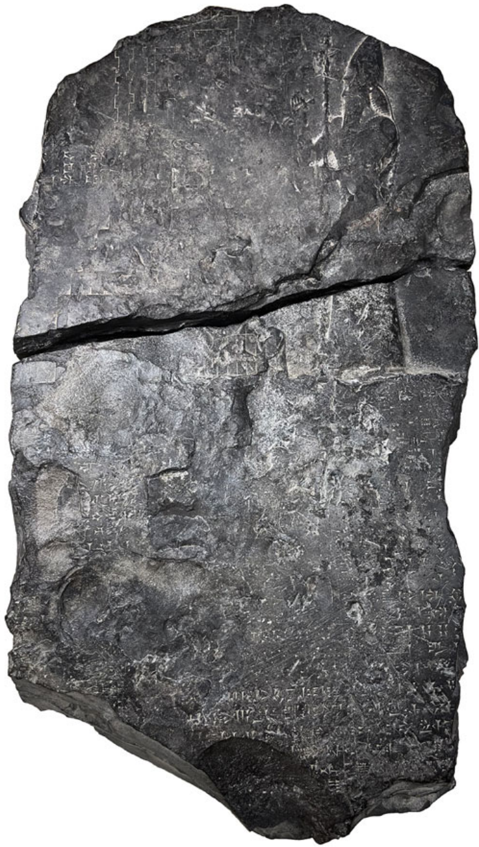
In the early 1990s the two fragments of black stone making up the Tower of Babylon stele with pictures of the ziggurat in Babylon and the king Nebuchadnezzar II were found in the large open trench from the German excavations of Amran in 1900. The findspot was about 20 m north of the Esagil temple in Babylon, but the level where it was discovered is not Neo-Babylonian but later, possibly Parthian. The archaeological and historical background of the stele is discussed, and the image of the Ziggurat on the stele is considered. After 28 years in the Schøyen Collection Oslo, the stele is now in the Iraq Museum in Baghdad.
Checked 2026-11-24 · 1 reference not checked yet
Overview
CoChat Summary
TL;DR
The article publishes the find circumstances of the Tower of Babylon stele, a black stone stele with images of Nebuchadnezzar II and the Etemenanki ziggurat, found in the early 1990s about 20 m north of Esagil in Babylon in a possibly Parthian level. It argues the findspot makes an original placement in Esagil probable (with possible earlier Etemenanki location) and uses the stele’s measurements to reconstruct the ziggurat.
Key findings
- The stele consists of two black stone fragments, complete size 47 × 25.5 × 11 cm; it was previously MS 2063 in the Schøyen Collection and is now in the Iraq Museum, Baghdad. It shows King Nebuchadnezzar II, a side view and plan of Etemenanki, a three-line epigraph identifying Etemenanki, and a longer inscription that is a variant of Nebuchadnezzar II inscriptions about building Etemenanki and Eurmeiminanki.
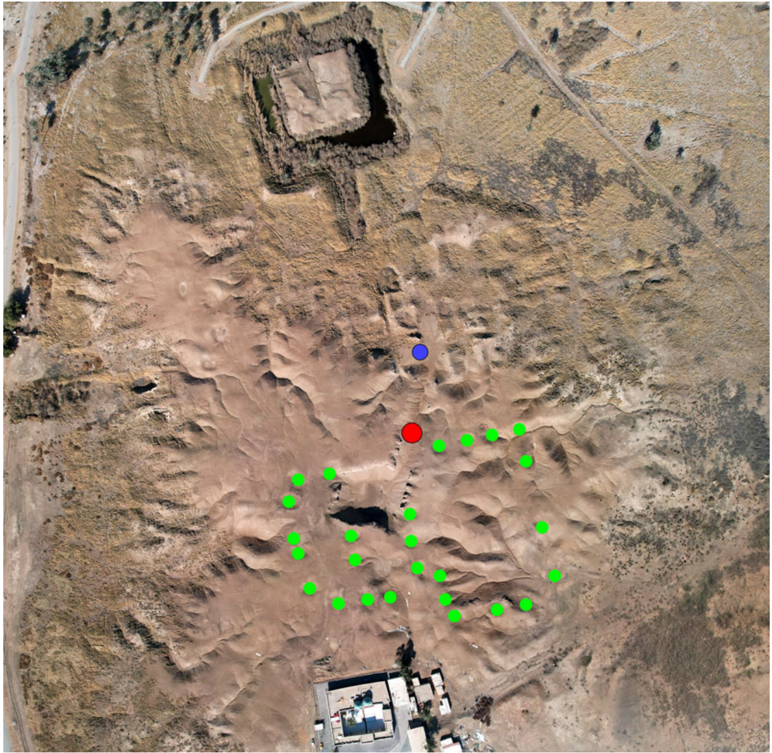
- The findspot was in the large trench from the 1900 German excavations on Amran, about 20 m north of Esagil, at UTM zone 38N coordinates 445705E 3599790N; the level was not Neo-Babylonian but later, possibly Parthian. Nearby, a Parthian house had more than 220 fragmentary precious objects in Room E on its lowest floor at +8.0 m (33.5 MASL), 60–90 m north of the Marduk temple.
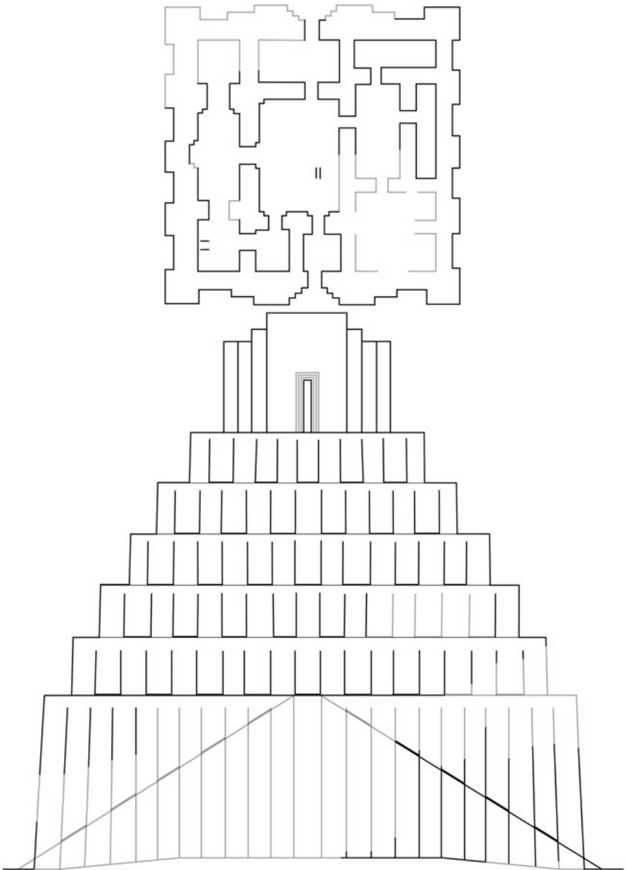
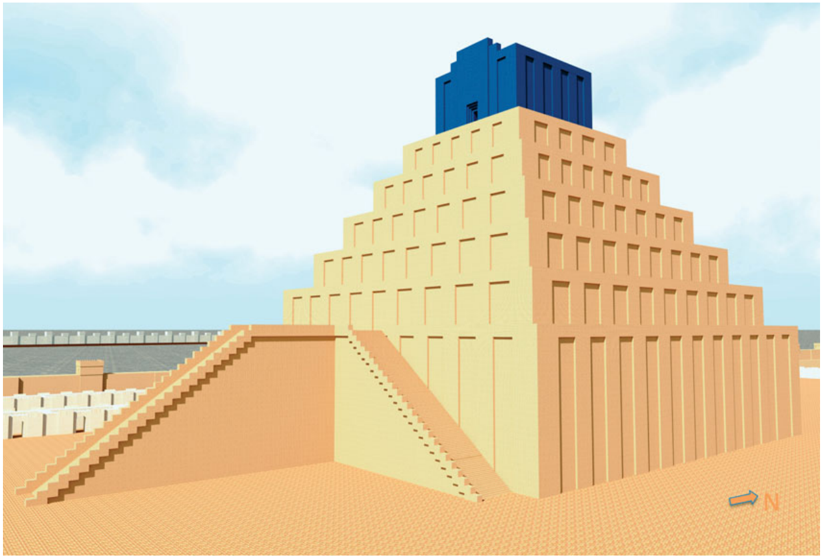
- From the stele’s ziggurat picture, 12.5 cm wide and about 12.5–12.8 cm high, and the archaeologically established lower first terrace width of about 91.5 m (180 ammatu), the author estimates a total ziggurat height of 91.5 m (left and right 93.7 m). The reconstruction gives six terraces with approximate heights of 27.1–29.3 m, then 9.5, 8.8, 8.8, 8.8, and 8.1 m, plus a 20.4 m high top building; the door to the top sanctuary would correspond to about 1.4 m wide and 8.9 m high.
- After Norwegian police seizure in 2021 and a September 2022 court decision that Iraq had not proven the objects’ origin, the collector decided to return the stele; in December 2023 it was presented as a gift to the Iraqi authorities and is now in the Iraq Museum, Baghdad.
Methods
- The article combines archaeological and historical contextualization with the author’s first-hand inspection of the stele in September and October 2023, once with Jamie Novotny and once with Rocío Da Riva; a 3D photogrammetry of the stele was made in October 2023.
- It uses oral findspot information from villagers in Jumjuma, gathered during the author’s work in Babylon with the State Board of Antiquity and Heritage in Iraq and the World Monuments Fund from 2015 onward, with more exact place and time obtained in 2019 and 2022.
- It compares the stele’s imagery and measurements with German excavation results (Koldewey/Wetzel 1913; Schmid 1962), cuneiform texts, and the better-preserved Borsippa ziggurat.
Limitations
- Stated in the paper: the villagers’ story is plausible but lacks corroboration by photograph or witness statements; the findspot level is less securely dated archaeologically; the inscriptions have not been professionally cleaned, making assessment difficult; surface wear and damage make details hard to assess from photos; and more work and preferably more texts are needed.
- Evident from the text: the findspot information is oral, anonymous, and published without independent archaeological verification, and earlier faulty findspot information had caused scholarly doubts about the stele’s authenticity.
Model-written summary. Check it against the paper before relying on it.
Integrity signals
Registry
Cites
Statistics
Figures
Verification
Claims the paper makes
0 Valid · 4 Not valid · 30 Not checked · 98 Own results and interpretations
A result the paper reports from its own data — it cites no other source for it, so there is none to check. The quote shows it is in the paper.
In the paper
“In the area between Esagil and Etemenanki, some 60 to 90 m north of the Marduk temple, a large Parthian house (Fig. 2, blue dot) was unearthed with lowest floor levels at +8.0 m (33.5 MASL), and higher floors at +10.0 as well as +12.0 m (35.5 and 37.5 MASL).”
§ THE TOWER OF BABYLON STELE FOUND IN BABYLON > 4. The archaeological and historical background: The Parthian hoard and the large trench
plainSingle case- Asserted: passes — The authors put it forward as true.
- Checkable: passes — It can be checked against evidence.
- Load-bearing: unclear — It is unclear whether the paper’s conclusions depend on it.
- Based: passes — The paper gives a reason why it holds.
A result the paper states — it cites no source for it, so there is none to check. The quote shows it is in the paper.
In the paper
“The surfaces are sometimes badly worn.”
§ THE TOWER OF BABYLON STELE FOUND IN BABYLON > 6. Inspection of the stele with the Etemenanki ziggurat
plain- Asserted: passes — The authors put it forward as true.
- Checkable: passes — It can be checked against evidence.
- Load-bearing: unclear — It is unclear whether the paper’s conclusions depend on it.
- Based: passes — The paper gives a reason why it holds.
A result the paper states — it cites no source for it, so there is none to check. The quote shows it is in the paper.
In the paper
“In the middle of the first terrace, almost all of the immediate surface has disappeared making the interpretation of the staircases a bit problematic, especially when compared with the excavation results.”
§ THE TOWER OF BABYLON STELE FOUND IN BABYLON > 6. Inspection of the stele with the Etemenanki ziggurat
plainstates a cause- Asserted: passes — The authors put it forward as true.
- Checkable: passes — It can be checked against evidence.
- Load-bearing: unclear — It is unclear whether the paper’s conclusions depend on it.
- Based: passes — The paper gives a reason why it holds.
A result the paper states — it cites no source for it, so there is none to check. The quote shows it is in the paper.
In the paper
“It is only preserved on the top at the middle and left parts where hardly any separation in layers is visible.”
§ THE TOWER OF BABYLON STELE FOUND IN BABYLON > 6. Inspection of the stele with the Etemenanki ziggurat
plain- Asserted: passes — The authors put it forward as true.
- Checkable: passes — It can be checked against evidence.
- Load-bearing: unclear — It is unclear whether the paper’s conclusions depend on it.
- Based: passes — The paper gives a reason why it holds.
A result the paper reports from its own data — it cites no other source for it, so there is none to check. The quote shows it is in the paper.
In the paper
“There were three staircases on the depicted south façade leading up to the top of the first terrace.”
§ THE TOWER OF BABYLON STELE FOUND IN BABYLON > 6. Inspection of the stele with the Etemenanki ziggurat
plain- Asserted: passes — The authors put it forward as true.
- Checkable: passes — It can be checked against evidence.
- Load-bearing: unclear — It is unclear whether the paper’s conclusions depend on it.
- Based: passes — The paper gives a reason why it holds.
49 more claims
Create a free account to see all 132 claims and to verify the 9 references still open.
- It may state two separate claims as one. 52
- Probably not a substantial claim. 37
- The quote only partly states this claim. 1
Self-check
Percentages, sums and reported differences re-computed from the paper’s own numbers.
Each contradiction between two passages listed here was confirmed by an independent check.
Rated minor: it would not touch a result — a value no result rests on, a p-value that stays on the same side of the significance level, or a conflict that is clerical, resolved elsewhere in the paper, or outside its own findings.
In the paper
§ THE TOWER OF BABYLON STELE FOUND IN BABYLON > 2. The archaeological and historical background: Esagilthe Marduk Temple
“There are several references to removal (or sometimes lack of removal) of debris from Esagil in 320-317 BC during Philip and Alexander IV (r.316-307 BC) in the diaries.”
§ THE TOWER OF BABYLON STELE FOUND IN BABYLON > 2. The archaeological and historical background: Esagilthe Marduk Temple
“Alexander IV (r.316-307 BC)”
Citations
Cites
The Royal Inscriptions of Sennacherib, King of Assyria (704-681 BC), Part 1
Grayson, A. K., & Novotny, J. R. (2012) · Penn State University Press eBooks · doi:10.1515/9781575066790 · Cited by 172
The Royal Inscriptions of Esarhaddon, King of Assyria (680-669 BC)
Leichty, E. (2011) · doi:10.1515/9781575066462 · Cited by 79
The Tower of Babel: archaeology, history and cuneiform texts
George, G. (2016) · Cited by 50
Die Tempel von Babylon und Borsippa
Koldewey, R. (1911) · University of Heidelberg, GERMANY, Diglit · doi:10.11588/diglit.4122 · Cited by 41
The twin inscriptions of Nebuchadnezzar at Brisa (Wadi esh-Sharbin, Lebanon)
Riva, R. D. (2012) · Cited by 30
Babylonian Chronographic Texts from the Hellenistic Period
van der Spek, R. J., Finkel, I. L., Pirngruber, R., & Stevens, K. (2025) · SBL Press eBooks · doi:10.2307/jj.31106783 · Cited by 27
Die Tempel von Babylon und Borsippa, nach den ausgrabungen durch die Deutsche Orient-Gesellschaft
Koldewey, R. (1911) · University of Michigan Library Repository · Cited by 24
Weiershäuser, F., & Novotny, J. (2020) · doi:10.1515/9781646021178 · Cited by 20
Pedersén, O. (2021) · doi:10.2307/jj.18654658 · Cited by 13
Self-citation
Research works printed but not linked: 10
- Wetzel, F., Schmidt, E., Mallwitz, A. 1957. Das Babylon der Spätzeit. Wissenschaftliche Veröffentlichung der Deutschen Orient-Gesellschaft 62. Gebr. Mann. Berlin.
- Wetzel, F. 1938. Das Hauptheiligtum des Marduk in Babylon, Esagila und Etemenanki. Wissenschaftliche Veröffentlichung der Deutschen Orient-Gesellschaft 59. Hinrichs. Leipzig.
- Sollberger, E. 1985. "Babylon's beginning". Sumer 41, 10-13.
- --2011. "A stele of Nebuchadnezzar II." In: A. R. George (ed.) Cuneiform royal inscriptions and related texts in the Schøyen collection. Cornell University Studies in Assyriology and Sumerology 17. CDL Press. Bethesda MD. 153-169, pls. LVIII-LXVII.
- Frame, G. 1995. Rulers of Babylonia, From the Second Dynasty of Isin to the End of Assyrian Domination (1157- 612 BC). The Royal Inscriptions of Mesopotamia. Babylonian Periods 2. Eisenbrauns. University of Toronto Press. Toronto.
- George, forthcoming, On the authenticity of the Tower of Babel stele, Bibliotheca Orientalis
- Reade, J. E. 1987. "Babylonian Boundary-Stones and Comparable Monuments in the British Museum". Annual Review of the Royal Inscriptions of Mesopotamia Projects 5, 47-51.
- Marzahn, J. and Schauerte, G. (eds). 2008. Babylon: Mythos und Wahrheit. Hirmer. München.
- Sachs, A. J. and Hunger, H. 1995. Astronomical Diaries and Related Texts from Babylonia. Vol. 1. Diaries from 652 B.C. to 262 B.C. Österreichische Akademie der Wissenschaften. Philosophisch-Historische Klasse, Denkschriften 195. Wien.
- --2013. "The Neo-Babylonian Monuments at Shir es-Sanam and Wadi es-Saba (North Lebanon)." Wiener Zeitschrift für die Kunde des Morgenlandes 103, 87-100.
Cited by
Рассказ о Вавилонской башне и датировка библейской «праистории»
Луппова, А. А. (2026) · The Quarterly Journal of St Philaret s Institute · doi:10.25803/26587599_2026_1_57_36 · Cited by 1
Royal Dress and the Expression of Power in Babylonia, First Millennium BCE
Quillien, L. (2024) · Journal of Ancient Near Eastern History · doi:10.1515/janeh-2024-0007
Junk, S., & Mutterer, F. (2025) · international conference on 3D web technology · doi:10.1145/3746237.3746292
Wasmuth, M., Alstola, T., Meir, R. A., Bennett, E., Bonnie, R., Debourse, C., Lorenzón, M., Malekzadeh, Y., Nitschke, J. L., Ramsey, G., et al. (2025) · Studia Orientalia Electronica · doi:10.23993/store.157310
Metadata
- Authors
- Pedersén, O.
- Corresponding author
- Pedersén, Olof
- ORCID
- Pedersén, Olof
- Venue
- IRAQ
- Publisher
- Cambridge University Press (CUP)
- Published
- 2023-12
- Volume
- 85
- Pages
- 179-191
- ISSN
- 0021-0889 (ISSN-L)
- 2053-4744
- OpenAlex
- W4391971431
- Cited by
- 4
- References
- 18
- Citations by year
- 2026: 1 · 2025: 2 · 2024: 1
- FWCI
- 2.34
- Type
- journal article
- Language
- en
- Open access
- hybrid
- doi.org
- Locations
- Iraq (publishedVersion, cc-by)
- Uppsala University Publications (Uppsala University) (submittedVersion, other-oa)
- Topics
- Social Sciences › Arts and Humanities › Archeology (arts and humanities) › Ancient Near East History
- Social Sciences › Arts and Humanities › Religious studies › Biblical Studies and Interpretation
- Social Sciences › Arts and Humanities › Archeology (arts and humanities) › Ancient Egypt and Archaeology
- Keywords
- Nebuchadnezzar II, ziggurats, Babylon, Parthian period, Neo-Babylonian period, Schøyen Collection, Iraq Museum, German excavations
About these checks
Registry, retraction, Cites and statistics results are computed, not judged, with one exception: a printed reference that no index lists is read once by a model before it counts as a citation error. Claims are extracted by a model and kept only when their quote appears verbatim in the text; each cited source is then checked, with a model’s help, for whether it says what the claim relies on. Those verdicts can be wrong — read the claim’s quote and the cited source before relying on one.
A language model drew the claims from the paper on 2026-11-24, under version 3 of the claim definition (model deepseek-v4.1-flash, prompt extract-v3).
A second model labelled each claim on 2026-11-24 (model jev-1.13-20260917, definition revision gold-guideline-v0.2).
Statistics and arithmetic are recomputed, not judged.
Confidence bands are shown only for fields calibrated on our annotated test set. None is calibrated yet, so no band is shown.
What counts as a claim ›How we measure confidence ›How we check this ›
Are you an author, or do you see a problem with this page? Request a review
Data sources
Bibliographic data: Semantic Scholar, OpenAlex, Crossref.
Contains information from the Semantic Scholar Academic Graph Datasets, made available under the ODC Attribution License (ODC-BY 1.0).
Semantic Scholar’s data is described in: Kinney, R., et al. (2023). The Semantic Scholar Open Data Platform. arXiv:2301.10140.
