

The DOI matches its Crossref record; 34 of the 35 references it cites were found in a registry or an index.
Outreach and screening following the 2005 London bombings: usage and outcomes
Open accessAbstract
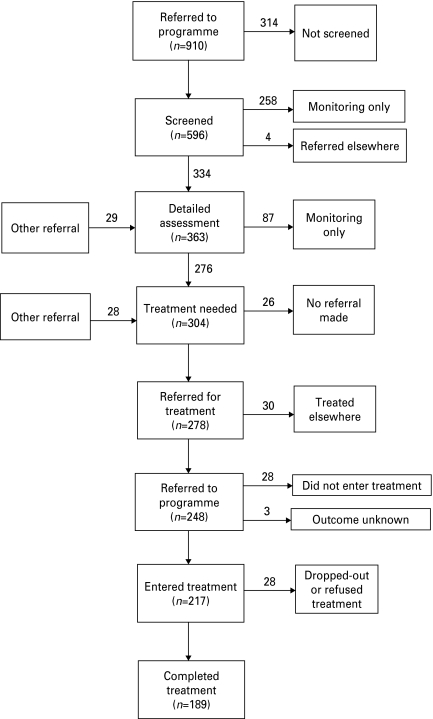
Background: Little is known about how to remedy the unmet mental health needs associated with major terrorist attacks, or what outcomes are achievable with evidence-based treatment. This article reports the usage, diagnoses and outcomes associated with the 2-year Trauma Response Programme (TRP) for those affected by the 2005 London bombings. Method: Following a systematic and coordinated programme of outreach, the contact details of 910 people were obtained by the TRP. Of these, 596 completed a screening instrument that included the Trauma Screening Questionnaire (TSQ) and items assessing other negative responses. Those scoring ⩾6 on the TSQ, or endorsing other negative responses, received a detailed clinical assessment. Individuals judged to need treatment (n=217) received trauma-focused cognitive-behaviour therapy (TF-CBT) or eye movement desensitization and reprocessing (EMDR). Symptom levels were assessed pre- and post-treatment with validated self-report measures of post-traumatic stress disorder (PTSD) and depression, and 66 were followed up at 1 year. Results: Case finding relied primarily on outreach rather than standard referral pathways such as primary care. The effect sizes achieved for treatment of DSM-IV PTSD exceeded those usually found in randomized controlled trials (RCTs) and gains were well maintained an average of 1 year later. Conclusions: Outreach with screening, linked to the provision of evidence-based treatment, seems to be a viable method of identifying and meeting mental health needs following a terrorist attack. Given the failure of normal care pathways, it is a potentially important approach that merits further evaluation.
Overview
The claims and statistics of this paper haven’t been checked yet.
Run the check — free, no account needed. It reads the open-access text and checks the sources it cites.
Integrity signals
Registry
Cites
Statistics
Figures
Verification
Claims the paper makes
The claims and statistics of this paper haven’t been checked yet.
Run the check — free, no account needed. It reads the open-access text and checks the sources it cites.
Claims other papers make about this one
Each is checked against this paper’s own text: does it say what the citing paper says it does?
In the citing paper
“Studies have also suggested that the threshold for an ICD-10 diagnosis of the disorder is relatively low 48,49 .”
Self-check
Percentages, sums and reported differences re-computed from the paper’s own numbers.
The self-check needs the paper’s full text.
Citations
Cites
Posttraumatic Stress Disorder in the National Comorbidity Survey
Kessler, R. C. (1995) · Archives of General Psychiatry · doi:10.1001/archpsyc.1995.03950240066012 · Cited by 10,379
Cognitive Therapy for Depression
(2012) · PsycEXTRA Dataset · doi:10.1037/e675542012-001 · Cited by 9,678
Jacobson, N. S., & Truax, P. (1991) · Journal of Consulting and Clinical Psychology · doi:10.1037/0022-006x.59.1.12 · Cited by 7,770
The Patient Health Questionnaire-2: Validity of a Two-Item Depression Screener
Kroenke, K., Spitzer, R. L., & Williams, J. B. W. (2003) · Medical Care · doi:10.1097/01.mlr.0000093487.78664.3c · Cited by 6,359
Meta-analysis of risk factors for posttraumatic stress disorder in trauma-exposed adults
Brewin, C. R., Andrews, B., & Valentine, J. D. (2000) · Journal of Consulting and Clinical Psychology · doi:10.1037/0022-006x.68.5.748 · Cited by 5,243
Self-citationFoa, E. B., Cashman, L., Jaycox, L., & Perry, K. (1997) · Psychological Assessment · doi:10.1037/1040-3590.9.4.445 · Cited by 2,709
Cognitive Therapy of Depression
Fischer, H. (1980) · Psychosomatics · doi:10.1016/s0033-3182(80)73639-3 · Cited by 1,612
Post-traumatic stress disorder following disasters: a systematic review
Neria, Y., Nandi, A., & Galea, S. (2008) · Psychological Medicine · doi:10.1017/s0033291707001353 · Cited by 1,429 · cited 2×
“…attacks, a minority of individuals develop a persistent mental health problem, most commonly posttraumatic stress disorder (PTSD; Call & Pfefferbaum, 1999; Whalley & Brewin, 2007 ; Neria et al. 2008 ; WTC Medical Working Group, 2008), the evidence base for planning an effective response is lacking.”
BackgroundInfluentialPost-Traumatic Stress Disorder in the General Population
Helzer, J. E., Robins, L. N., & McEvoy, L. (1987) · New England Journal of Medicine · doi:10.1056/nejm198712243172604 · Cited by 1,199
Brief screening instrument for post-traumatic stress disorder
Brewin, C. R., Rose, S., Andrews, B., Green, J., Tata, P., McEvedy, C., Turner, S., & Foa, E. B. (2002) · British Journal of Psychiatry · doi:10.1192/bjp.181.2.158 · Cited by 623
Self-citation
Research works printed but not linked: 5
- 2005, Post-traumatic Stress Disorder: the Management of PTSD in Adults and Children in Primary and Secondary Care
- First, 1997, Structured Clinical Interview for DSM-IV Axis I Disorders – Patient Edition (SCID-IP; Version 2.0, 4/97 revision). Biometrics Research Department
- 2008, Annual Report on 9/11 Health
- 10.1017/S0007125000161896 · DOI · Paper page
- Turner, 1989, The King's Cross fire: planning a ‘phase two’ psychosocial response, Disaster Management, 2, 31
Cited by
Sorted by citations
A Handbook for the Study of Mental Health Second Edition
Scheid, T. L., & Brown, T. N. (2009) · Cited by 1,320
Bonanno, G. A., Brewin, C. R., Kaniasty, K., & Greca, A. M. L. (2010) · Psychological Science in the Public Interest · doi:10.1177/1529100610387086 · Cited by 1,289
Self-citationDiagnosis and classification of disorders specifically associated with stress: proposals for ICD-11
Maercker, A., Brewin, C. R., Bryant, R. A., Cloitre, M., van Ommeren, M., Jones, L. M., Humayan, A., Kagee, A., Llosa, A. E., Rousseau, C., et al. (2013) · World Psychiatry · doi:10.1002/wps.20057 · Cited by 762
Self-citationA review of current evidence regarding the ICD-11 proposals for diagnosing PTSD and complex PTSD
Brewin, C. R., Cloitre, M., Hyland, P., Shevlin, M., Maercker, A., Bryant, R. A., Humayun, A., Jones, L. M., Kagee, A., Rousseau, C., et al. (2017) · Clinical Psychology Review · doi:10.1016/j.cpr.2017.09.001 · Cited by 678
Self-citationRosenfield, S., & Mouzon, D. M. (2012) · Handbooks of sociology and social research · doi:10.1007/978-94-007-4276-5_14 · Cited by 591
Metadata
- Authors
- Brewin, C. R., Fuchkan, N., Huntley, Z., Robertson, M., Thompson, M., Scragg, P., d'Ardenne, P., & Ehlers, A.
- Affiliations
- University College London (GB)
- Camden and Islington NHS Foundation Trust (GB)
- East London NHS Foundation Trust (GB)
- Corresponding author
- Brewin, C. R.
- Venue
- Psychological Medicine
- Publisher
- Cambridge University Press (CUP)
- Published
- 2010-03-09
- Volume
- 40
- Issue
- 12
- Pages
- 2049-2057
- ISSN
- 0033-2917 (ISSN-L)
- 1469-8978
- PMC
- PMC2964043
- OpenAlex
- W2048941857
- Cited by
- 169
- References
- 35
- Citations by year
- 2026: 2 · 2025: 2 · 2024: 3 · 2023: 5 · 2022: 9 · 2021: 13 · 2020: 11 · 2019: 12 · 2018: 11 · 2017: 42 · 2016: 5 · 2015: 12 · 2014: 9 · 2013: 9 · 2012: 7
- FWCI
- 7.71
- Type
- journal article
- Language
- en
- Open access
- hybrid
- doi.org
- Licence
- cc-by-nc-sa
- www.cambridge.org/core/terms (unspecified)
- Locations
- Psychological Medicine (publishedVersion, cc-by-nc-sa)
- PubMed Central (publishedVersion, cc-by-nc-sa)
- PubMed (publishedVersion)
- UCL Discovery (University College London) (submittedVersion)
- Research Portal (King's College London) (submittedVersion)
- Funders
- Wellcome Trust (069777)
- Topics
- Social Sciences › Psychology › Clinical Psychology › Posttraumatic Stress Disorder Research
- Social Sciences › Sociology and Political Science › Terrorism, Counterterrorism, and Political Violence
- Social Sciences › Psychology › Clinical Psychology › Migration, Health and Trauma
- Keywords
- 2005 London bombings, post-traumatic stress disorder, EMDR, mental health outreach, trauma screening, case finding, unmet mental health needs, depression, treatment outcomes, long-term follow-up
- MeSH terms
- Adult, Community-Institutional Relations, Depression, Female, Humans, London, Male, Mass Screening, Mental Health Services, Middle Aged, Primary Health Care, Referral and Consultation, Stress Disorders, Post-Traumatic, Wounds and Injuries, Cohort Studies, Cognitive Behavioral Therapy, Evidence-Based Medicine, Needs Assessment, Terrorism, Eye Movement Desensitization Reprocessing
About these checks
Registry, retraction, Cites and statistics results are computed, not judged, with one exception: a printed reference that no index lists is read once by a model before it counts as a citation error. Claims are extracted by a model and kept only when their quote appears verbatim in the text; each cited source is then checked, with a model’s help, for whether it says what the claim relies on. Those verdicts can be wrong — read the claim’s quote and the cited source before relying on one.
Statistics and arithmetic are recomputed, not judged.
Confidence bands are shown only for fields calibrated on our annotated test set. None is calibrated yet, so no band is shown.
What counts as a claim ›How we measure confidence ›How we check this ›
Are you an author, or do you see a problem with this page? Request a review
