

The DOI matches its Crossref record; 39 of the 41 references it cites were found in a registry or an index, and 2 are not checked yet.
Emotional distress in young adults during the COVID-19 pandemic: evidence of risk and resilience from a longitudinal cohort study
Open accessAbstract
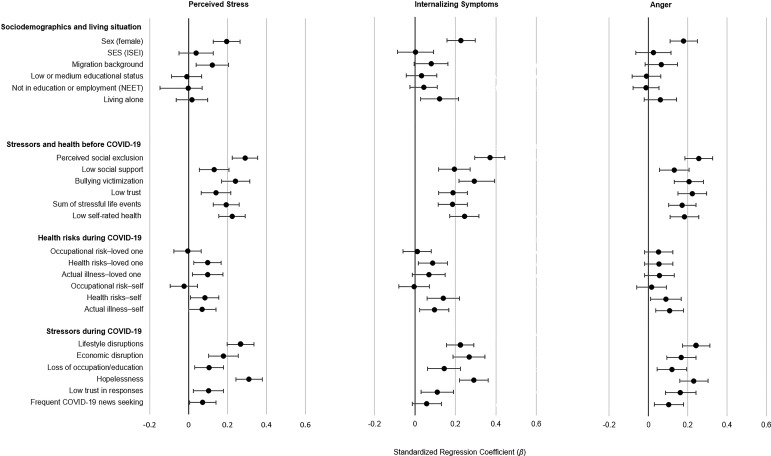
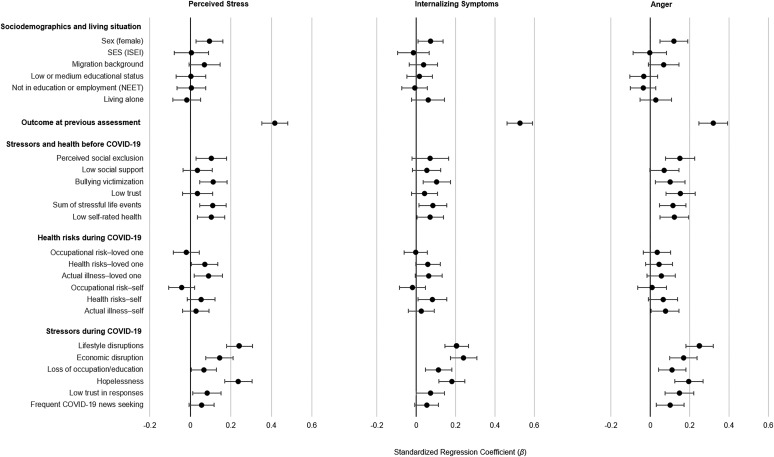
Background: The coronavirus disease 2019 (COVID-19) pandemic and associated lockdown could be considered a ‘perfect storm’ for increases in emotional distress. Such increases can only be identified by studies that use data collected before and during the pandemic. Longitudinal data are also needed to examine (1) the roles of previous distress and stressors in emotional distress during the pandemic and (2) how COVID-19-related stressors and coping strategies are associated with emotional distress when pre-pandemic distress is accounted for. Methods: Data came from a cohort study ( N = 768). Emotional distress (perceived stress, internalizing symptoms, and anger), COVID-19-related stressors, and coping strategies were measured during the pandemic/lockdown when participants were aged 22. Previous distress and stressors were measured before COVID-19 (at age 20). Results: On average, participants showed increased levels of perceived stress and anger (but not internalizing symptoms) during the pandemic compared to before. Pre-COVID-19 emotional distress was the strongest predictor of during-pandemic emotional distress, followed by during-pandemic economic and psychosocial stressors (e.g. lifestyle and economic disruptions) and hopelessness, and pre-pandemic social stressors (e.g. bullying victimization and stressful life events). Most health risks to self or loved ones due to COVID-19 were not uniquely associated with emotional distress in final models. Coping strategies associated with reduced distress included keeping a daily routine, physical activity, and positive reappraisal/reframing. Conclusions: In our community sample, pre-pandemic distress, secondary consequences of the pandemic (e.g. lifestyle and economic disruptions), and pre-pandemic social stressors were more consistently associated with young adults' emotional distress than COVID-19-related health risk exposures.
Overview
The claims and statistics of this paper haven’t been checked yet.
Run the check — free, no account needed. It reads the open-access text and checks the sources it cites.
Integrity signals
Registry
Cites
Statistics
Figures
Verification
Claims the paper makes
The claims and statistics of this paper haven’t been checked yet.
Run the check — free, no account needed. It reads the open-access text and checks the sources it cites.
Claims other papers make about this one
Each is checked against this paper’s own text: does it say what the citing paper says it does?
The check wasn’t confident either way, so it gives no verdict — never disputed.
In the citing paper
“Test scores do not consider children’s psychosocial development (63, 64), either societal costs due to productivity decline or heightened pressure among parents (65, 66).”
From Learning loss due to school closures during the COVID-19 pandemic (2021) · cites this paper as [64]
Experimental — accuracy not yet measured
Self-check
Percentages, sums and reported differences re-computed from the paper’s own numbers.
The self-check needs the paper’s full text.
Citations
Cites
A Global Measure of Perceived Stress
Cohen, S., Kamarck, T., & Mermelstein, R. (1983) · Journal of Health and Social Behavior · doi:10.2307/2136404 · Cited by 32,807
Multiple Imputation for Nonresponse in Surveys
Rubin, D. B. (1987) · Wiley Series in Probability and Statistics · doi:10.1002/9780470316696 · Cited by 20,701
Emerging adulthood: A theory of development from the late teens through the twenties.
Arnett, J. J. (2000) · American Psychologist · doi:10.1037/0003-066x.55.5.469 · Cited by 16,843
The Psychological Impact of Quarantine and How to Reduce It: Rapid Review of the Evidence
Brooks, S. K., Webster, R. K., Smith, L. E., Woodland, L., Wessely, S., Greenberg, N., & Rubin, G. J. (2020) · doi:10.2139/ssrn.3532534 · Cited by 16,394
The psychological impact of quarantine and how to reduce it: Rapid review of the evidence
Brooks, S. K., Webster, R. K., Smith, L. E., Woodland, L., Wessely, S., Greenberg, N., & Rubin, G. J. (2020) · The Lancet · doi:10.1016/s0140-6736(20)30460-8 · Cited by 16,378
Missing data: our view of the state of the art
Schafer, J. L., & Graham, J. W. (2002) · Psychological Methods · doi:10.1037/1082-989x.7.2.147 · Cited by 11,638
Wang, C., Pan, R., Wan, X., Tan, Y., Xu, L., Ho, C. S., & Ho, R. C. (2020) · International Journal of Environmental Research and Public Health · doi:10.3390/ijerph17051729 · Cited by 9,923
Ordinary magic: Resilience processes in development.
Masten, A. S. (2001) · American Psychologist · doi:10.1037/0003-066x.56.3.227 · Cited by 8,497 · cited 1×
“Thus, they also have the potential to experience resilience (i.e. adaptive or better-than-expected outcomes despite the presence of significant risk/adversity, Masten, 2001; Werner, 1993) during the COVID-19 pandemic.”
You want to measure coping but your protocol’ too long: Consider the brief cope
Carver, C. S. (1997) · International Journal of Behavioral Medicine · doi:10.1207/s15327558ijbm0401_6 · Cited by 7,361
Pearlin, L. I., Menaghan, E. G., Lieberman, M. A., & Mullan, J. T. (1981) · Journal of Health and Social Behavior · doi:10.2307/2136676 · Cited by 6,289
Research works printed but not linked: 3
- Eisner, 2011, The SAGE handbook of criminological research methods, 410
- Veer, I. , Riepenhausen, A. , Zerban, M. , Wackerhagen, C. , Engen, H. , Puhlmann, L. , … Kalisch, R. (2020). Mental resilience in the Corona lockdown: First empirical insights from Europe. preprint. Retrieved from https://psyarxiv.com/4z62t
- Muthén, 2012, Mplus user's guide
Cited by
Sorted by citations
Learning loss due to school closures during the COVID-19 pandemic
Engzell, P., Frey, A., & Verhagen, M. D. (2021) · Proceedings of the National Academy of Sciences · doi:10.1073/pnas.2022376118 · Cited by 1,848
“Test scores do not consider children’s psychosocial development (63, 64), either societal costs due to productivity decline or heightened pressure among parents (65, 66).”
Fancourt, D., Steptoe, A., & Bu, F. (2021) · The Lancet Psychiatry · doi:10.1016/s2215-0366(20)30482-x · Cited by 1,161
Robinson, E., Sutin, A. R., Daly, M., & Jones, A. (2022) · Journal of Affective Disorders · doi:10.1016/j.jad.2021.09.098 · Cited by 1,147
Prati, G., & Mancini, A. D. (2021) · Psychological Medicine · doi:10.1017/s0033291721000015 · Cited by 890
Blame the Bot: Anthropomorphism and Anger in Customer–Chatbot Interactions
Crolic, C., Thomaz, F., Hadi, R., & Stephen, A. T. (2021) · Journal of Marketing · doi:10.1177/00222429211045687 · Cited by 874
Metadata
- Authors
- Shanahan, L., Steinhoff, A., Bechtiger, L., Murray, A. L., Nivette, A., Hepp, U., Ribeaud, D., & Eisner, M.
- Affiliations
- University of Zurich (CH)
- University of Edinburgh (GB)
- Utrecht University (NL)
- Integrierte Psychiatrie Winterthur (CH)
- Corresponding author
- Shanahan, Lilly
- Venue
- Psychological Medicine
- Publisher
- Cambridge University Press (CUP)
- Published
- 2020-06-23
- Volume
- 52
- Issue
- 5
- Pages
- 824-833
- ISSN
- 0033-2917 (ISSN-L)
- 1469-8978
- PMC
- PMC7338432
- OpenAlex
- W3036964275
- Cited by
- 675
- References
- 38
- Citations by year
- 2026: 22 · 2025: 42 · 2024: 78 · 2023: 118 · 2022: 168 · 2021: 213 · 2020: 34
- FWCI
- 53.24
- Type
- journal article
- Language
- en
- Open access
- hybrid
- doi.org
- Locations
- Psychological Medicine (publishedVersion, cc-by)
- PubMed Central (publishedVersion, cc-by)
- PubMed (publishedVersion)
- Edinburgh Research Explorer (University of Edinburgh) (submittedVersion, cc-by)
- Zurich Open Repository and Archive (University of Zurich) (submittedVersion, cc-by)
- Utrecht University Repository (Utrecht University) (submittedVersion, other-oa)
- Topics
- Social Sciences › Psychology › Clinical Psychology › COVID-19 and Mental Health
- Health Sciences › Medicine › Public Health, Environmental and Occupational Health › Maternal Mental Health During Pregnancy and Postpartum
- Social Sciences › Psychology › Developmental and Educational Psychology › Student Stress and Coping
- Keywords
- COVID-19 pandemic, emotional distress, young adults, perceived stress, internalizing problems, anger, coping strategies, hopelessness, economic stressors, psychosocial stressors, bullying victimization, life events, lockdown, resilience, positive reappraisal
- MeSH terms
- Psychological Distress, COVID-19, Adult, Communicable Disease Control, Humans, Longitudinal Studies, Cohort Studies, Young Adult, Pandemics
About these checks
Registry, retraction, Cites and statistics results are computed, not judged, with one exception: a printed reference that no index lists is read once by a model before it counts as a citation error. Claims are extracted by a model and kept only when their quote appears verbatim in the text; each cited source is then checked, with a model’s help, for whether it says what the claim relies on. Those verdicts can be wrong — read the claim’s quote and the cited source before relying on one.
Statistics and arithmetic are recomputed, not judged.
Confidence bands are shown only for fields calibrated on our annotated test set. None is calibrated yet, so no band is shown.
What counts as a claim ›How we measure confidence ›How we check this ›
Are you an author, or do you see a problem with this page? Request a review
