

The DOI matches its Crossref record, with a small difference in title or year; 110 of the 111 references it cites were found in a registry or an index.
Psychological treatment of perinatal depression: a meta-analysis
Open accessAbstract
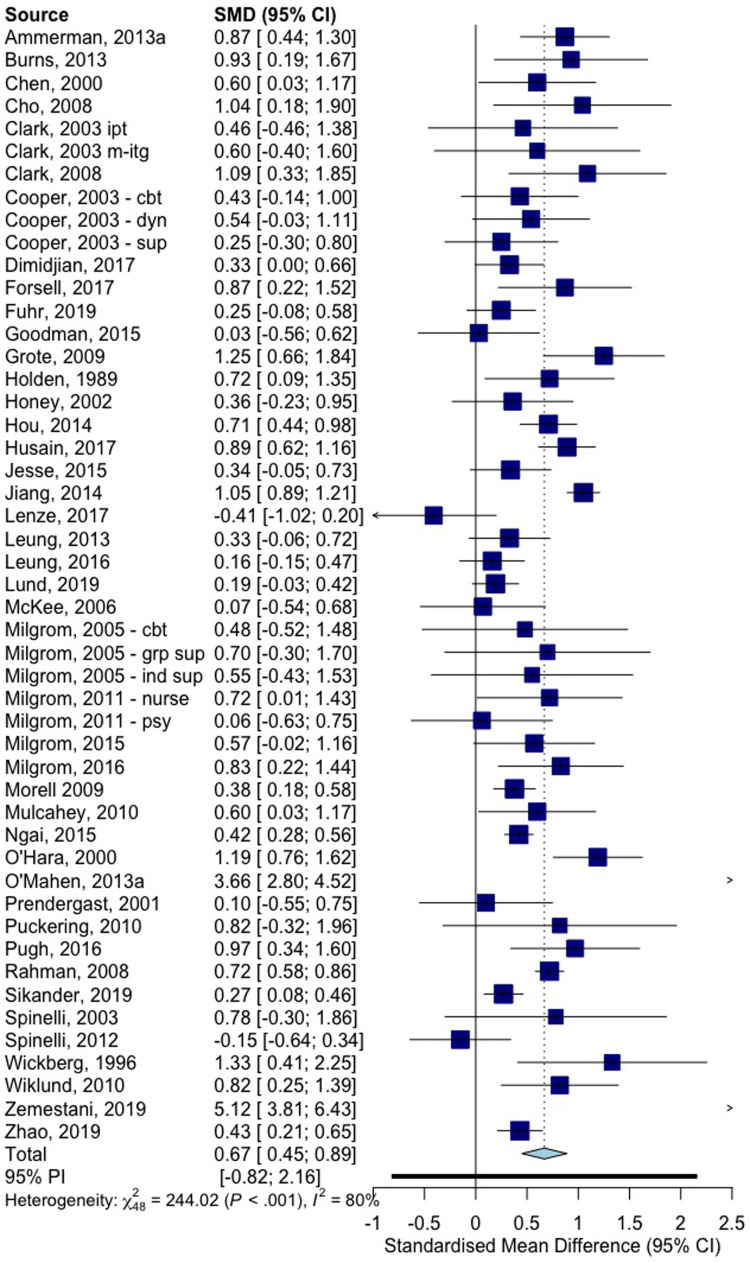
BACKGROUND: Depression during pregnancy and after the birth of a child is highly prevalent and an important public health problem. Psychological interventions are the first-line treatment and, although a considerable number of randomized trials have been conducted, no recent comprehensive meta-analysis has evaluated treatment effects. METHODS: We used an existing database of randomized controlled trials of psychotherapies for adult depression and included studies aimed at perinatal depression. Random effects models were used in all analyses. We examined the effects of the interventions in the short and long term, and also examined secondary outcomes. RESULTS: = 80%; 95% CI 75~85). This effect size remained largely unchanged and significant in a series of sensitivity analyses, although some publication bias was found. The effects remained significant at 6-12 months follow-up. Significant effects were also found for social support, anxiety, functional limitations, parental stress and marital stress, although the number of studies for each outcome was low. All results should be considered with caution because of the high levels of heterogeneity in most analyses. CONCLUSIONS: Psychological interventions are probably effective in the treatment of perinatal depression, with effects that last at least up to 6-12 months and probably also have effects on social support, anxiety, functional impairment, parental stress, and marital stress.
Overview
The claims and statistics of this paper haven’t been checked yet.
Run the check — free, no account needed. It reads the open-access text and checks the sources it cites.
Integrity signals
Registry
Cites
Statistics
Figures
Verification
Claims the paper makes
The claims and statistics of this paper haven’t been checked yet.
Run the check — free, no account needed. It reads the open-access text and checks the sources it cites.
Claims other papers make about this one
Each is checked against this paper’s own text: does it say what the citing paper says it does?
The check wasn’t confident either way, so it gives no verdict — never disputed.
In the citing paper
“Second, a significant portion of women do not respond to treatment (~10–40% do not see improvements in depression) [18].”
From Acceptance-based process variables on postpartum well-being and distress: The mediating role of psychological flexibility (2024) · cites this paper as [18]
Experimental — accuracy not yet measured
Self-check
Percentages, sums and reported differences re-computed from the paper’s own numbers.
The self-check needs the paper’s full text.
Citations
Cites
Statistical Power Analysis for the Behavioral Sciences
Muller, K. E., & Cohen, J. (1989) · Technometrics · doi:10.2307/1270020 · Cited by 99,603
Statistical power analysis for the behavioral sciences
Cohen, J. (1990) · Computers Environment and Urban Systems · doi:10.1016/0198-9715(90)90050-4 · Cited by 65,417
Measuring inconsistency in meta-analyses
Higgins, J. P. T., Thompson, S. G., Deeks, J. J., & Altman, D. G. (2003) · BMJ · doi:10.1136/bmj.327.7414.557 · Cited by 63,139
An inventory for measuring depression
BECK, A. T. (1961) · Archives of General Psychiatry · doi:10.1001/archpsyc.1961.01710120031004 · Cited by 38,032
The Cochrane Collaboration's tool for assessing risk of bias in randomised trials
Higgins, J. P. T., Altman, D. G., Gotzsche, P. C., Juni, P., Moher, D., Oxman, A. D., Savovic, J., Schulz, K. F., Weeks, L., Sterne, J. A. C., et al. (2011) · BMJ · doi:10.1136/bmj.d5928 · Cited by 33,817
Hamilton, M. (1960) · Journal of Neurology, Neurosurgery & Psychiatry · doi:10.1136/jnnp.23.1.56 · Cited by 32,817 · cited 1×
“In order to calculate effect sizes, we used all measures examining depressive symptoms (such as the Beck Depression Inventory/ BDI (Beck, Ward, Mendelson, Mock, & Erbaugh, 1961); the BDI-II (Beck, Steer, & Brown, 1996); or the Hamilton Rating Scale for Depression/HAMD-17 (Hamilton, 1960).”
MethodDermyshi, E., Wang, Y., Yan, C., Hong, W., Qiu, G., Gong, X., & Zhang, T. (2017) · Neonatology · doi:10.1159/000454668 · Cited by 24,586
Borenstein, M., Hedges, L. V., Higgins, J. P. T., & Rothstein, H. R. (2009) · doi:10.1002/9780470743386 · Cited by 14,225
Duval, S., & Tweedie, R. (2000) · Biometrics · doi:10.1111/j.0006-341x.2000.00455.x · Cited by 14,099
Wasserman, S. S., Hedges, L. V., & Olkin, I. (1988) · Journal of Educational Statistics · doi:10.2307/1164953 · Cited by 10,377
Research works printed but not linked: 2
- 10.1176/ps.2009.60.3.313 · DOI
- Beck, 1996, BDI-II. Beck depression inventory second edition: Manual
Cited by
Sorted by citations
Psychological treatment of depression: A systematic overview of a 'Meta-Analytic Research Domain'
Cuijpers, P., Miguel, C., Harrer, M., Plessen, C. Y., Ciharova, M., Papola, D., Ebert, D., & Karyotaki, E. (2023) · Journal of Affective Disorders · doi:10.1016/j.jad.2023.05.011 · Cited by 136
Self-citationVigod, S. N., Frey, B. N., Clark, C. T., Grigoriadis, S., Barker, L. C., Brown, H. K., Charlebois, J., Dennis, C., Fairbrother, N., Green, S. M., et al. (2025) · The Canadian Journal of Psychiatry · doi:10.1177/07067437241303031 · Cited by 91
Pettman, D., O’Mahen, H., Blomberg, O., Svanberg, A. S., von Essén, L., & Woodford, J. (2023) · BMC Psychiatry · doi:10.1186/s12888-023-04547-9 · Cited by 90
A unified model of the biology of peripartum depression
Levin, G., & Ein‐Dor, T. (2023) · Translational Psychiatry · doi:10.1038/s41398-023-02439-w · Cited by 51
The effects of psychological treatment of perinatal depression: an overview
Cuijpers, P. J., & Karyotaki, E. (2021) · Archives of Women s Mental Health · doi:10.1007/s00737-021-01159-8 · Cited by 43
Self-citation
Metadata
- Authors
- Cuijpers, P., Franco, P., Ciharova, M., Miguel, C., Segre, L., Quero, S., & Karyotaki, E.
- Affiliations
- Amsterdam Public Health (NL)
- Pontificia Universidad Católica de Chile (CL)
- University of Iowa (US)
- Universitat Jaume I (ES)
- Corresponding author
- Cuijpers, Pim
- Venue
- Psychological Medicine
- Publisher
- Cambridge University Press (CUP)
- Published
- 2021-11-16
- Volume
- 53
- Issue
- 6
- Pages
- 2596-2608
- ISSN
- 0033-2917 (ISSN-L)
- 1469-8978
- PMC
- PMC10123831
- OpenAlex
- W3212134895
- Cited by
- 103
- References
- 111
- Citations by year
- 2026: 24 · 2025: 33 · 2024: 22 · 2023: 16 · 2022: 6 · 2021: 2
- FWCI
- 2.05
- Type
- journal article
- Language
- en
- Open access
- hybrid
- doi.org
- Locations
- Psychological Medicine (publishedVersion, cc-by)
- PubMed Central (publishedVersion, cc-by)
- PubMed (publishedVersion)
- VU Research Portal (publishedVersion, other-oa)
- Repositori UJI (Universitat Jaume I) (submittedVersion, cc-by)
- OSF Preprints (OSF Preprints) (submittedVersion)
- Data Archiving and Networked Services (DANS) (submittedVersion, other-oa)
- Funders
- Chilean National Agency for Research and Development (ANID) / Scholarship Program (DOCTORADO NACIONAL/ 2019 – 21190745)
- Topics
- Health Sciences › Medicine › Public Health, Environmental and Occupational Health › Maternal Mental Health During Pregnancy and Postpartum
- Health Sciences › Medicine › Obstetrics and Gynecology › Pregnancy-related medical research
- Social Sciences › Psychology › Clinical Psychology › Personality Disorders and Psychopathology
- Keywords
- perinatal depression, psychological intervention, psychotherapy, treatment effectiveness, postpartum depression, pregnancy, social support, anxiety, functional disability, parental stress, marital stress, long-term outcomes
- MeSH terms
- Adult, Anxiety, Anxiety Disorders, Child, Depression, Depressive Disorder, Female, Humans, Pregnancy, Psychotherapy
About these checks
Registry, retraction, Cites and statistics results are computed, not judged, with one exception: a printed reference that no index lists is read once by a model before it counts as a citation error. Claims are extracted by a model and kept only when their quote appears verbatim in the text; each cited source is then checked, with a model’s help, for whether it says what the claim relies on. Those verdicts can be wrong — read the claim’s quote and the cited source before relying on one.
Statistics and arithmetic are recomputed, not judged.
Confidence bands are shown only for fields calibrated on our annotated test set. None is calibrated yet, so no band is shown.
What counts as a claim ›How we measure confidence ›How we check this ›
Are you an author, or do you see a problem with this page? Request a review
