

The development of Sanskrit velars into Gāndhārī
Open accessThe DOI matches its Crossref record; 9 of the 11 references it cites were found in a registry or an index; 2 of the 28 sources its claims cite were checked for support.
Abstract
As a language of religious and administrative importance in the early centuries of the common era, Gāndhārī came to be a donor into its neighbouring languages, such as Tocharian and Chinese. Consequently, advances in Gāndhārī historical phonology can help us discover new loanwords, refine our understanding of the historical phonology of its neighbouring languages, and eventually improve our understanding of the relationship between the communities that spoke those languages. One unresolved problem in the study of Gāndhārī phonology is the development of Sanskrit unaspirated velar stops: the relative paucity of data and variation in spelling have left previous researchers hesitant regarding the developments of those stops and their phonetic realization. In the present article, we take a bird’s eye view and analyse the development of these velars across the whole edited corpus; our main contribution is the discovery of the phonetic environment conditioning the development of /k/ and /g/, thereby fully explaining the seemingly chaotic spelling observed in previous publications.
Overview
CoChat Summary
TL;DR
This corpus-wide study argues that Sanskrit unaspirated velars in Gāndhārī had regular but previously unrecognized developments: intervocalic *k* palatalized after *i* and otherwise lenited through *ɣ* to *j* in some texts, while *g* followed a separate lenition chain only in some texts. It also argues that Gāndhārī spelling reflects pronunciation more faithfully than often assumed.
Key findings
- The main discovery is the phonetic conditioning of intervocalic unaspirated velars: Skt. *k* > *j* / *i* _ V in all but the earliest texts, and *k* > *ɣ* > *j* / V _ V with texts showing the three stages; Skt. *g* > *ɣ* > *j* / V _ V only in some texts, visibly starting after the corresponding *k* chain had completed.
- Non-intervocalic velars are mostly regular: word-initial *k*, *kh*, and *g* are nearly always preserved; word-initial *gh* de-aspirates to *g* except before *r/ṛ*; word-final *-k* disappears; clusters with nasals yield voiced *g/gh*; *sk* and *skh* yield *kh*; compound boundaries block lenition.
- The dataset contains some 5,000 entries. Tables show distribution across the 30 documents with the most words of interest: for Skt. *-aka#*, outcomes shift from predominantly *k* to *g* to *g̱* to ∅ across text groups, while Skt. *-ika#* predominantly yields *y* or ∅ except in the oldest texts.
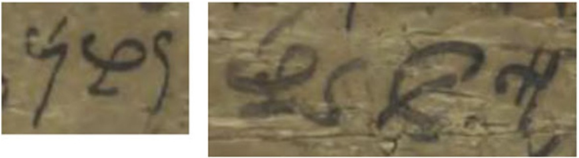
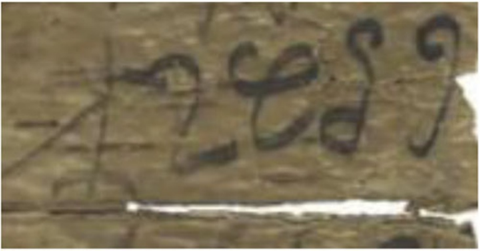
- The authors connect the findings to Chinese transcriptions: Skt. *campaka* > Gdh. *\*caṃpag̱(a)* > Late Hàn Chinese 占匐 */tśam.bǝk/* with final /-k/, whereas Skt. *sugandhika* > Gdh. *\*sugaṃdhi(a)* > LHC 須揵提 */sio.gan.de/* without such a coda.
Methods
- The study uses the online Gāndhārī dictionary at Baums and Glass (2002), retrieving all entries where a Sanskrit equivalent is identified and contains *k* or *g*, including *kh* and *gh*; this dataset contains some 5,000 entries.
- Each attestation was annotated for the outcome of the Sanskrit velar using the set {k, ḵ, kh, g, g̱, gh, h, y, ∅}, then analyzed by environment: word-initial, word-final, adjacent to another consonant, intervocalic, compound boundary, the *-ka* suffix, and preceding vowel.
- Presentation of outcome counts is restricted to the 30 documents containing the most words of interest, with document families grouped under headings such as Av L; tables report outcomes by document and environment.
Limitations
- The paper states that scarcity of material makes the analysis of velars preceding other consonants tentative; it offers no explanation for the fluctuation of *ṣk* between *k* and *kh*, nor for the inconsistent spelling of *rgh* in Skt. *dīrgha*.
- The paper states that it is not possible to establish a relative chronology between every pair of sound changes, that no geographic angle was attempted, and that scarcity of data precludes strong conclusions about exceptions to *gh* > *h*.
- The paper states uncertainty about whether “g texts” represent actual /g/ or scribes lacking means to write *g̱*, and whether the *g̱* group reflects dialect or local spelling innovation. Evident from the text: the corpus is dictionary/edition-based, some readings are damaged or uncertain, and some table cells are blank where information was unavailable.
Model-written summary. Check it against the paper before relying on it.
Integrity signals
Registry
Cites
Statistics
Figures

Verification
Claims the paper makes
1 Valid · 5 Not valid · 21 Not checked · 77 Own results and interpretations
A result the paper reports from its own data — it cites no other source for it, so there is none to check. The quote shows it is in the paper.
In the paper
“the outcome of k when preceded by either e, o, or u is the same as when preceded by a, as shown in Table 2.”
§ The development of Sanskrit velars into Ga ˉndha ˉrī > 4.2.3. Intervocalic k in other environments
plain- Asserted: passes — The authors put it forward as true.
- Checkable: passes — It can be checked against evidence.
- Load-bearing: passes — The paper’s conclusions depend on it.
- Based: passes — The paper gives a reason why it holds.
A result the paper reports from its own data — it cites no other source for it, so there is none to check. The quote shows it is in the paper.
In the paper
“On the -ika# side (right), however, and with the exception of the two oldest texts (Sha ˉh and Ma ˉn), there is a very clear predominance of either an empty spelling or a y.”
§ The development of Sanskrit velars into Ga ˉndha ˉrī > 4.2.2. The case of the -ka suffix
boosted- Asserted: passes — The authors put it forward as true.
- Checkable: passes — It can be checked against evidence.
- Load-bearing: passes — The paper’s conclusions depend on it.
- Based: passes — The paper gives a reason why it holds.
A result the paper states — it cites no source for it, so there is none to check. The quote shows it is in the paper.
In the paper
“In such cases, things behave as they usually do in compounds, i.e. the velar stop behaves as if it were at the end of a word and disappears.”
§ The development of Sanskrit velars into Ga ˉndha ˉrī > 3.4. Velars preceding other consonants
plainstates a cause- Asserted: passes — The authors put it forward as true.
- Checkable: passes — It can be checked against evidence.
- Load-bearing: passes — The paper’s conclusions depend on it.
- Based: passes — The paper gives a reason why it holds.
The paper states this without a source or data behind it here, so there is nothing to check it against. The quote shows it is in the paper.
In the paper
“kr is preserved very consistently.”
§ The development of Sanskrit velars into Ga ˉndha ˉrī > 3.4. Velars preceding other consonants
plain- Asserted: passes — The authors put it forward as true.
- Checkable: passes — It can be checked against evidence.
- Load-bearing: unclear — It is unclear whether the paper’s conclusions depend on it.
- Based: unclear — It is unclear why the paper says it holds.
A result the paper reports from its own data — it cites no other source for it, so there is none to check. The quote shows it is in the paper.
In the paper
“As we find no”
§ The development of Sanskrit velars into Ga ˉndha ˉrī > 4.2.4. Intervocalic
plain- Asserted: passes — The authors put it forward as true.
- Checkable: passes — It can be checked against evidence.
- Load-bearing: passes — The paper’s conclusions depend on it.
- Based: passes — The paper gives a reason why it holds.
33 more claims
Create a free account to see all 104 claims and every source verdict.
- Probably not a substantial claim. 27
- It may state two separate claims as one. 50
- The quote only partly states this claim. 2
Citations
Cites
Salomon, R. (1998) · Zenodo · doi:10.5281/zenodo.3524126 · Cited by 79
Boucher, D. (1998) · Journal of the American Oriental Society · doi:10.2307/604783 · Cited by 36 · cited 1×
“Boucher(1998)considersitimpossible to prove which was the source language, but in light of the examples above, we choose to follow the general consensus and take Gaˉndhaˉrī as the source of these texts as the currently best available hypothesis.”
Grammatically Conditioned Sound Change
W. Hill, N. (2014) · Language and Linguistics Compass · doi:10.1111/lnc3.12073 · Cited by 35
Bailey, H. W. (1946) · Bulletin of the School of Oriental and African Studies · doi:10.1017/s0041977x00089801 · Cited by 24
Chinese Transcription of Buddhist Terms in the Late Hàn Dynasty
Baley, J., Hill, N. W., & Caldwell, E. (2023) · Journal of Open Humanities Data · doi:10.5334/johd.110 · Cited by 3 · cited 1×
“The evidence for Gaˉndhaˉrī being the source language of these earliest Chinese Buddhist texts is the use of phonetic transcriptions for technical Buddhist terms (Baley, Hill, and Caldwell 2023) that are better explained if the phonology of Gaˉndhaˉrī is assumed.”
Self-citationThree Early Mahāyāna Treatises from Gandhāra
(2022) · doi:10.1515/9780295750750 · Cited by 2
The Son of the King: Iranistic notes on Gāndhārī Kṣabura
Schoubben, N. (2022) · Zeitschrift der Deutschen Morgenländischen Gesellschaft · doi:10.13173/zdmg/2022/1/9 · Cited by 1 · cited 1×
“The actual pronunciation of this ligature is still debated, the debate residing in whether the cluster is pronounced with an initial / ʈ / (Bailey 1946: 774) or initial /k/ (Schoubben 2022: 150), a debate we do not aim to resolve here.”
"Gāndhārī Hybrid Sanskrit'': New Sources for the Study of the Sanskritization of Buddhist Literature
Salomon, R. (2001) · Indo-Iranian Journal · doi:10.1023/a:1012626411425
Research works printed but not linked: 23
- Carling, Gerd and Georges-Jean Pinault. 2023. Dictionary and Thesaurus of Tocharian A. Wiesbaden: Harrassowitz Verlag.
- Baums, Stefan. 2009. "A Ga ˉndha ˉrī commentary on early Buddhist verses: British Library Kharoṣ ṭ hī Fragments 7, 9, 13 and 18". PhD dissertation, Seattle: University of Washington, Department of Asian Languages and Literature.
- Coblin, W. South. 1983. A Handbook of Eastern Han Sound Glosses. Hong Kong: The Chinese University Press.
- Burrow, Thomas. 1940. A Translation of the Kharoṣ ṭ hī Documents from Chinese Turkestan. (James G. Forlong, Fund XX.) London: The Royal Asiatic Society.
- Glass, Andrew. 2007. Four Ga ˉndha ˉrī Saṃyukta ˉgama Sūtras: Senior Kharoṣ ṭ hī Fragment 5. (Gandha ˉran Buddhist Texts 4.) Seattle: University of Washington Press.
- Boyer, A.M., E.J. Rapson, and E. Senart. 1920. Kharoṣ ṭ hī Inscriptions Discovered by Sir Aurel Stein in Chinese Turkestan, Part I. Text of Inscriptions Discovered at the Niya Site 1901. Oxford: Published under the authority of H.M. Secretary of State for India in Council by the Clarendon Press.
- Strauch, Ingo. 2010. "More missing pieces of early Pure Land Buddhism: new evidence for Akṣ obhya and Abhirati in an early Mahayana Sutra from Gandha ˉra", The Eastern Buddhist 41, 23-66.
- Salomon, Richard. 2000. A Ga ˉndha ˉrī Version of the Rhinoceros Sūtra: British Library Kharoṣ ṭ hī Fragment 5B. (Gandha ˉran Buddhist Texts 1.) Seattle: University of Washington Press.
- Glass, Andrew. 2000. "Paleography and orthography", in A Ga ˉndha ˉrī Version of the Rhinoceros Sūtra: British Library Kharoṣ ṭ hī Fragment 5B, 53-78. (Gandha ˉran Buddhist Texts 1.) Seattle: University of Washington Press.
- Silverlock, Blair Alan. 2015. "An edition and study of the Gos̱ iga-Sutra, the Cow-Horn Discourse (Senior Collection Scroll No. 12): an account of the Harmonious Aṇ arudha Monks". PhD thesis, Sydney: University of Sydney.
- Schoubben, Niels. 2022. "The Son of the King: Iranistic notes on Ga ˉndha ˉrī Kṣ abura", Zeitschrift Der Deutschen Morgenländischen Gesellschaft 172/1, 149-53.
- Konow, Sten. 1929. Kharoshṭ hī Inscriptions with the Exception of Those of A ś oka. Vol. II. (Corpus Inscriptionum Indicarum.) Calcutta: Government of India Central Publication Branch.
- Lenz, Timothy. 2014. "The British Library Kharoṣ ṭ hī fragments: behind the birch bark curtain", in Alice Collett (ed.), Women in Early Indian Buddhism: Comparative Textual Studies. Oxford: Oxford University Press.
- Lenz, Timothy. 2010. Gandha ˉran Avada ˉnas: British Library Kharoṣ ṭ hī Fragments 1-3 and 21 and Supplementary Fragments A-C. Illustrated edition. (Gandha ˉran Buddhist Texts 6.) Seattle: University of Washington Press.
- Burrow, Thomas. 1937. The Language of the Kharoṣ ṭ hi Documents from Chinese Turkestan. Cambridge: Cambridge University Press.
- Harrison, Paul. 2019. "Lokakṣ ema", in Brill's Encyclopedia of Buddhism, 2, 700-06. (Handbook of Oriental Studies 2.) Leiden: Brill.
- Salomon, Richard. 1999. Ancient Buddhist Scrolls from Gandhara: The British Library Kharoṣ ṭ hī Fragments. London: British Library; Seattle: University of Washington Press.
- Allon, Mark. 2001. Three Ga ˉndha ˉrī Ekottarika ˉgama-Type Sūtras: British Library Kharoṣ ṭ hī Fragments 12 and 14. (Gandha ˉran Buddhist Texts 2.) Seattle, WA: University of Washington Press.
- Brough, John. 1962. The Ga ˉndha ˉrī Dhammapada. Edited with an Introduction and Commentary by John Brough. [With Facsimiles of the Manuscript]. (London Oriental Series, Vol. 7.) London: Oxford University Press.
- Zacchetti, Stefano. 2019. "An Shigao", in Brill's Encyclopedia of Buddhism, 2: 630-41. (Handbook of Oriental Studies = Handbuch Der Orientalistik. Section Two, India.) Leiden: Brill.
- Salomon, Richard. 2008. Two Ga ˉndha ˉrī Manuscripts of the Songs of Lake Anavatapta (Anavatapta-Ga ˉtha ˉ). British Library Kharoṣ ṭ hī Fragment 1 and Senior Scroll 14. Seattle: University of Washington Press.
- Schlosser, Andrea. 2022. Three Early Maha ˉya ˉna Treatises from Gandha ˉra: Bajaur Kharoṣ ṭ hī Fragments 4, 6, and 11. (Gandha ˉran Buddhist Texts 7.) Seattle: University of Washington Press.
- Fussman, Gérard. 1989. "Ga ˉndha ˉrī écrite, Ga ˉndha ˉrī parlée", in Dialectes Dans Les Littératures Indo-aryennes, 55: 433-501. (Publications de l'Institut de Civilisation Indienne 8.) Paris: Institut de civilisation indienne.
Metadata
- Authors
- Baley, J., & Avdagic, A.
- Affiliations
- SOAS University of London (GB)
- Julius-Maximilians-Universität Würzburg
- Corresponding author
- Baley, Julien
- ORCID
- Baley, Julien
- Venue
- Bulletin of the School of Oriental and African Studies
- Publisher
- Cambridge University Press (CUP)
- Published
- 2026-03-09
- Volume
- 89
- Issue
- 2
- Pages
- 281-307
- ISSN
- 0041-977X (ISSN-L)
- 1474-0699
- OpenAlex
- W7134252412
- Cited by
- 0
- References
- 7
- FWCI
- 0.00
- Type
- journal article
- Language
- en
- Open access
- hybrid
- doi.org
- Locations
- Bulletin of the School of Oriental and African Studies (publishedVersion, cc-by)
- SOAS Research Online (SOAS University of London) (publishedVersion, other-oa)
- SOAS Research Online (SOAS University of London) (submittedVersion, cc-by)
- Funders
- UK Research and Innovation (AH/V008722/1)
- Trinity College Dublin
- Arts and Humanities Research Council (AH/V008722/1)
- Topics
- Social Sciences › Arts and Humanities › Language and Linguistics › Linguistics and language evolution
- Social Sciences › Arts and Humanities › Religious studies › Indian and Buddhist Studies
- Social Sciences › Psychology › Experimental and Cognitive Psychology › Phonetics and Phonology Research
- Keywords
- Gandhari, historical phonology, Sanskrit loanwords, Tocharian, Chinese, phonetic environment, spelling variation, Indo-Aryan languages, language contact
About these checks
Registry, retraction, Cites and statistics results are computed, not judged, with one exception: a printed reference that no index lists is read once by a model before it counts as a citation error. Claims are extracted by a model and kept only when their quote appears verbatim in the text; each cited source is then checked, with a model’s help, for whether it says what the claim relies on. Those verdicts can be wrong — read the claim’s quote and the cited source before relying on one.
The claim verdicts this report counts are experimental: their accuracy is not yet measured.
A language model drew the claims from the paper on 2026-10-05, under version 3 of the claim definition (model deepseek-v4.1-flash, prompt extract-v3).
A second model labelled each claim on 2026-10-05 (model jev-1.13-20260917, definition revision gold-guideline-v0.2).
Statistics and arithmetic are recomputed, not judged.
Confidence bands are shown only for fields calibrated on our annotated test set. None is calibrated yet, so no band is shown.
What counts as a claim ›How we measure confidence ›How we check this ›
Are you an author, or do you see a problem with this page? Request a review
How to cite
Cite CoChat for the checks on this page, and the paper for its own findings.
- This page
- CoChat. (2026). Citation check: The development of Sanskrit velars into Gāndhārī. https://app.cochat.ai/papers/10.1017/s0041977x26101025
- The paper
- Baley, J., & Avdagic, A. (2026). The development of Sanskrit velars into Gāndhārī. Bulletin of the School of Oriental and African Studies. https://doi.org/10.1017/s0041977x26101025
Data sources
Bibliographic data: Semantic Scholar, OpenAlex, Crossref.
Contains information from the Semantic Scholar Academic Graph Datasets, made available under the ODC Attribution License (ODC-BY 1.0).
Semantic Scholar’s data is described in: Kinney, R., et al. (2023). The Semantic Scholar Open Data Platform. arXiv:2301.10140.
