

Burden of acute gastrointestinal illness in the Metropolitan region, Chile, 2008
Open accessThe DOI matches its Crossref record; 34 of the 35 references it cites were found in a registry or an index; 42 of the 65 sources its claims cite were checked for support.
Abstract
Population survey comparing recall windows and incidence estimates for acute gastrointestinal illness.
Overview
CoChat Summary
## TL;DR
This population-based, face-to-face survey estimated the burden of acute gastrointestinal illness (GI) in Chile’s Metropolitan region in 2008 and found an age-adjusted monthly prevalence of 9.2%. The study also showed that shorter recall periods gave higher annual incidence estimates, with the 7-day recall yielding about 2.2 times the 30-day estimate.
## Key findings
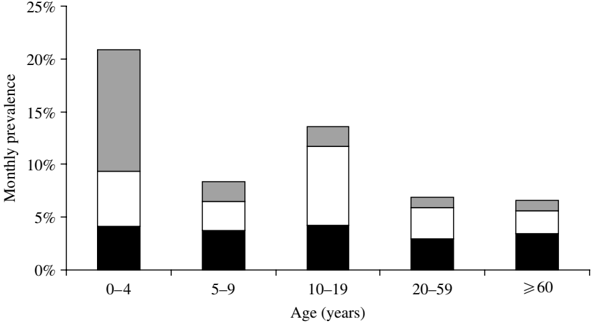
- In 6,047 completed surveys (average response rate 75.8%), 467 respondents had GI symptoms in the prior 30 days, 384 in the prior 15 days, and 262 in the prior 7 days; the age-adjusted monthly prevalence was 9.2%.
- The annual incidence rate estimate from the 7-day recall was about 2.2 times greater than the 30-day recall estimate.
- In multivariable analysis, significant predictors of being a monthly GI case were age, health system, occupation, sewer system, antibiotic use, and ownership of a cat.
- Reported effect sizes included: age 0–4 years OR 2.98, age 10–19 years OR 1.55, private health system OR 0.68, no insurance OR 1.54, septic tank/latrine OR 4.18, antibiotic use OR 0.61, and cat ownership OR 1.36.
## Methods
- Cross-sectional, door-to-door population survey of randomly selected residents in Chile’s Metropolitan region, conducted in two phases: 21 July–25 August 2008 and 14 November–21 December 2008.
- Sample: 6,047 respondents from a population of 6,061,185 residents; the target sample size was 6,000 surveys, with 3,033 completed in phase 1 and 3,014 in phase 2.
- Main analyses: prevalence, incidence rate, and incidence proportion were calculated for 7-, 15-, and 30-day recall periods; Fisher’s exact test and multivariable logistic regression with backward elimination were used to identify risk factors.
## Limitations
- The paper states that the retrospective design may be subject to recall bias, and that prospective methods would be preferred under ideal conditions.
- The paper states that selection bias may have occurred because of differences in age and gender between respondents and the referent community, and because institutions and hospitals were not included in the study population.
- Evident from the text: households were “conveniently selected” within randomly selected blocks, which may introduce additional selection bias.
Model-written summary. Check it against the paper before relying on it.
Integrity signals
Registry
Cites
Statistics
Figures
Verification
Claims the paper makes
10 Valid · 3 Not valid · 4 Not checked · 74 Own results and interpretations
Some cited sources support this claim and some don’t — read each source’s verdict below.
In the paper
“which is similar to other reported studies where children and youths have higher odds of being a GI case [7-9, 13-16].”
What the sources say
- Partly supportedcites [7] 7. Jones TF, et al. A population-based estimate of the substantial burden of diarrhoeal disease in the United States; FoodNet, 1996-2003. Epidemiology and Infection 2007; 135 : 293-301. sourceExperimental — accuracy not yet measured
The Results (page not provided) report significantly higher rates of acute diarrhoeal illness among children under 5 than among adults aged 36–54. But rates among 5–17-year-olds were lower than in that adult comparison group, so the finding does not support higher odds for children and youths as a whole. (LLM, conf=0.90)
- Not checked — no full text of the sourcecites [8] 8. de Wit MA, et al. Sensor, a population-based cohort study on gastroenteritis in the Netherlands: incidence and etiology. American Journal of Epidemiology 2001; 154 : 666-674. source
- Not matchedcites [9] 9. Aguiar Prieto P, et al. Burden of self-reported acute gastrointestinal illness in Cuba. Journal of Health, Population and Nutrition 2009; 27 : 345-347.
We searched by its title and found no matching paper.
- Supportedcites [13] 13. Majowicz SE, et al. Magnitude and distribution of acute, self-reported gastrointestinal illness in a Canadian community. Epidemiology and Infection 2004; 132 : 607-617. source
The Distribution section reports that cases were significantly younger than non-cases and that illness prevalence peaked at ages 0–9 and 20–24. The Discussion says the increased prevalence in children under 10 is consistent with other studies and identifies higher rates in both age groups. (LLM, conf=0.91)
- Not matchedcites [14] 14. Scallan E, et al. Acute gastroenteritis in northern Ireland and the Republic of Ireland: a telephone survey. Communicable Disease and Public Health 2004; 7 : 61-67.
We searched by its title and found no matching paper.
- Disputedcites [15] 15. Sargeant JM, Majowicz SE, Snelgrove J. The burden of acute gastrointestinal illness in Ontario, Canada, 2005-2006. Epidemiology and Infection 2008; 136 : 451-460. sourceExperimental — accuracy not yet measured
The Discussion reports the opposite result for this study: it found no significant association between age and acute GI (P=0.37). Although it notes that other studies found higher rates in children and young adults, this paper did not find higher odds for those groups in its own population. (LLM, conf=0.90)
Checked by a reasoning model — may be wrong.
- Supportedcites [16] 16. Thomas MK, et al. Population distribution and burden of acute gastrointestinal illness in British Columbia, Canada. BMC Public Health 2006; 6 . source
The Results (Multivariate analysis) report that children aged 0–9 and 10–14 were 1.8 and 1.6 times more likely, respectively, to experience GI than adults aged 25–64. The Discussion says the study’s age distribution was similar to other reported results. The elevated likelihood is specifically established for those under 15, not all older youths. (LLM, conf=0.88)
plainstates an association- Asserted: passes — The authors put it forward as true.
- Checkable: passes — It can be checked against evidence.
- Load-bearing: unclear — It is unclear whether the paper’s conclusions depend on it.
- Based: passes — The paper gives a reason why it holds.
- Partly supported
The cited sources support only part of this claim — read each source’s verdict below.
In the paper
“However, there are still unresolved methodological issues within population-based studies, including recall period selection and recall bias [17, 19, 20].”
What the sources say
- Partly supportedcites [17] 17. Wheeler JG, et al. Study of infectious intestinal disease in England: rates in the community, presenting to general practice, and reported to national surveillance. The Infectious Intestinal Disease Study Executive. British Medical Journal 1999; 318 : 1046-1050. sourceExperimental — accuracy not yet measured
The Community rates section identifies recall bias as a probable reason retrospective estimates were higher than prospective estimates. The Community cohort section specifies a one-month recall period, but the paper does not discuss recall-period selection as an unresolved methodological issue. (LLM, conf=0.86)
- Partly supportedcites [19] 19. Boland M, et al. Emerging advantages and drawbacks of telephone surveying in public health research in Ireland and the U.K. BMC Public Health 2006; 6 : 208. sourceExperimental — accuracy not yet measured
The Background and Discussion > Representativeness identify methodological problems in telephone-based population surveys, including coverage, sampling and non-response bias. The paper does not address recall-period selection or recall bias; searches for those terms and related wording found no supporting passage. No page numbers are available in our copy. (LLM, conf=0.85)
- Not matchedcites [20] 20. Rodrigues LC. Let us not forget telescoping as a major risk of telephone surveys. Comment on Boland et al . BMC Public Health 2006; 6 .
We searched by its title and found no matching paper.
plain- Asserted: passes — The authors put it forward as true.
- Checkable: passes — It can be checked against evidence.
- Load-bearing: passes — The paper’s conclusions depend on it.
- Based: passes — The paper gives a reason why it holds.
- Partly supported
The cited sources support only part of this claim — read each source’s verdict below.
In the paper
“The overall range of annual incidence rates of 0 . 98-2 . 3 episodes per person-year in our study are higher than those reported in Ireland, the UK and The Netherlands [14, 17, 24].”
What the sources say
- Not matchedcites [14] 14. Scallan E, et al. Acute gastroenteritis in northern Ireland and the Republic of Ireland: a telephone survey. Communicable Disease and Public Health 2004; 7 : 61-67.
We searched by its title and found no matching paper.
- Supportedcites [17] 17. Wheeler JG, et al. Study of infectious intestinal disease in England: rates in the community, presenting to general practice, and reported to national surveillance. The Infectious Intestinal Disease Study Executive. British Medical Journal 1999; 318 : 1046-1050. source
The Community incidence section reports an English rate of 19.4 cases per 100 person-years, or 0.194 episodes per person-year. That is below the citing study’s range of 0.98–2.3. This source supports the UK comparison; the sentence cites other sources for Ireland and the Netherlands. (LLM, conf=0.92)
- Supportedcites [24] 24. de Wit MA, et al. Gastroenteritis in sentinel general practices, The Netherlands. Emerging Infectious Diseases 2001; 7 : 82-91. source
The Abstract reports a Netherlands general-population gastroenteritis incidence of 450 per 1,000 person-years (0.45 per person-year), below the citing study’s range of 0.98–2.3. This source supports the Netherlands comparison; the sentence cites other sources for Ireland and the UK. (LLM, conf=0.88)
plainn = 467- Asserted: passes — The authors put it forward as true.
- Checkable: passes — It can be checked against evidence.
- Load-bearing: unclear — It is unclear whether the paper’s conclusions depend on it.
- Based: passes — The paper gives a reason why it holds.
- Not matched
The cited sources support only part of this claim — read each source’s verdict below.
In the paper
“Similarly, percentages of cases reported here that sought medical care and submitted a stool sample are at the low end of the range of percentages reported from other studies [7, 11, 14-16, 18].”
What the sources say
- Supportedcites [7] 7. Jones TF, et al. A population-based estimate of the substantial burden of diarrhoeal disease in the United States; FoodNet, 1996-2003. Epidemiology and Infection 2007; 135 : 293-301. source
The Results (page unavailable) report that 19.5% of respondents with acute diarrhoeal illness sought medical care and 3.7% submitted a stool specimen. This paper therefore provides an example of the other-study percentages used for comparison; the assessment that the citing study falls at the low end is the citing authors’ own comparison. (LLM, conf=0.87)
- Partly supportedcites [11] 11. Imhoff B, et al. Burden of self-reported acute diarrheal illness in FoodNet surveillance areas, 1998-1999. Clinical Infectious Diseases 2004; 38 (Suppl. 3): S219-26. sourceExperimental — accuracy not yet measured
The Results section (Health care seeking behaviour; page unavailable) reports that 11.6% of cases visited a health care provider and ten submitted a stool sample. These figures make the paper a relevant comparison study, but it does not establish that the citing study’s percentages fall at the low end of a range across studies. (LLM, conf=0.78)
- Not matchedcites [14] 14. Scallan E, et al. Acute gastroenteritis in northern Ireland and the Republic of Ireland: a telephone survey. Communicable Disease and Public Health 2004; 7 : 61-67.
We searched by its title and found no matching paper.
- Supportedcites [15] 15. Sargeant JM, Majowicz SE, Snelgrove J. The burden of acute gastrointestinal illness in Ontario, Canada, 2005-2006. Epidemiology and Infection 2008; 136 : 451-460. source
The Health-care-seeking behaviour section reports that 22% of cases visited a clinician and that 33% of those were asked for a stool sample, with full compliance. This paper supplies one of the other-study percentages used for comparison; the characterization of the citing study’s percentages as at the ‘low end’ is the citing authors’ comparison. (LLM, conf=0.88)
- Supportedcites [16] 16. Thomas MK, et al. Population distribution and burden of acute gastrointestinal illness in British Columbia, Canada. BMC Public Health 2006; 6 . source
The citation identifies this paper as one of the other studies reporting medical-care and stool-sample submission rates. In Results > Health care seeking behaviour (page unavailable), it reports that 52 cases (11.6%) visited a health care provider and that ten cases submitted a stool sample. The paper does not establish where the citing study’s percentages fall in the overall range; that comparison is the citing authors’ own statement. (LLM, conf=0.88)
- Not checked — no full text of the sourcecites [18] 18. Herikstad H, et al. A population-based estimate of the burden of diarrhoeal illness in the United States: FoodNet, 1996-7. Epidemiology and Infection 2002; 129 : 9-17. source
plain- Asserted: passes — The authors put it forward as true.
- Checkable: passes — It can be checked against evidence.
- Load-bearing: passes — The paper’s conclusions depend on it.
- Based: passes — The paper gives a reason why it holds.
- Supported
Every source the paper cites for this claim was checked and supports it.
In the paper
“However, this is contrary to the suggestion that 'telescoping' past illnesses into the observation period causes overestimates of disease in the population when using retrospective methods, as suggested by Wheeler et al . [17].”
What the sources say
- Supportedcites [17] 17. Wheeler JG, et al. Study of infectious intestinal disease in England: rates in the community, presenting to general practice, and reported to national surveillance. The Infectious Intestinal Disease Study Executive. British Medical Journal 1999; 318 : 1046-1050. source
The Community rates section says retrospective assessment produced much higher rates, probably because recall bias tends to ‘telescope’ illness events into the recent past. The Community incidence section reports a retrospective rate of 55 per 100 person-years, nearly three times the prospective estimate. The claim accurately presents this as Wheeler et al.’s suggestion rather than an established cause. (LLM, conf=0.94)
plain- Asserted: passes — The authors put it forward as true.
- Checkable: passes — It can be checked against evidence.
- Load-bearing: passes — The paper’s conclusions depend on it.
- Based: passes — The paper gives a reason why it holds.
- Supported
30 more claims
Create a free account to see all 91 claims and to verify the 8 references still open.
- Probably not a substantial claim. 37
- It may state two separate claims as one. 34
Citations
Cites
Wheeler, J. G., Sethi, D., Cowden, J. M., Wall, P. G., Rodrigues, L. C., Tompkins, D. S., Hudson, M. J., & Roderick, P. J. (1999) · BMJ · doi:10.1136/bmj.318.7190.1046 · Cited by 794 · cited 4×
“3 episodes per person-year in our study are higher than those reported in Ireland, the UK and The Netherlands [14, 17, 24].”
Influentialde Wit, M. A. S., Koopmans, M. P. G., Kortbeek, L. M., Wannet, W. J. B., Vinjé, J., van Leusden, F., Bartelds, A. I. M., & van Duynhoven, Y. T. H. P. (2001) · American Journal of Epidemiology · doi:10.1093/aje/154.7.666 · Cited by 583
Antibiotic-Associated Diarrhea
Bartlett, J. G. (1992) · Clinical Infectious Diseases · doi:10.1093/clind/15.4.573 · Cited by 414
Salmonella surveillance: a global survey of public health serotyping
HERIKSTAD, H., MOTARJEMI, Y., & TAUXE, R. V. (2002) · Epidemiology and Infection · doi:10.1017/s0950268802006842 · Cited by 370
Mechanisms and Management of Antibiotic‐Associated Diarrhea
Hogenauer, C., Hammer, H. F., Krejs, G. J., & Reisinger, E. C. (1998) · Clinical Infectious Diseases · doi:10.1086/514958 · Cited by 348
Cold Weather Seasonality of Gastroenteritis Associated with Norwalk‐like Viruses
Mounts, A. W., Ando, T., Koopmans, M., Bresee, J. S., Noel, J., & Glass, R. I. (2000) · The Journal of Infectious Diseases · doi:10.1086/315586 · Cited by 288
CAMPYLOBACTER ENTERITIS AT A UNIVERSITY: TRANSMISSION FROM EATINGCHICKEN AND FROM CATS
DEMING, M. S., TAUXE, R. V., BLAKE, P. A., DIXON, S. E., FOWLER, B. S., JONES, T. S., LOCKAMY, E. A., PATTON, C. M., & SIKES, R. O. (1987) · American Journal of Epidemiology · doi:10.1093/oxfordjournals.aje.a114685 · Cited by 271
Seasonality in six enterically transmitted diseases and ambient temperature
NAUMOVA, E. N., JAGAI, J. S., MATYAS, B., DeMARIA, A., MacNEILL, I. B., & GRIFFITHS, J. K. (2007) · Epidemiology and Infection · doi:10.1017/s0950268806006698 · Cited by 259
Flint, J. A., Van Duynhoven, Y. T., Angulo, F. J., DeLong, S. M., Braun, P., Kirk, M., Scallan, E., Fitzgerald, M., Adak, G. K., Sockett, P., et al. (2005) · Clinical Infectious Diseases · doi:10.1086/432064 · Cited by 245
Gastroenteritis in Sentinel General Practices, the Netherlands
de Wit, M. A. S., Koopmans, M. P. G., Kortbeek, L. M., van Leeuwen, N. J., Bartelds, A. I. M., & van Duynhoven, Y. T. H. P. (2001) · Emerging Infectious Diseases · doi:10.3201/eid0701.010113 · Cited by 236 · cited 2×
“3 episodes per person-year in our study are higher than those reported in Ireland, the UK and The Netherlands [14, 17, 24].”
Research works printed but not linked: 2
- 22. Rothman KJ, Greenland S. Modern Epidemiology , 2nd edn. Philadelphia, PA: Lippincott-Raven Publishers, 1998.
- 20. Rodrigues LC. Let us not forget telescoping as a major risk of telephone surveys. Comment on Boland et al . BMC Public Health 2006; 6 .
Cited by
Thomas, M. K., Murray, R., Flockhart, L., Pintar, K., Pollari, F., Fazil, A., Nesbitt, A., & Marshall, B. (2013) · Foodborne Pathogens and Disease · doi:10.1089/fpd.2012.1389 · Cited by 440
Self-citationBurden of self-reported acute gastrointestinal illness in China: a population-based survey
Chen, Y., Yan, W.-X., Zhou, Y.-J., Zhen, S.-Q., Zhang, R.-H., Chen, J., Liu, Z.-H., Cheng, H.-Y., Liu, H., Duan, S.-G., et al. (2013) · BMC Public Health · doi:10.1186/1471-2458-13-456 · Cited by 55
Scavia, G., Baldinelli, F., Busani, L., & Caprioli, A. (2011) · Epidemiology and Infection · doi:10.1017/s0950268811002020 · Cited by 57
Harper, S. L., Edge, V. L., Ford, J. D., Thomas, M. K., Pearl, D. L., Shirley, J., IHACC, RICG, & McEWEN, S. A. (2015) · Epidemiology and Infection · doi:10.1017/s0950268814003744 · Cited by 64
Self-citationIncidence of acute respiratory infections in Australia
Chen, Y., & Kirk, M. (2013) · Epidemiology and Infection · doi:10.1017/s0950268813002471 · Cited by 53
Metadata
- Authors
- THOMAS, M. K., PEREZ, E., MAJOWICZ, S. E., REID-SMITH, R., OLEA, A., DIAZ, J., SOLARI, V., & McEWEN, S. A.
- Affiliations
- Public Health Agency of Canada (CA)
- Ministry of Health (CL)
- University of Guelph (CA)
- Corresponding author
- THOMAS, M. K.
- Venue
- Epidemiology and Infection
- Publisher
- Cambridge University Press (CUP)
- Published
- 2010-05-24
- Volume
- 139
- Issue
- 4
- Pages
- 560-571
- ISSN
- 0950-2688 (ISSN-L)
- 1469-4409
- OpenAlex
- W2107423446
- Semantic Scholar
- 6c88c607cbc1e8fc14bf4c17372de6003f7996a5
- Cited by
- 22
- References
- 33
- Citations by year
- 2024: 1 · 2023: 2 · 2020: 1 · 2018: 1 · 2017: 1 · 2016: 2 · 2015: 3 · 2014: 3 · 2013: 4 · 2012: 3
- FWCI
- 1.65
- Type
- journal article
- Language
- en
- Open access
- bronze
- doi.org
- Locations
- Epidemiology and Infection (publishedVersion)
- PubMed (publishedVersion)
- Funders
- University of Guelph
- Universidad Iberoamericana Ciudad de México
- Public Health Agency of Canada
- International Development Research Centre
- Public Health Agency
- Pan American Health Organization
- Topics
- Health Sciences › Medicine › Infectious Diseases › Viral gastroenteritis research and epidemiology
- Life Sciences › Agricultural and Biological Sciences › Food Science › Salmonella and Campylobacter epidemiology
- Health Sciences › Medicine › Public Health, Environmental and Occupational Health › Global Health and Epidemiology
- Keywords
- acute gastrointestinal illness, disease burden, prevalence, incidence, recall period, recall bias, risk factors, antibiotic use, cat ownership, sewer systems, occupation, health care system, Metropolitan Region of Chile
- MeSH terms
- Adolescent, Adult, Aged, 80 and over, Child, Child, Preschool, Chile, Female, Gastroenteritis, Humans, Infant, Infant, Newborn, Interviews as Topic, Male, Middle Aged, Risk Factors, Urban Population, Prevalence, Young Adult
About these checks
Registry, retraction, Cites and statistics results are computed, not judged, with one exception: a printed reference that no index lists is read once by a model before it counts as a citation error. Claims are extracted by a model and kept only when their quote appears verbatim in the text; each cited source is then checked, with a model’s help, for whether it says what the claim relies on. Those verdicts can be wrong — read the claim’s quote and the cited source before relying on one.
The claim verdicts this report counts are experimental: their accuracy is not yet measured.
A language model drew the claims from the paper on 2026-10-10, under version 3 of the claim definition (model deepseek-v4.1-flash, prompt extract-v3).
A second model labelled each claim on 2026-10-10 (model jev-1.13-20260917, definition revision gold-guideline-v0.2).
Cited sources are checked with a language model’s help (gpt-6-sol).
Statistics and arithmetic are recomputed, not judged.
Confidence bands are shown only for fields calibrated on our annotated test set. None is calibrated yet, so no band is shown.
What counts as a claim ›How we measure confidence ›How we check this ›
Are you an author, or do you see a problem with this page? Request a review
How to cite
Cite CoChat for the checks on this page, and the paper for its own findings.
- This page
- CoChat. (2026). Citation check: Burden of acute gastrointestinal illness in the Metropolitan region, Chile, 2008. https://app.cochat.ai/papers/10.1017/s0950268810001160
- The paper
- THOMAS, M. K., PEREZ, E., MAJOWICZ, S. E., REID-SMITH, R., OLEA, A., DIAZ, J., SOLARI, V., & McEWEN, S. A. (2011). Burden of acute gastrointestinal illness in the Metropolitan region, Chile, 2008. Epidemiology and Infection. https://doi.org/10.1017/s0950268810001160
Data sources
Bibliographic data: Semantic Scholar, OpenAlex, Crossref.
Contains information from the Semantic Scholar Academic Graph Datasets, made available under the ODC Attribution License (ODC-BY 1.0).
Semantic Scholar’s data is described in: Kinney, R., et al. (2023). The Semantic Scholar Open Data Platform. arXiv:2301.10140.
