

Unattended distributional training can shift phoneme boundaries
Open accessThe DOI matches its Crossref record; 68 of the 68 references it cites were found in a registry or an index; none of the 58 sources its claims cite is checked for support yet.
Abstract
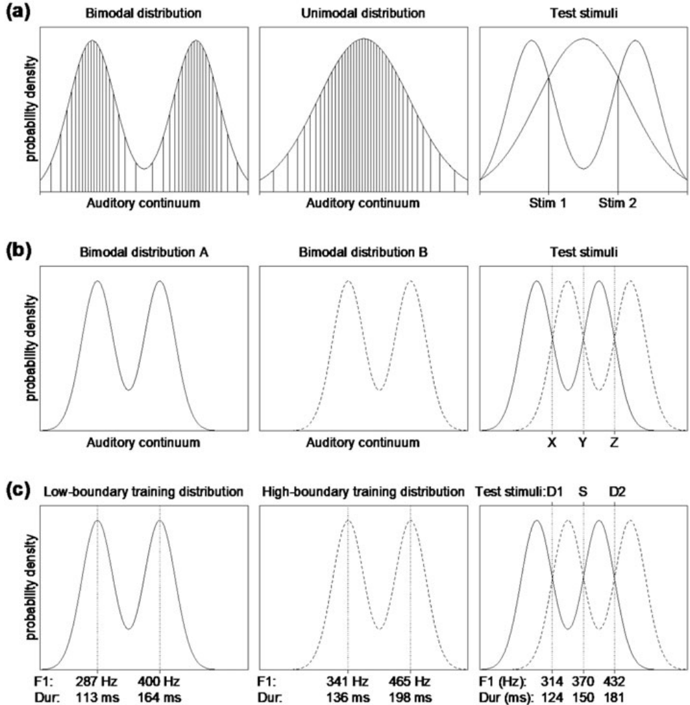
Listeners are sensitive to speech sounds’ probability distributions. Distributional training (DT) studies with adults typically involve conscious activation of phoneme labels. We show that distributional exposure can shift existing phoneme boundaries (Spanish /e/–/i/) pre-attentively. Using a DT paradigm involving two bimodal distributions we assessed listener's neural discrimination across three sounds, showing pre-to-post-test improvement for the two adjacent sounds that fell into different clusters of the trained distribution than for those that fell into one cluster. Upon unattended exposure to an intricate stimulus set, listeners thus relocate native phoneme boundaries. We assessed whether the paradigm also works for category creation (Spanish establishing a duration contrast), where it has methodological advantages over the usual unimodal-versus-bimodal paradigm. DT yielded a greater effect for the /e/–/i/ boundary shift than for duration contrast creation. It seems that second-language phoneme contrasts similar to native ones might be easier to acquire than new contrasts.
Overview
CoChat Summary
TL;DR
In a fully unattended EEG distributional-training paradigm, 40 native Spanish listeners were exposed to bimodal distributions shifted along either the native F1 /i/-/e/ dimension or a nonnative duration dimension. Training shifted the /i/-/e/ boundary pre-attentively, as indexed by the absolute mismatch response, but produced no significant comparable effect for duration contrast creation.
Key findings
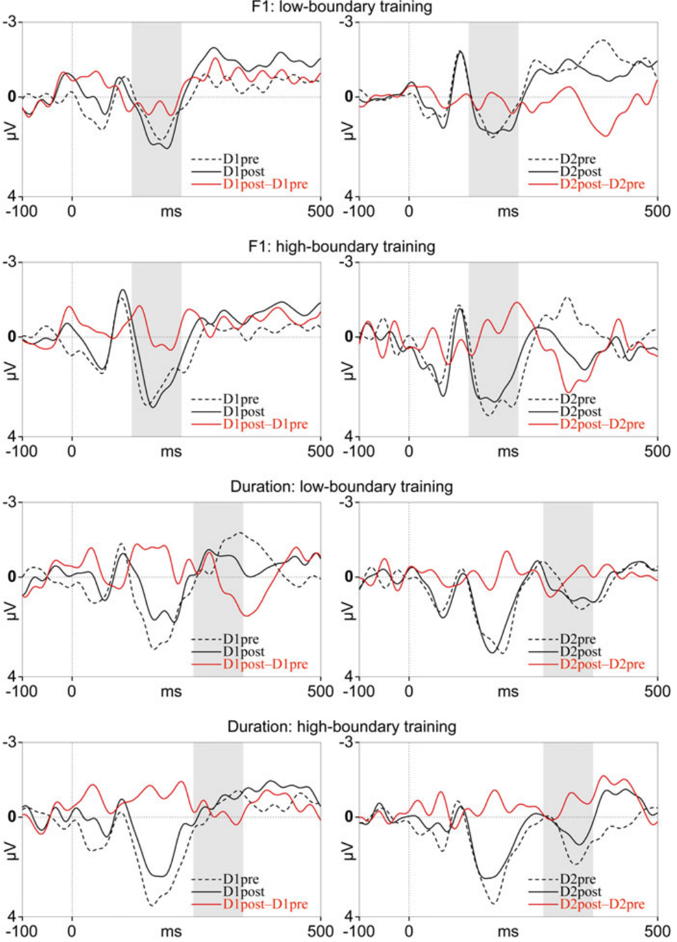
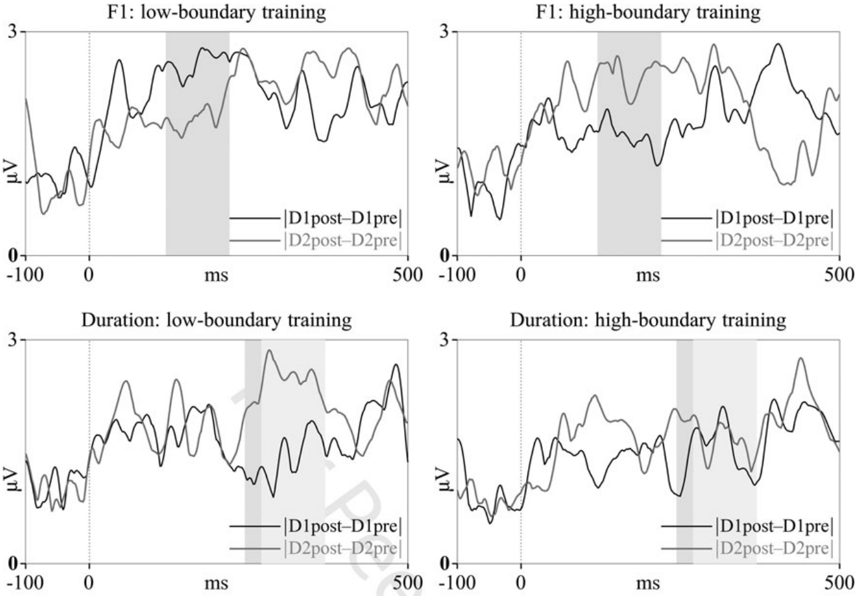
- For the absolute MMR, the predicted Boundary × Deviant interaction was significant for F1: +1.718 μV, t(35.999) = +3.017, 95% CI 0.563–2.873 μV, p = 0.0047; low-boundary training yielded a larger MMR for D1 than D2, and high-boundary training yielded a larger MMR for D2 than D1.
- The Dimension × Boundary × Deviant interaction was +2.519 μV, t(35.999) = +3.129, 95% CI +0.886–+4.153 μV, p = 0.0035, indicating the effect was larger for F1 than for duration.
- For duration, the Boundary × Deviant interaction was −0.801 μV, t(35.999) = −1.412, 95% CI −1.956–+0.354 μV, p = 0.17, nonsignificant and opposite to the predicted direction.
- No learning effects were detected in the negative MMN: the predicted Boundary × Deviant interaction was −0.263 μV, p = 0.79, and its interaction with Dimension was +0.329 μV, p = 0.86; effects emerged only for the absolute MMR.
Methods
- Participants were 40 native Spanish speakers (20 women, 20 men), 19–36 years old, functional Spanish monolinguals with low English proficiency, in the Netherlands less than 2 weeks; they were randomly assigned to the F1 or duration dimension and to low- or high-boundary training (10 per cell). Three additional people were excluded (2 technical error, 1 noisy EEG with >65% artifact-contaminated epochs).
- Training was a 9-minute unattended exposure to 600 acoustically different synthetic vowels sampled from bimodal distributions (two equal-variance Gaussians, equal-area method, randomly permuted). F1 low boundary was 341 Hz and high boundary 400 Hz; duration low boundary was 136 ms and high boundary 164 ms. Native Spanish /i/-/e/ boundary is roughly 370 Hz; the duration boundary is roughly 150 ms.
- Pre- and post-test used an unattended EEG oddball mismatch-response paradigm while participants watched a muted movie with Spanish subtitles; EEG was recorded from 64 active electrodes plus 7 external channels at 8 kHz and downsampled to 512 Hz. F1 test stimuli were standard 370 Hz, D1 314 Hz, D2 423 Hz; duration test stimuli were standard 150 ms, D1 124 ms, D2 181 ms. Analysis used linear mixed-effects models in R/lme4 on 720 data points (40 participants × 9 channels × 2 deviant types), with fixed effects Dimension, Boundary, Deviant, Laterality, and Anteriority, and participant random slope for Deviant.
Limitations
- Stated: the authors cannot yet exclude that the F1 boundary shift is language-independent and applies universally to the frequency dimension; testing nativeness would require two continua A and B and native listeners of languages X and Y with/without native contrasts along them.
- Stated: it is unknown to what extent Spanish listeners treated the isolated vowel stimuli as linguistic and to what extent the experiment mimicked a language-learning scenario; the distributions were atypical for Spanish, so the effect may reflect adaptation to a different language, accent, or atypical speaker.
- Stated/evident: the duration effect was nonsignificant (p = 0.17), so the conclusion that category creation is smaller or absent is qualified by the usual caveat against interpreting nonsignificant p-values; the paper also notes no negative-MMN effects and only absolute-MMR effects, and that convergence problems forced a reduced random-effects structure with only a random slope for Deviant.
Model-written summary. Check it against the paper before relying on it.
Integrity signals
Registry
Cites
Statistics
Figures
Verification
Claims the paper makes
0 Valid · 3 Not valid · 39 Not checked · 67 Own results and interpretations
A result the paper reports from its own data — it cites no other source for it, so there is none to check. The quote shows it is in the paper.
In the paper
“Using a DT paradigm involving two bimodal distributions we assessed listener's neural discrimination across three sounds, showing pre-to-post-test improvement for the two adjacent sounds that fell into different clusters of the trained distribution than for those that fell into one cluster.”
§ Unattended distributional training can shift phoneme boundaries > Abstract
plainstates a cause- Asserted: passes — The authors put it forward as true.
- Checkable: passes — It can be checked against evidence.
- Load-bearing: passes — The paper’s conclusions depend on it.
- Based: passes — The paper gives a reason why it holds.
A result the paper reports from its own data — it cites no other source for it, so there is none to check. The quote shows it is in the paper.
In the paper
“We show that distributional exposure can shift existing phoneme boundaries (Spanish /e/-/i/) pre-attentively.”
§ Unattended distributional training can shift phoneme boundaries > Abstract
plainstates a cause- Asserted: passes — The authors put it forward as true.
- Checkable: passes — It can be checked against evidence.
- Load-bearing: passes — The paper’s conclusions depend on it.
- Based: passes — The paper gives a reason why it holds.
A result the paper reports from its own data — it cites no other source for it, so there is none to check. The quote shows it is in the paper.
In the paper
“DT yielded a greater effect for the /e/-/i/ boundary shift than for duration contrast creation.”
§ Unattended distributional training can shift phoneme boundaries > Abstract
plainstates a cause- Asserted: passes — The authors put it forward as true.
- Checkable: passes — It can be checked against evidence.
- Load-bearing: passes — The paper’s conclusions depend on it.
- Based: passes — The paper gives a reason why it holds.
A result the paper reports from its own data — it cites no other source for it, so there is none to check. The quote shows it is in the paper.
In the paper
“While perceptual learning did occur between the language's already existing vowels /i/ and /e/, the same procedure turned out to be less capable (if at all capable) of creating a new boundary on the language's virgin continuum between short and long vowels; our preliminary interpretation of this is that it may be easier to shift an existing contrast than to create a new contrast.”
§ Unattended distributional training can shift phoneme boundaries > 5. Conclusion
plainstates a cause- Asserted: passes — The authors put it forward as true.
- Checkable: passes — It can be checked against evidence.
- Load-bearing: passes — The paper’s conclusions depend on it.
- Based: passes — The paper gives a reason why it holds.
- Rests on an assumption not shown here.
A result the paper reports from its own data — it cites no other source for it, so there is none to check. The quote shows it is in the paper.
In the paper
“Learning effects WERE detected when the mismatch response was measured as the absolute, i.e., polarity-unspecified, deflection of the ERP difference waves.”
§ Unattended distributional training can shift phoneme boundaries > Relevance to L2 acquisition theories
plainstates an association- Asserted: passes — The authors put it forward as true.
- Checkable: passes — It can be checked against evidence.
- Load-bearing: passes — The paper’s conclusions depend on it.
- Based: passes — The paper gives a reason why it holds.
47 more claims
Create a free account to see all 109 claims and to verify the 36 references still open.
- It may state two separate claims as one. 35
- Probably not a substantial claim. 38
Self-check
Percentages, sums and reported differences re-computed from the paper’s own numbers.
Each contradiction between two passages listed here was confirmed by an independent check.
Rated minor: it would not touch a result — a value no result rests on, a p-value that stays on the same side of the significance level, or a conflict that is clerical, resolved elsewhere in the paper, or outside its own findings.
In the paper
§ Unattended distributional training can shift phoneme boundaries > Absolute mismatch response
“For the absolute MMR, the following parameters differed significantly from zero.”
§ Unattended distributional training can shift phoneme boundaries > Absolute mismatch response
“The main effect of Dimension was +0.332 μV (t [36.000] = +2.016,95% CI = -0.002.. +0.667 μV, p = 0.051)”
Citations
Cites
Fitting Linear Mixed-Effects Models Using lme4
Bates, D., Mächler, M., Bolker, B., & Walker, S. (2015) · Journal of Statistical Software · doi:10.18637/jss.v067.i01 · Cited by 86,835
lmerTest Package: Tests in Linear Mixed Effects Models
Kuznetsova, A., Brockhoff, P. B., & Christensen, R. H. B. (2017) · Journal of Statistical Software · doi:10.18637/jss.v082.i13 · Cited by 24,346
Random effects structure for confirmatory hypothesis testing: Keep it maximal
Barr, D. J., Levy, R., Scheepers, C., & Tily, H. J. (2013) · Journal of Memory and Language · doi:10.1016/j.jml.2012.11.001 · Cited by 10,328
Simmons, J. P., Nelson, L. D., & Simonsohn, U. (2011) · Psychological Science · doi:10.1177/0956797611417632 · Cited by 6,567
Speech perception and linguistic experience : issues in cross-language research
Strange, W. (1995) · Cited by 1,510
Infant sensitivity to distributional information can affect phonetic discrimination
Maye, J., Werker, J. F., & Gerken, L. (2002) · Cognition · doi:10.1016/s0010-0277(01)00157-3 · Cited by 1,364 · cited 3×
“For instance, Maye et al. (2002) exposed American English infants to bimodal or unimodal distributions between a pre-voiced [d] and a voiceless unaspirated [t], both of which fall within the same phonemic category /d/ in English.”
InfluentialRobust speech perception: Recognize the familiar, generalize to the similar, and adapt to the novel.
Kleinschmidt, D. F., & Jaeger, T. F. (2015) · Psychological Review · doi:10.1037/a0038695 · Cited by 635
BRIDGING THE GAP BETWEEN L2 SPEECH PERCEPTION RESEARCH AND PHONOLOGICAL THEORY
Escudero, P., & Boersma, P. (2004) · Studies in Second Language Acquisition · doi:10.1017/s0272263104040021 · Cited by 459
Self-citationStatistical phonetic learning in infants: facilitation and feature generalization
Maye, J., Weiss, D. J., & Aslin, R. N. (2008) · Developmental Science · doi:10.1111/j.1467-7687.2007.00653.x · Cited by 376
The specificity of perceptual learning in speech processing
Eisner, F., & Mcqueen, J. M. (2005) · Perception & Psychophysics · doi:10.3758/bf03206487 · Cited by 366
Perception of speech reflects optimal use of probabilistic speech cues
Clayards, M., Tanenhaus, M. K., Aslin, R. N., & Jacobs, R. A. (2008) · Cognition · doi:10.1016/j.cognition.2008.04.004 · Cited by 350
McAllister, R., Flege, J. E., & Piske, T. (2002) · Journal of Phonetics · doi:10.1006/jpho.2002.0174 · Cited by 346
Proceedings of the 18th International Congress of Phonetic Sciences
Skarabela, B., Ota, M., Fazekas, J., & Wihlborg, L. (2015) · Cited by 317
Proceedings of the 37th Annual Conference of the Cognitive Science Society
Kehler, A., & Rohde, H. (2015) · Cited by 245
Statistical learning of phonetic categories: insights from a computational approach
McMurray, B., Aslin, R. N., & Toscano, J. C. (2009) · Developmental Science · doi:10.1111/j.1467-7687.2009.00822.x · Cited by 242
Measuring duration mismatch negativity
Jacobsen, T., & Schröger, E. (2003) · Clinical Neurophysiology · doi:10.1016/s1388-2457(03)00043-9 · Cited by 239
A role for the developing lexicon in phonetic category acquisition.
Feldman, N. H., Griffiths, T. L., Goldwater, S., & Morgan, J. L. (2013) · Psychological Review · doi:10.1037/a0034245 · Cited by 231
On the dominance of unidimensional rules in unsupervised categorization
Ashby, F. G., Queller, S., & Berretty, P. M. (1999) · Perception & Psychophysics · doi:10.3758/bf03207622 · Cited by 199
Learning to perceive and recognize a second language: the L2LP model revised
van Leussen, J.-W., & Escudero, P. (2015) · Frontiers in Psychology · doi:10.3389/fpsyg.2015.01000 · Cited by 194
Self-citationLinguistic entrenchment: Prior knowledge impacts statistical learning performance
Siegelman, N., Bogaerts, L., Elazar, A., Arciuli, J., & Frost, R. (2018) · Cognition · doi:10.1016/j.cognition.2018.04.011 · Cited by 174
The linguistic perception of SIMILAR L2 sounds
Escudero, P. (2009) · Mouton eBooks · doi:10.1515/9783110219234.151 · Cited by 170
Self-citationKondaurova, M. V., & Francis, A. L. (2008) · The Journal of the Acoustical Society of America · doi:10.1121/1.2999341 · Cited by 138
Escudero, P., Benders, T., & Lipski, S. C. (2009) · Journal of Phonetics · doi:10.1016/j.wocn.2009.07.006 · Cited by 117
Self-citationSupervised and unsupervised learning of multidimensional acoustic categories.
Goudbeek, M. B., Swingley, D., & Smits, R. (2009) · Journal of Experimental Psychology Human Perception & Performance · doi:10.1037/a0015781 · Cited by 114
Formant-frequency discrimination for isolated English vowels
Kewley-Port, D., & Watson, C. S. (1994) · The Journal of the Acoustical Society of America · doi:10.1121/1.410024 · Cited by 113
Proceedings of the 17th International Congress of Phonetic Sciences
Kirby, J., & Ladd, B. (2011) · Cited by 109
Supervised and unsupervised learning of multidimensionally varying non-native speech categories
Goudbeek, M. B., Cutler, A., & Smits, R. (2007) · Speech Communication · doi:10.1016/j.specom.2007.07.003 · Cited by 107
Shafer, V. L., Yu, Y. H., & Datta, H. (2010) · Ear & Hearing · doi:10.1097/aud.0b013e3181e5d1a7 · Cited by 103
Mismatch responses to lexical tone, initial consonant, and vowel in Mandarin-speaking preschoolers
Lee, C.-Y., Yen, H.-L., Yeh, P.-W., Lin, W.-H., Cheng, Y.-Y., Tzeng, Y.-L., & Wu, H.-C. (2012) · Neuropsychologia · doi:10.1016/j.neuropsychologia.2012.08.025 · Cited by 98
Maurer, U., Bucher, K., Brem, S., & Brandeis, D. (2003) · Clinical Neurophysiology · doi:10.1016/s1388-2457(03)00032-4 · Cited by 98
Wanrooij, K., Escudero, P., & Raijmakers, M. E. J. (2013) · Journal of Phonetics · doi:10.1016/j.wocn.2013.03.005 · Cited by 71
Self-citationFast phonetic learning occurs already in 2-to-3-month old infants: an ERP study
Wanrooij, K., Boersma, P., & van Zuijen, T. L. (2014) · Frontiers in Psychology · doi:10.3389/fpsyg.2014.00077 · Cited by 71
Self-citationIndividual differences in perceptual adaptability of foreign sound categories
Schertz, J. L., Cho, T., Lotto, A. J., & Warner, N. L. (2015) · Attention Perception & Psychophysics · doi:10.3758/s13414-015-0987-1 · Cited by 68
Enhanced bimodal distributions facilitate the learning of second language vowels
Escudero, P., Benders, T., & Wanrooij, K. (2011) · The Journal of the Acoustical Society of America · doi:10.1121/1.3629144 · Cited by 57
Self-citationLearning phonemes: How far can the input take us
Maye, J., & Gerken, L. (n.d.) · Cited by 55
Cheng, Y.-Y., Wu, H.-C., Tzeng, Y.-L., Yang, M.-T., Zhao, L.-L., & Lee, C.-Y. (2015) · International Journal of Psychophysiology · doi:10.1016/j.ijpsycho.2015.03.007 · Cited by 52
Lexical and statistical evidence in the acquisition of second language phonemes
Hayes-Harb, R. (2007) · Second Language Research · doi:10.1177/0267658307071601 · Cited by 52
Smits, R., Sereno, J. A., & Jongman, A. (2006) · Journal of Experimental Psychology Human Perception & Performance · doi:10.1037/0096-1523.32.3.733 · Cited by 52
Language-dependent cue weighting: An investigation of perception modes in L2 learning
Yazawa, K., Whang, J., Kondo, M., & Escudero, P. (2019) · Second language Research · doi:10.1177/0267658319832645 · Cited by 52
Self-citationChildren’s brain responses to sound changes in pseudo words in a multifeature paradigm
Partanen, E., Torppa, R., Pykäläinen, J., Kujala, T., & Huotilainen, M. (2013) · Clinical Neurophysiology · doi:10.1016/j.clinph.2012.12.005 · Cited by 50
Morrison, G. S. (2008) · Language and Speech · doi:10.1177/0023830908099067 · Cited by 49
Boersma, P., Escudero, P., & Hayes, R. (n.d.) · Cited by 48
Self-citationPhonological generalization from distributional evidence
Pająk, B., & Lévy, R. (2011) · eScholarship (California Digital Library) · Cited by 47
Colby, S., Clayards, M. A., & Baum, S. R. (2018) · Journal of Speech Language and Hearing Research · doi:10.1044/2018_jslhr-s-17-0392 · Cited by 42
Distributional learning has immediate and long-lasting effects
Escudero, P., & Williams, D. (2014) · Cognition · doi:10.1016/j.cognition.2014.07.002 · Cited by 39
Self-citationOlejarczuk, P., Kapatsinski, V. M., & Baayen, R. H. (2018) · Linguistics Vanguard · doi:10.1515/lingvan-2017-0020 · Cited by 39
Llompart, M., & Reinisch, E. (2018) · Bilingualism Language and Cognition · doi:10.1017/s1366728918000925 · Cited by 39
Wanrooij, K., Boersma, P., & van Zuijen, T. L. (2014) · PLoS ONE · doi:10.1371/journal.pone.0109806 · Cited by 37
Self-citationIndividual Differences in Distributional Learning for Speech: What's Ideal for Ideal Observers?
Theodore, R. M., Monto, N. R., & Graham, S. (2019) · Journal of Speech Language and Hearing Research · doi:10.1044/2019_jslhr-s-19-0152 · Cited by 37
Garrido, M. I., Teng, C. L. J., Taylor, J. A., Rowe, E. G., & Mattingley, J. B. (2016) · npj Science of Learning · doi:10.1038/npjscilearn.2016.6 · Cited by 33
Perceptual adaptation of vowels generalizes across the phonology and does not require local context.
Chládková, K., Podlipský, V. J., & Chionidou, A. (2017) · Journal of Experimental Psychology Human Perception & Performance · doi:10.1037/xhp0000333 · Cited by 27
Self-citationDistributional Learning of Lexical Tones: A Comparison of Attended vs. Unattended Listening
Ong, J. H., Burnham, D., & Escudero, P. (2015) · PLOS ONE · doi:10.1371/journal.pone.0133446 · Cited by 24
Self-citationLipski, S. C., Escudero, P., & Benders, T. (2012) · Psychophysiology · doi:10.1111/j.1469-8986.2011.01347.x · Cited by 24
Self-citationDistributional training of speech sounds can be done with continuous distributions
Wanrooij, K., & Boersma, P. (2013) · The Journal of the Acoustical Society of America · doi:10.1121/1.4798618 · Cited by 22
Self-citationChládková, K., & Šimáčková, Š. (2020) · Language Learning · doi:10.1111/lang.12432 · Cited by 20
Self-citationChládková, K., Escudero, P., & Lipski, S. C. (2013) · Brain and Language · doi:10.1016/j.bandl.2013.05.020 · Cited by 19
Self-citationEffect of Linguistic and Musical Experience on Distributional Learning of Nonnative Lexical Tones
Ong, J. H., Burnham, D., Escudero, P., & Stevens, C. J. (2017) · Journal of Speech, Language, and Hearing Research · doi:10.1044/2016_jslhr-s-16-0080 · Cited by 18
Self-citationWanrooij, K., Boersma, P., & Benders, T. (2015) · Frontiers in Psychology · doi:10.3389/fpsyg.2015.01341 · Cited by 16
Self-citationChládková, K., & Escudero, P. (2012) · The Journal of the Acoustical Society of America · doi:10.1121/1.3674991 · Cited by 15
Self-citationBenders, T., Escudero, P., & Sjerps, M. J. (2012) · The Journal of the Acoustical Society of America · doi:10.1121/1.3688512 · Cited by 14
Self-citationEffective Acoustic Cue Learning Is Not Just Statistical, It Is Discriminative
Nixon, J. S. (2018) · Interspeech (USB) · doi:10.21437/interspeech.2018-1024 · Cited by 11
Manipulating phonological boundaries using distributional cues
Schreiber, E., Onishi, K. H., & Clayards, M. A. (2013) · Proceedings of meetings on acoustics · doi:10.1121/1.4801082 · Cited by 10
Distributional vowel training may not be effective for Dutch adults
Wanrooij, K., de Vos, J. F., & Boersma, P. (2015) · UvA-DARE (University of Amsterdam) · Cited by 6
Self-citationKleinschmidt, D. F., & Jaeger, T. F. (2015) · Psychological Review · doi:10.1037/a0038695.supp · Cited by 1
Perceptual learning in speech reveals pathways of processing
Munson, C. M. (2018) · doi:10.17077/etd.0thh67fy
(2015) · eScholarship (California Digital Library)
(2011) · ICPhS
(2005) · UvA-DARE (University of Amsterdam)
Self-citation
Research works printed but not linked: 1
- Bohn O-S (1995) Cross language speech perception in adults: first language transfer doesn't tell it all. In Speech perception and linguistic experience: issues in cross language research. (W Strange, editor), Timonium, MD: York Press, pp. 279-304.
Cited by
Demystifying unsupervised learning: how it helps and hurts
Bröker, F., Holt, L. L., Roads, B. D., Dayan, P., & Love, B. C. (2024) · Trends in Cognitive Sciences · doi:10.1016/j.tics.2024.09.005 · Cited by 37
The Second Language Linguistic Perception Model
Escudero, P., & Yazawa, K. (2024) · Cambridge University Press eBooks · doi:10.1017/9781009105767.009 · Cited by 26
Self-citationLiu, L., Yuan, C., Ong, J. H., Tuninetti, A., Antoniou, M., Cutler, A., & Escudero, P. (2022) · Brain Sciences · doi:10.3390/brainsci12050559 · Cited by 13
Self-citationClinical Linguistics: Analysis of Mapping Knowledge Domains in Past, Present and Future
Alduais, A. M. S., Alduais, A. M. S., Alfadda, H. A., & Allegretta, S. (2022) · Children · doi:10.3390/children9081202 · Cited by 12
Yazawa, K., Whang, J., Kondo, M., & Escudero, P. (2023) · Frontiers in Language Sciences · doi:10.3389/flang.2023.1303511 · Cited by 9
Self-citation
Metadata
- Authors
- Chládková, K., Boersma, P., & Escudero, P.
- Affiliations
- Czech Academy of Sciences (CZ)
- University of Amsterdam (NL)
- Australian National University (AU)
- Corresponding author
- Chládková, Kateřina
- Venue
- Bilingualism: Language and Cognition
- Publisher
- Cambridge University Press (CUP)
- Published
- 2022-03-25
- Volume
- 25
- Issue
- 5
- Pages
- 827-840
- ISSN
- 1366-7289 (ISSN-L)
- 1469-1841
- OpenAlex
- W4229046639
- Cited by
- 18
- References
- 67
- Citations by year
- 2026: 2 · 2025: 3 · 2024: 4 · 2023: 5 · 2022: 3
- FWCI
- 2.33
- Type
- journal article
- Language
- en
- Open access
- hybrid
- doi.org
- Locations
- Bilingualism Language and Cognition (publishedVersion, cc-by)
- UvA-DARE (University of Amsterdam) (publishedVersion, cc-by)
- Data Archiving and Networked Services (DANS) (submittedVersion, other-oa)
- Funders
- Nederlandse Organisatie voor Wetenschappelijk Onderzoek (277-70-008, 446-14-012)
- Univerzita Karlova v Praze (Primus/17/HUM/19)
- Grantová Agentura České Republiky (18-01799S)
- Australian Research Council (FT160100514)
- Topics
- Social Sciences › Psychology › Experimental and Cognitive Psychology › Phonetics and Phonology Research
- Social Sciences › Psychology › Experimental and Cognitive Psychology › Categorization, perception, and language
- Social Sciences › Psychology › Developmental and Educational Psychology › Language Development and Disorders
- Keywords
- phoneme boundaries, preattentive processing, bimodal distribution
About these checks
Registry, retraction, Cites and statistics results are computed, not judged, with one exception: a printed reference that no index lists is read once by a model before it counts as a citation error. Claims are extracted by a model and kept only when their quote appears verbatim in the text; each cited source is then checked, with a model’s help, for whether it says what the claim relies on. Those verdicts can be wrong — read the claim’s quote and the cited source before relying on one.
A language model drew the claims from the paper on 2026-11-19, under version 3 of the claim definition (model deepseek-v4.1-flash, prompt extract-v3).
A second model labelled each claim on 2026-11-19 (model jev-1.13-20260917, definition revision gold-guideline-v0.2).
Statistics and arithmetic are recomputed, not judged.
Confidence bands are shown only for fields calibrated on our annotated test set. None is calibrated yet, so no band is shown.
What counts as a claim ›How we measure confidence ›How we check this ›
Are you an author, or do you see a problem with this page? Request a review
Data sources
Bibliographic data: Semantic Scholar, OpenAlex, Crossref.
Contains information from the Semantic Scholar Academic Graph Datasets, made available under the ODC Attribution License (ODC-BY 1.0).
Semantic Scholar’s data is described in: Kinney, R., et al. (2023). The Semantic Scholar Open Data Platform. arXiv:2301.10140.
