

The DOI matches its Crossref record; 59 of the 62 references it cites were found in a registry or an index.
What stops us from eating: a qualitative investigation of dietary barriers during pregnancy in Punjab, Pakistan
Open accessAbstract
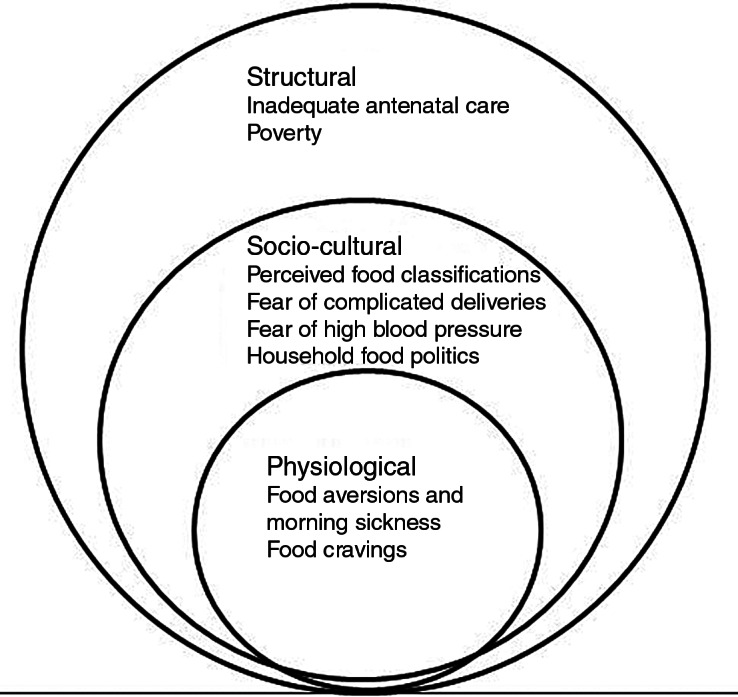
Objective: Adequate dietary intake during pregnancy is vital for the health and nutritional status of both mother and fetus. The nutritional status of reproductive age women in Pakistan is poor, with 14 % being underweight (BMI < 18·5) and 42 % experiencing Fe deficiency anaemia. This may stem from beliefs, practices and other barriers influencing dietary intake. This qualitative study seeks to determine which factors impact dietary intake during pregnancy in rural Punjab. Design: In-depth interviews and focus group discussions were conducted and then analysed using thematic analysis. Setting: Three purposively selected rural districts (Sahiwal, Okara and Pakpatan) with the highest prevalence of maternal and child malnutrition in the province of Punjab, Pakistan Participants: Mothers with children under age two (n 29) and healthcare providers with at least 5 years of experience working in the district (n 12). Results: We identified a combination of physiological, socio-cultural and structural barriers that inhibited healthful dietary intake during pregnancy. The primary physiological barriers to optimal dietary intake and dietary practices included food aversions and food cravings. Food classification, fear of a difficult childbirth, fear of high blood pressure and household food politics were the principal socio-cultural barriers. Additionally, two structural barriers, inadequate antenatal counseling and a lack of affordable food options, were identified. Conclusions: Our study demonstrates that complex barriers prevent pregnant women in the Punjab area from consuming adequate dietary intake and that antenatal health education programmes and structural interventions are needed to support healthful dietary practices during this critical period.
Overview
The claims and statistics of this paper haven’t been checked yet.
Run the check — free, no account needed. It reads the open-access text and checks the sources it cites.
Integrity signals
Registry
Cites
Statistics
Figures
Verification
Claims the paper makes
The claims and statistics of this paper haven’t been checked yet.
Run the check — free, no account needed. It reads the open-access text and checks the sources it cites.
Claims other papers make about this one
Each is checked against this paper’s own text: does it say what the citing paper says it does?
The source backs part of the claim, not all of it — or backs it for a different population, condition or comparison.
In the citing paper
“In low- and middle-income countries (LMICs), cultural food practices often exacerbate challenges in the management of GDM [164,165].”
From Medical Nutrition Therapy for Women with Gestational Diabetes: Current Practice and Future Perspectives (2025) · cites this paper as [165]
Experimental — accuracy not yet measured
Self-check
Percentages, sums and reported differences re-computed from the paper’s own numbers.
The self-check needs the paper’s full text.
Citations
Cites
A General Inductive Approach for Analyzing Qualitative Evaluation Data
Thomas, D. R. (2006) · American Journal of Evaluation · doi:10.1177/1098214005283748 · Cited by 10,858
Maternal and child undernutrition and overweight in low-income and middle-income countries
Black, R. E., Victora, C. G., Walker, S. P., Bhutta, Z. A., Christian, P., de Onis, M., Ezzati, M., Grantham-McGregor, S., Katz, J., Martorell, R., et al. (2013) · The Lancet · doi:10.1016/s0140-6736(13)60937-x · Cited by 8,475
Qualitative descriptive methods in health science research
Colorafi, K. J., & Evans, B. (2016) · HERD: Health Environments Research & Design Journal · doi:10.1177/1937586715614171 · Cited by 1,423
WHO recommendations on antenatal care for a positive pregnancy experience—going beyond survival
Tunçalp, Ö., Peña‐Rosas, J. P., Lawrie, T. A., Bucagu, M., Oladapo, O., Portela, A. G., & Gülmezoglu, A. M. (2017) · BJOG An International Journal of Obstetrics & Gynaecology · doi:10.1111/1471-0528.14599 · Cited by 502
Lawn, J. E., & Kerber, K. J. (2006) · Cited by 447
Özaltin, E. (2010) · JAMA · doi:10.1001/jama.2010.450 · Cited by 440
Hyperemesis gravidarum, a literature review
Verberg, M. F. G., Gillott, D. J., Alfardan, N., & Grudzinskas, J. G. (2005) · Human Reproduction Update · doi:10.1093/humupd/dmi021 · Cited by 429
Nausea and Vomiting of Pregnancy
Lee, N. M., & Saha, S. (2011) · Gastroenterology Clinics of North America · doi:10.1016/j.gtc.2011.03.009 · Cited by 422
Morning Sickness: A Mechanism for Protecting Mother and Embryo
Flaxman, S. M., & Sherman, P. W. (2000) · The Quarterly Review of Biology · doi:10.1086/393377 · Cited by 349
Quantifying the global rates of nausea and vomiting of pregnancy: a meta analysis.
Einarson, T. R., Piwko, C., & Koren, G. (2013) · PubMed · Cited by 268
Research works printed but not linked: 5
- Nag, 1994, Beliefs and practices about food during pregnancy: implications for maternal nutrition, Eco Poli Weekly, 29, 2427
- Hisam, 2014, Knowledge, attitude and practice regarding folic acid deficiency; A hidden hunger, Pak J Med Sci, 30, 583
- Lakshmi, 2013, Food preferences and taboos during ante-natal period among the tribal women of north coastal Andhra Pradesh, J Com Nutr Health, 2, 32
- Wegrzyniak, 2012, Treatment of hyperemesis gravidarum, Rev Obstet Gynecol, 5, 78
- 2019, Pakistan Demographic and Health Survey 2017–18
Cited by
Harrison, C. L., Khomami, M. B., Enticott, J., Thangaratinam, S., Rogozińska, E., & Teede, H. J. (2023) · JAMA Network Open · doi:10.1001/jamanetworkopen.2023.18031 · Cited by 38
Olajide, B. R., van der Pligt, P., & McKay, F. H. (2024) · PLoS ONE · doi:10.1371/journal.pone.0303185 · Cited by 36
Maggiulli, O., Rufo, F., Johns, S. E., & Wells, J. C. K. (2022) · PeerJ · doi:10.7717/peerj.13633 · Cited by 33
Li, Q., Piaseu, N., Phumonsakul, S., & Thadakant, S. (2024) · Nutrients · doi:10.3390/nu16020217 · Cited by 26
Aubel, J. (2023) · Global Health Promotion · doi:10.1177/17579759231191494 · Cited by 23
Bayked, E. M., Yimer, E. M., Gelaw, T., Mohammed, A. O., & Abebaw, N. (2024) · Frontiers in Public Health · doi:10.3389/fpubh.2024.1393764 · Cited by 21
Cheong, L., Law, L. S.-C., Tan, L. Y. L., Amal, A. A.-A., Khoo, C. M., & Eng, P. C. (2025) · Nutrients · doi:10.3390/nu17071210 · Cited by 14
Fikadu, T., Tamiru, D., & Ademe, B. W. (2024) · Frontiers in Nutrition · doi:10.3389/fnut.2024.1443227 · Cited by 11
Dietary Intake patterns in women with GDM and Non-GDM: A comparative study
Nadeem, S., Khatoon, A., Rashid, S., & Ali, F. (2022) · Pakistan Journal of Medical Sciences · doi:10.12669/pjms.38.7.5889 · Cited by 9
Benson, J., DeVries, M., McLaurin‐Jiang, S., & Garner, C. D. (2024) · Maternal and Child Nutrition · doi:10.1111/mcn.13660 · Cited by 7
Ngotie, T. K., Kaura, D., & Mash, R. J. (2024) · International Journal of Africa Nursing Sciences · doi:10.1016/j.ijans.2024.100701 · Cited by 7
Anemia in Pregnant Women as a Cultural Phenomenon: A Literature ReviewPreprint
Aden, C., Pandin, M. G. R., & Nursalam, N. (2023) · medRxiv · doi:10.1101/2023.12.22.23300423 · Cited by 5
Food Security, Nutrition, and Social Policy for Women of Pakistan
Jafree, S. R. (2023) · Springer eBooks · doi:10.1007/978-3-031-32863-3_4 · Cited by 4
Ahmad, A., Asim, M., Malik, N., Safdar, M. R., Sher, F., & Sohail, M. M. (2023) · Journal of Religion and Health · doi:10.1007/s10943-023-01828-1 · Cited by 3
Self-citationMalik, A., Liaqat, R., Suleman, N., Etyemez, S., Ahmed, B., Asif, R., Khan, S. A., Surkan, P. J., & Osborne, L. M. (2026) · Cambridge Prisms Global Mental Health · doi:10.1017/gmh.2026.10184 · Cited by 3
Pico, M. L., Rangel-Osuna, F., Estrada, M. S., Granich-Armenta, A., Grunnet, L. G., Ramírez‐Silva, C. I., Ávila-Jiménez, L., Christensen, D. L., & Nielsen, K. K. (2024) · Nutrition · doi:10.1016/j.nut.2024.112493 · Cited by 3
Health Education and Promotion Interventions to Mitigate Geophagic Practise: A Scoping Review
Malebatja, M. F., Randa, M. B., Mokgatle, M. M., & Oguntibeju, O. O. (2025) · Public health reviews · doi:10.3389/phrs.2025.1607614 · Cited by 2
Food Taboos and Cultural Beliefs among Pregnant Mothers in Rural Sindh
Bala, M., Khoharoo, Y. N., Mehmood, M., & Asif, B. (2021) · Journal of Liaquat University of Medical & Health Sciences · doi:10.22442/jlumhs.2021.00857 · Cited by 2
CULTURAL BELIEFS AND PRACTICES REGARDING MATERNAL HEALTH: A CASE STUDY OF RURAL AREAS OF PUNJAB
Ghani, A., Hassan, Z., & Carlo, D. P. (2022) · Pakistan Journal of Social Research · doi:10.52567/pjsr.v4i03.1301 · Cited by 2
Ijaz, M., Ahmed, Z., & Khalid, N. (2024) · Global Knowledge, Memory and Communication · doi:10.1108/gkmc-08-2023-0314 · Cited by 2
Self-citationShine, J., Kwara, V. L., Esau, D., Abdallah, F., Zangira, A., Lekey, A., Twinomujuni, A., Ngilisho, M., Amiri, Z., Lyimo, E. J., et al. (2025) · PLOS Global Public Health · doi:10.1371/journal.pgph.0004438 · Cited by 2
Gebre, T. P., Tafesse, T., & Abebo, T. A. (2024) · SAGE Open Medicine · doi:10.1177/20503121241284950 · Cited by 1
Malebatja, M. F., Randa, M. B., Mokgatle, M. M., & Oguntibeju, O. O. (2024) · Women · doi:10.3390/women4040040 · Cited by 1
Bhanbhro, S., Thellmann, C., Memon, Z., Ahmed, W., Ansar, F., Ali, S., Ali, S., Khan, M., & Soltani, H. (2025) · BMJ Open · doi:10.1136/bmjopen-2025-107469 · Cited by 1
Relationship of Adiponectin Levels with Body Mass Index (BMI) in Pregnancy
Akhtar, Y., Fatima, K., Mehtab, M. U., & Kashif, S. (2022) · International Journal of Current Research and Review · doi:10.31782/ijcrr.2022.141103
Urinary Sodium and Pregnancy Induced Hypertension; A Unsolved Mystery
Khattak, M. I., Shahid, R. Z., Khattak, S. N., Khan, J. A., Naveed, A., & Akram, U. (2022) · Pakistan Armed Forces Medical Journal · doi:10.51253/pafmj.v72i4.7363
Ramírez, C. A. C., Valladolid, K. S. S., Guartatanga, A. C. E., & Valarezo, M. J. P. M. (2024) · Ciencia Latina Revista Científica Multidisciplinar · doi:10.37811/cl_rcm.v7i6.9536
Kamble, M. W., Upendra, S., Bansal, S. C., & Phule, M. (2025) · Universal Journal of Public Health · doi:10.13189/ujph.2025.130111
Channa, M. J., Rajput, M. S., Mirani, B. N., Mirbhar, I., Kumar, G., Khalil, S., Channa, N. A., Shah, A., Malik, R., & Guljan, B. (2024) · Kurdish Studies · doi:10.53555/ks.v12i5.3931
Dietary Patterns and Occurrence of Gestational Diabetes Mellitus in Pregnant Women
Khalid, S., Hussain, M. I., Sajad, S., & Zohaib, M. (2023) · Riphah Journal of Allied Health Sciences · doi:10.53389/rjahs.2023020105
Analysis Family Assistance by Health Cadres Can Increase LILA of Pregnant Women
Nurhalinah, N., & Athiutama, A. (2024) · Jurnal Health Sains · doi:10.46799/jhs.v5i3.1242
Haris, M., Yasin, Z., Momna, Bashir, M., Mobeen, A., Talat, A., & Farooq, A. (2025) · Indus journal of bioscience research. · doi:10.70749/ijbr.v3i10.2494
Malebatja, M. F., Mokgatle, M. M., & Oguntibeju, O. O. (2025) · International Journal of Research in Business and Social Science (2147-4478) · doi:10.20525/ijrbs.v14i8.4362
Ice cream, Oranges, or Clay? - Characteristics and Risk Factors of Dietary Behaviours in Pregnancy
Eberl, E. E. (2026) · Research at the University of Copenhagen (University of Copenhagen)
Pirthvi, B., Acharya, P., Abro, P. A., Brahman, R., Neeraj, & Acharia, S. (2026) · Journal of Health Wellness and Community Research · doi:10.61919/cvr8bq14
Anemia in pregnant women, taboo perception and social support: A literature review
Aden, C., Nursalam, Triharini, M., Purba, M. M., & Ariestini, T. R. (2026) · Multidisciplinary Reviews · doi:10.31893/multirev.2027303
Ekasari, T., & Erisna, M. (2026) · Minsight: Midwifery Insight and Innovation Journal · doi:10.33650/minsight.v2i2.15517
Metadata
- Authors
- Asim, M., Ahmed, Z. H., Nichols, A. R., Rickman, R., Neiterman, E., Mahmood, A., & Widen, E. M.
- Affiliations
- Aga Khan University (PK)
- The University of Texas at Austin (US)
- University of Waterloo (CA)
- Corresponding author
- Widen, Elizabeth M
- ORCID
- Widen, Elizabeth M
- Venue
- Public Health Nutrition
- Publisher
- Cambridge University Press (CUP)
- Published
- 2021-04-19
- Volume
- 25
- Issue
- 3
- Pages
- 760-769
- ISSN
- 1368-9800 (ISSN-L)
- 1475-2727
- PMC
- PMC8523588
- OpenAlex
- W3152897503
- Cited by
- 22
- References
- 62
- Citations by year
- 2025: 5 · 2024: 10 · 2023: 5 · 2022: 2
- FWCI
- 4.20
- Type
- journal article
- Language
- en
- Open access
- hybrid
- doi.org
- Locations
- Public Health Nutrition (publishedVersion, cc-by)
- PubMed Central (publishedVersion, cc-by)
- PubMed (publishedVersion)
- eScholarship (California Digital Library) (submittedVersion, cc-by)
- Funders
- Eunice Kennedy Shriver National Institute of Child Health and Human Development (R00HD086304, P2CHD042849)
- Topics
- Health Sciences › Medicine › Pediatrics, Perinatology and Child Health › Public Health and Nutrition
- Health Sciences › Nursing › Nutrition and Dietetics › Nutrition, Health and Food Behavior
- Health Sciences › Nursing › Nutrition and Dietetics › Child Nutrition and Water Access
- Keywords
- dietary intake during pregnancy, barriers to healthy eating, food aversion, food cravings, food classification, fear of childbirth, antenatal counseling, maternal nutrition, rural Punjab, food affordability
- MeSH terms
- Child, Child, Preschool, Diet, Female, Humans, Nutritional Status, Pakistan, Pregnancy, Rural Population, Pregnant People, Pregnant Women
About these checks
Registry, retraction, Cites and statistics results are computed, not judged, with one exception: a printed reference that no index lists is read once by a model before it counts as a citation error. Claims are extracted by a model and kept only when their quote appears verbatim in the text; each cited source is then checked, with a model’s help, for whether it says what the claim relies on. Those verdicts can be wrong — read the claim’s quote and the cited source before relying on one.
Statistics and arithmetic are recomputed, not judged.
Confidence bands are shown only for fields calibrated on our annotated test set. None is calibrated yet, so no band is shown.
What counts as a claim ›How we measure confidence ›How we check this ›
Are you an author, or do you see a problem with this page? Request a review
Data sources
Bibliographic data: Semantic Scholar, OpenAlex, Crossref.
Contains information from the Semantic Scholar Academic Graph Datasets, made available under the ODC Attribution License (ODC-BY 1.0).
Semantic Scholar’s data is described in: Kinney, R., et al. (2023). The Semantic Scholar Open Data Platform. arXiv:2301.10140.
