

The DOI matches its Crossref record; 59 of the 62 references it cites were found in a registry or an index.
What stops us from eating: a qualitative investigation of dietary barriers during pregnancy in Punjab, Pakistan
Open accessAbstract
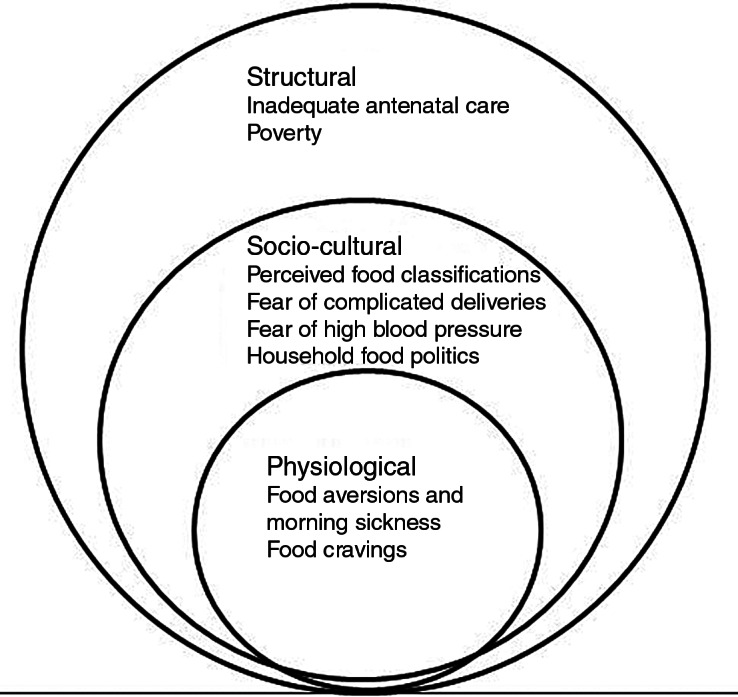
Objective: Adequate dietary intake during pregnancy is vital for the health and nutritional status of both mother and fetus. The nutritional status of reproductive age women in Pakistan is poor, with 14 % being underweight (BMI < 18·5) and 42 % experiencing Fe deficiency anaemia. This may stem from beliefs, practices and other barriers influencing dietary intake. This qualitative study seeks to determine which factors impact dietary intake during pregnancy in rural Punjab. Design: In-depth interviews and focus group discussions were conducted and then analysed using thematic analysis. Setting: Three purposively selected rural districts (Sahiwal, Okara and Pakpatan) with the highest prevalence of maternal and child malnutrition in the province of Punjab, Pakistan Participants: Mothers with children under age two (n 29) and healthcare providers with at least 5 years of experience working in the district (n 12). Results: We identified a combination of physiological, socio-cultural and structural barriers that inhibited healthful dietary intake during pregnancy. The primary physiological barriers to optimal dietary intake and dietary practices included food aversions and food cravings. Food classification, fear of a difficult childbirth, fear of high blood pressure and household food politics were the principal socio-cultural barriers. Additionally, two structural barriers, inadequate antenatal counseling and a lack of affordable food options, were identified. Conclusions: Our study demonstrates that complex barriers prevent pregnant women in the Punjab area from consuming adequate dietary intake and that antenatal health education programmes and structural interventions are needed to support healthful dietary practices during this critical period.
Overview
The claims and statistics of this paper haven’t been checked yet.
Run the check — free, no account needed. It reads the open-access text and checks the sources it cites.
Integrity signals
Registry
Cites
Statistics
Figures
Verification
Claims the paper makes
The claims and statistics of this paper haven’t been checked yet.
Run the check — free, no account needed. It reads the open-access text and checks the sources it cites.
Claims other papers make about this one
Each is checked against this paper’s own text: does it say what the citing paper says it does?
The source backs part of the claim, not all of it — or backs it for a different population, condition or comparison.
In the citing paper
“In low- and middle-income countries (LMICs), cultural food practices often exacerbate challenges in the management of GDM [164,165].”
From Medical Nutrition Therapy for Women with Gestational Diabetes: Current Practice and Future Perspectives (2025) · cites this paper as [165]
Experimental — accuracy not yet measured
Self-check
Percentages, sums and reported differences re-computed from the paper’s own numbers.
The self-check needs the paper’s full text.
Citations
Cites
A General Inductive Approach for Analyzing Qualitative Evaluation Data
Thomas, D. R. (2006) · American Journal of Evaluation · doi:10.1177/1098214005283748 · Cited by 10,858
Maternal and child undernutrition and overweight in low-income and middle-income countries
Black, R. E., Victora, C. G., Walker, S. P., Bhutta, Z. A., Christian, P., de Onis, M., Ezzati, M., Grantham-McGregor, S., Katz, J., Martorell, R., et al. (2013) · The Lancet · doi:10.1016/s0140-6736(13)60937-x · Cited by 8,475
Qualitative descriptive methods in health science research
Colorafi, K. J., & Evans, B. (2016) · HERD: Health Environments Research & Design Journal · doi:10.1177/1937586715614171 · Cited by 1,423
WHO recommendations on antenatal care for a positive pregnancy experience—going beyond survival
Tunçalp, Ö., Peña‐Rosas, J. P., Lawrie, T. A., Bucagu, M., Oladapo, O., Portela, A. G., & Gülmezoglu, A. M. (2017) · BJOG An International Journal of Obstetrics & Gynaecology · doi:10.1111/1471-0528.14599 · Cited by 502
Lawn, J. E., & Kerber, K. J. (2006) · Cited by 447
Özaltin, E. (2010) · JAMA · doi:10.1001/jama.2010.450 · Cited by 440
Hyperemesis gravidarum, a literature review
Verberg, M. F. G., Gillott, D. J., Alfardan, N., & Grudzinskas, J. G. (2005) · Human Reproduction Update · doi:10.1093/humupd/dmi021 · Cited by 429
Nausea and Vomiting of Pregnancy
Lee, N. M., & Saha, S. (2011) · Gastroenterology Clinics of North America · doi:10.1016/j.gtc.2011.03.009 · Cited by 422
Morning Sickness: A Mechanism for Protecting Mother and Embryo
Flaxman, S. M., & Sherman, P. W. (2000) · The Quarterly Review of Biology · doi:10.1086/393377 · Cited by 349
Quantifying the global rates of nausea and vomiting of pregnancy: a meta analysis.
Einarson, T. R., Piwko, C., & Koren, G. (2013) · PubMed · Cited by 268
Sarker, B. K., Rahman, M., Rahman, T., Hossain, J., Reichenbach, L., & Mitra, D. K. (2016) · PLoS ONE · doi:10.1371/journal.pone.0146161 · Cited by 231
Sialubanje, C., Massar, K., Hamer, D. H., & Ruiter, R. A. C. (2015) · BMC Pregnancy and Childbirth · doi:10.1186/s12884-015-0652-7 · Cited by 205
Kavle, J. A., & Landry, M. (2017) · Maternal and Child Nutrition · doi:10.1111/mcn.12508 · Cited by 181
Samerski, S. (2019) · Social Science & Medicine · doi:10.1016/j.socscimed.2019.02.024 · Cited by 175
Current Concepts of Maternal Nutrition
Lowensohn, R. I., Stadler, D. D., & Naze, C. (2016) · Obstetrical & Gynecological Survey · doi:10.1097/ogx.0000000000000329 · Cited by 169
Iqbal, S., Maqsood, S., Zakar, R., Zakar, M. Z., & Fischer, F. (2017) · BMC Health Services Research · doi:10.1186/s12913-017-2111-9 · Cited by 162
Cesare, M. D., Bhatti, Z., Soofi, S. B., Fortunato, L., Ezzati, M., & Bhutta, Z. A. (2015) · The Lancet Global Health · doi:10.1016/s2214-109x(15)70001-x · Cited by 155
Kibret, K. T., Chojenta, C., Gresham, E., Tegegne, T. K., & Loxton, D. J. (2018) · Public Health Nutrition · doi:10.1017/s1368980018002616 · Cited by 152
Lopes, K. D. S., Ota, E., Shakya, P., Dagvadorj, A., Balogun, O. O., Peña‐Rosas, J. P., De‐Regil, L. M., & Mori, R. (2017) · BMJ Global Health · doi:10.1136/bmjgh-2017-000389 · Cited by 147
Routledge Handbook of Families in Asia
(2015) · Routledge eBooks · doi:10.4324/9781315881706 · Cited by 143
Traditional Practices of Women From India: Pregnancy, Childbirth, and Newborn Care
Choudhry, U. K. (1997) · Journal of Obstetric, Gynecologic & Neonatal Nursing · doi:10.1111/j.1552-6909.1997.tb02156.x · Cited by 143
Prevalence of hypertensive disorders of pregnancy in Ethiopia: a systemic review and meta-analysis
Berhe, A. K., Kassa, G. M., Fekadu, G. A., & Muche, A. A. (2018) · BMC Pregnancy and Childbirth · doi:10.1186/s12884-018-1667-7 · Cited by 141
Classifying foods in contexts: How adults categorize foods for different eating settings
Blake, C. E., Bisogni, C. A., Sobal, J., Devine, C. M., & Jastran, M. (2007) · Appetite · doi:10.1016/j.appet.2007.03.009 · Cited by 138
The double burden of malnutrition in SE Asia and the Pacific: priorities, policies and politics
Haddad, L., Cameron, L., & Barnett, I. (2014) · Health Policy and Planning · doi:10.1093/heapol/czu110 · Cited by 137
Choudhury, N., & Ahmed, S. M. (2011) · BMC Pregnancy and Childbirth · doi:10.1186/1471-2393-11-15 · Cited by 126
Orloff, N. C., & Hormes, J. M. (2014) · Frontiers in Psychology · doi:10.3389/fpsyg.2014.01076 · Cited by 124
Majrooh, M. A., Hasnain, S., Akram, J., Siddiqui, A. M., & Memon, Z. (2014) · PLoS ONE · doi:10.1371/journal.pone.0113390 · Cited by 108
Young, S. L., Khalfan, S. S., Farag, T. H., Kavle, J. A., Ali, S. M., Hajji, H., Rasmussen, K. M., Pelto, G. H., Tielsch, J. M., & Stoltzfus, R. J. (2010) · The American Society of Tropical Medicine and Hygiene · doi:10.4269/ajtmh.2010.09-0442 · Cited by 107
Nausea and vomiting in early pregnancy: Effects on food intake and diet quality
Crozier, S., Inskip, H. M., Godfrey, K. M., Cooper, C. C., Robinson, S. M., & SWS Study Group (2016) · Maternal and Child Nutrition · doi:10.1111/mcn.12389 · Cited by 94
McNamara, K., & Wood, E. A. (2019) · Journal of Health Population and Nutrition · doi:10.1186/s41043-019-0170-8 · Cited by 94
Roro, M. A., Hassen, E. M., Lemma, A., Gebreyesus, S. H., & Afework, M. F. (2014) · BMC Research Notes · doi:10.1186/1756-0500-7-556 · Cited by 92
Mumtaz, S., Bahk, J., & Khang, Y. (2017) · PLoS ONE · doi:10.1371/journal.pone.0186563 · Cited by 81
Food taboos in pregnancy and early lactation among women living in a rural area of West Bengal
Chakrabarti, S., & Chakrabarti, A. (2019) · Journal of Family Medicine and Primary Care · doi:10.4103/jfmpc.jfmpc_53_17 · Cited by 76
Health care seeking behaviours in pregnancy in rural Sindh, Pakistan: a qualitative study
CLIP Working Group, Qureshi, R. N., Sheikh, S. S., Khowaja, A. R., Hoodbhoy, Z. A., Zaidi, S., Sawchuck, D., Vidler, M., Bhutta, Z. A., & von Dadeslzen, P. (2016) · Reproductive Health · doi:10.1186/s12978-016-0140-1 · Cited by 73
Beliefs and practices surrounding postpartum period among Myanmar women
Sein, K. K. (2013) · Midwifery · doi:10.1016/j.midw.2012.11.012 · Cited by 65
Itrat, A., Taqui, A. M., Qazi, F., & Qidwai, W. (2007) · PubMed · Cited by 61
Eating Downin Pregnancy: Exploring Food-Related Beliefs and Practices of Pregnancy in Rural Nepal
Christian, P. S., Srihari, S. B., Thorne‐Lyman, A., Khatry, S. K., LeClerq, S. C., & Shrestha, S. R. (2006) · Ecology of Food and Nutrition · doi:10.1080/03670240600846336 · Cited by 60
Food classifications: Levels and categories
Furst, T., Connors, M. M., Sobal, J., Bisogni, C. A., & Falk, L. W. (2000) · Ecology of Food and Nutrition · doi:10.1080/03670244.2000.9991623 · Cited by 59
Noh, J., Kim, Y. M., Lee, L. J., Akram, N., Shahid, F., Kwon, Y. D., & Stekelenburg, J. (2019) · PLoS ONE · doi:10.1371/journal.pone.0213987 · Cited by 56
Low plasma zinc and iron in pica
Singhi, S. C., Ravishanker, R., SINGHI, P. D., & Nath, R. (2003) · The Indian Journal of Pediatrics · doi:10.1007/bf02723740 · Cited by 56
The lady health worker program in Pakistan--a commentary
Jalal, S. (2011) · European Journal of Public Health · doi:10.1093/eurpub/ckq199 · Cited by 56
MacDonald, C., Aubel, J., Aidam, B. A., & Girard, A. W. (2019) · Current Developments in Nutrition · doi:10.1093/cdn/nzz141 · Cited by 49
Aiming higher for maternal and child nutrition in South Asia
Torlesse, H., & Aguayo, V. M. (2018) · Maternal and Child Nutrition · doi:10.1111/mcn.12739 · Cited by 47
Shrimpton, R. (2012) · Paediatric and Perinatal Epidemiology · doi:10.1111/j.1365-3016.2012.01279.x · Cited by 43
Roy, A., Fuentes‐Afflick, E., Fernald, L. C. H., & Young, S. L. (2017) · Appetite · doi:10.1016/j.appet.2017.08.033 · Cited by 41
Harding, K. L., Matias, S. L., Mridha, M. K., Vosti, S. A., Hussain, S., Dewey, K. G., & Stewart, C. P. (2017) · Public Health Nutrition · doi:10.1017/s1368980017000672 · Cited by 40
Kahsay, Z. H., Birhanu, Z., Chaka, M., & Gebreyesus, H. (2017) · BMC Nutrition · doi:10.1186/s40795-017-0159-x · Cited by 37
Coresidence with mother-in-law and maternal anemia in rural India
Varghese, R., & Roy, M. (2019) · Social Science & Medicine · doi:10.1016/j.socscimed.2019.02.027 · Cited by 27
Kaleem, R., Adnan, M., Nasir, M., & Rahat, T. (2020) · Pakistan Journal of Medical Sciences · doi:10.12669/pjms.36.4.1919 · Cited by 27
Kariuki, L., Lambert, C., Purwestri, R. C., & Biesalski, H. K. (2016) · NFS Journal · doi:10.1016/j.nfs.2016.09.001 · Cited by 27
Khoushabi, F., Ahmadi, P., Shadan, M. R., Heydari, A., Miri, A., & Jamnejad, M. (2014) · Open Journal of Obstetrics and Gynecology · doi:10.4236/ojog.2014.411090 · Cited by 22
Ali, N. S., Azam, S. I., & Noor, R. (2004) · PubMed · Cited by 19
Diet and Nutrition: A Knowledge, Attitude and Practice Study of Pregnant Women in Karachi
Zobairi, S. E., Freitas, M. L., & Wasti, S. (1998) · Australian and New Zealand Journal of Obstetrics and Gynaecology · doi:10.1111/j.1479-828x.1998.tb02999.x · Cited by 15
The impact of ancient Greek medicine in India: the birth of Unani medicine.
Poulakou-Rebelakou, E. L., Karamanou, M., & Androutsos, G. (2015) · PubMed · Cited by 13
Diet Intake Trends Among Pregnant Women In Rural Area Of Rawalpindi, Pakistan
Qureshi, Z., & Khan, R. (2015) · PubMed · doi:10.13140/rg.2.2.23298.22729 · Cited by 12
Chowbey, P. (2017) · Sociological Research Online · doi:10.1177/1360780417726958 · Cited by 9
WOMEN'S PERCEPTIONS ABOUT QUALITY OF MATERNITY CARE AT TERTIARY CARE HOSPITAL KARACHI, PAKISTAN
Munawar, A., Hassan, Z. U., Ayub, A., Shaikh, B. T., Buriro, N. A., Ahmed, F., & Kumar, R. (1970) · Pakistan Journal of Public Health · doi:10.32413/pjph.v7i2.46 · Cited by 9
Salam, F. T., & Sarfraz, M. (2018) · PubMed · Cited by 1
F ood C ulture in S outheast A sia by Penny Van Esterik
Peters, E. J. (2010) · Food Culture & Society · doi:10.2752/175174410x12699432701105 · Cited by 1
Research works printed but not linked: 5
- Nag, 1994, Beliefs and practices about food during pregnancy: implications for maternal nutrition, Eco Poli Weekly, 29, 2427
- Hisam, 2014, Knowledge, attitude and practice regarding folic acid deficiency; A hidden hunger, Pak J Med Sci, 30, 583
- Lakshmi, 2013, Food preferences and taboos during ante-natal period among the tribal women of north coastal Andhra Pradesh, J Com Nutr Health, 2, 32
- Wegrzyniak, 2012, Treatment of hyperemesis gravidarum, Rev Obstet Gynecol, 5, 78
- 2019, Pakistan Demographic and Health Survey 2017–18
Cited by
Harrison, C. L., Khomami, M. B., Enticott, J., Thangaratinam, S., Rogozińska, E., & Teede, H. J. (2023) · JAMA Network Open · doi:10.1001/jamanetworkopen.2023.18031 · Cited by 38
Olajide, B. R., van der Pligt, P., & McKay, F. H. (2024) · PLoS ONE · doi:10.1371/journal.pone.0303185 · Cited by 36
Maggiulli, O., Rufo, F., Johns, S. E., & Wells, J. C. K. (2022) · PeerJ · doi:10.7717/peerj.13633 · Cited by 33
Li, Q., Piaseu, N., Phumonsakul, S., & Thadakant, S. (2024) · Nutrients · doi:10.3390/nu16020217 · Cited by 26
Aubel, J. (2023) · Global Health Promotion · doi:10.1177/17579759231191494 · Cited by 23
Metadata
- Authors
- Asim, M., Ahmed, Z. H., Nichols, A. R., Rickman, R., Neiterman, E., Mahmood, A., & Widen, E. M.
- Affiliations
- Aga Khan University (PK)
- The University of Texas at Austin (US)
- University of Waterloo (CA)
- Corresponding author
- Widen, Elizabeth M
- ORCID
- Widen, Elizabeth M
- Venue
- Public Health Nutrition
- Publisher
- Cambridge University Press (CUP)
- Published
- 2021-04-19
- Volume
- 25
- Issue
- 3
- Pages
- 760-769
- ISSN
- 1368-9800 (ISSN-L)
- 1475-2727
- PMC
- PMC8523588
- OpenAlex
- W3152897503
- Cited by
- 22
- References
- 62
- Citations by year
- 2025: 5 · 2024: 10 · 2023: 5 · 2022: 2
- FWCI
- 4.20
- Type
- journal article
- Language
- en
- Open access
- hybrid
- doi.org
- Locations
- Public Health Nutrition (publishedVersion, cc-by)
- PubMed Central (publishedVersion, cc-by)
- PubMed (publishedVersion)
- eScholarship (California Digital Library) (submittedVersion, cc-by)
- Funders
- Eunice Kennedy Shriver National Institute of Child Health and Human Development (R00HD086304, P2CHD042849)
- Topics
- Health Sciences › Medicine › Pediatrics, Perinatology and Child Health › Public Health and Nutrition
- Health Sciences › Nursing › Nutrition and Dietetics › Nutrition, Health and Food Behavior
- Health Sciences › Nursing › Nutrition and Dietetics › Child Nutrition and Water Access
- Keywords
- dietary intake during pregnancy, barriers to healthy eating, food aversion, food cravings, food classification, fear of childbirth, antenatal counseling, maternal nutrition, rural Punjab, food affordability
- MeSH terms
- Child, Child, Preschool, Diet, Female, Humans, Nutritional Status, Pakistan, Pregnancy, Rural Population, Pregnant People, Pregnant Women
About these checks
Registry, retraction, Cites and statistics results are computed, not judged, with one exception: a printed reference that no index lists is read once by a model before it counts as a citation error. Claims are extracted by a model and kept only when their quote appears verbatim in the text; each cited source is then checked, with a model’s help, for whether it says what the claim relies on. Those verdicts can be wrong — read the claim’s quote and the cited source before relying on one.
Statistics and arithmetic are recomputed, not judged.
Confidence bands are shown only for fields calibrated on our annotated test set. None is calibrated yet, so no band is shown.
What counts as a claim ›How we measure confidence ›How we check this ›
Are you an author, or do you see a problem with this page? Request a review
Data sources
Bibliographic data: Semantic Scholar, OpenAlex, Crossref.
Contains information from the Semantic Scholar Academic Graph Datasets, made available under the ODC Attribution License (ODC-BY 1.0).
Semantic Scholar’s data is described in: Kinney, R., et al. (2023). The Semantic Scholar Open Data Platform. arXiv:2301.10140.
