

Implementing dementia risk reduction in primary care: a preliminary conceptual model based on a scoping review of practitioners’ views
Open accessThe DOI matches its Crossref record; 43 of the 47 references it cites were found in a registry or an index.
Abstract
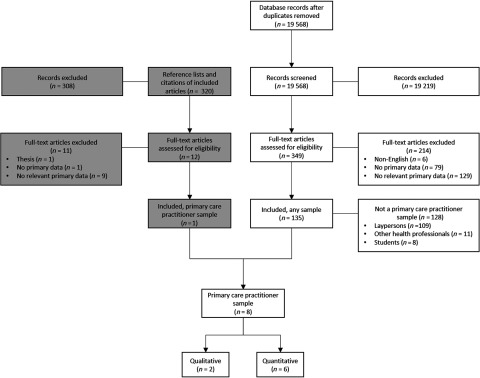
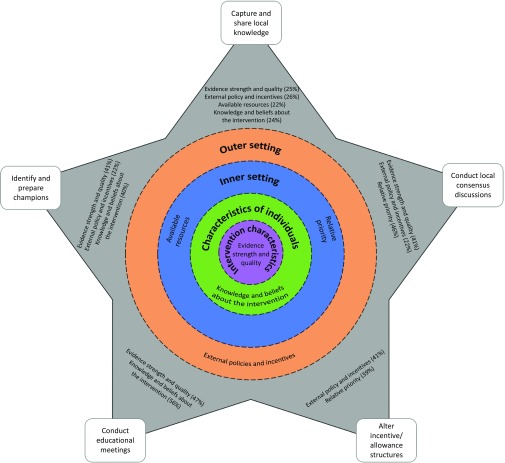
Primary care practitioners (PCPs) do not routinely promote dementia risk reduction. The purpose of this study was to map the published literature on the views of PCPs about dementia risk reduction, in order to identify implementation constructs and strategies crucial to the development of an implementation intervention to support dementia risk reduction in primary care. We undertook a scoping review of the PCPs’ views about promoting brain health for reducing dementia risk. We searched MEDLINE, PsycINFO, CINAHL, and Embase for English-language articles published between 1995 and December 2017. We then applied the Consolidated Framework for Implementation Research (CFIR) and matched Expert Recommendations for Implementing Change to the scoping review findings in order to develop a preliminary implementation model. Eight articles reported views of PCPs about dementia prevention. Study findings were mapped to 5 of the 39 CFIR constructs: (i) knowledge and beliefs about dementia risk reduction, (ii) evidence strength and quality, (iii) relative priority, (iv) available resources, and (v) external policy and incentives. The findings suggest implementation strategies to consider in our preliminary model include (i) educational meetings, (ii) identifying and preparing champions, (iii) conducting local consensus discussions, (iv) altering incentive structures, and (v) capturing and sharing local knowledge. There have been few studies about the views of PCPs about dementia risk reduction. Implementation in the primary care setting is fundamental to early identification of risk and supporting preventive practices, but it needs to focus on more than just education for PCPs. We need more up-to-date and in-depth data on the views of PCPs about dementia risk reduction and context-specific analyses of implementation needs. Further research into effective primary care interventions to reduce dementia risk is expected to support implementation efforts.
Overview
The claims and statistics of this paper haven’t been checked yet.
Free: it reads the open-access text and checks the first 5 claims that cite a source we can check. Create a free account to check every claim.
Integrity signals
Registry
Cites
Statistics
Figures
Verification
Claims the paper makes
The claims and statistics of this paper haven’t been checked yet.
Free: it reads the open-access text and checks the first 5 claims that cite a source we can check. Create a free account to check every claim.
Claims other papers make about this one
Each is checked against this paper’s own text: does it say what the citing paper says it does?
The source backs part of the claim, not all of it — or backs it for a different population, condition or comparison.
In the citing paper
“This could explain the alarming finding that although healthcare professionals believe they should play an important role in identifying individuals at risk for dementia, they only sporadically provide advice on dementia risk reduction to their patients.17,34”
From Awareness of dementia risk reduction among current and future healthcare professionals: A survey study (2021) · cites this paper as [17]
Experimental — accuracy not yet measuredThe cited source says what the claim attributes to it.
In the citing paper
“Nevertheless, previous studies have shown that general practitioners (GPs) only sporadically provide advice on preventive strategies for dementia, which could be explained by the concerns about their knowledge regarding this topic.15-17”
From Awareness of dementia risk reduction among current and future healthcare professionals: A survey study (2021) · cites this paper as [17]
The cited source says what the claim attributes to it.
In the citing paper
“Limited time and resources being the major ones, that may force PCPs to neglect efforts towards prevention, despite their intentions, as it is usually less of priority or urgent [45, 46].”
From Multidomain Dementia Risk Reduction in Primary Care is Feasible: A Proof-of-concept study (2024) · cites this paper as [46]
In the citing paper
“Nurses and allied health workers were more aware of lifestyle risk factors than physicians, which is contrary to the findings of other studies (11–14).”
From Awareness of dementia risk factors among healthcare professionals at Hamad Medical Corporation, Qatar: a cross-sectional survey (2024) · cites this paper as [11]
Self-check
Percentages, sums and reported differences re-computed from the paper’s own numbers.
The self-check needs the paper’s full text.
Citations
Cites
PRISMA Extension for Scoping Reviews (PRISMA-ScR): Checklist and Explanation
Tricco, A. C., Lillie, E., Zarin, W., O'Brien, K. K., Colquhoun, H., Levac, D., Moher, D., Peters, M. D. J., Horsley, T., Weeks, L., et al. (2018) · Annals of Internal Medicine · doi:10.7326/m18-0850 · Cited by 43,565 · cited 2×
“The review is reported in accordance with the PRISMA Extension for Scoping Reviews (PRISMA-ScR) Checklist (Tricco et al ., 2018).”
Damschroder, L. J., Aron, D. C., Keith, R. E., Kirsh, S. R., Alexander, J. A., & Lowery, J. C. (2009) · Implementation Science · doi:10.1186/1748-5908-4-50 · Cited by 14,496 · cited 1×
“We applied the CFIR (Damschroder et al., 2009) to the findings of the scoping review.”
Guidance for conducting systematic scoping reviews
Peters, M. D. J., Godfrey, C. M., Khalil, H., McInerney, P., Parker, D., & Soares, C. B. (2015) · International Journal of Evidence-Based Healthcare · doi:10.1097/xeb.0000000000000050 · Cited by 7,472 · cited 3×
“Scoping reviews are useful for answering broad questions such as ‘What is known about a concept?’ and for examining emerging evidence when it is still unclear what other, more specific questions can be posed and valuably addressed by other research methods (Peters et al., 2015; Tricco et al., 2016).”
Diffusion of Innovations in Service Organizations: Systematic Review and Recommendations
GREENHALGH, T., ROBERT, G., MACFARLANE, F., BATE, P., & KYRIAKIDOU, O. (2004) · The Milbank Quarterly · doi:10.1111/j.0887-378x.2004.00325.x · Cited by 7,448 · cited 1×
“The CFIR is one of the most commonly used determinant frameworks (Birken et al ., 2017) and is based on theories identified in Greenhalgh et al. ’ s (2004) widely cited systematic review.”
Why Don't Physicians Follow Clinical Practice Guidelines?: A Framework for Improvement
Cabana, M. D., Rand, C. S., Powe, N. R., Wu, A. W., Wilson, M. H., Abboud, P.-A. C., & Rubin, H. R. (1999) · JAMA · doi:10.1001/jama.282.15.1458 · Cited by 6,677 · cited 1×
“Simply providing PCPs with guidelines for dementia risk reduction will not be enough to change their professional behaviour (Cabana et al., 1999).”
Dementia prevention, intervention, and care
Livingston, G., Sommerlad, A., Orgeta, V., Costafreda, S. G., Huntley, J., Ames, D., Ballard, C., Banerjee, S., Burns, A., Cohen-Mansfield, J., et al. (2017) · The Lancet · doi:10.1016/s0140-6736(17)31363-6 · Cited by 6,072 · cited 2×
“Epidemiological evidence suggests that up to one-third of all dementia cases are attributable to modifiable risk factors such as obesity, hypertension, diabetes, physical inactivity, and smoking (Livingston et al ., 2017).”
Powell, B. J., Waltz, T. J., Chinman, M. J., Damschroder, L. J., Smith, J. L., Matthieu, M. M., Proctor, E. K., & Kirchner, J. E. (2015) · Implementation Science · doi:10.1186/s13012-015-0209-1 · Cited by 4,963
Making sense of implementation theories, models and frameworks
Nilsen, P. (2015) · Implementation Science · doi:10.1186/s13012-015-0242-0 · Cited by 4,447 · cited 2×
“Implementation science is a relatively new area of health research that focusses on bridging such gaps in practice, with implementation models used to describe the process of changing routine practice (Nilsen, 2015).”
U.S. Department of Health and Human Services
(2006) · Encyclopedia of Sexual Behavior and the Law · doi:10.4135/9781452240107.n226 · Cited by 3,170
(2015) · HAL · Cited by 2,238
Research works printed but not linked: 9
- Britt H, Miller GC, Henderson J, Bayram C, Harrison C, Valenti L, Pan Y, Charles J, Pollack AJ, Wong C and Gordon J (2016b) General practice activity in Australia 2015-16 BEACH Bettering the Evaluation and Care of Health. Sydney: Sydney University Press.
- Britt H, Miller GC, Bayram C, Henderson J, Valenti L, Harrison C, Pan Y, Charles J, Pollack AJ, Chambers T, Gordon J and Wong C (2016a) A decade of Australian general practice activity 2006–07 to 2015–16 BEACH Bettering the evaluation and care of health, Sydney: Sydney University Press.
- RACGP (2016) Guidelines for preventive activities in general practice. East Melbourne, Victoria: The Royal Australian College of General Practice.
- NICE (2015) Dementia, disability and frailty in later life—mid-life approaches to delay or prevent onset. London: National Institute for Health and Care Excellence.
- RCGP (2007) Healthy People: promoting health and preventing disease. London: Royal College of General Practitioners.
- National Academies of Sciences (2017) Preventing cognitive decline and dementia: a way forward. Washington (DC): National Academies Press. 28650595
- Peters MDJ, Godfrey C, McInerney P, Baldini Soares C, Khalil H and Parker D (2017) Scoping reviews In Aromataris E and Munn Z, editors, Joanna Briggs Institute Reviewer’s Manual. The Joanna Briggs Institute Retrieved May 2018 from https://reviewersmanual.joannabriggs.org/
- Bassil N and Grossberg GT (2009) Evidence-based approaches to preventing Alzheimer’s disease: part 1. Primary Psychiatry 16, 29– 37.
- British Medical Association (2017) Media Brief: General Practice in the UK – Background Briefing. Retreived May 2018 from https://www.bma.org.uk/-/media/files/pdfs/news%20views%20analysis/press%20briefings/general-practice.pdf?la=en
Cited by
Van Asbroeck, S., van Boxtel, M. P. J., Steyaert, J., Köhler, S., Heger, I., de Vugt, M., Verhey, F., & Deckers, K. (2021) · Preventive Medicine · doi:10.1016/j.ypmed.2021.106522 · Cited by 102
Atri, A., Dickerson, B. C., Clevenger, C. K., Karlawish, J. H., Knopman, D. S., Lin, P., Norman, M., Onyike, C. U., Sano, M., Scanland, S., et al. (2024) · Alzheimer s & Dementia · doi:10.1002/alz.14333 · Cited by 111
“49 An evidence-based consensus 50 recommended that clinicians perform individualized risk assessment and counseling, focusing on the American Heart Asso-ciationLife’sSimple7.”
Curran, E. M., Chong, T. W. H., Godbee, K., Abraham, C., Lautenschlager, N. T., & Palmer, V. J. (2021) · PLoS ONE · doi:10.1371/journal.pone.0257540 · Cited by 73
Self-citationKulmala, J., Rosenberg, A., Ngandu, T., Hemiö, K., Tenkula, T., Hyytiä, A., Vienola, M., Huhtamäki-Kuoppala, M., Saarinen, A., Korkki, S., et al. (2021) · European Journal of Public Health · doi:10.1093/eurpub/ckab087 · Cited by 47
Parial, L. L., Lam, S. C., Ho, J. Y. S., Suen, L. K. P., & Leung, A. Y. M. (2021) · Aging & Mental Health · doi:10.1080/13607863.2020.1786801 · Cited by 43
Naismith, S. L., Michaelian, J. C., Low, L., Arsenova, V., Mehrani, I., Fyfe, K. P., Kochan, N. A., Kurrle, S. E., Rowe, C. C., & Sachdev, P. S. (2022) · BMC Geriatrics · doi:10.1186/s12877-022-03253-7 · Cited by 39
“Although preliminary work is emerging on communicating risk [36], effective methods to optimise delivery and behaviour change in relation to risk reduction strategies are not yet established [37].”
BackgroundGodbee, K., Gunn, J., Lautenschlager, N. T., & Palmer, V. J. (2020) · Australian Journal of Primary Health · doi:10.1071/py19249 · Cited by 20
Self-citationMultidomain Dementia Risk Reduction in Primary Care is Feasible: A Proof-of-concept study
Van Asbroeck, S., Köhler, S., Wimmers, S. C. P. M., Muris, J. W. M., van Boxtel, M. P. J., & Deckers, K. (2024) · Journal of Alzheimer’s Disease · doi:10.3233/jad-240229 · Cited by 17
Hallam, B., Rees, J., Petersen, I., Cooper, C., Avgerinou, C., & Walters, K. R. (2021) · Family Practice · doi:10.1093/fampra/cmab014 · Cited by 18
de Krom, F. J. W., Sivananthan, S., Alkhotany, F., Celen, M., Hol, I. E., Houben, K. J. G., Sivananthan, P., Koekebakker, H., & Deckers, K. (2021) · Journal of Public Health Research · doi:10.4081/jphr.2021.1961 · Cited by 16
Zheng, L., Godbee, K., Steiner, G. Z., Daylight, G., Ee, C., Hill, T. Y., Hohenberg, M. I., Lautenschlager, N. T., McDonald, K., Pond, D., et al. (2021) · Australian Journal of Primary Health · doi:10.1071/py20189 · Cited by 8
Self-citationFactors for the integration of prevention in primary care: an overview of reviews
Clet, E., Leblanc, P., Alla, F., & Cohidon, C. (2024) · BJGP Open · doi:10.3399/bjgpo.2023.0141 · Cited by 12
Al Hamad, H., & Sathian, B. (2024) · Frontiers in Public Health · doi:10.3389/fpubh.2024.1443525 · Cited by 5
Godbee, K., Farrow, M., Bindoff, A. D., Gunn, J., Lautenschlager, N. T., & Palmer, V. J. (2021) · Australian Journal of Primary Health · doi:10.1071/py21122 · Cited by 6
Self-citationHornby‐Turner, Y. C., Russell, S., Quigley, R., Matthews, V., Larkins, S., Hayman, N. E., Lakhan, P., Flicker, L. A., Smith, K., McKeown, D., et al. (2023) · Methods and Protocols · doi:10.3390/mps6050103 · Cited by 3
“Furthermore, there is evidence to suggest that limited education and training about dementia for PHC staff may result in it being classified as low priority [19,20].”
BackgroundBuilding digital solutions to support brain health prescribing in primary care: Where to begin?
Siette, J., & Adam, P. J. (2024) · Alzheimer s & Dementia Translational Research & Clinical Interventions · doi:10.1002/trc2.12447 · Cited by 2
“8 Yet dedicated discussionsonhealthybrainageingareinfrequentinclinicalsettings, 15 and deliberate efforts to modify factors linked to dementia risk are limited.”
BackgroundSaragosa, M., Mulligan, K., Hsiung, S., Biswas, S., Card, K. G., Hébert, P. C., Welch, V. A., & Nelson, M. L. A. (2024) · Health Expectations · doi:10.1111/hex.14144 · Cited by 3
“Therefore, study participants perceived a lack of evidence to support dementia risk reduction, undermining the relative importance of promoting brain health [30].”
BackgroundPeckham, A., Maxfield, M., & James, D. L. (2024) · Dementia · doi:10.1177/14713012241270756 · Cited by 4
“…policies, legislation, and population based programs to reduce the risk of Alzheimer ’ s disease and related dementia (Centers for Disease Control and Prevention, 2023; Daly, 2024; Godbee et al., 2019; Livingston et al., 2017, 2020; Walsh et al., 2023; World Health Organization, 2017, 2019).”
Cusack, M. C., Varley, A. L., & Montgomery, A. E. (2022) · Journal of Veterans Studies · doi:10.21061/jvs.v8i1.313 · Cited by 2
Morse, R. M., Lang, I., Rapaport, P., Poppe, M., Morgan‐Trimmer, S., & Cooper, C. (2024) · BMC Geriatrics · doi:10.1186/s12877-024-04762-3 · Cited by 3
“…as a content analysis of the FINGER intervention and a scoping review, highlight the need for tactics such as educational meetings, program champi-ons, altered incentive structures, improved educational materials, increased coordination and collaboration, and enhanced access to resources [19, 20].”
BackgroundChong, T. W. H., Rego, T. W. H., Lai, R., Westphal, A., Pond, C. D., Curran, E. M., Kootar, S., Peters, R. K., Anstey, K. J., & Lautenschlager, N. T. (2023) · Journal of Alzheimer s Disease · doi:10.3233/jad-230287 · Cited by 2
Self-citationDementia and Cognitive Impairment
Chong, Y. F. V., & Tang, S. (2024) · Elsevier eBooks · doi:10.1016/b978-0-323-99967-0.00134-4 · Cited by 2
Schultz, A., Luppa, M., Bleckwenn, M., Riedel-Heller, S. G., & Zülke, A. E. (2025) · JMIR Formative Research · doi:10.2196/56310 · Cited by 1
“However, existing research has shown that dementia risk reduction is not routinely conducted in primary care settings [7,8].”
Godbee, K., Palmer, V. J., Gunn, J. M., Lautenschlager, N. T., & Francis, J. (2024) · Australian Journal of Primary Health · doi:10.1071/py24063
Self-citationZabaleta‐del‐Olmo, E., Casajuana‐Closas, M., López‐Jiménez, T., Pombo, H., Pons‐Vigués, M., Ribera, E. P., Cabezas-Peña, C., Llobera, J., Martí‐Lluch, R., Vicens, C., et al. (2020) · Research Square · doi:10.21203/rs.3.rs-52192/v1 · Cited by 1
Demenzprävention und hausärztliche Versorgung: Schätzung der Zielpopulation
Bohlken, J., Riedel-Heller, S. G., Gothe, H., & Kostev, K. (2020) · Fortschritte der Neurologie · Psychiatrie · doi:10.1055/a-1227-6287 · Cited by 2
“In ihrer Übersichtsarbeit haben Godbee und Kollegen (2019) auf die verschiedenen Barrieren hingewiesen, die bei einer Implementierung von das Demenzrisiko reduzierenden Interventionen in Hausarztpraxen berücksichtigt werden sollten [6].”
BackgroundInfluentialAsbroeck, S. V. (2024) · Research Publications (Maastricht University) · doi:10.26481/dis.20240618sa
Understanding Dementia: Knowledge and Risk Factor Awareness Among University Psychology StudentsPreprint
Sabatini, S., Burley, C. V., Ambagtsheer, R. C., & Stephan, B. C. M. (2025) · Research Square · doi:10.21203/rs.3.rs-6523159/v1 · Cited by 1
Naismith, S. L., Michaelian, J. C., Low, L.-F., Arsenova, V., Mehrani, I., Fyfe, K. P., Kochan, N. A., Kurrle, S. E., Rowe, C., & Sachdev, P. S. (2022) · Figshare · doi:10.6084/m9.figshare.20317657
Naismith, S. L., Michaelian, J. C., Low, L.-F., Arsenova, V., Mehrani, I., Fyfe, K. P., Kochan, N. A., Kurrle, S. E., Rowe, C., & Sachdev, P. S. (2022) · Figshare · doi:10.6084/m9.figshare.20317654
Kuroda, Y., Goto, A., Shindo, Y., Koyama, Y., & Suzuki, K. (2026) · BMC Public Health · doi:10.1186/s12889-026-28068-8
Morgan, E., & Bark, P. (2026) · Journal of Geriatric Psychiatry and Neurology · doi:10.1177/08919887261464574
Perceived value of antihypertensives for dementia, heart disease, or death: a randomized experiment
Chaitoff, A., Kohli-Lynch, C., Cameron, K. A., Maust, D. T., Langa, K. M., Levine, D. A., Wilkins, J. T., Carnethon, M. R., & Zheutlin, A. R. (2026) · American Journal of Preventive Cardiology · doi:10.1016/j.ajpc.2026.102562 · Cited by 1
Metadata
- Authors
- Godbee, K., Gunn, J., Lautenschlager, N. T., Curran, E., & Palmer, V. J.
- Affiliations
- The University of Melbourne (AU)
- Corresponding author
- Godbee, Kali
- Venue
- Primary Health Care Research & Development
- Publisher
- Cambridge University Press (CUP)
- Published
- 2019
- Volume
- 20
- Pages
- e140-e140
- ISSN
- 1463-4236 (ISSN-L)
- 1477-1128
- PMC
- PMC6842648
- OpenAlex
- W2982054841
- Cited by
- 33
- References
- 47
- Citations by year
- 2026: 3 · 2025: 2 · 2024: 11 · 2023: 2 · 2022: 4 · 2021: 7 · 2020: 4
- FWCI
- 0.69
- Type
- journal article
- Language
- en
- Open access
- gold
- doi.org
- Locations
- Primary Health Care Research & Development (publishedVersion, cc-by)
- Europe PMC (PubMed Central) (publishedVersion, cc-by)
- PubMed Central (publishedVersion, cc-by)
- PubMed (publishedVersion)
- Minerva Access (University of Melbourne) (submittedVersion, cc-by)
- Funders
- National Heart Foundation of Australia
- NSW Ministry of Health
- New South Wales Government
- Cancer Council NSW
- Topics
- Health Sciences › Health Professions › General Health Professions › Health Policy Implementation Science
- Health Sciences › Medicine › Psychiatry and Mental health › Dementia and Cognitive Impairment Research
- Health Sciences › Health Professions › General Health Professions › Health Sciences Research and Education
- Keywords
- dementia risk reduction, dementia prevention, primary care physicians, practitioner views, implementation model, implementation strategies, Consolidated Framework for Implementation Research, change agents, incentive structures
- MeSH terms
- Dementia, Humans, Health Knowledge, Attitudes, Practice, Primary Health Care, Risk Reduction Behavior
About these checks
Registry, retraction, Cites and statistics results are computed, not judged, with one exception: a printed reference that no index lists is read once by a model before it counts as a citation error. Claims are extracted by a model and kept only when their quote appears verbatim in the text; each cited source is then checked, with a model’s help, for whether it says what the claim relies on. Those verdicts can be wrong — read the claim’s quote and the cited source before relying on one.
Statistics and arithmetic are recomputed, not judged.
Confidence bands are shown only for fields calibrated on our annotated test set. None is calibrated yet, so no band is shown.
What counts as a claim ›How we measure confidence ›How we check this ›
Are you an author, or do you see a problem with this page? Request a review
Data sources
Bibliographic data: Semantic Scholar, OpenAlex, Crossref.
Contains information from the Semantic Scholar Academic Graph Datasets, made available under the ODC Attribution License (ODC-BY 1.0).
Semantic Scholar’s data is described in: Kinney, R., et al. (2023). The Semantic Scholar Open Data Platform. arXiv:2301.10140.
