

No Global Demos, No Global Democracy? A Systematization and Critique
Open accessThe DOI matches its Crossref record; 150 of the 157 references it cites were found in a registry or an index, and 6 are not checked yet; 1 of the 45 sources its claims cite were checked for support.
Abstract
A globalized world, some argue, needs a global democracy. But there is considerable disagreement about whether global democracy is an ideal worth pursuing. One of the main grounds for scepticism is captured by the slogan: “No global demos, no global democracy.” The fact that a key precondition of democracy—a demos—is absent at the global level, some argue, speaks against the pursuit of global democracy. I discuss four interpretations of the skeptical slogan—each based on a specific account of the notion of “the demos”—and conclude that none of them establishes that the global democratic ideal must be abandoned. In so doing, I systematize different types of objections against global democracy, thus bringing some clarity to an otherwise intricate debate, and offer a robust but qualified defense of the global democratic ideal.
Verified 2026-11-25 · 6 references not checked yet
Overview
CoChat Summary
## TL;DR
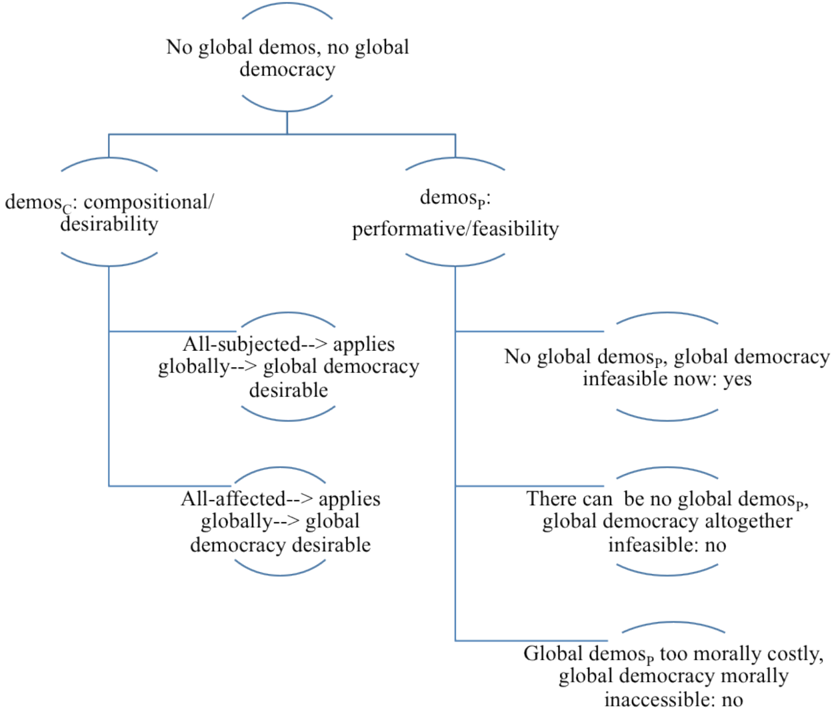
Valentini argues that the slogan “No global demos, no global democracy” does not defeat the global democratic ideal: global democracy is, in her view, desirable, not shown to be infeasible in principle, and not morally inaccessible. She offers a systematization of four skeptical interpretations of the slogan and rejects each one, while also insisting that global democratization must proceed cautiously because key preconditions are presently missing.
## Key findings
- The paper examines four readings of the skeptical slogan: global democracy is (a) undesirable, (b) infeasible now, (c) altogether infeasible, or (d) morally inaccessible; Valentini concludes that none of them shows that global democracy should be abandoned.
- On the compositional view of the demos, she argues there are global issues that qualify under either the all-subjected or all-affected principle; for example, she says border control and international property are areas in which “the world’s population is entitled to participation,” and climate change and trade also generate global stakes.
- On the performative view of the demos, she argues that the lack of current global cohesion does not prove impossibility: globalization is increasing interdependence, and she treats a global demos as a long-term possibility rather than something excluded by human nature or by current trajectories.
- She says global democracy is “desirable, morally accessible, and not infeasible,” but that its pursuit should be cautious and incremental because the preconditions for successful global democracy are currently lacking.
## Methods
- Normative conceptual analysis in political theory: the paper defines democracy, distinguishes two senses of “demos” (compositional and performative), and then tests four skeptical interpretations against those definitions.
- The argument engages existing literature rather than empirical original data, drawing on debates about coercion, affected interests, solidarity, feasibility, and moral accessibility.
- Main analysis is philosophical: it reconstructs opponents’ strongest versions and then argues that each fails as a reason to abandon global democracy.
## Limitations
- Stated in the paper: Valentini says she is “in no position to assess” whether a global democracy would ultimately take the shape of a global state or a looser network of governance institutions.
- Stated in the paper: she does not positively demonstrate that global democracy will come about, or how it will come about.
- Evident from the text: the paper is a theoretical argument and does not present new empirical tests or data on whether global democracy is politically achievable.
Model-written summary. Check it against the paper before relying on it.
Integrity signals
Registry
Cites
Statistics
Figures
Verification
Claims the paper makes
0 Valid · 16 Not valid · 42 Not checked · 119 Own results and interpretations
A conclusion the paper draws from its own results — it cites no other source for it, so there is none to check. The quote shows it is in the paper.
In the paper
“most laws that typically demand democratic justification can be described as preventative.”
plain- Asserted: passes — The authors put it forward as true.
- Checkable: passes — It can be checked against evidence.
- Load-bearing: passes — The paper’s conclusions depend on it.
- Based: passes — The paper gives a reason why it holds.
In the paper
“First, it is instrumentally valuable because it ensures that social outcomes are, to the extent that this is possible, responsive to everyone's interests.”
What the sources say
- Not checked — no full text of the sourcecites [33] matched to “From Global Poverty to Global Equality: A Philosophical Exploration” (2012) source
hedgedstates a cause- Asserted: passes — The authors put it forward as true.
- Checkable: passes — It can be checked against evidence.
- Load-bearing: passes — The paper’s conclusions depend on it.
- Based: passes — The paper gives a reason why it holds.
A conclusion the paper draws from its own results — it cites no other source for it, so there is none to check. The quote shows it is in the paper.
In the paper
“thus global democratic arrangements are desirable.”
- Also stated in: § Understanding II: There is no 'global affectedness,' therefore global democracy is undesirable · plain
“hence global democracy is desirable.”
- Also stated in: § Understanding II: There is no 'global affectedness,' therefore global democracy is undesirable · plain
“therefore global democracy is desirable.”
plain- Asserted: passes — The authors put it forward as true.
- Checkable: unclear — It is unclear whether it could be checked against evidence.
- Load-bearing: passes — The paper’s conclusions depend on it.
- Based: passes — The paper gives a reason why it holds.
- Also stated in: § Understanding II: There is no 'global affectedness,' therefore global democracy is undesirable · plain
A conclusion the paper draws from its own results — it cites no other source for it, so there is none to check. The quote shows it is in the paper.
In the paper
“if we subscribe to the all-subjected principle, it follows that everyone should have a say in the decisions governing these forms of coercion.”
plainstates a cause- Asserted: passes — The authors put it forward as true.
- Checkable: unclear — It is unclear whether it could be checked against evidence.
- Load-bearing: passes — The paper’s conclusions depend on it.
- Based: passes — The paper gives a reason why it holds.
A conclusion the paper draws from its own results — it cites no other source for it, so there is none to check. The quote shows it is in the paper.
In the paper
“Even if correct, the claim that there is no cluster of decisions which affect the world's population equally does not show that there is no global demosC.”
plain- Asserted: passes — The authors put it forward as true.
- Checkable: unclear — It is unclear whether it could be checked against evidence.
- Load-bearing: passes — The paper’s conclusions depend on it.
- Based: passes — The paper gives a reason why it holds.
70 more claims
Create a free account to see all 177 claims and every source verdict.
- Probably not a substantial claim. 88
- It may state two separate claims as one. 24
Citations
Cites
Between Facts and Norms: Contributions to a Discourse Theory of Law and Democracy
Habermas, J. (1996) · The MIT Press eBooks · doi:10.7551/mitpress/1564.001.0001 · Cited by 9,998
Johnson, K., & Nozick, R. (1975) · The Western Political Quarterly · doi:10.2307/447864 · Cited by 7,692
Nozick, R. (2018) · Princeton Readings in Political Thought · doi:10.2307/j.ctv19fvzzk.69 · Cited by 6,631
Dworkin, R. M. (1986) · Medical Entomology and Zoology · Cited by 4,736
(1990) · Choice Reviews Online · doi:10.5860/choice.27-2963 · Cited by 3,601
Between facts and norms: contributions to a discourse theory of law and democracy
(1997) · Choice Reviews Online · doi:10.5860/choice.34-2995 · Cited by 3,574
Stanford encyclopedia of philosophy
(1998) · Choice Reviews Online · doi:10.5860/choice.35-4860 · Cited by 3,398
(1962) · Excellence and Leadership in a Democracy · doi:10.7312/grau91070-013 · Cited by 3,317
(2008) · Cited by 2,463
IX.—Essentially Contested Concepts
Gallie, W. B. (1956) · Proceedings of the Aristotelian Society · doi:10.1093/aristotelian/56.1.167 · Cited by 2,280
Research works printed but not linked: 4
- Whelan, Frederick. 1983. 'Prologue: Democratic Theory and the Boundary Problem.' In Liberal Democracy: Nomos XXV , edited by J.R. Pennock and J.W. Chapman. New York: New York University Press.
- ---. 2010a. 'Against Global Democracy.' In After the Nation: Critical Reflections on Post-Nationalism , edited by Kaith Breen and Shane O'Neill, 141-60. Basingstoke: Palgrave Macmillan.
- Rawls, John. 1996. Political Liberalism . New York: Columbia University Press.
- Archibugi, Daniele, Mathias Koenig-Archibugi, and Raffaele Marchetti. 2011a. Global Democracy: Normative and Empirical Perspectives . Cambridge: Cambridge University Press. · DOI
Cited by
A Republican Europe of States: Cosmopolitanism, Intergovernmentalism and Democracy in the EU
Bellamy, R. (2019) · Cambridge University Press eBooks · doi:10.1017/9781139136303 · Cited by 173
Human Dignity and Human Rights
Gilabert, P. (2018) · doi:10.1093/oso/9780198827221.001.0001 · Cited by 163
A Republican Europe of States: Cosmopolitanism, Intergovernmentalism and Democracy in the EU
Bellamy, R. (2019) · Cited by 137
Wolkenstein, F. (2019) · doi:10.1093/oso/9780198849940.001.0001 · Cited by 118
Demoicracy, Transnational Partisanship and the EU
Wolkenstein, F. (2017) · JCMS Journal of Common Market Studies · doi:10.1111/jcms.12590 · Cited by 104
How to diagnose democratic deficits in global politics: the use of the ‘all-affected principle’
Koenig‐Archibugi, M. (2017) · International Theory · doi:10.1017/s1752971916000312 · Cited by 88
Varieties of Nationalism: Communities, Narratives, Identities
Mylonas, H., & Tudor, M. (2023) · Cambridge University Press eBooks · doi:10.1017/9781108973298 · Cited by 95
The Global Governance of Artificial Intelligence: Some Normative Concerns
Erman, E., & Furendal, M. (2022) · Moral Philosophy and Politics · doi:10.1515/mopp-2020-0046 · Cited by 70
Global political legitimacy beyond justice and democracy?
Erman, E. (2015) · International Theory · doi:10.1017/s1752971915000196 · Cited by 55
Promoting Justice Across Borders: The Ethics of Reform Intervention
Rafanelli, L. M. (2021) · doi:10.1093/oso/9780197568842.001.0001 · Cited by 45
Global democracy and feasibility
Erman, E., & Kuyper, J. W. (2019) · Critical Review of International Social and Political Philosophy · doi:10.1080/13698230.2019.1565713 · Cited by 45
“Yet, these kinds of principles are often rejected outright in the literature on global democracy, for example, because they presumably require a global demos or fulfil some other empirical premise (Miller, 2010; for a critique, see Valentini, 2014).”
BackgroundBillionaires in World Politics
Hägel, P. (2020) · doi:10.1093/oso/9780198852711.001.0001 · Cited by 56
The Humble Cosmopolitan: Rights, Diversity, and Trans-state Democracy
Cabrera, L. C. (2020) · doi:10.1093/oso/9780190869502.001.0001 · Cited by 52
Could Global Democracy Satisfy Diverse Policy Values? An Empirical Analysis
Hale, T. N., & Koenig‐Archibugi, M. (2018) · The Journal of Politics · doi:10.1086/700106 · Cited by 46
“The requirement is particularly strong when the power-wielders employ coercion (Abizadeh 2012; Erman 2016; Valentini 2014).”
BackgroundInfrastructures and Laws: Publics and Publicness
Kingsbury, B., & Maisley, N. (2021) · Annual Review of Law and Social Science · doi:10.1146/annurev-lawsocsci-011521-082856 · Cited by 37
Who Are the People? Defining the Demos in the Measurement of Democracy
Koenig‐Archibugi, M. (2020) · Political Studies · doi:10.1177/0032321720966481 · Cited by 30
“…(1995), Koenig-Archibugi (2012), List and Koenig-Archibugi (2010), Macdonald (2003, 2008, 2018), Marchetti (2008), Miller (2009), Näsström (2011), Saunders (2012), Saward (1998, 2000), Schlenker and Blatter (2014), Sharma (2020), Song (2012), Stevenson (2016), Valentini (2014) and Whelan (1983).”
The asymmetry between domestic and global legitimacy
Brinkmann, M. (2023) · Critical Review of International Social and Political Philosophy · doi:10.1080/13698230.2023.2216044 · Cited by 25
“All of the premises in this argument have been contested (Valentini, 2014), but let us assume that the argument is essentially correct.”
International courts and global democratic values: Participation, accountability, and justification
Kuyper, J. W., & Squatrito, T. (2016) · Review of International Studies · doi:10.1017/s0260210516000218 · Cited by 30
Looking at the World Bank’s safeguard reform through the lens of deliberative democracy
Houghton, R. (2019) · Leiden Journal of International Law · doi:10.1017/s0922156519000281 · Cited by 22
Membership ballots and the value of intra-party democracy
Wolkenstein, F. (2016) · Critical Review of International Social and Political Philosophy · doi:10.1080/13698230.2016.1159400 · Cited by 21
The Spirit of Democracy: Corruption, Disintegration, Renewal
Näsström, S. (2021) · doi:10.1093/oso/9780192898869.001.0001 · Cited by 48
Immigration Controls: Why the Self‐Determination Argument Is Self‐Defeating
Lepoutre, M. (2016) · Journal of Social Philosophy · doi:10.1111/josp.12156 · Cited by 24
The Human Right to Democracy and the Pursuit of Global Justice
Gilabert, P. (2020) · Oxford University Press eBooks · doi:10.1093/oxfordhb/9780198714354.013.14 · Cited by 17
Freedom as Non-domination and Democratic Inclusion
Beckman, L., & Rosenberg, J. H. (2017) · Res Publica · doi:10.1007/s11158-016-9348-8 · Cited by 23
“In assessing the reasonableness of principles of democratic inclusion, we take into account recent debates on the all-affected principle and the all-subjected principle (Miller 2009; Näsström 2011; Erman 2014; Valentini 2014; Beckman 2008; Owen 2012).”
MethodThe Demos of the democratic firm
González-Ricoy, Í., & Magaña, P. (2024) · Politics Philosophy & Economics · doi:10.1177/1470594x241239986 · Cited by 15
“It might if we assume, as most do (Abizadeh, 2008; Archer, 2010; Valentini, 2014), that what renders subjection to others ’ authority normatively distinctive is that, absent suitable controls, such authority may compromise the self-government of the obeying party.”
The democratization of global AI governance and the role of tech companies
Erman, E., & Furendal, M. (2024) · Nature Machine Intelligence · doi:10.1038/s42256-024-00811-z · Cited by 24
The boundary problem of democracy: A function-sensitive view
Erman, E. (2021) · Contemporary Political Theory · doi:10.1057/s41296-021-00517-6 · Cited by 17
“…connecting coercion with autonomy is problematic because even if coercion has a deep impact on the autonomy of persons – i.e. on ‘their ability to lead their lives in pursuit of their conceptions of the good’ – some non-coercive interventions might have that too (Valentini, 2014, p. 792).”
BackgroundInfluentialThe Boundaries of Democracy: A Theory of Inclusion
Beckman, L. (2022) · Routledge eBooks · doi:10.4324/9781003359807 · Cited by 32
The democratic deficit of the G20
Hilbrich, S. (2021) · Journal of Global Ethics · doi:10.1080/17449626.2021.1969982 · Cited by 11
Fifty Years of Global Justice: Five Theses
Beitz, C. R. (2018) · Fudan Journal of the Humanities and Social Sciences · doi:10.1007/s40647-018-0244-9 · Cited by 9
Hatfield, P., & Trueblood, L. (2020) · Acta Astronautica · doi:10.1016/j.actaastro.2020.11.053 · Cited by 9
A Deliberative Model of Intra-Party Democracy
Wolkenstein, F. (2019) · Oxford University Press eBooks · doi:10.1093/oso/9780198849940.003.0003 · Cited by 7
The Universal Republic: A Realistic Utopia?
Koenig‐Archibugi, M. (2024) · doi:10.1093/9780198921158.001.0001 · Cited by 39
Does Global Democracy Require a World State?
Erman, E. (2019) · Philosophical Papers · doi:10.1080/05568641.2019.1588153 · Cited by 9
“But it is, I argue, both desirable and feasible (see also Valentini 2014).”
BackgroundA Cosmopolitan Reading of Modern Monetary Theory
Kotilainen, K. (2021) · Global Society · doi:10.1080/13600826.2021.1898343 · Cited by 9
Should We Increase Young People’s Voting Power?
Angell, K. (2024) · Ethical Theory and Moral Practice · doi:10.1007/s10677-024-10443-2 · Cited by 7
“…observed, however, by proponents and critics alike, that the logic of the principle arguably implies that people should be included on different terms depending upon their degree of affectedness (Brighouse and Fleurbaey 2010; Angell and Huseby 2020; Valentini 2014; Erman 2014; Bergström 2007).”
The concept of affectedness in international development
Jokubauskaite, G. (2019) · World Development · doi:10.1016/j.worlddev.2019.104700 · Cited by 7
Koenig‐Archibugi, M. (2024) · Oxford University Press eBooks · doi:10.1093/9780198921158.005.0003 · Cited by 5
Fiege, L. (2025) · The International Sports Law Journal · doi:10.1007/s40318-025-00323-x · Cited by 6
“35 See Gould CC (2018) and Valentini (2014) for further conceptual reasoning.”
Cabrera, L. C. (2023) · Globalizations · doi:10.1080/14747731.2023.2190706 · Cited by 9
The Boundary Problem in Democratic Theory: A Methodological Approach
Magaña, P. (2023) · Res Publica · doi:10.1007/s11158-023-09617-z · Cited by 7
Beckman, L., & Rosenberg, J. H. (2022) · Philosophy & Technology · doi:10.1007/s13347-022-00525-3 · Cited by 8
“Recent democratic theory has come to a stand-still between the two major alternatives: the all-affected principle (AAP) and the all-subjected principle (ASP) (see Goodin, 2007, 2016; Miller, 2009; Hultin Rosenberg, 2020; Beckman, 2009; Valentini, 2014).”
BackgroundHumanist and Political Perspectives on Human Rights
Gilabert, P. (2018) · Oxford University Press eBooks · doi:10.1093/oso/9780198827221.003.0002 · Cited by 4
Equality, Proportionality, and the All-Affected Principle
Rosenberg, J. H. (2019) · Democratic Theory · doi:10.3167/dt.2019.060105 · Cited by 6
Hägel, P. (2020) · Oxford University Press eBooks · doi:10.1093/oso/9780198852711.003.0007 · Cited by 4
Sharman, N. (2025) · Global Constitutionalism · doi:10.1017/s2045381725000012 · Cited by 4
“On the one hand, some theorists are extremely sceptical that a global demos is feasible or desirable (Valentini, 2014).”
Cooperation, Democracy, and Coercion: On the Grounds and Scope of Freedom of Movement
Arnaiz, B. N. (2024) · Moral Philosophy and Politics · doi:10.1515/mopp-2024-0012 · Cited by 3
Post Post-Cold War Democratic Theory
Culp, J., & Sawyer, S. W. (2024) · Democratic Theory · doi:10.3167/dt.2024.110201 · Cited by 2
“Echoes of the ancient Greek terms demos and kratos have been resounding among democratic theorists in recent years (cf., e.g., Brown 2015; Inerar-ity 2014; Jolly 2007; Maltais et al. 2019; Ronzoni 2017; Sawyer 2018, 2025; Spector 2021; Valentini 2014; Wills 2023).”
Legitimate international authority and institutional diversity
Scherz, A., & Suttle, O. (2025) · Critical Review of International Social and Political Philosophy · doi:10.1080/13698230.2025.2499356 · Cited by 2
“These are not simply the problems of democratic theory (though they are that); they are problems that are rendered especially difficult by the fact of international institutional diversity and interaction (see e.g. Christiano, 2010; Valentini, 2014).”
Understanding Human Dignity in Human Rights
Gilabert, P. (2018) · Oxford University Press eBooks · doi:10.1093/oso/9780198827221.003.0005 · Cited by 4
Yhdentyminen vai pirstoutuminen?
Kotilainen, K. (2021) · Poliittinen talous · doi:10.51810/pt.v9i0.103397 · Cited by 2
Democratic Parties and Popular Sovereignty
Wolkenstein, F. (2019) · Oxford University Press eBooks · doi:10.1093/oso/9780198849940.003.0002 · Cited by 2
Representing the Peoples of Europe: Addressing the Demoicratic Disconnect
Bellamy, R. (2019) · Cambridge University Press eBooks · doi:10.1017/9781139136303.005 · Cited by 1
Gilabert, P. (2018) · Oxford University Press eBooks · doi:10.1093/oso/9780198827221.003.0009 · Cited by 2
Legitimacy Crisis and the ISDS Reform in a Political Economy Context
Li, S., & Shen, W. (2024) · International law in Asia · doi:10.1007/978-981-97-2183-2_5 · Cited by 1
Self-Determination and the All-Affected Principle
Stilz, A. (2024) · Cambridge University Press eBooks · doi:10.1017/9781009453981.007 · Cited by 1
Legitimate distribution without legislation
Hassoun, N. (2025) · Critical Review of International Social and Political Philosophy · doi:10.1080/13698230.2025.2499359 · Cited by 1
“For instance, some endorse theories on which only democratic processes legitimate (e.g. states’) rules – that is, the rules are only legitimate when they are the rules of the majority (Christiano, 1996; Rousseau, 1762; Valentini, 2012, 2014; Waldron, 1987).”
Legitimität und Autorität in der globalen Ordnung
Benz, A. (2017) · Springer eBooks · doi:10.1007/978-3-658-19780-3_13 · Cited by 2
Defending the Significance of Human Dignity
Gilabert, P. (2018) · Oxford University Press eBooks · doi:10.1093/oso/9780198827221.003.0006 · Cited by 1
Cabrera, L. C. (2020) · Oxford University Press eBooks · doi:10.1093/oso/9780190869502.003.0006 · Cited by 1
Hilbrich, S. (2024) · Springer eBooks · doi:10.1007/978-3-031-54125-4_4 · Cited by 1
Towards a Standard of Legitimacy for Global Governance Institutions
Hilbrich, S. (2024) · Springer eBooks · doi:10.1007/978-3-031-54125-4_5 · Cited by 2
Who Should Decide? Beyond the Democratic Boundary Problem
Valentini, L. (2024) · Cambridge University Press eBooks · doi:10.1017/9781009453981.010 · Cited by 2
Self-citationFailures of Partisan Deliberation
Wolkenstein, F. (2019) · Oxford University Press eBooks · doi:10.1093/oso/9780198849940.003.0007 · Cited by 2
Cabrera, L. C. (2020) · Oxford University Press eBooks · doi:10.1093/oso/9780190869502.003.0010 · Cited by 1
Ribeiro-Hoffmann, A. (2011) · doi:10.1093/obo/9780199743292-0058 · Cited by 1
The Dignitarian Approach as a Program
Gilabert, P. (2018) · Oxford University Press eBooks · doi:10.1093/oso/9780198827221.003.0008
Dignity and Solidaristic Empowerment
Gilabert, P. (2018) · Oxford University Press eBooks · doi:10.1093/oso/9780198827221.003.0007 · Cited by 1
The Feasibility of Human Rights
Gilabert, P. (2018) · Oxford University Press eBooks · doi:10.1093/oso/9780198827221.003.0003
Minimalist versus Expansive Views of Human Rights: Dignity and the Arc of Humanist Justice
Gilabert, P. (2018) · Oxford University Press eBooks · doi:10.1093/oso/9780198827221.003.0011
Gilabert, P. (2018) · Oxford University Press eBooks · doi:10.1093/oso/9780198827221.003.0004
Ambedkar on Political Humility and Challenging Political Arrogance
Cabrera, L. C. (2020) · Oxford University Press eBooks · doi:10.1093/oso/9780190869502.003.0002
Partisan Deliberation in Action
Wolkenstein, F. (2019) · Oxford University Press eBooks · doi:10.1093/oso/9780198849940.003.0006
Breaking India: Moral Parochialism and Neo-imperialism Objections
Cabrera, L. C. (2020) · Oxford University Press eBooks · doi:10.1093/oso/9780190869502.003.0008
Cabrera, L. C. (2020) · Oxford University Press eBooks · doi:10.1093/oso/9780190869502.003.0009
Partisan Activism in the Age of Individualization
Wolkenstein, F. (2019) · Oxford University Press eBooks · doi:10.1093/oso/9780198849940.003.0004
The “Soul of Democracy”: Instrumental Justification and Political Humility
Cabrera, L. C. (2020) · Oxford University Press eBooks · doi:10.1093/oso/9780190869502.003.0004
Cabrera, L. C. (2020) · Oxford University Press eBooks · doi:10.1093/oso/9780190869502.003.0007
The Circumstances of Partisan Deliberation
Wolkenstein, F. (2019) · Oxford University Press eBooks · doi:10.1093/oso/9780198849940.003.0005
Introduction: Claims of Cosmopolitan Arrogance and Humility
Cabrera, L. C. (2020) · Oxford University Press eBooks · doi:10.1093/oso/9780190869502.003.0001
The Global Challenge of the National Campaign on Dalit Human Rights
Cabrera, L. C. (2020) · Oxford University Press eBooks · doi:10.1093/oso/9780190869502.003.0005
Embracing the “Fiction of Equality”: Grounding Equal Status and Categories of Fundamental Rights
Cabrera, L. C. (2020) · Oxford University Press eBooks · doi:10.1093/oso/9780190869502.003.0003
Sovereignty, Republicanism and the Democratic Legitimacy of the EU
Bellamy, R. (2019) · Cambridge University Press eBooks · doi:10.1017/9781139136303.004
Individuals in International Relations
Hägel, P. (2020) · Oxford University Press eBooks · doi:10.1093/oso/9780198852711.003.0002
The Structural Context for Billionaires
Hägel, P. (2020) · Oxford University Press eBooks · doi:10.1093/oso/9780198852711.003.0003
The Political Agency of Billionaires
Hägel, P. (2020) · Oxford University Press eBooks · doi:10.1093/oso/9780198852711.003.0004
Bellamy, R. (2019) · Cambridge University Press eBooks · doi:10.1017/9781139136303.001
Conclusion: The Global Trilemma, the Future of the EU and Brexit
Bellamy, R. (2019) · Cambridge University Press eBooks · doi:10.1017/9781139136303.008
Bellamy, R. (2019) · Cambridge University Press eBooks · doi:10.1017/9781139136303.003 · Cited by 1
Union Citizenship: Supra- and Post-National, Transnational or International?
Bellamy, R. (2019) · Cambridge University Press eBooks · doi:10.1017/9781139136303.006
Cosmopolitism and Statism: Global Interdependence and National Self-Determination
Bellamy, R. (2019) · Cambridge University Press eBooks · doi:10.1017/9781139136303.002 · Cited by 1
Differentiated Integration and the Demoi cratic Constitution of the EU
Bellamy, R. (2019) · Cambridge University Press eBooks · doi:10.1017/9781139136303.007
Rafanelli, L. M. (2021) · Oxford University Press eBooks · doi:10.1093/oso/9780197568842.003.0003
Collective Self-Determination without Isolation
Rafanelli, L. M. (2021) · Oxford University Press eBooks · doi:10.1093/oso/9780197568842.003.0005
Rafanelli, L. M. (2021) · Oxford University Press eBooks · doi:10.1093/oso/9780197568842.003.0004
Chaos and Consequences: Promoting Justice in a Nonideal World
Rafanelli, L. M. (2021) · Oxford University Press eBooks · doi:10.1093/oso/9780197568842.003.0006
Rafanelli, L. M. (2021) · doi:10.1093/oso/9780197568842.003.0002
The boundaries of democracy: justification and legitimacy
FUKUHARA, M. (2018) · The Annuals of Japanese Political Science Association · doi:10.7218/nenpouseijigaku.69.2_224
Rafanelli, L. M. (2021) · Oxford University Press eBooks · doi:10.1093/oso/9780197568842.003.0001
Näsström, S. (2021) · Oxford University Press eBooks · doi:10.1093/oso/9780192898869.003.0007
Metadata
- Authors
- Valentini, L.
- Affiliations
- Uppsala University (SE)
- Corresponding author
- Valentini, Laura
- ORCID
- Valentini, Laura
- Venue
- Perspectives on Politics
- Publisher
- Cambridge University Press (CUP)
- Published
- 2014-12
- Volume
- 12
- Issue
- 4
- Pages
- 789-807
- ISSN
- 1537-5927 (ISSN-L)
- 1541-0986
- OpenAlex
- W2110386669
- Semantic Scholar
- 0d524a639e0369417639a551884abf08fae9c684
- Cited by
- 178
- References
- 144
- Citations by year
- 2026: 2 · 2025: 17 · 2024: 30 · 2023: 5 · 2022: 7 · 2021: 29 · 2020: 30 · 2019: 31 · 2018: 18 · 2017: 4 · 2016: 3 · 2015: 1
- FWCI
- 17.39
- Type
- journal article
- Language
- en
- Open access
- bronze
- doi.org
- Locations
- Perspectives on Politics (publishedVersion)
- London School of Economics and Political Science Research Online (London School of Economics and Political Science) (submittedVersion)
- PhilPapers (PhilPapers Foundation) (submittedVersion)
- Research Portal (King's College London) (submittedVersion)
- Topics
- Social Sciences › Political Science and International Relations › Political Theory and Democracy
- Social Sciences › Political Science and International Relations › Political Philosophy and Ethics
- Social Sciences › Political Science and International Relations › Globalization and political ideologies
- Keywords
- global democracy, global governance, democratic legitimacy
About these checks
Registry, retraction, Cites and statistics results are computed, not judged, with one exception: a printed reference that no index lists is read once by a model before it counts as a citation error. Claims are extracted by a model and kept only when their quote appears verbatim in the text; each cited source is then checked, with a model’s help, for whether it says what the claim relies on. Those verdicts can be wrong — read the claim’s quote and the cited source before relying on one.
The claim verdicts this report counts are experimental: their accuracy is not yet measured.
A language model drew the claims from the paper on 2026-10-11, under version 3 of the claim definition (model deepseek-v4.1-flash, prompt extract-v3).
A second model labelled each claim on 2026-10-11 (model jev-1.13-20260917, definition revision gold-guideline-v0.2).
Statistics and arithmetic are recomputed, not judged.
Confidence bands are shown only for fields calibrated on our annotated test set. None is calibrated yet, so no band is shown.
What counts as a claim ›How we measure confidence ›How we check this ›
Are you an author, or do you see a problem with this page? Request a review
Data sources
Bibliographic data: Semantic Scholar, OpenAlex, Crossref.
Contains information from the Semantic Scholar Academic Graph Datasets, made available under the ODC Attribution License (ODC-BY 1.0).
Semantic Scholar’s data is described in: Kinney, R., et al. (2023). The Semantic Scholar Open Data Platform. arXiv:2301.10140.
