

No Global Demos, No Global Democracy? A Systematization and Critique
Open accessThe DOI matches its Crossref record; 150 of the 157 references it cites were found in a registry or an index, and 6 are not checked yet; 1 of the 45 sources its claims cite were checked for support.
Abstract
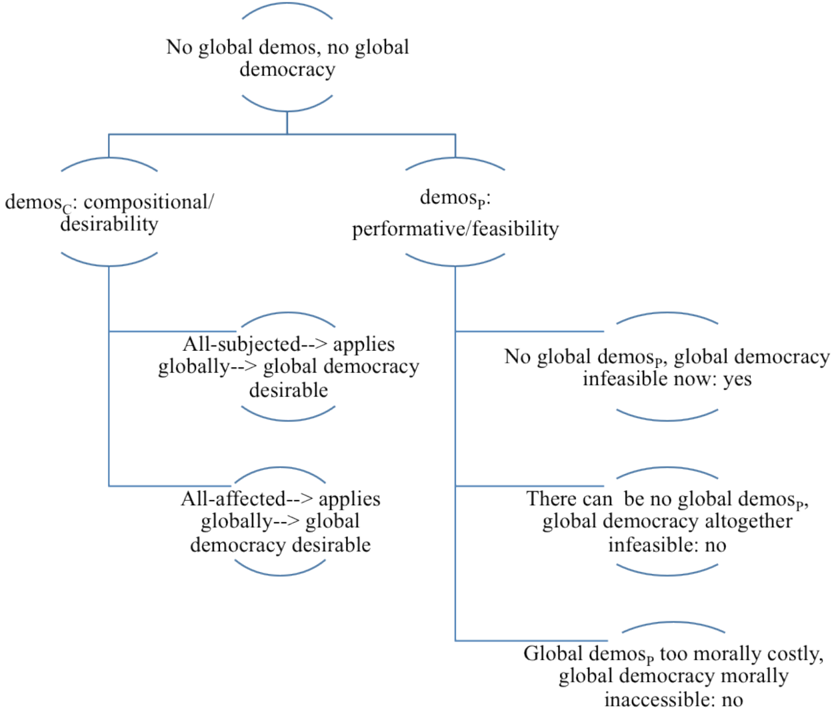
A globalized world, some argue, needs a global democracy. But there is considerable disagreement about whether global democracy is an ideal worth pursuing. One of the main grounds for scepticism is captured by the slogan: “No global demos, no global democracy.” The fact that a key precondition of democracy—a demos—is absent at the global level, some argue, speaks against the pursuit of global democracy. I discuss four interpretations of the skeptical slogan—each based on a specific account of the notion of “the demos”—and conclude that none of them establishes that the global democratic ideal must be abandoned. In so doing, I systematize different types of objections against global democracy, thus bringing some clarity to an otherwise intricate debate, and offer a robust but qualified defense of the global democratic ideal.
Verified 2026-11-22 · 6 references not checked yet
Overview
CoChat Summary
## TL;DR
Valentini argues that the slogan “No global demos, no global democracy” does not defeat the global democratic ideal: global democracy is, in her view, desirable, not shown to be infeasible in principle, and not morally inaccessible. She offers a systematization of four skeptical interpretations of the slogan and rejects each one, while also insisting that global democratization must proceed cautiously because key preconditions are presently missing.
## Key findings
- The paper examines four readings of the skeptical slogan: global democracy is (a) undesirable, (b) infeasible now, (c) altogether infeasible, or (d) morally inaccessible; Valentini concludes that none of them shows that global democracy should be abandoned.
- On the compositional view of the demos, she argues there are global issues that qualify under either the all-subjected or all-affected principle; for example, she says border control and international property are areas in which “the world’s population is entitled to participation,” and climate change and trade also generate global stakes.
- On the performative view of the demos, she argues that the lack of current global cohesion does not prove impossibility: globalization is increasing interdependence, and she treats a global demos as a long-term possibility rather than something excluded by human nature or by current trajectories.
- She says global democracy is “desirable, morally accessible, and not infeasible,” but that its pursuit should be cautious and incremental because the preconditions for successful global democracy are currently lacking.
## Methods
- Normative conceptual analysis in political theory: the paper defines democracy, distinguishes two senses of “demos” (compositional and performative), and then tests four skeptical interpretations against those definitions.
- The argument engages existing literature rather than empirical original data, drawing on debates about coercion, affected interests, solidarity, feasibility, and moral accessibility.
- Main analysis is philosophical: it reconstructs opponents’ strongest versions and then argues that each fails as a reason to abandon global democracy.
## Limitations
- Stated in the paper: Valentini says she is “in no position to assess” whether a global democracy would ultimately take the shape of a global state or a looser network of governance institutions.
- Stated in the paper: she does not positively demonstrate that global democracy will come about, or how it will come about.
- Evident from the text: the paper is a theoretical argument and does not present new empirical tests or data on whether global democracy is politically achievable.
Model-written summary. Check it against the paper before relying on it.
Integrity signals
Registry
Cites
Statistics
Figures
Verification
Claims the paper makes
0 Valid · 16 Not valid · 42 Not checked · 119 Own results and interpretations
A conclusion the paper draws from its own results — it cites no other source for it, so there is none to check. The quote shows it is in the paper.
In the paper
“most laws that typically demand democratic justification can be described as preventative.”
plain- Asserted: passes — The authors put it forward as true.
- Checkable: passes — It can be checked against evidence.
- Load-bearing: passes — The paper’s conclusions depend on it.
- Based: passes — The paper gives a reason why it holds.
In the paper
“First, it is instrumentally valuable because it ensures that social outcomes are, to the extent that this is possible, responsive to everyone's interests.”
What the sources say
- Not checked — no full text of the sourcecites [33] matched to “From Global Poverty to Global Equality: A Philosophical Exploration” (2012) source
hedgedstates a cause- Asserted: passes — The authors put it forward as true.
- Checkable: passes — It can be checked against evidence.
- Load-bearing: passes — The paper’s conclusions depend on it.
- Based: passes — The paper gives a reason why it holds.
A conclusion the paper draws from its own results — it cites no other source for it, so there is none to check. The quote shows it is in the paper.
In the paper
“thus global democratic arrangements are desirable.”
- Also stated in: § Understanding II: There is no 'global affectedness,' therefore global democracy is undesirable · plain
“hence global democracy is desirable.”
- Also stated in: § Understanding II: There is no 'global affectedness,' therefore global democracy is undesirable · plain
“therefore global democracy is desirable.”
plain- Asserted: passes — The authors put it forward as true.
- Checkable: unclear — It is unclear whether it could be checked against evidence.
- Load-bearing: passes — The paper’s conclusions depend on it.
- Based: passes — The paper gives a reason why it holds.
- Also stated in: § Understanding II: There is no 'global affectedness,' therefore global democracy is undesirable · plain
A conclusion the paper draws from its own results — it cites no other source for it, so there is none to check. The quote shows it is in the paper.
In the paper
“if we subscribe to the all-subjected principle, it follows that everyone should have a say in the decisions governing these forms of coercion.”
plainstates a cause- Asserted: passes — The authors put it forward as true.
- Checkable: unclear — It is unclear whether it could be checked against evidence.
- Load-bearing: passes — The paper’s conclusions depend on it.
- Based: passes — The paper gives a reason why it holds.
A conclusion the paper draws from its own results — it cites no other source for it, so there is none to check. The quote shows it is in the paper.
In the paper
“Even if correct, the claim that there is no cluster of decisions which affect the world's population equally does not show that there is no global demosC.”
plain- Asserted: passes — The authors put it forward as true.
- Checkable: unclear — It is unclear whether it could be checked against evidence.
- Load-bearing: passes — The paper’s conclusions depend on it.
- Based: passes — The paper gives a reason why it holds.
70 more claims
Create a free account to see all 177 claims and every source verdict.
- Probably not a substantial claim. 88
- It may state two separate claims as one. 24
Citations
Cites
Between Facts and Norms: Contributions to a Discourse Theory of Law and Democracy
Habermas, J. (1996) · The MIT Press eBooks · doi:10.7551/mitpress/1564.001.0001 · Cited by 9,998
Johnson, K., & Nozick, R. (1975) · The Western Political Quarterly · doi:10.2307/447864 · Cited by 7,692
Nozick, R. (2018) · Princeton Readings in Political Thought · doi:10.2307/j.ctv19fvzzk.69 · Cited by 6,631
Dworkin, R. M. (1986) · Medical Entomology and Zoology · Cited by 4,736
(1990) · Choice Reviews Online · doi:10.5860/choice.27-2963 · Cited by 3,601
Between facts and norms: contributions to a discourse theory of law and democracy
(1997) · Choice Reviews Online · doi:10.5860/choice.34-2995 · Cited by 3,574
Stanford encyclopedia of philosophy
(1998) · Choice Reviews Online · doi:10.5860/choice.35-4860 · Cited by 3,398
(1962) · Excellence and Leadership in a Democracy · doi:10.7312/grau91070-013 · Cited by 3,317
(2008) · Cited by 2,463
IX.—Essentially Contested Concepts
Gallie, W. B. (1956) · Proceedings of the Aristotelian Society · doi:10.1093/aristotelian/56.1.167 · Cited by 2,280
NAGEL, T. (2005) · Philosophy & Public Affairs · doi:10.1111/j.1088-4963.2005.00027.x · Cited by 2,176
The Regime Complex for Climate Change
Keohane, R. O., & Victor, D. G. (2011) · Perspectives on Politics · doi:10.1017/s1537592710004068 · Cited by 2,047
Democracy and the global order: from the modern state to cosmopolitan governance
(1996) · Choice Reviews Online · doi:10.5860/choice.33-6572 · Cited by 1,959
Essentially Contested Concepts
Gallie, W. B., & Philosophy Documentation Center (1994) · Inquiry: Critical Thinking Across the Disciplines · doi:10.5840/inquiryctnews19941415 · Cited by 1,851
National Responsibility and Global Justice
Miller, D. (2007) · Oxford University Press eBooks · doi:10.1093/acprof:oso/9780199235056.001.0001 · Cited by 1,793
Waldron, J. (1999) · Oxford University Press eBooks · doi:10.1093/acprof:oso/9780198262138.001.0001 · Cited by 1,649
Accountability and Abuses of Power in World Politics
GRANT, R. W., & KEOHANE, R. O. (2005) · American Political Science Review · doi:10.1017/s0003055405051476 · Cited by 1,620
Politics in the Vernacular: Nationalism, Multiculturalism, and Citizenship
Kymlicka, W. (2001) · doi:10.1093/0199240981.001.0001 · Cited by 1,539
1 Distributional Effects of Globalization in Developing Countries*
Koujianou, P., & Pavcnik, G. N. (2006) · Cited by 1,418
Kant, I. (1991) · Cambridge University Press eBooks · doi:10.1017/cbo9780511809620 · Cited by 1,385
List, C., & Pettit, P. (2011) · doi:10.1093/acprof:oso/9780199591565.001.0001 · Cited by 1,344
The Legitimacy of Global Governance Institutions
Buchanan, A., & Keohane, R. O. (2006) · Ethics & International Affairs · doi:10.1111/j.1747-7093.2006.00043.x · Cited by 1,240
The Law of Peoples With “The Idea of Public Reason Revisited”
Zelič, N. (2001) · Croatian Journal of Philosophy · Cited by 1,167
Enfranchising All Affected Interests, and Its Alternatives
GOODIN, R. E. (2007) · Philosophy & Public Affairs · doi:10.1111/j.1088-4963.2007.00098.x · Cited by 1,157
Sovereign virtue: the theory and practice of equality
(2000) · Choice Reviews Online · doi:10.5860/choice.38-1824 · Cited by 1,077
SIMMONS, A. J. (2010) · Philosophy & Public Affairs · doi:10.1111/j.1088-4963.2009.01172.x · Cited by 1,030
Citizenship and national identity
(2001) · Choice Reviews Online · doi:10.5860/choice.38-4134 · Cited by 1,027
Justice As Impartiality: A Treatise on Social Justice Volume II
Barry, B. (1995) · doi:10.1093/oso/9780198279136.001.0001 · Cited by 1,026
Christiano, T. (2008) · Oxford University Press eBooks · doi:10.1093/acprof:oso/9780198297475.001.0001 · Cited by 894
Why a World State is Inevitable
Wendt, A. (2003) · European Journal of International Relations · doi:10.1177/135406610394001 · Cited by 877
Does Europe Need a Constitution?
Grimm, D. (1995) · European Law Journal · doi:10.1111/j.1468-0386.1995.tb00033.x · Cited by 796
Stanford Encyclopedia of Philosophy
Ladyman, J. (2007) · Cited by 709
(1996) · Choice Reviews Online · doi:10.5860/choice.33-2992 · Cited by 662
Democratic Theory and Border Coercion: No Right to Unilaterally Control Your Own Borders
Abizadeh, A. (2008) · Political Theory · doi:10.1177/0090591707310090 · Cited by 661 · cited 21×
“73 See, e.g., Miller 2010a; Song 2012; Risse 2012, 342; see also Calhoun 2002; Scheuerman 2011, 106–121; Brown 2000.”
InfluentialTilly, C. (2007) · doi:10.1017/cbo9780511804922 · Cited by 661
Justice, Legitimacy, and Self-Determination: Moral Foundations for International Law
Buchanan, A. (2003) · doi:10.1093/0198295359.001.0001 · Cited by 657
Calhoun, C. (2002) · South Atlantic Quarterly · doi:10.1215/00382876-101-4-869 · Cited by 638
Dignity in adversity: human rights in troubled times
(2012) · Choice Reviews Online · doi:10.5860/choice.50-1130 · Cited by 586
The crisis of the European Union. A response
Habermas, J. (2012) · Publication Server of Goethe University Frankfurt am Main (Goethe University Frankfurt) · Cited by 585
Deliberative Global Politics: Discourse and Democracy in a Divided World
Dryzek, J. S. (2006) · Cited by 580
The Challenge of the All-Affected Principle
Näsström, S. (2011) · Political Studies · doi:10.1111/j.1467-9248.2010.00845.x · Cited by 563
(2002) · Philosophy and Phenomenological Research · doi:10.1111/j.1933-1592.2002.tb00157.x · Cited by 556
Distributional Effects of Globalization in Developing Countries
Goldberg, P. K., & Pavcnik, N. (2007) · Journal of Economic Literature · doi:10.1257/jel.45.1.39 · Cited by 539
Political parties and party systems
(1996) · Choice Reviews Online · doi:10.5860/choice.33-5354 · Cited by 531
Democracy across Borders: From Dêmos to Dêmoi
Bohman, J. (2007) · The MIT Press eBooks · doi:10.7551/mitpress/2327.001.0001 · Cited by 531
How Do International Institutions Matter? The Domestic Impact of International Rules and Norms
Cortell, A. P., & Davis, J. W. (1996) · International Studies Quarterly · doi:10.2307/2600887 · Cited by 530
Waldron, J. (1999) · doi:10.2307/3182603 · Cited by 504
Can international organizations be democratic? A skeptic's view
Dahl, R. A. (1999) · Democracy's Edges · doi:10.1017/cbo9780511586361.003 · Cited by 498
Political Feasibility: A Conceptual Exploration
Gilabert, P., & Lawford-Smith, H. (2012) · Political Studies · doi:10.1111/j.1467-9248.2011.00936.x · Cited by 481
Does Europe Need a Constitution? Demos, Telos and the German Maastricht Decision
Weiler, J. H. H. (1995) · European Law Journal · doi:10.1111/j.1468-0386.1995.tb00030.x · Cited by 461
Political parties and party systems
(2004) · Choice Reviews Online · doi:10.5860/choice.41-6170 · Cited by 453
Justice, legitimacy, and self-determination: moral foundations for international law
(2005) · Choice Reviews Online · doi:10.5860/choice.42-4277 · Cited by 435
The Global Commonwealth of Citizens: Toward Cosmopolitan Democracy
Archibugi, D. (2008) · Princeton University Press eBooks · doi:10.1515/9781400829767 · Cited by 410
Political equality: an essay in democratic theory
(1989) · Choice Reviews Online · doi:10.5860/choice.27-2343 · Cited by 391
Global Justice and Avant-Garde Political Agency
Ypi, L. (2011) · Oxford University Press eBooks · doi:10.1093/acprof:oso/9780199593873.001.0001 · Cited by 375
Sovereign Virtue: The Theory and Practice of Equality
DWORKIN, R. (2002) · Harvard University Press eBooks · doi:10.2307/j.ctv1c3pd0r · Cited by 359
Owen, D. (2012) · Ethics & Global Politics · doi:10.3402/egp.v5i3.18617 · Cited by 358
The global commonwealth of citizens: toward cosmopolitan democracy
(2009) · Choice Reviews Online · doi:10.5860/choice.46-7072 · Cited by 352
After the revolution?: authority in a good society
(1991) · Choice Reviews Online · doi:10.5860/choice.28-6480 · Cited by 332
The boundary problem in democratic theory: why the demos should be bounded by the state
Song, S. (2012) · International Theory · doi:10.1017/s1752971911000248 · Cited by 329 · cited 21×
“73 See, e.g., Miller 2010a; Song 2012; Risse 2012, 342; see also Calhoun 2002; Scheuerman 2011, 106–121; Brown 2000.”
BackgroundInfluentialBounding Power: Republican Security Theory from the Polis to the Global Village
Kupchan, C. A. (2007) · Perspectives on Politics · doi:10.1017/s1537592707072660 · Cited by 307
Habermas, J., & Cronin, C. (2006) · Virtual Defense Library (Ministerio de Defensa) · Cited by 305
The Global Order: A Case of Background Injustice? A Practice‐Dependent Account
RONZONI, M. (2009) · Philosophy & Public Affairs · doi:10.1111/j.1088-4963.2009.01159.x · Cited by 300
Bounding power: republican security theory from the polis to the global village
(2007) · Choice Reviews Online · doi:10.5860/choice.44-6487 · Cited by 298
Cosmopolitan Ideals and National Sentiment
Beitz, C. R. (1983) · The Journal of Philosophy · doi:10.2307/2026155 · Cited by 296
Global democracy: normative and empirical perspectives
Archibugi, D., Koenig‐Archibugi, M., & Marchetti, R. (2011) · Cited by 293
Miller, D. (2009) · Philosophy & Public Affairs · doi:10.1111/j.1088-4963.2009.01158.x · Cited by 284
On the Demos and Its Kin: Nationalism, Democracy, and the Boundary Problem
ABIZADEH, A. (2012) · American Political Science Review · doi:10.1017/s0003055412000421 · Cited by 279
Brighouse, H., & Fleurbaey, M. (2010) · Journal of Political Philosophy · doi:10.1111/j.1467-9760.2008.00316.x · Cited by 269
Cosmopolitan Democracy and its Critics: A Review
Archibugi, D. (2004) · European Journal of International Relations · doi:10.1177/1354066104045543 · Cited by 269
Does Collective Identity Presuppose an Other? On the Alleged Incoherence of Global Solidarity
ABIZADEH, A. (2005) · American Political Science Review · doi:10.1017/s0003055405051488 · Cited by 266
Dryzek, J. S. (1999) · Journal of Political Philosophy · doi:10.1111/1467-9760.00064 · Cited by 241
Why Immigration Controls Are Not Coercive: A Reply to Arash Abizadeh
Miller, D. (2010) · Political Theory · doi:10.1177/0090591709348194 · Cited by 230
Understanding Political Feasibility*
LAWFORD‐SMITH, H. (2013) · Journal of Political Philosophy · doi:10.1111/j.1467-9760.2012.00422.x · Cited by 229
Global Stakeholder Democracy: Power and Representation Beyond Liberal States
Macdonald, T. (2008) · doi:10.1093/acprof:oso/9780199235001.001.0001 · Cited by 202
Does Diversity Hurt Democracy?
Fish, M. S. (. S., & Brooks, R. S. (2004) · Journal of Democracy · doi:10.1353/jod.2004.0009 · Cited by 196
Justice, Disagreement and Democracy
Valentini, L. (2013) · British Journal of Political Science · doi:10.1017/s0007123412000294 · Cited by 191
Self-citationThe Consequences of Economic Globalization for Affluent Democracies
Brady, D., Beckfield, J., & Zhao, W. (2007) · Annual Review of Sociology · doi:10.1146/annurev.soc.33.040406.131636 · Cited by 185
Democracy is not intrinsically just
Arneson, R. J. (2004) · Justice and Democracy · doi:10.1017/cbo9780511490217.003 · Cited by 180
On Partisan Political Justification
WHITE, J., & YPI, L. (2011) · American Political Science Review · doi:10.1017/s0003055411000074 · Cited by 175
On the Creation of a Global Peoples Assembly: Legitimacy and the Power of Popular Sovereignty
Strauss, A. L., & Falk, R. (2000) · Stanford journal of international law · Cited by 174
A Democratic Theory of Territory and Some Puzzles about Global Democracy
Christiano, T. (2006) · Journal of Social Philosophy · doi:10.1111/j.1467-9833.2006.00304.x · Cited by 172
Must Pluri-national Federations Fail?
McGarry, J., & O'Leary, B. (2009) · Ethnopolitics · doi:10.1080/17449050902738838 · Cited by 171
Koenig‐Archibugi, M. (2010) · European Journal of International Relations · doi:10.1177/1354066110366056 · Cited by 167
Global Stakeholder Democracy: Power and Representation Beyond Liberal States
Macdonald, T. (2008) · Cited by 164
Risse, M. (2012) · Cited by 149
Democratic Legitimacy and State Coercion: A Reply to David Miller
Abizadeh, A. (2010) · Political Theory · doi:10.1177/0090591709348192 · Cited by 149
Economic Globalization and the Environment
Gallagher, K. P. (2009) · Annual Review of Environment and Resources · doi:10.1146/annurev.environ.33.021407.092325 · Cited by 149
From Global Poverty to Global Equality: A Philosophical Exploration
Gilabert, P. (2012) · doi:10.1093/acprof:oso/9780199639717.001.0001 · Cited by 145 · cited 1×
“22 Gilabert 2011; Lawford-Smith 2013.”
The Crisis of the European Union. A Response
Gül, D. (2013) · Journal of Contemporary European Studies · doi:10.1080/14782804.2013.823688 · Cited by 143
Шапиро, Я., & Hacker-Cordón, C. (2008) · Cited by 141
Global democracy: in the beginning
Goodin, R. E. (2010) · International Theory · doi:10.1017/s1752971910000060 · Cited by 138
Accountability in World Politics1
Keohane, R. O. (2006) · Scandinavian Political Studies · doi:10.1111/j.1467-9477.2006.00143.x · Cited by 135
Cosmopolitan Democracy: Paths and Agents
Archibugi, D., & Held, D. (2011) · Ethics & International Affairs · doi:10.1017/s0892679411000360 · Cited by 132
Can There Be a Global Demos? An Agency-Based Approach
List, C., & Koenig‐Archibugi, M. (2010) · Philosophy & Public Affairs · doi:10.1111/j.1088-4963.2009.01174.x · Cited by 131
The Realist Case for Global Reform
Reid, J. M. (2012) · Australian Journal Of International Affairs · doi:10.1080/10357718.2012.642714 · Cited by 128
Democracy and noncitizen voting rights
Song, S. Y. (2009) · Citizenship Studies · doi:10.1080/13621020903309607 · Cited by 117
Global Democracy: For and Against
Marchetti, R. (2008) · Routledge eBooks · doi:10.4324/9780203928806 · Cited by 114
Beckman, L. (2009) · doi:10.1057/9780230244962 · Cited by 110
Cosmopolitanism, world citizenship and global civil society
Brown, C. (2000) · Critical Review of International Social and Political Philosophy · doi:10.1080/13698230008403300 · Cited by 108
Tax Competition and Inequality: The Case for Global Tax Governance
Rixen, T. (2011) · Global Governance A Review of Multilateralism and International Organizations · doi:10.1163/19426720-01704004 · Cited by 108
Authority and democracy: a general theory of government and management
(1995) · Choice Reviews Online · doi:10.5860/choice.32-4587 · Cited by 103
(2016) · Routledge eBooks · doi:10.4324/9781315023595 · Cited by 97
How Domestic Is Domestic Politics? Globalization and Elections
Kayser, M. A. (2007) · Annual Review of Political Science · doi:10.1146/annurev.polisci.10.080605.135728 · Cited by 97
The Feasibility Condition in Political Theory
Räikkä, J. (1998) · Journal of Political Philosophy · doi:10.1111/1467-9760.00044 · Cited by 97 · cited 1×
“29 Räikkä 1998.”
Cosmopolitan Democracy: Paths and Agents
Archibugi, D., & Held, D. (2011) · Palgrave Macmillan UK eBooks · doi:10.1057/9780230357075_2 · Cited by 95
Varieties of Sovereignty and Citizenship
Ben‐Porath, S., & Smith, R. M. (2013) · University of Pennsylvania Press eBooks · doi:10.9783/9780812207484 · Cited by 94
The Resurgent Idea of World Government
Craig, C. (2008) · Ethics & International Affairs · doi:10.1111/j.1747-7093.2008.00139.x · Cited by 85
Global Democracy: Normative and Empirical Perspectives
Marchetti, R., Falk, R., Frey, B., Archibugi, D., Koenig Archibugi, M., & Marchetti, R. (2011) · Cambridge University Press eBooks · doi:10.1017/cbo9780511977992 · Cited by 85
Debate: Feasibility and Socialism*
Gilabert, P. (2010) · Journal of Political Philosophy · doi:10.1111/j.1467-9760.2010.00383.x · Cited by 80
The Frontiers of Democracy: The Right to Vote and its Limits
Beckman, L. (2009) · Medical Entomology and Zoology · Cited by 80
Authority and Democracy: A General Theory of Government and Management, by Christopher McMahon
Knott, J. H. (1995) · Political Science Quarterly · doi:10.2307/2151915 · Cited by 79
Caney, S., & Department of Philosophy, F. S. U. (2006) · Social Theory and Practice · doi:10.5840/soctheorpract200632437 · Cited by 75 · cited 19×
“73 See, e.g., Miller 2010a; Song 2012; Risse 2012, 342; see also Calhoun 2002; Scheuerman 2011, 106–121; Brown 2000.”
InfluentialThe Blackwell Guide to Kant's Ethics
Hill, T. E. (2009) · Wiley eBooks · doi:10.1002/9781444308488 · Cited by 72
The realist case for global reform
(2011) · Choice Reviews Online · doi:10.5860/choice.49-1728 · Cited by 72
Democracy Unbound: Basic Explorations I
Tersman, F. (2005) · Cited by 72
Dupuy, P. (2005) · European Journal of International Law · doi:10.1093/ejil/chi107 · Cited by 71
The Legitimacy of Global Governance Institutions
Buchanan, A. E., & Keohane, R. O. (2008) · Springer eBooks · doi:10.1007/978-3-540-77764-9_2 · Cited by 68
Civil society and global democracy: An assessment
Tallberg, J., & Uhlin, A. (2011) · Cambridge University Press eBooks · doi:10.1017/cbo9780511977992.011 · Cited by 65
Global Democracy: For and Against. Ethical Theory, Institutional Design, and Social Struggles
Marchetti, R. (2008) · Cited by 63
Tax Competition and Inequality: The Case for Global Tax Governance
Rixen, T. (2011) · doi:10.2139/ssrn.1488066 · Cited by 63
Global Democratization: Soup, Society, or System?
Dryzek, J. S. (2011) · Ethics & International Affairs · doi:10.1017/s0892679411000074 · Cited by 62
Miller, D. E. (1999) · Palgrave Macmillan UK eBooks · doi:10.1007/978-1-349-14623-9_3 · Cited by 62
Towards global political parties
Patomäki, H. (2011) · Ethics & Global Politics · doi:10.3402/egp.v4i2.7334 · Cited by 50
Coercion, Inequality and the International Property Regime*
Cavallero, E. (2009) · Journal of Political Philosophy · doi:10.1111/j.1467-9760.2009.00343.x · Cited by 50
A Philosophical Argument for a Bill of Rights
Fabre, C. (2000) · British Journal of Political Science · doi:10.1017/s0007123400000041 · Cited by 34
Citizens or stakeholders? Exclusion, equality and legitimacy in global stakeholder democracy
Macdonald, T. (2011) · Cambridge University Press eBooks · doi:10.1017/cbo9780511977992.003 · Cited by 34
Wendt’s Violation of the Constructivist Project: Agency and Why a World State is Not Inevitable
Shannon, V. P. (2005) · European Journal of International Relations · doi:10.1177/1354066105057903 · Cited by 31
From Global Poverty to Global Equality: A Philosophical Exploration
Gilabert, P. (2012) · Cited by 30
Civil Society and Global Democracy: An AssessmentPreprint
Tallberg, J., & Uhlin, A. (2011) · SSRN Electronic Journal · Cited by 30
THE EU: THE COMMUNITARIAN DEFICIT
Etzioni, A. (2013) · European Societies · doi:10.1080/14616696.2013.787436 · Cited by 29
Realising cosmopolitanism : the role of a world state
Ulaş, L. (2013) · London School of Economics and Political Science Theses Online (London School of Economics and Political Science) · Cited by 28
Global Democracy: Notes on contributors
Archibugi, D., Koenig‐Archibugi, M., & Marchetti, R. (2011) · Cited by 26
Risse, M. (2012) · Princeton University Press eBooks · doi:10.23943/princeton/9780691142692.001.0001 · Cited by 26
Dowding, K. M., Goodin, R. E., & Pateman, C. (2004) · Cited by 24
Chapter 8. World Government Is Here!
Goodin, R. E. (2013) · University of Pennsylvania Press eBooks · doi:10.9783/9780812207484.149 · Cited by 24
Kant's Vision of a Just World Order
Pogge, T. W. (2009) · doi:10.1002/9781444308488.ch9 · Cited by 23
Global democracy and domestic analogies
Koenig‐Archibugi, M. (2011) · Cambridge University Press eBooks · doi:10.1017/cbo9780511977992.009 · Cited by 20
Boundaries beyond borders: Delineating democratic 'peoples' in a globalizing world
Macdonald, T. (2003) · Democratization · doi:10.1080/13510340312331293977 · Cited by 19
Motivating Cosmopolitanism? A Skeptical View
Lenard, P. T. (2010) · Journal of Moral Philosophy · doi:10.1163/174552410x511437 · Cited by 17
Introduction: Mapping Global Democracy
Archibugi, D., Koenig‐Archibugi, M., & Marchetti, R. (2011) · BIROn (Birkbeck, University of London) · Cited by 14
Nagel, T. (2005) · Philosophy & Public Affairs · doi:10.1111/papa.2005.33.issue-2 · Cited by 13
Democratizing the World Trade Organization
McGillivray, F. (2000) · Cited by 12
Cosmopolitan Democracy: Neither a Category Mistake Nor a Categorical ImperativePreprint
Føllesdal, A. (2011) · SSRN Electronic Journal · Cited by 10
Alternative accountability after the ‘naughts’
Steele, B. J. (2011) · Review of International Studies · doi:10.1017/s0260210510001671 · Cited by 9
(2014) · Palgrave Macmillan eBooks · doi:10.1057/9781137475084.0006 · Cited by 7
Authority and democracy: A general theory of government and management
McMahon, C. (1995) · Long Range Planning · doi:10.1016/0024-6301(95)90294-5 · Cited by 6
The Coming of Age of Global Democracy?
Tinnevelt, R., & Geenens, R. (2008) · Ethical Perspectives · doi:10.2143/ep.15.4.2034390 · Cited by 3
Ten Normative Theses on the European Union
Ferry, J.-M. (2008) · Ethical Perspectives · doi:10.2143/ep.15.4.2034395 · Cited by 2
Benhabib, S. (2012) · International Journal of Constitutional Law · doi:10.1093/icon/mor069
Cosmopolitan Democracy: Paths and Agents
Archibugi, D., & Held, D. (2011) · doi:10.2139/ssrn.1758725
Barry, B. (1995) · Justice As Impartiality · doi:10.1093/oso/9780198279136.003.0003
The Resurgent Idea of World Government
Craig, C. (n.d.) · World Governance: Do We Need It, Is It Possible, What Could It (All) Mean? · doi:10.5848/csp.2302.00005
Activist Political Theory and Avant-Garde Agency
Ypi, L. (2011) · Global Justice and Avant-Garde Political Agency · doi:10.1093/acprof:oso/9780199593873.003.0003
Is democratic legitimacy possible for international institutions?
Christiano, T. (2011) · Global Democracy · doi:10.1017/cbo9780511977992.004
Miller, D. (n.d.) · Routledge Encyclopedia of Philosophy · doi:10.4324/9780415249126-s039-2
Political Equality: An Essay in Democratic Theory
Beitz, C. R. (1990) · doi:10.1515/9780691221410
Research works printed but not linked: 4
- Whelan, Frederick. 1983. 'Prologue: Democratic Theory and the Boundary Problem.' In Liberal Democracy: Nomos XXV , edited by J.R. Pennock and J.W. Chapman. New York: New York University Press.
- ---. 2010a. 'Against Global Democracy.' In After the Nation: Critical Reflections on Post-Nationalism , edited by Kaith Breen and Shane O'Neill, 141-60. Basingstoke: Palgrave Macmillan.
- Rawls, John. 1996. Political Liberalism . New York: Columbia University Press.
- Archibugi, Daniele, Mathias Koenig-Archibugi, and Raffaele Marchetti. 2011a. Global Democracy: Normative and Empirical Perspectives . Cambridge: Cambridge University Press. · DOI
Cited by
A Republican Europe of States: Cosmopolitanism, Intergovernmentalism and Democracy in the EU
Bellamy, R. (2019) · Cambridge University Press eBooks · doi:10.1017/9781139136303 · Cited by 173
Human Dignity and Human Rights
Gilabert, P. (2018) · doi:10.1093/oso/9780198827221.001.0001 · Cited by 163
A Republican Europe of States: Cosmopolitanism, Intergovernmentalism and Democracy in the EU
Bellamy, R. (2019) · Cited by 137
Wolkenstein, F. (2019) · doi:10.1093/oso/9780198849940.001.0001 · Cited by 118
Demoicracy, Transnational Partisanship and the EU
Wolkenstein, F. (2017) · JCMS Journal of Common Market Studies · doi:10.1111/jcms.12590 · Cited by 104
Metadata
- Authors
- Valentini, L.
- Affiliations
- Uppsala University (SE)
- Corresponding author
- Valentini, Laura
- ORCID
- Valentini, Laura
- Venue
- Perspectives on Politics
- Publisher
- Cambridge University Press (CUP)
- Published
- 2014-12
- Volume
- 12
- Issue
- 4
- Pages
- 789-807
- ISSN
- 1537-5927 (ISSN-L)
- 1541-0986
- OpenAlex
- W2110386669
- Semantic Scholar
- 0d524a639e0369417639a551884abf08fae9c684
- Cited by
- 178
- References
- 144
- Citations by year
- 2026: 2 · 2025: 17 · 2024: 30 · 2023: 5 · 2022: 7 · 2021: 29 · 2020: 30 · 2019: 31 · 2018: 18 · 2017: 4 · 2016: 3 · 2015: 1
- FWCI
- 17.39
- Type
- journal article
- Language
- en
- Open access
- bronze
- doi.org
- Locations
- Perspectives on Politics (publishedVersion)
- London School of Economics and Political Science Research Online (London School of Economics and Political Science) (submittedVersion)
- PhilPapers (PhilPapers Foundation) (submittedVersion)
- Research Portal (King's College London) (submittedVersion)
- Topics
- Social Sciences › Political Science and International Relations › Political Theory and Democracy
- Social Sciences › Political Science and International Relations › Political Philosophy and Ethics
- Social Sciences › Political Science and International Relations › Globalization and political ideologies
- Keywords
- global democracy, global governance, democratic legitimacy
About these checks
Registry, retraction, Cites and statistics results are computed, not judged, with one exception: a printed reference that no index lists is read once by a model before it counts as a citation error. Claims are extracted by a model and kept only when their quote appears verbatim in the text; each cited source is then checked, with a model’s help, for whether it says what the claim relies on. Those verdicts can be wrong — read the claim’s quote and the cited source before relying on one.
The claim verdicts this report counts are experimental: their accuracy is not yet measured.
A language model drew the claims from the paper on 2026-10-11, under version 3 of the claim definition (model deepseek-v4.1-flash, prompt extract-v3).
A second model labelled each claim on 2026-10-11 (model jev-1.13-20260917, definition revision gold-guideline-v0.2).
Statistics and arithmetic are recomputed, not judged.
Confidence bands are shown only for fields calibrated on our annotated test set. None is calibrated yet, so no band is shown.
What counts as a claim ›How we measure confidence ›How we check this ›
Are you an author, or do you see a problem with this page? Request a review
Data sources
Bibliographic data: Semantic Scholar, OpenAlex, Crossref.
Contains information from the Semantic Scholar Academic Graph Datasets, made available under the ODC Attribution License (ODC-BY 1.0).
Semantic Scholar’s data is described in: Kinney, R., et al. (2023). The Semantic Scholar Open Data Platform. arXiv:2301.10140.
