

What level of domestic government health expenditure should we aspire to for universal health coverage?
Open accessThe DOI matches its Crossref record; 18 of the 18 references it cites were found in a registry or an index.
Abstract
Global discussions on universal health coverage (UHC) have focussed attention on the need for increased government funding for health care in many low- and middle-income countries. The objective of this paper is to explore potential targets for government spending on health to progress towards UHC. An explicit target for government expenditure on health care relative to gross domestic product (GDP) is a potentially powerful tool for holding governments to account in progressing to UHC, particularly in the context of UHC’s inclusion in the Sustainable Development Goals. It is likely to be more influential than the Abuja target, which requires decreases in budget allocations to other sectors and is opposed by finance ministries for undermining their autonomy in making sectoral budget allocation decisions. International Monetary Fund and World Health Organisation data sets were used to analyse the relationship between government health expenditure and proxy indicators for the UHC goals of financial protection and access to quality health care, and triangulated with available country case studies estimating the resource requirements for a universal health system. Our analyses point towards a target of government spending on health of at least 5% of GDP for progressing towards UHC. This can be supplemented by a per capita target of $86 to promote universal access to primary care services in low-income countries.
Overview
The claims and statistics of this paper haven’t been checked yet.
Free: it reads the open-access text and checks the first 5 claims that cite a source we can check. Create a free account to check every claim.
Integrity signals
Registry
Cites
Statistics
Figures
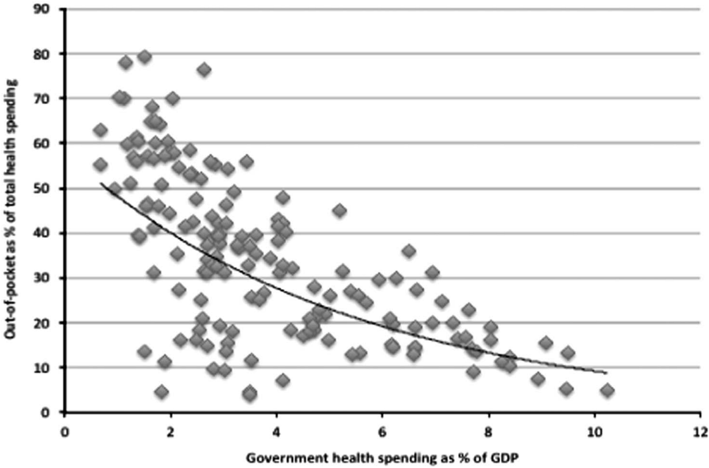
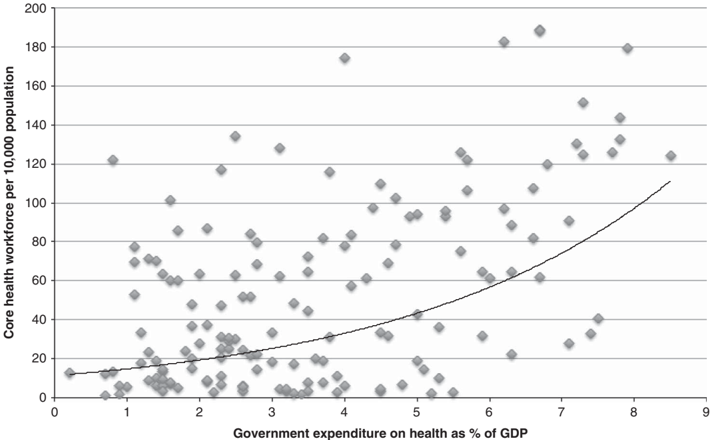
Verification
Claims the paper makes
The claims and statistics of this paper haven’t been checked yet.
Free: it reads the open-access text and checks the first 5 claims that cite a source we can check. Create a free account to check every claim.
Claims other papers make about this one
Each is checked against this paper’s own text: does it say what the citing paper says it does?
In the citing paper
“This is consistent with previous studies that estimated that lower-resource countries would need to spend about 5% of GDP on healthcare to make sufficient progress towards UHC.140”
From Global health 2050: the path to halving premature death by mid-century (2024) · cites this paper as [140]
Self-check
Percentages, sums and reported differences re-computed from the paper’s own numbers.
The self-check needs the paper’s full text.
Citations
Cites
Household catastrophic health expenditure: a multicountry analysis
Xu, K., Evans, D. B., Kawabata, K., Zeramdini, R., Klavus, J., & Murray, C. J. (2003) · The Lancet · doi:10.1016/s0140-6736(03)13861-5 · Cited by 2,309 · cited 1×
“Reducing the reliance on OOP payments for health care is important for financial protection, as demonstrated by Xu et al. (2003) in their study of 59 countries: ‘A 1% increase in the proportion of total health expenditure provided by out-of-pocket payments is associated with an average increase in…”
BackgroundMacroeconomics and health: investing in health for economic development
Sachs, J. D. (2002) · Revista Panamericana de Salud Pública · doi:10.1590/s1020-49892002000800017 · Cited by 1,830
Macroeconomics and Health: Investing in Health for Economic Development
Ivinson, A. J. (2002) · Nature Medicine · doi:10.1038/nm0602-551b · Cited by 436
Reeves, A., Gourtsoyannis, Y., Basu, S., McCoy, D., McKee, M., & Stuckler, D. (2015) · The Lancet · doi:10.1016/s0140-6736(15)60574-8 · Cited by 280
Broader Health Coverage is Good for the Nation’s Health: Evidence from Country Level Panel Data
Moreno-Serra, R., & Smith, P. C. (2015) · Journal of the Royal Statistical Society Series A: Statistics in Society · doi:10.1111/rssa.12048 · Cited by 238 · cited 1×
“…large cross-national panel data sets, confirms the importance of increased levels of public funding of health services (particularly increased tax funding) in improving countries’ health status, the ultimate goal of universal coverage reforms (Moreno-Serra and Smith, 2015; Reeves et al., 2015).”
BackgroundFiscal space for domestic funding of health and other social services
Meheus, F., & McIntyre, D. (2017) · Health Economics, Policy and Law · doi:10.1017/s1744133116000438 · Cited by 172 · cited 3×
“…resource mobilisation and spending on the full range of human rights and social determinants of health in situations where governments are not presently providing ‘maximum available resources’ (see Meheus and McIntyre, 2017 for discussion of how government resource mobilisation can be improved).”
BackgroundSelf-citationMonitoring Intervention Coverage in the Context of Universal Health Coverage
Boerma, T., AbouZahr, C., Evans, D., & Evans, T. (2014) · PLoS Medicine · doi:10.1371/journal.pmed.1001728 · Cited by 116
Does Funding From Donors Displace Government Spending For Health In Developing Countries?
Farag, M., Nandakumar, A. K., Wallack, S. S., Gaumer, G., & Hodgkin, D. (2009) · Health Affairs · doi:10.1377/hlthaff.28.4.1045 · Cited by 114
What Should A Country Spend On Health Care?
Savedoff, W. D. (2007) · Health Affairs · doi:10.1377/hlthaff.26.4.962 · Cited by 72
Health in fragile states. Country case study: Democratic Republic of the Congo.
Waldman, R. J., Newbrander, W., Hsiao, W. C., Savedoff, W. D., Staveteig, S. E., Avogo, W. A., Agadjanian, Akresh, R., Verwimp, P., Bundervoet, T., et al. (2006) · Health Affairs · Cited by 54
Research works printed but not linked: 10
- 2012, World Economic Outlook, October 2012
- Mathauer, I., L. Musango, G. Carrin and K. Mthethwa (2008), Feasibility Assessment and Financial Projection Results for a Social Health Insurance Scheme in Swaziland: Exploring Possible Options, Geneva: World Health Organization.
- Balakrishnan, R., D. Elson, J. Heintz and N. Lusiani (2011), Maximum Available Resources and Human Rights, NJ: Center for Women's Global Leadership, Rutgers, New Brunswick, NJ.
- Taskforce on Innovative International Financing for Health Systems (2009), More Money for Health, and More Health for the Money: Report of the Taskforce, Geneva: International Health Partnership.
- Njora, G. (2010), 'African finance ministers dismiss development declarations'. FAHAMU, http://pambazuka.org/en/category/comment/63894 [25 May 2010]. Organisation of African Unity (2001), Abuja Declaration on HIV/AIDS, Tuberculosis and Other Related Infectious Diseases, Addis Ababa: Organisation of African Unity.
- United Nations (UN) (2015), Report of the Third International Conference on Financing for Development, New York: United Nations.
- World Health Organisation (WHO) (2011), World Health Statistics, 2011, Geneva: World Health Organisation.
- World Health Organisation (WHO) (2012), Measuring Service Availability and Readiness: A Health Facility Assessment Methodology for Monitoring Health System Strengthening. Service Availability Indicators, Geneva: WHO.
- Mathauer, I., O. Doetinchem, J. Kirigia and G. Carrin (2007), Feasibility Assessment and Financial Projection Results for a Social Health Insurance Scheme in Lesotho: Exploring Possible Options, Geneva: World Health Organization.
- UN System Task Team on the Post-2015 UN Development Agenda (2012), Realizing the Future we Want for All: Report to the Secretary-General, New York: United Nations.
Cited by
Bello, A. K., Okpechi, I. G., Levin, A., Ye, F., Damster, S., Arruebo, S., Donner, J.-A., Caskey, F. J., Cho, Y., Davids, M. R., et al. (2024) · The Lancet Global Health · doi:10.1016/s2214-109x(23)00570-3 · Cited by 522
Gender equality in science, medicine, and global health: where are we at and why does it matter?
Shannon, G., Jansen, M., Williams, K., Cáceres, C., Motta, A., Odhiambo, A., Eleveld, A., & Mannell, J. (2019) · The Lancet · doi:10.1016/s0140-6736(18)33135-0 · Cited by 534
Bukhman, G., Mocumbi, A. O., Atun, R., Becker, A. E., Bhutta, Z., Binagwaho, A., Clinton, C., Coates, M. M., Dain, K., Ezzati, M., et al. (2020) · The Lancet · doi:10.1016/s0140-6736(20)31907-3 · Cited by 285
Financial protection analysis in eight countries in the WHO South-East Asia Region
Wang, H., Torres, L. V., & Travis, P. (2018) · Bulletin of the World Health Organization · doi:10.2471/blt.18.209858 · Cited by 261
Health financing for universal health coverage in Sub-Saharan Africa: a systematic review
Ifeagwu, S. C., Yang, J. C., Parkes-Ratanshi, R., & Brayne, C. (2021) · Global Health Research and Policy · doi:10.1186/s41256-021-00190-7 · Cited by 179
Fiscal space for domestic funding of health and other social services
Meheus, F., & McIntyre, D. (2017) · Health Economics, Policy and Law · doi:10.1017/s1744133116000438 · Cited by 172
“In another paper in this special issue, McIntyre et al. (2017) argued that it would be more appropriate to express government spending on health relative to GDP rather than general government expenditure.”
BackgroundSelf-citationGlobal health 2050: the path to halving premature death by mid-century
Jamison, D. T., Summers, L. H., Chang, A. Y., Karlsson, O., Mao, W., Norheim, O. F., Ogbuoji, O., Schäferhoff, M., Watkins, D., Adeyi, O., et al. (2024) · The Lancet · doi:10.1016/s0140-6736(24)01439-9 · Cited by 125
Measuring progress towards Sustainable Development Goal 3.8 on universal health coverage in Kenya
Barasa, E., Nguhiu, P. K., & McIntyre, D. (2018) · BMJ Global Health · doi:10.1136/bmjgh-2018-000904 · Cited by 151
“Conclusion Significant gaps exist in Kenya’s quest to achieve UHC.”
BackgroundInfluentialSelf-citationUniversal Health Coverage and Essential Packages of Care
Watkins, D. A., Jamison, D. T., Mills, A., Atun, R., Danforth, K., Glassman, A., Horton, S., Jha, P., Kruk, M. E., Norheim, O. F., et al. (2017) · Disease Control Priorities, Third Edition (Volume 9): Improving Health and Reducing Poverty · doi:10.1596/978-1-4648-0527-1_ch3 · Cited by 101
A Thousand Cuts: Social Protection in the Age of Austerity
Kentikelenis, A., & Stubbs, T. (2023) · doi:10.1093/oso/9780190637736.001.0001 · Cited by 94
Adebisi, Y. A., Umah, J. O., Olaoye, O. C., Alaran, A. J., Sina-Odunsi, A. B., & Lucero‐Prisno, D. E. (2020) · International journal of health and life sciences · doi:10.5812/ijhls.102552 · Cited by 90
“1 percent amounting to just US$ 11 per capita - well below regional and lower middle-income averages and the recommended US$ 86 per capita low- and middle-income country benchmark needed to deliver a limited set of key health services (3, 23).”
BackgroundInfluentialAdhikari, B., Mishra, S. R., & Schwarz, R. K. (2022) · Globalization and Health · doi:10.1186/s12992-022-00798-5 · Cited by 109
Toward a New Common Sense: The Need for New Paradigms of Global Health Beyond the COVID-19 Emergency
Bakker, I., Gill, S. R., & Wamsley, D. (2021) · Cambridge University Press eBooks · doi:10.1017/9781108692137.040 · Cited by 83
Trends and drivers of government health spending in sub-Saharan Africa, 1995–2015
Micah, A. E., Chen, C. S., Zlavog, B. S., Hashimi, G., Chapin, A., & Dieleman, J. L. (2019) · BMJ Global Health · doi:10.1136/bmjgh-2018-001159 · Cited by 88
“Mcintyre et al 38 have suggested that in order for countries to make good progress towards providing universal health coverage BMJ Global Health for all, countries must spend 5% of their GDP.”
Management of human resources for health: implications for health systems efficiency in Kenya
Nyawira, L., Tsofa, B., Musiega, A., Munywoki, J., Njuguna, R. G., Hanson, K., Mulwa, A., Molyneux, S. C., Maina, I., Normand, C. E. M., et al. (2022) · BMC Health Services Research · doi:10.1186/s12913-022-08432-1 · Cited by 77
Wolff, J. (2011) · Cambridge University Press eBooks · doi:10.1017/9781108692137.008 · Cited by 78
Landscape of tobacco control in sub-Saharan Africa
Egbe, C. O., Magati, P., Wanyonyi, E., Sessou, L., Owusu‐Dabo, E., & Ayo-Yusuf, O. A. (2022) · Tobacco Control · doi:10.1136/tobaccocontrol-2021-056540 · Cited by 77
Erondu, N. A., Martin, J. L., Marten, R., Ooms, G., Yates, R., & Heymann, D. L. (2018) · The Lancet · doi:10.1016/s0140-6736(18)32332-8 · Cited by 80
Inter-Philosophies Dialogue: Creating a Paradigm for Global Health Ethics
Benatar, S. R., Daibes, I., & Tomsons, S. (2016) · Kennedy Institute of Ethics journal · doi:10.1353/ken.2016.0027 · Cited by 69
Financing health system elements in Africa: A scoping review
Karamagi, H. C., Njuguna, D., Kidane, S. N., Djossou, H., Kipruto, H., Seydi, A. B.-W., Nabyonga‐Orem, J., Muhongerwa, D. K., Frimpong, K. A., & Nganda, B. (2023) · PLoS ONE · doi:10.1371/journal.pone.0291371 · Cited by 72
Onarheim, K. H., Sisay, M. M., Gizaw, M., Moland, K. M., Norheim, O. F., & Miljeteig, I. (2018) · BMC Health Services Research · doi:10.1186/s12913-018-2943-y · Cited by 56
“In 2014, the health expenditure per capita was $27, which is substantially lower than what is recommended to uphold access to primary care services in lowincome countries ($86) [14, 15].”
BackgroundArhin, K., Oteng-Abayie, E. F., & Novignon, J. (2023) · Health Economics Review · doi:10.1186/s13561-023-00433-y · Cited by 62
“[77] and the Abuja Declaration (OAU, 2001) that call for an increase in government funding for healthcare to accelerate progress towards the UHC goal.”
BackgroundWatkins, D. A., Qi, J., Kawakatsu, Y., Pickersgill, S. J., Horton, S. E., & Jamison, D. T. (2020) · The Lancet Global Health · doi:10.1016/s2214-109x(20)30121-2 · Cited by 46
“20 McIntyre and colleagues, 21 drawing on cost estimates from the WHO Commission, estimated that the minimum required expenditure on UHC in LICs would be US$86 per capita (in 2012 US dollars) annually, although they argued that 5% of gross domestic product would be a more appropriate target in…”
BackgroundChallenges in healthcare financing for surgery in Sub-Saharan Africa
Okoroh, J. S., & Riviello, R. R. (2021) · Pan African Medical Journal · doi:10.11604/pamj.2021.38.198.27115 · Cited by 53
“Yet, many countries in SSA still invest less than 2% of their GDP on health care [35-37].”
BackgroundOkonji, O. C., Okonji, E. F., Mohanan, P., Babar, M. S., Saleem, A., Khawaja, U. A., Essar, M. Y., & Hasan, M. M. (2021) · Clinical Epidemiology and Global Health · doi:10.1016/j.cegh.2021.100920 · Cited by 50
Dhirar, N., Dudeja, S., Khandekar, J., & Bachani, D. (2018) · Indian Pediatrics · doi:10.1007/s13312-018-1276-6 · Cited by 48
“Global evidence states that, unless a country expends at least 5% of its GDP on health with Government expenditure contributing to a major part, fundamental healthcare needs are hard to meet [23,24].”
BackgroundFerraz, D. E., Mariano, E. B., Rebelatto, D. A. D. N., & Hartmann, D. (2019) · Social Indicators Research · doi:10.1007/s11205-020-02338-3 · Cited by 52
Maternal mortality ratio in China from 1990 to 2019: trends, causes and correlations
Chen, L., Feng, P., Shaver, L. G., & Wang, Z. (2021) · BMC Public Health · doi:10.1186/s12889-021-11557-3 · Cited by 49
Pourmohammadi, K., Shojaei, P., Rahimi, H., & Bastani, P. (2018) · Cost Effectiveness and Resource Allocation · doi:10.1186/s12962-018-0151-6 · Cited by 43
Paul, É., Ndiaye, Y., Sall, F. L., Fecher-Bourgeois, F., & Porignon, D. (2020) · Health Policy OPEN · doi:10.1016/j.hpopen.2020.100012 · Cited by 44
“13% in 2017) is below the international threshold of 5% of Gross Domestic Product (GDP) [17], and social health insurance continues to represent a very small portion of CHE (less than 4% in 2017).”
InfluentialHealth care and the future of economic growth: exploring alternative perspectives
Hensher, M., Tisdell, J. G., Canny, B. J., & Zimitat, C. (2019) · Health Economics Policy and Law · doi:10.1017/s1744133119000276 · Cited by 43
Ampon-Wireko, S., Zhou, L., Xu, X., Dauda, L., Mensah, I. A., Larnyo, E., & Nketia, E. B. (2021) · Journal of Environmental Economics and Policy · doi:10.1080/21606544.2021.1979101 · Cited by 40
Borghi, J., Munthali, S., Million, L. B., & Martínez-Álvarez, M. (2017) · Health Policy and Planning · doi:10.1093/heapol/czx130 · Cited by 46
“Consideration of methods for increasing domestic resource generation is needed through earmarked taxes for health, increased efficiency in tax revenue collection and more effective lobbying for funds to health (Meheus and McIntyre 2017; Mcintyre et al. 2017).”
MethodMbau, R., Barasa, E., Munge, K., Mulupi, S., Nguhiu, P. K., & Chuma, J. M. (2018) · The International Journal of Health Planning and Management · doi:10.1002/hpm.2604 · Cited by 38
Financial development and health care expenditure in Sub Saharan Africa Countries
Chireshe, J., & Ocran, M. K. (2020) · Cogent Economics & Finance · doi:10.1080/23322039.2020.1771878 · Cited by 42
“They also promote prepayment mechanisms in health financing like health insurance (social and private) and tax-financed health systems (Elovainio & Evans, 2017; Mcintyre et al., 2017; Musgrove, 1996).”
BackgroundDriving Growth: The Integral Role of Small Businesses in the U.S. Economic Landscape
Hasan, R., Chy, M. А. R., Johora, F. T., Ullah, M. W., & Saju, M. A. B. (2024) · American Journal of Industrial and Business Management · doi:10.4236/ajibm.2024.146043 · Cited by 37
Towards a coherent global framework for health financing: recommendations and recent developments
Ottersen, T., Elovainio, R., Evans, D., McCoy, D., McIntyre, D., Meheus, F., Moon, S., Ooms, G., & Røttingen, J. (2017) · Health Economics Policy and Law · doi:10.1017/s1744133116000505 · Cited by 45
“An update to 2015 $US terms based on inflation and exchange rates generated the exact same figure, partly due to negative inflation rates in some countries (McIntyre et al., 2017).”
BackgroundSelf-citationPublic Health Services, Health Human Capital, and Relative Poverty of Rural Families
Yang, Y., Zhou, L., Zhang, C., Luo, X., Luo, Y., & Wei, W. (2022) · International Journal of Environmental Research and Public Health · doi:10.3390/ijerph191711089 · Cited by 35
“The government’s popularization of individual health knowledge can promote the improvement of residents’ health awareness, and the emphasis on vaccination and disease prevention can enhance the ability of individual residents to prevent and control diseases and improve the health level of residents [51].”
BackgroundGiving voice to African thought in medical research ethics
Tangwa, G. B. (2017) · Metamedicine · doi:10.1007/s11017-017-9402-3 · Cited by 41
Global Health: Ethical Challenges
Benatar, S. R., & Brock, G. (2020) · Cited by 34
Koch, S. F., & Setshegetso, N. (2020) · PLoS ONE · doi:10.1371/journal.pone.0237217 · Cited by 37
Shuleta-Qehaja, S., Qehaja, D., Hoti, A. H., & Marovci, E. (2022) · International Journal of Applied Economics Finance and Accounting · doi:10.33094/ijaefa.v15i1.724 · Cited by 44
“According to Mcintyre, Meheus, and Røttingen (2017) 5% of GDP is commonly mentioned as the minimum level of public health spending required for universal coverage.”
BackgroundTandon, A., Roubal, T., McDonald, L., Cowley, P., Palu, T., Cruz, V. D. O., Eozenou, P., Cain, J. S., Teo, H. S., Schmidt, M., et al. (2020) · World Bank, Washington, DC eBooks · doi:10.1596/34572 · Cited by 33
Sfakianakis, G., Grigorakis, N., Galyfianakis, G., & Katharaki, M. (2020) · EuroMed Journal of Business · doi:10.1108/emjb-03-2020-0029 · Cited by 30
Ooms, G., & Kruja, K. (2019) · Globalization and Health · doi:10.1186/s12992-019-0487-5 · Cited by 29
Zhang, D., & Rahman, K. M. A. (2020) · The International Journal of Health Planning and Management · doi:10.1002/hpm.3017 · Cited by 29
Implementing health financing policies to overhaul the healthcare delivery system in Ukraine
Ávila, C. (2020) · Journal of Hospital Management and Health Policy · doi:10.21037/jhmhp-20-97 · Cited by 31
Health Coverage and Financial Protection in Uganda: A Political Economy Perspective
Nannini, M., Biggeri, M., & Putoto, G. (2021) · International Journal of Health Policy and Management · doi:10.34172/ijhpm.2021.116 · Cited by 31
Universal health coverage, economic slowdown and system resilience: Africa’s policy dilemma
Russo, G., Bloom, G., & McCoy, D. (2017) · BMJ Global Health · doi:10.1136/bmjgh-2017-000400 · Cited by 30
Cancer Care in Pakistan: A Descriptive Case Study
Rattani, S. A., Dahlke, S., & Cameron, B. L. (2022) · Global Qualitative Nursing Research · doi:10.1177/23333936221080988 · Cited by 22
“Studies suggest that at least 5% of gross domestic product (GDP) be spent on health (McIntyre et al., 2017), yet Pakistan spends less.”
BackgroundShi, X., Jian-ying, L., Wang, F., Dınçer, H., & Yüksel, S. (2019) · International Journal of Environmental Research and Public Health · doi:10.3390/ijerph16183295 · Cited by 22
“[37] and McPake and Hanson [38] also focused on this condition in their studies.”
BackgroundZODPEY, S. P., Negandhi, H., & Tiwari, R. (2021) · Journal of Health Management · doi:10.1177/0972063421995005 · Cited by 26
“However, it has been reiterated that a target of government spending on health of at least 5% of the GDP must be set for progressing towards UHC (Mcintyre et al., 2017).”
BackgroundInfluentialTowards Health System Strengthening: A Review of the Nigerian Health System From 1960 to 2019Preprint
Aregbeshola, B. S. (2021) · SSRN Electronic Journal · doi:10.2139/ssrn.3766017 · Cited by 24
Hensher, M., Blizzard, L., Campbell, J. A., Canny, B. J., Zimitat, C., & Palmer, A. J. (2024) · The Lancet Planetary Health · doi:10.1016/s2542-5196(24)00207-9 · Cited by 26
Global economic burden of unmet surgical need for appendicitis
Reuter, A., Rogge, L., Monahan, M., Kachapila, M., Morton, D. G., Davies, J. I., Vollmer, S., Essam, A., Sallam, A. E., Elshafay, A. E., et al. (2022) · British journal of surgery · doi:10.1093/bjs/znac195 · Cited by 21
Njie, H., Wangen, K. R., Chola, L., Gopinathan, U., Mdala, I., Sundby, J., & Ilboudo, P. G. (2022) · Health Policy and Planning · doi:10.1093/heapol/czac089 · Cited by 26
“Many studies have shown that progress towards universal health coverage (UHC) requires the predominant use of domestic funding to finance health (Reeves et al. , 2015; Mathauer et al. , 2019).”
BackgroundInfluentialRao, K. D., Roberton, T., Vecino-Ortiz, A. I., Noonan, C. M., Hernández, A. L., Mora-García, C. A., Prado, A. M., Machado, C. J., Landaeta, A. P. V., Palacio-Martínez, N., et al. (2024) · The Lancet Regional Health - Americas · doi:10.1016/j.lana.2024.100781 · Cited by 30
Behera, D. K., Mohanty, R. K., & Dash, U. (2019) · International Review of Economics · doi:10.1007/s12232-019-00333-w · Cited by 20
Tanzania Health Sector Public Expenditure Review 2020
Ally, M., & Piatti-Fünfkirchen, M. (2020) · World Bank, Washington, DC eBooks · doi:10.1596/34620 · Cited by 33
Health System Resilience: Withstanding Shocks and Maintaining Progress
Binagwaho, A., Hirwe, D., & Mathewos, K. (2022) · Global Health Science and Practice · doi:10.9745/ghsp-d-22-00076 · Cited by 27
Adegoke, Y. O., Mbonigaba, J., & George, G. (2022) · Frontiers in Public Health · doi:10.3389/fpubh.2022.999514 · Cited by 25
Beaugé, Y., Koulidiati, J., Ridde, V., Robyn, P. J., & Allegri, M. D. (2018) · Health Economics Review · doi:10.1186/s13561-018-0205-7 · Cited by 20
Budgeting challenges on the path towards universal health coverage: the case of Benin
Paul, É., Sambieni, N. E., Wangbe, J.-P., Fecher-Bourgeois, F., & Bourgeois, M. (2020) · Health Economics Review · doi:10.1186/s13561-020-00286-9 · Cited by 22
Pakistan’s path to universal health coverage: national and regional insights
Yang, D., Nikoloski, Z., Khalid, G., & Mossialos, E. A. (2024) · International Journal for Equity in Health · doi:10.1186/s12939-024-02232-1 · Cited by 21
“The existing literature suggests 5% as the benchmark for general government health spending as percentage of GDP [11, 12].”
BackgroundFresh Money for Health? The (False?) Promise of “Innovative Financing” for Health in Malawi
Chansa, C., Mwase, T., Matsebula, T. C., Kandoole, P., Revill, P. A., Makumba, J. B., & Lindelöw, M. (2018) · Health Systems & Reform · doi:10.1080/23288604.2018.1506643 · Cited by 23
“On the other hand, government health spending in low- and lowermiddle-income countries must be at least 5% of gross domestic product (GDP) to achieve sufficient progress toward universal health coverage (UHC).(4) However, this is not the case in several low- and lower-middle-income countries, particularly in sub-Sahar…”
BackgroundA Study on Nepal’s National Health Insurance Program
(2024) · doi:10.22617/tcs240257-2 · Cited by 26
Philanthrocapitalism and Global Health
Wilson, J. (2021) · Cambridge University Press eBooks · doi:10.1017/9781108692137.035 · Cited by 20
Ijaiya, M., Anibi, A. U.-K., Abubakar, M. M., Obanubi, C., Anjorin, S., & Uthman, O. A. (2024) · PLOS Global Public Health · doi:10.1371/journal.pgph.0003159 · Cited by 16
Fiscal capacity and public health expenditure in Zimbabwe
Chipunza, T., & Nhamo, S. (2023) · Cogent Economics & Finance · doi:10.1080/23322039.2023.2175459 · Cited by 17
“Moreover, the government needs to move towards achieving a minimum of 5% PHE to GDP ratio recommended for the attainment of UHC (WHO 2010; McIntyre et al., 2017).”
BackgroundRaising more domestic money for health: prospects for low- and middle-income countries
Elovainio, R., & EVANS, D. B. (2017) · Health Economics Policy and Law · doi:10.1017/s1744133116000426 · Cited by 16
“Increasing the share of government expenditure going to health is politically complex, illustrated by the fact that in the 10 years after the Abuja Declaration was signed, almost as many African Union countries moved away from the target of 15% as moved closer to it (WHORegional Office for Africa, 2011;McIntyre et al.…”
BackgroundBloom, D. E., & Cadarette, D. (2021) · Cambridge University Press eBooks · doi:10.1017/9781108692137.004 · Cited by 18
Rahman, M. M., Jung, J., Islam, M. R., Rahman, M. M., Nakamura, R., Akter, S., & Sato, M. (2022) · Social Science & Medicine · doi:10.1016/j.socscimed.2022.115367 · Cited by 15
Financing health care in the WHO South-East Asia Region
Tandon, A., Cruz, V. O., Bhatnagar, A., Wang, H., Haque, T., & Jhalani, M. (2021) · WHO South-East Asia Journal of Public Health · doi:10.4103/2224-3151.309879 · Cited by 15
Cotlear, D., & Rosemberg, N. (2018) · Cited by 25
Developmental Changes in the Philippine Health System: Accomplishments, Successes and Challenges
Seposo, X. (2019) · Healthcare · doi:10.3390/healthcare7040116 · Cited by 19
“[13] argue that the “percentage of GDP provides a basis in advocating an in increase in both government resource mobilization and spending on the full range of human rights and social determinants of health in situations where governments are not presently providing maximum available resources”.”
BackgroundOgbuabor, D. C., & Onwujekwe, O. E. (2019) · Health Economics Review · doi:10.1186/s13561-019-0235-9 · Cited by 14
Assefa, Y. A., Ooms, G., Komatsu, R., Woldeyohannes, S. M., & Gilks, C. F. (2025) · Globalization and Health · doi:10.1186/s12992-025-01181-w · Cited by 17
“Strong national leadership, improved governance, and increased domestic financial commitment, with reliable international financial transfers, are essential for achieving and maintaining UHC [121–123].”
Sumankuuro, J., Griffiths, F. E., Koon, A. D., Mapanga, W., Maritim, B., Mosam, A., & Goudge, J. (2023) · International Journal of Health Policy and Management · doi:10.34172/ijhpm.2023.7352 · Cited by 18
Health and Healthcare Delivery in Zimbabwe: Past and Present
Chipunza, T., & Nhamo, S. (2023) · Advances in African economic, social and political development · doi:10.1007/978-3-031-30541-2_10 · Cited by 16
Rosemberg, N., & Cotlear, D. (2018) · World Bank, Washington, DC eBooks · doi:10.1596/29177 · Cited by 14
Zambia Health Sector Public Expenditure Review
Workie, N. W., Piatti, M., Matsebula, T. C., Yoo, K. J., & Chansa, C. (2018) · World Bank, Washington, DC eBooks · doi:10.1596/31784 · Cited by 18
Su, C., Huang, S., Tao, R., & Haris, M. (2021) · Frontiers in Public Health · doi:10.3389/fpubh.2021.661279 · Cited by 14
ОБЩЕСТВЕННОЕ ЗДОРОВЬЕ И РАЗВИТИЕ ЗДРАВООХРАНЕНИЯ В РЕГИОНАХ РОССИИ
Ivanova, S. N. (2021) · Siberian Journal of Life Sciences and Agriculture · doi:10.12731/2658-6649-2021-13-2-47-63 · Cited by 13
Magnitude and determinants of inpatient health expenditure among the elderly in India
Chatterjee, C., Nayak, N. C., & Mahakud, J. (2021) · The International Journal of Health Planning and Management · doi:10.1002/hpm.3410 · Cited by 13
Tiwari, C., Jain, N., Goli, S., & Puri, P. (2022) · Health Economics Policy and Law · doi:10.1017/s1744133123000026 · Cited by 15
“SDGs have redefined global health problems in a much broader and inclusive manner, provided new norms and demanded political and institutional commitments to handle global health challenges (McIntyre et al., 2017; Montoya-Williams and Fuentes-Afflick, 2019).”
BackgroundRethinking international financing for health to better respond to future pandemics
Xu, M., Benn, C., Reid‐Henry, S. M., Brown, T., Zhou, S., Yang, J., Chen, Y., & Wang, Z. (2023) · BMJ Global Health · doi:10.1136/bmjgh-2023-012988 · Cited by 14
“22 Innovative or improved taxation should be considered, such as taxes related to global health bads (eg, tobacco, alcohol and sugar), and should be combined with adapted policies and measures to increase tax compliance, reduce illicit flows and curtail tax competition among countries.”
BackgroundMiranda, J., Barahona, O. M., Krüger, A. B., Lagos, P., & Moreno‐Serra, R. (2023) · Value in Health Regional Issues · doi:10.1016/j.vhri.2023.11.001 · Cited by 12
Adegoke, Y. O., Mbonigaba, J., & George, G. (2025) · International Journal of Environmental Research and Public Health · doi:10.3390/ijerph22040482 · Cited by 13
“…performance like factors that determine maternal and infant health outcomes [7], threshold effect of health expenditures on health outcomes [1,8], impact of health expenditures on economic growth [9], and productivity [10,11] have been researched, none has projected the required PHE levels…”
The Impacts of Flattening Fiscal Reform on Health Expenditure in China
Hao, J., Tang, C., Zhu, J., & Jiang, J. (2021) · Frontiers in Public Health · doi:10.3389/fpubh.2021.614915 · Cited by 10
Measuring progress towards universal health coverage in 22 Middle East and North African countries
Alshehari, A. H., Al-Selwi, A. A. M., Agu, S. A., & Younes, M. A. (2024) · Dialogues in Health · doi:10.1016/j.dialog.2024.100191 · Cited by 14
“Mainly, MENA countries must double public funding for healthcare to reach the recommended 5 %-of-GDP threshold required to achieve UHC [30].”
BackgroundRao, K. D., Ortiz, A. I. V., Roberton, T., Hernández, A. L., & Noonan, C. D. (2022) · doi:10.18235/0004185 · Cited by 11
Chipunza, T., & Nhamo, S. (2023) · PLoS ONE · doi:10.1371/journal.pone.0286374 · Cited by 10
“Ghana and Rwanda have also been cited as role models for the success of mandatory health insurance in moving towards UHC [17,18].”
BackgroundSingh, N., John, P., Shukla, S. K., Bajpai, R. P., Sengupta, R., Sadanandan, R., & Singh, N. (2025) · The Lancet Regional Health - Southeast Asia · doi:10.1016/j.lansea.2025.100634 · Cited by 10
“6 To achieve UHC, each LMIC in SEAR would need to allocate between 5% and 7.5% of their GDP. 7,10,15 The financial strain on households is also evident in this region.”
InfluentialRubeis, G. D., Fabiano, S., Bertaccini, L., Wlderk, A., Pezzella, F. R., Anticoli, S., Saba, L., Gasperini, C., & Pampana, E. (2022) · World Neurosurgery · doi:10.1016/j.wneu.2022.09.127 · Cited by 10
A historic opportunity for universal health coverage in India
Patel, V., Bhadada, S., Mazumdar‐Shaw, K., Mukherji, A., Khanna, T., & Kang, G. (2022) · The Lancet · doi:10.1016/s0140-6736(22)01395-2 · Cited by 10
Onwujekwe, O. E., & Agwu, P. (2022) · Health Systems & Reform · doi:10.1080/23288604.2022.2057836 · Cited by 10
Loneliness in Brazil: a silent threat to Public Health
Passarelli-Araújo, H. (2025) · Cadernos de Saúde Pública · doi:10.1590/0102-311xen229524 · Cited by 10
“Public health expenditure in Brazil has historically fallen below the recommended 5% of the Gross Domestic Product (GDP) 94 , hovering around 3.9% of the GDP in recent years.”
InfluentialWatkins, D., Ahmed, S., & Pickersgill, S. J. (2023) · Journal of Benefit-Cost Analysis · doi:10.1017/bca.2023.25 · Cited by 9
“Nearly 20 years after the WHO ’ s Framework Convention on Tobacco Control was opened for signature, progress on tobacco taxes has stagnated, in part because of economic growth and continued political influence of the tobacco industry across Asia and Africa (Delobelle, 2019).”
Kolesar, R. J., Pheakdey, S., Jacobs, B., & Phay, S. (2020) · Journal of Policy Modeling · doi:10.1016/j.jpolmod.2020.04.009 · Cited by 9
Metadata
- Authors
- Mcintyre, D., Meheus, F., & Røttingen, J.-A.
- Affiliations
- University of Cape Town (ZA)
- Norwegian Institute of Public Health (NO)
- Corresponding author
- Mcintyre, Di
- Venue
- Health Economics, Policy and Law
- Publisher
- Cambridge University Press (CUP)
- Published
- 2017-03-23
- Volume
- 12
- Issue
- 2
- Pages
- 125-137
- ISSN
- 1744-1331 (ISSN-L)
- 1744-134X
- OpenAlex
- W2602623443
- Cited by
- 270
- References
- 18
- Citations by year
- 2026: 28 · 2025: 21 · 2024: 29 · 2023: 36 · 2022: 29 · 2021: 69 · 2020: 20 · 2019: 12 · 2018: 13 · 2017: 11
- FWCI
- 22.26
- Type
- journal article
- Language
- en
- Open access
- hybrid
- doi.org
- Locations
- Health Economics Policy and Law (publishedVersion, cc-by)
- PubMed (publishedVersion)
- RePEc: Research Papers in Economics (submittedVersion)
- NORA - Norwegian Open Research Archives (submittedVersion, other-oa)
- NORA - Norwegian Open Research Archives (submittedVersion, cc-by)
- Funders
- University of Cambridge
- National Research Foundation
- Topics
- Health Sciences › Medicine › Public Health, Environmental and Occupational Health › Healthcare Systems and Reforms
- Social Sciences › Economics, Econometrics and Finance › Economics and Econometrics › Global Health Care Issues
- Social Sciences › Economics, Econometrics and Finance › Economics and Econometrics › Healthcare Policy and Management
- Keywords
- universal health coverage, public health expenditure, financial protection, Sustainable Development Goals, low- and middle-income countries, primary health care financing, per capita health expenditure, health financing policy
- MeSH terms
- Health Expenditures, Financing, Government, Humans, Universal Health Insurance, Gross Domestic Product, Healthcare Financing
About these checks
Registry, retraction, Cites and statistics results are computed, not judged, with one exception: a printed reference that no index lists is read once by a model before it counts as a citation error. Claims are extracted by a model and kept only when their quote appears verbatim in the text; each cited source is then checked, with a model’s help, for whether it says what the claim relies on. Those verdicts can be wrong — read the claim’s quote and the cited source before relying on one.
Statistics and arithmetic are recomputed, not judged.
Confidence bands are shown only for fields calibrated on our annotated test set. None is calibrated yet, so no band is shown.
What counts as a claim ›How we measure confidence ›How we check this ›
Are you an author, or do you see a problem with this page? Request a review
Data sources
Bibliographic data: Semantic Scholar, OpenAlex, Crossref.
Contains information from the Semantic Scholar Academic Graph Datasets, made available under the ODC Attribution License (ODC-BY 1.0).
Semantic Scholar’s data is described in: Kinney, R., et al. (2023). The Semantic Scholar Open Data Platform. arXiv:2301.10140.
