

Ovariohysterectomy alters body composition and adipose and skeletal muscle gene expression in cats fed a high-protein or moderate-protein diet
Open accessThe DOI matches its Crossref record; 50 of the 50 references it cites were found in a registry or an index.
Abstract
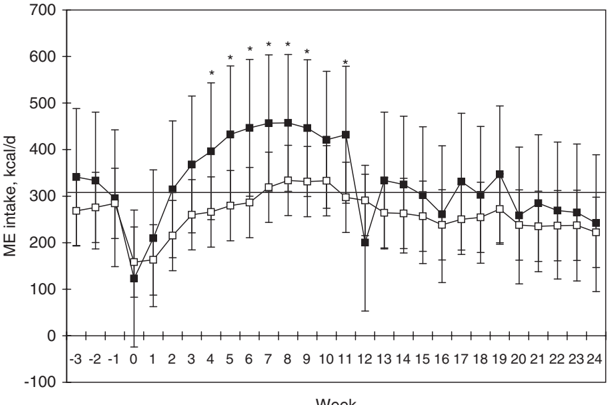
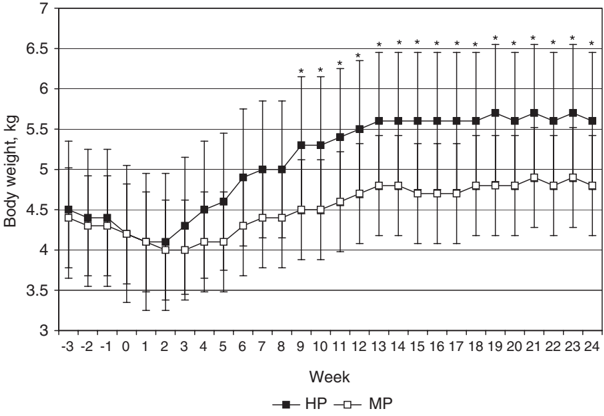
The objective of this study was to measure changes in body composition, physical activity and adipose and skeletal muscle gene expression of cats fed a high-protein (HP) diet or moderate-protein (MP) diet, following ovariohysterectomy. Eight cats were randomized onto HP or MP diets and were fed those diets for several months prior to baseline. All cats underwent an ovariohysterectomy at baseline (week 0) and were allowed ad libitum access to dietary treatments for 24 weeks. Food intake was measured daily, and BW and body condition score were measured weekly. Blood, adipose and skeletal muscle tissue samples were collected, physical activity was measured, and body composition was determined using DEXA (dual-energy X-ray absorptiometry) at weeks 0, 12 and 24. Caloric intake increased soon after ovariohysterectomy, resulting in increased (P < 0.05) BW at weeks 12 and 24 compared to week 0. Body condition score and body fat percentage increased (P < 0.05) over time. Blood glucose increased (P < 0.05) linearly over time. Non-esterified fatty acids were decreased (P < 0.05) at weeks 12 and 24 compared to week 0. Blood leptin increased (P < 0.05) over time. Total physical activity decreased (P < 0.05) from week 0 to weeks 12 and 24 in all cats. Adipose tissue mRNA abundance of adiponectin, hormone sensitive lipase, toll-like receptor-4, uncoupling protein-2 (UCP2) and vascular endothelial growth factor decreased (P < 0.05) linearly over time, regardless of diet. Skeletal muscle mRNA abundance for glucose transporter-1, hormone sensitive lipase and UCP2 were decreased (P < 0.05), regardless of dietary treatment. Our research noted metabolic changes following ovariohysterectomy that are in agreement with gene expression changes pertaining to lipid metabolism. Feeding cats ad libitum after ovariohysterectomy is inadvisable.
Overview
The claims and statistics of this paper haven’t been checked yet.
Free: it reads the open-access text and checks the first 5 claims that cite a source we can check. Create a free account to check every claim.
Integrity signals
Registry
Cites
Statistics
Figures
Verification
Claims the paper makes
The claims and statistics of this paper haven’t been checked yet.
Free: it reads the open-access text and checks the first 5 claims that cite a source we can check. Create a free account to check every claim.
Claims other papers make about this one
Each is checked against this paper’s own text: does it say what the citing paper says it does?
The cited source says what the claim attributes to it.
In the citing paper
“Given the known association between neutering and obesity in cats [25–28], it is possible that growth patterns are affected by either castration or ovariohysterectomy.”
From Growth standard charts for monitoring bodyweight in intact domestic shorthair kittens from the USA (2022) · cites this paper as [27]
Experimental — accuracy not yet measured
Self-check
Percentages, sums and reported differences re-computed from the paper’s own numbers.
The self-check needs the paper’s full text.
Citations
Cites
Official Methods of Analysis of
(1980) · Analytical Chemistry · doi:10.1021/ac50052a726 · Cited by 59,330
Nutrient Requirements of Dogs and Cats
(2006) · National Academies Press eBooks · doi:10.17226/10668 · Cited by 1,216
Rotter, V., Nagaev, I., & Smith, U. (2003) · Journal of Biological Chemistry · doi:10.1074/jbc.m301977200 · Cited by 1,062
Development and validation of a body condition score system for cats: a clinical tool
Laflamme, D. P. (1997) · Feline Practice · Cited by 693
Bastard, J.-P., Maachi, M., van Nhieu, J. T., Jardel, C., Bruckert, E., Grimaldi, A., Robert, J.-J., Capeau, J., & Hainque, B. (2002) · The Journal of Clinical Endocrinology & Metabolism · doi:10.1210/jcem.87.5.8450 · Cited by 625
(2005) · The journal of applied research in veterinary medicine · Cited by 457
Gonadal effects on food intake and adiposity: A metabolic hypothesis
Wade, G. N., & Gray, J. M. (1979) · Physiology & Behavior · doi:10.1016/0031-9384(79)90028-3 · Cited by 437
Determination of Insoluble and Soluble Dietary Fiber in Foods and Food Products: Collaborative Study
Prosky, L., Asp, N.-G., Schweizer, T. F., Devries, J. W., & Furda, I. (1992) · Journal of AOAC INTERNATIONAL · doi:10.1093/jaoac/75.2.360 · Cited by 400
Role of estrogens in adipocyte development and function
Cooke, P. S., & Naaz, A. (2004) · Experimental Biology and Medicine · doi:10.1177/153537020422901107 · Cited by 370
Lejeune, M. P., Westerterp, K. R., Adam, T. C., Luscombe-Marsh, N. D., & Westerterp-Plantenga, M. S. (2006) · The American Journal of Clinical Nutrition · doi:10.1093/ajcn/83.1.89 · Cited by 363
Research works printed but not linked: 1
- American Association of Cereal Chemists 1983. Approved methods, 8th edition. AACC, St.
Cited by
Pallotto, M. R., de Godoy, M. R. C., Holscher, H. D., Buff, P. R., & Swanson, K. S. (2018) · American Journal of Veterinary Research · doi:10.2460/ajvr.79.2.181 · Cited by 46
“In previous studies, 19,20 weight gain was accompanied by a reduction in voluntary physical activity.”
BackgroundSelf-citationEffects of neutering on food intake, body weight and body composition in growing female kittens
Alexander, L. G., Salt, C., Thomas, G., & Butterwick, R. (2011) · British Journal of Nutrition · doi:10.1017/s0007114511001851 · Cited by 35
“A GAMM substituting intake for weeks since neutering (data not shown) did not describe the variation in the BW data as accurately as the model using weeks since neutering, suggesting that there are other factors that are contributing to weight gain such as reduced ME requirements possibly caused by reduced spontaneous…”
BackgroundMethodResultInfluentialde Godoy, M. R. C., & Swanson, K. S. (2013) · Journal of Animal Science · doi:10.2527/jas.2012-5860 · Cited by 42
Self-citationMacronutrients in Feline Health
Villaverde, C., & Fascetti, A. J. (2014) · Veterinary Clinics of North America Small Animal Practice · doi:10.1016/j.cvsm.2014.03.007 · Cited by 33
“7% protein ME, respectively), no differences in body composition were reported between the groups.(80) Similar outcomes were reported when the same diets used in the aforementioned study were fed to growing kittens.”
ResultEffects of photoperiod on food intake, activity and metabolic rate in adult neutered male cats
Kappen, K. L., Garner, L. M., Kerr, K. R., & Swanson, K. S. (2013) · Journal of Animal Physiology and Animal Nutrition · doi:10.1111/jpn.12147 · Cited by 20
Self-citationAllaway, D., Gilham, M. S., Colyer, A., Jönsson, T. J., Swanson, K. S., & Morris, P. (2016) · PLoS ONE · doi:10.1371/journal.pone.0168144 · Cited by 22
Self-citationThe impact of time of neutering on weight gain and energy intake in female kittens
Allaway, D., Gilham, M. S., Colyer, A., & Morris, P. (2017) · Journal of Nutritional Science · doi:10.1017/jns.2017.20 · Cited by 24
“Studies report that cats have acute changes in intake post-neuter when fed ad libitum, gaining BW and fat mass within 8–12 weeks of neutering((10,11)) that may persist throughout the individual’s adult life((12)).”
Backgroundde Godoy, M. R. C. (2018) · Journal of Animal Science · doi:10.1093/jas/sky146 · Cited by 19
Growth standard charts for monitoring bodyweight in intact domestic shorthair kittens from the USA
Salt, C., German, A. J., Henzel, K. S., & Butterwick, R. F. (2022) · PLOS ONE · doi:10.1371/journal.pone.0277531 · Cited by 14
Identifying the target population and preventive strategies to combat feline obesity
Godfrey, H., Morrow, S., Abood, S. K., & Verbrugghe, A. (2024) · Journal of Feline Medicine and Surgery · doi:10.1177/1098612x241228042 · Cited by 19
“32,33,35,37,45,51 Comparison of the growth curves of neutered kittens with those of intact kittens further confirms growth disturbances, characterized by greater BW and body fat mass, following gonadectomy, 51 and female kittens appear to be most affected.”
BackgroundCline, M. G., Witzel, A. L., Moyers, T. D., & Kirk, C. A. (2018) · Journal of Feline Medicine and Surgery · doi:10.1177/1098612x18780872 · Cited by 14
Vester, B. M., Belsito, K. R., & Swanson, K. S. (2011) · Animal Science Journal · doi:10.1111/j.1740-0929.2011.00974.x · Cited by 10
“Body fat mass was not reported herein, but was determined in the male kittens used in this experiment and reported elsewhere (Vester et al. 2009a).”
BackgroundMethodSelf-citationComparison of growth in neutered Domestic Shorthair kittens with growth in sexually-intact cats
Salt, C., Butterwick, R. F., Henzel, K. S., & German, A. J. (2023) · PLoS ONE · doi:10.1371/journal.pone.0283016 · Cited by 8
“Previous studies have suggested that these changes are the result of increased voluntary food intake [7–9], possibly, with a concurrent decrease in physical activity and energy expenditure [8]; the latter is supported by findings from a recent study, examining growth patterns in male and PLOS ONE Comparison of growth…”
BackgroundResultInfluentialGarcia, S. P., & Chebly, A. (2024) · Applied Animal Behaviour Science · doi:10.1016/j.applanim.2024.106287 · Cited by 11
Long‐term effect of neutering age on body condition score and bodyweight in domestic cats
Foreman-Worsley, R., Blackwell, E. J., Finka, L. R., Skillings, E., & McDonald, J. L. (2025) · Veterinary Record · doi:10.1002/vetr.5433 · Cited by 8
“41,42 Concerns have been raised that cats neutered prepubertally may experience greater long-term impacts on their health compared to those neutered later.”
Iwazaki, E., Lee, A. H., Kruis, A. M., Phungviwatnikul, T., Valentine, H., Arend, L. S., Knox, R. V., de Godoy, M. R. C., & Swanson, K. S. (2022) · Journal of Animal Science · doi:10.1093/jas/skac104 · Cited by 9
Self-citationEffect of photoperiod on the feline adipose transcriptome as assessed by RNA sequencing
Mori, A., Kappen, K. L., Dilger, A. C., & Swanson, K. S. (2014) · BMC Veterinary Research · doi:10.1186/1746-6148-10-146 · Cited by 7
“Although previous studies have identified mechanisms by which ovariohysterectomy and/or dietary intervention contribute to changes in adipose tissue metabolism and BW in cats [25-27], a molecular analysis of how photoperiod affects the adipose tissue transcriptome has not yet been performed in this species.”
BackgroundSelf-citationTechnology-enhanced weight-loss program in multiple-cat households: a randomized controlled trial
Hadar, B. N., Lambrecht, K. J., Poljak, Z., Coe, J. B., STONE, E. A., Verbrugghe, A., & Bernardo, T. M. (2021) · Journal of Feline Medicine and Surgery · doi:10.1177/1098612x211044412 · Cited by 12
Domestic cat management in the UK: learnings from a global perspective
McDonald, J. L., Hodgson, D. J., Roberts, C., Finka, L. R., Halls, V., & Foreman-Worsley, R. (2025) · Frontiers in Veterinary Science · doi:10.3389/fvets.2025.1610123 · Cited by 7
Effects of photoperiod on weight maintenance in adult neutered male cats
Kappen, K. L. (2012) · Illinois Digital Environment for Access to Learning and Scholarship (University of Illinois at Urbana-Champaign) · Cited by 2
Bonder, B. S. A., Teixeira, F. A., Porsani, M. Y. H., Gonçales, L. A., Nagashima, J. K., de Oliveira, C. M., Balieiro, J. C. D. C., Pfrimer, K., Massoco, C. D. O., Fantoni, D. T., et al. (2023) · PLoS ONE · doi:10.1371/journal.pone.0287797 · Cited by 1
Hill, S. R., Rutherfurd-Markwick, K. J., Ravindran, G., & Thomas, D. G. (2015) · Journal of Applied Animal Nutrition · doi:10.1017/jan.2015.2 · Cited by 1
Wahyuni, R. M., Gunanti, G., & Noviana, D. (2023) · Jurnal Kedokteran Hewan - Indonesian Journal of Veterinary Sciences · doi:10.21157/j.ked.hewan.v17i2.28242 · Cited by 1
“Average wound healing hematological values of local female cats aged 2-4, 5-9, and ≥10 months post-operative ovariohysterectomy on days 1, 5, and 7 by (Vester et al. 2009).”
BackgroundInfluentialBonder, B. S. A. (2018) · Digital Library of Theses and Dissertations (Universidade de São Paulo) · doi:10.11606/d.10.2018.tde-25082017-120929 · Cited by 1
Hastono, S. D., Nugroho, W. S., & Mulyani, G. T. (2026) · Veterinary World · doi:10.14202/vetworld.2026.2531-2544
“Increased food intake commonly peaks approximately 8 – 10 weeks after surgery [7, 8].”
Metadata
- Authors
- Vester, B. M., Sutter, S. M., Keel, T. L., Graves, T. K., & Swanson, K. S.
- Affiliations
- University of Illinois Urbana-Champaign (US)
- Corresponding author
- Swanson, K.S.
- ORCID
- Swanson, K.S.
- Venue
- Animal
- Publisher
- Elsevier BV
- Published
- 2009
- Volume
- 3
- Issue
- 9
- Pages
- 1287-1298
- ISSN
- 1751-7311 (ISSN-L)
- OpenAlex
- W2125248414
- Cited by
- 25
- References
- 50
- Citations by year
- 2026: 1 · 2025: 2 · 2024: 2 · 2023: 3 · 2022: 2 · 2021: 1 · 2018: 4 · 2017: 1 · 2016: 1 · 2015: 1 · 2014: 2 · 2013: 2 · 2012: 1
- FWCI
- 1.56
- Type
- journal article
- Language
- en
- Open access
- hybrid
- doi.org
- Licence
- cc-by-nc-nd
- www.elsevier.com/tdm/userlicense/1.0/ (tdm)
- www.elsevier.com/legal/tdmrep-license (tdm)
- creativecommons.org/licenses/by-nc-nd/4.0/ (vor, 4324 d)
- Locations
- animal (publishedVersion, cc-by-nc-nd)
- PubMed (publishedVersion)
- DOAJ (DOAJ: Directory of Open Access Journals) (submittedVersion, cc-by-sa)
- Topics
- Health Sciences › Veterinary › Small Animals › Veterinary Medicine and Surgery
- Life Sciences › Neuroscience › Endocrine and Autonomic Systems › Regulation of Appetite and Obesity
- Health Sciences › Medicine › Physiology (medical) › Adipose Tissue and Metabolism
- Keywords
- ovariohysterectomy, cats, high-protein diet, body composition, adipose tissue gene expression, skeletal muscle gene expression, physical activity, leptin, blood glucose, free fatty acids, lipid metabolism, UCP2, hormone-sensitive lipase, adiponectin, vascular endothelial growth factor, TLR4, weight gain
About these checks
Registry, retraction, Cites and statistics results are computed, not judged, with one exception: a printed reference that no index lists is read once by a model before it counts as a citation error. Claims are extracted by a model and kept only when their quote appears verbatim in the text; each cited source is then checked, with a model’s help, for whether it says what the claim relies on. Those verdicts can be wrong — read the claim’s quote and the cited source before relying on one.
Statistics and arithmetic are recomputed, not judged.
Confidence bands are shown only for fields calibrated on our annotated test set. None is calibrated yet, so no band is shown.
What counts as a claim ›How we measure confidence ›How we check this ›
Are you an author, or do you see a problem with this page? Request a review
Data sources
Bibliographic data: Semantic Scholar, OpenAlex, Crossref.
Contains information from the Semantic Scholar Academic Graph Datasets, made available under the ODC Attribution License (ODC-BY 1.0).
Semantic Scholar’s data is described in: Kinney, R., et al. (2023). The Semantic Scholar Open Data Platform. arXiv:2301.10140.
