

The DOI matches its Crossref record; 1 of the 1 references it cites were found in a registry or an index.
Prefer a cash slap in your face over credit for halva
Abstract
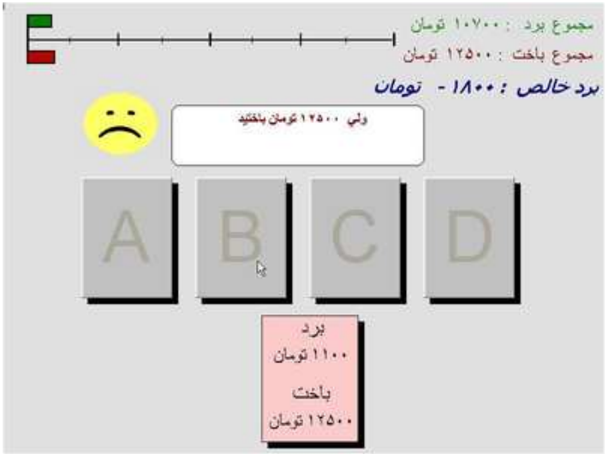
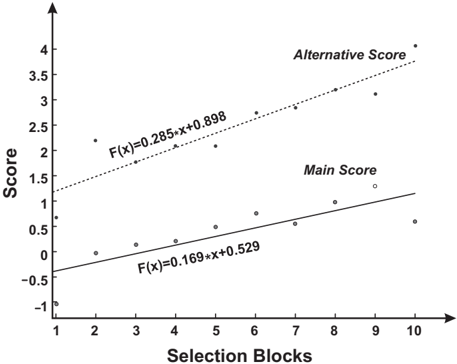
We investigated how frequency and amount of punishment affect the decision making of Iranian subjects. In our first experiment, performing a computer-based Persian version of the Iowa Gambling Task (IGT), our subjects scored remarkably lower than their Western counterparts. Moreover, our subjects chose more frequently and more rapidly from decks that had less frequent but larger amounts of punishments in comparison to decks that had more frequent punishments with smaller amounts. In our second experiment, subjects did not differentiate between decks with the same frequency of punishment but with different punishment amounts. However, among decks with the same amount but different frequency of punishment, a significant preference was apparent towards decks with less frequency of punishment. Our results differ from previous studies, indicating a different strategy in risky decision making among healthy adult Iranian subjects, as they show low attention to the amount of punishment and are more concerned with the frequency of punishment.
Overview
The claims and statistics of this paper haven’t been checked yet.
Run the check — free, no account needed. It reads the open-access text and checks the sources it cites.
Integrity signals
Registry
Cites
Statistics
Figures
Verification
Claims the paper makes
The claims and statistics of this paper haven’t been checked yet.
Run the check — free, no account needed. It reads the open-access text and checks the sources it cites.
Claims other papers make about this one
Each is checked against this paper’s own text: does it say what the citing paper says it does?
In the citing paper
“Decision making in the IGT is observed to be governed by frequency of reinforcement rather than the intertemporal attribute in several cultural contexts including Taiwan (Chiu and Lin, 2007; Lin et al., 2007; Chiu et al., 2008), Iran (Ekhtiari et al., 2009), Brazil (Schneider et al., 2010), and India (Singh and Khan, 2008).”
From Dual conception of risk in the Iowa Gambling Task: effects of sleep deprivation and test-retest gap (2013) · cites this paper as Ekhtiari et al., 2009
Self-check
Percentages, sums and reported differences re-computed from the paper’s own numbers.
The self-check needs the paper’s full text.
Citations
Cites
Cavedini, P., Riboldi, G., D'Annucci, A., Belotti, P., Cisima, M., & Bellodi, L. (2002) · Neuropsychologia · doi:10.1016/s0028-3932(01)00077-x · Cited by 277
Research works printed but not linked: 40
- 10.1017/S1355617707070890 · DOI
- 10.1016/j.schres.2004.03.020 · DOI
- 10.1111/j.1530-0277.2006.00051.x · DOI
- 10.1016/S0028-3932(99)00158-X · DOI
- 10.1080/092970490911261 · DOI
- 10.1016/S0920-9964(03)00086-0 · DOI
- Javadian, 2003, Culture and leadership in Iran: The land of individual achievers, strong family ties, and powerful elite, Academy of Management Executive, 17, 127
- Cole, 1996, Cultural Psychology: A Once and Future Discipline.
- Markman, 2002, Decision making. Stevens Handbook of Experimental Psychology, 2
- 10.1207/s15326942dn2503_2 · DOI · Paper page
- 10.1016/j.neuroimage.2005.02.012 · DOI
- 10.1016/j.bandc.2004.02.022 · DOI
- 10.1176/appi.ajp.162.2.304 · DOI · Paper page
- 10.1016/0010-0277(94)90018-3 · DOI · Paper page
- 10.1016/S0920-9964(97)00135-7 · DOI · Paper page
- 10.2307/3512141 · DOI
- 10.1016/S0278-2626(03)00111-8 · DOI · Paper page
- 10.1111/1464-0597.00072 · DOI
- 10.1111/1464-0597.00070 · DOI
- 10.1016/S0028-3932(03)00081-2 · DOI
- Bowman, 2004, Emotion-based learning on a simplified card game: The Iowa and Bangor Gambling Tasks, Brain and Cognition, 21
- 10.1093/cercor/bhh083 · DOI
- 10.1017/CBO9780511803475 · DOI · Paper page
- 10.1037/0096-3445.126.1.45 · DOI
- Denburg, 2001, Normal aging may compromise the ability to decide advantageously., Brain and Cognition, 47, 156
- 10.1523/JNEUROSCI.19-13-05473.1999 · DOI · Paper page
- 10.1006/obhd.1998.2788 · DOI
- DeDonno, 2008, Perceived time pressure and the Iowa Gambling Task, Judgment and Decision Making, 3, 636, 10.1017/S1930297500001583 · DOI
- 10.1002/(SICI)1099-0771(199906)12:2<165::AID-BDM316>3.0.CO;2-N · DOI
- Afary, 1996, The Iranian Constitutional Revolution, 1906–1911: Grassroots Democracy, Social Democracy, and the Origins of Feminism.
- 10.1016/j.paid.2007.09.021 · DOI
- 10.1093/cercor/6.2.215 · DOI · Paper page
- 10.1093/cercor/10.3.295 · DOI · Paper page
- 10.1136/jnnp.74.3.376 · DOI
- Bartke, 2008, Risk-averse by nation or by religion, SOEPpapers 1/31/2008, Socio-Economic Panel Study (SOEP) at German Institute for Economic Research
- 10.1016/S1053-8119(03)00113-7 · DOI
- Ekhtiari, 2001, Advances in Cognitive Science Studies, 3, 62
- 10.1037/0735-7044.115.1.196 · DOI
- 10.1037/0882-7974.20.2.220 · DOI
- 10.1111/1464-0597.00005 · DOI
Cited by
Sorted by citations
Iowa gambling task performance in currently depressed suicide attempters
Gorlyn, M., Keilp, J. G., Oquendo, M. A., Burke, A. K., & John Mann, J. (2013) · Psychiatry Research · doi:10.1016/j.psychres.2013.01.030 · Cited by 94
Dual conception of risk in the Iowa Gambling Task: effects of sleep deprivation and test-retest gap
Singh, V. (2013) · Frontiers in Psychology · doi:10.3389/fpsyg.2013.00628 · Cited by 13
Metadata
- Authors
- Ekhtiari, H., Behzadi, A., Dehghani, M., Jannati, A., & Mokri, A.
- Venue
- Judgment and Decision Making
- Publisher
- Cambridge University Press (CUP)
- Published
- 2009-12
- Volume
- 4
- Issue
- 7
- Pages
- 534-542
- ISSN
- 1930-2975
- Cited by
- 8
- References
- 1
- Language
- en
About these checks
Registry, retraction, Cites and statistics results are computed, not judged, with one exception: a printed reference that no index lists is read once by a model before it counts as a citation error. Claims are extracted by a model and kept only when their quote appears verbatim in the text; each cited source is then checked, with a model’s help, for whether it says what the claim relies on. Those verdicts can be wrong — read the claim’s quote and the cited source before relying on one.
Statistics and arithmetic are recomputed, not judged.
Confidence bands are shown only for fields calibrated on our annotated test set. None is calibrated yet, so no band is shown.
What counts as a claim ›How we measure confidence ›How we check this ›
Are you an author, or do you see a problem with this page? Request a review
