

Esketamine for treatment resistant depression: a trick of smoke and mirrors?
Open accessThe DOI matches its Crossref record; 20 of the 20 references it cites were found in a registry or an index; none of the 31 sources its claims cite is checked for support yet.
Abstract
In March 2019, the US Food and Drug Administration (FDA) approved a nasal spray formulation of esketamine for the treatment of resistant depression in adults. Esketamine is the S-enantiomer of ketamine, an FDA-approved anaesthetic, known to cause dissociation and, occasionally, hallucinations. While ketamine has not been approved for depression in the USA or in any other country, it has been used off-label in cases of severe depression. This commentary critically reviewed the evidence on esketamine submitted to the FDA, aiming to draw implications for clinical practice, research and regulatory science.
Overview
CoChat Summary
TL;DR
This commentary argues that the FDA evidence package for esketamine in treatment-resistant depression (TRD) shows only modest short-term benefit, with substantial concerns about acceptability and dissociation. The authors conclude that the approval relied on limited placebo-controlled evidence and that larger pragmatic trials are urgently needed.
Key findings
- The FDA evidence base comprised four phase III trials; three were short-term placebo-controlled efficacy trials in TRD, and one was a withdrawal trial (SUSTAIN-1) with 297 patients randomized to continue esketamine + AD (N = 152) or switch to placebo nasal spray while continuing AD (N = 145).
- In the short-term trials, only TRANSFORM-2 showed a significant benefit: MADRS change at day 28 was −21.4 with esketamine + AD vs −17.0 with placebo + AD, a mean difference of 4.4 points.
- Re-analysis of the three short-term studies found an overall mean difference of −4.08 on MADRS (95% CI −6.20 to 1.97; I² = 0%; 3 studies; 641 participants), which the authors note is below the 6.5-point difference they cite as clinically significant from the trial authors.
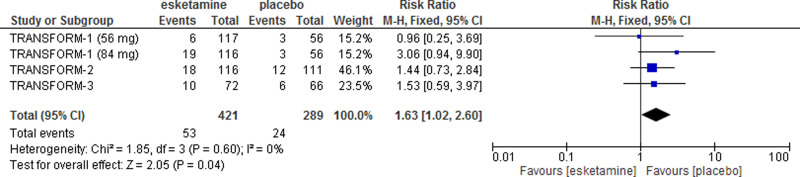
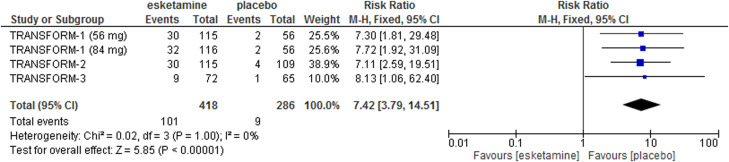
- Acceptability was worse with esketamine: dropout due to any cause was higher than placebo (RR = 1.63; 95% CI 1.02–2.60; I² = 0%; 3 studies; 711 participants), and dissociation risk was reported as almost seven times higher than placebo, with about 25% of esketamine-treated patients experiencing severe dissociation.
Methods
- Narrative commentary based on a review of FDA-submitted esketamine documentation; the authors searched the FDA website using the term “esketamine” up to June 2019 and independently inspected downloaded documents.
- The paper re-analyzed phase III trial data using standard Cochrane meta-analytical methods to extract and pool efficacy and acceptability outcomes.
- The main analyses reported were pooled estimates for MADRS change, dropout due to any cause, and dissociation.
Limitations
- The paper states that the evidence base is limited by the explanatory nature of the existing studies and that long-term data are completely lacking.
- The authors note that the withdrawal design in SUSTAIN-1 tends to overemphasize maintenance efficacy because the comparison group stops treatment abruptly after improvement.
- Evident from the text: the review is based on FDA-submitted trials only and does not include direct comparisons with an active comparator; the authors explicitly say that evidence against placebo, rather than against an active comparator, was used for approval.
Model-written summary. Check it against the paper before relying on it.
Integrity signals
Registry
Cites
Statistics
Figures

Verification
Claims the paper makes
0 Valid · 5 Not valid · 21 Not checked · 28 Own results and interpretations
None of the sources cited for this claim have been checked yet.
In the paper
“A total of 297 patients who achieved stable remission or stable response (without remission) with esketamine + AD were randomised to continue esketamine + AD ( N = 152) or continue AD and switch esketamine to placebo nasal spray ( N = 145).”
plainn = 297- Asserted: passes — The authors put it forward as true.
- Checkable: passes — It can be checked against evidence.
- Load-bearing: passes — The paper’s conclusions depend on it.
- Based: passes — The paper gives a reason why it holds.
In the paper
“The fourth study is a withdrawal placebo-controlled clinical trial (SUSTAIN-1, NCT02493868 ) (Daly et al ., 2019 ).”
What the sources say
- Not checked yetcites Daly et al ., 2019
plainn = 297- Asserted: passes — The authors put it forward as true.
- Checkable: passes — It can be checked against evidence.
- Load-bearing: passes — The paper’s conclusions depend on it.
- Based: passes — The paper gives a reason why it holds.
None of the sources cited for this claim have been checked yet.
In the paper
“Critical inspection of the FDA documentation revealed a total of four phase III trials”
What the sources say
- Not checked yetcites Ochs-Ross et. al. , 2019
- Not checked yetcites Daly et al ., 2019
- Not checked yetcites Fedgchin et al ., 2019
plain- Asserted: passes — The authors put it forward as true.
- Checkable: passes — It can be checked against evidence.
- Load-bearing: passes — The paper’s conclusions depend on it.
- Based: passes — The paper gives a reason why it holds.
A result the paper reports from its own data — it cites no other source for it, so there is none to check. The quote shows it is in the paper.
In the paper
“Re-analysis of the primary efficacy data of the three phase III short-term studies (four comparisons in total, as for one three-arm trial each arm was considered separately v. placebo) revealed an overall mean difference of −4.08 (95% CI −6.20 to 1.97, I 2 = 0%, three studies, 641 participants)”
plainn = 641- Asserted: passes — The authors put it forward as true.
- Checkable: passes — It can be checked against evidence.
- Load-bearing: passes — The paper’s conclusions depend on it.
- Based: passes — The paper gives a reason why it holds.
A result the paper reports from its own data — it cites no other source for it, so there is none to check. The quote shows it is in the paper.
In the paper
“TRANSFORM-2 is the only short-term efficacy trial that found a significant difference between esketamine + AD and placebo + AD.”
plain- Asserted: passes — The authors put it forward as true.
- Checkable: passes — It can be checked against evidence.
- Load-bearing: passes — The paper’s conclusions depend on it.
- Based: passes — The paper gives a reason why it holds.
42 more claims
Create a free account to see all 54 claims and to verify the 31 references still open.
- Probably not a substantial claim. 6
- It may state two separate claims as one. 3
Claims other papers make about this one
Each is checked against this paper’s own text: does it say what the citing paper says it does?
In the citing paper
“However, this approval and the use of ketamine generally to treat depression has met some criticism concerning the adverse effects associated with (S)-ketamine treatment, especially the dissociative properties, as well as the potential for abuse that limit patients’ treatments to specialized clinics or hospital settings”
From Mechanisms of ketamine and its metabolites as antidepressants (2022) · cites this paper as Gastaldon et al., 2019
Self-check
Percentages, sums and reported differences re-computed from the paper’s own numbers.
Each contradiction between two passages listed here was confirmed by an independent check.
Rated major: it would touch a result — a value a result rests on, reported and recomputed p-values on opposite sides of the significance level, two passages that conflict with no sign which is right, or a cited work retracted before this paper was published.
In the paper
“overall mean difference of −4.08 (95% CI −6.20 to 1.97, I 2 = 0%, three studies, 641 participants)”
“Although this difference is statistically significant, its clinical meaning seems very uncertain.”
Rated major: it would touch a result — a value a result rests on, reported and recomputed p-values on opposite sides of the significance level, two passages that conflict with no sign which is right, or a cited work retracted before this paper was published.
In the paper
“overall mean difference of −4.08 (95% CI −6.20 to 1.97, I 2 = 0%, three studies, 641 participants)”
Reported -4.08 · recomputed -2.115
Citations
Cites
Cochrane Handbook for Systematic Reviews of Interventions: Cochrane Book Series
(2008) · doi:10.1002/9780470712184 · Cited by 25,048
GRADE: an emerging consensus on rating quality of evidence and strength of recommendations
Guyatt, G. H., Oxman, A. D., Vist, G. E., Kunz, R., Falck-Ytter, Y., Alonso-Coello, P., & Schünemann, H. J. (2008) · BMJ · doi:10.1136/bmj.39489.470347.ad · Cited by 23,305 · cited 1×
“As a consequence, generalizing results from a withdrawal trial to patients with a current depressive episode is difficult (Guyatt et al., 2008; Post et al., 2013), and extrapolating efficacy in the long-term seems very problematic.”
BackgroundCochrane Handbook for Systematic Reviews of Interventions
Tarsilla, M. (2010) · Journal of MultiDisciplinary Evaluation · doi:10.56645/jmde.v6i14.284 · Cited by 5,178
Popova, V., Daly, E. J., Trivedi, M., Cooper, K., Lane, R., Lim, P., Mazzucco, C., Hough, D., Thase, M. E., Shelton, R. C., et al. (2019) · American Journal of Psychiatry · doi:10.1176/appi.ajp.2019.19020172 · Cited by 904
Daly, E. J., Trivedi, M. H., Janik, A., Li, H., Zhang, Y., Li, X., Lane, R., Lim, P., Duca, A. R., Hough, D., et al. (2019) · JAMA Psychiatry · doi:10.1001/jamapsychiatry.2019.1189 · Cited by 795 · cited 6×
“5 points at MADRS between esketamine and placebo should be observed to make a claim of clinical significance (Daly et al., 2019), based on the results of phase II studies (Daly et al.”
BackgroundInfluentialDaly, E. J., Singh, J. B., Fedgchin, M., Cooper, K., Lim, P., Shelton, R. C., Thase, M. E., Winokur, A., Van Nueten, L., Manji, H., et al. (2018) · JAMA Psychiatry · doi:10.1001/jamapsychiatry.2017.3739 · Cited by 718 · cited 1×
“The authors of the three studies reported that a difference of at least 6.5 points at MADRS between esketamine and placebo should be observed to make a claim of clinical significance (Daly et al., 2019), based on the results of phase II studies (Daly et al., 2017).”
BackgroundInfluentialFedgchin, M., Trivedi, M., Daly, E. J., Melkote, R., Lane, R., Lim, P., Vitagliano, D., Blier, P., Fava, M., Liebowitz, M., et al. (2019) · International Journal of Neuropsychopharmacology · doi:10.1093/ijnp/pyz039 · Cited by 606
A Consensus Statement on the Use of Ketamine in the Treatment of Mood Disorders
Sanacora, G., Frye, M. A., McDonald, W., Mathew, S. J., Turner, M. S., Schatzberg, A. F., Summergrad, P., Nemeroff, C. B., & for the American Psychiatric Association (APA) Council of Research Task Force on Novel Biomarkers and Treatments (2017) · JAMA Psychiatry · doi:10.1001/jamapsychiatry.2017.0080 · Cited by 576 · cited 2×
“Moreover, other treatment combinations, which might have been used as pragmatic control conditions, are often employed in clinical practice for TRD (Sanacora et al., 2017; Kim et al., 2019), but, according to the FDA, a demonstration of efficacy against placebo is enough to grant a marketing…”
MethodOchs-Ross, R., Daly, E. J., Zhang, Y., Lane, R., Lim, P., Morrison, R. L., Hough, D., Manji, H., Drevets, W. C., Sanacora, G., et al. (2020) · The American Journal of Geriatric Psychiatry · doi:10.1016/j.jagp.2019.10.008 · Cited by 481
Esketamine for Treatment-Resistant Depression — First FDA-Approved Antidepressant in a New Class
Kim, J., Farchione, T., Potter, A., Chen, Q., & Temple, R. (2019) · New England Journal of Medicine · doi:10.1056/nejmp1903305 · Cited by 333 · cited 12×
“Three were short-term placebo-controlled efficacy trials conducted in participants suffering from TRD.”
BackgroundMethodInfluential
Research works printed but not linked: 1
- 2018, Depression in Adults: Recognition and Management Clinical Guideline (CG90)
Cited by
Mechanisms of ketamine and its metabolites as antidepressants
Hess, E. M., Riggs, L. M., Michaelides, M., & Gould, T. D. (2022) · Biochemical Pharmacology · doi:10.1016/j.bcp.2021.114892 · Cited by 175
Kohtala, S. (2021) · Pharmacological Reports · doi:10.1007/s43440-021-00232-4 · Cited by 142
“Indeed, a re-analysis of the four phase III studies submitted to the FDA suggests that intranasal S-ketamine may only improve depressive symptoms by reducing 4 points on the Montgomery-Åsberg Depression Rating Scale (MADRS), a scale that ranges from 0 to 60 [118].”
BackgroundGastaldon, C., Raschi, E., Kane, J. M., Barbui, C., & Schoretsanitis, G. (2021) · Psychotherapy and Psychosomatics · doi:10.1159/000510703 · Cited by 134
Self-citationCeban, F., Rosenblat, J. D., Kratiuk, K., Lee, Y. L., Rodrigues, N. B., Gill, H., Subramaniapillai, M., Nasri, F., Lui, L. M. W., Lipsitz, O., et al. (2021) · CNS Drugs · doi:10.1007/s40263-021-00846-5 · Cited by 104
Esketamine Treatment for Depression in Adults: A PRISMA Systematic Review and Meta-Analysis
Fountoulakis, K. N., Saitis, A., & Schatzberg, A. F. (2025) · American Journal of Psychiatry · doi:10.1176/appi.ajp.20240515 · Cited by 90
Esketamine for Treatment-Resistant Depression: A Review of Clinical Evidence (Review)
Vasiliu, O. (2023) · Experimental and Therapeutic Medicine · doi:10.3892/etm.2023.11810 · Cited by 82
“Esketamine is the only pharmacological agent with glutama‑ tergic neuromodulatory properties approved by the US Food and Drug Administration (FDA) and European Medicines Agency (EMA) in 2019 to enhance the effects of serotonin selective or serotonin and norepinephrine reuptake inhibi‑ tors (1).”
InfluentialKetamine exerts its sustained antidepressant effects via cell-type-specific regulation of Kcnq2
Lopez, J. P., Lücken, M. D., Brivio, E., Karamihalev, S., Kos, A., De Donno, C., Benjamin, A., Yang, H., Dick, A. L. W., Stoffel, R., et al. (2022) · Neuron · doi:10.1016/j.neuron.2022.05.001 · Cited by 79
“Our study describes a previously unknown celltype-specific molecular mechanism for the sustained effects of ketamine and provides new strategies for MDD treatment.”
BackgroundInfluentialVekhova, K. A., Namiot, E. D., Jonsson, J., & Schiöth, H. B. (2024) · Clinical Pharmacology & Therapeutics · doi:10.1002/cpt.3478 · Cited by 71
“89 Patients with TRD received esketamine nasal spray as an “intervention” in eight trials of 56 that used ketamine and its enantiomers in different forms in patients with depression.”
Sapkota, A., Khurshid, H., Qureshi, I. A., Jahan, N., Went, T. R., Sultan, W., & Alfonso, M. (2021) · Cureus · doi:10.7759/cureus.17352 · Cited by 63
“[24], the occurrence of dissociation was found to be seven times higher in esketamine plus OAD group compared to placebo plus OAD group, and around 25% of patients receiving esketamine were reported to have experienced dissociation during treatment.”
BackgroundMethodResultInfluentialSafety and effectiveness of NMDA receptor antagonists for depression: A multidisciplinary review
Moore, T. J., Alami, A., Alexander, G. C., & Mattison, D. R. (2022) · Pharmacotherapy The Journal of Human Pharmacology and Drug Therapy · doi:10.1002/phar.2707 · Cited by 50
Ketamine – A New Antidepressant Drug with Anti-Inflammatory Properties
Jóźwiak-Bębenista, M., Sokołowska, P., Wiktorowska‐Owczarek, A., Kowalczyk, E., & Sienkiewicz, M. (2023) · Journal of Pharmacology and Experimental Therapeutics · doi:10.1124/jpet.123.001823 · Cited by 39
Larrea, A., Sánchez-Sánchez, L., Díez-Martín, E., Elexpe, A., Torrecilla, M., Astigarraga, E., & Barreda‐Gómez, G. (2024) · Journal of Clinical Medicine · doi:10.3390/jcm13061727 · Cited by 35
“Esketamine has been shown to be capable of modifying central metabolic pathways, such as glycolysis and the Krebs cycle.”
BackgroundConsistently Modest Antidepressant Effects in Clinical Trials: the Role of Regulatory Requirements
Khan, A., Mar, K. F., & Brown, W. A. (2025) · Psychopharmacology Bulletin · doi:10.64719/pb.4412 · Cited by 27
Baudot, J., Soeiro, T., Tambon, M., Navarro, N., Veyrac, G., Mezaache, S., & Micallef, J. (2021) · Fundamental and Clinical Pharmacology · doi:10.1111/fcp.12745 · Cited by 26
Erhel, F., Scanff, A., & Naudet, F. (2020) · Epidemiology and Psychiatric Sciences · doi:10.1017/s2045796020000359 · Cited by 21
Gomez-Escolar, A., Folch‐Sanchez, D., Stefaniuk, J., Swithenbank, Z., Nisa, A., Braddick, F., Chaudhary, N. I., van der Meer, P. B., & Batalla, A. (2024) · CNS Drugs · doi:10.1007/s40263-024-01101-3 · Cited by 22
“However, despite these broad legislative changes, to date only esketamine has received approval as treatment for a mental health disorder (i.e. treatment-resistant depression) by the FDA and the European Medicines Agency (EMA) [26].”
Ketamine and Hydroxynorketamine as Novel Pharmacotherapies for the Treatment of Opioid Use Disorders
Onisiforou, A., Michael, A., Apostolakis, M., Mammadov, E., Mitka, A., Kalatta, M. A., Koumas, M., Georgiou, A. N., Chatzittofis, A., Panayiotou, G., et al. (2024) · Biological Psychiatry · doi:10.1016/j.biopsych.2024.09.008 · Cited by 16
Metabolic Risk Factors and Cardiovascular Safety in Ketamine Use for Treatment Resistant Depression
Szarmach, J., Cubała, W. J., Włodarczyk, A., & Gałuszko‐Węgielnik, M. (2020) · Neuropsychiatric Disease and Treatment · doi:10.2147/ndt.s273287 · Cited by 19
Esketamine Nasal Spray: Rapid Relief for TRD and Suicide Prevention—Mechanisms and Pharmacodynamics
Song, H., Luo, Y., & Fang, L. (2024) · Neuropsychiatric Disease and Treatment · doi:10.2147/ndt.s486118 · Cited by 21
“11,12 14 The disinhibition hypothesis suggests that ketamine selectively targets NMDARs on GABAergic interneurons, releasing glutamate and disinhibiting pyramidal cells via AMPA receptor activation.”
BackgroundEfficacy, Safety, and Tolerability of Psychedelics in Treatment-Resistant Depression (TRD)
Olivier, B., & Olivier, J. D. A. (2024) · Advances in experimental medicine and biology · doi:10.1007/978-981-97-4402-2_3 · Cited by 14
van der Gronde, T., Los, L., Herremans, A. H. J., Oosting, R. S., Zorzanelli, R., & Pieters, T. (2020) · Frontiers in Psychiatry · doi:10.3389/fpsyt.2020.00412 · Cited by 13
“Esketamine, the S-enantiomer of ketamine, has been approved by the Food and Drug Administration (FDA) for treatment-resistant depression (78), but ketamine has been and continues to be used offlabel to treat depression too (79).”
BackgroundHow to deprescribe esketamine in resistant depression? A point of view after first clinical uses
de Laportalière, T. T., Yrondi, A., Jullien, A., Cestac, P., & Montastruc, F. (2022) · Epidemiology and Psychiatric Sciences · doi:10.1017/s204579602100072x · Cited by 13
Fragile promise of psychedelics in psychiatry
Lemarchand, C., Chopin, R., Paul, M., Braillon, A., Cosgrove, L., Cristea, I., Fried, E. I., Turner, E. H., & Naudet, F. (2024) · BMJ · doi:10.1136/bmj-2024-080391 · Cited by 11
“22 Functionalunblindingwasalsonot formally assessed in the first pivotal study of MDMA assisted psychotherapy used for a new drug application to the FDA.”
Deng, Q., Parker, E., Wu, C., Zhu, L., Liu, T. C., Duan, R., & Yang, L. (2024) · Aging and Disease · doi:10.14336/ad.2024.0239 · Cited by 12
“Nevertheless, the approval of (S)-ketamine and its application in depression therapy has sparked controversy due to concerns about adverse reactions, such as potential abuse and the onset of psychotomimetic effects [25].”
Why psychiatry needs an honest dose of gentle medicine
Cosgrove, L., D’Ambrozio, G., Herrawi, F., Freeman, M., & Shaughnessy, A. F. (2023) · Frontiers in Psychiatry · doi:10.3389/fpsyt.2023.1167910 · Cited by 16
“, esketamine for “treatment-resistant depression” (51, 52); dextromethorphan HBr-bupropion HCI (Auvelity) for depression (53); and 3,4-Methylenedioxy methamphetamine (MDMA) in post-traumatic stress disorder” (54).”
BackgroundKetamine a dissociative anesthetic: Neurobiology and biomolecular exploration in depression
Liu, G.-L., Cui, Y., Lu, C., & Zhao, P. (2020) · Chemico-Biological Interactions · doi:10.1016/j.cbi.2020.109006 · Cited by 12
Comment to Drs Gastaldon, Papola, Ostuzzi and Barbui
Mathews, M., Daly, E. J., Popova, V., Heerlein, K., Canuso, C., & Drevets, W. C. (2020) · Epidemiology and Psychiatric Sciences · doi:10.1017/s2045796020000268 · Cited by 7
Approval of esketamine for treatment-resistant depression – Authors' reply
Naudet, F., & Cristea, I. A. (2020) · The Lancet Psychiatry · doi:10.1016/s2215-0366(20)30040-7 · Cited by 7
A real-world pharmacovigilance study of esketamine nasal spray
Chen, Y., Gu, H., Li, W., & Chen, Y. (2024) · Medicine · doi:10.1097/md.0000000000039484 · Cited by 6
“[16] In the instructions for esketamine, it was specified that patient monitoring for a minimum of 2 hours was necessary, and the clinical stability and timing of patients leaving the medical institution were evaluated at each treatment stage.”
Current drug targets for the treatment of depression
Pathak, G., Nigade, A., Anitha, K., & Bhatt, S. (2025) · Brain Disorders · doi:10.1016/j.dscb.2025.100270 · Cited by 9
Depression, an unmet health need in Africa: Understanding the promise of ketamine
Millen, A. M. E., Daniels, W. M. U., & Baijnath, S. (2024) · Heliyon · doi:10.1016/j.heliyon.2024.e28610 · Cited by 8
“Based on its demonstrated clinical efficacy, in 2019, the US Food and Drug Administration (FDA) approved the use of esketamine (the (S) -enantiomer of ketamine) as an antidepressant nasal spray (Spravato ™ ) [52].”
BackgroundEsketamine clinical trials: reply to Maju et al.
Gastaldon, C., Papola, D., Ostuzzi, G., & Barbui, C. (2020) · Epidemiology and Psychiatric Sciences · doi:10.1017/s204579602000027x · Cited by 6
“…previously commented that the FDA and EMA made approval decisions only considering four trials (TRANSFORM-1, -2, -3 and SUSTAIN-1) (Daly et al., 2019; Fedgchin et al., 2019; Popova et al., 2019; Gastaldon et al., 2020; Ochs-Ross et al., 2020), and that none of these studies provided long-term data.”
BackgroundResultInfluentialSelf-citationNaudet, F., Pellen, C., Fodor, L. A., Gastaldon, C., Barbui, C., Turner, E. H., Le Pabic, E., & Cristea, I. A. (2025) · BMC Medicine · doi:10.1186/s12916-025-04435-x · Cited by 6
Self-citationBarruel, D., Belnou, P., Plaze, M., & Masson, V. D. (2025) · Psychiatry Research · doi:10.1016/j.psychres.2025.116738 · Cited by 7
Mario, A., Leccisotti, I., Claudia, M. M., Bellomo, A., Panza, F., Tommaso, C., & Madia, L. (2025) · Biomedicine & Pharmacotherapy · doi:10.1016/j.biopha.2025.118199 · Cited by 9
Tamman, A. J. F., Anand, A., & Mathew, S. J. (2022) · Expert Opinion on Drug Safety · doi:10.1080/14740338.2022.2049754 · Cited by 7
“An estimated 25% of patients experience severe dissociation [170].”
BackgroundTreatment-resistant depression: Established and emerging therapies
McBroom, L. A., & Timmons, M. (2024) · The Nurse Practitioner · doi:10.1097/01.npr.0000000000000258 · Cited by 4
Esketamine for treatment-resistant depression
(2020) · Drug and Therapeutics Bulletin · doi:10.1136/dtb.2020.000043 · Cited by 8
Caution Is Warranted in Prescribing Ketamine for Mental Health
Drabiak, K. (2025) · Journal of General Internal Medicine · doi:10.1007/s11606-025-10024-8 · Cited by 4
Huang, C.-J., Yang, Y., Wang, X., & Liao, C. (2026) · Journal of Medicinal Chemistry · doi:10.1021/acs.jmedchem.5c03086 · Cited by 4
Ketamine and depression: An old drug in search of a clinical indication
White, P. F. (2021) · Journal of Clinical Anesthesia · doi:10.1016/j.jclinane.2021.110500 · Cited by 2
The mysterious beauty of ketamine: Benefits and risks
Mattison, D. R., Alami, A., Moore, T. J., & Alexander, G. C. (2022) · Advances in neurotoxicology · doi:10.1016/bs.ant.2022.06.004 · Cited by 1
Beyond surgery: Repurposing anesthetics for treatment of central nervous system disorders
Mielko, J., Pakulska, J., Oszczyk, A., Lustyk, K., Pytka, K., & Sałaciak, K. (2025) · Progress in Neuro-Psychopharmacology and Biological Psychiatry · doi:10.1016/j.pnpbp.2025.111386 · Cited by 1
Liu, S.-Y., Huang, R., Liu, Z., Wang, S.-S., & Zhao, M.-Q. (2026) · BMC Psychiatry · doi:10.1186/s12888-026-07837-0 · Cited by 1
“In 2019, the FDA approved the nasal spray formulation esketamine for the treatment of treatment-resistant depression [20].”
An, Y., Park, S.-Y., & Kang, U. G. (2022) · 신경정신의학 · doi:10.4306/jknpa.2022.61.4.243 · Cited by 1
Artificial Intelligence (AI) and Its Role in Depression
Farmer, A. A., Lange, B., Kim, S., Pathak, S., Chakravarthy, S., DeRuiter, J., Vijayarani, K. R., Ramanathan, A., Alharbi, H. F., & Dhanasekaran, M. (2024) · Nutritional neurosciences · doi:10.1007/978-981-97-2577-9_4 · Cited by 1
Spravato oder die Frage: „Wie viel darf ein Antidepressivum kosten?“
Spießl, H. (2021) · Psychiatrische Praxis · doi:10.1055/a-1500-9805 · Cited by 1
“[8] Gastaldon C, Papola D, Ostuzzi D et al.”
BackgroundReply to the Comments by Doherty et al.
Gastaldon, C., Raschi, E., Kane, J. M., Barbui, C., & Schoretsanitis, G. (2020) · Psychotherapy and Psychosomatics · doi:10.1159/000511830 · Cited by 2
Self-citationUso da escetamina intranasal no tratamento da depressão resistente: uma revisão de literatura
Carvalho, A. J., Pimenta, S. B. D. B., & Simeoni, A. R. (2022) · Research Society and Development · doi:10.33448/rsd-v11i16.38613 · Cited by 5
Anti-inflammatory effects of ketamine in the treatment-resistant depression: a narrative review
Jóźwiak-Bębenista, M., Sokołowska, P., Kowalczyk, E., & Wiktorowska‐Owczarek, A. (2024) · Farmacja Polska · doi:10.32383/farmpol/183264 · Cited by 2
The Top 50 Articles and Authors of the New Millennium in Psychiatry: A Bibliometric Analysis
Havlik, J. L., Uranga, S. I., Lee, M. S., et al. (2024) · Cureus · doi:10.7759/cureus.54762
“…healthcare is not reflective of the number of patients receiving the care they need to safely and properly manage their mental health; social stigma, insurance coverage, and lack of access to skilled psychiatric clinicians continue to impede the provision of psychiatric care in this country [5,6].”
BackgroundKetamine’s Multifaceted Neuropharmacological and Neurobiological Actions
Kohtala, S., & Annala, I. (2025) · Neuromethods · doi:10.1007/978-1-0716-4603-8_2
Psychedelics: Future Therapeutics in Major Depression?
Olivier, B., & Olivier, J. D. A. (2026) · Advances in experimental medicine and biology · doi:10.1007/978-981-95-6872-7_25
Metadata
- Authors
- Gastaldon, C., Papola, D., Ostuzzi, G., & Barbui, C.
- Affiliations
- University of Verona (IT)
- Corresponding author
- Gastaldon, C.
- Venue
- Epidemiology and Psychiatric Sciences
- Publisher
- Cambridge University Press (CUP)
- Published
- 2019-12-16
- Volume
- 29
- Pages
- e79-e79
- ISSN
- 2045-7960 (ISSN-L)
- 2045-7979
- PMC
- PMC8061126
- OpenAlex
- W2995768649
- Semantic Scholar
- 59f33dfb6a9d4f721f959b23c2ec8c035e88dd7d
- Cited by
- 54
- References
- 20
- Citations by year
- 2026: 4 · 2025: 8 · 2024: 14 · 2023: 3 · 2022: 8 · 2021: 7 · 2020: 10
- FWCI
- 3.87
- Type
- journal article
- Language
- en
- Open access
- hybrid
- doi.org
- Locations
- Epidemiology and Psychiatric Sciences (publishedVersion, cc-by)
- PubMed Central (publishedVersion, cc-by)
- PubMed (publishedVersion)
- INFM-OAR (INFN Catania) (submittedVersion, cc-by)
- Zenodo (CERN European Organization for Nuclear Research) (cc-by)
- Topics
- Health Sciences › Medicine › Pharmacology (medical) › Treatment of Major Depression
- Health Sciences › Medicine › Psychiatry and Mental health › Electroconvulsive Therapy Studies
- Social Sciences › Psychology › Clinical Psychology › Psychedelics and Drug Studies
- Keywords
- esketamine, treatment-resistant depression, ketamine, nasal spray formulation, FDA approval, off-label drug use, dissociation, hallucinations, regulatory science, evidence base
- MeSH terms
- Adult, Antidepressive Agents, Depression, Humans, Infusions, Intravenous, Ketamine, United States, United States Food and Drug Administration, Drug Approval, Evidence-Based Medicine, Depressive Disorder, Treatment-Resistant
About these checks
Registry, retraction, Cites and statistics results are computed, not judged, with one exception: a printed reference that no index lists is read once by a model before it counts as a citation error. Claims are extracted by a model and kept only when their quote appears verbatim in the text; each cited source is then checked, with a model’s help, for whether it says what the claim relies on. Those verdicts can be wrong — read the claim’s quote and the cited source before relying on one.
A language model drew the claims from the paper on 2026-10-11, under version 3 of the claim definition (model deepseek-v4.1-flash, prompt extract-v3).
A second model labelled each claim on 2026-10-11 (model jev-1.13-20260917, definition revision gold-guideline-v0.2).
Statistics and arithmetic are recomputed, not judged.
Confidence bands are shown only for fields calibrated on our annotated test set. None is calibrated yet, so no band is shown.
What counts as a claim ›How we measure confidence ›How we check this ›
Are you an author, or do you see a problem with this page? Request a review
Data sources
Bibliographic data: Semantic Scholar, OpenAlex, Crossref.
Contains information from the Semantic Scholar Academic Graph Datasets, made available under the ODC Attribution License (ODC-BY 1.0).
Semantic Scholar’s data is described in: Kinney, R., et al. (2023). The Semantic Scholar Open Data Platform. arXiv:2301.10140.
