

Microaggressions towards people affected by mental health problems: a scoping review
Open accessThe DOI matches its Crossref record; 42 of the 43 references it cites were found in a registry or an index.
Abstract
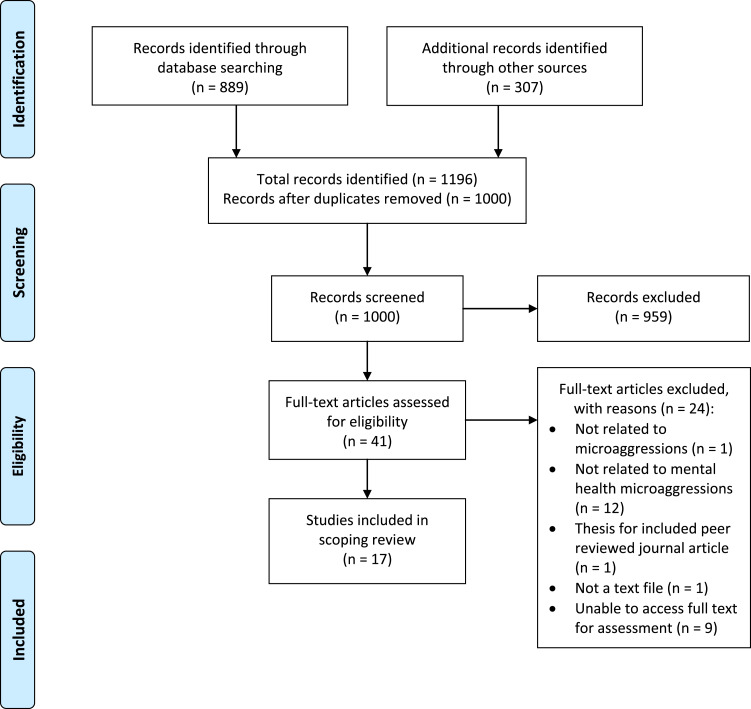
AIMS: This review aims to understand the scope of the literature regarding mental health-related microaggressions towards people affected by mental health problems. METHODS: A scoping review was conducted to explore this question. Four electronic health-oriented databases were searched alongside Google Scholar. As per scoping review principles, the inclusion criteria were developed iteratively. The results of included studies were synthesised using a basic narrative synthesis approach, utilising principles of thematic analysis and thematic synthesis where appropriate. RESULTS: A total of 1196 records were identified, of which 17 met inclusion criteria. Of these, 12 were peer-reviewed journal articles, three were research degree theses and two were book chapters. Six included empirical studies were qualitative, four were quantitative and two employed a mixed-methods design. Within these, five qualitative studies aimed to describe the nature of mental health microaggressions experienced by people with mental health problems. Themes identified in a thematic synthesis of these five studies included stereotypes about mental illness, invalidating peoples' experience and blaming people with mental illness for their condition. The included publications informed on the perpetration of mental health microaggressions by family, friends, health professionals and social workers. In addition, two studies created scales, which were then used in cross-sectional surveys of the general public and community members to assess characteristics, such as right-wing political views, associated with endorsement of mental health microaggressions. A consensus definition of microaggressions emerged from the included studies: microaggressions are brief, everyday slights, snubs or insults, that may be subtle or ambiguous, but communicate a negative message to a target person based on their membership of a marginalised group, in this case, people affected by mental illness. CONCLUSIONS: The study of mental health microaggressions is an emerging, heterogeneous field, embedded in the wider stigma and discrimination literature. It has been influenced by earlier work on racial microaggressions. Both can be ambiguous and contradictory, which creates difficulty defining the boundaries of the concept, but also underpins the key theoretical basis for the negative impact of microaggressions. Mental illness is a more concealable potential type of identity, so it follows that the reported perpetrators of microaggressions are largely friends, family and professionals. This has implications for intervening to reduce the impact of microaggressions. There are several challenges facing research in this area, and further work is needed to understand the impact of mental health microaggressions on people affected by mental health problems.
Overview
The claims and statistics of this paper haven’t been checked yet.
Free: it reads the open-access text and checks the first 5 claims that cite a source we can check. Create a free account to check every claim.
Integrity signals
Registry
Cites
Statistics
Figures
Verification
Claims the paper makes
The claims and statistics of this paper haven’t been checked yet.
Free: it reads the open-access text and checks the first 5 claims that cite a source we can check. Create a free account to check every claim.
Claims other papers make about this one
Each is checked against this paper’s own text: does it say what the citing paper says it does?
In the citing paper
“56 reviews were published between 1994 and 2021 and focused on prequalifying stigma reduction programmes for trainees (eg, nursing and medical students) and in-service programmes for qualified staff.29”
From The Lancet Commission on ending stigma and discrimination in mental health (2022) · cites this paper as [29]
In the citing paper
“29 addressed mental health conditions generally, ten exclusively involved people with dementia, seven assessed substance use disorders, five personality disorders, three borderline personality disorder, four suicidality and self-harm, one intellectual disabilities, one neurodevelopmental disorder, one psychosis, and one eating disorders”
From The Lancet Commission on ending stigma and discrimination in mental health (2022) · cites this paper as [29]
Self-check
Percentages, sums and reported differences re-computed from the paper’s own numbers.
The self-check needs the paper’s full text.
Citations
Cites
Using thematic analysis in psychology
Braun, V., & Clarke, V. (2006) · Qualitative Research in Psychology · doi:10.1191/1478088706qp063oa · Cited by 194,414
Preferred Reporting Items for Systematic Reviews and Meta-Analyses: the PRISMA statement
Moher, D., Liberati, A., Tetzlaff, J., Altman, D. G., & for the PRISMA Group (2009) · BMJ · doi:10.1136/bmj.b2535 · Cited by 83,823
Preferred reporting items for systematic reviews and meta-analyses: the PRISMA Statement.
(2009) · PubMed Central · Cited by 44,859
Preferred reporting items for systematic reviews and meta-analyses: The PRISMA statement
Moher, D., Liberati, A., Tetzlaff, J., Altman, D. G., & the PRISMA Group* (2009) · Annals of Internal Medicine · doi:10.7326/0003-4819-151-4-200908180-00135 · Cited by 37,554
Scoping studies: towards a methodological framework
Arksey, H., & O'Malley, L. (2005) · International Journal of Social Research Methodology · doi:10.1080/1364557032000119616 · Cited by 36,742
Scoping studies: advancing the methodology
Levac, D., Colquhoun, H., & O'Brien, K. K. (2010) · Implementation Science · doi:10.1186/1748-5908-5-69 · Cited by 15,268 · cited 2×
“We followed the procedure outlined by Arksey and O’Malley (2005) and further developed by Levac et al. (2010).”
MethodMunn, Z., Peters, M. D. J., Stern, C., Tufanaru, C., McArthur, A., & Aromataris, E. (2018) · BMC Medical Research Methodology · doi:10.1186/s12874-018-0611-x · Cited by 11,385
Methods for the thematic synthesis of qualitative research in systematic reviews
Thomas, J., & Harden, A. (2008) · BMC Medical Research Methodology · doi:10.1186/1471-2288-8-45 · Cited by 9,312
Racial microaggressions in everyday life: Implications for clinical practice.
Sue, D. W., Capodilupo, C. M., Torino, G. C., Bucceri, J. M., Holder, A. M. B., Nadal, K. L., & Esquilin, M. (2007) · American Psychologist · doi:10.1037/0003-066x.62.4.271 · Cited by 5,569 · cited 7×
“Finally, microinvalidations negate or nullify the feelings or experiences of a person, by saying, for example, ‘Don’t be so oversensitive’ (Sue et al., 2007, p. 275). https://doi.org/10.1017/S2045796019000763 Downloaded from https://www.cambridge.org/core.”
BackgroundInfluential(2004) · Choice Reviews Online · doi:10.5860/choice.41-3182 · Cited by 4,690
Research works printed but not linked: 2
- McCue MJ (2016) An Ecological Systems Approach to Understanding The Lived Experience of Law Students with Mental Illness. Michigan, USA: Michigan State University.
- Zenga D (2018) Perceived Effects of Microaggressions on Peer Support Workers in Mental Health Recovery. San Diego, USA: Alliant International University.
Cited by
The Lancet Commission on ending stigma and discrimination in mental health
Thornicroft, G., Sunkel, C., Alikhon Aliev, A., Baker, S., Brohan, E., el Chammay, R., Davies, K., Demissie, M., Duncan, J., Fekadu, W., et al. (2022) · The Lancet · doi:10.1016/s0140-6736(22)01470-2 · Cited by 748
Self-citationJohnson, V. E., Nadal, K. L., Sissoko, D. R. G., & King, R. (2021) · Perspectives on Psychological Science · doi:10.1177/17456916211011963 · Cited by 136
Purgato, M., Uphoff, E., Singh, R., Thapa Pachya, A., Abdulmalik, J., & van Ginneken, N. (2020) · Epidemiology and Psychiatric Sciences · doi:10.1017/s204579602000061x · Cited by 94
Page, A., Charteris, J., & Berman, J. (2020) · International Journal of Social Robotics · doi:10.1007/s12369-020-00714-0 · Cited by 64
King, A. J., Brophy, L. M., Fortune, T., & Byrne, L. (2020) · Psychiatric Services · doi:10.1176/appi.ps.201900606 · Cited by 70
Microaggression and the adult stuttering experience
Coalson, G. A., Crawford, A., Treleaven, S., Byrd, C. T., Davis, L., Dang, L., Edgerly, J., & Turk, A. (2021) · Journal of Communication Disorders · doi:10.1016/j.jcomdis.2021.106180 · Cited by 62
Veiled Harm: Impacts of Microaggressions on Psychological Safety and Physician Burnout
Desai, V. N., Conte, A. H., Nguyen, V. T., Shin, P., Sudol, N. T., Hobbs, J., & Qiu, C. X. (2023) · The Permanente Journal · doi:10.7812/tpp/23.017 · Cited by 61
Diversity and Discrimination In Healthcare
Togioka, B. M., Duvivier, D., & Young, E. (2021) · StatPearls · Cited by 62
Louis, C. C., Webster, C. T., Gloe, L. M., & Moser, J. S. (2022) · Frontiers in Human Neuroscience · doi:10.3389/fnhum.2022.1058953 · Cited by 32
Kimber, B., Oxlad, M., & Twyford, L. (2024) · International Journal of Transgender Health · doi:10.1080/26895269.2024.2380903 · Cited by 36
Purgato, M., Prina, E., Ceccarelli, C., Cadorin, C., Abdulmalik, J. O., Amaddeo, F., Arcari, L., Churchill, R., Jordans, M. J., Lund, C., et al. (2023) · Cochrane Database of Systematic Reviews · doi:10.1002/14651858.cd014722.pub2 · Cited by 27
Interpreting Microaggression as a Determinant of Wellbeing
Adedeji, A., Olonisakin, T. T., Metzner, F., Buchcik, J., Tsabedze, W. F., Boehnke, K., & Idemudia, E. S. (2022) · Journal of Racial and Ethnic Health Disparities · doi:10.1007/s40615-022-01426-z · Cited by 32
DeLuca, J. S., Hwang, J., Stepinski, L., & Yanos, P. T. (2020) · Journal of Mental Health · doi:10.1080/09638237.2020.1836556 · Cited by 26
Barrita, A. M., Strong, M. N., Ferraris, J., & Wong‐Padoongpatt, G. (2023) · Journal of Substance Use and Addiction Treatment · doi:10.1016/j.josat.2023.209078 · Cited by 26
Purgato, M., Abdulmalik, J. O., Prina, E., Ceccarelli, C., Tol, W. A., van Ginneken, N., Uphoff, E., Papola, D., Amaddeo, F., Churchill, R. C., et al. (2021) · Cochrane Database of Systematic Reviews · doi:10.1002/14651858.cd014722 · Cited by 22
Zeying, M. D., Ashcroft, T., Kulkarni, D., Sawrikar, V., & Jackson, C. (2022) · Journal of Global Health · doi:10.7189/jogh.12.04049 · Cited by 27
Zhao, T., Markevych, I., Buczyłowska, D., Romanos, M., & Heinrich, J. (2022) · Environmental Research · doi:10.1016/j.envres.2022.114715 · Cited by 24
Freeman, L., & Stewart, H. (2024) · doi:10.1093/oso/9780197652480.001.0001 · Cited by 18
Living while fat: Development and validation of the Fat Microaggressions Scale.
Lindloff, M. R., Meadows, A., & Calogero, R. M. (2024) · Journal of Personality and Social Psychology · doi:10.1037/pspi0000450 · Cited by 22
Brohan, E., Thornicroft, G., Rüsch, N., Lasalvia, A., Campbell, M., Alkar, Ö. Y., Lanfredi, M., Ochoa, S., Üçok, A., Tomás, C. C., et al. (2022) · Psychological Medicine · doi:10.1017/s0033291722000630 · Cited by 18
Microaggressions and Psychosocial Adjustment among Greek University Students with Disabilities
Andreou, E., Psyllou, A., Vlachou, A., Fyssa, A., & Saridaki, M. (2021) · Education Sciences · doi:10.3390/educsci11120781 · Cited by 20
Bidstrup, H., Brennan, L., Kaufmann, L. M., Meadows, A., & Garcia, X. D. L. P. (2023) · Obesity Reviews · doi:10.1111/obr.13676 · Cited by 13
Li, Y., Qiu, D., Wu, Q., Ni, A., Tang, Z., & Xiao, S. (2023) · Schizophrenia · doi:10.1038/s41537-023-00393-6 · Cited by 9
Hana, R. A., Heim, E., Cuijpers, P. J., Sijbrandij, M., Chammay, R. E., & Kohrt, B. A. (2024) · BMC Family Practice · doi:10.1186/s12875-024-02680-2 · Cited by 10
Zoubaa, S., Dial, B., Ryan-Jones, L. D., et al. (2021) · Counselling Psychology Quarterly · doi:10.1080/09515070.2021.1968795 · Cited by 8
Predicting Mental Health Quality of Life in Policing: Officers and Civilians
Short, J. L. (2020) · Journal of Police and Criminal Psychology · doi:10.1007/s11896-020-09415-w · Cited by 10
Defourny, P., van Sambeek, N., van de Bovenkamp, H., Scheepers, F. E., & Heerings, M. (2024) · BMC Psychiatry · doi:10.1186/s12888-024-06262-5 · Cited by 13
Pei, L. (2022) · Frontiers in Psychiatry · doi:10.3389/fpsyt.2022.1001796 · Cited by 8
Koch, J. M., Knutson, D., Lee, H.-S., Robitschek, C., Wang, K. T., Burdine, K., & Shin, J. (2025) · Journal of Prevention and Health Promotion · doi:10.1177/26320770241309101 · Cited by 9
Toward Affective Empathy via Personalized Analogy Generation: A Case Study on Microaggression
Ju, H., Lee, J., Yang, S., Ok, J., & Hwang, I. (2025) · CHI Conference on Human Factors in Computing Systems · doi:10.1145/3706598.3714122 · Cited by 16
Martínez, P. R. (2022) · Frontiers in Sociology · doi:10.3389/fsoc.2022.948811 · Cited by 10
Diversity and Culturally Responsive Mental Health Practice
Murphy, R., & Higgins, A. (2022) · Springer eBooks · doi:10.1007/978-3-031-05536-2_13 · Cited by 6
Even mild internalized stigma merits attention among adults with serious mental illness.
Drapalski, A. L., Tonge, N., Muralidharan, A., Brown, C. H., & Lucksted, A. A. (2023) · Psychological Services · doi:10.1037/ser0000744 · Cited by 5
Gibson, A. M., Lindsay, B. L., & Szeto, A. C. H. (2023) · Stigma and Health · doi:10.1037/sah0000471 · Cited by 4
Mental Health Providers’ Attitudes, Norms, and Beliefs About Cultural Humility in Service Delivery
Bauer, A. G., Balaraman, A., & Gilmore, A. (2025) · The Journal of Behavioral Health Services & Research · doi:10.1007/s11414-025-09953-3 · Cited by 7
Exploring the Human-LLM Synergy in Advancing Theory-driven Qualitative Analysis
Meng, H., Yang, Y., Fu, W., Lee, J., Li, Y., & Lee, Y. (2026) · ACM Transactions on Computer-Human Interaction · doi:10.1145/3778354 · Cited by 39
Validity and reliability study of the mental illness micro-aggression scale-perpetrator version
Ertem, M., & Karakaş, M. (2022) · Archives of Psychiatric Nursing · doi:10.1016/j.apnu.2022.09.005 · Cited by 4
Persons With Disabilities’ Experiences of Microaggression: A Qualitative Meta-Synthesis
Qi, C., Wang, Y., Kong, N., Jiao, Y., Zhang, S., Zhao, F., Lai, J., Wang, L., & Liu, Z. (2025) · Trauma Violence & Abuse · doi:10.1177/15248380251361811 · Cited by 7
Spanish adaptation and validation of the Peer Mental Health Stigmatization Scale (PMHSS-24)
Romero, J. D. L. H., Candelas-Muñoz, A., Jiménez-González, A., Castañeda-Jiménez, C., Fuica-Pereg, P., Zurita-Carrasco, M., Martínez-Fernandez-Repeto, E., & Senín‐Calderón, C. (2022) · Revista de Psiquiatría y Salud Mental (English Edition) · doi:10.1016/j.rpsmen.2022.09.001 · Cited by 6
Sodhi, M. S. (2024) · Production and Operations Management · doi:10.1177/10591478241238974 · Cited by 7
Zhao, W., Chen, S., Hu, J., Zhou, Q. F., Tao, J., Gao, R., Zhang, J., Su, S., Wang, Y., Su, Y., et al. (2023) · Frontiers in Psychiatry · doi:10.3389/fpsyt.2022.991465 · Cited by 2
Holley, L. C., Kondrat, D. C., & Charles, J. L. K. (2024) · Social Work in Mental Health · doi:10.1080/15332985.2024.2334273 · Cited by 4
Saposnek, D. T., & Berstein, D. (2025) · Family Court Review · doi:10.1111/fcre.12851 · Cited by 3
How Do People Who Stutter Experience Ableist Microaggressions? A Mixed Methods Exploratory Study
Senior, T., Calder‐Dawe, O., & Szabó, Á. (2024) · New Zealand journal of psychology · doi:10.63146/001c.138413 · Cited by 2
Oudejans, S. C. C., Spits, M., & van Weeghel, J. (2021) · Social Psychiatry and Psychiatric Epidemiology · doi:10.1007/s00127-021-02111-y · Cited by 3
Mental Health Disclosure in Social Work Education: Opportunities and Discrimination
Charles, J. L. K., Holley, L. C., Kondrat, D. C., & Naddy, M. B. G. (2024) · Journal of Social Work Education · doi:10.1080/10437797.2024.2386305 · Cited by 4
Microaggression Towards Mental Illness and Related Factors
Ayhan, C. H., Tanhan, F., Sükut, Ö., Bilgin, H., Aktaş, M. C., & Aslan, K. (2025) · Yüzüncü Yıl Üniversitesi Sosyal Bilimler Enstitüsü Dergisi · doi:10.53568/yyusbed.1591104 · Cited by 1
Arundell, L.-L., Saunders, R., Barnett, P., Leibowitz, J., Buckman, J. E. J., Woodcock, F., & Pilling, S. (2025) · BJPsych Open · doi:10.1192/bjo.2025.36 · Cited by 1
Combating Mental Illness Microaggressions in Colleges and Improving Mental Health
Uygur, S. S. (2025) · The Journal of Nervous and Mental Disease · doi:10.1097/nmd.0000000000001834 · Cited by 1
Fundamentals of research and practice in public health for behavior analysts
Slanzi, C. M., & McKune, S. L. (2025) · Elsevier eBooks · doi:10.1016/b978-0-443-22358-7.00012-5 · Cited by 1
İŞ HAYATINDA MİKROAGRESYON: BİR ÖLÇEK GELİŞTİRME ÇALIŞMASI
ÖZKAYNAR, G. K. (2025) · Ufuk Üniversitesi Sosyal Bilimler Enstitüsü Dergisi · doi:10.58635/ufuksbedergi.1808490 · Cited by 1
Romero, J. D. L. H., Candelas-Muñoz, A., Jiménez-González, A., Castañeda-Jiménez, C., Fuica-Pereg, P., Zurita-Carrasco, M., Martínez-Fernandez-Repeto, E., & Senín‐Calderón, C. (2020) · Revista de Psiquiatría y Salud Mental · doi:10.1016/j.rpsm.2020.06.004 · Cited by 2
Conceptual Foundations: Relational Thinking for Mental Health Contexts
Boden, Z., & Larkin, M. (2023) · Springer eBooks · doi:10.1007/978-3-031-50047-3_2 · Cited by 2
Microaggressions: A Brief History
Freeman, L., & Stewart, H. (2024) · Oxford University Press eBooks · doi:10.1093/oso/9780197652480.003.0002 · Cited by 2
Person-Centered Rehabilitation
Farkas, M. D., Kesselring, J. P., & Slavin, M. D. (2023) · Springer eBooks · doi:10.1007/978-3-031-17650-0_16 · Cited by 2
Stuart, H. L., & Sartorius, N. (2022) · Oxford University Press eBooks · doi:10.1093/med/9780197555804.005.0001
Social Psychology Models of Mental Function and Behavior
Hamilton, H. R., & Tennen, H. A. (2023) · Springer eBooks · doi:10.1007/978-3-030-42825-9_85-1
Empathy as a resilience factor in lesbian, gay, and bisexual individuals: A scoping review
Mandracchia, F., Raghavan, A., & Gonzales, L. (2023) · Journal of Gay & Lesbian Mental Health · doi:10.1080/19359705.2023.2239725
Emergency Department Psychiatry
Thomson, A. B., & Albert, R. (2023) · Cambridge University Press eBooks · doi:10.1017/9781911623533.023
Freeman, L., & Stewart, H. (2024) · Oxford University Press eBooks · doi:10.1093/oso/9780197652480.002.0004
Microaggressions Reconsidered: A Critique of the Act-Based Account of Microaggressions
Freeman, L., & Stewart, H. (2024) · Oxford University Press eBooks · doi:10.1093/oso/9780197652480.003.0003
Freeman, L., & Stewart, H. (2024) · Oxford University Press eBooks · doi:10.1093/oso/9780197652480.003.0005
Freeman, L., & Stewart, H. (2024) · Oxford University Press eBooks · doi:10.1093/oso/9780197652480.003.0001
Microaggressions Reconsidered: A Harm-Based Account
Freeman, L., & Stewart, H. (2024) · Oxford University Press eBooks · doi:10.1093/oso/9780197652480.003.0004
Freeman, L., & Stewart, H. (2024) · Oxford University Press eBooks · doi:10.1093/oso/9780197652480.003.0009
Freeman, L., & Stewart, H. (2024) · Oxford University Press eBooks · doi:10.1093/oso/9780197652480.003.0006 · Cited by 1
How to Avoid Committing Microaggressions: A Practical Guide for Healthcare Professionals
Freeman, L., & Stewart, H. (2024) · Oxford University Press eBooks · doi:10.1093/oso/9780197652480.003.0008
Self-Identity Microaggressions
Freeman, L., & Stewart, H. (2024) · Oxford University Press eBooks · doi:10.1093/oso/9780197652480.003.0007
Freeman, L., & Stewart, H. (2024) · Oxford University Press eBooks · doi:10.1093/oso/9780197652480.002.0007
Freeman, L., & Stewart, H. (2024) · Oxford University Press eBooks · doi:10.1093/oso/9780197652480.002.0005
Zupančić, V., & Erjavec, K. (2024) · Research Square · doi:10.21203/rs.3.rs-3948904/v1
Social Psychology Models of Mental Function and Behavior
Hamilton, H. R., & Tennen, H. A. (2024) · Springer eBooks · doi:10.1007/978-3-030-51366-5_85
Reducing stigma and discriminatory behaviour
Gronholm, P. C., Gurung, D., Parry, S., Mehta, N., & Thornicroft, G. (2025) · Oxford University Press eBooks · doi:10.1093/med/9780198898818.003.0031
Milenova, M., Parry, S., Mehta, N., & Thornicroft, G. (2025) · The International Library of Bioethics · doi:10.1007/978-94-024-2274-0_12
Aydemir-Döke, D., Herbert, J. T., Eissenstat, S. J., & Mariani, J. (2025) · Rehabilitation Research Policy and Education · doi:10.1891/re-24-16
Hirdes, A., Machado, W. D. L., Fogaça, P. C., et al. (2025) · International Journal of Methods in Psychiatric Research · doi:10.1002/mpr.70040
Sum, M. Y., Wong, C. T. W., Chu, S. T., Tsui, H. K. H., Suen, Y. N., Lee, E. H. M., Hui, C. L. M., Chang, W. C., Lim, K. O., & Chan, S. K. W. (2025) · BMC Psychiatry · doi:10.1186/s12888-025-07609-2
Zupančić, V., & Erjavec, K. (2026) · BMC Health Services Research · doi:10.1186/s12913-026-14001-7
Zhao, W., Tang, W., Chen, S., Yao, J., Hu, J., Zhou, Q., Tao, J., Gao, R., Zhang, J., Wu, Y., et al. (2026) · BMC Psychiatry · doi:10.1186/s12888-026-07807-6 · Cited by 1
Yan, C., Wagler, A., & Eno, A. D. (2026) · Virtual Worlds · doi:10.3390/virtualworlds5010012
Jean-Philippe, S., Merlin‐Knoblich, C., & Cofield, D. (2026) · Journal of Counseling & Development · doi:10.1002/jcad.70038
Serpas, D. G., Cintron, D. W., Ignacio, D. A., Gabbidon, K., & Cherry, B. J. (2026) · The Counseling Psychologist · doi:10.1177/00110000261447501
Rüsch, N. (2021) · Elsevier eBooks · doi:10.1016/b978-3-437-23520-7.00003-9
(2021) · Elsevier eBooks · doi:10.1016/b978-3-437-23520-7.09981-5
Strohmeier, H., Gritti, A., Allsop, A. S., Schroff, J., & Atwoli, L. (2026) · Frontiers in Psychology · doi:10.3389/fpsyg.2026.1771077
Bouraleh, S. M., Muray, M., Ngwaka, N., Archambault, H., Kalay, A. L., Tempier, R., & Chomienne, M. (2026) · Santé Publique · doi:10.3917/spub.hs1.2026.0083
Yu, B. C. L., Yang, M., Peng, S. X., Tsang, E. Z., Chio, F. H. N., Chen, S. X., & Mak, W. W. S. (2026) · Social Science & Medicine · doi:10.1016/j.socscimed.2026.119936
Metadata
- Authors
- Barber, S., Gronholm, P. C., Ahuja, S., Rüsch, N., & Thornicroft, G.
- Affiliations
- King's College London (GB)
- Universität Ulm (DE)
- Corresponding author
- Barber, S.
- Venue
- Epidemiology and Psychiatric Sciences
- Publisher
- Cambridge University Press (CUP)
- Published
- 2019-12-16
- Volume
- 29
- Pages
- e82-e82
- ISSN
- 2045-7960 (ISSN-L)
- 2045-7979
- PMC
- PMC8061293
- OpenAlex
- W2994963983
- Semantic Scholar
- 2a56b4d2c5fec118a2b6b0bab4b691d32e28a68e
- Cited by
- 88
- References
- 43
- Citations by year
- 2026: 8 · 2025: 16 · 2024: 23 · 2023: 13 · 2022: 13 · 2021: 9 · 2020: 6
- FWCI
- 1.08
- Type
- journal article
- Language
- en
- Open access
- hybrid
- doi.org
- Locations
- Epidemiology and Psychiatric Sciences (publishedVersion, cc-by)
- PubMed Central (publishedVersion, cc-by)
- PubMed (publishedVersion)
- LSHTM Research Online (London School of Hygiene and Tropical Medicine) (acceptedVersion)
- Research Portal (King's College London) (submittedVersion, cc-by)
- Funders
- National Institute for Health and Care Research
- Department of Health and Social Care
- King's College London
- National Institutes of Health (R023697, S001255, MR/S001255/1, MR/R023697/1)
- Medical Research Council (MR/R023697/1, MR/S001255/1)
- Economic and Social Research Council
- National Institute of Mental Health (R01MH100470)
- Topics
- Health Sciences › Medicine › Psychiatry and Mental health › Mental Health Treatment and Access
- Health Sciences › Medicine › Public Health, Environmental and Occupational Health › Obesity and Health Practices
- Social Sciences › Psychology › Clinical Psychology › Psychology and Mental Health
- Keywords
- mental illness, stigma, discrimination, stereotypes, invalidation, blame, family and friends, healthcare workers, social workers
- MeSH terms
- Aggression, Mental Disorders, Discrimination, Psychological, Humans, Mental Health, Prejudice, Stereotyping, Mentally Ill Persons, Persons with Psychiatric Disorders, Racial Groups, Social Stigma, Social Discrimination
About these checks
Registry, retraction, Cites and statistics results are computed, not judged, with one exception: a printed reference that no index lists is read once by a model before it counts as a citation error. Claims are extracted by a model and kept only when their quote appears verbatim in the text; each cited source is then checked, with a model’s help, for whether it says what the claim relies on. Those verdicts can be wrong — read the claim’s quote and the cited source before relying on one.
Statistics and arithmetic are recomputed, not judged.
Confidence bands are shown only for fields calibrated on our annotated test set. None is calibrated yet, so no band is shown.
What counts as a claim ›How we measure confidence ›How we check this ›
Are you an author, or do you see a problem with this page? Request a review
Data sources
Bibliographic data: Semantic Scholar, OpenAlex, Crossref.
Contains information from the Semantic Scholar Academic Graph Datasets, made available under the ODC Attribution License (ODC-BY 1.0).
Semantic Scholar’s data is described in: Kinney, R., et al. (2023). The Semantic Scholar Open Data Platform. arXiv:2301.10140.
