

Microaggressions towards people affected by mental health problems: a scoping review
Open accessThe DOI matches its Crossref record; 42 of the 43 references it cites were found in a registry or an index.
Abstract
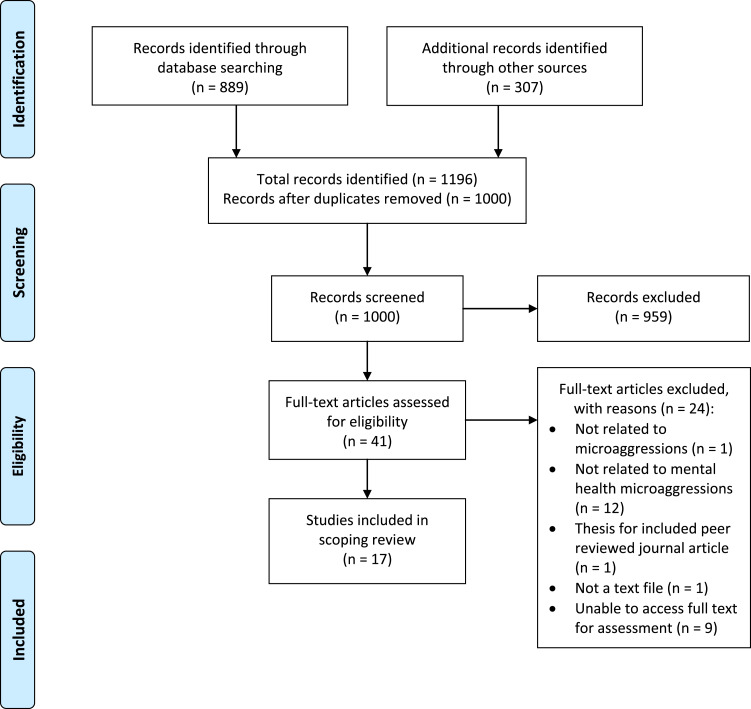
AIMS: This review aims to understand the scope of the literature regarding mental health-related microaggressions towards people affected by mental health problems. METHODS: A scoping review was conducted to explore this question. Four electronic health-oriented databases were searched alongside Google Scholar. As per scoping review principles, the inclusion criteria were developed iteratively. The results of included studies were synthesised using a basic narrative synthesis approach, utilising principles of thematic analysis and thematic synthesis where appropriate. RESULTS: A total of 1196 records were identified, of which 17 met inclusion criteria. Of these, 12 were peer-reviewed journal articles, three were research degree theses and two were book chapters. Six included empirical studies were qualitative, four were quantitative and two employed a mixed-methods design. Within these, five qualitative studies aimed to describe the nature of mental health microaggressions experienced by people with mental health problems. Themes identified in a thematic synthesis of these five studies included stereotypes about mental illness, invalidating peoples' experience and blaming people with mental illness for their condition. The included publications informed on the perpetration of mental health microaggressions by family, friends, health professionals and social workers. In addition, two studies created scales, which were then used in cross-sectional surveys of the general public and community members to assess characteristics, such as right-wing political views, associated with endorsement of mental health microaggressions. A consensus definition of microaggressions emerged from the included studies: microaggressions are brief, everyday slights, snubs or insults, that may be subtle or ambiguous, but communicate a negative message to a target person based on their membership of a marginalised group, in this case, people affected by mental illness. CONCLUSIONS: The study of mental health microaggressions is an emerging, heterogeneous field, embedded in the wider stigma and discrimination literature. It has been influenced by earlier work on racial microaggressions. Both can be ambiguous and contradictory, which creates difficulty defining the boundaries of the concept, but also underpins the key theoretical basis for the negative impact of microaggressions. Mental illness is a more concealable potential type of identity, so it follows that the reported perpetrators of microaggressions are largely friends, family and professionals. This has implications for intervening to reduce the impact of microaggressions. There are several challenges facing research in this area, and further work is needed to understand the impact of mental health microaggressions on people affected by mental health problems.
Overview
The claims and statistics of this paper haven’t been checked yet.
Free: it reads the open-access text and checks the first 5 claims that cite a source we can check. Create a free account to check every claim.
Integrity signals
Registry
Cites
Statistics
Figures
Verification
Claims the paper makes
The claims and statistics of this paper haven’t been checked yet.
Free: it reads the open-access text and checks the first 5 claims that cite a source we can check. Create a free account to check every claim.
Claims other papers make about this one
Each is checked against this paper’s own text: does it say what the citing paper says it does?
In the citing paper
“56 reviews were published between 1994 and 2021 and focused on prequalifying stigma reduction programmes for trainees (eg, nursing and medical students) and in-service programmes for qualified staff.29”
From The Lancet Commission on ending stigma and discrimination in mental health (2022) · cites this paper as [29]
In the citing paper
“29 addressed mental health conditions generally, ten exclusively involved people with dementia, seven assessed substance use disorders, five personality disorders, three borderline personality disorder, four suicidality and self-harm, one intellectual disabilities, one neurodevelopmental disorder, one psychosis, and one eating disorders”
From The Lancet Commission on ending stigma and discrimination in mental health (2022) · cites this paper as [29]
Self-check
Percentages, sums and reported differences re-computed from the paper’s own numbers.
The self-check needs the paper’s full text.
Citations
Cites
Using thematic analysis in psychology
Braun, V., & Clarke, V. (2006) · Qualitative Research in Psychology · doi:10.1191/1478088706qp063oa · Cited by 194,414
Preferred Reporting Items for Systematic Reviews and Meta-Analyses: the PRISMA statement
Moher, D., Liberati, A., Tetzlaff, J., Altman, D. G., & for the PRISMA Group (2009) · BMJ · doi:10.1136/bmj.b2535 · Cited by 83,823
Preferred reporting items for systematic reviews and meta-analyses: the PRISMA Statement.
(2009) · PubMed Central · Cited by 44,859
Preferred reporting items for systematic reviews and meta-analyses: The PRISMA statement
Moher, D., Liberati, A., Tetzlaff, J., Altman, D. G., & the PRISMA Group* (2009) · Annals of Internal Medicine · doi:10.7326/0003-4819-151-4-200908180-00135 · Cited by 37,554
Scoping studies: towards a methodological framework
Arksey, H., & O'Malley, L. (2005) · International Journal of Social Research Methodology · doi:10.1080/1364557032000119616 · Cited by 36,742
Scoping studies: advancing the methodology
Levac, D., Colquhoun, H., & O'Brien, K. K. (2010) · Implementation Science · doi:10.1186/1748-5908-5-69 · Cited by 15,268 · cited 2×
“We followed the procedure outlined by Arksey and O’Malley (2005) and further developed by Levac et al. (2010).”
MethodMunn, Z., Peters, M. D. J., Stern, C., Tufanaru, C., McArthur, A., & Aromataris, E. (2018) · BMC Medical Research Methodology · doi:10.1186/s12874-018-0611-x · Cited by 11,385
Methods for the thematic synthesis of qualitative research in systematic reviews
Thomas, J., & Harden, A. (2008) · BMC Medical Research Methodology · doi:10.1186/1471-2288-8-45 · Cited by 9,312
Racial microaggressions in everyday life: Implications for clinical practice.
Sue, D. W., Capodilupo, C. M., Torino, G. C., Bucceri, J. M., Holder, A. M. B., Nadal, K. L., & Esquilin, M. (2007) · American Psychologist · doi:10.1037/0003-066x.62.4.271 · Cited by 5,569 · cited 7×
“Finally, microinvalidations negate or nullify the feelings or experiences of a person, by saying, for example, ‘Don’t be so oversensitive’ (Sue et al., 2007, p. 275). https://doi.org/10.1017/S2045796019000763 Downloaded from https://www.cambridge.org/core.”
BackgroundInfluential(2004) · Choice Reviews Online · doi:10.5860/choice.41-3182 · Cited by 4,690
Minority Stress and Mental Health in Gay Men
Meyer, I. H. (1995) · Journal of Health and Social Behavior · doi:10.2307/2137286 · Cited by 4,264 · cited 1×
“The theoretical basis of this assertion is grounded in ‘minority stress theory’ (Meyer, 1995) which states that a hostile social environment demands heightened vigilance to protect oneself from discrimination and violence.”
BackgroundBeyond PICO: The SPIDER Tool for Qualitative Evidence Synthesis
Cooke, A., Smith, D., & Booth, A. (2012) · Qualitative Health Research · doi:10.1177/1049732312452938 · Cited by 2,608 · cited 1×
“Identifying the review question and aims The research question was formulated through consideration of the concept and target population, using aspects of the SPIDER question format tool (i.e. examining Sample, Phenomenon of Interest, Design, Evaluation, and Research type) (Cooke et al., 2012).”
MethodThe role of google scholar in evidence reviews and its applicability to grey literature searching
Haddaway, N. R., Collins, A. M., Coughlin, D., & Kirk, S. (2015) · PLOS ONE · doi:10.1371/journal.pone.0138237 · Cited by 2,387 · cited 1×
“We also searched Google Scholar, identified as a powerful addition to traditional search methods (Haddaway et al., 2015).”
MethodMicroaggressions and marginality : manifestation, dynamics, and impact
Sue, D. W. (2010) · Cited by 916
Shunned: Discrimination against people with mental illness
Thornicroft, G. (2003) · doi:10.1093/med/9780198570981.001.0001 · Cited by 643
An Experiment in Racism: TV Commercials
Pierce, C. M., Carew, J. V., Pierce-Gonzalez, D., & Wills, D. (1977) · Education and Urban Society · doi:10.1177/001312457701000105 · Cited by 496
Microaggressions: Strong Claims, Inadequate Evidence
Lilienfeld, S. O. (2017) · Perspectives on Psychological Science · doi:10.1177/1745691616659391 · Cited by 433
The impact of racial microaggressions on mental health: Counseling implications for clients of color
Nadal, K. L., Griffin, K. E., Wong, Y., Hamit, S., & Rasmus, M. (2014) · Journal of Counseling & Development · doi:10.1002/j.1556-6676.2014.00130.x · Cited by 360
Torres, L., Driscoll, M. W., & Burrow, A. L. (2010) · Journal of Social and Clinical Psychology · doi:10.1521/jscp.2010.29.10.1074 · Cited by 347
Shunned: Discrimination Against People Mental Illness
Nelson, S. H. (2007) · The Journal of Clinical Psychiatry · doi:10.4088/jcp.v68n1223b · Cited by 252
Microaggressions experienced by persons with mental illnesses: An exploratory study.
Gonzales, L., Davidoff, K. C., Nadal, K. L., & Yanos, P. T. (2015) · Psychiatric Rehabilitation Journal · doi:10.1037/prj0000096 · Cited by 118
Fiorillo, A., Vecchio, V. D., Luciano, M., Sampogna, G., Rosa, C. D., Malangone, C., Volpe, U., Bardicchia, F., Ciampini, G., Crocamo, C., et al. (2014) · Journal of Affective Disorders · doi:10.1016/j.jad.2014.10.021 · Cited by 99
User involvement in community mental health services – principles and practices
BORG, M., KARLSSON, B., & KIM, H. S. (2009) · Journal of Psychiatric and Mental Health Nursing · doi:10.1111/j.1365-2850.2008.01370.x · Cited by 88
Holley, L. C., Tavassoli, K. Y., & Stromwall, L. K. (2016) · Community Mental Health Journal · doi:10.1007/s10597-016-9990-9 · Cited by 84
Schibalski, J. V., Müller, M., Ajdacic‐Gross, V., Vetter, S., Rodgers, S., Oexle, N., Corrigan, P. W., Rössler, W., & Rüsch, N. (2017) · Comprehensive Psychiatry · doi:10.1016/j.comppsych.2017.02.001 · Cited by 74
Black psychiatry one year after Miami.
Cm, P. (1970) · PubMed · Cited by 63
Prodromal Symptoms to Relapse in Bipolar Disorder
Sierra, P., Livianos, L., Arques, S., Castelló, J., & Rojo, L. (2007) · Australian & New Zealand Journal of Psychiatry · doi:10.1080/00048670701266854 · Cited by 63
Political attitudes as predictors of the multiple dimensions of mental health stigma
DeLuca, J. S., Vaccaro, J., Seda, J., & Yanos, P. T. (2018) · International Journal of Social Psychiatry · doi:10.1177/0020764018776335 · Cited by 56
Perceived Microaggressions and Mental Health in a Sample of Black Youths Experiencing Homelessness
Gattis, M. N., & Larson, A. (2017) · Social Work Research · doi:10.1093/swr/svw030 · Cited by 53
Microaggressions: The experience of individuals with mental illness
Peters, H. J., Schwenk, H. N., Ahlstrom, Z. R., & McIalwain, L. N. (2016) · Counselling Psychology Quarterly · doi:10.1080/09515070.2016.1164666 · Cited by 49
The mental illness microaggressions scale-perpetrator version (MIMS-P): Reliability and validity
Gonzales, L., Davidoff, K. C., DeLuca, J. S., & Yanos, P. T. (2015) · Psychiatry Research · doi:10.1016/j.psychres.2015.07.061 · Cited by 44
Seelman, K. L. (2018) · Journal of Teaching in Social Work · doi:10.1080/08841233.2018.1517558 · Cited by 33
Gonzales, L., Yanos, P. T., Stefančić, A., Alexander, M. J., & Harney-Delehanty, B. (2017) · Psychiatric Services · doi:10.1176/appi.ps.201700165 · Cited by 32
Finding citizenship: What works?
Harper, A., Kriegel, L. S., Morris, C., Hamer, H. P., & Gambino, M. (2017) · American Journal of Psychiatric Rehabilitation · doi:10.1080/15487768.2017.1338036 · Cited by 30
Holley, L. C., Mendoza, N. S., Del‐Colle, M., & Bernard, M. L. (2016) · Sexual and Gender Diversity in Social Services · doi:10.1080/10538720.2016.1155520 · Cited by 28
Addressing our own biases: social work educators’ experiences with students with mental illnesses
Charles, J. L. K., Holley, L. C., & Kondrat, D. C. (2017) · Social Work Education · doi:10.1080/02615479.2017.1297393 · Cited by 27
Measuring Recurring Stigma in the Lives of Individuals with Mental Illness
Ezell, J. M., Choi, C.-W. J., Wall, M. M., & Link, B. G. (2017) · Community Mental Health Journal · doi:10.1007/s10597-017-0156-1 · Cited by 16
DeLuca, J. S., Clement, T. W., & Yanos, P. T. (2017) · PubMed · Cited by 12
Written Off: Mental Health Stigma and the Loss of Human Potential
Yanos, P. T. (2018) · Cited by 11
Written off: mental health stigma and the loss of human potential
Hatcher, C. (2018) · Journal of Social Work Practice · doi:10.1080/02650533.2018.1498070 · Cited by 8
Reid, E. (2017) · Cited by 6
The Relationship Among Mental Illness Microaggressions, Level of Contact, and Prejudicial Beliefs
Zurick, S. (n.d.) · ProQuest Demo Repository · Cited by 3
Research works printed but not linked: 2
- McCue MJ (2016) An Ecological Systems Approach to Understanding The Lived Experience of Law Students with Mental Illness. Michigan, USA: Michigan State University.
- Zenga D (2018) Perceived Effects of Microaggressions on Peer Support Workers in Mental Health Recovery. San Diego, USA: Alliant International University.
Cited by
The Lancet Commission on ending stigma and discrimination in mental health
Thornicroft, G., Sunkel, C., Alikhon Aliev, A., Baker, S., Brohan, E., el Chammay, R., Davies, K., Demissie, M., Duncan, J., Fekadu, W., et al. (2022) · The Lancet · doi:10.1016/s0140-6736(22)01470-2 · Cited by 748
Self-citationJohnson, V. E., Nadal, K. L., Sissoko, D. R. G., & King, R. (2021) · Perspectives on Psychological Science · doi:10.1177/17456916211011963 · Cited by 136
Purgato, M., Uphoff, E., Singh, R., Thapa Pachya, A., Abdulmalik, J., & van Ginneken, N. (2020) · Epidemiology and Psychiatric Sciences · doi:10.1017/s204579602000061x · Cited by 94
Page, A., Charteris, J., & Berman, J. (2020) · International Journal of Social Robotics · doi:10.1007/s12369-020-00714-0 · Cited by 64
King, A. J., Brophy, L. M., Fortune, T., & Byrne, L. (2020) · Psychiatric Services · doi:10.1176/appi.ps.201900606 · Cited by 70
Metadata
- Authors
- Barber, S., Gronholm, P. C., Ahuja, S., Rüsch, N., & Thornicroft, G.
- Affiliations
- King's College London (GB)
- Universität Ulm (DE)
- Corresponding author
- Barber, S.
- Venue
- Epidemiology and Psychiatric Sciences
- Publisher
- Cambridge University Press (CUP)
- Published
- 2019-12-16
- Volume
- 29
- Pages
- e82-e82
- ISSN
- 2045-7960 (ISSN-L)
- 2045-7979
- PMC
- PMC8061293
- OpenAlex
- W2994963983
- Semantic Scholar
- 2a56b4d2c5fec118a2b6b0bab4b691d32e28a68e
- Cited by
- 88
- References
- 43
- Citations by year
- 2026: 8 · 2025: 16 · 2024: 23 · 2023: 13 · 2022: 13 · 2021: 9 · 2020: 6
- FWCI
- 1.08
- Type
- journal article
- Language
- en
- Open access
- hybrid
- doi.org
- Locations
- Epidemiology and Psychiatric Sciences (publishedVersion, cc-by)
- PubMed Central (publishedVersion, cc-by)
- PubMed (publishedVersion)
- LSHTM Research Online (London School of Hygiene and Tropical Medicine) (acceptedVersion)
- Research Portal (King's College London) (submittedVersion, cc-by)
- Funders
- National Institute for Health and Care Research
- Department of Health and Social Care
- King's College London
- National Institutes of Health (R023697, S001255, MR/S001255/1, MR/R023697/1)
- Medical Research Council (MR/R023697/1, MR/S001255/1)
- Economic and Social Research Council
- National Institute of Mental Health (R01MH100470)
- Topics
- Health Sciences › Medicine › Psychiatry and Mental health › Mental Health Treatment and Access
- Health Sciences › Medicine › Public Health, Environmental and Occupational Health › Obesity and Health Practices
- Social Sciences › Psychology › Clinical Psychology › Psychology and Mental Health
- Keywords
- mental illness, stigma, discrimination, stereotypes, invalidation, blame, family and friends, healthcare workers, social workers
- MeSH terms
- Aggression, Mental Disorders, Discrimination, Psychological, Humans, Mental Health, Prejudice, Stereotyping, Mentally Ill Persons, Persons with Psychiatric Disorders, Racial Groups, Social Stigma, Social Discrimination
About these checks
Registry, retraction, Cites and statistics results are computed, not judged, with one exception: a printed reference that no index lists is read once by a model before it counts as a citation error. Claims are extracted by a model and kept only when their quote appears verbatim in the text; each cited source is then checked, with a model’s help, for whether it says what the claim relies on. Those verdicts can be wrong — read the claim’s quote and the cited source before relying on one.
Statistics and arithmetic are recomputed, not judged.
Confidence bands are shown only for fields calibrated on our annotated test set. None is calibrated yet, so no band is shown.
What counts as a claim ›How we measure confidence ›How we check this ›
Are you an author, or do you see a problem with this page? Request a review
Data sources
Bibliographic data: Semantic Scholar, OpenAlex, Crossref.
Contains information from the Semantic Scholar Academic Graph Datasets, made available under the ODC Attribution License (ODC-BY 1.0).
Semantic Scholar’s data is described in: Kinney, R., et al. (2023). The Semantic Scholar Open Data Platform. arXiv:2301.10140.
